(1) Universidade Federal de Santa Maria (UFSM), Santa Maria, RS, Brasil. Research support source: CAPES.
Conflict of interests: Nonexistent
Respiratory muscle training outcomes on
swallowing biomechanics and respiratory
function measures in normal subjects
João Rafael Sauzem Machado(1)
Diego Fernando Dorneles Bilheri(1)
Lidia Lis Tomasi(1)
Eduardo Matias dos Santos Steidl(1)
Renata Mancopes(1)
Received on: June 5, 2017 Accepted on: October 2, 2018
Corresponding address:
Renata Mancopes
Centro de Ciências da Saúde – UFSM Av Roraima, n. 1000, Prédio 26, sala 1410, Bairro Camobi
CEP: 97105-900 - Santa Maria, Rio Grande do Sul, Brasil
E-mail: [email protected]
ABSTRACT
Purpose: to verify the outcomes of respiratory muscle training (RMT) with flow-orien
-ted incentive spirometer on respiratory function measurements and their relationship with the swallowing biomechanics variables.
Methods: 29 subjects underwent training for seven consecutive days (three sets of ten
repetitions for inspiration and expiration). The swallowing biomechanics was asses
-sed by video fluoroscopy, using as temporal variable the pharyngeal transit time and as visuoperceptual variables the number of swallows, residues in pyriform sinuses and valleculae, and penetration/aspiration. Respiratory function measurements were assessed by maximal respiratory pressures and spirometry.
Results: RMT influenced pharyngeal transit time (p=0.002) and maximal inspira
-tory pressure correlated with the number of swallows after RMT (ρ=0.62, p=0.01). There was a significant increase in the maximum respiratory pressures post RMT
(p<0.0001).
Conclusion: RMT increased maximal respiratory pressures and influenced the reduc
-tion of pharyngeal transit time. Besides that, there was a rela-tion between the maxi
-mum inspiratory pressure and the number of post-training swallows.
INTRODUCTION
Swallowing is divided into three phases: oral, pharyngeal and esophageal. The oral phase can be controlled voluntarily, whereas the pharyngeal and esophageal phases happen involuntarily. The pharyngeal phase, with its sequenced and coordinated
actions, determines the flow of the swallowed material
towards the esophagus, making it pass laterally to the laryngeal opening, without penetration of the swallowed contents towards the tracheobronchial tree1-3.
According to Li et al.4, the act of swallowing requires
a series of voluntary and involuntary actions, highly coordinated with each other, so that the transportation of the food bolus along the pharynx happens safely. Therefore, there must be a deep biomechanical inter-action from the moment the food bolus is propelled from the oral cavity towards the pharynx, through the pressure generated by the contact of the tongue with the palate, to the moment when the contractile structures responsible for the superior and anterior vertical displacement of the hyoid bone and the larynx protect the laryngeal opening that leads to the trachea. Steele et al.5 call hyolaryngeal complex the functional
and anatomical integration of these structures of the pharyngeal phase.
Steele et al.6 published a literature review focused on elucidating and compiling scientific material on
pathophysiological factors associated with swallowing dysfunctions. Among the factors pointed out are changes in lung capacity and strength, non-coordi-nation between breathing / apnea / swallowing / respi-ration stages, reduction of the propulsion force of the bolus, increasing in the duration of the bolus stay in the pharyngeal phase of swallowing, changes in the hyoid bone mobility, and weakness of the suprahyoid muscles, which play a key role in generating the movement of the hyoid bone in the upper and anterior directions.
Respiratory muscular training (RMT) aims to improve respiratory performance through imposing a load on the respiratory system beyond its usual level of functioning, thus creating a training effect. Many RMT studies have been performed on healthy individuals, athletes and clinical populations with primary respiratory problems, always demonstrating, in the trained groups, absolute gains in lung capacity and lung strength variables 7.
The use of respiratory stimulators aims to stimulate a deep inspiration, aiming at the maximum expansion of the lungs and the exercise of deep breathing. Respiron® is an incentive of nonlinear pressure load8
(RI), used to RMT by forming a pressure threshold. It is responsible for increasing resistance to muscle fatigue and improving the respiratory function9.
Troche et al.10 demonstrated the importance of
RMT by using RI for the rehabilitation of dysphagia in parkinsonian subjects. There was an improvement in the swallowing function, attributed to the improvement of the hyolaryngeal complex function, resulting in a greater protection of the airways during swallowing.
In this context, this study objectives to verify the outcomes of RI assisted RMT on respiratory function measurements and their relationship with the swallowing biomechanics.
METHODS
A prospective longitudinal study was carried out, with approval of the Research Ethics Committee of the Federal University of Santa Maria, following Resolution 466/2012, under registration CAAE 23676813.8.0000.5346, and all participants signed a Consent Form agreeing to participate in the research.
The subjects were young adults, aged between 18 and 30 years, without previous diagnosis of respiratory disease, cold symptoms and / or respiratory condi-tions at the time of the evaluation, with no complaints of swallowing alterations and non-smokers. All subjects who presented any ventilatory alterations, evaluated by spirometry, were excluded from the study.
Thirty-two young people were evaluated at the start of the study, and two were excluded for presenting
allergy to the barium contrast used in video fluoroscopy
(VFD). Moreover, one was later excluded due to technical problems in the re-evaluation VFD recording, resulting in a sample of 29 subjects.
To analyze the biomechanics of swallowing, a VFD was performed using a 10ml scoop of paste consistency. Images were generated on a Siemens
equipment, model Iconos R200, in fluoroscopy mode
with 30 frames per second. The videos were recorded in the Zscan6 software, whose main technical character-istics are: images up to 720x576; 32Bit image resolution (32 million colors); 1440 dpi JPEG image format; video systems NTSC, PAL, SECAM (all standard); video up to 720x576 with real-time images (30 frames per second) AVI format and divX compressor, allowing recording on DVD or CD. During the VFD, subjects were evaluated in a sitting position with lateral projection. The video
fluoroscopic image field included lips, oral cavity,
0.14 mR/frame (2.1 mR/s). The dose measurements were performed under conditions that reproduce the technique and patient’s positioning, using a 4 cm aluminum simulator and a Radcal electrometer, model
9010, with a specific ionization chamber for fluoroscopy
procedures of 60 cm3.
Data collected through VFD were evaluated using temporal and visuoperceptual variables. The temporal variable analyzed was the pharyngeal transition time (PTT), expressed in seconds, and it considers as the beginning of the pharyngeal phase of swallowing the
moment when the bolus was in the final region of the
hard palate and the beginning of the soft palate, making an angle with the mandibular branch and the base of tongue, and as the end of the pharyngeal phase of swallowing the moment when the food bolus passed through the upper esophageal sphincter11.
The visuoperceptual variables were represented on numerical scales, as follows12:
• Number of swallows (number of times the bolus is fragmented): 0 – 1 swallow; 1 - two swallows; 2 - three swallows; 3 - four or more swallows.
• Residue in vallecula (stasis of the bolus in vallecula after complete swallowing): 0 - no stasis; 1 - residue
filled up to 50% of the vallecula; 2-residue filled more than 50% of the vallecula.
• Residue in pyriform sinus (food bolus stasis in pyriform sinuses after complete swallowing): 0 - no stasis; 1 - mild to moderate stasis; 2 - severe stasis,
filling the pyriform sinuses.
• Penetration / Aspiration: 0 - normal; 1 - penetration; 2 - aspiration.
The variables under study were analyzed by two
blinded referees, each one of them with five years
of experience in VFD analysis. Referees received prior training in Movie Maker® software to perform video analysis for both visuoperceptual and temporal variables.
In order to evaluate the respiratory function measurements, a spirometry was performed. For the spirometry, the subject was in a sitting position with the spirometer disposable mouthpiece adapted to the mouth and was encouraged to perform a maximal inspiration followed by a rapid and sustained expiration of at least six seconds. A nasal clip was used to assist in the airway sealing. The measurements were performed with a MicroQuark spirometer, using OneFlow 3.0.0 software to evaluate the measurements.
Both the technique and the quality controls were performed according to the references described in the
Guidelines for Pulmonary Function Tests published by the Brazilian Society of Pulmonology and Tisiology13.
The measured variables were: forced vital capacity (FVC), measured in liters, and the percentage over the predicted value was calculated; forced expiratory
volume in the first second (FEV1), measured in liters
per second and the percentage over the predicted value was calculated.
The maximum inspiratory pressure (MIP) and maximum expiratory pressure (MEP) measurements were performed with an MDV-500 Globalmed digital manovacuometer, which is graduated from - 500 / + 500 cmH2O. MIP and MEP measurements were taken with the subjects seated, as described by Black and Hyat14. According to the SBPT13 guidelines, the subject
was seated comfortably with a nasal clip, and all the instructions on the test were given prior to the evalu-ation. Up to six measurements of MIP and MEP were performed for each subject, with a one-minute interval between each repetition, to produce three acceptable maneuvers, without leaks and lasting at least two seconds each. The value adopted in the study as respiratory muscular strength of the individual was the greater value obtained, if there were at least two repro-ducible maneuvers with values that did not differ by
more than 10% on the highest value.
The evaluation of the respiratory function measure-ments (spirometry and manovacuometry) were randomly distributed among subjects, in order to minimize the effort factor among the participants.
The training with respiratory exercise was performed at home, with previous orientations given by a
physio-therapist, through flow RI on the Respiron®, for a
period of seven consecutive days. For inspiratory training, all participants should perform daily three sets of ten repetitions, starting from the Functional Residual Capacity (FRC) until reaching Inspiratory Capacity (IC)
and sustaining the spheres for a period of five to eight
seconds15. For the expiratory training, the Respiron®
use was reversed. Each participant was instructed to, during a week, daily perform three sets of ten repeti-tions, starting from IC until FRC, with a one-minute rest between each series. Daily contacts were made with each participant in order to reinforce the importance of conducting the training16.
Data collected were analyzed using the Statistical Package for Social Science (SPSS) version 17. Wilcoxon and t-test were performed to verify the
significance between the categorical variables. For the
Proportions was used. Also, the Spearman test was performed to correlate the biomechanics of deglutition with the respiratory function measurements.
To determine the agreement between referees, the Wilcoxon test was applied for the temporal variable and the Kappa test for the visuoperceptual ones.
The degree of agreement was defined according to
Landis and Koch17: <0.00 poor agreement; 0.00 – 0.19
poor agreement; 0.20 – 0.39 weak agreement; 0.40 – 0.59 moderate agreement; 0.60 – 0.79 substantial agreement; 0.80 – 1.00 almost perfect agreement. It was found that for the PTT variable the referees’ agreement
was of 100% (p = 1.00), which indicates almost perfect
agreement, as well as for the visuoperceptual variables
(Kappa = 1.0, p <0.001).
The results were expressed as mean ± standard deviation and percentage, considering statistically p values <0.05.
RESULTS
The sample consisted of 29 young adults, aged 20.9
± 3.2 years, 75% females. Table 1 presents the results
Table 1. Respiratory function of the evaluated subjects
Variables Mean ± SD
FEV1 (l) 3.5±0.5
%FEV1 94.5±9.9
FVC (l) 4.7±1.0
%FVC 107.6±10.6
FEV1/FVC (%) 87.32±7.5
FEV1 – forced expiratory volume in the first second; % FEV1 – percentage
of predicted forced expiratory volume in the first second; FVC – forced vital capacity; % FVC – percentage of predicted forced vital capacity;
FEV1/FVC (%) – Tiffeneau index.
The values for MIP and MEP pre and post respi-ratory exercise presented mean values of 79.3 ± 27.8 X 101 ± 32.8 and 77.9 ± 29.3 X 95.2 ± 35.3 cmH2O, respectively.
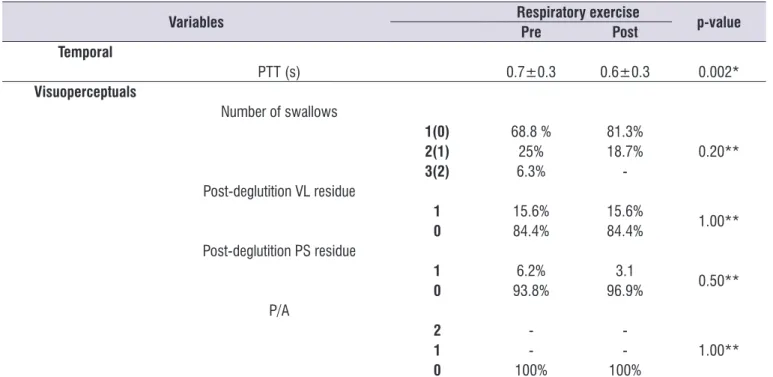
Table 2 presents the values of the swallowing biome-chanics variables analyzed before and after respiratory muscle exercise.
regarding respiratory function, showing that all subjects were healthy at the time of evaluation.
Table 2. Swallowing biomechanics variables pre and post respiratory muscle exercise
Variables Respiratory exercise p-value
Pre Post Temporal
PTT (s) 0.7±0.3 0.6±0.3 0.002*
Visuoperceptuals
Number of swallows
1(0) 68.8 % 81.3%
0.20**
2(1) 25% 18.7%
3(2) 6.3%
-Post-deglutition VL residue
1 15.6% 15.6%
1.00**
0 84.4% 84.4%
Post-deglutition PS residue
1 6.2% 3.1
0.50**
0 93.8% 96.9%
P/A
2 -
-1.00**
1 -
-0 100% 100%
PTT – pharyngeal transition time; s – seconds; VL – valleculae; PS – pyriform sinus; P/A – penetration / aspiration. * Wilcoxon Test
post-exercise MIP and the post-exercise number of
swallows (ρ = 0.62, p = 0.01). The other variables did
not present correlations.
The effects of respiratory exercise with Respiron® on
respiratory function showed only significant difference
on maximal respiratory pressures (Table 3). Table 2 shows that, when compared pre and post
respiratory exercise, only the PTT variable presented a
statistically significant difference (p = 0.002).
Regarding the correlation between respiratory variables and swallowing biomechanics variables, the only correlation observed was between the
Table 3. Comparison of respiratory variables pre and post respiratory muscle exercise
Variables Respiratory exercise p-value*
Pre Post
MIP 79.3±27.8 101±32.8 <0.0001
MEP 77.9±29.3 95.2±35.5 <0.0001
FEP 350.6±120.9 363±78.2 0.70
%FEP 70±20.6 73.4±14.2 0.50
FEV1 3.5±0.5 3.6±0.5 0.40
%FEV1 94.5±9.9 96.8±10 0.30
FVC 4.7±1.0 4.5±0.9 0.30
%FVC 107.6±10.6 104.1±20.2 0.50
MIP – maximum inspiratory pressure; MEP – maximum expiratory pressure; FEP – forced expiratory peak; % FEP – percentage over predicted forced expiratory peak;
FEV1 – forced expiratory volume in the first second; % FEV1 – percentage over predicted forced expiratory volume in the first second; FVC – forced vital capacity; % FVC – percentage over predicted forced vital capacity.
* Student’s t-test
DISCUSSION
Muscle fibers acquire the ability to change their
physiological and biochemical properties according to muscle training, leading to an increase in the amount
of fiber internal proteins responsible for the capacity of
contraction and force generation. This induces these cells to an adaptation and consequent increase of their mechanical performance. For Guyton and Hall18,
this means muscle plasticity and the ability to react to loads imposed by various forms of muscular exercise. As a result, an improvement in contraction power is obtained, which is determined not only by the force exerted by the muscle, but also by the contraction velocity.
In the present study, only the PTT variable presented
a significant difference between pre and post RMT (p = 0.002). However, this variable did not correlate with
any respiratory variable analyzed. Thus, it could be inferred that PTT depends on other factors, in addition to respiratory measures, such as the sensitivity of the
pharyngeal region, due to the increase in the airflow
caused by the IR, and measures of activation of the pharyngeal musculature, which should be better investigated.
Studies that verified the impact of using Respiron®
on the biomechanics of swallowing have not been found in the literature to date. Fregosi and Ludlow19
stated that muscular coordination in the pharyngeal path is of fundamental importance for swallowing and breathing to occur in an effective and safe way, being necessary for this, among other factors, muscular power. In the present study, there was a reduction in the number of swallows after RMT and this was
corre-lated with MIP, which presented a significant increase
after the training.
Reyes et al.20, in a randomized controlled study,
proposed RMT (inspiratory and expiratory) for individuals with Huntington’s disease. The trained group
achieved a significant improvement compared to the
control group in variables such as maximal pressures (inspiratory and expiratory), forced expiratory peak and deglutition, and in a quality of life questionnaire on swallowing, in 2 and 4-month RMT assessments. In this sense, it is possible to infer that RMT potentiated the musculature responsible for swallowing, inducing reduction in the number of swallows and greater tonic protection of the airways.
Rosa’s et al.16 study corroborates the findings
the inverted Respiron® on respiratory muscle strength in young adults (aged 20-30), showing an increase of 15 cmH2O in MIP and 23 cmH2O in MEP, after a two-month training, with triweekly sessions of 10 repetitions with a one-minute interval between each maneuver.
Another study used linear load RI for expiratory training (EMST-15) in a sample of stroke victims. Measurements of lung strength and lung capacity were performed at baseline, at four weeks and at 12 weeks post-training. Results showed a considerable gain in pulmonary strength and lung capacity variables, as well as in the capacity to generate subglottic pressure for coughing, causing a reduced incidence of aspiration pneumonia in secondary observations7.
Regarding the effects of RMT with flow RI, in this study a significant difference in respiratory pressures (p
<0.0001) was found, which was expected. Respiron® is commonly indicated by physiotherapists to promote tidal volume increase and, thus, improve pulmonary expansion in individuals affected by conditions of different etiologies16. In the literature, the main focus of
RI studies has been the pulmonary expansion. Only in the last 15 years21 it has been presented as a resource
for exercising the respiratory muscles.
Among the limitations of the present study are pointed the reduced sample size, the scarcity of other studies that evaluate the effects of Respiron® on swallowing in normal subjects and lack of an objective analysis of the other variables of the swallowing biomechanics.
CONCLUSION
Although the effects of respiratory muscle exercise with the use of RI are already known in pulmonary force and function, no studies were found to indicate their impact on the swallowing biomechanics.
This study shows that RMT has an effect on maximum respiratory pressures, a result already pointed out in the literature. As for RMT effects on the biomechanics of swallowing, there is a correlation between the MIP and the number of swallows post-training, which may be related to a reduction in PTT.
Thus, new studies addressing this subject, including a larger number of subjects, evaluation of the sensitivity of the anatomical regions responsible for swallowing and relations with the movement / displacement of the hyoid bone, are necessary.
REFERENCES
1. Costa M. Deglutição & Disfagia: bases
morfofuncionais e videofluoroscópicas. Rio de
Janeiro: Med Book; 2013.
2. Chaves RD, Carvalho CRF, Cukier A, Stelmach R, Andrade CRF. Sintomas indicativos de disfagia em portadores de DPOC. J Bras Pneumol. 2011;37(2):176-83.
3. Dozier TS, Brodsky MB, Michel Y, Walters BC, Martin-Harris B. Coordination of swallowing and respiration in normal sequential cup swallows. Laryngoscope. 2006;116(8):1489-93.
4. Li Q, Minagi Y, Hori K, Kondoh J, Fujiwara S, Tamine K et al. Coordination in oro-pharyngeal biomechanics during human swallowing. Physiology & Behavior. 2015;147:300-5.
5. Steele CM, Miller AJ. Sensory input pathways and mechanisms in swallowing: a review. Dysphagia. 2010;25(4):323-33.
6. Steele CM, Cichero JAY. Physiological factors related to aspiration risk: a systematic review. Dysphagia. 2014;29(3):295-304.
7. Kulnik ST, Rafferty GF, Birring SS, Moxham J, Kalra L. A pilot study of respiratory muscle training improve cough effectiveness and reduce the incidence of pneumonia in acute stroke: study protocol for a randomized controlled trial. Trials. 2014;15:123.
8. Sarmento G. Recursos em fisioterapia
cardiorrespiratória. São Paulo: Manole; 2012.
9. Paiva DN, Asmann LB, Bordin DF, Gass R, Jost RT, Bernardo-Filho M et al. Inspiratory muscle training with threshold or incentive spirometry: wich is the most effective? Rev Port Pneumol. 2015;21(2):76-81.
10. Troche MS, Okaun MS, Rosenbek JC, Musson N, Fernandez HH, Rodriquez R et al. Aspiration and swallowing in Parkinson disease and rehabilitation with EMST. Neurology. 2010;75(21):1912-9.
11. Kendall KA, Leonard RJ, McKenzie SW. Accommodation to changes in bolus viscosity in
normal deglutition: a videofluoroscopic study. Ann
Otol Rhinol Laryngol. 2001;110(11):1059-65.
12. Baijens LWJ, Speyer R, Passos VL, Pilz W, Roodengurg N, Clave P. Swallowing in
Parkinson patients versus healthy controls:
reliability of measurements in videofluoroscopy.
13. Pereira CAC. Espirometria. J Pneumol. 2002;28(Supl 3):S1-S82.
14. Black LF, Hyatt RE. Maximal respiratory pressures: normal values and relationship to age and sex. Am Rev Respir Dis. 1969;99(5):696-702.
15. Ysayama L, Lopes LR, Silva AMO, Andreollo NA.
A influência do treinamento muscular respiratório pré-operatório na recuperação de pacientes
submetidos à esofagectomia. Arq Bras Cir Dig. 2008;21(2):61-4.
16. Rosa R, Santos GK, Siqueira AB, Toneloto MGC. Inspirômetro de incentivo invertido
como exercitador da musculatura respiratória
em indivíduos saudáveis. Rev Intellectus. 2013.25:177-97.
17. Landis JR, Koch GG. The Measurement of observer agreement for categorical data. Biometrics. 1977;33(1):159-74.
18. Guyton AC, Hall JE. Tratado de fisiologia médica. 10º ed. Rio de Janeiro: Guanabara Koogan; 2002. 19. Fregosi RF, Ludlow CL. Activation of upper airway
muscles during breathing and swallowing. J Appl Physiol. 2014;116(3):291-301.
20. Reyes A, Cruickshank T, Nosaka K, Ziman M. Respiratory muscle training on pulmonary and swallowing function in patients with huntington’s disease: a pilot randomised controlled trial. Clinical Rehabilitation. 2014; PII: 0269215514564087. 21. Scalan CL, Wilkins RL, Stoller JK. Fundamentos
da terapia respiratória de Egan. 7º ed. São Paulo: