Revista Gaúcha
de Enfermagem
Biosafety in beauty centers: knowledge and
practices in a state capital in Northeast Brazil
Biossegurança em serviço de embelezamento: conhecimento e práticas em uma capital do nordeste brasileiro
Bioseguridad en los centros de embellecimento: conocimientos y prácticas en una capital del nordeste brasileño
Ilana Mírian Almeida Felipea
Rosane da Silva Diasa
Carolyna Lopes Leitão Coutob
Larissa Neuza da Silva Ninac
Serlyjane Penha Hermano Nunesd
ABSTRACT
Objective: To assess the knowledge and biosafety procedures of professionals of the beauty segment.
Methods: Descriptive study, of survey type, where 238 professionals of the beauty segment, randomly selected among establish-ments registered at the relevant regulatory bodies of the city of São Luís, Maranhão, were interviewed between August 2014 and 2015. Qualitative variables were expressed as absolute and relative frequencies, and quantitative variables were expressed as mean and standard deviation.
Results: 62.6% of the interviwed professionals reported having had contact with blood from customers when they were not wearing gloves; 74.4% said they washed their hands before and after each service, and only 16.8% of the respondents reported reusing non-sterilizable materials. None of them was able to inform the correct number of sets of tools needed , and 32.8% of the respondents did not use Personal Protective Equipment during their work activities.
Conclusions: The most frequently reported diseases associated with the risk of infection and transmission in the work activities were viral hepatitis, HIV and fungi. Regarding the biosafety procedures adopted, autoclave is the least used method for sterilizing devices.
Keywords: Beauty and aesthetics centers. Exposure to biological agents. Prevention of diseases.
RESUMO
Objetivo: Avaliar o conhecimento e as práticas de biossegurança adotadas por profissionais do segmento da beleza.
Métodos: Pesquisa descritiva do tipo survey. Foram entrevistados 238 profissionais de serviços de embelezamento entre agosto de 2014 e 2015. As variáveis foram apresentadas por meio de frequências absolutas e relativas, bem como média e desvio padrão.
Resultados: 62,6% dos profissionais tiveram contato com sangue de clientes sem uso de luvas; instrumentais para o atendimento e 32,8% dos entrevistados não utilizaram equipamentos de proteção individual durante suas atividades laborais.
Conclusões: As doenças mais citadas quanto ao risco de contágio e de transmissão na prática laboral foram as hepatites virais, HIV e fun-gos. Quanto aos procedimentos de biossegurança adotados, o autoclave é o equipamento menos usado na esterilização dos instrumentos.
Palavras-chave: Centros de embelezamento e estética. Exposição a agentes biológicos. Prevenção de doenças.
RESUMEN
Objetivo: Evaluar el conocimiento y las prácticas de bioseguridad adoptadas por profesionales del segmento del embellecimiento.
Métodos: IInvestigación descriptiva del tipo encuesta. Fueron entrevistados 238 profesionales de embellecimiento entre agosto de 2014 y 2015. Las variables fueron presentadas por medio de frecuencias absolutas y relativas, así como media y desviación estándar.
Resultados: 62,6% de los profesionales tuvieron contacto con sangre de clientes sin el uso de guantes; el 74,4% higienizaban las manos entre los atendimientos, el 16,8% reutilizaban materiales desechables. Ningún profesional informó la cantidad adecuada de instrumentos y el 32,8% de los entrevistados no utilizaban equipos de protección individual durante sus actividades laborales.
Conclusiones: Las enfermedades más citadas con respecto al riesgo de contagio y de transmisión en la práctica laboral fueron las hepatitis virales, el VIH y los hongos. Acerca de los procedimientos de bioseguridad adoptados, el autoclave fue el aparato menos utilizado en la esterilización de los instrumentos.
Palabras clave: Centros de belleza y estética. Exposición a agentes biológicos. Prevención de enfermedades.
How to cite this article:
Felipe IMA, Dias RS, Couto CLL, Nina LNS, Nunes SPH. Biosafety in beauty services: knowledge and practices in a state capital in Northeast Brazil. Rev Gaúcha Enferm. 2017;38(4):e2016-0003. doi: http://dx.doi.org/10.1590/1983-1447.2017.04.2016-0003.
doi: http://dx.doi.org/10.1590/1983-1447.2017.04.2016-0003
a Universidade Ceuma, Mestrado Profissional de Ges tão em Programas e Serviços de Saúde. São Luís, Maranhão, Brasil.
b Faculdade Pitágoras, Curso de Farmácia-Bioquímica. São Luís, Maranhão, Brasil.
c Universidade Ceuma, Curso de Enfermagem. São Luís, Maranhão, Brasil.
INTRODUCTION
Physical appearance has always been important for hu-mans(1). In recent decades, there has being a wide impact
of the market of beauty and aesthetics, through the use of image and style patterns, on men and women of diffe-rent social classes and age ranges(2).
The activities performed by professionals of the beauty segment pose risks of accidental exposure to blood borne pathogens, such as hepatitis B virus (HBV), hepatitis C virus (HCV) and the Human Immunodeficiency Virus (HIV)(3), and
bacterial and fungal infections(4). Undeniably, many
profes-sionals revealed ignorance of and poor adherence to bio-safety measures, like Personal Protection Equipment (PPE), proper reprocessing techniques, disposal of single-use ma-terials and hand hygiene(5).
Data reveal the lack of knowledge of professionals of the beauty and aesthetic segment regarding biosafety me-asures related to the risk of contamination and transmis-sion of infectious diseases during their work activities(6-7).
In Italy and Turkey, hepatitis B and C were considered occupational hazards for barbers and hairdressers mani-curists/ pedicurists(2). In Brazil, a survey in São Paulo found
that manicurists were not aware of the modes of transmis-sion of HBV (72%) and HCV (85%)(8).
From the 1990’s on, there has been an increased availabi-lity of procedures performed in traditional beauty care seg-ments(9), that involve the manipulation of nails and
surroun-ding tissue on the hands and feet of customers to remove the eponychium (cuticle), with the use of pliers, by mani-curists and pedimani-curists(7) as well as other more invasive
pro-cedures, such as tattoos and body piercing(10). Despite the
increased adherence of the population to beauty and aes-thetic procedures, there are few records of infections in this segment due to underreporting and to the lack of stu-dies on the knowledge of and adherence to biosafety re-commendations by professionals of the beauty segment(2,11).
Since professionals and users of these services are a high-risk group for infectious diseases due to their signifi-cant exposure to infectious microorganisms, access to in-formation on adherence to biosafety recommendations is particularly important. Therefore, this study was based on the following guiding question: What is the level of know-ledge of and adherence to biosafety procedures of profes-sionals of the beauty segment in the city of São Luis, in the Brazilian Northeast? In order to answer this question, the present study aimed to assess the knowledge and biosafe-ty practices used by professionals of the beaubiosafe-ty segment in the city of São Luis, (MA).
METHODOLOGY
Descriptive study that uses a survey methodology aimed to identify views and attitudes and describe the characteristics of the study group. Field research was con-ducted in from August 2014 to August 2015, in beauty and aesthetic services in the city of São Luis, capital of the state of Maranhão. The study population consisted of manicu-rists/pedicurists, tattoo artists and piercers.
The accurate number of professionals working in the beauty segment in São Luís is unknown because several establishments (shops/salons/studios) that provide beauty services were not registered at the relevant regulatory bo-dies of the city, despite the fact this is a mandatory require-ment for their operation. Sample size was calculated based on a list containing the names and addresses of beauty and aesthetic services provided by the Superintendency of Sa-nitary and Epidemiological Surveillance (SVEs) of São Luís, in 2013. Since 824 salons/shops were identified, the sample size was estimated in 263, considering a confidence inter-val of 95%, a standard deviation of 0.5 and type I error rate of 5%. The establishments were randomly selected using Excel 2007®. After the elimination of duplicated
registra-tions, the final sample included 256 establishments. During data collection, it was found that many esta-blishments did not keep updated records: some had chan-ged their locations and some had chanchan-ged their business names and had another owner. Thus, an alternative appro-ach was used to ensure the appropriate sample size, as follows: it was stipulated that if the establishment selec-ted was not found, the next similar establishment locaselec-ted on the same street would be selected for data collection, provided it was not part of the initial sample. Nonetheless, sample loss was reported because some of the previously establishments that failed to be contacted could not be replaced by others, in order to maintain the initial sample size. This fact, combined with refusals to receive the teams of researchers, resulted in 238 establishments visited: 226 salons and 12 tattoo and piercing studios. According to ad-ministrative and planning criteria of the Municipal Health Department (Semus), the city of São Luís is divided into se-ven health districts (HD). Thus, by random sampling, the establishments were distributed as follows: DS Centro (39), DS Bequimão (104) DS Cohab (67), DS Coroadinho (8) and DS Tirirical (20).
inter-views, the respondents completed questionnaires contai-ning items related to the way the professionals performed their work activities and the self-reported biosafety proce-dures adopted. The questionnaire had 51 questions, inclu-ding subjective and objective questions, and it was divided into 6 parts: demographic data, professional aspects and exposure to biological material, immunization, sexual acti-vity, personal background. All questions were asked orally by the researcher in a separate room, so as to avoid embar-rassing the respondents.
Qualitative variables were expressed as absolute and relative frequencies and quantitative variables were ex-pressed as mean and standard deviation. Data was co-ded using SPSS software version 18.0 and entered in dupli-cate. In accordance with Resolution 466/12, this study was
approved by the Research Ethics Committee (CEP) of Uni-versidade Ceuma (467,184# 2013). Prior to being included in the study, all the participants signed the Free Informed Consent Form (TCLE).
RESULTS
Sociodemographic characteristics of professionals in the beauty segment
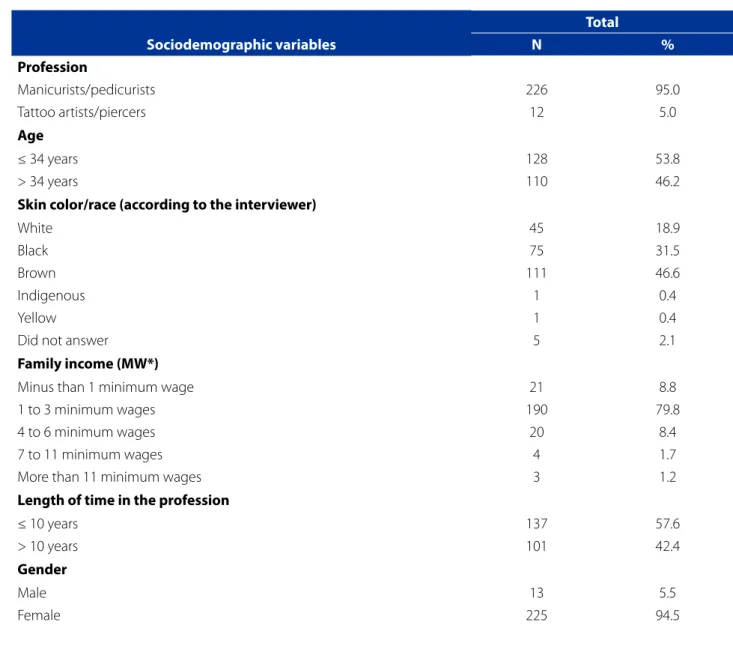
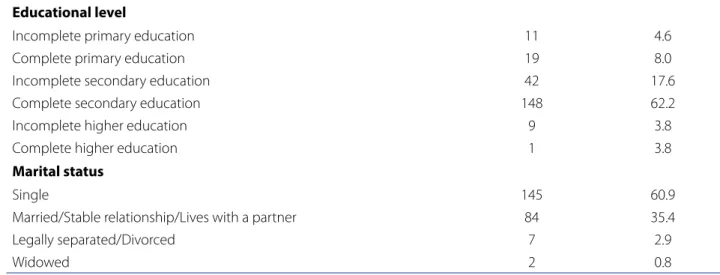
Table 1 includes data on the following characteristics of the respondents: occupation (in the beauty service), age, skin color, length of time in the profession, family income, gender, educational level and marital status, in absolute and relative data.
Table 1 – Sociodemographic profile of professionals of the beauty segment, São Luís – MA, 2015
Total
Sociodemographic variables N %
Profession
Manicurists/pedicurists 226 95.0
Tattoo artists/piercers 12 5.0
Age
≤ 34 years 128 53.8
> 34 years 110 46.2
Skin color/race (according to the interviewer)
White 45 18.9
Black 75 31.5
Brown 111 46.6
Indigenous 1 0.4
Yellow 1 0.4
Did not answer 5 2.1
Family income (MW*)
Minus than 1 minimum wage 21 8.8
1 to 3 minimum wages 190 79.8
4 to 6 minimum wages 20 8.4
7 to 11 minimum wages 4 1.7
More than 11 minimum wages 3 1.2
Length of time in the profession
≤ 10 years 137 57.6
> 10 years 101 42.4
Gender
Male 13 5.5
Frequency of responses about the knowledge of the professionals about transmission and prevention of diseases that may affect them during their professional activities
Around eighty-six percent (86.1%) of the respondents said they were at risk of being infected by one of their cus-tomers, and 70.6% also acknowledged that they could be potential sources of infection for their customers.
Respec-tively 92% and 69.7% of the respondents had already he-ard about HIV/AIDS and viral hepatitis, and 91.6% said they knew how to prevent these diseases.
The diseases most commonly mentioned by the res-pondents regarding the risk of infection and transmis-sion, during work activities were viral hepatitis, HIV/ AIDS and fungal infections; and the least cited diseases were other types of disease, bacterial infections, sexually trans-mitted diseases (STD’s) and diabetes (Figure 1).
Educational level
Incomplete primary education 11 4.6
Complete primary education 19 8.0
Incomplete secondary education 42 17.6
Complete secondary education 148 62.2
Incomplete higher education 9 3.8
Complete higher education 1 3.8
Marital status
Single 145 60.9
Married/Stable relationship/Lives with a partner 84 35.4
Legally separated/Divorced 7 2.9
Widowed 2 0.8
Source: Research data, 2015. *MW= minimum wages
Others
Others
Diabetes
Bacteria
Bacteria
Fungi
Fungi
STDs
STDs
Hepatitis
Hepatitis
HIV/AIDS
HIV/AIDS 33,60%
37,27% 1,31%
0,86%
17,32% 2,10%
0,86% 0,86%
8,40%
5,20% diseases that could be acquired
diseases that could be transmitted
9,10%
44,16%
38,96%
Figure 1 - Distribution of the infectious diseases that could be transmitted during work activities mentioned by professio-nals of the beauty segment in São Luís, 2015
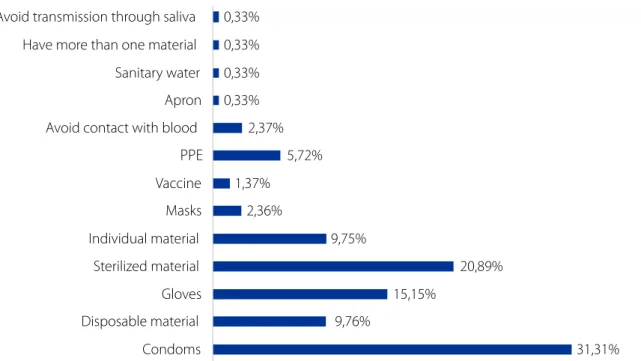
Regarding the modes of prevention of these diseases, the most frequently reported were the use of condoms (31.31%), sterilized material (20.89%) and disposable gloves (15.15%) (Figure 2).
Percentage of adherence to
biosafety procedures adopted in beauty and aesthetic services
Regarding the adoption of biosafety measures, 62.6% of the respondents said they had contact with blood from customers when they were not wearing gloves. Of these, 43.4% used some type of medication and 20.1% used
alco-hol as a preventive measure. Regarding hand hygiene (HH) before and after each service and another, 74.4% reported having adopted this procedure.
Interestingly, 32.8% of the participants reported not using any type of PPE during their work activities and 5% did not know the types of PPE required for their professional practice. Regarding the processes of cleaning, disinfection and sterilization of tools, 21.8% did not know the differen-ces between these practidifferen-ces, how to perform them and the necessary equipment.
Data related to knowledge and the biosafety prac-tices carried out by the study participants is shown in Table 2.
0,33%
0,33%
0,33%
0,33%
2,37%
5,72%
1,37%
2,36%
9,75%
20,89%
15,15%
9,76%
31,31% Avoid transmission through saliva
Have more than one material
Sanitary water
Apron
Avoid contact with blood
PPE
Vaccine
Masks
Individual material
Sterilized material
Gloves
Disposable material
Condoms
Figure 2- Distribution of the modes of prevention of infectious diseases cited by professionals of the beauty segment inSãoLuís, 2015
Source: Research data, 2015.
Table 2 - Biosafety procedures performed by professionals of the beauty segment – São Luis – MA, 2015
Procedures Total
N %
During work, did the respondent come in contact with blood from customers when he/she was not wearing protective gloves?
No 76 31.9
Does not know 12 5.0
Yes 149 62.6
What the respondent does when bleeding occurs?
Makes a bandage 2 0.8
Washes the bleeding site with soap and water 19 7.9
Stops bleeding by applying pressure to the site 31 13.0
Applies a medication 103 43.4
Applies alcohol 48 20.1
Various 3 1.3
Does the respondent discard single-use items (wooden sticks, nail files, etc.) after use?
No 40 16.8
Yes 191 80.2
Minimum amount of each item of the set of tools necessary to perform the procedures?
One 84 35.3
Two 32 13.4
Three 40 16.8
More than three 81 34.0
Does the respondent wash his/her hands before and after each service?
No 8 3,4
Yes sometimes 51 21.4
Yes, always 177 74.4
Method for sterilization of the materials used
Does not sterilize 4 1.7
Greenhouse 190 79.8
Autoclave 33 13.9
Others 8 3,4
Does the respondent know how to disinfect the tools?
No 58 24.4
Yes 177 74.3
Is there a difference between the process of cleaning, disinfecting and sterilizing the itools?
No 52 21.8
Yes 185 77.7
Does the respondent use PPE*?
No 78 32.8
Yes 148 62.2
Is not aware of the individual PPE 12 5.0
Source: Research data, 2015. *PPE = Personal Protective Equipment
DISCUSSION
The risk of infection and silent transmission of important diseases through aesthetic procedures provided by manicu-rists/pedicurists, tattoo artists and body-piercers is a serious
public health issue faced by these professionals and their clients, when proper biosafety practices are not observed(9).
of biological materials that can transmit infectious agents such as hepatitis B, hepatitis C and the human immuno-deficiency virus. Such data corroborates the findings of an international study conducted in a city of Pakistan on the knowledge and practices of barbers and professionals of the beauty and aesthetic segment regarding the preven-tion of viral hepatitis(12), and in a district of Ghana on
bar-bers’ awareness of and the factors associated with the risk of transmission of HBV and HCV(13).
A study with professionals of the beauty segment conducted in the city of Goiânia, capital of Goiás and the Metropolitan area of the state of Goiás also found an un-satisfactory/insufficient level of knowledge on the aspects related to adherence to biosafety recommendations(6),
which is similar to the findings of a study with professional manicurists/pedicurists in Maringá (PR)(3), as well as in a
stu-dy in the city of Itaúna (MG)(11).
Regarding the characterization of professionals, 94.5% m of the participants were young women with an average age of 34.13, corroborating the prevalent profile of the pro-fessionals of the beauty segment(11). However, most tattoo
artists and piercers were male individuals, which is com-mon in these services(2).
More than half of the respondents had completed se-condary education and have been working in the beau-ty segment for about 10 years, which is consistent with other findings(6-7). However, such characteristics do not
en-sure compliance with good biosafety practices in the work setting(8-9,14-15). Also, 42.4% of the respondents reported
they have been working in their profession for more than 10 years. Therefore, they began their activities before the regulation of the profession of manicurist, in 2012, with the publication of Law 12,592(16). The fact that the profession of
manicurist remained unregulated for a long time and that no specific training or education is required discourages the search for training and stimulates informal practice and non-compliance with biosafety standards.
Regarding the diseases that could be acquired and transmitted through unsafe actions and lack of relevant knowledge, the results suggest that most respondents are aware of the importance of HIV/AIDS and viral hepatitis be-cause of the biological risks associated to their professions. Nevertheless, previous studies conducted in Brazil found that manicurists /pedicurists had scarce knowledge about the modes of transmission/prevention of viral hepatitis(17).
Concerning unsafe actions, it is important to stress that a considerable number of subjects (62.6%) said they were not wearing gloves when they came into contact with bio-logical material (blood) from their clients. Such data reveals the susceptibility of professionals of the beauty segment to
infectious diseases such as hepatitis B and C and HIV /AIDS and bacterial dermatoses(18).
Non-use of protective gloves as PPE by manicurists/pe-dicurists during service was reported. On the other hand, adherence to this practice was more common among tattoo artists and piercers, perhaps because this group in-cludes individuals with a higher degree of education and because their studios were located in shopping malls or in most sophisticated areas of the capital, i.e., in places fre-quented by more educated and demanding persons.
Regarding the conducts of these professionals af-ter accidental exposure to biological maaf-terial, we found that few (7.9%) immediately adopted preventive measures such as washing the exposed body site with soap and wa-ter and alcohol (20.1%). In such cases, the National Health Surveillance Agency (ANVISA) and the Center for Disea-se Control and the US Prevention (Center of DiDisea-seaDisea-se Con-trol and Prevention - CDC) recommend thorough washing of the exposed body site with soap and water and the use of antiseptic solutions such as 70% ethanol, which reduces the number of microorganisms, but do not remove dirt(19).
Regarding the question on the use of disposable ar-ticles, 16.8% of the professionals said they reused single-use materials, such as wooden sticks and/ or nail files, for example, which could come in contact with blood, other body fluids, and fragments of nails. Therefore, professionals of the beauty segment must be aware of this risk as a mode of transmission of infectious agents(7).
Regarding the minimum amount of each item of the set of tools necessary item of the set of tools necessa-ry to perform the procedures, it is remarkable that 35.3% responded that one set of tools was ideal and 13.4% and 16.8% said that two and three set of tools, respectively, were sufficient. The percentages above are inadequate and worrying, corroborating data collected in a study in Turkey, where only 2.6% of the manicurists/pedicurists used one different set of tools for each client(20). This finding may be
attributed to the fact that these tools are considered ex-pensive, given the low income of most professionals of the beauty segment.
per-forming the procedures. Despite the awareness of these professionals of the biological risks associated with their occupation, adherence to biosafety standards is not con-sistent with their knowledge, i.e. perception of the risk of contamination by serious diseases such as viral hepatitis and AIDS was not sufficient to promote changes in profes-sional practices. For some authors, the fact that bleeding is usually not significant and not common during cuticle re-moval, associated to the fact that the professionals assume their customers to be healthy, contribute to the inaccura-te perception of the risks associainaccura-ted to their profession by these individuals(8). In the present study, 21.8% of the
sub-jects said there was no difference between the cleaning, disinfection and sterilization procedures, and 24.4% were not aware of the process necessary for disinfecting their to-ols. When asked about the method for sterilization of their items, only 13.9% said they performed sterilization by auto-clave; 79.8% in greenhouse heaters; 3.4% reported the use of a UV sterilizer that resembles a toaster oven; and 1.7% did not sterilized their tools. Also, 68% of the professionals reported using autoclaves, which was similar to the findin-gs of a study in the cities of Itaúna(11) and Arcos(2), both in
the state of Minas Gerais, where greenhouse heaters were mentioned by 83% of the respondents, followed by auto-clave, by 11.3% and 3.8%, respectively. The unusual use of the autoclave is possibly related to its higher cost compa-red to greenhouse heaters or even to the lack of informa-tion about this type of sterilizainforma-tion(2).
In beauty salons located in high-income neighborhoo-ds, the owners sometimes would not allow manicurists/ pedicurists to participate in the study. There are few tattoo and piercing studios in the city of São Luis, and in many ca-ses the locations provided by the local Health Surveillance agency were outdated.
Based on these findings, we suggest the implementa-tion of educaimplementa-tional campaigns on public health, particularly with clarification on the epidemiology of HBV, HCV and HIV, and biosafety recommendations for the use of PPE and washing/disinfection/sterilization procedures targeted to professionals of the beauty and aesthetic segments and to the population. In order to minimize the risk of occu-pational infections caused by blood - borne viruses, we also recommend that governmental authorities produce appropriate educational materials to be disseminated in establishments that provide beauty services and require that professionals take periodical refresher courses, and also improve the training provided in the aesthetic and beauty segments, health surveillance and the accreditation stan-dards of establishments and professionals of the beauty and aesthetic segments.
Since nursing and other health professionals strongly con-tribute to improve health education and professional training, the important role played by these professionals regarding the safety of the services provided in the beauty segment should be emphasized in order to improve the identification of accidents with sharp devices and increase adherence to biosafety recommendations. The present study reaffirms the importance of greater attention from Brazilian local, state and national health authorities, educational, research and exten-sion institutions and the civil society, to the elaboration of public policies in biosafety targeted to the health of these professionals and their clients, since all the actors should be responsible for the development of safe practices in this area.
CONCLUSION
This study on the assessment of knowledge and bio-safety practices adopted by professionals of the beauty segment found that most frequently reported diseases associated to the risk of infection and transmission in their work activities were viral hepatitis, HIV and fungi. Regar-ding the modes of prevention, the most frequent were the use of condoms, sterilization of the materials and use of disposable gloves. Regarding the biosafety procedures adopted, most participants reported using personal pro-tective equipment. However, a large percentage pf the sample had already come in contact with blood from cus-tomers when they were not wearing such equipment. A high percentage reported knowing the difference betwe-en the procedures of cleaning, disinfection and steriliza-tion of the tools. However, the greenhouse heater was the most prevalent method of sterilization. Most respondents reported applying a medication or alcohol to the body site in case of bleeding during the procedures.
REFERENCES
1. Alves D, Pinto M, Alves S, Mota A, Leirós V. Cultura e imagem corporal. Motric-idade. 2009;5(1):1-20.
2. Garbaccio JL, Oliveira AC O risco oculto no segmento de estética e beleza: uma avaliação do conhecimento dos profissionais e das práticas de biossegurança nos salões de beleza. Texto Contexto Enferm. 2013;22(4):989-98.
3. Barbosa LD, Sasso RN, Amadei JL. Manicures/pedicures: conhecimento e práticas de biossegurança para hepatites virais. Rev Bras Promoc Saúde. 2015;28(3):361-9.
4. Kiéc-Swierczynska M, Chomiczewska-Skóra D, Swierczynska-Machura D, Kre-cisz B. Manicurists and pedicurists-occupation group at high risk of work-related dermatoses. Med Pr. 2012;64(4):579-91.
Corresponding author:
Ilana Mírian Almeida Felipe E-mail: [email protected]
Received: 12.08.2016 Approved: 07.27.2017
6. Rocha Sobrinho HM, Gomes CM, Ferreira BD, Cunha FN, Moraes MLDS, Lima RACO, et al. Avaliação do conhecimento e práticas de biossegurança em uma amostra de profissionais da beleza de Goiânia-Goiás. J Health Sci Inst. 2014;32(4):343-52. 7. Diniz AF, Matté GR. Procedimentos de biossegurança adotados por profissionais
de serviços de embelezamento. Saúde Soc. 2013;22(3):751-9.
8. Oliveira ACDSD, Silva AMC, Scota S, Focaccia R. Study of hepatitis B and C preva-lence and adherence to standards of biosecurity on manicures and/or pedicures in Brazil. BMC Proc. 2011;5:220.
9. Garbaccio JL, Oliveira AC. Adherence to and knowledge of best practices and occupational biohazards among manicurists/ pedicurists. Am J Infect Control. 2014;42(7):791-5.
10. Andsoy II, Şahin AO. An undiscussed subject: nurse’s role in infection control of tattoo and body piercing practices. Bakırköy Tıp Dergisi. 2014;10(4):133-8. 11. Moraes JT, Barbosa FI, Costa TRS, Ferreira AF. Hepatite B: percepção dos riscos e
adoção de medidas de biossegurança por manicures/pedicures de Itaúna-MG. R Enferm Cent O Min. 2012;2(3):347-57.
12. Khan MI, Zhaidi AA, Mehar A, Ahmed R, Zahoor S, Sarfaraz A, et al. Assessment of knowledge and practice of barbers & beauticians regarding hepatitis B and C. Gomal J Med Sci. 2012;10(1):127-32.
13. Mutocheluh M, Kwarteng, K. Knowledge and occupational hazards of barbers in the transmission of hepatitis B and C was low in Kumasi, Ghana. Pan African Med J. 2015;20:260.
14. Amodio E, Benedetto MA, Gennaro L, Maida CM, Romano N. Knowledge, at-titudes and risk of HIV, HBV and HCV infections in hairdressers of Palermo city (South Italy). Eur J Public Health. 2009;20(4):433-7.
15. Ataei B, Shirani K, Alavian SM, Ataie M. Evaluation of knowledge and practice of hairdressers in women’s beauty salons in Isfahan about hepatitis B, hepatitis C, and aids in 2010 and 2011. Hepat Mon. 2013;13(3):62152.
16. Presidência da República (BR). Lei nº 12.592, de 18 de janeiro de 2012. Diá-rio Oficial da União [da] Repúblicas Federativa do Brasil. 2012 jan 19;149(14 Seção 1):1.
17. Moreira ACA, Silva FL, Silva JKF, Carvalho JLM. Grau de informações dos pro-fissionais de salões de beleza sobre aids e hepatite. Rev Ciênc Méd Biol. 2013;12(3):359-66.
18. Choi E, Reilly K, Sargent R, Wells V. Pedicure-associated infections. Environ Health Rev. 2013;56(2):39-48.
19. Siegel JD, Rhinehart E, Jackson M, Chiarello L; Healthcare Infection Control Practices advisory Committee. Management of multidrug-resistant organisms in health care settings, 2006. Am J Infect Control. 2007;35(10Suppl 2):S165-93.