Universidade da Beira Interior
Departamento de Gestão e Economia
Dissertação de Mestrado em Marketing
Introducing and Testing FLIBESA, a Consumer Profiling
Tool for the Financial Industry:
The Case of Millennium
bcpbank and the Portuguese diaspora in the USA
Orientador:
Professor Doutor Ricardo José de Ascensão Gouveia Rodrigues
Luís Filipe da Costa Moura Loureiro
COVILHÃ, 2008Universidade da Beira Interior
Departamento de Gestão e Economia
Dissertação de Mestrado em Marketing
Introducing and Testing FLIBESA, a Consumer Profiling
Tool for the Financial Industry:
The Case of Millennium
bcpbank and the Portuguese diaspora in the USA
Orientador:
Professor Doutor Ricardo José de Ascensão Gouveia Rodrigues
Luís Filipe da Costa Moura Loureiro
COVILHÃ, 2008A number of persons and organizations contributed to the research and implementation of the project that served as a base for the writing of this dissertation. It would not have been possible to conclude it without their ideas and support.
To my supervisor Prof. Doutor Ricardo Rodrigues. His support (mostly overseas) was vital, pointing out the right directions and providing me with constant knowledge and feedback.
To Millennium bcpbank, for the financial but especially for the human resources: Thank you Nuno, Hugo, Claudia, Monica, Jason, Sérgio and Renata.
To the Universidade da Beira Interior, for the personal and professional growth
To the Mouras, for making me feel I never left home.
been taking the role of profilers, from independent researchers to developed organizations. However, there are still few tools to assist those who need to gather consumer or customer knowledge, especially instruments tailored to a specific industry. The Financial Industry is no exception.
This paper introduces and tests the Financial Literacy Behavior and Satisfaction (FLIBESA) tool, a consumer profiling instrument customized to the Financial Industry. FLIBESA has two dimensions: on one hand, it includes a pre-designed questionnaire structure and data analysis methodology. On the other hand, each profiler can personalize FLIBESA’s variables of study, to best serve its needs and goals.
It includes four interrelated sections:
1. Financial Literacy: enquires those who take the survey on their knowledge of financial terminologies and includes them in one of the Quintiles of Financial Literacy; 2. Financial Behavior: scores the profiled group according to its involvement with Financial Institutions and includes it in one of the Quintiles of Financial Involvement; 3. Financial Satisfaction: aims to describe the Financial Satisfaction of the respondents (applying a modified Servqual Model), including them in one of the Quintiles of Financial Satisfaction;
4. Personal Information: respondents’ demographics and personal data.
The first test of the FLIBESA tool was performed by a US-based financial institution. Millennium bcpbank used FLIBESA to profile its target market: the Portuguese diaspora in the USA, living in the states of Massachusetts, New Jersey and New York. After the application of the FLIBESA tool (personalized to fit Millennium bcpbank’s needs), the Portuguese diaspora is concluded to have High Financial Literacy, Some Involvement with Financial Institutions and to be Satisfied with its Financial Institutions. As for the FLIBESA tool itself, and after analyzing its strengths and details that need improvement, it’s concluded that it has potential to become a reference in knowledge collection and consumer profiling.
KEY-WORDS: Bank Marketing, Consumer Profiling Tool, Financial Literacy, Financial Behavior, Financial Satisfaction, Millennium bcpbank, Portuguese Diaspora
independentes e grandes organizações necessitam, por diferentes razões, de perfilar consumidores ou clientes. No entanto, existe ainda um pequeno número de ferramentas de apoio para quem deseja recolher conhecimento, especialmente instrumentos personalizados a uma indústria específica. A Indústria Financeira não é excepção.
Esta dissertação destina-se à apresentação e teste da ferramenta FLIBESA (Financial Literacy, Behavior and Satisfaction), um instrumento de perfilamento de consumidores, personalizado à Indústria Financeira. A FLIBESA tem duas dimensões: por um lado, inclui uma estrutura pré-desenhada com questionário e tratamento de dados. Por outro lado, cada indivíduo ou organização pode personalizar a FLIBESA com as suas próprias variáveis de estudo, indo ao encontro das suas necessidades e objectivos.
A FLIBESA inclui quatro secções inter-relacionadas:
1. Conhecimento Financeiro: interroga os respondentes em relação ao seu conhecimento de terminologias financeiras, incluindo-os num dos Quintis de Conhecimento Financeiro;
2. Comportamento Financeiro: pontua o grupo perfilado de acordo com o seu envolvimento com instituições financeiras, incluindo-o num dos Quintis de Envolvimento Financeiro;
3. Satisfação Financeira: tem como objectivo descrever a satisfação financeira dos respondentes (aplicando uma escala Servqual modificada), incluindo-os num dos Quintis de Satisfação Financeira;
4. Informação Pessoal: dados demográficos e outras informações pessoais.
O primeiro teste da FLIBESA foi feito por uma instituição financeira sedeada nos Estados Unidos da América. O Millennium bcpbank utilizou a FLIBESA para perfilar o seu público-alvo: a diáspora portuguesa nos EUA, residente nos Estados de Massachusetts, Nova Jérsia e Nova Iorque.
Após a aplicação da FLIBESA (personalizada às necessidades do Millennium bcpbank), conclui-se que a diáspora portuguesa tem um Elevado Conhecimento Financeiro, Algum Envolvimento com Instituições Financeiras e está Satisfeita com as suas Instituições Financeiras. Em relação à FLIBESA como ferramenta de perfilamento, e depois de analisar as suas vantagens e detalhes que precisam de ser aperfeiçoados, conclui-se que tem potencial para se tornar um instrumento de referência na recolha de conhecimento e perfilamento de consumidores.
PALAVRAS-CHAVE: Marketing Bancário, Ferramenta de Perfilamento de Consumidores, Conhecimento Financeiro, Comportamento Financeiro, Satisfação Financeira, Millennium bcpbank, Diáspora Portuguesa
CHAPTER 1 – INTRODUCTION ... 9
CHAPTER 2 – LITERATURE REVIEW ... 12
2.1 – CONSUMER PROFILING ... 12
2.2 - FINANCIAL LITERACY ... 14
2.2.1 - Financial Literacy Programs ... 15
2.2.2 – Financial Literacy Studies ... 16
2.3 – FINANCIAL BEHAVIOR ... 18
2.4 – FINANCIAL SATISFACTION ... 20
2.4.1 – SERVQUAL Model ... 20
2.4.2 - Service Quality in the Banking Industry ... 22
CHAPTER 3 – THE FINANCIAL LITERACY, BEHAVIOR AND SATISFACTION (FLIBESA) TOOL ... 24
3.1 – QUESTIONNAIRE STRUCTURE AND DATA ANALYSIS METHOD ... 25
3.1.1 - Section 1: Financial Literacy ... 25
3.1.2 - Section 2: Financial Behavior ... 27
3.1.3 - Section 3: Financial Satisfaction ... 29
3.1.4 - Section 4: Personal Information ... 31
3.2 – POTENTIAL PROFILERS ... 31
3.3 – FINAL RESULTS ... 32
CHAPTER 4 – TESTING THE FLIBESA TOOL: MILLENNIUM BCPBANK AND THE PORTUGUESE DIASPORA IN THE USA ... 33
4.1 – THE PROFILER: MILLENNIUM BCPBANK ... 33
4.2 – THE PROFILED: PORTUGUESE DIASPORA IN THE USA ... 34
4.3 – SURVEY METHODOLOGY ... 36
4.4 – MILLENNIUM BCPBANK`S FLIBESA ... 38
4.4.1 - Section 1: Financial Literacy ... 38
4.4.2 - Section 2: Financial Behavior ... 40
4.4.3 - Section 3: Financial Satisfaction ... 42
4.4.4 - Section 4: Personal Information ... 45
5.3 – FINANCIAL BEHAVIOR ... 51 5.4 – FINANCIAL SATISFACTION ... 53 5.5 – FINAL RESULTS ... 58 CHAPTER 6 - CONCLUSIONS ... 59 6.1 - RESULTS OVERVIEW ... 59 6.1.1- Financial Literacy ... 59 6.1.2 - Financial Behavior ... 60 6.1.3 - Financial Satisfaction ... 62 6.1.4 - Personal Information ... 62
6.2 - FLIBESA PROFILING TOOL ... 63
6.2.1- Strengths ... 63
6.2.2 - Improvements and Future Studies ... 64
GLOSSARY ... 66
REFERENCES ... 68
Table 2: Terminology Weighting Key (Example) ... 26
Table 3: Mr. John's Knowledge Level (Example) ... 27
Table 4: Answer Scoring Key (Example) ... 28
Table 5: Satisfaction Analysis Sentences (Example) ... 30
Table 6: Mr. Geoffrey’s Agreement Levels (Example) ... 30
Table 7: Portuguese Diaspora in the USA: Breakdown by State ... 35
Table 8: Survey Methodology Summary ... 37
Table 9: Millennium bcpbank´s Terminology Weighting Key ... 39
Table 10: Millennium bcpbank´s Answer Scoring Key ... 41
Table 11: Millennium bcpbank’s Sets of Service Quality Statements ... 43
Table 12: Terminologies’ Individual Knowledge Level ... 50
Image 2: FLIBESA’s Script (Section 2 – Financial Behavior) ... 40
Image 3: FLIBESA’s Script (Section 3 – Financial Satisfaction) ... 44
Image 4: FLIBESA’s Script (Section 4 – Personal Information) ... 46
Image 5: Financial Literacy of the State of Massachusetts ... 48
Image 6: Financial Literacy of the State of New Jersey ... 48
Image 7: Financial Literacy of the State of New York ... 49
Image 8: Financial Literacy of the Portuguese diaspora in the USA ... 49
Image 9: Financial Involvement of the state of Massachusetts ... 51
Image 10: Financial Involvement of the state of New Jersey ... 51
Image 11: Financial Involvement of the state of New York ... 52
Image 12: Financial Involvement of the Portuguese diaspora in the USA ... 52
Image 13: Financial Satisfaction of the state of Massachusetts ... 53
Image 14: Financial Satisfaction of the state of New Jersey ... 54
Image 15: Financial Satisfaction of the state of New York ... 54
Image 16: Financial Satisfaction of the Portuguese diaspora in the USA ... 54
Image 17: Generation of the Portuguese diaspora in the USA ... 56
Image 18: Age of the Portuguese diaspora in the USA ... 56
Image 19: Household Income of the Portuguese diaspora in the USA ... 57
Image 20: Academic Background of the Portuguese diaspora in the USA ... 57
List of Appendices
APPENDIX A: FLIBESA Study Proposal to Millennium bcpbank ... 72CHAPTER 1 – INTRODUCTION
Consumer profiling is not a recent concept. However, this is an era where different individuals and organizations need to take the role of the profiler. Whether is an independent researcher looking to develop his latest investigation or governmental organizations collecting information to make grounded social decisions, everyone is a potential profiler. However, the current customer profiler issue is focused on profit- oriented corporations, investing to know its customers in order to formulate grounded strategic planning and decision-making.
There was a time when every company’s main concern was no other than the company itself. However, in the 50’s, Peter Drucker alerted for the fact that the business approach had changed, replacing an egocentric philosophy with customer focused values. Nowadays, needs’ satisfaction, client loyalty and customer relationship management are basic principles for every successful business model.
Therefore, the key principle has become: “Know your client”.
However, it can be said that this is, in fact, the biggest challenge of an organization. Understand each market’s current and potential personality is a task that can’t be attained with the simple use of common sense. The use of market studies and profiling efforts has become an extremely important piece of every strategy, giving the company the needed awareness of where it stands and where it needs to go.
The Financial Industry is no exception: the more the available information on its customers, the more tailored the offer becomes. And this is an industry where customized solutions are close to being synonymous with competitive advantage.
With this in mind, some tools have been created to assist the companies in their complex job of profiling the different markets where they act and pretend to act in the future. Still, the examples of this kind of technology - usually in the form of computer software - are extremely rare and, in most cases, low in user-friendliness.
And if consumer profiling tools are practically inexistent, examples of this kind of structure applied to a specific industry is a concept yet to be successfully explored – namely to the Financial Industry.
There is a lack of a well planned efficient structure able to collect and interpret consumer characteristics and feedback, allowing action definition and strategic planning based on reliable information.
This paper introduces the Financial Literacy, Behavior and Satisfaction (FLIBESA) tool: a structured questionnaire designed to help financial organizations understand any consumer segment of their choice, creating well-defined profiles that allow grounded decisions.
FLIBESA’s questionnaire involves 4 sections:
Section 1 - Financial Literacy: level of perceived knowledge of the respondent on financial terminologies;
Section 2 - Financial Behavior: level of involvement of the respondent with Financial Institutions;
Section 3 - Financial Satisfaction: level of satisfaction of the respondent with his current Financial Institution;
Section 4 - Personal Information: personal data of the respondent.
Each completed questionnaire corresponds to a typified individual, allowing perfect need satisfaction and customized solutions. Another advantage of FLIBESA is that it is not a rigid structure, having the flexibility to adapt to each profiler: although the questionnaire structure and data treatment are previously defined, the variables of study are to the profiler to decide, depending on its needs and goals.
Besides presenting FLIBESA, the main goal of this paper is to present a practical example of its use:
The user was Millennium bcpbank, a Banking Institution headquartered in Newark, New Jersey (United States of America);
The profiled population was the Portuguese Diaspora in the United States of America, living in the states of Massachusetts, New Jersey and New York.
The next chapters will include the literature that supported the creation of the FLIBESA tool, the clarification of all its four sections, its application methodology, detailed results for each section and, finally, both discriminated and global conclusions.
CHAPTER 2 – LITERATURE REVIEW
2.1 – CONSUMER PROFILING
It goes without saying that consumer profiling is a controversial idea, especially when it involves profit for the profiler. For some, is a “technology bound to grow in popularity and sophistication in future information environments” (Elmer, 2004). For others, it can be considered a “threatening technology” (Clarke, 1997).
The term “profiling” is being used in (at least) two ways:
Abstract Profiling: This involves the extraction from a large volume of data of an “abstract profile” of a class of person, followed by the comparison to a database of personal data about large numbers of people, in order to identify “suspects” or “prospects” (Clarke, 1993); and
Personal Profiling: This involves the “accumulation, acquisition and cross-referencing of data about individuals, possibly combined with geo-demographic data, followed by its use for various micro-marketing purposes” (Larsen, 1992).
This paper is focused on the second definition of the concept: typifying individuals based on their consuming characteristics.
There are two major academic dimensions concerning consumer profiling and consumer profiling tools: warnings highlighting the hazardous potential of this kind of technology and examples of successful applications of this concept with profit intentions, namely by the financial industry.
Clarke (1988, 1993, 1994a, 1994b, 1997) is one of the most active researchers of the different concepts on the scope of Consumer Profiling. In his paper “Customer Profiling and Privacy Implications for the Finance Industry” (1997), Clark alerts that tools of this nature “need to be undertaken very carefully indeed, within frameworks that reflect, and
anticipate, increased privacy regulation by governments, and increased demonstration of privacy-sensitiveness on the part of competitors.”
On the other hand, customer profiling is being regarded by marketers as a mainstream technique. Nowadays, part of all major companies’ budget is reserved to consumer research:
o Experian, a global information services company, developed Micromarketing, a computer-based customer profiling, local area analysis and mapping tool;
o Ticketmaster uses a customer profiling tool called "Profilemaster" which provides Ticketmaster with information on customer behavior such as buying patterns, card use, demographic analysis and Data Protection status;
o Data Locator Group has launched a direct marketing customer profile tool called Snapshot.
However, this sort of tools has a basic flaw: no consumer feedback is fed into them, meaning that systems such as these should only be used as tools for guidance, not as a solid decision-making ground.
Greg Elmer (2004) remarked that there is a “lack of sound theoretical and empirical studies on this important phenomenon. It is important for academia to lead and not follow industry in the study of these technologies. Academic research can uncover the many subtleties of these technologies and inform industry practices by proposing design guidelines.”
Although there are no tools similar to FLIBESA – concluding on global financial profile – many studies focused on particular financial aspects of the consumer. The next sections of this paper will include research on the three main elements of FLIBESA: Financial Literacy, Financial Behavior and Financial Satisfaction.
2.2 - FINANCIAL LITERACY
“Today’s increasingly complex financial services market offers consumers a vast array of products, services, and providers to choose from to meet their financial needs. While this degree of choice provides consumers with a great number of options, it also requires that they be equipped with the information, knowledge, and skills to evaluate their options and identify those that best suit their needs and circumstances. Financial education is essential to help consumers understand how to prevent becoming involved in transactions that are financially destructive, how to avoid becoming victims of fraud, and how to exercise their consumer protection rights.” (US Financial Literacy and Education Commission, 2006)
Also on a macro-economic level, financial literacy is of utmost importance for the alleviation of poverty: “Only if there is sufficient demand for financial services, (micro) finance institutions are able to reach an adequate number of customers and give sustainable access to financial services even in rural areas.” (Finanzgruppe, 2007)
This paper adopts the following definition of financial literacy: “The ability to make informed judgments and to take effective decisions regarding the use and management of money” (Schagen and Lines, 1996)
When examining existing research on financial literacy, a number of salient points emerge. First, almost all of this work has been undertaken in the United States and, to a lesser extent, the United Kingdom. Second, there has been an overwhelming emphasis in most studies on financial literacy in high school and university students and rather less attention paid to general populations.
The literature concerning financial literacy itself may be categorized into two areas: (1) efforts to evaluate the efficiency of individual financial literacy programs (Huddleston & Danes, 1999; Garman, et al, 1999; Chatzky, 2002) and (2) attempts to explain the differing patterns of financial literacy in the population (Schagen and Lines, 1996; Mandell, 1998).
2.2.1 - Financial Literacy Programs
There has been a surging interest in financial literacy by countries all over the world, but the most prominent examples come from US and UK financial institutions and their associations. For example, in 2003 some 98% of US banks sponsored financial literacy programs, and 72% offered their own programs (Community Banker, 2003). In 2005, the Consumer Bankers Association's Financial Literacy Study showed that this number had risen to 91%, a 19% increase from the previous research. Similarly, in the United Kingdom, in 2003, the Financial Services Authority called for a summit of industry leaders and consumer activists “…to come together to develop a strategy to take forward consumer education, information and generic financial advice in response to its identification of a pressing need to foster financial literacy as the gap between people’s long-term needs and their saving widens” (Burgess, 2003).
In 2003, the US Congress established the Financial Literacy and Education Commission, challenging it to “develop a national strategy to improve the financial literacy and education of persons in the United States” (US Financial Literacy and Education Commission, 2006).
In May 2004, the American Institute of Certified Public Accountants (AICPA) launched a unified financial literacy initiative: 360 Degrees of Financial Literacy, sending the message that financial education should be a lifelong endeavor—from “encouraging children to save their allowances to helping adults plan for a secure retirement”. The central premise of the program was that financial education improved the quality of one's life. (Stone, 2007)
Other financial literacy initiatives throughout the world include the Canadian Bankers Association’s (2005) Building a Better Understanding program and the New Zealand Financial Literacy Program developed by Enterprise New Zealand Trust (2005)
Regrettably, these government and industry initiatives aimed at understanding financial literacy “have not been mirrored by academic research, (…) which is unfortunate since such research can assist and advance the good intentions of Financial Literacy Stakeholders (like regulators, banking associations and consumer advocacy groups) through the better design and targeting of education programs” (Worthington, 2006).
2.2.2 – Financial Literacy Studies
A variety of large-scale surveys aimed at establishing the level and distribution of financial literacy has been conducted. Once again, the majority of the practical research was executed within US and UK boarders, although Australian academics also appear to be conscious that Financial Literacy plays a very important role in modern society.
There are two kinds of Financial Literacy studies: studies that conclude on “Perceived Financial Literacy” (what the respondent thinks he knows – see Cutler, 1996, and the Indiana State University’s survey, 2007) and studies that empirically test the respondents’ financial education (what the respondent really knows – examples are Mandell’s Jumpstart bi-annual Survey, 1998, and the Roy Morgan Research’s Surveys of Adult Financial Literacy in Australia, 2003)
FLIBESA’s Financial Literacy section was inspired by existing similar studies:
Indiana State University’s Network Financial Institute released, in 2007, the National Adult Financial Literacy Research Overview, assessing U.S. adults’ self-reported levels of financial literacy. The findings indicate that less than 30% of U.S. adults view their personal financial knowledge as very good or better; however, the research also found that more than half of U.S. adults believe they understand the concept of managing, saving, spending and investing money wisely.
In 2000, the Boettner Center’s research project found out that most people were not yet well-prepared for the responsibility of financial planning. The center developed a core set of questions and used in a nationally representative sample survey of US adults.
The basic conclusion was that when it comes to personal financial planning, the country needs more financial literacy.
On a different approach, some researchers aimed to discover the real knowledge instead of the perceived knowledge, through literacy evaluating questionnaires:
The most well known study is the Jumpstart Coalition for Personal Financial Literacy’s bi-annual tests of high school seniors in the United States. First convened in December, 1995, it has been concluding that the average student who graduates from high school lacks basic skills in the management of personal financial affairs. “Many are unable to balance a checkbook and most simply have no insight into the basic survival principles involved with earning, spending, saving and investing” (Mandell, 1998).
Notable financial literacy surveys outside of the United States include Schagen and Lines (1996) and Roy Morgan Research (2003).
Schagen and Lines (1996) conducted a survey of financial literacy in the UK for the NatWest Group Charitable Trust, with particular attention paid to younger people, students, single parents and people living in subsidized housing. The respondents were asked a variety of questions about their attitudes to buying and saving, money management and dealing with money matters. They were also asked questions testing their knowledge of financial markets and instruments, financial decision-making, problem-solving and planning. For the most part, the survey indicated that most people were confident with their financial affairs, though this was lower for some groups, especially single parents and to a lesser extent, students.
In Australia, Roy Morgan Research (2003) conducted a similar survey of financial literacy on behalf of the ANZ Bank. This study concluded that most Australians had a reasonable level of financial literacy and generated interesting findings:
o The high level of banking inclusion in Australia, as compared with some other Countries, with 97% of the consumers surveyed having an everyday banking account;
o eighty four per cent (84%) felt “well informed” when making financial decisions;
One of the clearest findings from the survey was the strong correlation between financial literacy and socio-economic status. The lowest levels of financial literacy were associated with:
o Those having lower education (Year 10 or less); o Those with lower incomes
o Those with lower savings levels (under $5,000); o Single people; and
o People at both extremes of the age profile (18–24 year olds and those aged 70 years and over).
The results of these various financial literacy surveys make it seem that there is a problem. However, it may be that actions speak louder than words (or, in this case, test scores), since none of these studies tried to match knowledge with behavior, which is perhaps the truest test of how financially literate populations really are.
The next chapter of this paper contemplates research related to FLIBESAS’ second Section, approaching consumers’ financial global behavior.
2.3 – FINANCIAL BEHAVIOR
In opposed to the relatively rare examples of research on consumers’ financial education, studies on their banking habits are relatively frequent and heterogeneous. However, most of the investigation has been focusing on specific parts of the behavior – e.g. online banking and credit card usage - instead of a global consumer financial portray.
In 2006, Canadian government’s Financial Consumer Agency released their General Survey on Consumers’ Financial Awareness, Attitudes and Behavior. A telephone questionnaire was administered to a random sample of 1,700 Canadian adults, including “bank” account holders and non-holders.
Findings of this survey indicated that of all adult Canadians:
o 96% reported holding a bank account;
o An estimated nearly 1 million adult Canadians do not hold a bank account; o 60% dealt with only one financial institution for their everyday banking
activities;
o 94% reported holding a debit (ATM) card; o 85% claimed to hold a credit card;
o 46% of the total sample used the Internet to do some of their everyday banking activities and 42% relied solely on conventional ways of banking (not by Internet or by telephone);
o 25% reported using telephone banking, a significant decline over the past three years;
o Of those who tried to open a new bank account, almost half (48%) did not shop around.
Last year, CashEdge, a US-based financial organization, announced the results of its second annual Consumer Banking Survey. Through a study that polled more than 400 consumer "heads-of-household" nationwide, it could be concluded that there’s a growing desire for more online capabilities and a willingness to switch institutions for more complete service offerings. Among the findings, the highlights include the high importance consumers are starting to attribute to online banking.
Although many studies on general population are available, little research on minorities’ financial behavior can be found. One of the few examples is a 2005 Federal Deposit Insurance Corp. research on Hispanics living in the US. According to FDIC1, “Hispanics might be the largest minority in the United States, but almost half that population – almost 20 million people – hasn’t opened a basic bank account”.
1
2.4 – FINANCIAL SATISFACTION
“There is a growing importance of services in the world economy. Services are difficult to manage due to certain inherited characteristics: they are intangible, heterogeneous, inseparable and perishable. The complex nature of services, coupled with the growing prominence of the services sector has also increased the need for better service quality.” (Lewis, 1991)
The pressure to understand market conditions and customer requirements is growing to the point where organizations are being compelled to exceed, rather than simply meet, customer expectations. In adapting to this pressure, organizations are looking to service initiatives as a way to create or sustain competitive advantages.
Measuring customer satisfaction is, therefore, “critical to the process of serving the customer and responding faster and better than the competition.” (Najjar, 2006)
2.4.1 – SERVQUAL Model
Just over a decade ago, Parasuraman et al. (1985) initiated a research that many consider to be the most comprehensive investigation into service quality, proposing the service quality concept to be a function of pre-purchase customer expectations and perceived process quality. They defined service quality as the gap between customers' expectations of service and their perceptions of the service experience, ultimately deriving the now-standard SERVQUAL multiple-item survey instrument.
The results of the initial published application of the SERVQUAL instrument indicated that five dimensions of service quality emerged across a variety of services (Parasuraman et al., 1988). These dimensions include tangibles, reliability, responsiveness, assurance, and empathy. Tangibles are the physical evidence of the service (e.g. physical facilities, appearance of personnel, or tools or equipment used to provide the service), reliability involves consistency of performance and dependability (i.e. a firm performs the service right the first time and honors its promises), responsiveness concerns the willingness or readiness of employees to provide service (e.g. timeliness of service), assurance corresponds to the knowledge and courtesy of
employees and their ability to inspire trust and confidence, and, finally, empathy pertains to caring and individualized attention that a firm provides its customers.
Many researchers have used the SERVQUAL dimensions as the basis for their research, and consequently SERVQUAL "has undoubtedly had a major impact on the business and academic communities" (Buttle, 1996), and has been said to be "insightful and a practical framework to use in service quality management" (Christopher, Payne & Ballantyne, 2002).
Nevertheless, SERVQUAL "has been criticized by different authors for diverse reasons, such as the operationalization of expectations, the reliability and validity of the instrument's difference score formulation and the scale's dimensionality across disparate industrial settings" (Sureshchandar, et al, 2001).
This led different researchers to develop the so called “modified Servqual instruments”, attempting to customize the 80’s scale to an industry’s particular needs.
In 1994, Avkiran developed the Bankserv instrument, a variation from the Servqual to specifically suit the banking industry. Introducing a 4 dimensional scale (“Staff Conduct”, Credibility”, “Communications” and “Access to Teller Services”), Avkiran emphasized the benefits of this tool to the banking institutions.
However, despite all the criticisms and renovations, the Servqual model continues to be one of the most widely recognized methods of measuring different industries’ service quality.
2.4.2 - Service Quality in the Banking Industry
One of the finest examples of a successful application of the Servqual instrument in the Banking industry was performed by Karin Newman (2001), who presented a pioneer use of Servqual in the UK by a prominent retail bank. Newman found that expectations and perceptions changed during the years, noticing that contrarily to the common sense, the customers’ expectations tended to drop over time. Moreover, expectations were not being met in four of the five dimensions (Reliability, Responsiveness, Assurance and Empathy; Tangibles were the only dimension with a positive gap). Items like “giving customers their undivided attention”, “having customers’ best interest at heart” or “being demonstrably responsive to customer’s requests” presented negative gaps between expectations and perceptions, galvanizing the Banking Institution to improve process efficiency and enhance service quality.
Years before (1996), Karin Newman had presented an empirical study on the outcome of major quality improvement initiatives undertaken by two British banks. Customers' expectations proved very high, exceeding 90 per cent across all five composite dimensions of service quality. In order of priority the reliability, assurance and responsiveness composites were the three most important elements of service quality expectations. As for the perceived quality, performance was weakest in the empathy and reliability dimensions and strongest in tangibles, the least valued by consumers. Back in 1993, at the customer satisfaction survey, respondents had expressed particular dissatisfaction with tangible factors, such as lack of cash in cash dispensers, rather than intangible factors such as the helpfulness and friendliness of staff.
Later, Lotfollah Najjar (2006) also used the Servqual instrument to “identify underlying dimensions of bank quality and to assess consumers’ perceptions of the importance of each of these dimensions.” The results showed that reliability and responsiveness were the two most critical dimensions of service quality and they were directly related to overall service quality. These have been shown to be important factors, supporting previous work by Berry, Zeithaml, and Parasuraman (1985) and Avkiran (1994). Allred and Addams (2000) conducted a similar study in a banking industry in a US midwestern city and discovered that assurance, reliability, and responsiveness were the most critical dimensions of service quality.
In 1995, Huseyin Arasli, et al, analyzed the service quality in the commercial banking sector of a small island economy – Cyprus – and investigated the relationship between overall bank customer satisfaction and positive word-of-mouth. Research results revealed that the expectations of bank customers in both areas were not met and that the largest gap was found in the empathy dimension. The assurance dimension had the largest influence on customer satisfaction and overall satisfaction areas of Cyprus had a positive effect on their word-of-mouth.
The following chapter introduces the FLIBESA tool, explaining its details, clarifying its methodology, presenting its potential users and exemplifying its generated results.
CHAPTER 3 – THE FINANCIAL LITERACY, BEHAVIOR AND SATISFACTION (FLIBESA) TOOL
During an internship at a US-based Banking Institution, the researcher realized the organization was missing a detailed and proficient customer profile database. However, he came to the conclusion that this was a problem concerning the whole financial industry, not an imperfection of that particular organization. This tended to happen because there was a lack of an easy-to-use financial data collector and evaluator, allowing grounded and precise decision-making.
This led to the development of the FLIBESA tool:
FLIBESA is a user-friendly financial profiling tool. It allows individuals, businesses and governmental organizations to create, in a simple, yet empirical way, detailed financial profiles of any group of customers or consumers.
Through a pre-designed group of questions and data-analysis methodology, profilers can finally rely on a well-defined efficient tool to collect data and create financially typified individuals.
Next, each of the four sections is presented, illustrating FLIBESA’s questionnaire structure and data-treatment method.
3.1 – QUESTIONNAIRE STRUCTURE AND DATA ANALYSIS METHOD
FLIBESA’s biggest strategic advantage is its structure, with a rigid yet customizable concept: on one hand, profilers must follow the basic composition of the questionnaire and data analysis methodology. On the other hand, each researcher has the freedom to build his own personal questionnaire to fit his individual needs. Here’s how it works:
The questionnaire is comprised of four correlated sections: Section 1: Financial Literacy
Section 2: Financial Behavior Section 3: Financial Satisfaction Section 4: Personal Information
For each of the four sections, profilers, although following the suggested questionnaire structure and data-analysis process, can decide on their variables of study and scoring procedures, as presented below:
3.1.1 - Section 1: Financial Literacy
The first section concludes on the respondents’ perceived financial literacy. Those who take the survey are presented with a number of financial terminologies (chosen by the researcher), deciding on their level of knowledge from a Likert-type scale.
To score the answers, different weights are attributed to each terminology, based on their complexity: low weights to common terminologies and high weights to complex terminologies.
A weighted mean is performed and the respondents are included in one of the Quintiles of Financial Literacy.
Table 1 illustrates the terminology weighting key to be used by the profilers:
Table 1: Terminology Weighting Key
PRODUCT Weight
Very Common Terminology 1
Common Terminology 2
Moderately Complex Terminology 3
Complex Terminology 4
Very Complex Terminology 5
Source: Own
After the weighted mean is concluded, the sample is included in one of the Financial Literacy Quintiles:
1st – Very Low Financial Literacy
2nd – Low Financial Literacy
3rd – Median Financial Literacy
4th – High Financial Literacy
5th – Very High Financial Literacy
EXAMPLE: Bank A chooses the following terms and weights:
Table 2: Terminology Weighting Key (Example)
PRODUCT Weight
Credit Card 2
Savings Account 1
Home Equity Loan 4
Stocks 4
When surveyed, Mr. John chooses the following levels of knowledge, from 1 to 5 (being 1 – “Never heard of this product” and 5 – “I have professional knowledge of this product”):
Table 3: Mr. John's Knowledge Level (Example)
Product Knowledge Level
(From 1 to 5)
Credit Card 3
Savings Account 5
Home Equity Loan 2
Stocks 3
Source: Own
To include Mr. John in one of the five Quintiles of Perceived Financial Literacy, a weighted mean is performed: (3x2 + 5x1 + 2x4 + 3x4) / (2+1+4+4) = 2.8 ≈ 3
Therefore, Mr. John is on the third Quintile of Financial Literacy, having Median Financial Literacy.
3.1.2 - Section 2: Financial Behavior
Respondents’ financial habits are portrayed over this second segment, illustrating their involvement with financial institutions2.
The profiler decides on what details of the respondents’ financial behavior he intends to know; the more financially active a respondent is, the highest the scores he achieves.
2 This Section was not designated “Financial Involvement” because, although the resulting profile is
based on the respondent’s involvement with financial institutions, the author concluded that this was a reductive terminology, as it concludes on various dimensions of the respondent´s financial attitudes.
The scoring is similar to the previous section: different questions are labeled with different points, based on the degree of its financial involvement (questions implicating high financial involvement score higher than those implicating a not so high involvement).
This time using a simple sum, the scoring is calculated and the respondent is included in one of the Quintiles of Financial Involvement:
1. 1st – No Involvement 2. 2nd – Little Involvement 3. 3rd – Some Involvement 4. 4th – Much Involvement 5. 5th – Very Much Involvement
EXAMPLE: Bank A creates his own set of questions and determines the scoring key for all possible answers, based on their level of involvement with financial institutions:
Table 4: Answer Scoring Key (Example)
ANSWER Points
Respondent banks with a Financial Institution 4
Respondent has a Checking Account 1
Respondent has a Savings Account 2
Respondent has a Money Market Account 2
Respondent has an IRA account 3
Respondent has sent money to other countries through Financial
Institutions 2
Respondent has purchased a loan from a Banking Institution 4 Respondent has an Individual Retirement Account 2
TOTAL 20
Based on the TOTAL score of the key, the Quintiles are created: 1. No Involvement: 0 points
2. Little Involvement: 1-5 points 3. Some Involvement: 6-10 points 4. Much Involvement: 11-15 points 5. Very Much Involvement: 16-20 points
Imagining Mr. Peter banks with a Financial Institution (4 points), has a Checking Account (1 point), a Savings Account (2 points), an IRA account (3 points) and has requested a Loan from a Financial Institution (4 points), he would be included in the 4th Quintile of Financial Involvement (4 + 1 + 2 + 3 + 4 = 14), meaning he has Much Involvement with Financial Institutions.
3.1.3 - Section 3: Financial Satisfaction
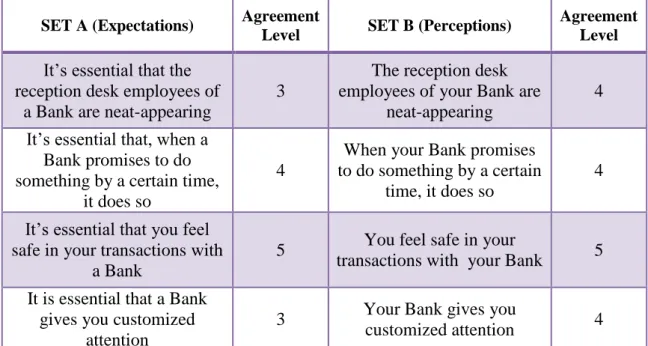
Using the 1985 Parasuraman’s Servqual model, Section 3 of the FLIBESA tool inquires those who take the survey on their satisfaction with Financial Institutions. Researchers choose two sets of statements: one regarding the consumers’ expectations from a “perfect” Financial Institution and the other related to their perceptions of their own financial partner.
Respondents choose their level of agreement for each of the statements and the gaps between each pair of matching statements is calculated.
Finally, a simple mean of all Gaps is performed and each individual is included in one of the five Quintiles of Financial Satisfaction:
1st – Very Unsatisfied – Gaps “-4” and “-3”
2nd – Unsatisfied: Gaps “-2” and “-1”
3rd – Satisfied: Gap “0”
4th – Very Satisfied: Gaps “1” and “2”
EXAMPLE: Bank A chooses the following sets of sentences:
Table 5: Satisfaction Analysis Sentences (Example)
Source: Own
Mr. Geoffrey chooses the following levels of agreement, from 1 to 5 (being 1 – Totally Disagree and 5 – Totally Agree):
Table 6: Mr. Geoffrey’s Agreement Levels (Example)
Source: Own
SET A (Expectations) SET B (Perceptions)
It’s essential that the reception desk employees of a Bank are neat-appearing
The reception desk employees of your Bank are neat-appearing It’s essential that, when a Bank promises to
do something by a certain time, it does so
When your Bank promises to do something by a certain time, it does so It’s essential that you feel safe in your
transactions with a Bank
You feel safe in your transactions with your Bank
It is essential that a Bank gives you customized attention
Your Bank gives you customized attention
SET A (Expectations) Agreement
Level SET B (Perceptions)
Agreement Level It’s essential that the
reception desk employees of a Bank are neat-appearing
3
The reception desk employees of your Bank are
neat-appearing
4 It’s essential that, when a
Bank promises to do something by a certain time,
it does so
4
When your Bank promises to do something by a certain
time, it does so
4
It’s essential that you feel safe in your transactions with
a Bank
5 You feel safe in your
transactions with your Bank 5 It is essential that a Bank
gives you customized attention
3 Your Bank gives you
On the previous example, we observe:
o A Gap “+1” on the matching statements #1 (4-3=1) o A Gap “0” on the matching statements #2 (4-4=0) o A Gap “0” on the matching statements #3 (5-5=0) o A Gap “+1” on the matching statements #4 (4-3=1)
Using a simple arithmetic mean, we have: (1 + 0 + 0 + 1) / 4 = 1. Therefore, it can be acknowledged that Mr. Jorge Fonseca is included in the 4th Quintile of Financial Satisfaction, being “Very Satisfied” with the Service of his Financial Institution.
3.1.4 - Section 4: Personal Information
The final section of the questionnaire refers to the population’s demographics. Variables like age, income or academic background allow detailed profiling. After all four sections are completed, researchers are able to cross the first 3 section with this final one and uncover unlimited profiles.
3.2 – POTENTIAL PROFILERS
Virtually any individual and organization can make use of FLIBESA. However, it was designed to best suit the following profilers:
o Researchers - Students and Professional investigators can count on a user friendly guide to their financial data collection and analysis;
o Financial Institutions – This tool allows financial companies’ effective consumer and customer depiction, allowing grounded thus profitable decision-making;
o Governmental Organizations – Census and other population financial representation from different communities can be executed by the FLIBESA tool. This way, data treatment from different cultures is patterned and can be easily compared.
3.3 – FINAL RESULTS
The final goal of the FLIBESA tool is to attain global profiles, encompassing different dimensions of an individual’s financial personality.
Examples of the final results when using FLIBESA are:
o Mr. John has Very High Financial Literacy, Very Much Involvement with Financial Institutions and is Extremely Satisfied with his Financial Institution;
o The individuals between 35-44 years old from the state of Massachusetts, USA, have Median Financial Literacy, Some Involvement with Financial Institutions and are Satisfied with their Financial Institutions;
o Europeans have High Financial Literacy, Much Involvement with Financial Institutions and are Very Satisfied with their Financial Institutions.
The next segment of this paper presents the pioneer application of the FLIBESA tool by a US-based financial institution. It describes how this community bank built its questionnaire and scoring parameters.
CHAPTER 4 – TESTING THE FLIBESA TOOL: MILLENNIUM BCPBANK AND THE PORTUGUESE DIASPORA IN THE USA
The first test of the FLIBESA tool was performed by a community bank based just outside New York City, USA.
This chapter presents one practical example of how a financial institution – Millennium bcpbank – profiled its main target market – the Portuguese diaspora in the USA – using FLIBESA and adapting it to its specific needs.
4.1 – THE PROFILER: MILLENNIUM BCPBANK
Headquartered in Newark, New Jersey, Millennium bcpbank was officially established in 2000. Today, it offers a unique community-focused banking approach that features trusted personalized service and a broad scope of products and services.
A wholly-owned subsidiary of Millennium BCP in the United States of America, Millennium bcpbank is genuinely international in its scope. Unlike many of its regional competitors, it has the advantage of being backed by the resources of one of the biggest successes of the European banking world, Banco Commercial Português. Created in 1985, BCP is currently Portugal’s largest private bank with a presence in Europe, North America and Africa, all under the Millennium brand.
In the United States specifically, Millennium bcpbank’s Board of Directors, Management and Employees take a proactive role in determining the particular needs of their local neighborhoods, and carefully allocate appropriate Bank resources that are consistent with safe and sound business practices to satisfy their financial services needs.
Being a Portuguese originated organization, the institution’s main target market is the Portuguese Diaspora living in North America, namely on the states where the Bank has its presence – Massachusetts, New Jersey and New York.
4.2 – THE PROFILED: PORTUGUESE DIASPORA IN THE USA
In the late 19th century, many Portuguese, mainly Azorean and Madeiran, immigrated to the United States, establishing in cities like East Providence, Rhode Island, Fall River, Massachusetts, Newark, New Jersey, Jacksonville, Illinois, and Modesto, California.
Many of them also moved to Hawaii during pre-U.S. times. In the mid-late 20th century there was another surge of Portuguese immigration in America, mainly in the Northeast (New Jersey, New York, Connecticut, and Massachusetts).
According to the United States’ most recent national Census3
, there are over one million Portuguese in the US, living throughout all fifty States. Numbers show that Portuguese and their descendents sum up to 1.176.615 - 578.523 men and 598.092 women.
Evaluating the data collected in 2000, a typical Lusitanic is 35 years old, works in the manufacturing industry and has a 3-member family that earns an annual income of 55 thousand dollars.
3
The States with the largest Luso-American populations include:
Table 7: Portuguese Diaspora in the USA: Breakdown by State
RANK STATE PORTUGUESE
POPULATION % OF THE TOTAL DIASPORA 1 California 330,974 28.1% 2 Massachusetts 279,722 23.7% 3 Rhode Island 91,445 7.76% 4 New Jersey 72,196 6.13% 5 Florida 48,974 4.16% 6 Hawaii 48,527 4.12% 7 Connecticut 44,695 3.79% 8 New York 43,839 3.72% 9 Washington 17,200 1.46% 10 Texas 16,552 1.40% Source: US Census 2000
Millennium bcpbank established in regions with a large Portuguese presence, namely in the states of Massachusetts and New Jersey. Today, it has become part of the diaspora culture, and although it is making efforts to become a mainstream organization, the concept of “Community Bank” is still highlighted by its board of Directors.
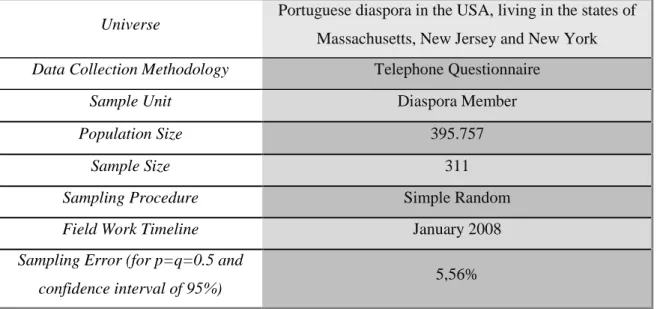
4.3 – SURVEY METHODOLOGY
FLIBESA was administered by three Contact Center professionals of Millennium bcpbank over the month of January 2008.
A telephone questionnaire was conducted, from Monday to Friday (2pm to 7pm), with two major goals:
- Test the FLIBESA tool;
- Gather nonexistent financial information on the Portuguese diaspora in the USA.
A list of Portuguese households was acquired to an online company specialized in marketing mailing lists. This list had 3054 records, and each entry included Full Name, Address, State and Phone Number.
Filling it were 1031 households from the state of Massachusetts (520 men, 511 women), 1019 from New Jersey (509 men, 510 women) and 1004 from New Jersey (502 men, 502 women)
The objective was to gather a minimum of 300 completed questionnaires (100 for each state, with a 1 to 1 ratio of men to women)
To guarantee the randomness of the sample, a new column was created on the excel sheet with a “Random” formula. The list was sorted ascending by this column and the questionnaires were filled in this order.
Each collaborator was equipped with a telephone (with confidential numbers, so that the respondents wouldn’t relate the study with Millennium bcpbank, skewing the data) and a survey script.
The script was created using a form on Microsoft Access, which allowed an immediate data collection into a table (later exported to an excel sheet)
After completing each successful call, the administrators would check a state and sex box to keep track of the finished questionnaires (“Fill State/Sex” section of the questionnaire), in order to survey the intended sample.
Missed calls, refused questionnaires and non-Portuguese respondent cases were checked on a “Questionnaire not Finished” section, for tracking purposes.
Below is a summary of the survey methodology:
Table 8: Survey Methodology Summary
Universe Portuguese diaspora in the USA, living in the states of
Massachusetts, New Jersey and New York
Data Collection Methodology Telephone Questionnaire
Sample Unit Diaspora Member
Population Size 395.757
Sample Size 311
Sampling Procedure Simple Random
Field Work Timeline January 2008
Sampling Error (for p=q=0.5 and
confidence interval of 95%) 5,56%
4.4 – MILLENNIUM BCPBANK`S FLIBESA
Millennium bcpbank used the FLIBESA tool for this research. The questionnaire was then comprised of four sections: Financial Literacy, Financial Behavior, Financial Satisfaction and Personal Information.
4.4.1 - Section 1: Financial Literacy
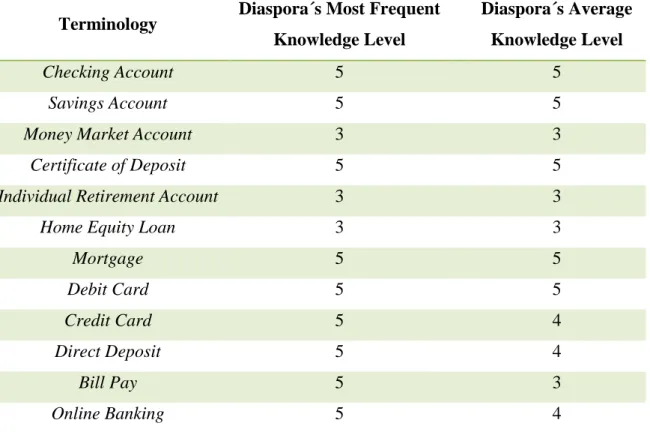
In this section, Millennium chose to present twelve financial products and services to the respondents. Using a 5-point Likert scale, they were asked to decide on their knowledge level for each financial terminology, being 1 – “I Never heard of this product” and 5-“I have professional knowledge of this product”.
The twelve concepts were : Checking Account, Savings Account, Money Market Account, CD – Certificate of Deposit, IRA – Individual Retirement Account, Home Equity Loan, Mortgage, Debit Card, Credit Card, Direct Deposit, Bill Pay, Online Banking. Below is the Microsoft Access script that guided Millennium bcpbank´s collaborators through the administration of Section 1 of the FLIBESA tool:
Image 1: FLIBESA's Script (Section 1 - Financial Literacy)
The following table shows the different weights Millennium attributed for each financial product:
Table 9: Millennium bcpbank´s Terminology Weighting Key
Product Weight Checking Account 1 Savings Account 1 Money Market 3 CD 2 IRA 3 HE Loan 3 Mortgage 2 Debit Card 2 Credit Card 2 Direct Deposit 3 Bill Pay 3 Online Banking 3 Source: Own
These weights were determined by Millennium’s perception of the complexity of each terminology.
For each respondent’s twelve levels of knowledge, a weighted mean is calculated and rounded to the closest unit. The result, a number from 1 to 5, will correspond to the respondent’s level of perceived Financial Knowledge
4.4.2 - Section 2: Financial Behavior
The second part of the questionnaire (see Image 2) referred to the practical interaction between the respondents and Financial Institutions. The Bank decided to include seven questions:
1. Do you currently Bank with a Financial Institution? 1.1 If “Yes”, with which one?
2. Which Financial Products do you currently own? (Options: “Checking Account”, “Savings Account”, “Money Market Account”, “CD – Certificate of Deposit”, “IRA – Individual Retirement Account”, “Home Equity Loan”, “Mortgage”, “Other - Which”, “Does not know”).
3. Have you ever requested a loan from a Bank?
3.1 If “Yes”, what for? (Options: “Home Purchase”, “Home Remodeling”, “Debt Consolidation”, “Auto Purchase”, “Start a Business”, “Business Loan”, “Education”, “Other Expenses - Which”)
4. Have you ever sent money to Portugal, through a Bank?
4.1 If “Yes”, what for? (Options: “Family”, “Savings”, “Pending Loan”, “Other – Which”)
Image 2: FLIBESA’s Script (Section 2 – Financial Behavior)
To each answer, different points were awarded to the respondent, as we can see on the following scoring key:
Table 10: Millennium bcpbank´s Answer Scoring Key
Question / Options Points
Respondent banks with a Financial Institution 5
Respondent has a Checking Account 1
Respondent has a Savings Account 1
Respondent has a Money Market Account 2
Respondent has a Certificate of Deposit 1
Respondent has an Individual Retirement Account 2
Respondent has a Home Equity Loan 2
Respondent has a Mortgage 1
Respondent has Other Financial Products / Services 1 Respondent has requested a loan from a Bank 3 Respondent has requested a loan for Home Purchase 1 Respondent has requested a loan for Home Remodeling 1 Respondent has requested a loan for Debt Consolidation 1 Respondent has requested a loan for Auto Purchase 1 Respondent has requested a loan to Start a business 2
Respondent has requested a Business Loan 1
Respondent has requested a Loan for Education 2 Respondent has requested a loan for Other Expenses 1
Respondent has sent money to Portugal 3
Respondent has sent money to Portugal for his Family 1 Respondent has sent money to Portugal for Savings 1 Respondent has sent money to Portugal to pay a Pending Loan 1 Respondent has sent money to Portugal for Other Expenses 1
TOTAL: 36 points
These points were determined by Millennium’s perception of the involvement level of each variable.
After all points added, the total score creates a Behavior profile for that specific individual, included in one of the following categories:
1 – No involvement: 0 points
2 – Little Involvement: 1 to 10 points 3 – Some Involvement: 11 to 20 points 4 – Much Involvement: 21 to 30 points 5 – Very Much Involvement: 31 to 36 points
4.4.3 - Section 3: Financial Satisfaction
The third section of the FLIBESA tool revised the Parasuraman4’s SERVQUAL model, analyzing gaps between the Portuguese diaspora’s expectations and perceptions of Banking Institutions:
Using two sets of statements – one respecting any given Bank and a second one concerning the respondent’s Bank - those who took the survey chose, from another 5-point Likert scale, their level of agreement, being 1-Totally Disagree and 5-Totally Agree.
4
PARASURAMAN, A., et al. A conceptual model of service quality and its implications for future
Millennium bcpbank created the two sets, including the following statements:
Table 11: Millennium bcpbank’s Sets of Service Quality Statements
Source: Own
SET A (Expectations) SET B (Perceptions)
1a. It is essential that the facilities and materials of a Bank (like the branches and the
brochures) are visually appealing
1b. The facilities and materials of your Bank (like the branches and the brochures) of your Bank are visually
appealing
2a. It is essential for a Bank that its reception desk employees are neat-appearing
2b. The employees at the reception desk of your Bank are neat-appearing
3a. It is essential for a Bank that when it promises to do something by a certain time, it
does so
3b. When your Bank promises to do something by a certain time, it does so
4a. It is essential that when you have a problem, a Bank shows sincere interest in
solving it
4b. When you have a problem, your Bank shows sincere interest in solving it
5a. It is essential that you feel safe in your transactions with a Bank
5b. You feel safe in your transactions with your Bank
6a. It is essential that the employees of a Bank are consistently courteous towards you
6b. The employees of your Bank are consistently courteous towards you
7a. It is essential that a Bank gives you customized attention
7b. Your Bank gives you customized attention
8a. It is essential that a Bank has operating hours convenient to all its clients
8b. Your Bank has operating hours convenient to all its clients
Image 3 illustrates the telephone questionnaire script for the Financial Satisfaction section of the FLIBESA tool:
Image 3: FLIBESA’s Script (Section 3 – Financial Satisfaction)
Source: Own
The difference between the rates given to matching statements of both sets (“1 from Set A & 1 from Set B”, “2 from Set A & 2 from Set B”, and so on) are calculated, giving us a Gap.
At this point, every respondent has 8 Gaps, one for each pair of matching statements. With the use of arithmetic means, it is possible to obtain the Satisfaction Level for each of the service statements, as well as an overall Financial Satisfaction Level (Arithmetic Mean of all 8 Gaps).
The final step is to label the Gap Averages, including the respondent in one of the five Quintiles of Financial Satisfaction:
1st - Very Unsatisfied: Gaps “-4” and “-3” 2nd - Unsatisfied: Gaps “-2” and “-1” 3rd - Satisfied: Gap “0”
4th - Very Satisfied: Gaps “1” and “2” 5th - Extremely Satisfied: Gaps “3” and “4”
4.4.4 - Section 4: Personal Information
The final series of questions (see Image 4) was designed to collect personal data from the respondents. Millennium decided to research the respondents’:
1. Generation in the USA (Options: 1st – respondent was the first of his family to emigrate, 2nd – respondent’s parents were the first of his family to emigrate or 3rd – respondent’s grandparents or earlier generations were the first of his family to emigrate);
2. Age: 1: -18, 2: 18-34, 3: 35-44, 4: 45-54, 5: 55-64, 6: 65+;
3. Household Income: 1: $0 - $20.000, 2: $21.000- $40.000, 3: $41.000 - $60.000, 4: $61.000 - $80.000, 5: $81.000 - $100.000, 6: $101.000 +;
4. Academic Background: 1: No school, 2: 4th Grade / Elementary, 3: 6th Grade, 4: 9th Grade, 5: 12th Grade / High School/College, 6: Bachelor’s Degree, 7: College, 8: Master’s Degree, 9: Doctoral Degree;
Image 4: FLIBESA’s Script (Section 4 – Personal Information)
Source: Own
This stage involves a global data cross between the results of the first three sections and the collected personal data.
Here, profiles regarding Financial Literacy, Behavior and Satisfaction are crossed with social features, allowing virtually infinite profile definitions and data analysis.
The next chapter presents the main results for each FLIBESA section, portraying the diaspora’s Financial Literacy, Behavior and Satisfaction profiles.
CHAPTER 5 - RESULTS
Through FLIBESA, profilers are able to encompass a vast number of characterization options. Although the first and primary goal of this tool is to achieve general patterned profiles, it is able to supply innumerous detailed information, namely through the cross-analysis of its four interrelated sections.
This chapter contains the main results of the first practical example of FLIBESA. The profiler was the US-based Millennium bcpbank. The profiled population was the Portuguese diaspora living in the states of Massachusetts, New Jersey and New York.
5.1 – SAMPLE RESPONSE RATE
Of the 1.727 telephone calls:
713 were not answered (41%);
467 resulted in refused questionnaires (27%);
178 were answered by non-Portuguese originated individuals (10%);
58 resulted in unfinished questionnaires (4%);
311 resulted in complete questionnaires (18% - breakdown by state: 105 from
5.2 – FINANCIAL LITERACY
The opening section of the FLIBESA questionnaire inquired the citizens of the three states on their perceived financial knowledge. After calculating the weighted mean for the twelve chosen concepts (Checking Account, Savings Account, Money Market Account, CD – Certificate of Deposit, IRA – Individual Retirement Account, Home Equity Loan, Mortgage, Debit Card, Credit Card, Direct Deposit, Bill Pay, Online Banking), individuals were included in one of the five Quintiles of Financial Literacy. The results are as follows:
Image 5: Financial Literacy of the State of Massachusetts
Source: Own
Image 6: Financial Literacy of the State of New Jersey
Image 7: Financial Literacy of the State of New York
Source: Own
Image 8: Financial Literacy of the Portuguese diaspora in the USA
Source: Own
As shown above, the majority of the Portuguese diaspora perceives itself of having High Financial Literacy (45%), followed by Median Financial Literacy (22%) and Very High Financial Literacy (19%).
However, this answer pattern is not identical for the three states: Massachusetts’ answers led to a different ranking, as “Very Low Financial Literacy” ended up being the third more frequent quintile.