M
ASTER
E
CONOMICS AND
P
UBLIC
P
OLICIES
M
ASTER
’
S
F
INAL
W
ORK
D
ISSERTATION
C
OMPETITIVE
L
OBBYING
:
T
HE
M
ATTER OF
N
ON
-
EGOISTIC
B
EHAVIOR
IN
R
EPEATED
G
AMES
V
ANESSA
S
ANTOS
M
ELLO
M
ASTER
E
CONOMICS AND
P
UBLIC
P
OLICIES
M
ASTER
’
S
F
INAL
W
ORK
D
ISSERTATION
C
OMPETITIVE
L
OBBYING
:
T
HE
M
ATTER OF
N
ON
-
EGOISTIC
B
EHAVIOR
IN
R
EPEATED
G
AMES
V
ANESSA
S
ANTOS
M
ELLO
S
UPERVISION:
PROFESSOR JOANA VAZ PAIS
i ABSTRACT
Interest groups play a crucial role in public policymaking. Providing information is often asserted to be the primary way to influence makers. Although decision-makers recognize that interest groups do have specialized private information and high technical expertise, they are aware that there may be an incentive for such groups to attempt to bias their decisions by manipulating the information transmitted in their favor. In this sense, a concern arises about the negative impact such groups may have on the quality of democratic government or economic indicators.
In the opposite direction, this research is concerned with the extent to which private interest groups can consider the preferences of other agents when lobbying. With this purpose in mind, we develop a game-theoretical lobbying model in which two interest groups with different utility functions must interact with a decision-maker in order to influence its decision. On the one hand, the groups are assumed to have private information that is relevant to the maker, whilst, on the other hand, the decision-maker is aware of the strategic incentives the groups have to report biased information. This situation is analysed by considering two scenarios: a proactive scenario, in which the interest groups act before the decision-maker reveals its utility function, and a reactive scenario, in which the groups’ actions comes after the decision-maker reveals its utility function.
We show that in a setting of partially conflicting interests, there exists a rationale for a group to consider the preferences of other agents, even if it is to improve its own utility. Furthermore, the model reveals some interesting findings: interest groups lobby decision-makers with similar utility functions; lobbying messages may be informative even if there is a partial conflict of interest; and groups do establish credibility with the decision-maker.
KEYWORDS: Lobbying; Signalling; Game Theory.
ii RESUMO
Grupos de interesse desempenham um papel fundamental na formulação de políticas públicas. O fornecimento de informações costuma ser considerado o principal meio de influenciar os decisores. Embora os decisores reconheçam que os grupos de interesse possuem informações privadas especializadas e grande conhecimento técnico, eles sabem que existe um grande incentivo para que tais grupos tentem influenciar as suas decisões através da manipulação da informação que é transmitida. Nesse sentido, surge uma preocupação com o impacto negativo que os grupos de interesse podem ter na qualidade do governo democrático ou de indicadores econômicos.
No sentido oposto, esta pesquisa preocupa-se com a importância que os grupos de interesse privado podem atribuir às preferências de outros agentes nas suas ações de
lobbying. Com este propósito, desenvolveu-se um modelo baseado na teoria dos jogos no
qual dois grupos de interesse com diferentes funções de utilidade devem interagir com um decisor a fim de influenciar a sua decisão. Por um lado, assume-se que os grupos possuem informação privada que é relevante para o decisor, enquanto que, por outro, o decisor está ciente dos incentivos que os grupos possuem para reportar informações enviesadas. Esta situação é analisada através de dois cenários: o proativo, no qual os grupos de interesse agem antes que o decisor revele sua função de utilidade, e o reativo, no qual a ação dos grupos ocorre depois do decisor revelar a sua função de utilidade.
Demonstra-se que, numa situação de interesses parcialmente conflituosos, existe uma racionalidade para que um grupo considere as preferências de um outro agente, ainda que isso seja com o propósito de melhorar a sua própria utilidade. Além disso, o modelo revela outros resultados interessantes: os grupos de interesse fazem lobbying com decisores que possuem funções de utilidade similares; as mensagens de lobbying podem ser informativas ainda que haja um conflito parcial de interesses; e grupos de interesse agem de forma a ganhar credibilidade junto aos decisores.
iii INDEX OF CONTENTS
Abstract ... i
Resumo ... ii
Index of Contents ... iii
Index of Figures ... iv
Index of Tables ... iv
Acknowledgments ... v
1. Introduction ... 6
2. Literature Review ... 9
2.1. The Theory of Economic Regulation ... 9
2.2. Strategic Transmission of Private Information ... 11
2.3. Critical analysis and interpretation ... 14
3. Basic Concepts ... 16
4. The Basic Model ... 22
5. Proactive Lobbying ... 24
5.1. The Sequential Game ... 24
5.2. Equilibrium ... 26
6. Reactive Lobbying ... 32
6.1. The Simultaneous-move Game ... 32
6.2. Equilibrium ... 34
7. Conclusions ... 39
iv INDEX OF FIGURES
FIGURE 1. Sequence of decisions in the first stage of the proactive lobbying game ... 25 FIGURE 2. Tree of the sequential game ... 30 FIGURE 3. Sequence of decisions in the first stage of the reactive lobbying game ... 32 FIGURE 4. Tree of the simultaneous game ... 37
INDEX OF TABLES
TABLE 1. Message profiles and corresponding outcomes for the proactive lobbying . 26 TABLE 2. Payoffs of the Two-Stage Sequential Game ... 27 TABLE 3. Message profiles and corresponding outcomes for the reactive lobbying .... 33 TABLE 4. Payoffs of the Two-Stage Simultaneous Game ... 34
v
ACKNOWLEDGMENTS
The path toward this dissertation was hard. Its completion is thanks to the special people who challenged and supported me. I want to say special thankfulness to the persons below who made my research successful.
I want to express the most profound appreciation to my supervisor, Prof. Joana Vaz Pais, for the patient guidance, encouragement, and advice she provided throughout my time as her student. I have been fortunate to have a supervisor who cared so much about my work and who responded to all my questions promptly. Her expertise was invaluable in the formulating of the research topic and methodology.
I am also grateful to all the professors of the master’s in Economics and Public Policies for the numerous discussions during the period I attended the program. They supported me greatly and were always willing to help me.
However, nobody has been more important to me in the pursuit of this dissertation than the members of my family. I want to thank my parents, whose love and guidance are with me in every personal and professional goal, and my brother. I must also express my gratitude to my husband for his continued encouragement and inspiration.
Finally, there are my friends, who were of great support in discussing our findings and problems as well as providing a happy distraction to rest my mind outside of this research.
6
COMPETITIVE LOBBYING: THE MATTER OF NON-EGOISTIC BEHAVIOR IN REPEATED GAMES
By Vanessa Santos Mello
1.INTRODUCTION
Providing information to regulators, policymakers, or legislators is often asserted to be the primary way to influence decision-makers. The ability of an interest group to provide relevant data in support of its position is an essential advantage in the run for influence. On the other hand, although decision-makers recognize that interest groups have specialized private information and high technical expertise, they are aware that there is an incentive for such groups to attempt to bias their decisions by manipulating the information transmitted in their favor.
It is a fact that interest groups play a crucial role in public policymaking. Sometimes they are faced as intermediaries between society and the government. More often, however, a concern arises about the negative impact such groups may have on the quality of democratic government or economic indicators. Undoubtedly, this concern refers to private interest groups, defined by Pereira (2008) as those in which the welfare of their members is improved at the expense of non-members. This definition is based on the assumption that all the actions of such groups are guided by egoistic behavior.
The concept of rationality in neoclassical economics is based on utility maximization, assuming that an economic agent decides to maximize his or her utility, and thus behaves in a purely selfish way. Rational choice is an adequate description of behavior in many real-life situations. However, there are several other situations where behavior reveals that individuals are not entirely selfish, but have social preferences, exhibit empathy, and are altruistic, as observed in the donation of resources or volunteer work, for example.
This dissertation aims to provide an answer to the following question: is there a rationale for a private interest group to consider the preferences of other players in a world of self-interested agents?
For this research, we develop a simple model of two interest groups lobbying based on the central premise that such activity is an exercise of strategic information
7
transmission. We assume that the groups possess information the decision-maker does not, and, at some point, such information is essential for the decision-maker in what the consequences of taking one action rather than another are concerned. However, given that the interests of the decision-maker do not necessarily coincide with those of the interest groups, the extent to which a group can persuade a decision-maker to act in its interest is questionable.
The present research demonstrates that, while interest groups seek to improve the welfare of their members, their actions are not motivated solely by selfishness and often incorporate benevolent aspects. Thus, the goal would be to increase the welfare of their members without necessarily implying a reduction in the welfare of non-members, which could remain constant or even increase. In other words, the action of the group could lead to improvements according to the Pareto criterion1.
This behavior would be justified by increasing the influence power of the group over government, which would see it as an essential ally in strategic decision-making. In contrast, the interest group would see its chance of success grow and, even if its gains are lower than it is possible or desirable, it would have improved its initial position by increasing the welfare of its members.
Some observations regarding the action of interest groups in Brazil were the primary motivation for this research. The Brazilian oil and gas sectors are subject to sectoral regulation, and ever since the sectors were opened to the private initiative, different interest groups appeared, representing all interested parties of this activity. My observations are related to the action of one specific group that, on many occasions, has decided to defend a position that was not necessarily the best for its interests. This situation happens for many reasons. The importance that the group attributes to credibility is one of them. Considering that the interaction with the decision-maker is a continuous process, we have a situation of repeated interaction, which means that the group may seek to acquire a reputation for being benevolent or presenting trustable information early in the game. This behavior is relevant because the extent to which any information offered to alter or to influence beliefs is effective depends on the credibility of the lobbyist to the decision-maker in question.
8
Secondly, assuming the government´s utility function is related to the political support it receives (its objective is to be reelected), the occurrence of previous discussions among organized groups of the sectors before sending a message to the decision-maker is common. The aim is to guarantee the maximum support to an idea in order to influence the decision-maker’s beliefs more effectively. The rationale behind this strategy is easy to understand: if the government wants to assure political support from all groups, an idea defended by all the groups is more easily implemented than an idea advocated by only one group. Logically, if groups with partially different interests send the same message, at least one of them had to forgo its best choice.
Finally, an interesting behavior that we could observe is the commitment regarding the objectives defined by the decision-maker. Given that, every time the government signalizes a goal and requests information, the group makes the best of its efforts to attend the decision-maker’s demand making sure the government will achieve its objective and its members will also receive an improvement on its welfare.
The plan for this dissertation is as follows. In Section 2, we relate this research to the literature - while the primary motivations for this study stem from the theory of regulation, it is relevant to approach the topic by considering the signaling literature. Section 3 presents the basic concepts for the construction of the model. In Section 4, we develop the basis of the model, while in Sections 5 and 6 we analyze two different scenarios: proactive lobbying and reactive lobbying, respectively. In Section 7, we conclude.
9
2.LITERATURE REVIEW
2.1. The Theory of Economic Regulation
The literature known as the theory of economic regulation had its beginning in Sigler (1971), and its principal characteristic is described as below:
The most important element of this theory is its integration of the analysis of political behavior with the larger body of economic analysis. Politicians, like the rest of us, are presumed to be self-interested maximizers. This means that interest groups can influence the outcome of the regulatory process by providing financial or other support to politicians or regulators.
In: Peltzman (1989), p. 1. Some relevant versions of capture theory had appeared earlier than Stigler's seminal paper2. For this reason, his model could be interpreted as a refined version of capture theory, considering that he introduced an original aspect by accumulating evidence from empirical research within the discipline. It is unclear, however, whether the theory of economic regulation is a theory about interest groups lobbying in the regulatory process or it is a theory focused on demonstrating that regulation is intended to protect the regulated industry.
Stigler’s model is shaped by two costs of obtaining legislation: information and organization. Stigler (1971, p.3) states that “regulation is acquired by the industry and is designed and operated primarily for its benefit”. Groups with lower costs tend to be favored at the expense of groups with higher costs. Numerically large groups tend to be the losers in the regulatory process. The main conclusion is that producers’ interests will always be victorious in the dispute over the services of a regulatory agency. More generically, in any similar political dispute between groups of different sizes, the more compactly organized interests will usually win. The conclusion stems directly from Olson (2009).
Additionally, Stigler (1971) specifies the objects of choice in the utility function of politicians in two aspects – votes and resources. The industry that seeks regulation must be prepared to pay with these two things.
10
The emphasis on political behavior, aimed at satisfying self-interest, and the costs of information and organization have become the touchstone of subsequent literature in regulation theory.
Posner (1974) argues that Stigler’s theory is unsatisfactory and cannot be said to have substantial empirical support. He defends that regulation may be the product of coalitions between the regulated industry and customer groups, at the expense of unorganized groups.
Peltzman (1976) further elaborated on the analysis of the action of interest groups. The author defends that no economic interest captures the regulator in an exclusive way and that regulation is a process of wealth transfer. The main reason is that the regulator will seek a structure of costs and benefits that maximizes its political return. In other words, the regulator’s choice problem is not limited to selecting the appropriate size of an interest group to benefit; it includes the selection of a proper structure of benefits and costs able to guarantee political support from all groups. For this reason, even if a single economic interest gets all the benefits of regulation, these must be less than the maximum result the group could obtain. He concludes that regulation usually tries to conciliate the interests of producers and consumers. The conclusion goes on the opposite direction of Stigler’s idea that regulation exclusively protects the producers.
It is interesting to note that Peltzman (1976) indicates the possibility of a capture made by the regulator – a typical agency problem in which the decision-maker (principal) imposes its objective function over the agents. Stigler (1971) did not consider this aspect in his analysis.
Both Stigler (1971) and Peltzman (1976), however, ignore the fact that regulators are usually agents of an executive or legislature rather than agents seeking votes. They also disregard situations in which decision-makers need specialized private information in order to understand possible outcomes of their decisions. If that is the case, the decision-maker will be in the position of demander and may interact with interest groups to collect information.
Becker (1983) has a setup similar to Peltzman’s: groups organize to exert pressure on the political process to obtain benefits. He assumes the capacity of a group to exert pressure is a function of the number of members and the resources spent by member for
11
maintaining the lobbying activity: pressure increases when expenditures increase. Even though popular support (voters) is said to be a relevant element in exerting pressure, the aspect was not incorporated in the function. Moreover, the author does not define what he means by “exerting political pressure”, albeit he highlighted the relevance of the productivity of the groups’ expenditures for this purpose. Therefore, there is some implicit evidence in the paper that indicates the distribution of relevant information for the decision-maker as a way of raising the influence of a group. The model does not examine aspects regarding the relevance of groups’ credibility in increasing their influence.
In accordance with Becker’s research, competition among groups can lead to efficient results, although cooperation is necessary to prevent the wasteful expenditures on political pressure that result from the competition for influence. In contrast, the author presents the political model as a zero-sum in influence – the increased influence of some groups decreases the influence of others by equal amounts – and, given that, cooperation is difficult to achieve.
The theory of economic regulation has two relevant limitations: it ignores both the principal-agent problem and the existence of information asymmetry (Laffont & Tirole; 1993). Considering the absence of such asymmetries, regulated firms would be incapable of extracting rent and, therefore, would have no incentive to lobby. Similarly, voters and legislators would be able to control their agents (politicians and agencies) that, hence, would not act in benefit of interest groups.
The school focuses on the “demand side,” which implies a naive assumption that decision-makers’ role in the political scenario is mainly to transmit the pressure of interest groups. It also disregards the differences between the objective functions of decision-makers and interest groups, ignoring that, under a context of information asymmetry, the rational and opportunistic behavior is present in all players.
2.Erro! Autoreferência de indicador não válida.2. Strategic Transmission of Private Information
We should care about information transmission for two reasons. Decision-makers are usually choosing policies without complete information. For this reason, information becomes valuable and those who possess it are in the position to influence policies in their
12
favor. On the other hand, when agents’ payoffs depend both on the better-informed agent’s information and on the decision of the decision-maker, the latter is aware that the first has an incentive to attempt to bias its decision by manipulating the information transmitted.
In a seminal paper, Crawford and Sobel (1982) study the strategic information transmission in the context of an abstract sender-receiver game. There are two agents, one of whom has private information relevant for both. The Sender (S), the better-informed one, sends a signal based on his private information to the other agent, the Receiver (R). R then makes a decision that defines the payoff of both players, based on the information contained in the signal. Given that, S will include enough information in the signal to induce R to respond to it and will hold back enough so that his response is as favorable as possible. Variants of this model have been applied widely ever since.
Direct communication is more likely to play an important role the more closely related are agents’ preferences (Crawford and Sobel, 1982; Potters and Van Winden, 1992; Austen-Smith, 1993). In the opposite direction, under a situation of conflicting preferences, Crawford and Sobel (1982) indicate that only no communication is consistent with rational behavior, and, for this reason, their model disregards issues related to reputation and credibility.
The most natural way to incorporate those aspects is to model the interaction as a repeated game. Sobel (1985) defines that credibility can only be communicated through actions and that an agent could become credible by providing accurate and relevant information or by acting responsibly. The model establishes that S and R will play the game a finite number of times and, at each stage: (a) R decides its action by accessing the credibility of S; and, (b) S can enhance its reputation by providing honest information to R. Sobel considers that, at some point, a group with opposed preferences to the decision-maker will take advantage by misleading him. When this happens, S loses all opportunities for deception in the future given that his reputation falls, and R believes nothing that he says. Aspects related to credibility were also considered by Kreps and Wilson (1982) and by Austen-Smith (1993).
Kreps and Wilson (1982) have studied the power of reputation on finitely repeated games. The model allows us to assert that reputation matters both in the context of
13
infinitely repeated games and on finite games with some uncertainty (incomplete information) as to the payoffs of each player. This paper and the research of Milgrom and Roberts (1982) were the first to present models in which players exploit uncertainty and take short-term losses seeking to build a reputation and make long-term gains.
Austen-Smith (1993) indicates that the extent to which any information offered to alter the beliefs of a decision-maker is effective depends on the credibility of the group. In his model, credibility is considered as an endogenous variable and depends on how closely the preferences of the interest group and the decision-maker are, and on how confident is the decision-maker that the group is informed. The author does not consider, however, that both agents interact through time, developing reputations.
Sobel (1985) defends that repeated plays allow the decision-maker to evaluate better the usefulness of a group’s information (R prefers to deal with a single Sender for t periods rather than t Senders separately). Long-term arrangements are a useful tool to moderate the inefficiencies caused by incomplete information. In the same direction, Potter and Van Winden (1992) indicate that repeated communication is more costly to the interest group and that higher costs induce a more favorable response from the decision-maker because private information is signaled more persuasively.
Potters and Van Winden (1992) indicate that lobbying messages from an interest group to a decision-maker may be informative even if there is a substantial conflict of interest. In that sense, there is scope for informational lobbying if there is sufficient congruence in the agent’s preferences.
Sobel (1985) and Potters and Van Winden (1992) assume the possibility of a no-transmission equilibrium, in which R takes the same action regardless of S’s signal. In other words, R’s response to lobbying is more favorable to S if R would already have made this favorable decision based on its prior beliefs.
Lobbying messages are more likely to occur if the interest group has ‘good’ information (informational signal) and if the costs of a message are small relative to the potential benefits. A rationale for costly lobbying exists if it induces a favorable change in the decision maker’s behavior relative to its prior beliefs and if S believes that R expects to receive any information and will make a less favorable decision in case of silence (Potter and Van Winden; 1992). In what concerns this aspect, Austen-Smith
14
(1993) indicates that not lobbying can itself constitute an informative signal (if R is indifferent between the status quo and a new proposal, in the absence of any influential lobbying, R will choose the new proposal). This means there is always an informed interest group that decide not to send a signal.
2.3. Critical analysis and interpretation
By analyzing the literature, it is noted that interest groups typically use an influence function to represent the transformation of inputs (money, capital, and labor) into political influence (e.g., Becker, 1985; Tullock, 1980). However, a major criticism of such models is that the interaction underlying its transformation is lacking (Mitchell, 1990).
In fact, the orthodox view of the lobbying activity is that such expenditures help to reinforce or to shape decision-maker’s positions (Matthews, 1960; Milbrath, 1960; Bauer, Poll and Dexter, 1963; Zeigler, 1964; Scott and Hunt, 1966; Dexter, 1969). Schlozman and Tierney (1986), Salisbury, Heinz, Laumann and Nelson (1987) and Berry (1989) state that the vast amount of money they spend on lobbying suggests that the interest groups’ influence may be considerable. Actually, recent empirical studies have demonstrated that lobbying can yield significant dividends in political support (Smith, 1984; Fowler and Shaiko, 1987; Smith, 1988; Rothenberg, 1989; Smith, 1989; Wright, 1990).
In contrast with the theory of economic regulation, under the information transmission approach, the political agents are treated as players and one aspect of the interaction is explicitly modeled as information transmission. This comes at the cost of not incorporating any competition between interest groups. On the other hand, the theory of economic regulation does not consider issues regarding the credibility and reputation of interest groups.
For the purpose of this research, lobbying will be modeled as a game of strategic information transmission. It will be necessary, however, to consider the possibility of competition and cooperation between interest groups. This is relevant because there are situations that information provided by one interest group can be contradicted or affirmed by messages from another group. Additionally, we have substantial support in the theory of economic regulation to consider that under a scenario of competition between interest groups, each one will seek to raise its political influence through the support of other groups or interested parties.
15
Given the exposed so far, the model that will be developed in this research differs from principal-agent models (e.g., Grossman and Hart; 1983) since it is not assumed that the uninformed player (R) can commit itself to a message-response profile at the beginning of the game. It also differs from cheap talk games (e.g., Farrell and Rabin; 1996), in that it is not assumed that informational lobbying is costless (Austen-Smith; 1994). It will be assumed that there is no way for R to check the accuracy of S’s message and players will be allowed to have different interests (contrary to, e.g., Crawford and Sobel, 1982). Also, we do not assume that lying is impossible (Milgrom, 1981). The model also differs from persuasion games (e.g., Bartlett, 1973; Calvert, 1985; Milgrom and Roberts;1986) since in these games the decision-maker and the interested parties interact only once so that issues regarding credibility and reputation does not arise. Furthermore, as Potter and Van Winden (1992), we assume that the cost of a signal is fixed, which means that it is independent of the content of the message and the private information of the sender. This assumption differs from a wide class of signaling games (e.g., Cho and Sobel, 1990).
16 3.BASIC CONCEPTS
That are two types of information that are germane to the lobbying context: the first one is technical, while the second one concerns intentions (Austen-Smith; 1992). Technical information is related to the information the decision-maker lacks regarding the consequences of choosing one action or another. On the other hand, verbal commitments and threats, or the coordination of actions, are examples of the second type of information (Banks and Calvert; 1990). This research focuses on technical information. Additionally, we are not concerned about the form of the message transmitted to the decision-maker. It is the informational content of the message that matters.
It should be clear from the exposed so far that lobbying is presumed to be strategic: an interest group chooses its political messages in an attempt to convince decision-makers to take one action rather than another. Logically, it is also expected that rational listeners are aware of the strategic nature of such messages.
We must also define a further restriction on our focus of attention. Potters and Van Winden (1992) consider that three incentive structures should be distinguished. In the first structure, there is no conflict of interest between the decision-maker and an interest group regarding the best action the decision-maker can take: the interest group has no incentive to provide bad information and there is no reason for the decision-maker to mistrust a message from this group. Hence, we say that this interest group is a Friend (F) of the decision-maker and has no incentive to lie or make an untruthful report on its private information given the congruence of interests between both agents. In the second structure, there is full conflict of interests between the decision-maker and an interest group. In this case, the group has an incentive to be dishonest and to misinform the policymaker, who will always interpret a message unfavorably for the group. No message will be sent under this scenario. Thirdly, there is a case of partial conflict of interests regarding the best action the decision-maker can take. We say that the interest group is an Enemy (E) of the decision-maker and may have incentives to lie or to make an untruthful report on its private information to influence its decision. The problem of the scope for information transmission is clearly most pertinent in this case.
It also is relevant to refer that, for the present research, we follow the model constructed by Austen-Smith (1994). The author states that assuming the existence of
17
organized groups on both sides of an issue, only the group whose interests the legislator will vote against in the absence of lobbying activity has incentives to devote resources to lobbying. The group whose interests the legislator is inclined to vote for ex-ante has no incentive to lobby if no other group does. However, if the group against the legislator decides to lobby, the second group must act in counteractive lobbying, that is, in providing information to offset any influence the initial group might exert.
Therefore, we will assume the existence of two interest groups competing for influence: one group has no conflict of interests with the decision-maker, F; and another group with partial conflict of interest with the decision-maker, E. We also consider two different approaches. An interest group may acquire information prior to, and independently of, the introduction of a legislative agenda; or it may acquire information only after the legislative agenda is revealed (Austen-Smith and Wright; 1992). In other words, a group may act proactively or reactively.
As such, an interest group acts in a proactive way if it decides to influence the decision-maker before it reveals its utility function. Consider a situation in which the decision-maker is satisfied with the current scenario but an interest group decides to persuade it into leaving the status quo by sending a lobbying message. It is logical to assume that this group believes it could improve its welfare in case the decision-maker takes action to leave the status quo. After this, an opponent group sends a lobbying message to reinforce or to counteract the rival. The lobbying messages are an attempt to inform or to misinform the decision-maker, but this decision-maker only discovers if the groups lied and whether they are an “enemy” or a “friend” after making the decision regarding the messages received.
In this case, we assume that in the absence of a lobbying message, the decision-maker prefers to take no action. This reflects the beliefs of the decision-maker regarding the preferences of its voters: if the status quo is maintained, the decision-maker believes it will not lose any political support from its voters (prior belief); however, depending on the lobbying messages received, the decision-maker may be willing to reevaluate its position.
The decision-maker wants to guarantee political support from all interest groups (Peltzman; 1976) and, therefore, the only way to persuade it into changing the status quo
18
is through the existence of consensus between the messages of both groups regarding the best action the decision-maker could take. We assume that the decision-maker believes it can increase its political support by taking an action that improves the welfare of both interest groups (potential voters) without losing anyone’s support. Therefore, even though the decision-maker is not sure about the real motives behind a lobbying message from an interest group, if both groups transmit the same message, we assume the decision-maker prefers to believe in the messages in order to assure political support.
We model proactive lobbying as a sequential game. Only one interest group can start the process by sending a lobbying message, while the other group acts in the sequence. Considering that we have two rival groups competing for influence, we assume that one of them is F, while the other is E. Logically, F is more satisfied with the status quo than E, given that F’s utility function is similar to the decision-maker’s, who has no intention to take action to leave the status quo if no lobbying message is transmitted. For that reason, we expect that E will start the sequential game by sending the first lobbying message.
Assuming the existence of a second interaction between the interest groups and the decision-maker, its decision rule only remains unchanged if E tells the truth in the first stage of the game. If the decision-maker concludes that E had incentives to report biased information and chose not to, E gains reputation that assures the decision-maker will listen to its message in the second stage of the game. On the other hand, when E lies, it is penalized by not being credible enough to start a new lobbying process, given that the decision-maker has no incentive to believe him when the second interaction takes place. In this case, it is safer for the decision-maker to maintain the status quo regardless of the messages received. This means that when E lies it loses reputation and its credibility becomes too low to start a second game and to persuade the decision-maker into changing the status quo.
Now, we shall consider the situation in which interest groups act after the decision-maker reveals its utility function: the groups involved observe how the decision-decision-maker rank its preferences and then decide the lobbying messages they will send. We define this scenario as reactive lobbying.
19
Consider that the decision-maker is determined to leave the status quo by implementing a new public policy that affects the welfare of the two interest groups involved in the process. This decision refers to the beliefs of the decision-maker regarding the preferences of its voters. However, depending on the lobbying messages received, the decision-maker may be willing to reevaluate its position.
Again, we say that one of the groups is F while the other is E and that, after discovering that the decision-maker is willing to implement a new policy, they send lobbying messages to support the proposed policy or to try to persuade the decision-maker into implementing another policy. Suppose, for example, that lobbying messages are private information related to the possible outputs generated by implementing the proposed policy, and that, by considering its outputs, the decision-maker may be willing to reevaluate its position. Similar to the proactive lobbying, we say the decision-maker only discovers if the groups lied and whether they are an “enemy” or a “friend” after making the decision regarding the messages received.
In this scenario, we assume that in the absence of a lobbying message, the decision-maker implements its preferred public policy. Under this situation, we assume that both interest groups get an increase in their utility. F will be in a better situation than E given that F’s utility functions are similar to the decision-maker’s. E’s welfare improves, but not as much as it would if the decision-maker had implemented E’s preferred public policy. This is also true if the groups decide to send different messages: imagine that one group has decided to support the decision-maker’s position while the other has decided to persuade the decision-maker into implementing another policy. Under this situation, it is expected that the decision-maker will act based on its prior beliefs guaranteeing political support from its voters and from the interest group that supported its decision. Logically, if both interest groups decide to send the same lobbying messages, we expect the decision-maker to believe that the information is an accurate report.
We model the reactive lobbying as a simultaneous-move game. After the decision-maker reveals its utility functions, we say that both groups will transmit their lobbying messages simultaneously because none of them had the proactive behavior of starting the process. The groups are merely reacting to the decision-maker’s demands by answering to a request.
20
It is expected that F has no incentive to try to misinform the decision-maker, given that their interests are aligned. This is not true for E.
Assuming the existence of a second interaction between the interest groups and the decision-maker, its decision rule only remains unchanged if at least one of the groups chose to report truthful information on the first-stage. If one of the groups lied on the first stage of the game, it is expected that it will lose reputation. However, considering that the decision-maker is sure about which policy it prefers to implement, it is more concerned in securing some support from either of the groups regarding its position than in assuring support by both of them regarding another possible policy, especially if one of the groups has proved to be a liar. For this reason, even if F lies and the decision-maker discovers that this led the group to a worst situation, the decision-maker will consider the signal received if it supports its prior beliefs on the second stage of the game. The same is true for E, even if the lie placed it in a better situation. Finally, if we assume that both interest groups lie on the first stage, when the second stage of the game takes place, the decision-maker believes nothing they say and prefers to follow its prior beliefs by implementing its preferred policy – this happens because the lie of both groups at the first-stage of the game led the decision-maker to take a wrong decision.
The incorporation of the benefits and the losses associated to telling the truth or a lie in the model should also consider another relevant aspect: under the situations in which E has incentives to lie and chooses not to, E gets reputation that allows it to ensure incremental gains on the second stage of the game. This assumption derives from Peltzman’s (1976) idea that decision-makers select the benefits structure that guarantee political support from all groups3. For example, imagine a debate about the implementation of a new policy that requires a high level of bureaucratic control by its executors, which we assume to be E and F. We say that F is favorable to the implementation of the proposed policy while E is contrary to it. When E informs the decision-maker about the possible outcomes of the policy, it can signal truthful information and, even if the policy is, in fact, implemented, E might get as a reward a reduction of the bureaucratic level initially proposed by the decision-maker, which would be contrary to F’s interests. This situation would lead to incremental improvement of E’s
21
payoff. Logically, E would only be able to demand such incremental payoff if it is credible enough to influence the decision-maker. We assume that an increase in E’s payoff leads to a decrease in F’s payoff – not necessarily in the same proportion – and that reputation gains could also be reflected by the increment associated with small adjustments to the policy initially proposed by the decision-maker.
Under the situations in which E lies in the first stage of the game, it makes no sense to discuss incremental gains associated with the increase of the influence power over the government, considering that there are no reputation gains. In the same direction, for F, incremental gains make no sense due to its alignment with the government and its total disincentive to lie. Thus, the exposed understanding for the construction of the payoffs must be reflected in the situations in which E tells the truth expecting to be rewarded at the second stage of the game. This situation is, indeed, observed in many real situations. A policymaker may wish to impose a tax only in one group, for example, E. If both groups, E and F, have a good reputation and provide truthful information, the government may choose to implement the tax but to reduce the rate proposed initially.
22 4.THE BASIC MODEL
Considering the complexity that characterizes the political and regulatory environment, the lobbying model presented here is an attempt to incorporate all relevant aspects regarding strategic informational lobbying in a synthetic structure.
We model lobbying as a two-player, two-stage game. The players are two groups with conflicting interests who compete for influence, denoted by E and F. In each stage, the two groups aim at impelling a benevolent decision-maker, the government, to take action and implement one of two possible policies. Policies in the first stage of the game are denoted by X1 = {x
1, x2} and policies in the second stage of the game are denoted by X2
= {x3, x4}. If no policy is taken, the status quo (SQ) remains. The interest groups’ payoffs
reflect the policies chosen in both stages of the game.
The real impact of each policy is unknown to the government but known to the interest groups. We assume that policies x1 and x3 are welfare superior when compared to policies
x2 and x4, respectively. Moreover, policy x1 is preferred by group F and policy x2 is
preferred by group E in the first stage of the game; in the second stage, policy x3 is
preferred by group F and policy x4 is preferred by group E4.
The groups exercise influence by sending messages to the government. For simplicity, there are two possible messages available in the first stage of the game – message θ1 aims
at convincing the government to implement policy x1, while message θ2 favors policy x2;
likewise, there are two messages available in the second stage of the game – θ3 supports
policy x3, while θ4 favors policy x4. Given the welfare effects of each policy, messages θ1
and θ3 are truthful, while messages θ2 and θ4 are biased.
Once messages are sent, the government processes the messages received and makes a decision by choosing one of the policies and thus setting the outcome for that stage. We assume that the government is primarily, but not necessarily, reelection seeker (Mayhew, 1974; Austen-Smith and Wright, 1992). As such, in the first stage of the game, in pursuing reelection, the government chooses the policy that carries support in case messages are identical.
4 Therefore, F’s interests are aligned with those of the benevolent government, while E’s are not. This
23
Once a policy is chosen at the end of the first stage, the government observes its real impact. The second stage of the game starts with the two interest groups sending messages θ3 or θ4 to the government, which triggers the government’s reaction to set the outcome
for the second stage. This time, the government’s decision reflects reelection concerns but also penalizes the interest group that conveyed a biased message in the first stage, in case such a group exists.
24
5.PROACTIVE LOBBYING 5.1. The Sequential Game
Our first scenario is proactive lobbying. In each stage of the game, the two interest groups, E and F, play a perfect information, sequential game, where E moves first and is followed by F. In what the government is concerned, it discovers if the senders sent a truthful or a biased message in the first stage, at the end of this stage. Such knowledge conditions the government’s decision in the second stage of the game, so that the interest groups – E in particular – may provide accurate and unbiased information in the first stage in order to take advantage of their reputation later5.
As described in the previous section, the two interest groups have conflicting preferences over possible policies and the status quo (SQ). This is reflected in the following assumptions, where Ui(p), p = x1, x2, x3, x4, SQ and i = E, F denote the utility
that interest group i derives from p.
Assumption A1. UF(x1) > UF(SQ) > UF(x2) and UF(x3) > UF(SQ) > UF(x4). Assumption A2. UE(x
2) > UE(x1) > UE(SQ) and UE(x4) > UE(x3) > UE(SQ).
Interest group i’s payoff, i = E, F, is the sum of utilities obtained in the first and in the second stages of the game. Moreover, we assume that F’s payoff when the government chooses not to take action is greater than that of E:
Assumption A3. UF(SQ) > UE(SQ).
Assumption A3 justifies the fact that E plays first in the sequential game, considering that it is less satisfied with the SQ than F and that every action taken by the government is better than the SQ. Following E, group F will play to reinforce or counteract the message sent by E.
5 See Hayes (1981). Having access is more important than winning. If a group forfeits access, it loses
25
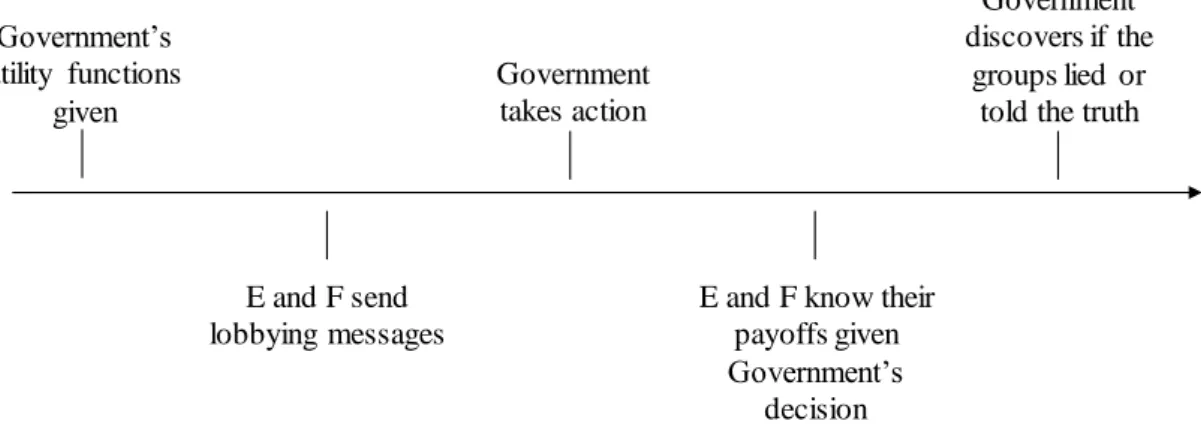
FIGURE 1. Sequence of decisions in the first stage of the proactive lobbying game
As mentioned in Section 4, we assume that groups know the true impact of each policy. Namely, policy x1 is welfare superior to policy x2 and policy x3 is superior to x4.
Since the government is not aware of policies’ welfare effects, the interest groups send messages that support one of the two possible policies in order to influence the government to take action. If a group chooses message θ = θ1 (θ = θ3), which favors the
welfare superior policy x1 (x3), it is telling the truth; whereas if a group chooses θ = θ2 (θ
= θ4), it is providing biased information to the government. For example, E may want to
persuade the government into changing the SQ in order to improve its welfare by informing the government about the possible positive outcome of new regulations; being aware that F is also able to signal the true impact of such regulations, E decides whether to inform (tell the truth, say θ = θ1 or θ = θ3) or to misinform (lie, say θ = θ2 or θ = θ4) the
government. Following E, group F plays and, after observing all the messages, the government decides to implement or not one of the new regulations. In the first stage of the game, strategic play additionally implies anticipating possible reputation effects from providing biased information.
In what concerns F, it has no incentive to try to mislead the government, given that both have similar preferences. For that reason, in case F chooses to lie, the government can only conclude that F was uninformed or committed a mistake.
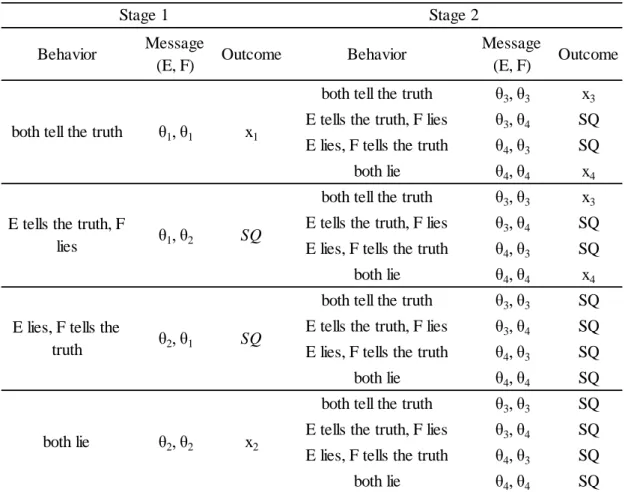
Given the concepts presented in Section 3 regarding the utilities of the decision-maker, the following table lists all plausible actions taken by the interest groups and the government’s decision for each combination of actions.
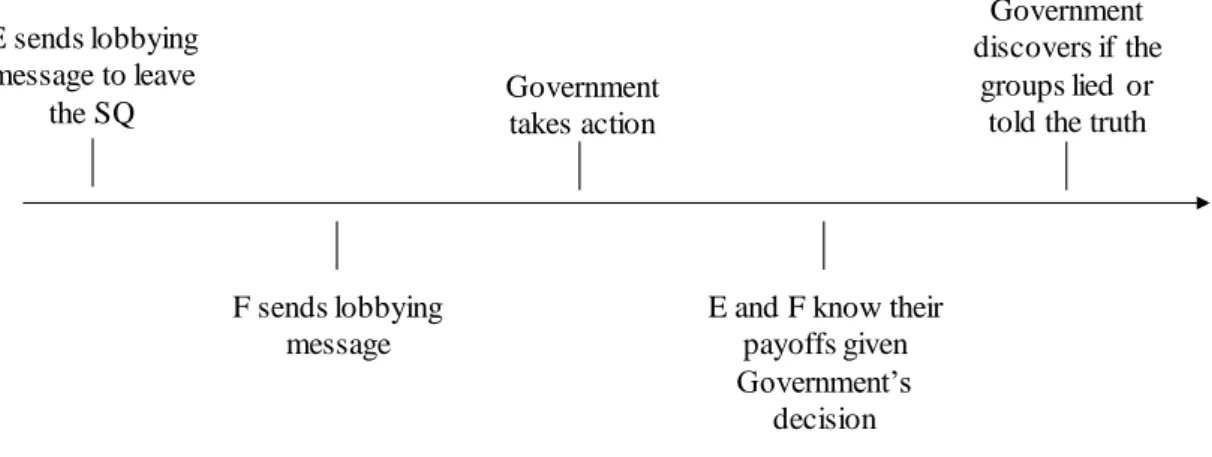
E sends lobbying message to leave the SQ F sends lobbying message Government takes action
E and F know their payoffs given Government’s decision Government discovers if the groups lied or told the truth
26
TABLE 1. Message profiles and corresponding outcomes for the proactive lobbying
5.2. Equilibrium
We use the concept of subgame perfect equilibrium to solve the lobbying game. A subgame perfect equilibrium is a Nash equilibrium of the game (i.e., a pair of strategies or plans of action of E and F that are best replies to each other) that induces a Nash equilibrium in every subgame of the original game. Since the game we describe is a perfect information game, subgame perfect equilibria can be obtained by backwards induction.
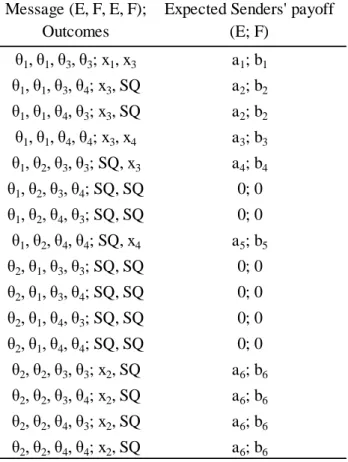
In the description of the subgame perfect equilibrium of this two-stage game, we assume that the game has payoffs as defined in Table 26.
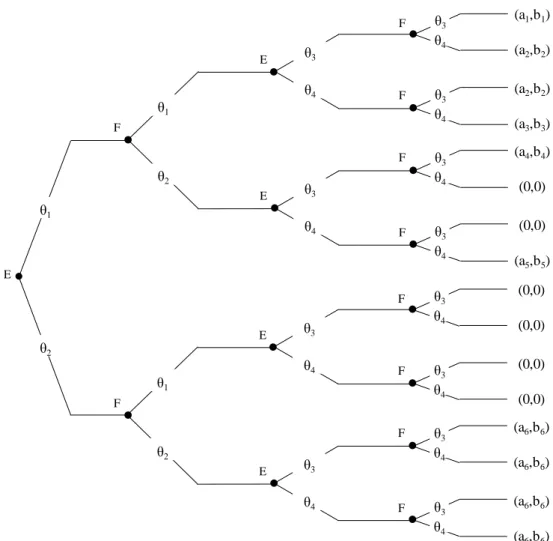
6 Figure 2 below contains the tree of the sequential game.
Behavior Message
(E, F) Outcome Behavior
Message
(E, F) Outcome both tell the truth θ3, θ3 x3
E tells the truth, F lies θ3, θ4 SQ
E lies, F tells the truth θ4, θ3 SQ
both lie θ4, θ4 x4
both tell the truth θ3, θ3 x3 E tells the truth, F lies θ3, θ4 SQ E lies, F tells the truth θ4, θ3 SQ
both lie θ4, θ4 x4
both tell the truth θ3, θ3 SQ
E tells the truth, F lies θ3, θ4 SQ
E lies, F tells the truth θ4, θ3 SQ
both lie θ4, θ4 SQ
both tell the truth θ3, θ3 SQ E tells the truth, F lies θ3, θ4 SQ E lies, F tells the truth θ4, θ3 SQ
both lie θ4, θ4 SQ
x2
θ1, θ1
both tell the truth
E tells the truth, F lies
E lies, F tells the truth both lie θ1, θ2 θ2, θ1 θ2, θ2 Stage 1 Stage 2 x1 SQ SQ
27
TABLE 2. Payoffs of the Two-Stage Sequential Game
Firstly, consider E’s decision: E must decide whether to lie or not to the government in order to improve its utility. When there is more than one stage, E may supply useful information to the government at first to take advantage of its reputation later (Sobel; 1985). This means that E is aware that if the government discovers a lie in the first stage when the second stage takes place, it will not believe in anything E says. In other words, lying in the first stage leads E to lose reputation, which is reflected in the second stage of the game and, hence, on its payoff. Additionally, when deciding whether to lie or not, E is aware of F’s payoffs.
Considering the decision rules established for the proactive game, for the first interaction, even though E prefers to induce the government into implementing policy x2
by saying that θ = θ2, if F chooses to signal that θ = θ1, E prefers to tell the truth and
guarantee some payoff. Therefore, if F tells the truth, E prefers to tell the truth. However, if F lies, E prefers to lie. Under this scenario, the only way E has to assure a payoff different from zero when it decides to lie on the first stage of the game is to make sure that F’s message will also be a lie.
Message (E, F, E, F); Outcomes
Expected Senders' payoff (E; F) θ1, θ1, θ3, θ3; x1, x3 a1; b1 θ1, θ1, θ3, θ4; x3, SQ a2; b2 θ1, θ1, θ4, θ3; x3, SQ a2; b2 θ1, θ1, θ4, θ4; x3, x4 a3; b3 θ1, θ2, θ3, θ3; SQ, x3 a4; b4 θ1, θ2, θ3, θ4; SQ, SQ 0; 0 θ1, θ2, θ4, θ3; SQ, SQ 0; 0 θ1, θ2, θ4, θ4; SQ, x4 a5; b5 θ2, θ1, θ3, θ3; SQ, SQ 0; 0 θ2, θ1, θ3, θ4; SQ, SQ 0; 0 θ2, θ1, θ4, θ3; SQ, SQ 0; 0 θ2, θ1, θ4, θ4; SQ, SQ 0; 0 θ2, θ2, θ3, θ3; x2, SQ a6; b6 θ2, θ2, θ3, θ4; x2, SQ a6; b6 θ2, θ2, θ4, θ3; x2, SQ a6; b6 θ2, θ2, θ4, θ4; x2, SQ a6; b6
28
Now, consider F’s decision: F must decide whether to reinforce or to counteract E’s message. It is logical that F has incentives to always tell the truth in both stages of the game and E is aware of this fact. Again, when deciding whether to lie or not, F is informed about E’s payoffs.
Before describing the equilibrium of the game, we shall state some relations between the expected payoffs.
If both E and F lie on the first stage of the game, the government implements policy x2, which guarantees an increase in utility for E despite leaving F in a worse situation than
it would be if the SQ were maintained. As discussed previously, once the government discovers that E lied, the second interaction will guarantee a null payoff for both groups, considering that E’s message will not be credible enough to persuade the government to change the SQ. Under this scenario, the sum of the single-period payoff for both players is assumed to be a6 for E while it is assumed to be b6 for F. Logically, b6 < 0, what
confirms that the implementation of policy x2 is a worse scenario for F than maintaining
the SQ.
The situation in which E lies and F tells the truth on the first stage of the game leads the government to take no action (SQ) in both stages of the game. Under this scenario, the total payoff for both players would be zero.
If we consider that E decides to tell the truth and F to lie in the first stage, the government will take no action (SQ), in accordance with the previous scenario. However, considering that E chose not to lie, it earns reputation that assures the government will listen to its lobbying message when the second interaction takes place. Given that, if E and F choose the same message in the second interaction, the government will believe it. Logically, for E, the best situation would be if both groups decided to lie. If this is the case, we assume that E gets a payoff of a5 while F gets b5. However, we are aware that
this would be a bad scenario for F. Hence, we expect that F tells the truth. We assume that if E and F tell the truth when the second interaction takes place, E gets a payoff of a4
while F gets b4. Evidently, a5 > a4 > 0 and b4 > 0 > b5. In fact, b5 is the worst possible
payoff for F since it represents a decrease in its utility associated with the fact that E assures reputation to persuade the government into starting a second interaction. This
29
means that 0 > b6 > b5. In the opposite direction, if the groups send different messages,
the SQ will be maintained for the second stage, guaranteeing a total null payoff for each player.
Finally, we shall analyze the situation when both E and F tell the truth in the first stage of the game and the government implements policy x1, which yields utility for both
groups. The utility F gets is higher than the utility granted for E. When the second interaction takes place, the government will believe in both signals and the SQ will be maintained only if the groups decide to send different messages. Under this situation, we assume that the sum of E’s single-period payoff would be a2 while F’s would be b2. Those
values derive from the first stage of the game, considering that keeping the SQ for the second stage yields a null payoff for both players. On the other hand, in the case where the messages sent are equal, the government will implement policy x3 if the messages are
that θ = θ3, which is the best scenario for F (policy x1 implemented on the first stage and
policy x3 implemented on the second stage). We assume that this situation ensures a total
payoff of b1, F’s highest possible payoff. For E, we assume that the payoff would be a1.
Since we assumed previously that policies x1 and x3 ensure some payoff for E, we can
state that a1 >a2 > 0. Considering that both groups decide to lie in the second stage and
the government implements policy x4, E would get a3 as total payoff and F would get b3.
In order to attend all the assumptions established so far, it is expected that a3 > a1 > a2 and
that b1 > b2 > b3.
In order to establish the equilibrium, we must state additional comparison relations between the expected payoffs for E. We assume that a3 > a6 > 0 to illustrate that if E and
F tell the truth on the first stage and then lie on the second stage, E will get a better payoff than it would if both of then lied on the first stage. More specifically, telling the truth enables E to start a new game in which the implementation of policy x4 is a better scenario
than the implementation of policy x3; lying leads to the SQ in the second stage, which
implies no increase of utility. For the same reason, we assume that a5 > a6. Finally, it is
intuitive to assume that a1 > a4 > 0 since a1 is associated with positive payoffs for the
implementation of policy x1 in the first stage and of policy x3 in the second stage, while
a4 is associated with a positive payoff only for the implementation of action x3 in the
30
Finally, given the relations between the expected payoffs, we obtain equilibria by using backwards induction. The extensive form of the proactive game is illustrated in Figure 2.
FIGURE 2. Tree of the sequential game
We begin the analysis by examining the final decision nodes of F, who has to choose whether or not to lie to the government in the second stage. At this point, F knows the whole story of the game. One way to narrow its choices is to observe what E chose in the first decision node (in the first stage of the game): if E tells the truth, F always tells the truth on the second stage (b1 > b2 > b3 and b4 > 0 > b5), and, if E lies, F is indifferent
between lying or telling the truth in the second stage of the game.
Now, move backward up the game tree to E’s decision nodes in the second stage of the game. Again, we must observe E’s choice at the first decision node and have in mind
E θ1 θ2 F F θ1 θ2 θ3 θ4 E E θ3 θ4 (a1,b1) (a2,b2) θ3 θ4 (a2,b2) (a3,b3) θ3 θ4 (a4,b4) (0,0) θ3 θ4 (0,0) (a5,b5) θ3 θ4 F F F F θ1 θ2 θ3 θ4 E E θ3 θ4 (0,0) (0,0) θ3 θ4 (0,0) (0,0) θ3 θ4 (a6,b6) (a6,b6) θ3 θ4 (a6,b6) (a6,b6) θ3 θ4 F F F F
31
that E is aware of F’s incentives to tell the truth. If E tells the truth in the first stage, it always chooses to tell the truth in the second stage of the game (a1 > a2 and a4 > 0). On
the other hand, if E lies, it is indifferent between lying or telling the truth in the second stage of the game.
Again, moving backwards to the first set of decision nodes of F, we can see that this group always chooses to tell the truth independently of what E does in its first decision node (b1 > b4 and 0 > b6).
Finally, by analyzing the first decision node, we conclude that E chooses to tell the truth (a1 > 0).
In conclusion, the subgame perfect equilibrium consists of both players telling the truth in order to induce government into implementing policy x1 in the first stage and x3
in the second stage of the game, which yields a payoff of a1 for E and b1 for F. This result
32
6.REACTIVE LOBBYING 6.1. The Simultaneous-move Game
Our second scenario is reactive lobbying. In each stage of the game, the two interest groups E and F play imperfect information, simultaneous-move game. All aspects assumed for the construction of the sequential game apply to the simultaneous-move game. When this generalization fails, we will indicate it.
As described in Section 4, the two interest groups have conflicting preferences over two possible policies. This is reflected in the following assumptions, where Ui(p), p = x
1,
x2, x3, x4 and i = E, F denotes the utility that interest group i derives from p. In the reactive,
the status quo is not a possibility given that the government necessarily implements a new public policy.
Assumption A1’. UE(x2) > UE(x1) and UE(x4) > UE(x3) > 0. Assumption A2’. UF(x1) > UF(x2) and UF(x3) > UF(x4) > 0.
Additionally:
Assumption A3’. UF(x1) > UE(x1) and UF(x3) > UE(x3). Assumption A4’. UF(x2) < UE(x2) and UF(x4) < UE(x4).
Assumptions A3’ and A4’ reflect the fact that the implementation of policy x1 (x3)
yields more utility for F than for E. In the opposite direction, the implementation of policy x2 (x4) yields more utility for E than for F.
FIGURE 3. Sequence of decisions in the first stage of the reactive lobbying game
Government’s utility functions given E and F send lobbying messages Government takes action
E and F know their payoffs given Government’s decision Government discovers if the groups lied or told the truth
33
As mentioned in Section 4, we assume that groups know the true impact of each policy. Namely, policy x1 is welfare superior to policy x2 and policy x3 is superior to x4.
Since the government is not aware of policies’ welfare effects, the interest groups send messages that support one of the two possible policies in order to influence the government’s action.
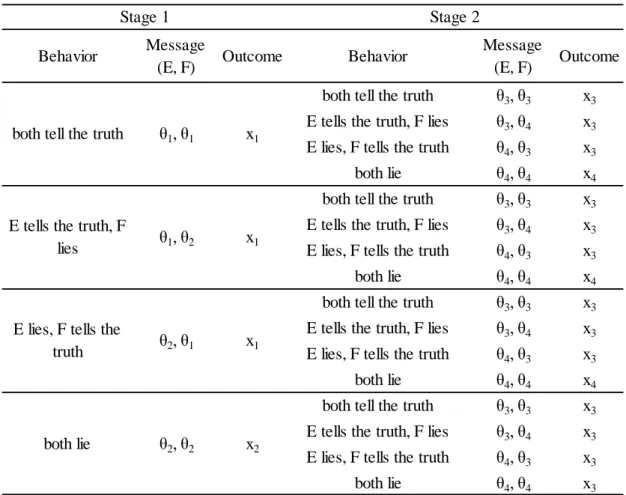
Given the concepts presented in Section 3 regarding the utilities of the government and the model presented in Sections 4 and 5, the following table lists all plausible actions taken by the interest groups and the government’s decision for each combination of actions.
TABLE 3. Message profiles and corresponding outcomes for the reactive lobbying
Behavior Message
(E, F) Outcome Behavior
Message
(E, F) Outcome both tell the truth θ3, θ3 x3 E tells the truth, F lies θ3, θ4 x3
E lies, F tells the truth θ4, θ3 x3
both lie θ4, θ4 x4
both tell the truth θ3, θ3 x3
E tells the truth, F lies θ3, θ4 x3
E lies, F tells the truth θ4, θ3 x3
both lie θ4, θ4 x4
both tell the truth θ3, θ3 x3 E tells the truth, F lies θ3, θ4 x3 E lies, F tells the truth θ4, θ3 x3
both lie θ4, θ4 x4
both tell the truth θ3, θ3 x3
E tells the truth, F lies θ3, θ4 x3
E lies, F tells the truth θ4, θ3 x3
both lie θ4, θ4 x3
E tells the truth, F
lies θ1, θ2 x1
Stage 1 Stage 2
both tell the truth θ1, θ1 x1
E lies, F tells the
truth θ2, θ1 x1
34
6.2. Equilibrium
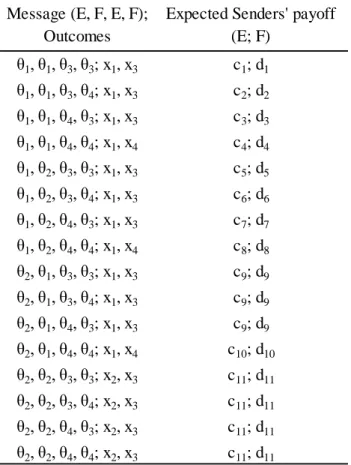
For the analysis of this two-stage game, we assume that the game has the payoffs as described in Table 47.
TABLE 4. Payoffs of the Two-Stage Simultaneous Game
For the proactive model, we assumed that F could have negative payoffs. However, for the reactive model, this does not occur since both policies x1 and x2 (x3 and x4) lead
to improvements in F’s and E’s utilities – unlike the proactive game, the reactive game has positive payoffs associated to the situations in which the groups send different lobbying messages.
Firstly, we consider E’s decision: similar to the proactive game, E has to choose whether to lie or not to the government, aware that this choice impacts its reputation for the second stage of the game. However, under this scenario, E is aware of which policy the government is inclined to implement. Regarding F’s decision, it is logical to suppose
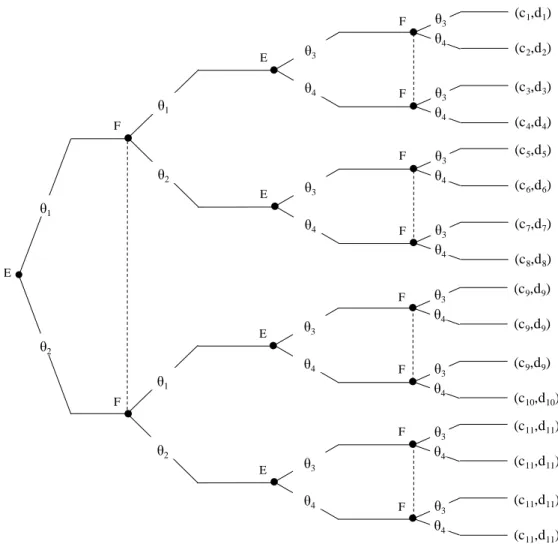
7 Figure 4 below contains the tree of the simultaneous-move game.
Message (E, F, E, F); Outcomes
Expected Senders' payoff (E; F) θ1, θ1, θ3, θ3; x1, x3 c1; d1 θ1, θ1, θ3, θ4; x1, x3 c2; d2 θ1, θ1, θ4, θ3; x1, x3 c3; d3 θ1, θ1, θ4, θ4; x1, x4 c4; d4 θ1, θ2, θ3, θ3; x1, x3 c5; d5 θ1, θ2, θ3, θ4; x1, x3 c6; d6 θ1, θ2, θ4, θ3; x1, x3 c7; d7 θ1, θ2, θ4, θ4; x1, x4 c8; d8 θ2, θ1, θ3, θ3; x1, x3 c9; d9 θ2, θ1, θ3, θ4; x1, x3 c9; d9 θ2, θ1, θ4, θ3; x1, x3 c9; d9 θ2, θ1, θ4, θ4; x1, x4 c10; d10 θ2, θ2, θ3, θ3; x2, x3 c11; d11 θ2, θ2, θ3, θ4; x2, x3 c11; d11 θ2, θ2, θ4, θ3; x2, x3 c11; d11 θ2, θ2, θ4, θ4; x2, x3 c11; d11
35
that, knowing its preferences are similar to the government’s, F has no incentive to misinform it.
Now we shall describe and analyze the relations between the payoffs associated with each action taken by E and by F in order to define the equilibrium of the game.
If both E and F lie on the first stage of the game, government implements policy x2,
which guarantees an increase in utility for E and F. In this case, E will gain a better payoff than F. As discussed previously, once the government discovers that both groups lied, it will act in accordance to its prior beliefs when the second stage of the game takes place. Even so, after the first stage is played, the government discovers that F has similar preferences. As such, even if the government doubts F due to the previous lie, a policy implemented in accordance with the government’s prior beliefs improves F’s payoff. Under this scenario, the sum of payoffs for the two periods is assumed to be c11 for E and
d11 for F.
The situation in which E lies and F tells the truth in the first stage of the game leads the government to implement policy x1. For the second stage of the game, the government
implements action x4 only if both groups decide to lie. In this case, the sum of payoffs for
the two periods is assumed to be c10 for E and d10 for F. In every other situation, the
government implements policy x3. So, E gets a payoff of c9 while F gets d9. It is logical
to note that it is expected that c10 > c9, given that c10 is associated with the implementation
of policy x4, which is the policy preferred by E. This implies that d9 > d10. We also expect
that c11 > c9 and that d9 > d11 since c11 and d11 are related to the implementation of policy
x2 in the first stage of the game, while c9 and d9 are related to the implementation of x1.
For the same reason, d10 > d11.
If we consider that E decides to tell the truth and F to lie in the first stage, the government implements policy x1. In accordance with the previous scenario, for the
second stage of the game, the government implements policy x4 only if both players
decide to lie. In this case, the sum of payoffs for the two periods is assumed to be c8 for
E and d8 for F. In all other situations, the government implements x3. We assume that if
E and F tell the truth when the second interaction takes place, E gets a payoff of c5, while