Mestre em Biotecnologia
Bioconversion of Cheese Whey into
Polyhydroxyalkanoates
Dissertação para obtenção do Grau de Doutor em Engenharia Química e Bioquímica
Orientadora:
Maria d´Ascensão Miranda Reis,
Professora Catedrática, Faculdade de Ciências e
Tecnologia, Universidade Nova de Lisboa
Co-orientadora:
Luísa Seuanes Serafim,
Professora Auxiliar Convidada, Universidade de Aveiro
Co-orientadora:
Maria Filomena Freitas,
Investigadora, Faculdade de Ciências e Tecnologia,
Universidade Nova de Lisboa
Júri:
Presidente: Prof. Doutor José Pires Santana Arguentes: Prof. Doutora Ana Maria Xavier
Prof. Doutor Frederico Ferreira Prof. Doutor Vítor Alves
Vogais: Prof. Doutora Maria d´Ascensão Reis Prof. Doutora Luísa Serafim
Doutora Filomena Freitas
Bioconversion of Cheese Whey into Polyhydroxyalkanoates
Copyright © Joana Oliveira Pais, Faculdade de Ciências e Tecnologia, Universidade Nova de Lisboa
A Faculdade de Ciências e Tecnologia e a Universidade Nova de Lisboa têm o direito, perpétuo e sem limites geográficos, de arquivar e publicar esta dissertação através de exemplares impressos reproduzidos em papel ou de forma digital, ou por qualquer outro meio conhecido ou que venha a ser inventado, e de a divulgar através de repositórios científicos e de admitir a sua cópia e distribuição com objetivos educacionais ou de investigação, não comerciais, desde que seja dado crédito ao autor e editor. Note-se que o conteúdo de alguns capítulos, quando devidamente assinalados, fazem parte integral ou parcial de publicações em revistas científicas, que detêm os direitos de autor, embora prevendo o direito à sua reprodução em teses ou trabalhos académicos.
Em primeiro lugar gostaria de agradecer aos orientadores deste trabalho, Professora Doutora Maria d´Ascensão Reis, Professora Doutora Luísa Serafim e Doutora Filomena Freitas, por me terem proposto o presente trabalho de inegável interesse científico, e por tudo terem feito para que o conseguisse levar a bom termo. O meu agradecimento pelo apoio científico, e também humano, que me deram ao longo destes anos permitindo-me ultrapassar todas as dificuldades. O seu sentido crítico e criativo, disponibilidade, exigência e rigor, bem como a amizade demonstrada foram decisivos para a realização deste trabalho. Agradeço-lhes ainda terem-me proporcionado e incentivado nos contactos e intercâmbio científico com outros grupos de investigação, os quais foram seguramente importantes para a minha formação pessoal e científica.
À Doutora Maria Auxiliadora Prieto (CSIC-CIB) e ao Doutor Miguel Arévalo-Rodríguez (Biomedal S.L.) pela sua contribuição no desenvolvimento da estirpe recombinante usada neste trabalho.
À Doutora Maria Auxiliadora Prieto, agradeço ainda ter-me recebido no seu laboratório para desenvolver o método do Protão Suicida e toda a disponibilidade que sempre manifestou, bem como o seu apoio teórico e prático. Também um agradecimento especial à Virgínia Martinez que acompanhou e apoiou o trabalho laboratorial.
À Professora Doutora Ana Maria Ramos gostaria de agradecer o seu apoio na caracterização do polímero, bem como todos os conhecimentos que me forneceu na área de polímeros.
À Doutora Carla Portugal agradeço os conhecimentos fornecidos sobre tecnologia de membranas, os quais me levaram a desenvolver um grande interesse nesta área.
Gostaria também de agradecer à Inês Farinha, Tânia Gameiro e Maria Inês Ribeiro pela ajuda preciosa na atividade laboratorial. Obrigada pelo empenho e esforço.
A todos os meus colegas e amigos do BPEG-Requimte agradeço a boa disposição, interesse e espírito de entreajuda ao longo destes anos. Em particular gostaria de agradecer à Luísa Neves, à Carla Daniel, à Cristiana Torres e à Mónica Carvalheira pela preocupação, amizade e pontualidade nos momentos difíceis e de festejo.
Aos colegas e amigos do CSIC-CIB agradeço o carinho, a disponibilidade, a grande hospitalidade, as lições de castelhano entre outras coisas.
Um agradecimento muito especial aos meus amigos que estiveram sempre presentes nos momentos mais difíceis e que me levavam ânimo e força. Obrigada Ana Lucena, João Lopes, Henrique Marçal, Isabelina Santos, Vanessa Nascimento, Luísa Cardoso, António Cavaco, Rita Ventura e João Penas.
Agradeço finalmente à minha família pelo suporte, amor, carinho e motivação. Obrigada Mãe, Pai, Avó, Mano e Ruben.
propriedades semelhantes. A utilização de matérias-primas de baixo custo, tais como subprodutos indústrias, pode contribuir para a redução dos custos de produção destes biopolímeros. Neste trabalho, o soro de leite doce e ácido, um subproduto da indústria do queijo, rico em lactose, foi utilizado como fonte de carbono por Escherichia coli recombinante e Haloferax mediterranei para a produção de PHAs.
A bactéria E. coli foi geneticamente modificada através da inserção dos genes de PHB da bactéria Cupriavidus necator, com o objetivo de obter estirpes com a capacidade de converter lactose em polihidroxibutirato (P(3HB)). Das várias estirpes recombinantes obtidas e testadas em frascos de agitação, a estirpe CML3-1 foi a escolhida devido à sua alta produção de P(3HB). Demonstrou-se que o meio definido (MR), suplementado com soro de leite, era adequado para o cultivo da estirpe selecionada. No entanto, foi verificado que parte da fonte de carbono era desviada para uma elevada produção de ácidos orgânicos (OA). A limitação em oxigénio dissolvido e a alimentação em contínuo de soro de leite foram estratégias adotadas e contribuíram para o aumento da produção de P(3HB) e de OA. A quantidade de P(3HB) obtida (28,68 g/L) com a limitação em oxigénio dissolvido foi quase três vezes superior à obtida (10,72 g/L) sem essa limitação. Com o modo de alimentação em contínuo, foi obtida uma maior quantidade de P(3HB) (38,55 g/L), no entanto, a quantidade produzida de OA (115,76 g/L) foi a mais elevada deste estudo.
Com o objetivo de reduzir a capacidade de produção de OA, foi utilizado o método do protão suicida de forma a dirigir o metabolismo para a síntese de PHAs. Foram obtidos treze mutantes e testados em ensaios em frascos de agitação. A estirpe P8-X8 foi selecionada como a melhor candidata para testes em biorreator. Esta estirpe apresentou um menor rendimento em OA e um maior rendimento em P(3HB) relativamente ao substrato (0,04 CmolOA/CmolLac e 0,28 CmolP(3HB)/CmolLac, respetivamente) em
comparação com a estirpe recombinante de origem (0,11 CmolOA/CmolLac e 0,10 CmolP(3HB)/CmolLac,
respetivamente).
Para a produção de poli-hidroxibutirato-co-valerato P(3HB-co-3HV) pela bactéria H.
mediterranei, foi otimizado um meio altamente salino (HS) para melhorar a conversão do soro de leite,
quimicamente hidrolisado, em PHAs. Os resultados mostraram que a suplementação do meio HS com 10 mL de uma solução de micronutrientes (MS) melhorou a produtividade de PHA. A utilização de soro de leite hidrolisado como substrato, melhorou o rendimento em PHA (0.61gPHA/gsugar) e, consequentemente,
a produtividade do processo (4,04 g/L.dia).
Palavras-chave: polihidroxialcanoatos (PHAs), polihidroxibutirato (P(3HB)), polihidroxibutirato-co-valerato P(3HB-co-3HV), soro de leite, Escherichia coli recombinante, Haloferax mediterranei.
Polyhydroxyalkanoates (PHAs) can substitute conventional plastics due to their similar properties. The use of cheap raw materials, such as industrial by-products, can contribute for the reduction of production costs. In this work, sweet and acid cheese whey, a by-product of cheese industry rich in lactose, were used as carbon sources by recombinant Escherichia coli and Haloferax mediterranei for the production of PHAs.
E. coli was engineered through the insertion of Cupriavidus necator P(3HB)-synthesis genes, in
order to obtain strains with the ability to convert lactose into polyhydroxybutyrate (P(3HB)). Recombinant strains were obtained and tested in shake flask experiments. Strain CML3-1 was selected due to its high P(3HB) production. Defined medium (MR), supplemented with cheese whey, showed to be suitable for this recombinant E. coli strain cultivation. However, a high amount of organic acids (OA) production was detected, which deviated part of the carbon source for its synthesis. Oxygen limitation and continuous feeding of cheese whey showed to increase P(3HB) and OA productions. The amount of P(3HB) obtained (28.68 g/L) with oxygen limitation was almost three times higher than that obtained (10.72 g/L) without that limitation. With the continuous feeding mode a higher amount of P(3HB) was attained (38.55 g/L), however, using this strategy, the amount of OA produced (115.76 g/L) was the highest.
The proton suicide method was used as a strategy to obtain an E. coli mutant strain with a reduced OA-producing capacity, aiming at driving bacterial metabolism towards PHAs synthesis. Thirteen E. coli mutant strains were obtained and tested in shake flask assays. Strain P8-X8 was selected as the best candidate strain for bioreactor fed-batch tests. A lower yield of OA on substrate and a higher P(3HB) production (0.04 CmolOA/CmolLac and 0.28 CmolP(3HB)/CmolLac, respectively) were achieved,
comparing to the original recombinant strain (0.11 CmolOA/CmolLac and 0.10 CmolP(3HB)/CmolLac,
respectively). This methodology showed to be effective on the reduction of OA yield by consequently improving the P(3HB) yield on lactose.
For the production of polyhydroxybutyrate-co-valerate P(3HB-co-3HV) by Haloferax
mediterranei, a highly saline medium (HS) was optimized to improve the conversion of chemically
hydrolyzed cheese whey into PHAs. The results showed that supplementation of HS with 10 mL of a micronutrients solution (MS) improved PHA productivity. The use of hydrolyzed cheese whey as substrate further improved the yield of polymer production (0.61gPHA/gsugar) and consequently a higher
process productivity (4.04 g/L.day) was achieved.
Key words: Polyhydroxyalkanoates (PHAs), Polyhydroxybutyrate (P(3HB)), Polyhydroxybutyrate-co-valerate P(3HB-co-3HV), Cheese whey, recombinant Escherichia coli, Haloferax mediterranei.
AcetylCoA – Acetyl-Coenzyme-A ATP – Adenosine Triphosphate BLAST - Basic local alignment tool CFU – Colony forming units CW – Cheese whey
DCW – Dry cell weight
DGGE - Denaturing gradient gel electrophoresis DSC – Differential scanning calorimetry
FID – Flame ionization detector GC – Gas chromatography
HPLC – High performance liquid chromatography HS - High saline medium
LB - Luria Bertani
LB+Lac - Luria Bertani medium supplemented with lactose
LBk+Lac – Luria Bertani medium supplemented with kanamycin and lactose LB+Whey – Luria Bertani medium supplemented with cheese whey
lcl-PHA - long chain length Polyhydroxyalkanoates Mw - Molecular mass
mOA – Organic Acids mass
mPHA – Polyhydroxyalkanoates mass
MR – Defined medium for recombinant E.coli
MR+Lac - Defined medium supplemented with lactose
MRk+Lac – Defined medium supplemented with kanamycin and lactose MR+Whey – Defined medium supplemented with cheese whey
MS – Micronutrients solution
NADH – Nicotinamide Adenine Dinucleotide NPCM – non Polyhydroxyalkanoates cell mass OA – Organic acids
PDI - Polydispersity index PHA – Polyhydroxyalkanoates P(3HB) – Polyhydroxy-3-butyrate P(3HB-co-3HV) - Poly(3-hydroxybutyrate-co-3-hydroxyvalerate) PP – polypropylene PS – polystyrene IV
qlac - Specific lactose consumption rate qsugars - Specific sugars consumption rate
rPHA- Polyhydroxyalkanoate volumetric production rate rP(3HB) – Polyhydroxy-3-butyrate volumetric production rate
rP(3HB-co-3HV) – Poly(3-hydroxybutyrate-co-3-hydroxyvalerate) volumetric production rate rOA- Organic Acids volumetric production rate
rLac- Lactose volumetric consumption rate rsugars- Sugars volumetric consumption rate
SEC – Size Exclusion Chromatography
scl-PHA - Short chain length Polyhydroxyalkanoate TCA – Tricarboxilic Acid
Tm - Melting temperature Tg - Glass transition temperature
YOA/lac – Organic Acids production yield on lactose YOA/X – Specific Organic Acids yield
YP(3HB)/lac – Storage yield on lactose
YP(3HB-co-3HV)/sugars – Storage yield on sugars YX/lac – Growth yield on lactose
YX/sugars – Growth yield on sugars
X – Active biomass
% pO2 – Dissolved oxygen (%)
% PHA – Polyhydroxyalkanoate content in dry cell weight μmax – maxim specific growth rate
1.Thesis outline ...1
2. State of the art ...3
2.1. Polyhydroxyalkanoates (PHAs)...4
2.1.1. Poly(3-hydroxybutyrate)...6
2.1.2. Poly(3-hydroxybutyrate-co-3-hydroxyvalerate) ...6
2.2. Economic and environmental aspects of PHAs ...6
2.3. PHAs Applications ...7
2.4. Bacterial strains for PHA production...7
2.5. Carbon sources ...9
2.5.1. Cheese whey as carbon source for PHAs production ...9
2.6. Bioproduction Process ...10
2.7. Bioproduction metabolism ...11
2.8. Conversion of cheese whey into PHA by recombinant Escherichia coli and Haloferax mediterranei ...12
2.9. Downstream Process ...13
3. Polyhydroxyalkanoates production by a new recombinant Escherichia coli strain using cheese whey as carbon source ...15
3.1. Summary ...15
3.2. Introduction ...16
3.3.1. Microorganism ...16
3.3.2. Media ...17
3.3.3. Inocula preparation ...18
3.3.4. Recombinant strains screening ...18
3.3.5. Bioreactor operation ...19
3.3.6. Analytical methods ...20
3.3.7. Calculations ...21
3.4. Results and discussion ...22
3.4.1. Selection of strain ...22
3.4.2. Bioreactor experiment ...23
3.5. Conclusions ...30
4. Improvement on the yield of polyhydroxyalkanoates production from cheese whey by a recombinant Escherichia coli strain using the proton suicide methodology ...33
4.2. Introduction ...33
4.3. Materials and methods ...35
4.3.1. Microorganisms ...35
4.3.2. Growth conditions ...35
4.3.3. Proton suicide method ...36
4.3.4. Selection of the best P(3HB)-producing mutant ...37
4.3.5. Evaluation of mutant stability ...37
4.3.6. Evaluation of mutant performance in bioreactor cultivation ...38
4.3.7. Analytical methods ...38
4.3.8. Calculations ...38
4.4. Results and discussion ...38
4.4.1. Mutants isolation ...39
4.4.2. Mutant selection ...42
4.4.3. Evaluation of the stability of mutant P8-X8 ...44
4.4.4. Fed-batch reactor performance of mutant P8-X8 for P(3HB) production ...45
4.5. Conclusion ...47
5. Medium optimization for polyhydroxyalkanoates production by Haloferax mediterranei from cheese whey ...49
5.1. Summary ...49
5.2. Introduction ...49
5.3. Materials and Methods ...51
5.3.1. Microorganism and media ...51
5.3.2. Lactose and cheese whey hydrolysis ...52
5.3.3. Inocula preparation ...52
5.3.4. Shake flask experiments ...52
5.3.5. Batch bioreactor cultivation ...53
5.3.6. Analytical methods ...53
5.3.7. Polymer extraction ...54
5.3.8. Characterization of PHAs ...54
5.3.9. Calculations ...55
5.4. Results and discussion ...55
5.4.1. Effect of micronutrientson H. mediterranei growth and PHA production...55
5.4.2. Effect of increasing micronutrients concentration ...60 VII
5.4.4. PHA production by H. mediterranei with cheese whey hydrolyzate in bioreactor ...65
5.5. Conclusions ...67
6. Conclusions and Future work ...69
6.1. Conclusions ...69
6.2. Future work ...70
Bibliography ...73
Figure 2.1: General structure of polyhydroxyalkanoates and some representative members (Lee et al. 1996). ...4 Figure 2.2: Life cycle of PHAs (Verlinden et al. 2007). ...4 Figure 2.3: Biosynthetic approaches to produce PHAs (Zinn et al. 2001). ... 11 Figure 2.4: Biosynthetic pathway to P(3HB) production (adapted from Madison & Huisman, 1999). ... 12 Figure 3. 1: Medium, carbon source, feeding strategy and pO2 control used in each bioreactor
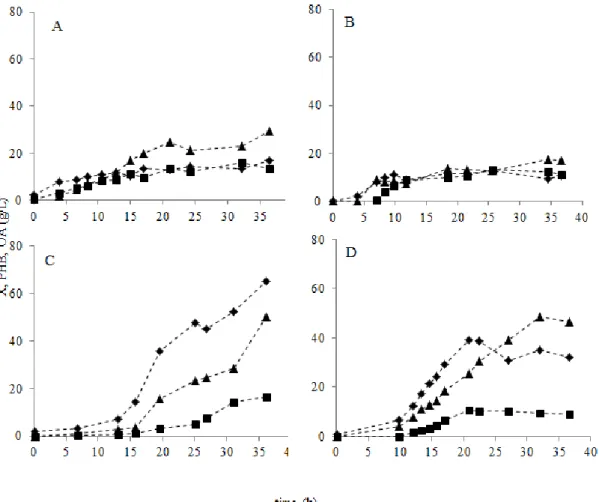
experiment………...………...………...19 Figure 3.2: Profiles of active biomass ( ), P(3HB) ( ) and OA ( ) concentration for bioreactor experiments with different media composition (A – LB Lac; B - LB Whey; C - MR Lac; D – MR Whey). ... 23 Figure 3.3: Profiles of active biomass ( ), P(3HB) ( ) and OA ( ) concentration obtained in bioreactor experiments using MR medium supplemented with cheese whey under oxygen limitation (30% of pO2), where the feeding was performed by pulses ( ×), to maintain the lactose
concentration between 0-20 g/L (E), by continuous fed-batch (-) mode after exponential phase started, to maintain the lactose concentration above 20 g/L (F) and by pulses, to maintain the lactose concentration between 10 and 20 g/L (G). ... 29 Figure 4.1: Colonies (centre image) and optical microscope photos in phase contrast (100x) of wild strain E. coli MG155 (a), original recombinant strain CML3-1 (b) and mutant P4-1 strain (c) grown in MacConkey agar plate supplemented with lactose. Fresh cultures were visualized with a 100 × phase-contrast objective (Olympus BX51). ………41 Figure 4.2: Total organic acids concentration ( ), active biomass produced ( ) and the specific OA molar yield ( ) for the original recombinant strain (CML3-1) and the isolated mutant strains (P4-1, P4-2, P8-1, P8-2, P8-X1, P8-X2, P8-X3, P8-X4, P8-X5, P8-X6, P8-X7, P8-X8) cultivated in (a) LBk+Lac and (b) MRk+Lac media, both supplemented with 1% (w/v) lactose………...42 Figure 4.3: P(3HB) content in biomass produced by the original recombinant (CML3-1) strain and each mutant (P4-1, P4-2, P8-1, P8-2, P8-X1, P8-X2, P8-X3, P8-X4, P8-X5, P8-X6, P8-X7, P8-X8) cultivated in LBk+Lac ( ) and MRk+Lac ( ) media, both supplemented with 1% (w/v) lactose. ... 43 Figure 4.4: Active biomass (a), organic acid concentration (b) and P(3HB) concentration (c) in three sequential batch shake flask cultivations for CML3-1 ( ) and P8-X8 mutant strains ( ). ... 44
concentration ( ) active biomass ( ), P(3HB) concentration ( ), OA concentration ( ) and lactose concentration ( ). ... 46 Figure 5.1: Profiles of active biomass ( ), PHA ( ), glucose ( ) and galactose ( ) concentration obtained in experiments with different media composition (experiment A - HS medium; experiment B – HS medium+1 mL MS; experiment C – HS medium without KCl; experiment D – HS medium with KH2PO4)……….57
Figure 5.2: Profiles of active biomass ( ), PHA ( ), glucose ( ) and galactose ( ) concentration obtained in experiments with different media composition (experiment E - HS medium+1 mL MS; experiment F - HS medium+2 mL MS; experiment G - HS medium+5 mL MS; experiment H - HS medium+10 mL MS). ... 61 Figure 5.3: Molar concentration of lactose ( ), glucose ( ) and galactose ( ) during the time of hydrolysis performed at 100ºC using HCl different concentrations: 0.4, 0.7 and 1M. ... 62 Figure 5.4: Profiles of active biomass ( ), PHA ( ), glucose ( ), and galactose ( ) concentration obtained in experiments with different media composition (I - HS medium+10 mL MS; J - HS medium+10 mL MS supplemented with hydrolyzed whey protein; K - HS medium+10 mL MS supplemented with hydrolyzed crude whey; L - HS medium+10 mL MS supplemented with hydrolyzed autoclaved whey). ... 63 Figure 5. 5: Active biomass ( ), PHA ( ), glucose ( ), galactose ( ) and supernatant protein (×) during the bioreactor operation using HS medium supplemented with 10 mL of MS and hydrolyzed crude whey. ... 65
Table 2. 1: Properties of P(3HB), P(3HB-co-HV) (containing 20% of 3HV monomers) and PP (Verlinden et al. 2007). ...6 Table 2. 2: Characterization of cheese whey powder. ... 10 Table 3.1: Medium, carbon source, feeding strategy and pO2 control used in each bioreactor
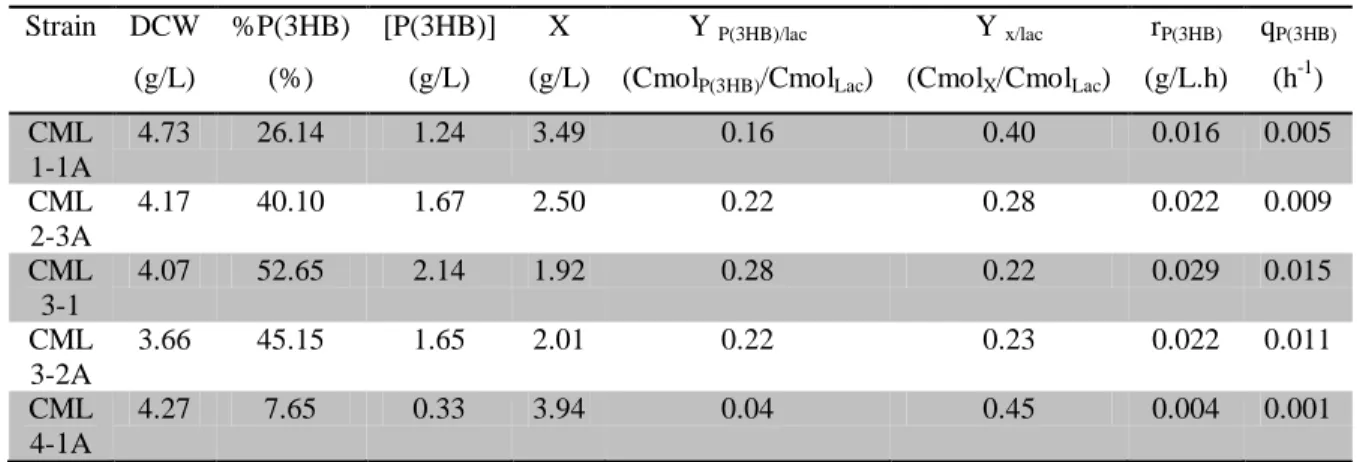
experiment...19 Table 3.2: Results obtained with the five recombinant E. coli strains cultivated in LBk+Lac medium. ... 22 Table 3.3: Kinetic and stoichiometric parameters obtained with the recombinant strain E. coli CML3-1 in bioreactor cultivation. ... 24 Table 4.1: Media, carbon source and type of cultivation used in each assay………….………..36 Table 4.2: CFU counting of CML3-1 in LBk+Lac agar plates with different bromate and bromide concentrations. ... 40 Table 4.3: Kinetic and stoichiometric parameters obtained with the recombinant original strain CML3-1 and mutant strain P8-X8 in bioreactor cultivation using defined medium supplemented with cheese whey. ... 46 Table 5.1: Parameters obtained for H. mediterranei cultivated in shake flasks with different media composition for the different sets of experiments……….56 Table 5.2: Comparison of results obtained in this work with the results obtained in the literature. Results obtained with H. mediterranei cultivation using different carbon, nitrogen e phosphorous source and parameters obtained with the H. mediterranei in bioreactor using HS medium supplemented with 10 mL of Micronutrients Solution (MS) and hydrolyzed crude whey. ... 59
Chapter 1
1.
Thesis outline
Polyhydroxyalkanoates (PHAs) are produced from renewable sources and can replace synthetic plastics in numerous applications. Nowadays, the PHA production is expensive and the process is far from optimized. To reduce the production costs, it is essential to focus the research in more productive strains, efficient fermentations, low-cost downstream processes and inexpensive substrates. Cheese whey (sweet or acid) is a cheap by-product from the cheese industry. It may cause environmental problems, due to its high organic matter content, thus needing to be treated before disposal or be economically valorized. Many microorganisms are described to produce PHA but few are able to convert lactose from cheese whey into PHA.
In this work a recombinant E.coli, was used to convert sweet whey into P(3HB), while Haloferax mediterranei was the strain chosen for the production of P(3HB-co-3HV) from acid whey that contains a higher salinity.
A genetic engineered E. coli strain harboring Cupriavidus necator P(3HB) synthesis genes was developed to produce P(3HB) from cheese whey. Different recombinant strains were obtained and evaluated for their ability to convert lactose into P(3HB). The objective of this work was the optimization of polymer productivity from cheese whey. With this propose several feeding and aeration strategies were tested to obtain high productivity and high P(3HB) concentration.
During the process to produce PHA from lactose, high production of organic acids (OA) was detected thus reducing the amount of carbon used for PHA production. In order to increase PHA productivity and yield, the deviation of carbon source for organic acids must be avoided. With this purpose, the Proton suicide method was applied. This is a simple and easy method developed by Winkelman and Clark (1984) to select mutants with a reduced or suppressed OA production capacity. This method relies on the toxicity of bromine (Br2) for cells. Br2 is formed
from bromide (Br-) and bromate (BrO3
-) as a result of the increase of the protons concentration during the formation of OA. Hence, only mutants unable to produce OA are able to survive in such conditions (Winkelman and Clark, 1984; Cueto et al. 1990).
In a second case study, the conversion of high salinity cheese whey was evaluated. In this study, a high saline medium (HS) was optimized to improve the conversion of hydrolyzed cheese whey into PHAs by the archea Haloferax mediterranei. However, this strain is not able use lactose thus whey lactose was converted into glucose and galactose by chemical hydrolysis. Thus, this work was divided into three sections: “Polyhydroxyalkanoates production by a new recombinant Escherichia coli strain using cheese whey as carbon source” (Chapter 3), 1
where it was tested two different culture media and different aeration and feeding strategies; The second section, named “Improvement on the yield of polyhydroxyalkanoates production from cheese whey by a recombinant Escherichia coli strain using the proton suicide methodology” (Chapter 4), was focused on the Isolation of P(3HB) producing mutants with low organic acids production, selection of mutant with improved performance and cultivation of the selected mutant in bioreactor; In the last section, “Medium optimization for polyhydroxyalkanoates production by Haloferax mediterranei from cheese whey” (Chaper 5), it was studied the effect of increasing the concentration of micronutrients, the cultivation medium supplemented with the hydrolyzed whey and the growing in bioreactor using the optimized medium.
Chapter 2
2. State of the art
Petrochemical-derived plastic materials are of the outmost importance in our daily life due to their versatility, low price and thermoplastic properties. Those materials can replace glass, metal and wood in many applications (Fiorese et al. 2009). Per year, 25 million tons of such nondegradable plastics are discarded in landfills and several hundred thousand tons are discarded into marine environments, being a serious threat to the environment (Jacquel et al. 2008; Reddy et al. 2003). The main concern today is to develop biodegradable plastics with characteristics similar to conventional plastics that may eventually replace them in the future.
Polyhydroxyalkanoates (PHAs) are polyesters of various hydroxyalkanoates, which are synthesized by numerous microorganisms, as a carbon and energy reserve material (Solaiman et al. 2006). These polymers are accumulated as intracellular granules to levels as high as 90% of the cell’s dry weight (Reddy et al. 2003).
PHAs have been receiving increasing worldwide attention because their production is based on renewable compounds instead of fossil fuels (Verlinden et al. 2007). Polymers like PHAs can be used in practically the same applications as conventional plastics (Koller et al. 2007; Reddy et al., 2003). The majority of possible applications for PHAs are as partially or entirely replacements of petrochemical polymers, especially on packaging and coating applications, such as films, personal hygiene products and adhesives (Reddy et al. 2003; Verlinden et al. 2007). Composites based on bioplastics are already used in the electronics industry, agriculture and chemical synthesis of optically active compounds (Verlinden et al. 2007). PHAs have also numerous medical applications, being their main advantage the fact that they are biocompatible (Zinn et al. 2001). PHAs are used as sutures, orthopedic pins, nerve guides and bone marrow scaffolds; and may be used as scaffolds in tissue engineering and as drug carriers (Verlinden et al. 2007).
Optimization of polyhydroxyalkanoates production has received increasing attention from researchers. Some production aspects are being modified to improve productivity and to make the processes economically attractive: the utilization of new organisms and the better understanding of known ones, the use of novel and/or inexpensive substrates, more efficient fermentation process and the development of new extraction/recovery methods (Lee et al. 1996; Verlinden et al. 2007).
The carbon source used should be inexpensive because substrate costs usually correspond up to 50% of PHAs production costs (Ahn et al. 2000). The use of inexpensive substrates, such as cheese whey, could lead to significant economic advantages, when compared 3
with the use of primary substrates (e.g. glucose) to produce PHAs (Lee et al. 1996; Reddy et al. 2003; Tian et al. 2009; Verlinden et al. 2007).
2.1. Polyhydroxyalkanoates (PHAs)
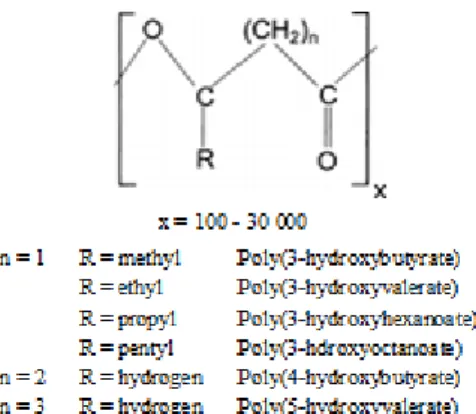
PHAs are accumulated when an essential nutrient, like nitrogen, phosphorus, sulfur or magnesium, or oxygen, is limited and an excess amount of the carbon source is present (Braunegg et al. 1998; Lee et al. 1996). PHAs can substitute the conventional plastics due to their similar properties to various synthetic thermoplastics and elastomers (Table 2.1) and complete biodegradability after disposal. PHAs composition depends on the PHA synthases, the metabolic routes involved, the cultivation conditions and the carbon source (Braunegg et al. 1998; Fonseca et al. 2007). Their general structure is shown in Figure 2.1.
Figure 2.1: General structure of polyhydroxyalkanoates and some representative members (adapted from
Lee et al. 1996).
Due to the stereospecificity of the biosynthetic enzymes, the monomeric units are in D– (–) configuration, which is essential for biodegradability and biocompatibility of PHAs. More than 100 different monomers have been reported as PHA constituents, but only a few were produced in amounts high enough to enable the characterization of their properties and development of potential applications. The most common PHAs are poly(3-hydroxybutyrate) (P(3HB)) and the co-polymer poly(3-hydroxybutyrate-co-3-hydroxyvalerate) (P(3HB-co-3HV)) (Lee, 1996; Zinn et al. 2001).
Renewable resources, like agricultural feedstock or wastes containing sugars and fatty acids can be used as carbon and energy sources for PHAs production. The synthesis and biodegradation of PHAs are totally compatible with carbon cycle ( Figure 2.2). Thus, while for some applications the biodegradability is critical, PHAs receive general attention because their production is based on renewable compounds instead of fossil fuels (Verlinden et al. 2007).
Figure 2.2: Life cycle of PHAs.
PHAs can be degraded upon exposure to soil, compost, or marine sediment. Biodegradation is dependent on a variety of factors, such as microbial activity of the environment, and the exposed surface area, temperature or pH, polymer composition and crystallinity (Reddy et al. 2003). Biodegradation of PHAs under aerobic conditions results in carbon dioxide and water, whereas in anaerobic conditions the degradation products are carbon dioxide and methane. Studies have shown that 85% of PHAs were degraded in seven weeks (Reddy et al. 2003).
PHAs can be divided in three classes: short chain length PHA (scl-PHA), with carbon numbers of monomers ranging from 3 to 5, medium chain length PHA (mcl-PHA), with 6 to 14 carbons in monomers, and long chain length PHA (lcl-PHA), with more than 14 carbons in monomers. The length of the side chain and its functional group influence the properties of the PHAs, as the melting point, the glass transition temperature and crystallinity (Zinn et al. 2001).
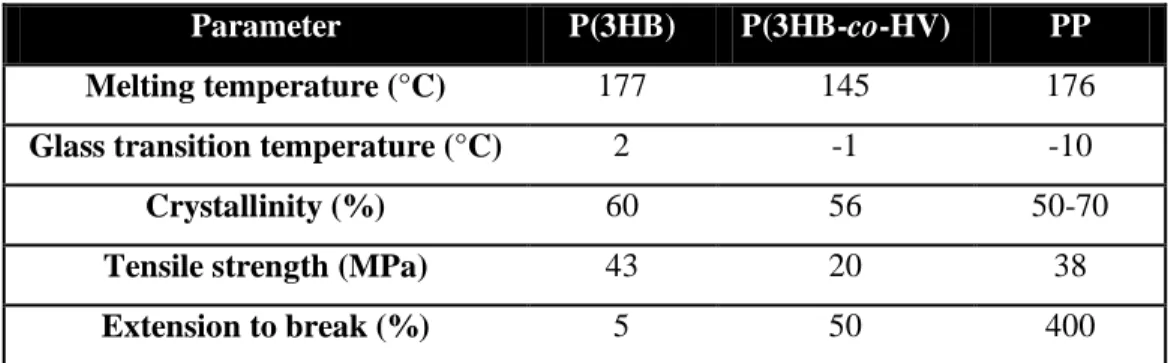
The molecular mass (Mw) of PHAs typically ranges between 2×10⁵ and 3×10⁶, varying with the PHA producer (Braunegg et al. 1998), while the polydispersity index is about 1.5 to 2.0 (Koller et al. 2007a; Fiorese et al. 2009). The properties of P(3HB), P(3HB-co-3HV) and polypropylene (PP) are compared in Table 2.1. The values of melting and glass transition temperatures, cristalinitty and tensile strength of P(3HB) and P(3HB-co-3HV) are near to those of PP. This similarity of properties between these biopolymers and synthetic propylene suggests similar applications.
PHAs are insoluble in water and have no toxic effects in living organisms (Verlinden et al. 2007). They have a high degree of polymerization and are optically active, piezoelectric and isotactic (stereochemical regularity in repeating units) (Reddy et al. 2003).
Table 2.1: Properties of P(3HB), P(3HB-co-HV) (containing 20% of 3HV monomers) and PP (adapted
from Verlinden et al. 2007).
Parameter P(3HB) P(3HB-co-HV) PP
Melting temperature (°C) 177 145 176
Glass transition temperature (°C) 2 -1 -10
Crystallinity (%) 60 56 50-70
Tensile strength (MPa) 43 20 38
Extension to break (%) 5 50 400
2.1.1.
Poly(3-hydroxybutyrate)
Poly(3-hydroxybutyrate), P(3HB), is a highly crystalline thermoplastic, with a melting point around 177°C (Table 2.1). P(3HB) has similar properties to polypropylene, polyethylene or polyvinylchloride, although the biopolymer is stiffer and more brittle (Fiorese et al. 2009; Braunegg et al. 1998).
2.1.2. Poly(3-hydroxybutyrate-co-3-hydroxyvalerate)
The properties of copolymers of 3-hydroxybutyrate and 3-hydroxyvalerate, P(3HB-co-3HV), vary with their HV content. The melting temperature is minimum (≈ 80°C) when the molar fraction of the monomer 3HV is about 30% (Silva et al. 2005). P(3HB-co-3HV) bears mechanical properties, such as toughness and softness, which make them more interesting than pure P(3HB) (Braunegg et al. 1998). P(3HB-co-3HV) is more flexible than P(3HB) and can be used in films, coated paper and board, and molded products such as bottles and razors (Lee et al. 1996). The P(3HB) decomposition starts at 246.3°C, while the P(3HB-co-HV) decomposition starts at 260.4°C, which indicates that the presence of 3HV increases the thermal stability of the polymers (Verlinden et al. 2007).
2.2. Economic and environmental aspects of PHAs
The price of the product depends significantly on the substrate cost, on the PHA yield and on downstream processing (Reddy et al. 2003). Using a natural producer, as Cupriavidus necator, the cost of PHA, depending on the amount purchased, may reach US$16 per Kg, while
the cost of polypropylene is about US$0.9 per Kg. The cost of PHA decreases to around US$4 per Kg if recombinant Escherichia coli is used as producer, which is close to the value of other biodegradable plastic materials. To turn PHA production commercially viable, the price of the final product should be US$3-5 per Kg (Reddy et al. 2003).
The synthesis and biodegradation of PHAs is compatible to the carbon cycle (see Figure 2.2). Nevertheless, some studies showed that the PHAs production may not be any better for the environment than the production of conventional plastics. During the life cycle of PHAs, more energy would be needed comparing with the life cycle of conventional polymers. However, the production process of PHAs is still not optimized, while the production of petrochemical-derived plastic materials is fully developed (Verlinden et al. 2007).
2.3. PHAs applications
PHAs are versatile and can be combined with other chemicals to achieve specific properties. They can be easily depolymerized to a rich source of hydroxyl acids, which are optically active and pure, and can be used for the synthesis of new chemical products (Reddy et al. 2003). PHAs can be used in disposable items such as razors, utensils, diapers, feminine hygiene products and cosmetic containers. They have also been processed into tonners for printing applications. In agriculture, PHAs can be used to encapsulate seeds and fertilizers for slow release, to produce biodegradable plastics films for crop protection and biodegradable containers for greenhouse facilities (Verlinden et al. 2007).
These polyesters have the potential to become an important compound for medical applications, due to its biocompatibility. In human blood and tissue monomers of PHA (3HB) are present, which is an advantage in medical applications for PHAs, in comparison to other polymers (Koller et al. 2007). PHAs can be used in orthopedic (scaffolds for cartilage engineering, bone graft substitutes), urology, dentistry, in vascular system (heart valves, cardiovascular fabrics, pericardial patches and vascular grafts), in drug delivery and wound management (sutures, skin substitutes, nerve cuffs, surgical meshes, staples and swabs) (Zinn et al. 2001).
2.4. Bacterial strains for PHA production
In 1926, the French scientist Lemoigne reported the bacterium Bacillus megaterium to accumulate P(3HB). Since then, more than 90 genera of Archae and Eubacteria (Gram+ and Gram–) have been recognized as PHAs producers, including Cupriavidus necator, Alcaligenes latus, Azotobacter vinelandii, Pseudomonas oleovorans and recombinant Escherichia coli (Lee, 1996). These bacteria are industrially used for the production of PHAs because they can reach 7
high cell densities with a high PHA content in a short period of time, resulting in high PHA productivity (Lee, 1996; Zinn et al. 2001).
The most well-known PHA producer is Cupriavidus necator, which accumulates PHAs up to 80% of its cell dry weight, when nitrogen or phosphorous is completely depleted (Lee, 1996). Currently, this bacterium is used to produce P(3HB) in a large scale. C. necator presents a high PHA production, its genome is already sequenced, especially the genes responsible for the PHA biosynthesis (Lee, 1996).
Bacteria, such as Escherichia coli, grow fast, even at high temperature, and are easy to lyse. E. coli can grow on various carbon sources, such as glucose, sucrose, lactose and xylose. However, they are unable to produce or degrade PHAs. For these reasons, E. coli is considered the ideal host for harboring the C. necator PHA biosynthesis genes, in order to achieve high PHA productivity (Reddy et al. 2003). The P(3HB) content obtained in recombinant E. coli is about 90% on cell dry weight. This high intracellular polymer content may simplify the extraction and purification of PHAs due to easy lysis of the cells, reducing the costs of the purification of the biopolymer (Dias et al. 2006; Reddy et al. 2003).
Some members of the Archae kingdom are able to produce PHAs. Bacteria of the genus Haloferax are interesting because, comparing with related organisms, these bacteria grow faster and can utilize various substrates for PHAs production. Haloferax mediterranei requires a highly saline medium (2 – 5M of NaCl) for growth, which minimizes the risk of microbial contamination. These bacteria are extremely sensitive when exposed to hypotonic media and, in distilled water, the cells lyse immediately. In previous works, (Koller et al. 2007a) H. mediterranei was cultivated for several weeks without sterilization conditions and no contamination was observed. These facts may reduce drastically the production costs since no sterilization is required and downstream is easier than for other bacteria without this capacity (Koller et al. 2007a). Moreover, H. mediterranei produces P(3HB-co-3HV) without the need of co-substrate addition, which is another advantage over most of PHAs-producing organisms (Koller et al. 2007b).
2.5. Carbon sources
As mentioned before, the carbon source used for PHAs production should be inexpensive. Carbohydrates, oils, alcohols, acids and hydrocarbons are used by various bacteria as carbon sources (Du et al. 2012), but their costs are high. Therefore, they should be replaced by crude carbon substrates, such as cane and beet molasses, cheese whey, glycerol, plant oils, hydrolysates of starch, sucrose, triacylglycerols, cellulose and hemicellulose, industrial and food wastes (Du et al. 2012). Other carbon sources, such as ethanol, oleic acid, methane and a mixture of hydrogen and carbon dioxide can be used, but the PHA contents and productivity values achieved are usually low (Lee, 1996; Reddy et al. 2003; Tian et al. 2009; Verlinden et al. 2007). Cheese whey has been used as carbon source for PHA production (Lee et al. 1997; Wong et al. 1998; Kim et al. 2000; Ahn et al. 2001; Nikel et al. 2005).
2.5.1. Cheese whey as carbon source for PHAs production
Cheese whey is the liquid part of milk that separates from the curd at the beginning of the manufacture of cheese. Cheese whey is available in large amounts as by-product stream and is rich in fermentable nutrients, such as lactose, lipids and soluble proteins. The composition of cheese whey is presented in Table 2.2. In addition to the nutrients listed in Table 2.2, cheese whey also contains citric acid, non-protein nitrogen compounds, such as urea and uric acid, B group vitamins and other nutrients (Siso, 1996).
From the feed stock milk, skimmed whey is produced after the casein precipitation and the major part of lipids are removed. After removing 80% of water from the skimmed whey, the concentrated whey is ultra-filtrated to obtain whey permeate (the lactose fraction) and whey retentate (the protein fraction, with lactose residues). Lactoalbumin and lactoferrin are found in the retentate and are of pharmaceutical interest. Other solid parts from whey solution can be used as fertilizer or as animal food supplement. Whey permeate (which contains 81% of the original lactose in milk) is a potential carbon source for the bioproduction of PHAs (Ahn et al. 2001; Povolo et al. 2010).
Depending on the casein precipitation method, whey produced can be acid (pH<5) or sweet (pH=6-7). The acid whey has higher salt content and lower protein content than sweet whey, and its use in feeding is limited due to its acidic flavor (Siso et al. 1996).
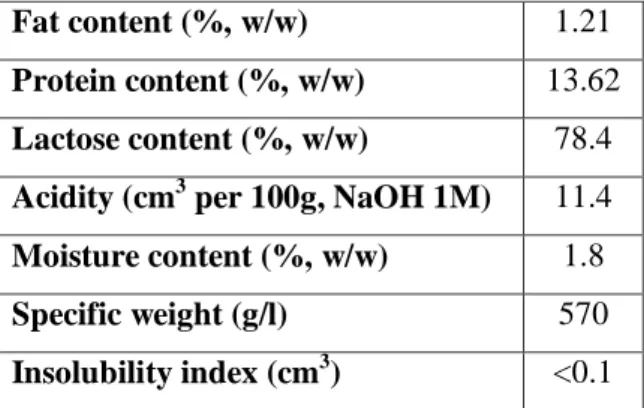
The cheese whey used in this work was supplied by the Portuguese company, Lactogal. The composition and main characteristics of cheese whey determined by the manufacturer are presented in Table 2.2.
Table 2.2: Characterization of sweet cheese whey powder provided by Lactogal.
Fat content (%, w/w) 1.21
Protein content (%, w/w) 13.62 Lactose content (%, w/w) 78.4 Acidity (cm3 per 100g, NaOH 1M) 11.4 Moisture content (%, w/w) 1.8
Specific weight (g/l) 570
Insolubility index (cm3) <0.1
Per year, about 6 million tons of cheese are produced in European Union, which correspond approximately to 40 million tons of whey. The major part of whey is used for lactose and feed production, but 13 million tons of whey, containing about 0.6 million tons of lactose, constitute a surplus product which is discarded as effluent (Koller et al. 2008). The disposal of these high amounts of whey is expensive and represents an environmental problem. Cheese whey has high organic matter content, with a BOD5 = 30–50 g/l and a COD = 60–80 g/l,
being lactose largely responsible for the high BOD5 and COD content. Lactose from whey can
be converted in single cell protein, ethanol or methane, reducing the BOD5, but the resulting
effluent is not ready for disposal (Siso, 1996).
Cheese whey can be used as carbon source by many bacteria, such as recombinant E. coli, Hydrogenophaga pseudoflava and Methylobacterium. These microorganisms are able to synthetize PHAs directly from lactose because they have sufficient β-galactosidase activity (Povolo et al. 2010). Other microorganisms, such as Pseudomonas hydrogenovora and Halferax mediterranei (Koller et al. 2007b) are unable to use lactose. Thus, in theses microorganisms lactose has to be enzymatic or chemically hydrolysed to galactose and glucose. The monosaccharides can then be converted to PHAs. The third option to produce PHAs involves the anaerobic conversion of lactose to lactic acid by lactobacilli. Bacteria such as C. necator and Alcaligenes latus can convert lactic acid to PHAs (Koller et al. 2007b).
2.6. Bioproduction process
There are four biosynthetic approaches to produce PHAs (Figure 2.3). The continuous cultures are the most controlled of the cultivation methods; however, this method is not yet applied to PHA production on a large scale. The batch cultures are suitable for growth studies and screenings for potential PHA accumulating organisms. The fed-batch cultures are used on a large scale to produce PHAs, with high productivity (Zinn et al. 2001).
Figure 2.3: Biosynthetic approaches to produce PHAs (adapted from Zinn et al. 2001).
Fed-batch cultivation is common asset up in two-step: in the first step, cells are grown to a desired concentration, without nutrient limitation; In the second step, an essential nutrient is limited to allow PHA production (Lee, 1996). For many bacteria, the most common limitation is nitrogen, while for fewer bacteria, such as Azotobacter spp., oxygen limitation is the most effective (Verlinden et al. 2007). The nutrient limitation activates a metabolic pathway, which shunts acetyl-CoA units from the Krebs cycle into the P(3HB) production (Lenz et al. 2005).
2.7. Bioproduction metabolism
In bacteria, acetyl-coenzyme-A (acetyl-CoA) is converted to P(3HB) by three enzymatic steps, as is shown in Figure 2.4. In first step, two molecules of acetyl-CoA are combined by 3-ketothiolase (encoded by phaA) to form acetoacetyl-CoA. Acetoacetyl-CoA reductase (encoded by phaB) allows the reduction of acetoacetyl-CoA by NADH to hydroxybutyril-CoA. In third step, P(3HB) synthase (encoded by phaC) polymerizes 3-hydroxybutyril-CoA to P(3HB) and coenzyme-A is liberated (Verlinden et al. 2007). The genes of the P(3HB)CAB operon encode the three enzymes that catalyze the three enzymatic reactions of P(3HB) production. The promoter upstream of P(3HB)C transcribes the complete operon
P(3HB)CAB (Reddy et al. 2003).
Figure 2.4: Biosynthetic pathway to P(3HB) production (adapted from Madison & Huisman, 1999).
2.8. Conversion of cheese whey into PHA by recombinant Escherichia
coli and Haloferax mediterranei
Ahn et al. (2001) described the use of recombinant E. coli for P(3HB) production from lactose present in cheese whey that resulted in a final P(3HB) concentration of 168 g/L and a final cell concentration of 194 g/L, corresponding to a P(3HB) content of 87% and a productivity of 4.6 gP(3HB)/L.h (Ahn et al. 2001).
Using Haloferax mediterranei as a P(3HB-co-HV) producer from hydrolyzed whey, by Koller (Koller et al. 2007a) reported the production of 12.2 g/L of PHAs, which corresponded to 72.8% of PHA in biomass and a low productivity, 0.09 gP(3HB)/L.h.
Comparing the aforementioned strains, H. mediterranei is able to produce an HB and HV copolymer, without adding precursors to the medium (Chen et al. 2006), while recombinant E. coli produces a homopolymer, P(3HB). Furthermore, H. mediterranei is easy to cultivate, with minimal sterility precautions. Thus, this strain may be economically attractive, due to copolymer applications and low production cost. On the other hand, H. mediterranei produces an exocellular polysaccharide which is released to the medium, decreasing the maximum yield of PHA (Rodriguez-Valera et al. 1992). The high saline concentration required for H.mediterranei growth is also a disadvantage since salts may corrode the stainless steel used in large-scale fermenters. This has been prevented in bench-scale cultivations by the use of bioreactors made of polyetherether ketone, glass, and silicium nitrite ceramics for the production of PHA by halophilic archaeon strain 56 (Hezayen et al. 2000). Salts are needed in
considerable amounts (2-5M of NaCl) and they cost roughly equals the synthetic carbon source (Rodriguez-Valera et al. 1992; Koller et al. 2007a).
Cultivation of E. coli at high cell concentrations may require the use of pure oxygen to maintain the dissolved O2 concentration at an ideal value, which is not economically attractive
(Park et al. 2002).
2.9. Downstream process
Reduced downstream costs, together with high purity recovery of PHAs will accelerate the commercialization of high quality PHA-based products (Ridiel et al. 2013). Separation and purification of PHA polymers from non-PHA cell mass (NPCM) presents a technical challenge due to the solid phase of both PHA granules and NPCM. Two strategies are usually adopted in the downstream processing: PHA solubilization and NPCM dissolution. In the former, the PHA macromolecules are dissolved in appropriate organic solvents and extracted from the cells, and in the latter, NPCM is digested and/or dissolved by chemical agents while PHA granules are left in the solid state (Yu & Chen. 2006). The generated solid and liquid phases are then separated by unit operations, such as filtration and centrifugation. Solvent extraction is widely used in the laboratories but with limited success in pilot-plant and large-scale processing (Gorenflo et al. 2001). The cost of PHA recovery with solvent extraction may reach up to 50% of the overall production cost (Chen et al. 2001). This high cost can be significantly reduced by using NPCM solubilization, such as sequential surfactant and hypochlorite digestion (Choi et al. 1997).
Recovering of PHA can be obtained by two methods: water-based separation or solvent-based extraction. In the first method, cells need to be broken up and various chemical additives added. The final PHA obtained may reach about 95% of purity and can be used as coating material. In solvent-based extraction, the PHA is extracted directly from biomass, by dissolving it in an organic solvent, such as chloroform, dichloroethane or methylene chloride. After filtration and precipitation, the polymer may reach a purity of more than 98%, which is required for medical applications (Zinn et al. 2001).
In alternative to solvent-based extraction, digestion methods can be used (such as chemical digestion with surfactants or sodium hypochloride and enzymatic digestion), mechanical cell disruption (high pressure homogenization, ultrasonication, centrifugation and chemical treatment) and supercritical fluid disruption. Another approach is based on the cell fragility that is usually verified after the accumulation of large amount of PHA, to get a simple procedure for PHA extraction. Recombinant strains of E. coli have been developed to release P(3HB) granules gently and efficiently (Jacquel et al. 2008).
Solvent extraction is the most common method to extract PHA from the cells. The use of solvents destroys the natural morphology of PHA granules but does not degrade the polymer. 13
The purity is high once the endotoxins from bacteria are eliminated and then the PHA can be used in medical applications. The use of solvents, mostly halogenated solvents, is hazardous to the environment and is not applicable in large scale. Other methods based on digestion of non-PHA cell material have been investigated, but by using hypochlorite polymer degradation was observed (Jaquel et al. 2008). Best results were obtained by combining hypochlorite with chloroform or surfactant treatment. Enzymatic digestion method was also reported, economically unattractive due to the cost of enzymes (Holmen & Lim, 1990). Mechanical cell disruption methods like using bead mills and high pressure homogenization appear to be more cost effective (Tamer et al. 1998). Recovery of P(3HB) by the use of supercritical CO2 has been
also reported (Hezazi et al. 2003), but is still expensive in comparison with other methods. Recently, new methods like spontaneous liberation of P(3HB) (Juang et al. 2005), dissolved air flotation (Hee et al. 2006), or air classification (Noda, 1998) are being investigated . Improvement of these new extraction and purification methods should lead to an optimal recovery of PHA, with a high purity and recovery level at a low production cost (Jaquel et al. 2008).
In the case of halophilic bacteria, such as Haloferax mediterranei, polymer can be recovered by only using water to disrupt the cells and isolate the PHAs produced, thus facilitating the downstream process (Koller et al. 2007a).
Chapter 3
This chapter was adapted from the manuscript: Pais J., Farinha I., Gameiro T., Freitas F., Serafim L., Arévalo-RodríguezM., M., Prieto M. A., Reis A.M.R. Polyhydroxyalkanoates production by a new recombinant Escherichia coli strain using cheese whey as carbon source. (in preparation)
3. Polyhydroxyalkanoates production by a new recombinant
Escherichia coli strain using cheese whey as carbon source
3.1. Summary
In this work, E. coli was engineered through the insertion of Cupriavidus necator P(3HB)-synthesis genes, fused to a lactose-inducible promoter, into the chromosome, via transposition-mediated mechanism in order to obtain strains with the ability to convert lactose into P(3HB). Recombinant strains were obtained and tested in shake flask experiments. Strain CML3-1 was selected due to its high P(3HB) production (2.14 g/L).
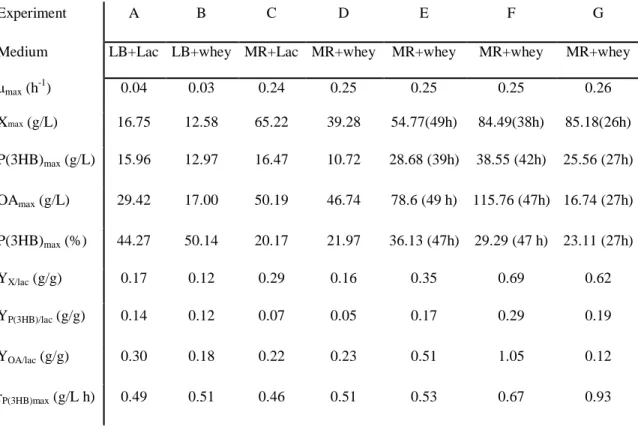
Defined medium (MR) supplemented with cheese whey in a bioreactor without oxygen limitation showed to be a good medium for this recombinant E. coli strain that achieved active biomass concentration of 39.28g/L with a P(3HB) content of 21.97%. However, a high amount of organic acids (OA) was also produced (46.74 g/L), thus deviating part of the carbon source from P(3HB) production.
To increase the P(3HB) production, oxygen concentration (pO2) was reduced from 60%
to 30% of . The lower oxygen availabily did not affect the culture growth, on the contrary, a higher biomass concentration (54.77 g/L) was achieved. On the other hand, P(3HB) production increased three-times (28.63 g/L), comparing to the assay where the oxygen was maintained
above 60% of pO2 (10.72 g/L). Despite the P(3HB) production improvement, OA were still
produced (78.60 g/L).
Aiming at improving P(3HB) in detriment to OA production, different reactor feeding strategies were evaluated: The culture was fed by pulses to maintain the lactose concentration in the ranges of 0 to 10 g/L and 10 to 20 g/L. A continuous fed-batch mode was also tested to maintain the lactose concentration above 30 g/L. While the latter strategy enhanced P(3HB) production (38.55 g/L), this operation mode led to a high level of OA production (115.76 g/L). The best productivity (0.93 g/L.h) and the low amount of OA produced (16.74 g/L) were obtained when the culture was fed by pulses maintaining the lactose concentration between 10 and 20 g/L, avoiding periods with absence of lactose.
3.2. Introduction
E. coli can be easily manipulated and improved by means of recombinant DNA methodologies. It is a suitable host for the heterologous expression of background genes and high cell density cultivation strategies for numerous E. coli strains have already been well established (Nikel et al. 2006). Ahn and co-workers (2001) cultivated, in a fed-batch bioreactor, a recombinant E. coli fed by carbon source pulses, using the pH feeding strategy and a sequential oxygen limitation (40, 30 and 15% of pO2). They obtained 119.5 g/L of DCW, a
polymer content of 80% and productivity of 2.57 g/L.h. Using the same feeding strategy and maintaining the oxygen above 30% of pO2, Wong and Lee (1998) obtained 87 g/L of DCW with
80% of P(3HB) content.
Another advantage of using E. coli cells is that after accumulating large amounts of P(3HB), they become fragile, facilitating the isolation and purification of the biopolymer (Nikel et al. 2006). Furthermore, the bacterium does not express PHA-degrading enzymes (Nikel et al. 2006).
In the present work, recombinant E. coli strains were constructed, where the genes that encode for the enzymes responsible for P(3HB) production were inserted into the chromosome. This type of construction allows maintain the stability of the genes inserted. The Ptrc promoter is associated to those genes, which is an advantage because the carbon source and inducer of the expression system used in this study is lactose from cheese whey. Different strains were screened in shake flask assays and the one showing the highest P(3HB) storage was tested in bioreactor. The performance of the selected strain was evaluated in rich and mineral medium supplemented with both commercial lactose and cheese whey. The medium that allowed for the best results was chosen for the subsequent studies, where the imposition of oxygen limitation and different fed-batch feeding strategies were studied aiming to achieve the highest P(3HB) productivity.
During cultivation Organic Acids (OA) production was detected. It was already reported in literature the production of acetic acid during aerobic growth of E. coli on glucose. (March et al. 2002; Akesson et al. 1999). The impact of OA excretion on P(3HB) production was evaluated.
3.3. Materials and methods
3.3.1. Microorganism
The recombinant Escherichia coli strains used in this work were obtained from the lab of A. Prieto (CSIC-CIB) and modified by BIOMEDAL (Spain). A genetic construct, plasmid pMAB26, was obtained in order to integrate the P(3HB)-producing genes of Cupriavidus
necator into the chromosome of recombinant E. coli, via transposition-mediated mechanism. This new construct contained the P(3HB) operon (with phbC, phbA and phbB genes) inserted in the mini-Tn5 element of plasmid pCNB5 and located under the lactose-inducible Ptrc promoter of this element allowed a stable integration of these genes and the expression of the corresponding enzymes in the E. coli strains. Plasmid pMAB26 was transferred by conjugation to four rifampicin-resistant derivates of E. coli strains: BL21(DE3), C, MG1655 and ET8000.
Plasmid pMAB26, harbouring the P(3HB) biosynthesis genes phbC, phbA and phbB from C. necator was constructed by binding the 4632 bp HindIII-BamHI, blunt-ended fragment of plasmid pAV1 (M. A. Prieto, unpublished), containing the phaCAB operon, to mini-Tn5 delivery vector pCNB5, (de Lorenzo et al. 1993), linearized with NotI and blunt-ended. E. coli strains DH5 λpir (Biomedal, Spain) and S17 1 λpir (de Lorenzo et al. 1993) were used for propagation and conjugative transfer of pMAB26, respectively. Insertion of phaCAB operon of C. necator in the chromosome of E. coli strain MG1655 (Hayashi et al. 2006) was carried out using S17 1 λpir as the donor strain for pMAB26 and MG1655-RIF-1 (a spontaneous, rifampicin-resistant derivative of MG1655) as the recipient strain. Transconjugant strains were selected as kanamycin-resistant, rifampicin-resistant, and ampicillin-sensitive colonies.
Derivates of the E. coli strains obtained were tested for their ability in storing PHAs from lactose by observation of P(3HB) granules by optical microscopy. The five best strains, in terms of lactose consumption (data not shown), were selected for this work: CML 1-1A from BL21 (DE3), CML 2-3A from C, CML 3-1 and CML 3-2A from MG1655 and CML 4-1A from ET8000. These strains carried in their chromosome a single copy of the expression cassette lacI-Ptrc::phbCAB that allowed for a maximal expression of the phb genes when lactose was present in the culture medium.
3.3.2. Media
LB (Luria-Bertani) medium (bactotriptone 10g, yeast extract 5g, NaCl 10g per L) (Sambrook and Russell, 2001) was prepared and autoclaved at 121°C for 20 minutes. pH was adjusted at 6.8 with NaOH 5N. LBk was prepared by supplementing LB medium with kanamycin solution (1mL/L). This solution was prepared by solubilizing 1.25 g of kanamycin sulfate (Sigma-Aldrich) in 50 mL of distilled water and filtered under sterile conditions (Sartorius Stedim Minisart, 0.2 μm). Solid LBk
was prepared by adding 15g/L of agar prior to autoclaving. LBk+Lac medium was supplemented with 1% (w/v) lactose autoclaved separately.
A defined medium (MR medium) was also used in some assays. MR medium had the following composition (per liter): KH2PO4, 13.5g ; (NH4)2HPO4, 4.0g;citric acid monohydrate,
1.9 g; 10 mL mineral solution (Lee et al. 1993). The mineral solution had the following composition (per liter of HCl 1M): FeSO4.7H2O, 10.0g; CaCl2.2H2O, 2.0g; ZnSO4.7H2O, 2.2g;
MnSO4.H2O, 0.5g; CuSO4.5H2O, 1.0g; (NH4)6MO7O24.4H2O, 0.1g; Na2B4O7.10H2O, 0.02g).
The pH was adjusted to 6.9 by adding NaOH pellets prior to autoclaving at 121ºC, for 20 min. Lactose 20% (w/v) and MgSO4.7H2O 20% (w/v) solutions were prepared and autoclaved
separately. When commercial lactose was used as the carbon source, 1 mL of a filter sterilized proline and thiamine solution was added (400 mg of Proline and 6.740 g of Thiamine-HCl dissolved in 20 mL distilled water). 1 mL/L of kanamycin (25g/L) solution were also added to MR medium after sterilization.
For the fed-batch reactor assay, MR medium was supplemented with cheese whey to obtain the desired concentration of lactose. The cheese whey used in this work was supplied by Lactogal (Portugal).
Before its use, cheese whey was deproteinized according to the procedure of Ahn et al. (2000), with some modifications. Briefly, a cheese whey solution was prepared by dissolving 300 - 400 g whey powder in 1 L of deionized water. Then the solution was autoclaved at 121ºC for 15 minutes, followed by centrifugation at 8000 g for 1 hour in sterile bottles for removal of the precipitated protein aggregates. The solution was filtered (SartoLab-P20 plus, 0.2 μm) to remove the remaining small protein aggregates and assure its sterility.
3.3.3. Inocula preparation
The inocula were prepared after two adaptation steps. First, a single colony of the recombinant strain grown on LBk+Lac agar plates was inoculated in 100 mL shake flasks containing 10 mL of medium and incubated at 37ºC and 200 rpm, during 16 hours in the assays with LBk+Lac medium and 32 hours with MRk+Lac. Then, 20 mL of each culture were centrifuged and the pellet was re-suspended in fresh LBk+Lac or MRk+Lac media (100 mL of the medium in 500 mL flask) and incubated for 10 hours under the same conditions.
3.3.4. Recombinant strains screening
The screening for the recombinant strain presenting the highest PHAs storage capacity was performed with recombinant strains CML 1-1A, CML 2-3A, CML 3-1, CML 3-2A, CML 4-1A. The experiments were performed by incubating 2.5 mL of inoculum in exponential phase (with 10 h of incubation time) in 500 mL flasks with 100 ml of medium LBk+Lac, in an orbital shaker (200 rpm) at 37ºC.
The assays were run for 75 h and samples were taken at the beginning and at the end of the experiments. Samples were analyzed for P(3HB), biomass and lactose quantification.
3.5. Bioreactor operation
The assays were performed in a 2-L reactor (BioStat® B-Plus, Sartorius, Germany) with 1 L working volume inoculated with 200 mL of the selected culture. The temperature was controlled at 37ºC and pH at 6.9±0.1, by the automatic addition of NH4OH 28% (v/v) solution.
A constant aeration rate of 3 vvm was maintained during the experiments. The dissolved oxygen concentration (% pO2) was controlled by automatically increasing the stirring rate from 200 to
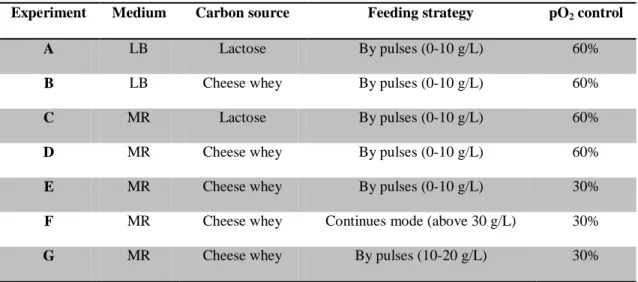
1000 rpm and, when necessary, supplementation of the air stream with pure oxygen. Foam formation was suppressed by the automatic addition of Antifoam A (Fluka). In experiments A to E the reactor was operated in a discontinuous fed-batch mode with the addition of several pulses of lactose or cheese whey after the exhaustion of the previous one. In experiment F, a continuous fed-batch mode was implemented in order to maintain the lactose concentration above 20g/L. In experiment G several pulses were added in order to maintain lactose concentration between 10 and 20 g/L. In experiments A, B, C and D the %pO2 was maintained
at 60%. An oxygen limitation was implemented (%pO2 at 30%) in experiments E, F and G. (Table 3.1)
Table 3. 1: Medium, carbon source, feeding strategy and pO2 control used in each bioreactor experiment.
Experiment Medium Carbon source Feeding strategy pO2 control
A LB Lactose By pulses (0-10 g/L) 60%
B LB Cheese whey By pulses (0-10 g/L) 60%
C MR Lactose By pulses (0-10 g/L) 60%
D MR Cheese whey By pulses (0-10 g/L) 60%
E MR Cheese whey By pulses (0-10 g/L) 30%
F MR Cheese whey Continues mode (above 30 g/L) 30%
G MR Cheese whey By pulses (10-20 g/L) 30%
The purpose of experiments A, B, C and D was to choose the best medium for growth and PHA storage by recombinant E. coli strain. LB medium supplemented with lactose or cheese whey was used in experiments A and B, respectively. MR medium supplemented with lactose was used for experiment C, while in experiment D MR medium was supplemented with cheese whey. In Experiment E, oxygen limitation (30% of pO2) was applied to increase the P(3HB) production. In Experiment F, the pulses feeding strategy was replaced by continuous mode feeding (0.2-11.7 g/L.h of lactose) in order to stimulate P(3HB) production. The biopolymer production was associated to a lactose promoter that was induced by lactose, for this
reason the last feeding strategy was tested. In experiment G, the feeding strategy by pulses was implemented again to maintain the lactose concentration between 10 and 20 g/L, to avoid periods with lactose absence (Table 3.1).
The experiments were run for 50-60 h and 10 mL samples were periodically taken for P(3HB), biomass, lactose and organic acids quantification.
3.3.6. Analytical methods
The dry cell weight (DCW), defined as the dry weight of cells per litre of culture broth, was gravimetrically determined by filtering a sample, after cell wash with NaCl 0.9% (w/v), through 0.2 μm membranes (GVS cellulose acetate) and drying at 100ºC until constant weight.
PHA was quantified by gas chromatography (GC) using the method proposed by Braunegg et al. (1978) and Comeau et al. (1998), with minor modifications introduced by Satoh et al. (1992) and Lemos et al. (2006). Briefly, the lyophilized biomass (~2 mg) was resuspended in methanol with 20% of sulfuric acid solution (1 mL) and chloroform (1 mL) containing 0.88 mg/mL of heptadecane (as internal standard). Then, the samples were hydrolysed at 100ºC for 3.5 h. After cooling, 500 μL of deionized water were added and the samples were shaken for 1 minute in a vortex. 800 μL of the chloroform phase were extracted and transferred to a 2 mL vial with molecular sieves (0.3 nm, Merck).
The samples (2 μL) were injected in a Varian CP-3800 gas chromatograph (Varian, CA, USA), equipped with a FID detector and a ZB-WAX plus column (60 m, 0.53 mm internal diameter, 1 mm film thickness, Phenomenex, USA) coupled with a guard-column (0.32 mm internal diameter). Helium was used as a carrier gas, at constant pressure (14.5 psi). The temperature of injection was 280 ºC, the temperature of the detector was 230 ºC and the temperature ramp started at 40 ºC, increased at a rate of 20 ºC/min until 100 ºC, further increased at a rate of 3 ºC/min until 155 ºC and finally increased again at 20 ºC/min until 220 ºC, to ensure a cleaning step of the column after each injection and 220 ºC during 1 minute.
A calibration curve, correlating the ratio between the peak areas of monomers (HB and HV) and heptadecane and the ratio between their concentrations, was obtained by preparing standards of HB/HV copolymer (88%/12%; Merck) and subjecting them to the same treatment as the samples.
Lactose and OA were quantified in the cell-free supernatant by high-performance liquid chromatography, using an Aminex HPX-87H (Biorad) column, coupled to a Refractive Index detector. The mobile phase was H2SO4 0.01 N, with an elution rate of 0.6 mL/min and an
operating temperature of 50 °C. Lactose, pyruvate, formate, succinate, acetate, butyrate, lactate, propionate (Sigma Aldrich) standard solutions (1.0 - 0.125 g/L) were used.
3.3.7. Calculations
PHA content (%PHA) was determined by Equation 1: 100 ] [ % = × DCW PHA PHA
where DCW includes active biomass(X) and PHA.
The active biomass (X, g/L) concentration was determined as follows:
[
PHA]
DCW
X = − (2)
The maximum specific growth rate (μmax) was determined from the linear regression
slope of the exponential phase of ln X versus time, where X (g/L) is the active biomass. The PHA volumetric productivity (rPHA, g/L.h) was determined by Equation 4:
t V m rPHA PHA ⋅ = max
where mPHAmax (g) is the maximum amount of PHA produced, V (L) is the working volume and t
(h), the time needed to obtain mPHAmax.
The OA volumetric productivity (rOA, g/L.h) was determined by Equation 5:
t V m rOA OA ⋅ = max
where mOAmax (g) is the maximum amount of OA produced.
The storage (YPHA/sugars, CmolPHA/Cmolsugars or gPHA/gsugars), growth (YX/sugars,
CmolX/Cmolsugars or gX/gsugars) and OA (YOA/lac, CmolOA/Cmollac yields on lactose were calculated
using Equations 6, 7 and 8, respectively:
sugars PHA sugars PHA
Cmol
Cmol
Y
∆
∆
=
/ or ] [ ] [ / sugars PHA YPHA sugars ∆ ∆ = sugars X sugars XCmol
Cmol
Y
∆
∆
=
/ or]
[
]
[
/sugars
X
Y
X sugars∆
∆
=
] [ ] [ / Lactose OA YOA lactose ∆ ∆ =The specific OA yield (YOA/X, gOA/gX) was determined using the following equation:
2. ] [ ] [ / X OA YOA X ∆ ∆ =
The volumetric sugars consumption rate (rsugars, g/L.h) was determined from the slope of
sugars concentration along the period of time considered. The specific consumption rate of sugars (qsugars, g/gX.h) was calculated by dividing the sugars volumetric consumption rate of
each pulse per the corresponding active biomass.
(1) (3) (5) (6) (7) (8) (4) 21