O
UT-
OF-
CLASS STUDIES FOCUS ON SOLVING PROBLEM AS A PREPARATION FOROBMEP
ESTUDOS EXTRACLASSE COM FOCO EM RESOLUÇÃO DE PROBLEMAS COMO PREPARATIVO PARA A OBMEP
DOI: http://dx.doi.org/10.23926/RPD.2526-2149.2018.v3.n1.p41-53.id180
Thiago Beirigo Lopes
Doctorating in Science and Mathematics Education (REAMEC).
Teacher at IFMT & research project coordinator.
[email protected] om.br
Laila Cristina Frizon
High School Technician student at IFMT. Fellowship of scientific initiation PIBIC-EM
Levi Manoel dos Santos
High School Technician student at IFMT. Fellowship of scientific initiation PIBIC-EM.
levidossantos2010643@gmai l.com
Research project approved by the announcement 016/2017 of the Federal Institute of Mato Grosso - Campus Confresa and Pro-Rectory of Research and Graduate Studies (PROPES) in a joint with the Institutional Scholarship Program for Scientific Initiation of High School (PIBIC-EM. It was in force from August 2016 to July 2017 and was attended by twelve high school students.
Abstract: A good classification in the Public-School Mathematics Olympiad (OBMEP) provides students, in addition to medals and honorable mentions, scientific initiation fellowships of the Junior Scientific Initiation (PIC). All this to intent students awaken to the taste and pleasure in studying mathematics and science in general, motivating them in the professional choice of scientific and technological careers. Therefore, was carried out the research project its objective is to analyze the contribution of the use of the Bank of Questions in the preparatory studies for the level 3 exam of the first phase of OBMEP. To this end, with the help of the two fellows, studies were carried out for two hours per week throughout the duration of the project from the perspective of George Pólya's problem solving. Initially, it was inhibited to use the resolutions of the Bank of Questions as an auxiliary to the study and subsequently had the use of it liberated for the questions that had not been resolved. With this study, were compared the results of the exams of 2016 and 2017 carrying out an analysis of these data and showing the vision of the fellows who were also individuals participating in the research. Keywords: OBMEP; Preparatory; Troubleshooting.
Resumo: Uma boa classificação na Olimpíada de Matemática das Escolas Públicas (OBMEP) proporciona aos estudantes, além de medalhas e menções honrosas, bolsas de iniciação científica do Programa de Iniciação Científica Jr. (PIC). Tudo isso no intuito de despertar nos estudantes o gosto e prazer em estudar matemática e a ciência em geral, motivando-os na escolha profissional pelas carreiras científicas e tecnológicas. Diante disso, foi realizado o projeto de pesquisa com objetivo analisar a contribuição da utilização do Banco de Questões nos estudos preparatórios para a prova de nível 3 da primeira fase da OBMEP. Para isso, com o auxílio de dois bolsistas, foram realizados estudos com duração de duas horas semanais em toda vigência do projeto sob uma perspectiva da resolução de problemas de George Pólya. Inicialmente sendo vedado o uso das resoluções dos Bancos de Questões como auxiliar no estudo e posteriormente teve o uso liberado para as questões até então não resolvidas. Com esse estudo, foram comparados os resultados das provas de 2016 e 2017, realizando uma análise desses dados e mostrando a visão dos bolsistas que foram também indivíduos participantes da pesquisa. Palavras-chave: OBMEP; Preparatório; Resolução de Problemas.
1 INTRODUCTION
Currently, a good classification in the Brazilian Mathematics Olympiad of Public Schools (OBMEP) can provide students, in addition to gold, silver or bronze medals and honorable mentions, scholarships for junior scientific initiation. The Scientific Initiation Program is carried out through national poles that have teachers selected for this type of action and the virtual forum. Having such incentives to awaken in students the pleasure of studying mathematics, science in general and can motivate them in the professional choice of scientific and technological careers (OBMEP, 2017).
Therefore, it is perceived that studies outside these classes monitored by a mathematics teacher are necessary and, with the assistance of scholars who do well in mathematics and who have already performed well in OBMEP in previous years. Having it, in these studies, the banks of questions as support material for carrying out the activities.
In this sense, this work aims to analyze the contribution of the use of the Bank of Questions, made available by the organization and application team, in the preparatory studies for the exam level 3 of the first phase of OBMEP. Group studies were carried out with the support of the resolutions of the questions indicated in these banks of questions from George Pólya’s perspective on solving problems. Also, making use of the multimedia materials that the OBMEP platform offers, such as videos and animations explaining mathematical problems. With this proposal, aims to improve the performance of students in the exam of the first phase of 2017 in relation to the exam of the first phase of 2016.
2 AN OVERVIEW OF THE OBMEP
The OBMEP is produced by the National Institute of Pure and Applied Mathematics (IMPA) with the support of the Brazilian Society of Mathematics (SBM), with the promotion of the Ministry of Science, Technology and Innovation (MCTI) and Ministry of Education (MEC).
The OBMEP is held annually and is directed to students from sixth to ninth grades of Elementary School (final years of Elementary School) and high school students in public schools, competing for awards according to their performance rating in the exams. Teachers of the participating students and Municipal Department of Education also compete for prizes according to the regulation of each edition. The students who participate in the OBMEP exams are classified into three levels, according to their level of education:
b) Level 2: students who study in the 8th or 9th grade of elementary school; c) Level 3: Students who study in any year of high school.
According to item 3 of the regulation available on the OBMEP webpage (2017), the purposes of this Olympiad are to
To stimulate and promote the study of mathematics among public school students; to contribute to the improvement of the quality of Basic Education; identify young talents and encourage their entry into scientific and technological areas; encourage the improvement of public school teachers, contributing to their professional development; contribute to the integration between public schools and public universities, research institutes and scientific societies; promote social inclusion within the diffusion of knowledge.
The first phase of the OBMEP is accomplished throughout the application of an objective exam with 20 questions of 5 alternatives to choose, differentiated by the levels, 1, 2 and 3. The assessments of the first phase are applied and corrected by the teachers of each school. Students with the highest scores participate in the second phase, with approximately 5% of students enrolled by level in each school. The second phase of the OBMEP is carried out with the application of the discursive exam, also differentiated by levels 1, 2 and 3. The discursive exams of the second phase have six questions and are applied by surveyors (not necessarily teachers) chosen by the local organization of OBMEP and are corrected in their regions of origin by committees chosen by the regional organization.
After a grade point cutoff has been stipulated, then the exams above this grade cutoff are re-correct in a national unified correction, from which it has the list of the awarded students. As stated earlier, the questions that make up this exam have an emphasis on cognitive and the ability to understand and treat situations rather than on the mechanical repetition of procedures. Decorative and repetitive profile questions are not a priority for this exam. If there are cross-cutting issues at two or all levels, there may be repetition of questions at different levels of exam. The previous exams, with answers, are on OBMEP website (2017) and, as of 2011, video solutions are also available.
Amongst the achievements of this Olympiad stand out: the production and free distribution of didactic material, such as books of the PIC and Bank of Questions available on the website; the Junior Scientific Initiation Program (PIC) for the medalists to study mathematics for one year, at poles distributed throughout the country, usually in federal institutions and in the virtual forum, being a fellow of the National Council of Scientific and Technological Development (CNPq); The Program of Scientific Initiation and Graduate School (PICME), which offers to university students that were performed in OBMEP and the Brazilian
Mathematical Olympiad (OBM) the opportunity to do advanced studies in mathematics at the same time as their under graduation with CNPq scholarships (IC) and CAPES (Master’s degree); The Special Preparation for International Competitions (PECI), which points gold medalist students selected exceptionally for their talents for international competitions; The Olympic Centers of Intensive Training (POTI), which aim to democratize and expand the access of Brazilian students to training for competitions that involve mathematics; The Mathematics Clubs, which are spaces for students and teachers to study mathematics, participate in activities such as regional and national gymnastics, discussion of films, solving of problems, games, as well as filming and activities that use dynamic geometry programs; The Portal of Mathematics, which provides video classes of mathematics, which cover the curriculum of the 6th grade to the 3rd year of high school, to all students and teachers of the country (OBMEP, 2017).
3 THEORETICAL AND PRACTICAL CONCEPTS ABOUT OBMEP
About these exams, over the last few years, it has been noticed that the level of thoroughness and difficulty of the OBMEP assessments has been high, thus creating some disappointment and disinterest in relation to the participating students when verifying their poor performance in the exam (PENA, 2014). According to Valerio (2017), this situation can be a result of the lack of time during the classes to discuss the questions of previous exams or Question Banks, and for a more intense work to carry out the two phases of this evaluation. Since the school program content is already very extensive and does not fully cover the contents necessary for its achievement. Neves (2016) confirms the need for a more thorough analysis in the elaboration of the exam questions, in all three phases, and there should be harmony between the Olympic content and the curriculum of Mathematics in schools.
Goes (2017, p. 8), about the institution where he works and carried out his research, indicates that
For a very long time, the competition was seen only as an obligation to be on the national calendar, but clearly there was no commitment to do the exams and much less expectations in obtaining good results. Teachers always stated that due to the difficulties presented in the learning of their classes, it would be practically impossible to focus OBMEP and at the same time to work on the contents of the school program determined for each grade. The students, since there was no previous training in the classroom, did the exams simply because they were put in their pews, they hardly read the questions, they did not understand the statements, they marked the alternatives at random and when by pure luck they were selected for the second phase, they were surprised and, consequently, the majority did not appear in the second stage of the competition.
Costa (2015) investigated whether the OBMEP exam, which is applied on a large scale, can be used as a support for significant learning. Where the researcher emphasized the relevance of the study and its continuousness to support teacher training in all spheres of teaching, averring that such evidence can be used as a means for meaningful learning.
The research proposed by Fidelis (2014, p. 50) planned to analyze OBMEP as an initiative that aims at improving the quality of mathematics teaching, especially the development of the ability to apply mathematical knowledge to solve problems and the use of problems to construct Mathematical knowledge. Where the researcher concludes that “teaching using Problem Resolving can give meaning to mathematics teaching, make the student more confident and autonomous, improve their learning, and consequently make the teaching work more satisfying.”
Considering these explanations above, several factors inhibit the good development of the preparation for OBMEP alongside to the classes that are included in the mathematics curriculum of each public school. That, in the investigations of Costa (2015) and Fidelis (2014), it was verified that if worked in a logical way with attention to the specificities, it is possible to be successful in the accomplishment of the exams of this olympiad. Also, according to Machado (2015, p. 98), “the habit of solving logical-mathematical problems from the earliest years of Elementary School can contribute significantly to the increase in the quality of Mathematics Teaching and the results of our students in diagnostic exam and competition.” In this way, the resolutions of the questions elaborated for the OBMEP can be glimpsed as guides in the teaching process.
4 OBMEP THEORETICAL ANALYSIS UNDER A PROBLEM-SOLVING VISION ACCORDING TO GEORGE PÓLYA’S CONCEPTIONS
VISION ACCORDING TO GEORGE PÓLYA’S CONCEPTIONS
The method of each teacher is directly related to his/ her way of seeing and comprehends what is the act of teaching. As been a complex action that has many variables, such as the way each student learns, the motivation given to each one of them and how each one acts about the study of Mathematics. There is no single method of teaching that is more efficient, that is, according to Pólya (1985, p. N), “there is no teaching method that is arguably the best, as there is no better interpretation of a Beethoven sonata.”
In this way, Pólya (1995, p. 3-4) elaborated his well widespread Method of Resolution, which consists of four phases:
First, we must understand the problem, we must clearly understand what is necessary. Second, we must see how the many items are interrelated, how the unknown is linked to the data, to have an idea of the resolution, to establish a plan. Third, we execute our plan. Fourth, we look back at the full resolution, reviewing and discussing it.
Pólya (1985) indicates that the primary purpose of mathematics teaching is to teach the student to think. Moreover, the author suggests that mathematics teaching will conceive only a unilateral and reduced idea of the mathematician’s thinking if non-formal activities are suppressed. And if is not done informal activities of guessing and extracting mathematical concepts from the visible world that curtails students, the teacher will spurn what may be the most interesting, most instructive part for the future user of Mathematics and the most fruitful and rich to a possible mathematical future.
According to Pólya (1985, p. n), the formulation of the “active learning principle” can be seen in the affirmation
Mathematics is not a sport for spectators: it cannot be appreciated and learned without active participation, so the principle of active learning is particularly important to us, mathematical teachers, especially if we have as our main goal, or as one of the most important objectives, teach children to think.
So, it is important the diversification of the types of projected activities, also using the mathematical demonstrations giving the idea of an axiomatic system. However, these terms are more distant from the habitual reasoning of the student and do not allow to be esteemed, or even understood, without a previous amount of mathematical experiences, that the student gets mainly proceeding in the problem solving (PÓLYA, The teaching through problems, 1985).
On this, adding as a motivating factor in the OBMEP exams, Machado (2015, p.73) points in his research the issue of transversality in his questions. Where it finds that “[...] the cross-cutting issues of OBMEP are important as they illustrate, in simple and effective ways, possibilities for discussion of certain concepts throughout Elementary Education.”
5 MATERIALS AND METHODS
I was conducted a study of the questions of the Bank of Questions relative for the year 2016 by the tutor and two scholarship students, where the former acted as mediator of the studies and led the dialogues with the ten other volunteer students selected to integrate this project. The scholarship students and other students that were the focus of this research were enrolled in the 1st year of High School (class A) of IFMT - Campus Confresa - Agriculture/Livestock Technical, such a choice was given as being the only high school class where the research coordinating taught. In this way, he had access to the correct amounts of the students participating in the research in the first phase of the OBMEP 2016, because it was he
who applied the exam and corrected. He could thus record such data and predict its usefulness in this project.
Within this class, the selection of scholarship students and volunteer was carried out according to their interest and participation during math classes. It is important to emphasize that the scholars studied and participated in the research the same as the volunteers, with the extra function of making monthly reports about the meetings and assisting the mediator teacher in the information among the other students about any event that affects in some way the moments of studies, being them another link between the volunteers and the mediator teacher.
The initial suggestion on the study meetings was that there would be no theoretical class explaining any kind of content, with the possibility of some point explanation made by the mediator teacher if it was necessary for some understanding in solving some specific question. Thus, studies are conducted only with a focus on solving questions and leaving open the behavior of each student to accomplish them, whether they meet in groups for resolution, individual resolution, discussions using the blackboard or any other means that they feel comfortable to activities. Not being dismissed the student to say if he missed a meeting and if there were absences with recurrence it would cause his/her suspension from the project.
At the first meeting, were shown the materials afforded by the institution for the study, that was images and sound box, and it was settle a weekly meeting of hours (due to the extensive study hours of the 21 subjects that students already have at school) and another 3 hours in extra studies regarding the time of the meeting. The guiding teaching material to be worked on was the Question Bank of the year 2016 and, if all questions were studied, it would be studied from previous years.
With this material, a study was carried out according to the students’ development according to levels 1, 2 and 3, with the rule of not using the resolutions for study to maximize the exploitation of the knowledge already acquired by the students. The liberation of the resolutions was announced on some unresolved questions at level 1 and levels 2 and 3 in full. So, the material with the unresolved questions was delivered to verify how far they could resolve without having to access the resolutions to understand or elaborate some strategy for each proposed problem. Initially students believed that content classes would be taught, even having difficulty adapting to the proposed model, where they would have the opportunity to be free with their intellectual and be able to be wrong in solving the questions without being warned or suffering any other type of sanction.
In the months of August (after the first meeting mentioned before), September and part of October, the meetings were held as planned. With a weekly meeting of two hours, with the students being comfortable to study in the way that they find most convenient, because one of the purposes, as stated before, is that it does not have a traditional classroom environment, so a free classroom environment has been developed, where students feel cozy, contented and able to study the proposal questions. Because of this freedom, many students have used the slate and technological support to aid in understanding some questions, such as graphing, geometry, and some calculators (Figure 1).
Figure 1 - Students using personal and institutional instruments available in the study environment
Source: Registered by scholars during activities.
As the extent of the project is long lasting (one year), problems and difficulties began to emerge. In the second half of October, activities had to be suspended due to the establishment of a general strike at IFMT - Campus Confresa with no time to end. This was finalized on December 22, 2016, a period that began the recess of teachers. Thus, during this period of approximately three months, it was impossible to carry out the scheduled activities. These activities got back on January 25, 2017.
In this continuation of studies in January, the mediating teacher had to leave for 45 days for professional training. The two fellows were responsible for the organization of the environment, the equipment and the schedules for the study periods during this period. They were also responsible for sending reports of the activities carried out and images of each meeting by e-mail to the coordinator teacher of the project.
At the teacher’s return, the study times continued as initially planned in the development of the project. It is important to emphasize that this two hour schedule alternated during the execution of the activities, because in that time there were several modifications in the class schedules that the students had in class and now the teacher had to teach in those periods. Thus, when necessary, they modified the schedules so that they would not be left without the weekly study meeting.
In the progress of the studies there was a student’s removal due to recurrence in the nonappearances and another student was not able to perform the OBMEP exam in 2017 due to family issue. Finally, with the completion of the first phase of OBMEP in June 2017, the correct data were collected from the students who were still participating in the project.
6 RESULTS AND DISCUSSION
Until the end of the activities, after the first phase of the OBMEP, it was perceptible the interesting of students in the meetings, being exposed in the discussions, resolutions and strategies proposed by the students themselves, guided by the Bank of Questions. In addition to the evolution of them in relation to the strategies of resolutions of each question. Another relevant factor to consider is the students’ attendance, since the project is carried out at students’ break periods, which has full-time classes (9 classes of 50 minutes each) 3 days per week and part-time (5 classes of 50 minutes each) in the others 2 days. In addition to the replacement of classes on Saturday due to the constant strikes of the federal education schools.
Another remarkable featured to point was the resolution of problems with consultations to the resolutions made available, after the effort to solve the questions without help, is that the students did not take these resolutions for themselves and discouraged themselves to understand the questions. They discussed about the resolutions they did not understand to get an understanding of the question and its resolution. Thus, making easier the following questions that required the same concepts, thus acquired.
In the resolutions of the questions it was noticed that the students used printed material to express the resolution, or their effort, only in the moments outside the meeting for the studies. During the studies, the whiteboard and marker were the predominant instruments, as shown in Figure 2. Also in this picture, you can notice a student using the help of applications on his personal smartphone.
Figure 2 - On the left a participant using the whiteboard with a student in the corner using the cell phone and to the right the register of the sketches of the mathematical thought to solve some question
Source: Registered by scholars during activities.
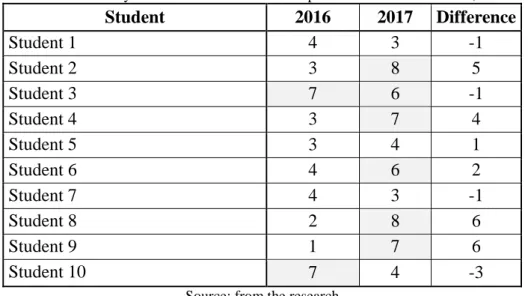
About the emphasis of the activities developed, which was the performance in the first phase of OBMEP in the edition of 2017, the amount of correct answers finished by the 10 students who participated in the activities from beginning to end are available in in table 1. Where one can see the correct answers of students in the 2016 and 2017 exams, highlighting their difference.
Table 1 - Occurrence of accuracy in 2016 and 2017 in the first phase of the OBMEP exam, with its difference1
Student 2016 2017 Difference Student 1 4 3 -1 Student 2 3 8 5 Student 3 7 6 -1 Student 4 3 7 4 Student 5 3 4 1 Student 6 4 6 2 Student 7 4 3 -1 Student 8 2 8 6 Student 9 1 7 6 Student 10 7 4 -3
Source: from the research
Given this situation, it can be seen that 6 students improved their performance in relation to the previous year. Some with significant improvements, in two cases reaching a difference
1 The highlights in gray shading are from students who have moved on to the second phase of OBMEP. Also, the
of 6 questions. There was also a worsening of one question in 3 cases and 3 questions in a single case. It still having a 60% of approved students in 2017, when in 2017 this index represented only 20%. In view of this observation, one can have an inverse situation of those verified by Pena (2014), where she reports the lack of interest of the students because of the verification of their poor performance. Because of this improvement in performance, students are expected to feel more motivated to continue their mathematical studies.
When analyzing the number of students of the educational institution locus of this research, it is verified that of the total of 380 students able to take the exam, 10 were members investigated in this research project through the meetings for studies. This represents a sample of just over 2.63% of the number of students mentioned above. Now, considering that only 5% of students go to the second phase, which gives a total of 19 students, it is estimated that 6 of these 19 students participated in the study meetings held. It made a total of approximately 31.58% of the students classified. That is, 2.63% of the total students represent 31.58% of the places obtained. In addition to having the 2 highest marks of the institution, got by student 2 and student 8.
So, this suggestion of activities in alternative time to class schedules goes against as solution to the difficulties encountered by Valério (2017), who highlighted the lack of time to perform activities necessary for a good performance in OBMEP. Also, Neves (2016), when he indicates a discrepancy between the curriculum and the content of the Olympic Games, because offering alternate hours, you do not need to have a direct link between the content studied in the classroom and a preparation for the exam. It can even have a different environment than the usual classroom environment.
This proposal even cooperated with what was pointed out by Goes (2017) in indicating that teachers claimed the great difficulties presented in student learning, it would be impossible to focus on a preparation for OBMEP. With these studies, it was possible to perceive the improvement of the students in the problem solving of mathematics. Also, it was endorsed Fideles’s (2014) observation that teaching using problem solving can give meaning to mathematics teaching. And Machado (2015) who stated that the habit of solving logic-mathematical problems can contribute significantly to the increase in the quality of mathematics teaching and the results of our students in diagnostic and competition exams.
7 CONCLUSION
The relevance of this project is recognized when students are interested in solving complex math questions with a focus on OBMEP. Their interest during the meetings is elucidated in the discussions, resolutions and strategies proposed by themselves. Another highlight is the students’ attendance in relation to the meetings for studies, since the project is carried out at the student’s rest periods, which already have an extensive workload.
In the occasion where teachers indicate the lack of time to work, difficulty in reconciling the school program content with a preparation or the great basic difficulty that students present, all this as obstructions to work in some way with a focus on studies to obtain a good performance in the OBMEP exams, this research showed a possible bias. Where models of problem-solving studies were approached in view of Pólya’s theory (1985, 1995).
Considering the teacher’s approach to problem solving, Pólya (1985, p. N) points out that if the teacher “... never experienced the tension and triumph of discovery and if, after a few years of teaching, he never observed such tension and such triumph in some of his students, then it is better to look for another profession and not teach mathematics anymore.” Despite some rather harsh words from the author, it is understood his position. For in alternative methods of studies, to consolidate students’ success in solving problems, it is essential to understand the sense of triumph highlighted by him.
REFERENCES
COSTA, Regiane Quezia Gomes da. Análise da prova da primeira fase da OBMEP como
subsidio para orientar a prática docente. 2015. 212 f. Brasília: Dissertação (Mestrado
Profissional em Matemática em Rede Nacional) - Universidade de Brasília, 2015. Disponível em: <http://repositorio.unb.br/handle/10482/20316>. Acesso em: 20 maio 2017.
FIDELES, Eduardo Cordeiro. A OBMEP sob uma perspectiva de Resolução de
Problemas. 2014. 57 f. Brasília: Dissertação (Mestrado Profissional em Matemática em Rede
Nacional) - Universidade de Brasília, 2014. Disponível em:
<http://repositorio.unb.br/handle/10482/17049>. Acesso em: 22 maio 2017.
GOES, Cícero Rufino de. Desenvolvendo e aplicando a matemática: um projeto voltado em produzir vencedores na OBMEP e elevar os indicadores sociais do município de Branquinha-AL. 2017. 79 f. Maceió: Dissertação (Mestrado Profissional em Matemática em Rede
Nacional) - Universidade Federal de Alagoas, 2017. Disponível em:
<http://www.repositorio.ufal.br/handle/riufal/1704>. Acesso em: 01 jun 2017.
MACHADO, Leandro da Silva. Uma análise crítica das provas da segunda fase da
OBMEP 2014. 2015. 111 f. Rio de Janeiro: Dissertação (Mestrado Profissional em
Disponível em:
<https://impa.br/wp-content/uploads/2016/12/Leandro_da_Silva_Machado.pdf>. Acesso em: 25 maio 2017. NEVES, Indalécio Ferreira das. Banco de questões da OBMEP níveis I e II: uma análise crítico-construtiva e uma nova proposta metodológica. 2016. 66 f. Palmas: DIssertação (Mestrado Profissional em Matemática em Rede Nacional) - Universidade do Tocantins, 2016. Disponível em: <https://sca.profmat-sbm.org.br/sca_v2/get_tcc3.php?id=95645>. Acesso em: 26 maio 2017.
OBMEP. 13ª OlimpÍada Brasileira de Matemática das Escolas Públicas. OlimpÍada
Brasileira de Matemática das Escolas Públicas (OBMEP), 2017. Disponível em:
<http://www.obmep.org.br/>. Acesso em: 01 mar. 2017.
PENA, Maria Botelho Alves. Experiências docente vivenciadas, dentro e fora da sala de
aula, em tempos de OBMEP de 2005 a 2013. 2014. 86 f. Uberaba: Dissertação (Mestrado
Profissional em Matemática em Rede Nacional) - Universidade Federal do Triângulo Mineiro, 2014. Disponível em: <http://bit.profmat-sbm.org.br/xmlui/handle/123456789/1085>. Acesso em: 10 jun. 2017.
PÓLYA, George. O ensino por meio de problemas. Revista do professor de matemática, Rio de Janeiro, v. 7, 1985. Disponível em: <http://rpm.org.br/cdrpm/7/3.htm>. Acesso em: 10 jun 2017.
PÓLYA, George. A arte de resolver problemas: um novo aspecto do método matemático. Tradução de Heitor Lisboa de Araújo. Rio de Janeiro: Interciência, 1995.
VALERIO, Wiviane. Resolução de problemas, uma abordagem com questões da OBMEP
em sala de aula. 2017. 87 f. São Carlos: Dissertação (Mestrado Profissional em Matemática
em Rede Nacional) - Universidade de São Paulo, 2017. Disponível em:
<http://www.teses.usp.br/teses/disponiveis/55/55136/tde-06032017-101943/en.php>. Acesso em: 10 jun. 2017.
Submetido em: 2 de abril de 2018. Aprovado em: 25 de maio de 2018.