International Journal of Marketing, Communication and New Media. ISSN: 2182-9306. Special Issue 5 – Tourism Marketing, APRIL 2019
54
Wine Tourism Experience in the Tejo Region: The influence of sensory
impressions on post-visit behaviour intentions
Vasco Santos* Ana Caldeira** Eulália Santos*** Simão Oliveira**** Paulo Ramos***** ABSTRACT
This study aims to explore the influence of the wine tourism experience on visitors’ memorable sensory impressions, and the effects of these impressions on their recommendation and loyalty intentions. Methodologically, 306 usable questionnaires were collected from national and international wine tourists during their visits to the Tejo wine region. A structural equation model analysis was performed using PLS, to test the validity of the constructs and the model hypotheses. The structural equation model results revealed a differentiated impact of the various sensory impressions on future behavioural intentions, suggesting that wineries should attract tourists by more than visual elements and taste-flavour activities alone. As research limitations, the data were collected from only one wine tourism region. Future studies can investigate sensory impressions relating to winery and wine cellar visits in a cross‐cultural context, covering a wider spread of wine regions in Portugal and abroad. This paper provides wine tourism managers with valuable information on how cellar and winery experiences can be improved across a range of different sensory impression dimensions. This paper is the first to empirically test wine tourist the impact of the different sensory impressions on post-visit behaviour intentions in the context of the wine tourism experience.
Keywords: wine tourism experience; sensory impressions; behavioural intentions;
recommendation; loyalty; structural equation modelling (SEM).
___
* ISLA Santarém, Portugal. E-Mail: [email protected] ** ISLA Santarém, Portugal. E-Mail: [email protected] *** ISLA Santarém, Portugal. E-Mail: [email protected]
**** University of Córdoba and CiTUR, Leiria, Peniche, Portugal. E-Mail: [email protected] ***** Fernando Pessoa University and CBQF UCP – ESB, Porto, Portugal. E-Mail: [email protected]
International Journal of Marketing, Communication and New Media. ISSN: 2182-9306. Special Issue 5 – Tourism Marketing, APRIL 2019
55
Received on: 2019.02.11 Approved on: 2019.04.03
Evaluated by a double blind review system
1. INTRODUCTION
Wine tourism has been defined as “visitation to vineyards, wineries, wine festivals and wine shows for which grape wine tasting and/or experiencing the attributes of the grape wine region are the prime motivating factors for visitors” (Hall & Macionis, 1998). However, other definitions may be found in the literature, according to the approach to the wine tourism phenomenon. According to Getz (2000) and Mitchell and Hall (2006), studies on wine tourism began to appear between 1990 and 2000. Considered a special-interest and a niche tourism (Montella, 2017; Novelli, 2005), wine tourism has drawn an increasing number of visitors and focus from academia.
Gómez, Marlene and Molina (2018), who conducted an exhaustive literature review analysing wine tourism papers from 1995 to 2014, identified the main approaches to the study of wine tourism experience: wine tourism development (wine routes), winery and cellar door (cellar door, service quality) and wine tourism models (consumer behaviour). According to their analysis, research on the experiential and sensory dimensions of wine tourism, and their joint effects on post-visit behavioural intentions, is clearly limited. Additionally, to our knowledge there is an absence of empirical works that test the differentiated impact of the so-called five sense impressions on future behavioural intentions by means of structural equation modelling.
Considering these aspects, this study aims to overcome this gap by proposing and testing a structural equation model to examine the influence of the wine tourism experience on visitors’ memorable sensory impressions, and the effects of these impressions on visitors’ post-visit behavioural intentions (recommendation and loyalty).
The rest of the paper is structured as follows: Section 2 presents the theoretical background and development of hypotheses; Section 3 lays out the study’s
International Journal of Marketing, Communication and New Media. ISSN: 2182-9306. Special Issue 5 – Tourism Marketing, APRIL 2019
56
methodology; Section 4 provides the results of the model assessment; and finally, Section 5 discusses the results and offers conclusions.
2. THEORETICAL BACKGROUND AND DEVELOPMENT OF HYPOTHESES 2.1. The wine tourism experience
Research on consumption experience has received growing attention (Holbrook, 2018; Kastenholz, Carneiro, Marques, & Loureiro, 2018) since the seminal work of Holbrook and Hirschman (1982). The authors suggested that consumers purchase products not only to solve a problem or to use a product, but also to have an experience, stressing the hedonic dimension of consumer behaviour. Value derived from hedonic aspects is personal and subjective, and “results more from the multisensory, fantasy and emotive aspects of the consumption experience” (Chen, Goodman, Bruwer, & Cohen, 2016, p. 174). Another pivotal work is that of Pine and Gilmore (1998), who announced the arrival of the “experience economy era”, in which customer experience provides a unique economic service, creating a competitive advantage that is difficult to imitate or replace (Lee & Chang, 2012). As services and goods become increasingly commoditized, businesses should provide meaningful experiences to their customers in order to add value to their offerings (Berry, Carbone, & Haeckel, 2002).
In recent years, cognitive models alone have been considered inadequate in explaining consumption. In his paramount article, Schmitt (1999) identifies five strategic experiential modules, which marketers can create for customers to offer distinguished experiences: sensory experiences (Sense); affective experiences (Feel); creative cognitive experiences (Think); physical experiences, behaviours and lifestyles (Act); and social-identity experiences that result from relating to a reference group or culture (Relate). Lee and Chang (2012) used Schmitt’s experiential marketing scale (1999) in the wine tourism context to study the influence of experience and activity involvement on tourists’ loyalty intentions.
In tourism and leisure industries, studying and managing experiences is crucial for success (Morgan, Lugosi, & Ritchie, 2010). Visitors “seek, in fact and above all, appealing, unique and memorable experiences” (Figueiredo, Kastenholz, & Lima, 2013). Nevertheless, the tourism experience concept has not yet been entirely elucidated, although authors from diverse scientific perspectives agree that it is a
International Journal of Marketing, Communication and New Media. ISSN: 2182-9306. Special Issue 5 – Tourism Marketing, APRIL 2019
57
multidimensional construct, encompassing cognitive, sensory, behavioural, emotional, relational, symbolic and spatiotemporal facets, taking place in a geographical and socio-cultural context (Kastenholz, Carneiro, Marques, & Loureiro, 2018). Even if clearly identified, these dimensions are difficult to isolate, expensive to orchestrate and beyond the company’s control (Fernandes & Cruz, 2016; Tynan & McKechnie, 2009).
The wine tourism experience, which usually occurs within a ‘rural experience-scape’ (Dissart & Marcouiller, 2012), requires further research (Bruwer & Alant, 2009; Bruwer & Rueger-Muck, 2018; Quadri-Felitti & Fiore, 2012; Vo Thanh & Kirova, 2018). Since consumption has an experiential dimension, there is growing attention to the fact that customers are in search of compelling co-created experiences, with both utilitarian and hedonic components, involving them emotionally, physically and intellectually (Fernandes & Cruz, 2016). According to the co-creation experience shift (Prahalad & Ramaswamy, 2004), tourists increasingly “want to do things rather than observe what lies before them” (Kim, 2014, p. 42). As such, destination and attraction managers should creatively develop activities that stimulate visitors’ five senses (Agapito, Valle, & Mendes, 2014) and promote co-creative entertaining and educational experiences (Hollebeek & Brodie, 2009). Activities provided by wineries therefore need to incorporate a sensory dimension into the tourist experience, to provide quality consumption experience opportunities (Schmitt, 1999).
2.2. Wine tourism and memorable sensory impressions
The sensory dimension of tourist experiences plays a vital role in the process of facilitating positive memorable experiences (Agapito, Pinto, & Mendes, 2017; Ballantyne, Packer, & Sutherland, 2011), even if this is under-investigated (Carneiro, Kastenholz, & Marques, 2014; Mateiro, Kastenholz, & Breda, 2018).
The external human senses (exteroceptive senses) have been studied in a variety of disciplines, and the relationship between sensations and perception has been a recurring focus of research (Agapito et al., 2017). Sensory inputs are selected, organized, and interpreted through a human perceptual process and result in a conscious sensory experience, described in terms of colours, odours, sounds, textures, and tastes (Goldstein, 2010).
In tourism, though the interaction between people and places involves multisensory-encounter experiences (Kastenholz et al., 2018), few studies focus on the sensory aspects of tourist experience, even if these are crucial in generating perceptions and
International Journal of Marketing, Communication and New Media. ISSN: 2182-9306. Special Issue 5 – Tourism Marketing, APRIL 2019
58
creating mental images, influencing their behaviour and memories (Lindstrom, 2006). Visual impressions have been most studied (Agapito, Pinto, & Mendes, 2017), but all the senses are engaged in tourism experiences. Nevertheless, empirical research on tourist experiences that examines the so-called five senses is limited (Kirillova, Fu, Lehto, & Cai, 2014; Pan & Ryan, 2009).
Empirical research pinpoints the importance of the sensory dimension of consumer experiences as key in engaging and co-creating value with consumers, when compared with other physical, intellectual, emotional or social dimensions (Gentile, Spiller, & Noci, 2007). This is even more evident in wine tourism experiences, in which the relevance of the sensory dimension is twofold: wine tourism, and not just its flavour-tasting component, appeals to the various senses (Vo Thanh & Kirova, 2018), and as this experience takes place in situ, the unique sensory qualities of the place have a significant impact on visitors (Agapito et al., 2017).
Research on sensory impressions in the context of tourism (Agapito et al., 2017; Agapito, Valle, & Mendes, 2014; Ballantyne et al., 2011; Gretzel & Fesenmaier, 2003; Pan & Ryan, 2009; Tussyadiah & Zach, 2012; Williams, Yuan, & Williams, 2018) has been developed mainly from a qualitative approach. Moreover, some authors have undertaken only a partial analysis, not considering all five senses in their studies, although all are significant in enriching the tourism experience (Xiong, Hashim, & Murphy, 2015). It should be noted that empirical research has shown some senses to be more impactful than others (Agapito et al., 2012; Lindstrom, 2005), which makes the study of differentiated determinants and the effects of sensory inputs in varied contexts all the more pertinent.
It is thus assumed that the in-situ experience in the context of wine tourism generates and impacts tourists’ sensory impressions, and the following hypothesis is drawn:
H1: The winery visit experience has a positive influence on sensory impressions, namely on those related to (H1a) sight; (H1b) hearing; (H1c) taste; (H1d) smell; and (H1f) touch.
2.3. Behavioural intentions in wine tourism
The study of post-visit behavioural intentions is of paramount value to the wine travel industry. Research on the behaviour of wine tourists is still very limited however, and it is vital to understand how attributes valued in wine tourism reflect tourists’ intention to engage in consumption patterns (Sparks, 2007). In light of this, the author points out it is
International Journal of Marketing, Communication and New Media. ISSN: 2182-9306. Special Issue 5 – Tourism Marketing, APRIL 2019
59
fundamental to have a systematic, theoretically oriented approach that tests the likelihood of visiting (and therefore re-visiting and recommending) a producer, a wine region or an activity. One recent study indicates that the personal involvement of wine tourists with the wine product, the emotions of the destination and their place attachment have a significant influence on their plans to visit or revisit the Porto wine cellars, definitively boosting their behavioural intentions (Santos, Ramos, & Almeida, 2017).
According to Agapito, Pinto and Mendes (2017), tourist experiences that are perceived to be richer on a sensory level may have a significant role in the long-term memory of individuals’ experiences, in turn enhancing tourist behaviour towards destinations. Gill, Byslma and Ouschan (2007) argue that service quality, technical quality, price and social value are four out of five dimensions of customer-perceived value which have a positive impact on the behavioural intentions of cellar door visitors. In relation to the behavioural models of wine tourism, Lee and Chang (2012) attest that experience of experiential marketing, activity involvement and satisfaction significantly affect the loyalty intentions of wine tourists. Quadri-Felitti and Fiore (2013), in their research about the impact on tourist loyalty of the 4Es (i.e. educational, esthetic, entertainment, and escapist experiences) for an entire destination, demonstrated the dominance of the aesthetic experience in predicting positive memories and destination loyalty in the wine tourism area. In addition, their results add new information, contradicting Pine and Gilmore’s view that the simultaneous incorporation of the 4Es is necessary. The authentic characteristics of winery experiences play a substantial role in the behavioural intentions of tourists (Kim & Bonn, 2016), and interestingly there were no significant relationships between a visitor’s willingness to recommend wineries. Fernandes and Cruz’s (2016) results show that a six-dimensional structure of experience quality (i.e., environment, service providers, learning, entertainment, functional benefits and trust) in tourism, specifically in the Porto wine cellars, has a direct positive impact on loyalty, satisfaction and word-of-mouth.
The literature review evidence highlighted above demonstrates that the understanding of the behaviour of wine tourists has advanced from the wine tourism experience itself to future behavioural intentions. Based on this background and drawing on the previous findings, a set of four further hypotheses has been formulated, and these are outlined below.
International Journal of Marketing, Communication and New Media. ISSN: 2182-9306. Special Issue 5 – Tourism Marketing, APRIL 2019
60
Since post-visit behavioural intentions have been confirmed as consequences of experience, operationalized by means of Schmitt’s (1999) experiential modules (T. H. Lee & Chang, 2012; Tsaur, Chiu, & Wang, 2006), it is hypothesized that:
H2: The winery visit experience has a positive influence on recommendation intentions.
H3: The winery visit experience has a positive influence on loyalty intentions. Additionally, given that the so-called five senses may have a different impact on tourism experiences, that diversified sensory impressions as perceived by tourists influence memory, and that research reveals an association between sensorial tourist experiences and behavioural intentions (Agapito et al., 2017), the following hypotheses arise to be tested:
H4: The sensory impressions, namely those related to (H4a) sight; (H4b) hearing; (H4c) taste; (H4d) smell; and (H4e) touch, will have a positive influence on tourists’ recommendation intentions.
H5: The sensory impressions, namely those related to (H5a) sight; (H5b) hearing; (H5c) taste; (H5d) smell; and (H5e) touch, will have a positive influence on tourists’ loyalty intentions.
3. METHODOLOGY
3.1. Sampling and data collection
The target population were tourists visiting the wineries in the Tejo region, certified by the Tejo Regional Wine Commission (CVR Tejo). This wine region is situated in the centre of Portugal, where the climate can be described as temperate southern Mediterranean, and it currently has approximately 19,000 hectares of wine vineyards of predominantly white grape varieties, corresponding to about 10% of the national wine production. This region, with excellent natural conditions for viniculture development and for the production of consistent and high-quality wines, has three distinct production zones: Campo, Bairro and Charneca. The Campo, with its extensive plains, adjacent to the Tejo river and therefore subject to periodic floods which increase the fertility of the soil, has potential for the production of white wines. On the right bank of the Tejo, after the soils near the river, the Bairro area is located, with soils of limestone and clay, arranged in more irregular fields between hills and plains, ideal for the red
International Journal of Marketing, Communication and New Media. ISSN: 2182-9306. Special Issue 5 – Tourism Marketing, APRIL 2019
61
varieties. The Charneca, located south of the Campo on the left bank of the Tejo, with sandy and moderately fertile soils, has potential for the production of white and red wines.
CVR Tejo contacted all the wineries, inviting them to cooperate with the research. Those that agreed to collaborate were associated with a cluster of tourists belonging to the population of interest (Davis, 1996). The wine tourism units were requested to invite their visitors to fill out the questionnaires, and also to contact the research team when receiving organized groups, so that they would be present to maximize the number of respondents. The 306 visitors who agreed to participate and constitute the sample were informed of the study’s objectives, and were guaranteed confidentiality and anonymity. The data collection process was carried out between May and September 2018, through Survey Pro software.
3.2. Instruments and measures
In this study, a quantitative methodology based on a questionnaire survey was used. Before the questionnaire design, a preliminary study (Santos et al., 2018) by means of a survey was carried out to identify and characterize the wine tourism units certified by CVR Tejo, which constitute the wine tourism supply of the region. The questionnaire was applied in four languages (Portuguese, Spanish, English and French), corresponding to the target audience, and was tested in a pilot study of 15 wine tourists to evaluate the clarity of the questions. After the pilot study, small adjustments were made, and the questionnaire was divided into four parts. The first one consists of 16 items measured on a 7-point Likert-type scale (1 – I totally disagree; 7 – I totally agree) and refers to the wine tourist experience, using Schmitt’s (1999) experience scale and its respective experiential modules (Sense, Think, Feel, Act and Relate), with small adaptations following Tsaur, Chiu and Wang (2006) and Lee and Chang (2012). The second part consists of 16 items evaluated on a 7-point Likert-type scale varying from 1 (Not significant) to 7 (Very significant) and analyses the sensory impressions of the wine tourism experience and its dimensions (Sight, Hearing, Taste, Smell and Touch) adapted from Agapito et al. (2017). The third part is made up of 4 items measured on a 7-point Likert-type scale (1 – I totally disagree; 7 – I totally agree) that evaluate the wine tourist’s behavioural intentions and their dimensions (Recommendation and Loyalty), adapted from Chen, Goodman, Bruwer and Cohen (2015). The fourth and last part is related to sociodemographic profile of the wine tourist (age, gender, educational
International Journal of Marketing, Communication and New Media. ISSN: 2182-9306. Special Issue 5 – Tourism Marketing, APRIL 2019
62
qualification, employment situation and country of residence). 3.3. Data analysis
The characterization of the sociodemographic profile of the wine tourists was performed using the software IBM SPSS Statistics 25. Partial least squares structural equation modelling (PLS-SEM), using SmartPLS 3.0 (Ringle, Wende, & Becker, 2014), was used to validate the measures developed and test the hypotheses.
As a structural equation modelling (SEM) technique, partial least squares path modelling (PLS-PM) is a variance-based method used to estimate composite-based models (Cepeda Carrión, Henseler, Ringle, & Roldán, 2016; Hair, Hult, Ringle, & Sarstedt, 2014). Increasingly used in various management contexts, namely in tourism research (Caldeira & Kastenholz, 2018; Carneiro, Eusébio, & Caldeira, 2018; C. Lee, Hallak, & Sardeshmukh, 2016), PLS-SEM focuses on the explanation of variances rather than covariances, making it a prediction-oriented approach applied to test relationships between multiple variables. Since the goal of this study is to identify key driver constructs referring to experiential and sensory aspects of the wine tourism experience and post-visit behavioural intentions, and the research is mainly exploratory (Hair et al., 2014), PLS-SEM was selected for data analysis.
4. RESULTS 4.1. Sample profile
Table 1 shows the sociodemographic profile of the wine tourists. The ages of the 306 respondents range between 18 and 80 years old (M = 52, SD = 12.99). The participants are predominantly male (65.7%, n = 201). In terms of educational qualifications, the majority have secondary education (52%, n = 159), and as regards employment situation, the majority are employed (61.4%, n = 188). Regarding country of residence, 84% (n = 257) live in Portugal and the remainder live in other countries (16%, n = 49).
International Journal of Marketing, Communication and New Media. ISSN: 2182-9306. Special Issue 5 – Tourism Marketing, APRIL 2019
63
Table 1. Sample profile
Source: authors
Regarding the sample size (n = 306), the “10 times” rule of thumb (Barclay, Higgins, & Thompson, 1995), which provides a basic guideline for the minimum sample size required for PLS use (Hair et al., 2014), is fulfilled.
4.2. Model assessment
The PLS estimation and assessment procedure encompasses two stages (Hair et al., 2014): (i) the validation of the measurement (outer) model refers to the evaluation of the relationships between the latent variables or constructs and their associated items; and (ii) the assessment of the structural (inner) model allows analysis of the hypothesized relations between the constructs.
The measurement model adopted in this study includes a second-order construct (winery visit experience), composed of five reflective first-order constructs (experiential modules: sense, feel, think, act, and relate); the five formative constructs regarding sensory impressions (sight, hearing, taste, smell, and touch), and the two reflective behavioural intentions constructs (recommendation and loyalty).
As the model proposed in this research includes both reflective and formative constructs, assessment of the measurement model will thus comprise the evaluation of reflective constructs and, subsequently, the evaluation of formative constructs.
Following Hair et al. (2014), the assessment of reflective constructs was carried out by analysing the reliability of the multiple-item scales, convergent validity and discriminant validity. As presented in Table 2, in the measurement model under
Variables Descriptive Statistics
Age Minimum: 18; Maximum: 80;
Mean: 52; Standard deviation: 12.99 Gender Male: 201 (65.7%); Female: 105 (34.3%) Educational qualification Elementary: 18 (5.9%); Secondary: 159 (52%);
Higher: 129 (42.2%)
Employment situation Employed: 188 (61.4%); Retired: 62 (20.3%); Self-employed: 51 (16.7%); Unemployed: 5 (1.6%) Country of residence Portugal: 257 (84%); Spain: 27 (8.8%);
France: 8 (2.6%); Brazil: 8 (2.6%); England: 6 (2%)
International Journal of Marketing, Communication and New Media. ISSN: 2182-9306. Special Issue 5 – Tourism Marketing, APRIL 2019
64
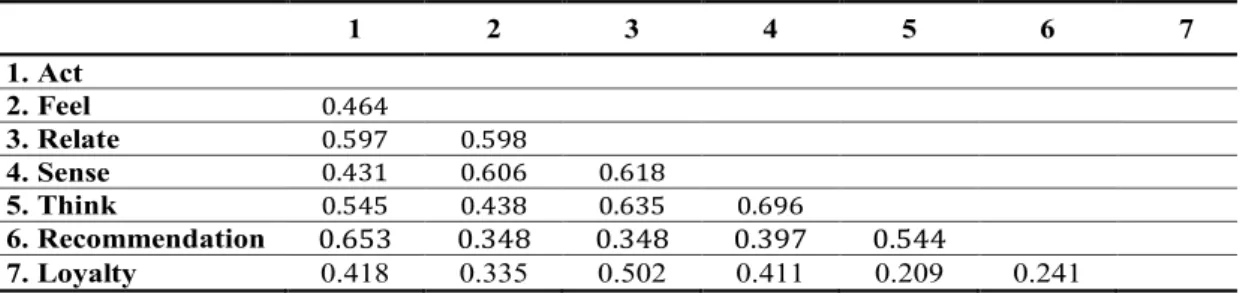
analysis, the composite reliability of all constructs is higher than 0.87, exceeding the reference value of 0.7. Moreover, all factor loadings surpass the threshold value of 0.6. As for the convergent validity, all first-order constructs have an AVE superior to 0.50, confirming a good convergent validity of the scales used; and discriminant validity was assessed following Fornell and Larcker’s (1981) guidelines, to examine whether a construct is more strongly related to its own measures than to any other construct. The heterotrait-monotrait (HTMT) ratio of correlations, the more demanding criterion proposed by Henseler, Ringle, and Sarstedt (2014), likewise confirms discriminant validity, taking into account the threshold value of 0.85 (Table 3).
In order to assess the formative constructs, the indicators’ weight and respective significance (Table 2), with all weights being significant and higher than 0.10, as well as their multicollinearity, were examined. Based on the Variation Inflation Factor (VIF), collinearity issues were rejected, since values range from 3.498 to 1.453, clearly below 5, as suggested by Hair et al. (2014). As for single-item constructs, as the construct equals its measure (indicator is 1.00), conventional reliability and convergent validity assessments are inadequate (Hair et al., 2014).
Then, second-order constructs were assessed. First, the quality and collinearity issues of first-order constructs (which influences the second-order constructs) was tested in the previous section, and all requirements were met. Subsequently, the weights and significance level of the first-order constructs on the second-order constructs were found to be significant and clearly higher than 0.10, positively influencing the second-order constructs, as suggested in the literature. The ‘relate’ experiential module emerges as the first-order construct with greatest influence on the second-order construct (winery visit experience); by contrast ‘think’ registers the lowest contribution to the winery visit experience.
International Journal of Marketing, Communication and New Media. ISSN: 2182-9306. Special Issue 5 – Tourism Marketing, APRIL 2019
65
Table 2. Measurement model assessment
Source: authors
Construct / indicators Mean Standard deviation
Item loading / weighta Cronbach's Alpha CR AVE Sense 0.825 0.896 0.741 engaged my senses 5.804 0.954 0.798
was perceptually interesting 5.493 0.809 0.894
offered an intense tasting experience 5.281 0.960 0.888
Feel 0.850 0.909 0.770
appealed to feelings 5.431 1.015 0.894
on-site experience was pleasurable 5.810 0.989 0.911
made me feel interested 6.010 0.810 0.825
Think 0.783 0.873 0.695
stimulated my curiosity about wine culture 5.637 0.927 0.829
appealed to my creative thinking 5.712 0.872 0.827
made me think about sustainable development of wine tourism 5.958 1.042 0.846
Act 0.814 0.890 0.730
made me think of my lifestyle 5.507 1.027 0.820
made me want to share what I experienced here 5.824 0.981 0.917
made me want to take pictures as mementos 6.088 0.905 0.822
Relate 0.886 0.922 0.747
got me to think about relationships 5.232 1.289 0.852
induced in me a sense of identity with wine culture 5.320 1.208 0.914
made me want to purchase wine products 5.539 1.365 0.891
I could relate to other people during my experience here 5.673 1.157 0.795
Sight n.a. n.a. n.a.
Landscape 6.216 0.921 0.112
Wine barrels 5.722 1.009 0.282
Wine glasses and tableware 5.654 1.053 0.400
Architectural details 5.647 1.152 0.396
Hearing n.a. n.a. n.a.
The wine being poured into glass 5.556 1.265 0.470
Wine toast (voices and tinkling of glasses) 5.131 1.253 0.296
Nature /outdoor sounds 5.268 1.172 0.512
Taste n.a. n.a. n.a.
Wines 5.830 1.366 0.467
Cheese 5.582 1.458 0.298
Bread 5.781 1.161 0.317
Smell n.a. n.a. n.a.
Wine aroma 5.542 1.157 0.502
Wine cellar smell (wood barrels) 5.605 1.104 0.522
Smell of food (cheese, cold meats, bread, etc.) 5.431 1.122 0.210
Touch n.a. n.a. n.a.
Touching food (bread, etc.) 5.399 0.988 0.344
Touching/holding the glass 5.520 1.158 0.329
Temperature (heat, coolness) 5.725 0.988 0.550
Recommendation 0.887 0.946 0.898
I am going to recommend this winery to my friends and relatives 6.310 0.843 0.946 I am going to share photos or comments on social media about my experience here 6.170 0.992 0.949
Loyalty 0.930 0.955 0.877
I will continue to buy wines produced by this winery 5.170 1.794 0.916 I will continue to be a loyal client of this winery 5.271 1.762 0.964
Notes: CR: composite reliability; AVE: average variance extracted; aloadings are indicated for indicators of reflective constructs and weights are indicated for indicators of formative constructs; n.a.: not applicable (for single-item or formative constructs).
International Journal of Marketing, Communication and New Media. ISSN: 2182-9306. Special Issue 5 – Tourism Marketing, APRIL 2019
66
Table 3. Discriminant validity of the constructs – Heterotrait-Monotrait Ratio (HTMT)
Source: authors
With the reliability and validity of the measurement model confirmed, the structural model was assessed by examining the estimates, in order to ascertain the hypothesized relationships, as well as the value of the R2 coefficients of the endogenous constructs. The results of testing the research model are exhibited in Figure 1.
Figure 1. Results of hypothesis testing
Source: authors
The explained variance (R2) of endogenous constructs, ranging from between 0.23 and 0.51 (Figure 2), supports the predictive power of the research model. The assessment of the value of the R2 is highly dependent upon the research area, and in behavioural
1 2 3 4 5 6 7 1. Act 2. Feel 0.464 3. Relate 0.597 0.598 4. Sense 0.431 0.606 0.618 5. Think 0.545 0.438 0.635 0.696 6. Recommendation 0.653 0.348 0.348 0.397 0.544 7. Loyalty 0.418 0.335 0.502 0.411 0.209 0.241
International Journal of Marketing, Communication and New Media. ISSN: 2182-9306. Special Issue 5 – Tourism Marketing, APRIL 2019
67
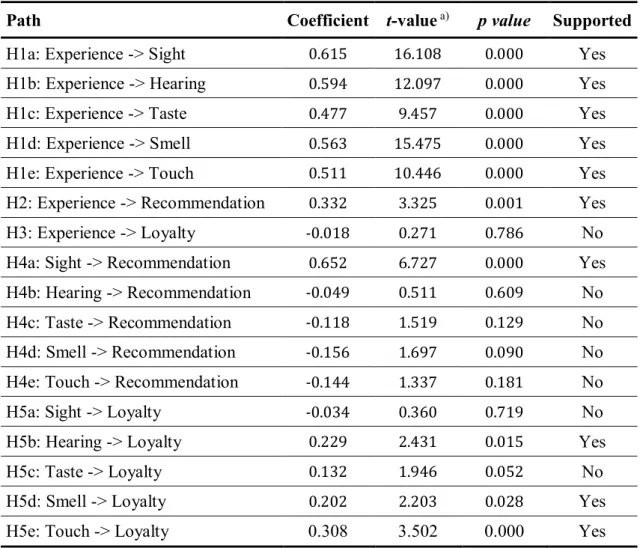
studies, a value of 0.2 may be considered suitable (Hair et al., 2014). Ten of the 17 hypotheses under analysis were supported (Table 4).
Table 4. Hypothesis testing
Source: authors
The first hypotheses – H1a to H1e, predicting that the winery visit experience influences the different post-visit sensory impressions – were all found significant at the 0.001 level. The winery visit experience records the highest impact on sight impressions (β = 0.62, p < 0.001), underlying the importance of visualscape (Bagdare & Roy, 2016), and the lowest on touch impressions. Nevertheless, the results indicate the importance of the various sensescapes (Agapito et al., 2017).
As for hypotheses H2 and H3, positing that the winery visit experience positively
Path Coefficient t-value a) p value Supported
H1a: Experience -> Sight 0.615 16.108 0.000 Yes
H1b: Experience -> Hearing 0.594 12.097 0.000 Yes
H1c: Experience -> Taste 0.477 9.457 0.000 Yes
H1d: Experience -> Smell 0.563 15.475 0.000 Yes
H1e: Experience -> Touch 0.511 10.446 0.000 Yes
H2: Experience -> Recommendation 0.332 3.325 0.001 Yes
H3: Experience -> Loyalty -0.018 0.271 0.786 No
H4a: Sight -> Recommendation 0.652 6.727 0.000 Yes
H4b: Hearing -> Recommendation -0.049 0.511 0.609 No
H4c: Taste -> Recommendation -0.118 1.519 0.129 No
H4d: Smell -> Recommendation -0.156 1.697 0.090 No
H4e: Touch -> Recommendation -0.144 1.337 0.181 No
H5a: Sight -> Loyalty -0.034 0.360 0.719 No
H5b: Hearing -> Loyalty 0.229 2.431 0.015 Yes
H5c: Taste -> Loyalty 0.132 1.946 0.052 No
H5d: Smell -> Loyalty 0.202 2.203 0.028 Yes
H5e: Touch -> Loyalty 0.308 3.502 0.000 Yes
International Journal of Marketing, Communication and New Media. ISSN: 2182-9306. Special Issue 5 – Tourism Marketing, APRIL 2019
68
impacts behavioural intentions, as expected and documented in the literature, recommendation (H2) registered a strong influence (β = 0.33, p < 0.001). In turn, the effect of the winery visit experience on loyalty was found non-significant, in contrast to previous empirical research. This seems to contradict Lee and Chang’s (2012) results, using the experiential marketing scale (Schmitt, 1999) to study the impact on loyalty and finding a positive significant relationship. Nonetheless, it should be noted that the authors grouped recommendation and loyalty intentions under the same construct and, as such, the results cannot be directly compared. Moreover, when total indirect effects are considered (Table 5), the winery visit experience exhibits a high impact on loyalty (β = 0.65, p < 0.001). This may be indicative of the mediating role of sensory impressions on the relationship between visit experience and loyalty.
Table 5. Total indirect effects
Source: authors
Regarding hypotheses H4a to H4e, which predict a positive and significant impact of sensory impressions on recommendation, only sight appears to influence the intention to recommend the winery to friends and relatives and to share photos or comments on social media, registering a high effect (β = 0.65, p < 0.001). According to the results, the other kinds of sensory impressions do not promote recommendation. This may be explained by the fact that sensory impressions were collected through a post-visit survey conducted in situ, when the immediacy of sharing photos (more associated with visual impressions) on social media was more evident.
As for hypotheses H5a to H5e, regarding the impact of sensory impressions on loyalty, hearing (β = 0.23, p < 0.05), smell (β = 0.20, p < 0.05) and, with the highest influence, touch (β = 0.31, p < 0.001) revealed significant effects on repurchase intentions. Taste slightly fails a significant effect at the level of 0.5 (β = 0.20, p = 0.052).
Path Direct a) Total indirect effects
coefficient t-value p value
Experience -> Recommendation -0.018 0.157 3.366 0.001
Experience -> Loyalty 0.652*** 0.445 8.270 0.000
International Journal of Marketing, Communication and New Media. ISSN: 2182-9306. Special Issue 5 – Tourism Marketing, APRIL 2019
69
Confirming the principle laid out by Agapito et al. (2017, p. 116), the findings suggest that “impressions related to senses other than sight contribute to the recollection of tourist experiences and that sensorily richer tourist experiences may have an important role in encouraging favorable tourist behaviour”.
In fact, when it comes to recommendation, visual impressions appear to be more appropriate and usable to share with others, whereas other sensory impressions that are arguably less conscious or more difficult to describe seem to have a greater influence regarding loyalty and repurchase intentions. Sounds may be associated with the social component of the winery visit experience (e.g. wine toast, voices), confirming the view that managers should make good use of soundscape when designing tourist experiences (Williams et al., 2018; Zhang, Zhang, & Zheng, 2018); smell, touch and taste seem to be more intrinsically linked to the taste-flavour dimension of the winery visit experience (Vo Thanh & Kirova, 2018).
5. DISCUSSION AND CONCLUSIONS
Due to the exploratory nature of the research and to the fact that the proposed model includes both reflective and formative constructs, PLS approach was an adequate choice for exploring the relationships between the constructs (Hair et al., 2014). All reflective scales presented good reliability indicators, as well as the scales showed satisfactory validity.
A main contribution is the fact that we were able to discriminate the different impact of the sensory impressions on the behavioural intentions. Moreover, the winery visit experience construct had a significant impact on all the sensory impressions, suggesting a good match between these two constructs. Yet, some of the expected outcomes were not confirmed. The winery visit experience registered a positive influence on recommendation intentions, but not on loyalty. Since Lee and Chang’s (2012) used the same scale (Schmitt, 1999) to study the winery visit experience impact on loyalty, but grouped recommendation as well as repurchase intentions under the same loyalty construct, the different results obtained are not directly comparable. However, the differential impact on recommendation and loyalty latent variables confirms the pertinence of modelling in separate constructs these future behavioural intentions. The non-significant impact on loyalty may result from the nature of the scale that measured
International Journal of Marketing, Communication and New Media. ISSN: 2182-9306. Special Issue 5 – Tourism Marketing, APRIL 2019
70
loyalty based on the presumption of a previous loyalty behaviour (i.e. I will continue to…), or simply because loyalty is not one of the expected outcomes of a winery visit. This is confirmed by the higher means of recommendation items when compared with loyalty indicators. In this context, the tourists’ recommendations seem to be a more important consequence than loyalty, since they can generate more visits in the future. Additionally, the winery visit experience has a positive relationship with the recommendation intentions but not with loyalty intentions. Again, this may result from the fact that loyalty is less likely to occur than a mere recommendation, namely by just sharing photos or comments on social media.
Also, only sight was found to have a significant relationship on the intentions to recommend. In this case, this construct can also serve as surrogate measure of satisfaction. This can imply that the overall look, aesthetics and physical facilities may have a more predominant role in pleasing the visitors or are more suitable to share than other sensory impressions.
More intriguing is the non-significant contribution (at the 0.05 level) of taste to none of the behavioural intentions. Since one of the main constituents of the visit is the tasting experience and it relies heavily on taste as a key attribute for the consumers (Ramos, 2011), this needs further explanation. The scale used to measure taste assessed not only the wine taste, but also the cheese and bread offered, which may have affected the wine tasting experience. This suggests that some further adaptation of the scales could be made.
This paper is the first to empirically test the impact of the different sensory impressions on post-visit behaviour intentions in the context of a wine tourism experience. We accomplished our aim by filling this gap based on empirical work that measured the discriminated impact of the five senses impressions on behavioural intentions. The structural equation model results revealed a quite differentiated impact of the different sensory impressions on future behavioural intentions, suggesting that wineries should attract tourists by more than visual elements and taste-flavour activities alone. The service component seems to be critical to the evaluation of the experience.
Although exploratory in nature, we believe that the present study is relevant for future research, particularly regarding the key role played by the sensory dimension of the wine tourism experience and offers a valuable contribution to the critical success factors of winery experience design, service quality, segmentation, branding and promotion.
International Journal of Marketing, Communication and New Media. ISSN: 2182-9306. Special Issue 5 – Tourism Marketing, APRIL 2019
71
5.1 Theoretical and Practical implications
Sensory impressions are confirmed to impact future behavioural intentions (in line with Agapito et al., 2017 and Kastenholz et al., 2012) and their role and relevance go beyond visual and gustative impressions. The results also reveal that it is pertinent to study the differential impact of the various sensory impressions.
This paper thus provides wine tourism managers with valuable information on how cellar and winery experiences can be improved across a range of different sensory impression dimensions. Results also confirm that sensory impressions of different nature impact in a varying way future behaviour intentions. Moreover, wineries should attract tourists by more than visual elements and taste-flavour activities alone, focusing also on service and complementary activities rather than just providing a tasting of their own products.
Other sensory impressions could be addressed by wine destinations “in order to enhance tourist experiences and consequently contribute to increasing their retention in memory, leading to destination loyalty” (Agapito et al., 2017, p. 115). Wineries and wine destinations should explore “the sounds of the setting, the scents of nature, the gastronomic specialties of the region, and the opportunities to experience diverse textures with respect to local architectural details, nature, or local products” (Agapito et al., 2017, p. 115).
According to the co-creation experience shift (Prahalad & Ramaswamy, 2004), tourists increasingly “want to do things rather than observe what lies before them” (Kim, 2014, p. 42). As such, destination and attraction managers should creatively develop activities that stimulate visitors’ five senses (Agapito, Valle, & Mendes, 2014) and promote co-creative entertaining and educational experiences (Hollebeek & Brodie, 2009). Activities provided by wineries therefore need to incorporate a sensory dimension into the tourist experience, to provide quality consumption experience opportunities (Schmitt, 1999).
5.2 Limitations and future research
The data were collected from only one wine tourism region and on a convenience sample basis. There is probably some bias regarding the sample, namely regarding the (high) education level of the respondents. Future studies should investigate the sensory impressions relating to the wineries and wine cellar visits in a cross‐cultural context, covering a wider spread of wine regions both in Portugal and abroad.
International Journal of Marketing, Communication and New Media. ISSN: 2182-9306. Special Issue 5 – Tourism Marketing, APRIL 2019
72
Some of the scales, namely those of formative nature used, may require further refinement and adjustment to the nature of wine tourism. Future studies should also study the impact of previous knowledge of the winery and its products, as well as its overall reputation prior to the visit. They should also include the service components and focus also on the measurement of the overall satisfaction with the wine tourism experience in order to obtain a more holistic approach.
ACKNOWLEDGEMENTS
This research was supported by the European Regional Development Fund (ERDF) through the COMPETE2020 under the program PT2020 (POCI-01-0145-FEDER-023969).
REFERENCES
Agapito, D., Pinto, P. & Mendes, J. (2017). Tourists’ memories, sensory impressions and loyalty: In loco and post-visit study in Southwest Portugal. Tourism Management, 58, 108-118.
Agapito, D., Valle, P., & Mendes, J. (2014). The sensory dimension of tourist experiences: Capturing meaningful sensory-informed themes in Southwest Portugal.
Tourism Management, 42, 224-237.
Bagdare, S., & Roy, S. (2016). VISUALSCAPE: a scale to measure visual experience in retailing. Services Marketing Quarterly, 37(4), 272-287.
Ballantyne, R., Packer, J., & Sutherland, L. A. (2011). Visitors’ memories of wildlife tourism: Implications for the design of powerful interpretive experiences. Tourism
Management, 32(4), 770-779.
Barclay, D. W., Higgins, C. A., & Thompson, R. (1995). The partial least squares approach to causal modeling: Personal computer adoption and use as illustration.
Technological Studies, 2, 285-309.
Berry, L. L., Carbone, L. P., & Haeckel, S. H. (2002). Managing the total customer experience. MIT Sloan management review, 43(3), 85-89.
Bruwer, J., & Alant, K. (2009). The hedonic nature of wine tourism consumption: an experiential view. International Journal of Wine Business Research, 21(3), 235-257. Bruwer, J., & Rueger-Muck, E. (2018). Wine tourism and hedonic experience: A motivation-based experiential view. Tourism and Hospitality Research.
Caldeira, A. M., & Kastenholz, E. (2018). It’s so hot: predicting climate change effects on urban tourists’ time–space experience. Journal of Sustainable Tourism, 1-27.
Carneiro, M. J., Eusébio, C., & Caldeira, A. (2018). The Influence of Social Contact in Residents’ Perceptions of the Tourism Impact on Their Quality of Life: A Structural Equation Model. Journal of Quality Assurance in Hospitality and Tourism, 19(1), 1-30.
Carneiro, M. J., Kastenholz, E., & Marques, C. (2014). A experiência turística rural vivida e cocriada pelos visitantes. In E. Kastenholz, C. Eusébio, E. Figueiredo, M. J. Carneiro, & L. Joana (Eds.), Reinventar o turismo rural em Portugal: Cocriação de experiências turísticas sustentáveis (pp. 71–88). Aveiro: Universidade de Aveiro.
International Journal of Marketing, Communication and New Media. ISSN: 2182-9306. Special Issue 5 – Tourism Marketing, APRIL 2019
73
Carù, A., & Cova, B. (2003). Revisiting Consumption Experience: A More Humble but Complete View of the Concept. Marketing theory, 3(2), 267-286.
Cepeda Carrión, G., Henseler, J., Ringle, C. M., & Roldán, J. L. (2016). Prediction-oriented modeling in business research by means of PLS path modeling: Introduction to a JBR special section. Journal of Business Research, 69(10), 4545-4551.
Chen, X., Goodman, S., Bruwer, J., & Cohen, J. (2015). Beyond Better Wine: The Impact of Experiential and Monetary Value on Wine Tourists’ Loyalty Intentions.
Asia Pacific Journal of Tourism Research, 21(2), 172-192.
Davis, D. (1996). Business Research for Decision Making (4th ed.). Belmont, CA: Duxbury Press.
Dissart, J. C., & Marcouiller, D. W. (2012). Rural tourism production and the experience-scape. Tourism Analysis, 17(6), 691-704.
Fernandes, T., & Cruz, M. (2016). Dimensions and outcomes of experience quality in tourism: The case of Port wine cellars. Journal of Retailing and Consumer Services, 31, 371–379.
Figueiredo, E., Kastenholz, E., & Lima, J. (2013). Recreating Rurality through Tourism: Visions of Hosts and Guests in two Portuguese Villages. In E. Figueiredo & A. Raschi (Eds.), Fertile Links? (pp. 43-70). Firenze: Firenze University Press.
Gentile, C., Spiller, N., & Noci, G. (2007). How to sustain the customer experience: An overview of experience components that co-create value with the customer.
European management journal, 25(5), 395-410.
Getz, D. (2000). Explore Wine Tourism: Management, Development & Destinations: Cognizant.
Gill, D., Byslma, B. & Ouschan, R. (2007). Customer perceived value in a cellar door visit: the impact on behavioural intentions. International Journal of Wine Business
Research, 19(4), 257-275.
Goldstein, E. B. (2010). Sensation and perception Encyclopedia of perception (8th ed.). Belmont: Wadsworth.
Pratt, M. A., & Molina, A. (2018). Wine tourism research: a systematic review of 20 vintages from 1995 to 2014. Current Issues in Tourism, 1-39.
Gretzel, U., & Fesenmaier, D. (2003). Experience-based internet marketing: an
exploratory study of sensory experiences associated with pleasure travel to the Midwest United States. Paper presented at the Information and communication
technologies in tourism 2003: Proceedings of the International Conference in Helsinki, Finland, 2003.
Hair, J. F., Hult, G. T. M., Ringle, C., & Sarstedt, M. (2014). A Primer on Partial
Least Squares Structural Equation Modeling (PLS-SEM). Thousand Oaks: SAGE
Publications.
Hall, C. M., & Macionis, N. (1998). Wine tourism in Australia and New Zealand. In R. W. Butler, J. C.M. Hall , & M. Jenkins (Eds.), Tourism and Recreation in Rural
Areas (pp. 197–221). England: John Wiley & Sons.
Henseler, J., Ringle, C. M., & Sarstedt, M. (2014). A new criterion for assessing discriminant validity in variance-based structural equation modeling. Journal of the
Academy of Marketing Science, 43(1), 115-135.
Holbrook, M. B. (2018). Essay on the origins, development and future of the consumption experience as a concept in marketing and consumer research. Qualitative Market Research: An International Journal, 21(4), 421-444.
Holbrook, M. B., & Hirschman, E. C. (1982). The experiential aspects of consumption: Consumer fantasies, feelings, and fun. Journal of consumer research,
9(2), 132-140.
Hollebeek, L. D., & Brodie, R. J. (2009). Wine service marketing, value co-creation and involvement: research issues. International Journal of Wine Business Research,
21(4), 339-353.
International Journal of Marketing, Communication and New Media. ISSN: 2182-9306. Special Issue 5 – Tourism Marketing, APRIL 2019
74
dimensions of rural tourism experience: impacts on arousal, memory, and satisfaction.
Journal of Travel and Tourism Marketing, 35(2), 189-201.
Kim, H., & Bonn, M. A. (2016). Authenticity: Do tourist perceptions of winery experiences affect behavioral intentions. International Journal of Contemporary
Hospitality Management, 28(4), 839-859.
Kim, J.-H. (2014). The antecedents of memorable tourism experiences: The development of a scale to measure the destination attributes associated with memorable experiences. Tourism management, 44, 34-45.
Kirillova, K., Fu, X., Lehto, X., & Cai, L. (2014). What makes a destination beautiful? Dimensions of tourist aesthetic judgment. Tourism Management, 42, 282-293.
Lee, C., Hallak, R., & Sardeshmukh, S. R. (2016). Innovation, entrepreneurship, and restaurant performance: A higher-order structural model. Tourism Management, 53, 215-228.
Lee, T. H., & Chang, Y. S. (2012). The influence of experiential marketing and activity involvement on the loyalty intentions of wine tourists in Taiwan AU. Leisure
Studies, 31(1), 103-121.
Lee, T. H., & Chang, Y. S. (2012). The influence of experiential marketing and activity involvement on the loyalty intentions of wine tourists in Taiwan. Leisure
Studies, 31(1), 103-121.
Lindstrom, M. (2006). Brand sense: How to build powerful brands through touch, taste, smell, sight and sound. Strategic Direction, 22(2).
Mateiro, B., Kastenholz, E., & Breda, Z. (2018). The sensory dimension of the tourist experience in mountain destinations: The case of Serra da Estrela Natural Park.
Revista Turismo & Desenvolvimento, 1(27/28), 2027-2038.
Mitchell, R., & Hall, C. M. (2006). Wine tourism research: the state of play. Tourism
Review International, 9(4), 307-332.
Montella, M. (2017). Wine Tourism and Sustainability: A Review. Sustainability,
9(1).
Morgan, M., Lugosi, P., & Ritchie, J. B. (2010). Introduction. In M. L. Morgan, P. & J. B.
Novelli, M. (2005). Niche tourism: contemporary issues, trends and cases: Routledge. Pan, S., & Ryan, C. (2009). Tourism sense‐making: The role of the senses and travel journalism. Journal of Travel & Tourism Marketing, 26(7), 625-639.
Pine, B. J., & Gilmore, J. H. (1998). Welcome to the Experience Economy. Harvard
business review, 76(4), 97-105.
Prahalad, C. K., & Ramaswamy, V. (2004). Co-creation experiences: The next practice in value creation. Journal of interactive marketing, 18(3), 5-14.
Quadri-Felitti, D. L., & Fiore, A. M. (2013). Destination loyalty: Effects of wine tourists’ experiences, memories, and satisfaction on intentions. Tourism and
Hospitality Research, 13(1), 47-62.
Quadri-Felitti, D., & Fiore, A. M. (2012). Experience economy constructs as a framework for understanding wine tourism. Journal of Vacation Marketing, 18(1), 3-15.
Ramos, P. M. G., Martins, F. V., & Barandas, H. G. (2011). Differences in the perception of wine attributes : A comparative view between consumers, producers and intermediaries. Bulletin de l’OIV, 84(1), 271–306.
Ringle, C. M., Wende, S., & Becker, J.-M. (2014). Smartpls 3. Hamburg. Retrieved from http://www.smartpls.com
Ritchie (Eds.), The tourism and leisure experience: Consumer and managerial
perspectives: Channel View Publications.
Santos, Ramos & Almeida (2017). The relationship between involvement, destination emotions and place attachment in the Porto wine cellars. International Journal of
Wine Business Research, 29(4).
International Journal of Marketing, Communication and New Media. ISSN: 2182-9306. Special Issue 5 – Tourism Marketing, APRIL 2019
75
Oferta de Enoturismo da Região Tejo. ISLA Multidisciplinary e-Journal, 1(1), 1-15. Schmitt, B. (1999). Experiential marketing: How to get customers to sense, feel, think,
act, and relate to your company and brands. Free Press, New York.
Sparks, B. (2007). Planning a wine tourism vacation? Factors that help to predict tourist behavioural intentions. Tourism Management, 28(5), 1180–1192.
Tsaur, S. H., Chiu, Y. T., and Wang, C. H. (2006). The visitors behavioral consequences of experiential marketing: An empirical study on Taipei Zoo. Journal of
Travel and Tourism Marketing, 21(1), 47-64.
Tussyadiah, I. P., & Zach, F. J. (2012). The role of geo-based technology in place experiences. Annals of Tourism Research, 39(2), 780-800.
Tynan, C., & McKechnie, S. (2009). Experience marketing: a review and reassessment. Journal of Marketing Management, 5-6, 501-517.
Vo Thanh, T., & Kirova, V. (2018). Wine tourism experience: A netnography study.
Journal of Business Research, 83, 30-37.
Vo Thanh, T., & Kirova, V. (2018). Wine tourism experience: A netnography study.
Journal of Business Research, 83, 30-37.
Williams, H. A., Yuan, J., & Williams, R. L. (2018). Attributes of Memorable Gastro-Tourists’ Experiences. Journal of Hospitality & Tourism Research, 43(3), 327-348. Xiong, J., Hashim, N. H., & Murphy, J. (2015). Multisensory image as a component of destination image. Tourism Management Perspectives, 14, 34-41.
Zhang, J., Zhang, H., & Zheng, C. (2018). Is looking always more important than listening in tourist experience? AU - Qiu, Mengyuan. Journal of Travel & Tourism
Marketing, 35(7), 869-881.
How to cite this article:
Santos, V.; Caldeira, A.; Santos, E.; Oliveira, S. & Ramos, P. (2019). Wine Tourism Experience in the Tejo Region: The influence of sensory impressions on post-visit behaviour intentions. International Journal of Marketing, Communication and New Media. Special Issue 5