p001 – uTilizaÇÃo dE CErTolizumab Em dosE dE Carga Em doEnTEs Com paTologia rEumÁTiCa inflamaTÓria: a ExpEriÊnCia dE um CEnTro
Bruno Miguel Fernandes1, Miguel Bernardes1, Georgina Terroso1, José Brito1, Lúcia Costa1
1. Serviço de Reumatologia, Centro Hospitalar de São João, Porto, Portugal
Introdução: o certolizumab pegol (CTZ) é um agente biotecnológico anti-fator de necrose tumoral alfa (TNFα) aprovado para o tratamento de várias doenças reumáticas inflamatórias: artrite reumatóide (AR), es-pondilartrite (SpA) axial e artrite psoriásica (APso). A sua administração é subcutânea, com uma dose de car-ga de 400mg nas semanas 0, 2 e 4; posteriormente, a dose de manutenção é de 200mg a cada 2 semanas. Na AR, alguns dados apontam para uma melhor resposta, com perfil de segurança semelhante, em doentes ex-postos à dose de carga de CTZ em comparação com doentes expostos à dose de manutenção.
Objetivos: descrever a experiência do uso de certoli-zumab na dose de carga (400mg s.c quinzenalmente) em doentes com diferentes patologias inflamatórias reu-máticas, seguidos num Serviço de Reumatologia de um Centro Hospitalar Universitário.
Métodos: foram selecionados todos os doentes regis-tados no reuma.pt com patologia reumática inflamató-ria expostos a dose de carga de CTZ após as 4 primei-ras semanas de tratamento. Para os doentes incluídos, descrevem-se aspetos da doença (diagnóstico, tempo de evolução, avaliação da atividade de doença antes e após dose de carga de CTZ) e do seu tratamento (DMARDs [Disease-Modifying Antirheumatic Drugs] prévios; tempo, motivo de início e descontinuação e eventos adversos).
Resultados: encontrámos 5 doentes tratados com CTZ em dose de carga. Relativamente à patologia de base, 2 tinham o diagnóstico de SpA associada a doença de Crohn, 1 de SpA axial, 1 de APso e 1 de AR. Quatro eram do sexo feminino (4/5), com uma idade média ao início do CTZ em dose de carga de 50 anos (33-73 anos) e duração média de doença de 6 anos (1-12 anos).
Posters
ACTA REUMATOL PORT. 2019:44:49-121 (SUP)
TabEla. CaraCTErizaÇÃo dos doEnTEs, Com difErEnTEs doEnÇas rEumÁTiCas, TraTados Com CErTolizumab na dosE dE Carga (400mg a Cada 2 sEmanas) E sEguidos no sErviÇo dE rEumaTologia dE um CEnTro HospiTalar univErsiTÁrio
Legenda: ADA: Adalimumab; APso: Artrite Psoriásica; AR: Artrite Reumatóide; ASAS: Assessment of SpondyloArthritis International Society; ASDAS: Ankylosing Spondylitis Disease Activity Score; AZT: Azatioprina; BASDAI: Bath Ankylosing Spondylitis Disease Activity Index; CTZ: Certolizumab; CSA: ciclosporina; DAS: Disease Activity Score; DC: Doença de Crohn; DMARDs: Disease-Modifying Antirheumatic Drugs; ETN: Etanercept; EULAR: European League Against Rheumatism; EVA: escala visual analógica da atividade de doença pelo doente; GOL: Golimumab; IFX: Infliximab; LFN: Leflunomida; MTX: Metotrexato; PsARC: Psoriatic Arthritis Response Criteria; PTA: Prótese total da anca; RTX: Rituximab; SCK: Secucinumab; SpA: Espondilartrite; SSZ: Sulfassalazina; TCZ: Tocilizumab; UST: Ustecinumab; *até Dez/2018; ** dose de manutenção (200mg s.c., quinzenalmente).
Quanto às terapêuticas prévias, apenas um doente teve o CTZ como primeiro fármaco biotecnológico e 3 rea-lizaram csDMARD (conventional synthetic Disease--Modifying Antirheumatic Drugs) concomitantemente ao CTZ (3/5). Em todos eles, o motivo de início foi a perda de resposta após o período de indução com a dose de carga, sendo o tempo médio de tratamento com CTZ em dose de carga de 10 meses (2-22 meses). Re-lativamente à avaliação da atividade de doença, apenas um doente (AR) apresentou resposta clínica satisfató-ria: resposta EULAR moderada. Quatro doentes apre-sentaram um aumento da proteína C-reativa (PCR). Quatro doentes descontinuaram a terapêutica (4/5): 2 fizeram switch para ustecinumab por refratoriedade da doença inflamatória intestinal (SpA associada a doen-ça de Crohn); 1 fez switch para abatacept após ter pa-rado o CTZ para realização de artroplastia total da anca com complicação infeciosa (AR); 1 aguarda switch para tofacitinib por falência tardia de resposta (APso). Um doente mantem-se sob terapêutica (SpA axial), apesar de manter atividade de doença, tendo sido otimizada a dose de anti-inflamatório, ponderando-se switch tera-pêutico caso se mantenha sem resposta (tabela 1). Conclusão: apesar da amostra exígua não permitir grandes inferências, os resultados da utilização do nos-so centro não são particularmente satisfatórios. Ainda que em termos de segurança só um doente tenha apre-sentado um evento adverso infecioso significativo, em apenas um doente foi possível observar uma resposta clínica satisfatória sustentada, em específico no doen-te com AR, doença reumática na qual exisdoen-tem mais da-dos da utilização do CTZ em da-dose de carga. Mais estu-dos são necessários para aferir a resposta clínica ao CTZ em dose de carga nas diferentes doenças reumáticas in-flamatórias.
p003 - a mÃo na arTriTE rEumaTÓidE: dEformidadEs E funÇÃo
Margarida Ramos Rodrigues1, Joana Ramos Rodrigues2, José Tavares-Costa2, Carmo Afonso2, Sérgio Alcino2, Daniela Peixoto2, Filipa Teixeira2, Joana Leite Silva2, Daniela Santos-Faria2, Soraia Azevedo2,
Fátima Gandarez1
1. Centro de Reabilitação do Norte, Porto, Portugal 2. Serviço de Reumatologia, Unidade Local de Saúde do Alto Minho, Ponte de Lima, Portugal
Introdução: a artrite reumatóide (AR) caracteriza-se, classicamente, pelo envolvimento das articulações do punho e mão, nomeadamente, das articulações
meta-carpofalângicas e interfalângicas proximais, salvaguar-dando o facto destas deformidades clássicas serem cada vez menos comuns, com o surgimento de terapêuticas mais eficazes. A deterioração da função da mão está bem documentada e os doentes referem, frequente-mente, dificuldade no desempenho das actividades de vida diária, comprometendo a sua autonomia e parti-cipação social.
Objectivo: caracterização da função da mão em doen-tes com AR e, secundariamente, identificação da utili-zação de produtos de apoio.
Materiais e Métodos: após a obtenção de consenti-mento informado, foi aplicado um inquérito a todos os doentes com o diagnóstico de AR (estabelecido por mé-dico reumatologista), avaliados consecutivamente em consulta externa de Reumatologia ou Hospital de Dia, entre Agosto e Outubro de 2018, sem outra patologia do foro músculo-esquelético ou neuromuscular que determinasse compromisso funcional importante da mão. Foram colhidas variáveis sociodemográficas e clí-nicas dos doentes, e aplicada a escala Cochin Hand Functional Scale (CHFS), cuja pontuação varia entre 0 (funcionalidade completa) e 90 (incapacidade funcio-nal máxima) pontos. As deformidades características do atingimento da mão e/ou punho pela doença foram observadas e registadas pelo médico assistente. A aná-lise estatística dos dados foi realizada utilizando o soft-ware SPSS versão 23.
Resultados: obteve-se uma amostra de 79 doentes, maioritariamente do sexo feminino (69,60%), com uma idade média de 59,72±11,77 anos e com o diag-nóstico de AR há 11,72±8,29 anos. A maioria (73,40%) apresentava, pelo menos, uma deformidade da mão ou punho, sendo a mais frequente a atrofia dos músculos interósseos, seguida pelo desvio cubital das metacar-pofalângicas e deformidade em tecla de piano. A pon-tuação média na CHFS foi de 17,94±18,26, com um valor mínimo e máximo registados de 0 e 80 pontos, respectivamente. A presença de deformidades, a pon-tuação no Health Assessment questionnaire (HAQ), a pontuação na escala numérica atribuída à dor das mãos, os anos decorridos desde o aparecimento de sintomas da doença e desde o estabelecimento do diagnóstico correlacionaram-se com a pontuação obtida na CHFS. Seis doentes possuíam produtos de apoio, sendo que somente num caso este visava colmatar o comprome-timento funcional da mão.
Conclusão: apesar da elevada prevalência de deformi-dades da mão e/ou punho, a maioria dos doentes pon-tuou significativamente abaixo do valor máximo da
CHFS. O facto de apenas uma minoria destes doentes possuir produtos de apoio alerta-nos para a necessida-de necessida-de uma avaliação funcional e inecessida-dentificação necessida-de ne-cessidades de forma mais criteriosa, entre doentes com artrite reumatóide.
p004 - assEssmEnT of THE vaCCinaTion sTaTus in rHEumaTiC disEasE paTiEnTs wiTH immunosupprEssivE THErapiEs Luisa Brites1, Flávio Campos Costa1, João Freitas1, Stefanie silva1, Cátia Duarte1, Mariana Santiago1
1. Serviço Reumatologia, Centro Hospitalar e Universitário de Coimbra, Coimbra, Portugal
Background: patients with rheumatic diseases are at a higher risk for infections associated to the underlying disease and immunosuppressive therapy. This fact leads to an increased morbidity and/or mortality. Effective vaccination is essential for the prevention of a signifi-cant number of these infections, namely influenza and pneumococcal vaccination. Vaccination rates in this subgroup of patients are relatively low and given the in-creased risk of infections, vaccination seems to be im-portant for patients with rheumatic diseases.
Objective: to characterize the vaccination status in a cohort of portuguese rheumatic disease patients under immunosuppressive treatment.
Methods: cross-sectional study in a tertiary rheuma-tology department. Convenience sampling was used for data collection from all 1086 patients aged ³ 18 years registered in rheuma.pt with at least one appointment in the last year. We apply a questionnaire (on the rheumatology appointment or by phone) between jan-uary and december 2018 asking about influenza and pneumococcal vaccination status, reasons for unvacci-nated status, who suggest vaccination and associated complications to the procedure. Influenza vaccination was considered completed if the patient was vaccina ted in the last year and pneumococcal vaccination was con-sidered completed according to the national recom-mendations. Categorical variables were described using absolute and relative frequencies and continuous data using mean and standard deviation. Statistical signifi-cance was defined as p<0.05. Statistical analysis was performed using IBM SPSS Statistics, version 21.0. Results: we include 432 patients (75.2% female, mean age 57.9±13.9 years); 60.2% (n=260) had RA, 15.3% (n=66) SpA, 13% (n=56) SLE, 7.6% (n=33) PsA, , 1.4% (n=6) JIA and 2.5% (n=11) vasculitis. The majority of the patients was treated with at least one cDMARD at
any point of the disease (83.8%, n=362, missing n=24) being 85,4% (n=309) in the last year and 46.8% (n=202, missing n=14) with biologic treatment. Vacci-nation rate and the reasons for non-vacciVacci-nation status are shown in Table I. Two patients reported flu episodes after influenza vaccination. A significant as-sociation was found between biologic treatment and influenza and pneumococcal vaccination rate (p£0.002) but no with cDMARDs and between age and influenza vaccination but no with pneumococcal vac-cination (higher influenza vacvac-cination rate in the pa-tients < 65 years; p=0.002). Vaccines were mostly pre-scribed by rheumatologists (41,9%) and general prac-titioner (18,8%).
Conclusion: in our cohort, and despite current recom-mendations, vaccination rates are still low among pa-tients with autoimune diseases. Comparing the three vaccines, vaccination rate was higher for influenza vac-cine and the main reason stated by unvaccinated pa-tients was their own belief that vaccination was useless. A greater effort is required to improve these results. p006 - impaCT of bloCk swiTCH To biosimilar ETanErCEpT in praCTiCE – an ExpEriEnCE from onE TErTiary rHEumaTology dEparTmEnT
Luisa Brites1, Flávio Campos Costa1, João Freitas1, Mariana Luis1, Margarida Coutinho1, 2,
Mariana Santiago1, 2, Cátia Duarte1, 2, Maria João Salvador1, 2, JAP da Silva1, 2
1. Serviço Reumatologia, Centro Hospitalar e Universitário de Coimbra, Coimbra, Portugal
2. Faculdade de Medicina, Universidade de Coimbra, Coimbra, Portugal
Background: biosimilars of biotechnological agents represent an important opportunity to increase
acces-TablE. vaCCinaTion raTE and THE rEasons for non-vaCCinaTion sTaTus
sibility to these medications. Clinicians still maintain reservations regarding the similarity of their efficacy and safety in practice.
Aim: to evaluate the clinical consequences of a nonmedical switch of etanercept (ETN) original to biosimi -lar in a clinical practice setting.
Methods: the study included all patients aged 18+ treated in a Tertiary Rheumatology Department with original ETN who were switched to his biosimilar fol-lowing a decison by the hospital administration, ac-cepted by rheumatologists. Patients were informed of the switch prior to its occurrence, in simple terms un-derlining the similarity in terms of regulatory issues and scientific evidence. Disease activity, adverse events and adaptation to the drug delivery system were eva -luated at each visit. Disease activity at baseline (time of switch), 3 and 6 months after was compared using Paired samples T-test or Wilcoxon test as adequate. A p£0.05 was considered statistically significant. Continuous variables are presented as means and categori -cal variables as proportions.
Results: from 98 patients treated with original ETN in our department, 89 were switched to his biosimilar. The remaining ones maintained the treatment with the reference biological product for several reasons. Eight patients were excluded from this analysis due to poor adherence to treatment (n=4) and early interruption of treatment [n=4: due to surgery (n=1), respiratory in-fection (n=1), suspected allergic reaction to biosimilar (n=1) and own initiative (n=1)]. Of the remaining 81 patients (58% female, mean age 56.2±12.1 years), 38.3% had RA, 40.7% SpA, 18.5% PsA and 2.5% JIA. Disease activity was stable over the follow up in pa-tients with RA, PsA and SpA as no statistically signifi-cant differences were observed in acute phase reactants, patient or physician global assessment between the
three time points. Minor adverse events were reported by 2 patients (pain and local cutaneous reaction), 2 re-ported sense of disease exacerbation in the first three months that was not confirmed by clinical and analyt-ical evaluation and 2 patients reported minor infec-tions. Good adaptation to the drug delivery instrument was reported by 93.8% of patients (n=76).
Conclusion: the switch from ETN to his biosimilar in this group of patients followed in routine care did not affect the overall efficacy and safety of treatment. We did not observe a significant impact of nocebo effect. p008 - ulTrasound inTEr-rEadEr
rEliabiliTy of inflammaTory findings in paTiEnTs wiTH polyarTHriTis
Luisa Brites1, Mariana Santiago1, 2, João Rovisco1,2, João Freitas1, JAP da Silva1, 2, Inês Silva3, Filipa Teixeira4, Daniela Santos-Faria4, Cândida Silva5,6, Sandra Falcao3, 7
1. Serviço Reumatologia, Centro Hospitalar e Universitário de Coimbra, Coimbra, Portugal
2. Faculdade de Medicina, Universidade de Coimbra, Coimbra, Portugal
3. Serviço de Reumatologia, Hospital de Egas Moniz, Lisboa, Portugal
4. Serviço de Reumatologia, Unidade Local de Saúde do Alto Minho, Ponte de Lima, Portugal
5. Escola Superior de Saúde de Leiria, Instituto Politécnico de Leiria, Leiria, Portugal
6. Centro de Química de Coimbra, Coimbra, Portugal 7. Faculdade de Ciências Médicas da Universidade Nova de Lisboa, Lisboa, Portugal
Introduction: Ultrasonography is an imaging technique that allows rheumatologists to visualise structural and inflammatory changes within a joint. The objective of this study was to assess the inter-reader reli bility of in-terpretation of inflammatory and destructive changes in a wide range of joints in patients with polyarthritis. Methods: This study was divided in two parts: 1) con-sensus process and 2) reliability exercise. For the first part, a written questionnaire was sent by email to 6 sono-graphers from 3 portuguese hospitals with the highest level of competence (EULAR competency assessment level 2). The questionnaire included 17 questions di-vided in two groups: 1) elementary components in B-mode and Doppler assessment (effusion, synovial hy-pertrophy (SH), power Doppler (PD), erosions and syn-ovitis definition) and 2) approach at the joint level (the definition of which plan and recess will be assessed in each joint). The participants were asked to rate their lev-TablE i. aCuTE rEaCTanTs, disEasE aCTiviTy,
joinT CounT, paTiEnT and pHysiCian global assEssmEnT THrougH follow-up
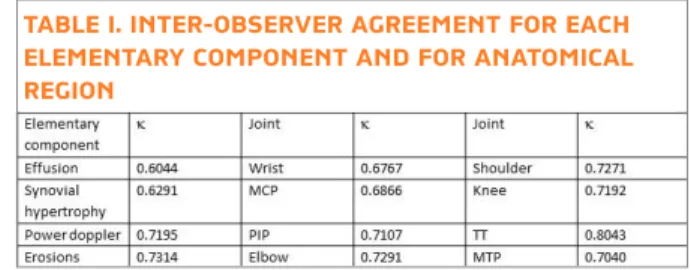
el of agreement/disagreement for each statement using a 1-5 Likert scale (1=strongly disagree to 5-strongly agree). For the reliability exercise, video clips of US examina-tions of 40 joints (wrist, metacarpophalangeal (MCP) from 1 to 5, proximal interphalangeal (PIP) from 1 to 5, knee, tibiotarsal (TT) and metatarsophalangeal (MTP) joints from 1 to 5, elbow and shoulder) from each of 15 patients were collected (showing a multiplanar bilateral ultrasound approach). Each joint in each video was scored by individual ultrasonographers for the pres-ence/absence of elementary components: effusion (Yes/No), SH (No/Grade 1 to 3), PD (No/Grade 1 to 3) and erosions (Yes/No). Inter-reader agreement analysis was assessed through Fleiss’ kappa coefficient and clas-sified according to Landis and Koch[8]: κ va lues < 0 were considered poor, 0-0.20 slight, 0.21-0.40 fair, 0.41-0.60 moderate, 0.61-0.80 good and 0.81-1.00 excellent. Sta-tistical significance was defined as p<0.05. StaSta-tistical analysis was performed using STATA V.14.
Results: Thirty-seven joints of the 600 joints were ex-cluded due to dislocation of the joint or presence of ob-jects (rings/catheters) and the videos of a total of 563 joints were analysed by the 6 ultrasound experts. Inter-reader agreement was superior for TT joints and inferior for wrist; the identification of the erosions had the better agreement in the elementary components (Table I). Conclusions: The reliability of interpretation of in-flammatory and destructive changes using video clips was in general good to excellent and it was better for erosions and tibiotarsal joint (regarding elementary component and anatomical region, respectively). p011 - nEuTropHil-, monoCyTE-,
EosinopHil- and basopHil-lympHoCyTE raTios: assoCiaTions wiTH TradiTional inflammaTory markErs and disEasE aCTiviTy mEasurEs aT basElinE and 6 monTHs afTEr a bdmard among biologiC--naivE rHEumaToid arTHriTis paTiEnTs Bruno Miguel Fernandes1, Salomé Garcia1,
Raquel Miriam Ferreira1, Sara Santos1, Miguel Bernardes1, Lúcia Costa1
1. Serviço de Reumatologia, Centro Hospitalar de São João, Porto, Portugal
Background: Neutrophil-lymphocyte (NLR) and monocyte-lymphocyte (MLR) ratios have been not only suggested as systemic inflammatory markers, but also associated with disease activity in some inflammatory diseases. Eosinophil-lymphocyte (ELR) and basophil-lymphocyte (BLR) ratios have been studied to a lesser extent.
Methods: We conducted a retrospective study includ-ing all RA patients under the first bDMARD (biological disease-modifying antirheumatic drug), followed in a tertiary university hospital and registered in the Rheumatic Diseases Portuguese Register (Reuma.pt). Results of blood tests (C-reactive protein [CPR], ery-throcyte sedimentation rate [ESR], serum amyloid A [SAA], rheumatoid factor [RF], anti-citrullinated pro-tein autoantibodies [ACPA], haemoglobin, platelets, 25-hydroxide-vitamin D [25OHvitD]), leukocyte for-mula ratios (NLR, MLR, ELR, BLR) and disease activi-ty and function measures (disease activiactivi-ty score 28 [DAS28 4V, 3V, 4V-CPR, 3V-CPR], clinician and simple disease activity scores [CDAI, SDAI], swollen and ten-der joint count [SJC, TJC], physician and patient visu-al anvisu-alogicvisu-al scvisu-ale [VAS]) at baseline and at 6 months of bDMARD therapy were collected. Correlations be-tween variables were evaluated by Spearman rank test (significance level at p<0.05), using SPSS 25.0 soft-ware.
Results: 435 patients were included: 81.2% female, mean age at baseline 53.3±11.4 years, mean disease duration 12.6±8.8 years, 72.2% RF positive, 77.1% ACPA positive, 52.5% erosive disease.
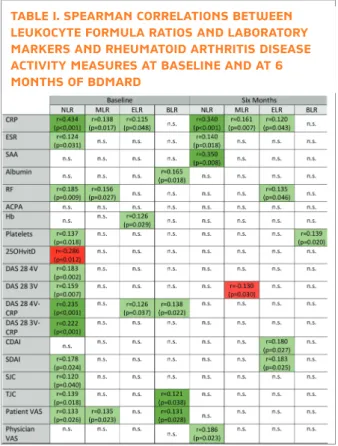
At baseline, NLR correlated positively with CRP (r=0.343; p<0.001), ESR (r=0.124; p=0.031), RF title (r=0.185; p=0.009), platelets count (r=0.137; p=0.018), DAS28(4V) (r=0.183; p=0.002), DAS28(3V) (r=0.159; p=0.007), DAS28(4V-CRP) (r=0.235; p<0.001), DAS28(3V-CRP) (r=0.222; p<0.001), SDAI (r=0.178; p=0.024), SJC (r=0.120; p=0.040), TJC (r=0.139; p=0.018) and patient VAS (r=0.133; p=0.026). At baseline, we also found a negative corre-lation between NLR and 25OHvitD levels (r=-0.286; p=0.012). Baseline MLR showed a positive correlation with baseline CRP (r=0.138; p=0.017), RF (r=0.156; p=0.027) and patient VAS (r=0.135; p=0.023). Simi-larly, at baseline, ELR correlated with CRP (r=0.115; TablE i. inTEr-obsErvEr agrEEmEnT for EaCH
ElEmEnTary ComponEnT and for anaTomiCal rEgion
p=0.048) haemoglobin levels (r=0.126; p=0.029) and DAS28(4VCRP) (r=0.126; p=0.037); and BLR associa -ted positively with DAS28(4V-CRP) (r=0.138; p=0.022), TJC (r=0.121; p=0.038) and patient VAS (r=0.131; p=0.028).
At six months of a bDMARD, NLR correlated posi-tively with: CRP (r=0.340; p<0.001), ESR (r=0.140; p=0.018), SAA (r=0.350; p=0.008) and physician VAS (r=0.186; p=0.023). MLR also exhibited a positive as-sociation with CRP (r=0.161; p=0.007). Similarly, at six months, ELR correlated positively with CRP (r=0.120; p=0.043), RF (r=0.135; p=0.046), CDAI (r=0.180; p=0.027) and SDAI (r=0.183; p=0.025); and BLR correlated positively with platelets count (r=0.139; p=0.020). The results are shown in Table I.
Conclusion: Although weak to moderate in strength, we found significant correlations, between leukocyte formula ratios (NLR, MLR and ELR) and, not only,
in-flammatory markers but also disease activity measures, predominantly at baseline but also at 6 months of bD-MARD. Interestingly, is of note the negative association between NLR and 25OHvitD at baseline. This study reinforced the suggested place of NLR and MLR (but also of ELR) as inflammatory markers and possible di -sease activity measures in RA. More studies are needed to validate this data.
p016 - manifEsTaÇÕEs rEumÁTiCas assoCiadas a imunoTErapia – a ExpEriÊnCia dE um CEnTro
Ana Catarina Duarte1, Sandra Sousa1, Ana Cordeiro1, Frederico Sanches2, Hélder Mansinho2, José Duarte3
1. Rheumatology Department, Hospital Garcia de Orta, Almada, Portugal
2. Oncology Department, Hospital Garcia de Orta, Almada, Portugal
3. Pulmonology Department, Hospital Garcia de Orta, Almada, Portugal
Introdução: As proteínas CTLA-4 (cytotoxic T-lymp-hocyte-associated protein 4) e PD-1 (programmed cell death protein 1) integram as vias de sinalização que as-seguram a tolerância a auto-antigénios e são adquiridas por certos tumores como forma de escape tumoral. A inibição destes alvos por fármacos denominados im-mune checkpoint inhibitors permite o reconhecimen-to e destruição das células neoplásicas pelos linfócireconhecimen-tos T. Esta é a base da imunoterapia (IT), que tem de-monstrado resultados promissores em tumores como carcinoma do pulmão não pequenas células, melano-ma metastático e carcinomelano-ma de células renais.
No entanto, o uso destes fármacos está associado a várias reações adversas imunomediadas, nomeada-mente manifestações reumáticas. As mais comuns são artralgias (1-43%) e mialgias (2-21%), embora casos de artrite, miosite, vasculite, polimialgia reumática e queixas sicca (por vezes cumprindo critérios de Sín-drome de Sjögren) já tenham sido descritos.
Objetivos: Avaliar a prevalência das manifestações reu-máticas nos doentes sob IT, descrevendo a clínica apre-sentada e a estratégia adotada.
Material e Métodos: Análise retrospetiva dos doentes sob IT seguidos na Consulta de Oncologia e Pneumo-logia Oncológica do Hospital Garcia de Orta, entre Abril de 2016 e Dezembro de 2018. Colhidas variáveis demográficas, data de diagnóstico, duração da IT, ma-nifestações reumáticas identificadas, respetivo trata-mento e evolução.
ACPA - anti-citrullinated protein autoantibodies; BLR - basophil-lymphocyte ratio; CDAI - clinician disease activity score; CRP - C-reactive protein; DAS 28 - disease activity score 28; ELR - eosinophil-lymphocyte ratio; ESR - erythrocyte sedimentation rate; Hb - haemoglobin; MLR - monocyte--lymphocyte ratio; NLR - neutrophilmonocyte--lymphocyte ratio; n.s. – not significant; RF - rheumatoid factor; SAA - serum amyloid A; SDAI - simple disease activity score; SJC swollen joint count; TJC tender joint count; VAS -visual analogical scale; 25OHvitD - 25-hydroxide-vitamin D.
TablE i. spEarman CorrElaTions bETwEEn lEukoCyTE formula raTios and laboraTory markErs and rHEumaToid arTHriTis disEasE aCTiviTy mEasurEs aT basElinE and aT 6 monTHs of bdmard
Resultados: No total 51 doentes realizaram IT. O ni-volumab foi usado em 30 doentes, o pembrolizumab em 17, o atezolizumab em 4 (1 com tratamento prévio com nivolumab) e o ipilimumab em 1. A idade média foi 65.8±10.9 anos, sendo a maioria (84.3%) do sexo masculino. A duração mediana da terapêutica foi 6 me-ses [IQR 5-12], sendo a progressão da doença o prin-cipal motivo de suspensão do fármaco. Um doente sob nivolumab suspendeu o fármaco por pneumonite imu-nológica e outro sob pembrolizumab por hepatite tó-xica. Durante a IT 11 doentes morreram por progres-são da doença.
Dos 51 doentes, 5 (9.8%) desenvolveram manifes-tações articulares com possível associação à IT. A clíni-ca surgiu em média 4.4 meses após início da IT, todos sob nivolumab e sem metastização óssea. A tabela 1 mostra as características destes 5 doentes.
As manifestações articulares foram tratadas com anti-inflamatórios não esteroides, analgésicos opióides e não-opióides, e em alguns casos com corticoterapia sistémica, de acordo com protocolo definido por on-cologista/pneumologista assistente. Por persistência das queixas sob corticoterapia, o doente 5 foi posterior-mente referenciado a consulta de Reumatologia, onde foi objetivada artrite das mãos e punhos bilateralmen-te, sem erosões e com fator reumatóide, anticorpos anti-pé tidos citrulinados e anticorpos antinucleares nega-tivos Nenhum dos doentes suspendeu IT, tendo todos apresentado remissão das queixas articulares cerca de 2-3 semanas após instituição terapêutica. Até à data ne-nhum apresentou recorrência das manifestações arti-culares.
Conclusões: A ocorrência de manifestações reumáticas em doentes sob IT é uma realidade, embora muitas ve-zes subdiagnosticada. Apesar da amostra ser pequena, cerca de 10% dos doentes teve manifestações muscu-lo-esquéticas com necessidade de intervenção
farma-cológica. A avaliação destes doentes por Reumatologia é fundamental para uma correta avaliação diagnóstica, com exclusão de outras etiologias possíveis, bem como para adequada orientação terapêutica. Deste modo, a criação de um protocolo entre oncologistas/pneumo-logistas e reumatooncologistas/pneumo-logistas poderá constituir uma mais-valia nos cuidados a estes doentes.
p018 - nEurologiC involvEmEnT in anTinEuTropHil CyToplasmiC anTibody (anCa)-assoCiaTEd vasCuliTis
–ExpEriEnCE from a porTuguEsE CEnTEr Ana Catarina Duarte1, Sandra Sousa1, Ana Cordeiro1
1. Rheumatology Department, Hospital Garcia de Orta, Almada, Portugal
Background: Involvement of peripheral (PNS) and central nervous system (CNS) in antineutrophil cyto-plasmic antibody (ANCA)-associated vasculitis has been reported in 15-60% and 5-15% of patients (pts), respectively. PNS involvement occurs mainly in eosinophilic granulomatosis with polyangiitis (EGPA) and CNS involvement has been almost exclusively de-scribed in granulomatosis with polyangiitis (GPA). Neurologic involvement is associated with a higher morbidity and implies more immunosuppressive treat-ment in most patients (pts).
Objectives: Evaluate prevalence and clinical features of PNS/CNS involvement in pts with ANCA-vasculitis in a Portuguese center.
Methods: Retrospective analysis of ANCA-vasculitis pts with neurologic involvement followed in our de-partment from January 2016 to December 2018. Data was collected from the Portuguese database REUMA.PT and included demographic data, vasculitis subtype, date of diagnosis, neurologic manifestations and treatment approach.
Results: In total, 11 pts were identified, mostly female (7/11) with mean age of 61±13.3 years (yrs). Five pts had EGPA, 5 GPA and 1 microscopic polyangiitis (MPA). Neurologic involvement was part of disease pre-sentation in 8 pts (5 EGPA, 3 GPA). The other 3 pts had neurologic involvement 7±2.2 yrs after vasculitis diag-nosis. At the time of neurologic involvement diagnosis, Birmingham Vasculitis Activity Score was 8.8±4.3. PNS involvement occurred in 9 pts, all presenting mononeuritis multiplex (MM). From these, 5 had EGPA, 3 GPA and 1 MPA.
CNS involvement was reported in 3 pts, 2 with GPA and 1 with EGPA. Pachymeningitis was diagnosed in 1 Legenda: CPC – carcinoma pavimento-celular; ADC – adenocarcinoma;
IT – imunoterapia; TT- tibiotársicas
TabEla i. CaraCTErÍsTiCas dos doEnTEs Com manifEsTaÇÕEs rEumÁTiCas no ConTExTo dE imunoTErapia
GPA pt with persistent headache, refractory to anal-gesics, and thickening and enhancement of the dura mater on postcontrast magnetic resonance imaging. Two pts had cranial mononeuropathy, 1 with EGPA and MM who developed VI palsy 2 yrs after vasculitis di-agnosis and 1 pt with GPA and VII palsy at disease pre-sentation who developed XII palsy 8 yrs later.
All pts were treated with prednisolone (1mg/kg/day), mostly in combination with other im-munosuppressive drugs. The choice of the treatment was based on the age of the pt and other comorbidities. Detailed treatment of these pts and subsequent re-sponses are shown in Table I.
In our cohort there were 2 pts with serious infections: 1 with oropharyngeal and esophageal candidiasis and another with bacteraemia to Pseudomonas aeruginosa. Both pts were under immunosuppressive agents in-cluding corticosteroids and rituximab or cyclophos-phamide.
Conclusion: Neurologic involvement was part of dis-ease presentation in most pts and the commonest man-ifestation was mononeuritis multiplex.
PDN was prescribed to all pts, in most cases in associ-ation with other immunosuppressive drugs. Cy-clophosphamide and rituximab (RTX) were used as in-duction treatment, and mycophenolate mofetil, aza-thioprine and RTX as maintenance. Intravenous hu-man immunoglobulin was used in pts colonized by multiresistant microorganisms/severe infection with immunosuppression and as a bridging therapy to
fur-ther immunossupression. Most pts achieved clinical improvement, documented in electromyography. p022 - monoCyTE-lympHoCyTE raTio and plaTElET-lympHoCyTE raTio: rolE as biomarkErs of disEasE aCTiviTy in psoriaTiC arTHriTis paTiEnTs
Raquel Miriam Ferreira1, Sara Ganhão1, Bruno Miguel Fernandes1, Salomé Garcia1, Sofia Pimenta1, Miguel Bernardes1, Lúcia Costa1
1. Serviço de Reumatologia, Centro Hospitalar de São João, Porto, Portugal
Background: Monocyte-lymphocyte ratio (MLR), neu-trophil-lymphocyte ratio (NLR) and platelet-lympho-cyte ratio (PLR) had emerged as good indicators of sys-temic inflammation status in a variety of diseases like cancer, cardiovascular and autoimmune diseases. Fur-thermore, some recent data showed relevant associa-tion of this haematological parameters with others tra-ditional inflammatory measures as serum c- reactive protein (CRP) levels in rheumatic patients, suggesting their use as a valuable indicator of disease activity. Objectives: To assess the association between the NLR, MLR, eosinophil-lymphocyte ratio (ELR), basophils-lymphocyte ratio (BLR) and PLR with disease activity and functional parameters in psoriatic arthritis (PsA) patients.
Methods: An observational cross-sectional study was performed in patients with psoriatic arthritis before in-troduction of a bDMARD, followed at our Rheumatol-ogy department until December 2018. Demographic, clinic and laboratory information were collected from the national database (Reuma.pt). Available data of blood cell counts were consulted and NLR, MLR, ELR, BLR and PLR were calculated by dividing neutrophil, monocyte, eosinophil, basophils and platelet count by lymphocyte count, respectively. The following disease activity and functional scores were also registered: CRP and ESR levels, DAS28 4V and 3V (ESR and CRP), HAQ, BASDAI, ASDAS-CRP, BASFI, BASMI, swollen and tender joints counts (SJC and TJC), SPARCC index, patient global assessment (PtGA) and physician global assessment (PGA) rated on a visual analogue scale (VAS). Correlations between variables were evaluated with Spearman’s test. The statistical analysis was per-formed using SPSS 21.0 software. Differences were considered statistically significant at p<0.05.
Results:A total of 83 patients were enrolled. Forty-three were females (51.8%) and forty were males TablE i. dETailEd daTa on paTiEnTs wiTH
nEurologiC involvEmEnT in rElaTion To anCa vasCuliTis
(48.2%). The mean age was 47 years (±10.9) and the median disease duration at start of biological therapy was 6.9 years (min:1.4; max:32.4). In total, 67.5% of the patients had axial involvement (n=56), 91.6% ar-ticular involvement (n=76) and 43.4% enthesopathic involvement (n=36). Almost all patients fulfilled the CASPAR criteria for PsA (n=78; 94%). Thirty patients presented with dactlylitis (36%). Most were non-smok-ing (n=48; 57.8%) and most didn’t have history of al-cohol consumption (n=55; 66.3%). According to AS-DAS criteria, 25 patients (30.1%) had high disease ac-tivity and 45 patients (54.2%) very high disease activ-ity. At time of evaluation, 71.1% were receiving csDMARDs. NSAIDs and corticosteroids were pre-scribed in 80.7% and 54.2% of the patients, respec-tively. We found statistically significant correlation be-tween MLR values and CRP levels (r=0.276, p=0.014). MLR did not correlate with ESR levels, DAS28 4V and 3V (ESR and CRP), HAQ, BASDAI, ASDAS-CRP, BAS-FI, BASMI, SJC, TJC, SPARCC, PtGA and PGA. PLR values also had weak correlation with ESR (r=0.340, p=0.002), DAS 4V-ESR (r=0.260; p=0.027) and with DAS 3V-ESR (r=0.290, p=0.012). There was no statis-tically significant correlation between PLR values and others disease parameters. No significant correlation was found between NLR, ELR and BLR and the func-tional and disease activity scores evaluated.
Conclusion: Our study showed that MLR had a posi-tive association with CRP and PLR with ESR, DAS 4V-ESR and DAS 3V-4V-ESR. Evaluation of this novel inflam-matory biomarkers may represent a simple, cost-effec-tive and useful tool in monitoring disease activity in PsA patients.
p023 - TimE-CoursE CHangE of nEuTropHil-lympHoCyTE raTio, monoCyTE-lympHoCyTE raTio and
plaTElET-lympHoCyTE raTio in psoriaTiC arTHriTis paTiEnTs and rEsponsE To biologiC THErapy
Raquel Miriam Ferreira1, Sara Ganhão1, Salomé Garcia1, Bruno Miguel Fernandes1, Sofia Pimenta1, Miguel Bernardes1, Lúcia Costa1
1. Serviço de Reumatologia, Centro Hospitalar de São João, Porto, Portugal
Background: Recently, systemic inflammation has been shown to be a key determinant of prognosis. Neu-trophil-lymphocyte ratio (NLR), monocyte-lympho-cyte ratio (MLR) and platelet-lymphomonocyte-lympho-cyte ratio (PLR)
has been related to inflammation status and suggested as additional markers of response to bDMARDs in pa-tients with rheumatoid arthritis. However, few studies were yet developed about this subject in psoriatic arthritis (PsA).
Objectives: To investigate the time-course change of NLR, MLR and PLR levels in PsA patients after 6 and 12 months of bDMARD therapy and to evaluate their utility in monitoring response to biologic agents. Methods: An observational study was performed in patients with PsA under bDMARD, followed at our Rheumatology department until December 2018. De-mographic and clinical data were collected from Reuma.pt. CRP, ESR and total blood count were con-sulted before and after 6 and 12 months of biologic treatment and NLR, MLR and PLR were calculated by dividing neutrophil, monocyte and platelet count by lymphocyte count, respectively. Disease activity was evaluated with DAS28 and ASDAS. The variation of each parameter was calculated as the difference be-tween the levels registered at 6 and 12 months and the baseline and presented as ∆. Correlations between variables were evaluated with Spearman’s test. Results: 83 patients were included. 43 were females (51.8%). The mean age at diagnosis was 41 years (±11.3) and the median disease duration at start of bD-MARD was 6.9 years (min:1.4; max:32.4). In total, 67.5% of the patients had axial involvement (n=56), 91.6% articular involvement (n=76) and 43.4% en-thesopathic involvement (n=36). At the baseline, 25 patients (30.1%) had high disease activity and 45 pa-tients (54.2%) very high disease activity according to ASDAS criteria. The most used bDMARD was etaner-cept (n=29; 35%), followed by golimumab (n=26; 31%), adalimumab (n=16; 19%) and infliximab (n=8; 10%). Certolizumab was administered to 2 patients and secukinumab to others 2 patients. Fifty-nine pa-tients were concomitantly treated with csDMARDs. The median value of CPR was 1.5mg/dL [0.03-30], 0.26 [0.03-11] and 0.37 [0.02-19] at baseline, 6 and 12 months, respectively. The median value of ESR was 33mm/hr [4-98], 11 [2-75] and 10 [1-68] at baseline, 6 and 12 months, respectively. We realize that NLR, MLR and PLR decreased after 6 months of treatment and remained relatively stable at 12 months (NLR dian: 2.6 [0.1-8.8], 1.6 [0.5-5.3], 1.6 [0.5-8]; MLR me-dian: 0.32 [0.11-250], 0.23 [0-7.4], 0.25 [0.05-1]; PLR median: 132 [69.6-342.5], 97.6 [33.4-415.1], 98.6 [ 38.3- 528.6] at baseline, 6 and 12 months, respective-ly). A significant positive correlation was found
be-tween ∆NLR and ∆CPR at 6 months (r=0.272; p=0.016) and also between ∆MLR and ∆CPR at 6 and 12 months (r=0.309, p=0.006; r=0.364, p=0.002). ∆PLR showed a statistically significant correlation only with ∆ESR at 6 months (r=0.312; p=0.006). No cor-relation were found between ∆NLR, ∆MLR and ∆PLR with ∆DAS28 or between ∆NLR, ∆MLR and ∆PLR with ∆ASDAS at evaluation of 6 and 12 months. Conclusion: Our data showed that NLR, MLR de-creased promptly in parallel with decrease of CRP and PLR with ESR for up 6 months of therapy with biolog-ics. This results, in agreement with the literature, sug-gests that NLR, MLR and PLR may be seen as a useful marker for demonstrating systemic inflammation in PsA patients. Further studies are needed to better em-phasize the importance of these parameters and to eval-uate their utility to monitor the effectiveness of biolog-ic therapy.
p024 - EvEnTos CardiovasCularEs nos doEnTEs Com goTa TraTados Com fEbuxosTaTE
Raquel Miriam Ferreira1, Sofia Pimenta1, Lúcia Costa1
1. Serviço de Reumatologia, Centro Hospitalar de São João, Porto, Portugal
Introdução: O febuxostate é um potente inibidor da xantina oxidase aprovado para o tratamento de gota crónica. No entanto, existe alguma controvérsia a res-peito de um potencial aumento do risco cardiovascu-lar associado ao uso do fármaco.
Objetivo: Avaliar o perfil de segurança do febuxosta-te, analisando a ocorrência de eventos cardiovasculares após a sua introdução.
Métodos: Estudo observacional dos doentes com ar-tropatia gotosa seguidos no nosso serviço de Reuma-tologia sob tratamento com febuxostate 80mg id. Os dados sociodemográficos e clínico-laboratoriais foram obtidos através da consulta dos processos hospitalares. Os eventos cardiovasculares considerados foram sín-drome coronário agudo (SCA), insuficiência cardíaca congestiva (ICC), acidente vascular cerebral (AVC), ar-ritmia e morte por causa cardiovascular. Para a análise estatística foram utilizados os testes Mann-whitnney e qui-quadrado. O nível de significância estabelecido foi p<0.05.
Resultados: Nós identificamos 36 doentes com diag-nóstico de gota sob tratamento com febuxostate. Cin-co doentes foram excluídos por não apresentarem um período mínimo de 3 meses de seguimento. A idade
média era de 64±14 anos e a duração média de doen-ça de 13±9 anos. Vinte e dois eram homens (71%). A presença de tofos gotosos confirmou-se em 19 doentes (61%). Vinte e três doentes apresentavam hipertensão arterial (HTA) e excesso ponderal (74%), 22 dislipide-mia (71%), 16 eram diabéticos (52%) e 13 tinham his-tória de tabagismo (42%). Treze doentes apresentavam doença renal crónica (DRC) (42%). A respeito dos eventos cardiovasculares conhecidos previamente ao início de febuxostate, 3 doentes tinham antecedentes de SCA, 2 tinham sofrido um AVC, 2 apresentavam doença arterial periférica e 3 tinham ICC estabelecida. Não se verificou nenhum caso de intolerância ou rea-ção alérgica ao fármaco. Após início de febuxostate, 4 doentes desenvolveram um evento cardiovascular: 1 apresentou episódio de síncope por bloqueio aurico-ventricular completo paroxístico que estabilizou após colocação de pacemaker, 1 doente apresentou angina instável tendo sido submetido a angioplastia com im-plante de stent coronário, registou-se 1 caso de des-compensação de ICC e um caso de novo de fibrilação auricular e ICC associada. Não se verificaram eventos cardiovasculares fatais. Na análise comparativa segun-do o desenvolvimento de um evento cardiovascular posterior à introdução de febuxostate, verificamos uma associação positiva de forma significativa da ocorrên-cia de evento com a presença de DRC (100% vs 33%; p=0.02). Não houve relação estatisticamente significa-tiva com presença de história prévia de evento cardio-vascular, idade, sexo ou fatores de risco cardiovascula-res modificáveis.
Conclusão: A nossa análise confirmou que a existên-cia de comorbilidades é comum nos doentes com gota, podendo constituir fatores determinantes na decisão terapêutica. Quatro doentes da nossa amostra (13%) apresentaram um evento cardiovascular de novo após início de febuxostate. Os nossos dados parecem suge-rir que o seu desenvolvimento pode associar-se a ante-cedentes de DRC, pelo que o uso do fármaco deve ser prudente nesse contexto clínico.
p025 - prinCipais indiCaÇÕEs E EfiCÁCia do fEbuxosTaTE nos doEnTEs Com arTropaTia goTosa- ExpEriÊnCia dE um CEnTro HospiTalar
Raquel Miriam Ferreira1, Sofia Pimenta1, Lúcia Costa1
1. Serviço de Reumatologia, Centro Hospitalar de São João, Porto, Portugal
hipouricemian-te utilizado no tratamento de artropatia gotosa. No en-tanto, o tratamento com febuxostate parece particular-mente útil em caso de intolerância ao alopurinol ou em caso de insuficiência renal crônica.
Objetivo: Avaliar a eficácia do febuxostate no trata-mento de gota e a influência de características clínicas na resposta terapêutica.
Métodos: Estudo retrospetivo dos doentes com artro-patia gotosa seguidos no nosso serviço de Reumatolo-gia sob tratamento com febuxostate 80mg id. O prin-cipal alvo terapêutico estabelecido foi ácido úrico séri-co <6mg/dL. Os dados epidemiológiséri-cos e clíniséri-cos fo-ram obtidos através da consulta dos registos hospitalares. Para a análise estatística foram usados tes-te paramétricos e não paramétricos. O nível de signifi-cância estabelecido foi p<0.05.
Resultados: Nós identificamos 36 doentes com diag-nóstico de gota sob tratamento com febuxostate desde 2010. Cinco doentes foram excluídos por não apre-sentarem um período mínimo de 3 meses de segui-mento, pelo que a nossa amostra totalizou 31 doentes. Vinte e dois (71%) eram homens e nove (29%) mu-lheres, com uma idade média de 64±14 anos e uma du-ração média de doença de 13±9 anos. O padrão de en-volvimento era poliarticular na maioria dos doentes, sendo que 2 doentes apresentavam uma forma oli-goarticular. Dezanove doentes tinham tofos gotosos (61%). Na maioria dos casos, o febuxostate foi inicia-do após o alopurinol, seninicia-do os motivos de switch mais frequentes: reação cutânea a alopurinol (n=14;45%), refratariedade a alopurinol (n=11;35,5%), insuficiên-cia renal (n=3;10%) ou hepatotoxicidade a alopurinol (n=2;6.5%). Febuxostate foi usado como fármaco de 1ª linha somente em 1 doente, tratando-se de um trans-plantado renal. Vinte e três doentes tinham hiperten-são arterial e excesso ponderal (74%), 22 dislipidemia (71%), 16 diabetes mellitus (52%), 13 história de ta-bagismo (42%) e 13 doença renal crónica (DRC). A me-diana do nível de ácido úrico no baseline era de 9.6mg/dL (min:6.8; max:16). Em 65% dos casos (n=20) atingiu-se o alvo de uricemia sérica <6mg/dL, num período de tempo mediano de 69 dias (min 10; max 1202). Em 48% dos doentes alcançou-se o nível sérico de ácido úrico <5mg/dL, em um período de tem-po mediano de 132 dias (min:13; max: 902). Não se ve-rificaram diferenças estatisticamente significativas na taxa de resposta terapêutica (para alvo de 6 ou 5mg/dl) entre os doentes segundo variáveis como sexo, idade, duração da doença, presença de tofos, comor-bilidades cardiovasculares, DRC ou níveis de
hiperuri-cemia basais.
Conclusão:A maioria dos doentes apresentava doen-ça poliarticular tofácea, o que revela que o febuxostate permanece como importante opção de 2ª linha para casos de difícil controlo ou em caso de toxicodermia ao alopurinol. Ao contrário dos achados de alguns estudos que apontam para uma influência dos níveis de ácido úrico sérico no baseline com a eficácia do febuxostate, nós não encontramos nenhuma relação associada às ca-racterísticas clínicas ou laboratoriais. Os resultados sa-tisfatórios da eficácia do febuxostate e aquisição de maior experiência clínica nos próximos anos poderão vir a ampliar a sua utilização.
p026 - THE rolE of nEuTropHis To lympHoCyTE raTio (nlr), monoCyTE To lympHoCyTE raTio (mlr), plaTElET To lympHoCyTE raTio (plr), EosinopHil To lympHoCyTEs raTio (Elr) and basopHilE To lympHoCyTE raTio (blr) in assEssing disEasE aCTiviTy in spondyloarTHriTis Salomé Garcia1, Bruno Miguel Fernandes1,
Raquel Miriam Ferreira1, Sara Ganhão1,
Miguel Bernardes1, Georgina Terroso1, Lúcia Costa1
1. Serviço de Reumatologia, Centro Hospitalar de São João, Porto, Portugal
Background:Neutrophil to lymphocyte ratio (NLR), monocyte to lymphocyte ratio (MLR), platelet to lym-phocyte ratio (PLR), eosinophil to lymlym-phocyte ratio (ELR) and basophile to lymphocyte ratio (BLR) have been demonstrated to be promising systemic inflam-mation markers. NLR, MLR and PLR have been asso-ciated with disease activity in Spondyloarthritis (SpA) but the results remain conflicting.
Objectives: We aim to determine the role of NLR, MLR, PLR, ELR and BLR in assessing disease activity in SpA.
Methods: Observational retrospective study was per-formed including consecutive patients with the diag-nosis of SpA (according to ASAS classification criteria) followed at our Rheumatology Department. Demo-graphic, clinical (including BASDAI, BASFI, ASDAS ESR and ASDAS CRP indices) and laboratorial data were collected from our national database at baseline and 6 months after initiation of a tumour necrosis fac-tor inhibifac-tor (TNFi). Correlations between variables were studied using Spearman correlation analysis and comparison between groups was performed using Wilcoxon test.
Results: The mean age of patients (n=297) was 41 years old (± 12), 160 (53.9%) were males with medi-an disease duration of 12.4 (IQR 14.8) years. Two hun-dred and seven patients (69.7%) had Ankylosing Spondylitis, 26 (8.8%) Inflammatory Bowel Disease re-lated SPA and 36 (12.1%) Undifferentiated SpA. Sev-enty-three (24.7%) patients were taking glucocorti-coids and regarding conventional synthetic disease-modifying anti-rheumatic drugs (csDMARDs) use be-fore starting the TNFi: 188 (63.3%) were not under any csDMARD and the remaining ones were under Sul-fasalazine (70, 23.6%), Methotrexate (MTX) (21, 7.1%), Azathioprine (AZA) (5, 1,7%), Leflunomide (1, 0.3%) or associations between Sulfasalazine and AZA or MTX. Regarding the iTNF the majority of patients initiate Adalimumab (n=168, 28.6%), Golimumab (n= 61, 25.6%) or Infliximab (n= 57, 23.9%). The majori-ty of patients had very high or high disease activimajori-ty at baseline (59.6% and 31.3%, respectively); mean AS-DAS CRP was 3.85 (± 0.99), mean ESR was 30.1 mm/h (± 21.9) and mean CRP was 36.9 mg/L (±113.9). The post-treatment mean ESR, CRP, CRP, ASDAS-ESR and BASDAI were significantly lower than mean baseline values, as they were also for NLR, MLR and PLR (p<0.01).
At the baseline evaluation, in anti-TNF naïve pa-tients, NLR and MLR were positively correlated with the majority of parameters evaluated: ESR level (r=0.322; r=0.203, p<0.01 respectively), CRP level (r= 0.475; r=0.221, p<0.01 respectively), ASDAS-CRP (r=0.255; r=0.192, p<0.01 respectively), ASDAS-ESR (r=0.257; r=0.206, p<0.01 respectively) and BASMI (r=0.288; r=0.150, p<0.01 respectively). No correla-tions were found with BASDAI. PLR was positively cor-related with ESR level (r=0.379, p<0.01), CRP level (r= 0.331, p<0.01), ASDCRP (0.215, p<0.01) and AS-DAS-ESR (r=0.208, p<0.01). No correlations were found between those parameters and ELR or BLR. At the evaluation 6 months after introducing a TNFi, we found less and weaker correlations than in naïve pa-tients: NLR and PLR correlate positively with CRP (r=0.302; 0.315, p<0.01 respectively) and, reaching lower statistical significance, PLR correlate also with ASDAS-ESR (0.156, p<0.05); NLR with BASMI (0.184, p<0.05) and ESR (0.179, p<0.05); MLR with CRP (0.173, p<0.05).
Conclusion: NLR, MLR and PLR may reflect disease activity and could represent future inexpensive poten-tial parameters to evaluate disease activity or severity in SpA.
p027 - THE lung in sjogrEn’s syndromE paTiEnTs – an ovErviEw of CliniCal CHaraCTErisTiCs and disEasE ouTComE Ana Catarina Duarte1, Ana Cordeiro1,
Maria José Santos1, 2
1. Rheumatology Department, Hospital Garcia de Orta, Almada, Portugal
2. Unidade de Investigação em Reumatologia, Instituto de Medicina Molecular, Faculdade de Medicina, Universidade de Lisboa, Centro, Lisboa, Portugal
Background: Lung involvement has been reported in 10-20% of patients (pts) with primary Sjögren’s syn-drome (pSS) and mostly affecting parenchyma and air-ways. Its occurrence significantly impacts both quali-ty of life and mortaliquali-ty in pSS pts.
Objectives: To characterize lung involvement in a co-hort of pSS pts and present our experience with im-munosuppressive drug treatment for pSS-interstitial lung disease (ILD).
Methods: Retrospective analysis of pSS pts followed in our Rheumatology department until December 2018. Lung involvement was based on high resolution com-puted tomography and/or histopathological alterations described in the spectrum of pSS-associated lung dis-ease. Patients with and without lung disease were com-pared using parametric and non-parametric tests. Results: In total, 137 pSS pts that fulfilled the Euro-pean-American consensus criteria 2002 were identi-fied, 130 (94.9%) females, with mean age at pSS diag-nosis of 56.1 (±12.2) years; median disease duration of 6 [IQR 10] years and median follow-up 6 [IQR 3-10.25] years. Antinuclear antibodies (ANA) were pos-itive in 113 (82.5%) pts, with 95/134 (70.9%) pts pre-senting positive anti-SSA and 60/128 (46.9%) anti-SSB. Specific immunoassays were performed in 82 pts, al-lowing identification of anti-Ro52 antibody in 48 (58.5%) of them. Rheumatoid factor was positive in 48/91 (52.7%).
During follow-up 3 pts died, one of them due to ILD progression and the other 2 due to sepsis (respiratory and abdominal), both treated with immunosuppres-sive drugs.
Lung involvement occurred in 17 (12.4%) pts. The median time to lung disease was 2 years [IQR 0-8] af-ter pSS diagnosis.
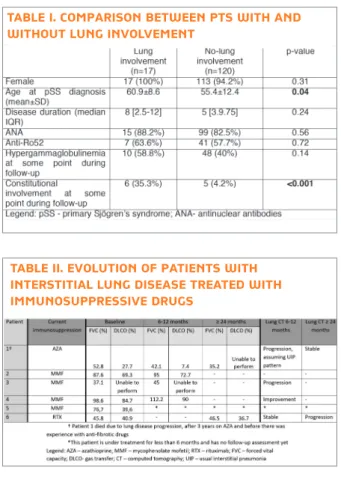
Mean EULAR SS disease activity index (ESSDAI) at the time of lung involvement diagnosis was 13.1 (±5). Main differences between pts with and without lung involvement are shown in Table I.
Detailed lung function and imaging evolution of pSS-ILD pts is shown in Table II.
Conclusions: Lung involvement occurred in 12.4% of our cohort and was associated with older disease at SS diagnosis and presence of constitutional involvement.
Small airways disease and ILD had nearly the same prevalence and in the ILD sub-group, NSIP was the commonest pattern.
Despite the small number of ILD pts receiving im-munosuppression, these drugs seemed to be associat-ed with disease stabilization in most of them. Only 1 pt with UIP pattern had disease progression and even-tually died.
p029 - riTuximab no TraTamEnTo da doEnÇa pulmonar inTErsTiCial assoCiada a arTriTE rEumaTÓidE
Bruno Miguel Fernandes1, Miguel Bernardes1, Natália Melo2, Patrícia Mota2, António Morais2, Lúcia Costa1
1. Serviço de Reumatologia, Centro Hospitalar São João, Porto, Portugal, 2Serviço de Pneumologia, Centro Hospitalar São João, Porto, Portugal
Introdução: A Doença Pulmonar Intersticial (DPI) constitui uma manifestação extra-articular comum e uma causa major de morbilidade e mortalidade na Ar-trite Reumatóide (AR), sendo ainda escassa a evidência da utilização do rituximab (RTX) nesse contexto. Métodos: Estudo monocêntrico e retrospetivo, in-cluindo todos os doentes tratados com RTX por DPI associada à AR, seguidos num Centro Hospitalar Uni-versitário. O padrão de DPI foi definido por tomogra-fia computorizada de alta resolução (TC-AR) ou biópsia pulmonar e foram obtidos dados relativos à monitori-zação da doença articular e pulmonar [TC-AR, capaci-dade vital forçada prevista (CVFprev), capacicapaci-dade de difusão do monóxido de carbono prevista (DLCOprev) e prova da marcha dos 6 minutos (PM6M)] aos 6, 12, 24 e 36 meses de tratamento com RTX. A associação en-tre as diferentes variáveis recolhidas foi estabelecida através do coeficiente de correlação de Spearman. Resultados: Foram incluídos 24 doentes [19 do sexo feminino (79.2%), idade média de 64±8.9 anos, 17 (70.8%) seropositivos para fator reumatóide, 23 (95.8%) seropositivos para anticorpos anti-peptídeos citrulinados cíclicos (ACPAs), 4 (16.7%) fumadores ati-vos e 4 (16.7%) ex-fumadores], com duração média de AR de 12±7.8 anos e duração média de DPI de 55.3±40.7 meses. Relativamente ao padrão de DPI, ve-rificou-se um padrão de pneumonia intersticial usual Regarding the pattern of lung involvement, 9
(52.9%) pts had ILD, 6 (35.3%) isolated bronchiecta-sis and 2 (11.8%) follicular bronchiolitis.
In ILD pts, non-specific interstitial pneumonia (NSIP) was documented in 6 pts, lymphocytic inter-stitial pneumonia in 2 and 1 pt had unclassifiable ILD pattern with lymphocytic alveolitis in bronchoalveolar lavage. One of the pts with NSIP pattern later devel-oped radiographic characteristics suggestive of usual interstitial pneumonia (UIP).
Six ILD pts were treated with immunosuppressive drugs. One received cyclophosphamide (CYC), 2 aza-thioprine (AZA) and 4 mycophenolate mofetil (MMF). From pts receiving MMF, 1 was previously treated with CYC as induction treatment and the other with AZA, but with inefficacy.
Rituximab (RTX) was given to 1 pt with refractory arthritis and new ILD onset. After 11 years on RTX (to-tal 10 cycles) this pt complained of persistent dysp-noea and fatigue on minor exertion (cardiac causes ex-cluded), with onset of subtle honeycombing in high resolution computed tomography. At this point pir-fenidone was added to RTX, with clinical improvement.
TablE i. Comparison bETwEEn pTs wiTH and wiTHouT lung involvEmEnT
TablE ii. EvoluTion of paTiEnTs wiTH inTErsTiTial lung disEasE TrEaTEd wiTH immunosupprEssivE drugs
em onze pacientes (45.8%), pneumonia intersticial não específica em quatro (16.7%), bronquiolite folicular em três (12.5%) e outros padrões em seis pacientes (25%). A tabela 1 ilustra a evolução da resposta ao RTX a nível pulmonar.
A DLCOprev basal correlacionou-se com a DLCO-prev aos 6 meses (r=0.929; p=0.030), aos 12 meses (r=0.905; p=0.002), e aos 24 meses (r=0.900; p=0.037). Além disso, aos 12 meses, a variação da DLCOprev correlacionou-se negativamente com a car-ga tabágica total (r=-0.768; p=0.009) e positivamente com o título basal de ACPAs (r=0.685; p=0.029). Veri-ficou-se, ainda, uma forte correlação entre a DLCO-prev aos 24 meses e a percentagem basal de células NK (r=0.900; p=0.037).
Por outro lado, a CVFprev aos 6 meses correlacio-nou-se negativamente com a proteína C-reativa basal (r=-0.745; p=0.013) e positivamente com a idade (r=0.793; p=0.06). Aos 12 meses, a CVFprev correla-cionou-se com a pressão parcial de oxigénio inicial (r=0.717; p=0.030), a DLCOprev e CVFprev iniciais [r=0.648 (p=0.043) e r=0.867 (p=0.001), respetiva-mente]. Já aos 24 meses, a CVFprev correlacionou-se negativamente com as seguintes variáveis: DAS 28 (4V) (r=-0.881; p=0.004); HAQ (r=-0.952; p<0.001) e es-cala de Borg de dispneia na PM6M (r=-0.975; p=0.005).
Oito doentes (33.3%) suspenderam definitivamen-te o tratamento com RTX: três (37.5%) por indefinitivamen-tercor- intercor-rências infeciosas e três faleceram (um por infeção pul-monar, um por neutropenia febril e outro por motivo desconhecido).
Conclusão: Os nossos resultados reforçam os dados positivos que o RTX tem apresentado no tratamento da DPI associada à AR. Maior atividade basal da doença ar-ticular e maior carga tabágica associaram-se a pior res-posta funcional respiratória ao RTX. Por outro lado, melhores parâmetros funcionais respiratórios basais, títulos mais elevados de ACPAs, maior percentagem de células NK e idade mais avançada associaram-se a me-lhor resposta ao RXT.
p036 - sErum spHingolipids as
CandidaTE biomarkErs in rHEumaToid arTHriTis
Ana Rita Cruz-Machado1, 2, Miltenyi G2, Vasco A Conceição2, Ângelo Calado2, Lopes IP2, Maria Fuller3, JE Fonseca1, 2
1. Serviço de Reumatologia e Doenças Ósseas Metabólicas, Hospital de Santa Maria, CHULN, Centro Académico de Medicina de Lisboa, Lisboa, Portugal
2. Unidade de Investigação em Reumatologia, Instituto de Medicina Molecular, Faculdade de Medicina, Universidade de Lisboa, Centro Académico de Medicina de Lisboa, Lisboa, Portugal
3. Genetics and Molecular Pathology, SA Pathology, Women and Children Hospital, University of Adelaide, Adelaide, Australia
Background: The identification of rheumatoid arthri-tis (RA) serum biomarkers with applicability to early di-agnosis and treatment stratification is a relevant unmet medical need. Various lipid species, including sphin-golipids, which are implicated in inflammatory path-ways, were identified to be significantly increased in the synovial fluid (SF) of RA patients and have been shown to be associated with inflammatory activity in other diseases.
Objectives: To identify serum sphingolipids as candi-date serum biomarkers in RA.
Methods: We performed lipidomics analyses on Ce-ramide (Cer), MonohexosylceCe-ramide (MHCer) and Sphingosine (So) using high-performance liquid chro-matography-mass spectrometry in the serum of 19 es-tablished RA, 18 early arthritis patients who latter de-veloped classification criteria for RA, 17 early arthritis patients who did not develop classification criteria for RA, 12 established spondyloarthritis (SpA) patients and 20 age and gender matched healthy controls. We car-ried out multiple regression analyses considering age at diagnosis, gender, DAS-28, medication and disease du-ration as independent variables to compare patient TabEla i. EvoluÇÃo da rEsposTa ao riTuximab
a nÍvEl pulmonar
Legenda: DLCOprev - Capacidade de Difusão de Monóxido de Carbono prevista; CVFprev - Capacidade Vital Forçada prevista; TC-AR - Tomografia computorizada torácica de alta resolução.
groups with controls.
Results: Patients with established RA had increased levels of Cer, MHCer and So vs. controls, when in-cluding age and gender in the analyses. MHCer was also increased when additionally controlling for med-ication (conventional disease-modifying anti-rheumat-ic drugs and cortanti-rheumat-icoid treatment). On the contrary, SpA patients, who were all on nonsteroidal anti-inflamma-tory drugs, had significantly decreased levels of Cer, compared to controls, in both analyses.
Conclusions: Our results suggest that there is an in-crease in certain sphingolipid levels in the serum of RA patients, in line with previous observations on SF. This suggests that sphingolipids play a role in the patho-physiology of RA and should be further explored as serum biomarkers in RA.
p045 - wHaT is axial spondyloarTHriTis? a laTEnT Class and TransiTion
analysis in THE spaCE and dEsir CoHorTs
Alexandre Sepriano1, 2, Sofia Ramiro1, 2, 3, Désirée van der Heijde1, Pierre Hoonhout4, Anna Moltó5, Alain Saraux6, Dougados M5, Robert Landewé7
1. Department of Rheumatology, Leiden University Medical Center, Leiden, Netherlands
2. CEDOC, NOVA Medical School. Faculdade de Ciências Médicas da Universidade NOVA de Lisboa., Lisboa, Portugal
3. Zuyderland MC, Heerlen, Netherlands
4. ISEG - Lisbon School of Economics and Management, Lisboa, Portugal
5. Department of Rheumatology, Cochin Hospital, Paris, France
6. Rheumatology, CHU de la Cavale-Blanche, Brest, France 7. Amsterdam Rheumatology and Immunology Center (ARC), Amsterdam, Netherlands
Background: Axial spondyloarthritis (axSpA) is a di -sease with a rather heterogeneous presentation that may be difficult to diagnose. Classification criteria, such as the ASAS criteria, which have been developed and validated against the gold-standard ‘expert diagnosis’, exist, but may suffer from inappropriate circularity be-cause features deemed important by experts (e.g. sacroiliitis on MRI) may have easily got a too promi-nent, and therefore biased, role. If classification crite-ria are used inappropcrite-riately to confirm a diagnosis, overdiagnosis (‘too much SpA’) may be an unwarran -ted consequence.
Objectives: To gain an unbiased insight into the con-cept of axSpA, by circumventing expert opinion and investigating its ‘latent constructs’: We examined the SpA-features’ mutual statistical coherence, established the unbiased ‘Gestalt’ of SpA, and evaluated how well the ASAS axSpA classification criteria capture these ‘la-tent constructs’.
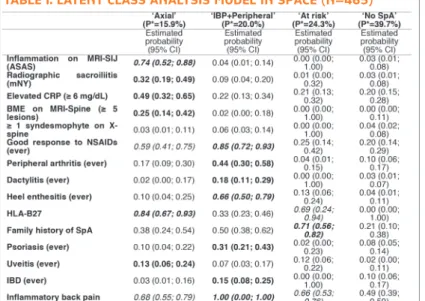
Methods: Two independent cohorts of patients (pts) with early onset chronic back pain (SPACE cohort) and inflammatory back pain (IBP) (DESIR cohort) were in-cluded. Latent class analysis (LCA) (different than a cluster analysis) was used to estimate the latent (i.e. unobserved) ‘Gestalt’ of axSpA by modelling the co-variance of the observed SpA features (without ‘a pri-ori’ assumptions on their ‘weights’). The selected best LCA model splits axSpA into a number of (clinically meaningful) classes with best data fit. Each class was la-belled by us and named according to most prominent features. The latent axSpA classes were then used as ‘gold-standard’ against which the ASAS axSpA, pSpA (ignoring IBP) and both (SpA criteria) were tested. Fi-nally, 5-year follow-up data from DESIR were used to perform a latent transition analysis (LTA) in order to examine if patients change classes over 5-year time. Results: In total, data of 465 (SPACE) and 576 (DESIR) pts were analyzed. SPACE yielded 4 latent classes (Table I). The ‘Axial’ class characterized by highest likelihood on abnormal imaging and HLA-B27-positivity; the ‘IBP+Peripheral’ class had 100% likelihood of IBP in association with peripheral signs. The ‘At risk’ class is anchored on a positive family history and HLA-B27 positivity in association with IBP; and the ‘No SpA’ class had very low likelihoods for all SpA-features which were correlated. The independent analysis in DESIR (without ‘no-SpA’ patients) yielded identical latent classes (‘Axial’:19%; ‘IBP+Peripheral’:27% and ‘At risk’:55%) (Table II). The ASAS axSpA criteria, tested in SPACE (‘No SpA’ absent in DESIR), captured 67% of the patients in the ‘Axial’ and ‘IBP+Peripheral’ classes (‘latent gold-standard’), but sensitivity was better (87%) if axSpA and pSpA criteria were combined. Of note, the axSpA criteria captured only 4% of the patients from the ‘No SpA’ class. Importantly, the LTA suggests that transition between classes over time was highly unlikely. ‘Axial’ and ‘IBP+Peripheral’ patients did not switch and only 11% of ‘At risk’ pts had switched to ‘IBP+Peripheral’ after 5 years.
Conclusion: The ‘Gestalt’ of axial spondyloarthritis comprises three distinguishable clinical entities (‘pure axial SpA’, ‘axial SpA with peripheral signs, and ‘axial
TablE i. laTEnT Class analysis modEl in spaCE (n=465)
TablE ii. laTEnT Class analysis modEl in dEsir (n=576)
SpA at risk’). Patients keep their clinical entity over 5 years and transition is very rare. The ‘Axial’ and ‘IBP+Peripheral’ entities are best captured by combin-ing the ASAS axSpA and pSpA criteria.
p046 - HigHEr disEasE aCTiviTy is assoCiaTEd wiTH morE spinal
radiograpHiC progrEssion in paTiEnTs wiTH axial spondyloarTHriTis
Alexandre Sepriano1, 2, Sofia Ramiro1, 2, 3,
Stephanie Wichuk4, Praveena Chiowchanwisawakit5,
Terrie MacCosham4, Joel Paschke6, Désirée van der Heijde1, Robert Landewé7, Walter P. Maksymowych4, 6
1. Rheumatology, Leiden University Medical Center, Leiden, Netherlands
2. CEDOC, NOVA Medical School. Faculdade de Ciências Médicas da Universidade NOVA de Lisboa., Lisboa, Portugal
3. Zuyderland MC, Heerlen, Netherlands 4. Department of Medicine, University of Alberta, Edmonton, Canada
6. CARE Arthritis, Edmonton, Canada, 7Amsterdam Rheumatology and Immunology Center (ARC), Amsterdam, Netherlands
Background: The association between disease activity and spinal radiographic progression in radiographic axial spondyloarthritis (r-axSpA) has been previously shown in a cohort of patients (pts) not being treated with TNF inhibitors (TNFi).
Objectives: To test the possible association between disease activity and spinal radiographic progression in r-axSpA in a real-life cohort, also including patients treated with TNFi.
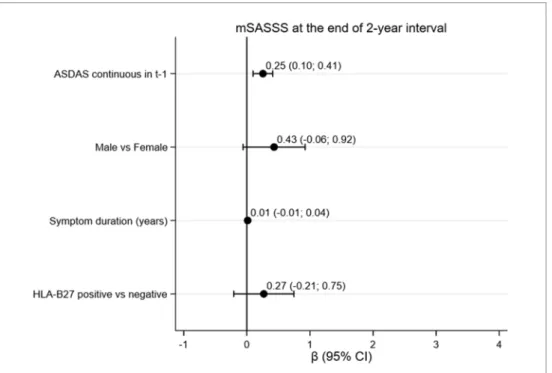
Methods: Pts with axial spondyloarthritis (axSpA) ful-filling the modified New York criteria (mNY) were in-cluded in this prospective, observational cohort (AL-BERTA FORCAST). Clinical and imaging data were col-lected at baseline and every 2 years up to 10 years of follow-up. Radiographs of the spine were indepen-dently scored by 2 central readers and one adjudicator (if disagreement), with known chronological order but blinded to clinical data, using the modified Stoke Anky-losing Spondylitis Spine Score (mSASSS). To be in-cluded, pts had to have ≥ one 2-year interval with data on mSASSS from ≥1 reader available as well as
com-plete data on ASDAS and TNFi exposure at the start of the interval. The association between ASDAS at the start of the interval (t) and mSASSS 2 years later (t+1) was tested in two types of longitudinal GEE models: i. multilevel (2 readers) model with the individual read-er scores as outcome (2-level models); ii. Using as out-come averaged scores between readers (1-level mod-els). Both type of models were adjusted for mSASSS at t (autoregression) and for a set of potential confounders defined a priori on clinical grounds (Figure).
Results: In total, 314 pts (442 intervals) were includ-ed [74% males, mean symptom duration 17.8 (SD 11.7) years, 83% HLA-B27 positive and 7% previous-ly treated with ≥1 TNFi]. At baseline the mean ASDAS was 2.7 (1.3) and the mean mSASSS 13.8 (18.9). Dur-ing follow-up 213 (68%) pts received treatment with TNFi in ≥1 visit. Overall, the average 2-year progres-sion was 1.33 (2.68) mSASSS-units per 2-year interval. In the 2-level multivariable model, 1 ASDAS-unit in-crease at t was associated with an inin-crease of 0.25 mSASSS-units at t+1 [b (95% CI): 0.25 (95%CI 0.10; 0.41)] (Figure). Results were similar using the averaged mSASSS as the outcome [b (95% CI): 0.25 (0.08; 0.43)].
Conclusion: These data add to previous evidence by
figurE 1.Longitudinal effect of ASDAS at the start of the interval on mSASSS 2 years later in a multilevel, multivariable linear GEE model with autoregression [N=313; model also adjusted for mSASSS at t-1 (‘autoregressor), Number of TNFi before baseline (continuous) and TNFi at t-1 (yes vs no)]
showing that a higher ASDAS is associated with hi gher spinal radiographic progression in pts with r-axSpA in-dependent of prior treatment with TNFi.
p048 - inCrEasing impaCT on
sTruCTural damagE wiTH inCrEasing CumulaTivE inflammaTion aT THE si-joinT QuadranT lEvEl in axial
spondyloarTHriTis – 5-yEar daTa from THE dEsir CoHorT
Santiago Andres Rodrigues Manica1, 2, Alexandre Sepriano2, 3, Sofia Ramiro2, 3, 4,
Robert Landewé5, Pascal Claudepierre6, Anna Moltó7, Dougados M7, Miranda van Lunteren3, Désirée van der Heijde3
1. Serviço de Reumatologia, Centro Hospitalar Lisboa Ocidental | Hospital Egas Moniz, Lisboa, Portugal 2. CEDOC, NOVA Medical School. Faculdade de Ciências Médicas da Universidade NOVA de Lisboa., Lisboa, Portugal
3. Leiden University Medical Center, Leiden, Netherlands 4. Academic Medical Center, University of Amsterdam and Zuyderland Medical Center, Heerlen, Netherlands 5. ARC, Amsterdam & Atrium MC Heerlen, Amsterdam, Netherlands
6. Radiology, Hôpital Henri-Mondor, Créteil, Paris, France 7. Rheumatology B Department, Paris Descartes
University, Cochin Hospital, AP-HP, Paris, France
Background: Axial inflammation is a key feature in axial SpA (axSpA). There is lack of data relative to the persistence of BME in the same anatomical quadrant (Q, 8 in total for both SIJ together), regardless of the overall presence of BME.
Objective: This study aims to investigate particular patterns of distribution of SIJ-BME across quadrants over time, their persistence over time, and their impact on clinical and structural outcomes.
Methods: Patients from the DESIR cohort (early axS-pA according to the rheumatologist) with MRI-SIJ available at baseline, 2 and 5 years were included. Each image was scored by 3 trained central readers blinded to chronological order. BME was considered positive if detected in ≥1/6 slices in each of the 8 quadrants, ac-cording to each individual reader. Four different pat-terns of BME over time were defined (no BME, spo-radic pattern, fluctuating BME and persistent BME) considering all 8 quadrants (Figure). The effect of BME patterns on 5-year structural (mNY, mSASSS, ≥5 ero-sions and/or fatty leero-sions in MRI-SIJ) and clinical out-comes (BASFI, BASMI and ASQoL) was evaluated us-ing multilevel generalised estimatus-ing equations (GEE) models (taking the individual reader data into account) and linear regression (using the agreement of ≥ 2 out of 3), as appropriate. All models were adjusted for rel-evant confounders including treatment (Table). Results: In total, 136 patients were included (age 34 (SD 9) years, 50% male, and 63% HLA-B27 positive). ‘No BME’ was seen in 63 patients (46%), the ‘sporadic pattern’ in 34 patients (25%), the ‘fluctuating pattern’ was seen in 21 patients (15%) and the ‘persistent BME pattern’ was seen in 18 patients (13%). Compared to the ‘no BME’ pattern (reference), the ‘sporadic’ [OR (95% CI): 2.1 (1.0;4.5)], ‘fluctuating’ [OR: 5.6 (2.2;14.4)] and ‘persistent’ [OR: 7.5 (2.8;19.6)] pat-terns were associated with higher likelihood to be mNY positive at 5-years, suggesting a gradient between cu-mulative inflammation and damage. Similar findings were observed for mNY as a continuous outcome vari-able and for ≥5 erosions and/or fatty lesions on spinal MRI as outcomes, but not for mSASSS (Table). There was no association between the BME patterns and the clinical outcomes.
Conclusion: Only 13% of the patients showed persis-tent inflammation in the same Q over a 5-year period and in 15% inflammation was fluctuating across dif-TablE i. assoCiaTion bETwEEn sij-bmE paTTErns and