Full paper published online: February 28, 2009 ISSN 1678-9199.
RISKS OF VACCINATION: A REVIEW
Rashid A (1), Rasheed K (2), Asim M (1), Hussain A (1)
(1) Division of Virology, Cell Culture Section, Veterinary Research Institute, Lahore
Cantt, Pakistan; (2) University of Veterinary and Animal Sciences, Lahore, Pakistan.
ABSTRACT: To be granted a product license, a vaccine must present adequate
quality, safety and efficacy. Studies on these criteria often utilize target species in a
laboratory setting. Vaccines that had been proven effective during laboratory analysis
may not present the same features when sold on a large scale, after encountering
field conditions, and furthermore, can even produce complications. Measures are
already in place to detect adverse reactions as reported by veterinarians to
manufacturers, so that vaccines under suspicion of failing can be identified and
investigated. The present review article describes the main problems, specifically
adverse reactions and lack of efficacy, that have been encountered following release
of vaccines for general use.
KEY WORDS: vaccine, quality, safety, efficacy, adverse reactions.
CONFLICTS OF INTEREST: There is no conflict.
CORRESPONDENCE TO:
ASIF RASHID, Division of Virology, Cell Culture Section, Veterinary Research
Institute, Ghazi Road, Lahore Cantt, Pakistan. Phone: +92 300 4033654. Email:
INTRODUCTION
Safety is a concept that does not rest on well understood and generally accepted
boundaries. Although the word “safety” may be explained as a state in which humans
and other animals are uninjured, whole and healthy, the extension of this definition to
the more abstract, universalized and future state of safety raises questions (1).
A vaccine may be considered unsafe when it causes disease or harm to a recipient
or any individual associated with its production or delivery process. A vaccine that
presents maximum safety is normally the product of a consistently well run process,
the components of which have been thoroughly pretested before admittance into
mainstream production.
Vaccination safety i.e., ensuring and monitoring the safety of all aspects of
immunization, including vaccine quality, storage and handling, vaccine administration
and disposal of sharps, remains a major challenge (2). Immunization can cause
adverse events, ranging from inherent properties of vaccines to some error in the
immunization process. The aim of effective vaccination is the generation of memory
cells, namely memory B and memory T cells that are responsible for providing a fast
and efficient immunity in a second contact with specific antigens (3, 4).
Vaccines, in contrast to other pharmaceutical products, are administered to healthy
subjects because they aim to prevent, not to treat (5). Vaccines currently
recommended for use in food animals and equine medicine and those given to pets
consist mostly of dead bacteria and inactivated viruses, live attenuated bacteria and
viruses, subunits of synthetic peptides, and toxoid vaccines produced by methods, or
modifications of methods, that have been employed for decades (6).
Effective vaccines, developed for use in livestock, are expected to reduce the
incidence and severity of diseases (7). However, reports of poor efficacy and
unsightly reactions at the inoculation site have led to much confusion among
livestock owners about the choice of vaccine (8).
Mild local and systemic reactions to vaccines are likely to be a natural consequence
of vigorous stimulation of the immune system. Dramatic adverse responses are
occasionally observed due to mistakes during production or handling of the products.
More often, reactions are consequences of disobeying label instructions, particularly
their restrictions against using vaccines only in healthy animals (9). It is important to
and users of these products can learn from previous experiences and avoid similar
problems.
Animals affected by immunization side effects may show symptoms within a few
minutes or, sometimes, after a delay of several hours. In the acute fulminating type of
reaction, animals show labored breathing (dyspnea), sweating, incoordination,
prostration, sporadic violence, severe colic symptoms, frothy blood-stained discharge
from the mouth and nostrils, and sometimes anal discharge followed by death (10).
Some policies are already in place to detect adverse vaccine reactions through
reports from veterinarians to manufacturers, so that products under suspicion of
failure can be identified and investigated. The present study describes the two main
problems that have been encountered subsequent to release of vaccines for general
use; adverse reactions and lack of efficacy.
ADVERSE REACTIONS
Many types of adverse responses have been reported following vaccination, ranging
from mild reaction (at the injection site) to more serious side effects (Table 1).
Anaphylaxis and some autoimmune diseases such as immune-mediated hemolytic
anemia are also adverse reactions to vaccination (11). One report clearly documents
the elevation in humoral aspect but depression of cellular and innate immunity in a
dog two weeks after immunization (12). However, post-vaccine immunosuppression
is not a consistent observation among studies (13-15). Vaccination-induced
immunosuppression may be sufficient to permit the development of severe diseases
in animals that are already carrying subclinical opportunistic pathogens (16).
Table 1. Post-vaccination adverse reactions
Class Type of Reaction
I Not related to vaccine
II Lump or swelling at the injection site
III Facial swelling
IV Systemic signs, fever, vomiting, diarrhea
V Anaphylaxis, shock, collapse, death
Care must be taken to ensure that vaccines are not administered through an
inappropriate route, either directly or indirectly. It has been reported that accidental
intranasal administration of vaccines against feline respiratory diseases, which
should be inoculated subcutaneously, may result in replication of viruses in the
animal’s oropharynx and other clinical diseases. Similarly, accidental infection of
susceptible non-target hosts with vaccinal virus may lead to serious problems, for
example, encephalitis in young dogs caused by canine distemper vaccine given to
their dam in a booster dose when puppies were three days old (18).
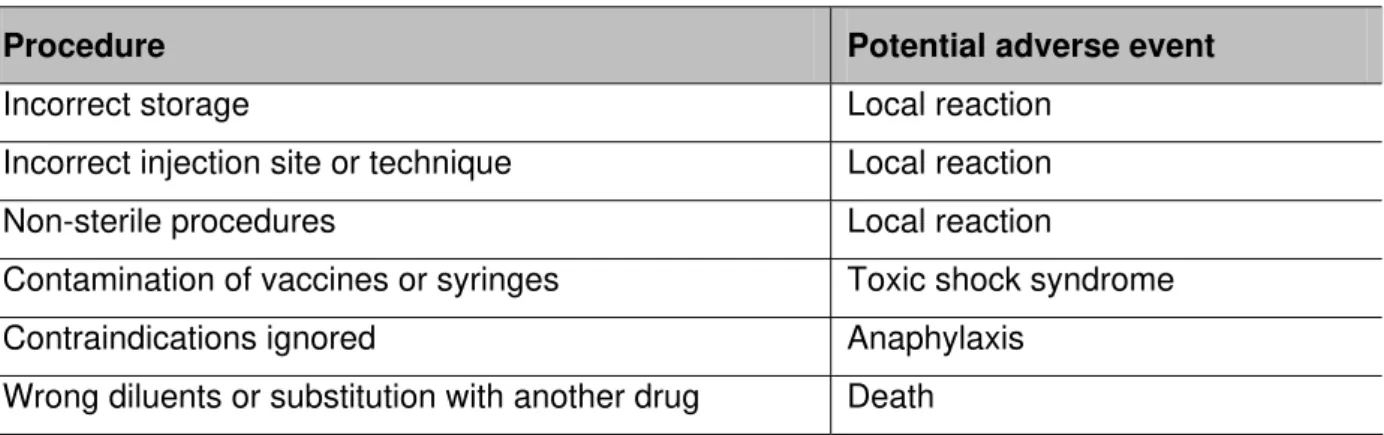
Adverse reactions caused by incorrect procedures of storage, handling or
administration are particularly interesting because they are more frequent than
events associated with intrinsic properties of vaccines and can be easily resolved
(Table 2). For instance, post-vaccinal distemper encephalitis is a rare condition that
can occur after administration of a modified live-virus canine distemper vaccine. The
affected animal may present aggression, incoordination and seizures or other
neurological signs. The pathogenesis of this condition is unknown but may be due to
residual virulence, increased susceptibility to, or triggering of, a latent paramyxovirus
by the vaccine (19).
Table 2. Inappropriate procedures and associated adverse events
Procedure Potential adverse event
Incorrect storage Local reaction
Incorrect injection site or technique Local reaction
Non-sterile procedures Local reaction
Contamination of vaccines or syringes Toxic shock syndrome
Contraindications ignored Anaphylaxis
Wrong diluents or substitution with another drug Death
Adapted from: Albert ET (20).
The key to managing adverse events is communication. Anticipatory guidance should
always be given to animal owners in the form of information on type and frequency of
adverse events that could be experienced.
Anaphylaxis is a serious and potentially fatal hypersensitivity reaction that leads to a
variety of distressing symptoms. Besides antigens, vaccines contain several other
context, it is not always clear which compound may be responsible for allergic
reactions. For example, in some vaccines, gelatin and egg proteins are present at
levels sufficient to induce hypersensitivity (21). However, the levels of mercury,
aluminum, formaldehyde, albumin and antibiotics that are present in vaccines have
not been shown to be harmful to humans or experimental animals (22).
Vaccination has been linked to a range of autoimmune disorders (particularly in
dogs) including immune-mediated hemolytic anemia (IMHA), immune-mediated
thrombocytopenia (IMTP), polyneuritis and polyarthritis (11, 23, 24). There are few
data that define the mechanism by which these associations may arise, although
hypothetically a number of possibilities could be proposed, including disturbance of
immunoregulation by vaccination; non-specific immune activation via adjuvants or
microbe-derived “superantigen” exposed to cross-reactive tissue protein incorporated
into vaccines; and molecular mimicry between autoantigens and vaccinal microbes
(25).
Local injection-site reactions are rarely reported in pets, although it is clear that tissue
inflammation does occur at vaccination sites, particularly on account of adjuvant
products. The most visible of local reactions consist of the range of aggressive feline
sarcoma in which adjuvant-induced chronic inflammation may trigger genetic
changes that underlie neoplasia (26, 27).
In some cases, following vaccination, a lump appears at the inoculation site and may
result in abscesses after infection enters through the pierced skin. The lumps are
hard and fibrous, and arise when a vaccine that should be injected into deep
intramuscular tissues leaks out into shallower subcutaneous tissues. In some
animals, administration of alum-precipitated vaccine results in a local reaction that
gradually leads to induration resulting in persistent hard lump (28).
Similarly, type IV or cell-mediated hypersensitivity reactions may occur in response to
vaccination but a more common reaction is granuloma formation at the inoculation
site. This may be a response to depot adjuvants that produce larger and more
persistent lesions at inoculation sites than vaccines containing alum or aluminum
hydroxide (19).
Other phenomena known as “physiological reactions” occur after vaccination. One
example of these responses is the rise of 1.2 to 1.5% in rectal temperature in some
animals 24 hours after vaccination against hemorrhagic septicemia; but the
which the elevation persists slightly longer) (29). Analogous reactions were observed
by Shah Najmul (30), studying the effects of single- (2 mL) and double-dose
administration of oil adjuvant vaccine to five healthy buffalo calves aged from six to
eight months, who found approximately a 2oC rise in body temperature at six hours
after vaccination. The respiration rate and feed intake remained unaffected. Two
calves showed a mild transient depression at six hours after vaccination.
LACK OF EFFICACY
Veterinary vaccines from different manufacturers can vary in their potency, efficacy
and duration of immunity. Failure of vaccines to adequately protect from infectious
disease is clearly a serious problem, but is more often due to inappropriate
administration or administration to immunosuppressed or immunodeficient
individuals, than to batches of subnormal efficacy (31). Moreover, it is important to
remember that no current vaccine can claim 100% efficacy on the basis of
experimental challenge or field studies. It has long been recognized that some dog
breeds (such as Rottweiler and Doberman Pinscher) present increased susceptibility
to parvoviral enteritis that may be related to suboptimal response to vaccination,
although specific studies have not addressed the mechanism by which this might
occur (32).
Efficacy can also be reduced by storage or reconstitution conditions; only small
doses of live organisms are found in attenuated vaccines and these organisms may
be killed by poor handling. Similarly, malnutrition can suppress immune response by
decreasing availability of nutrients for cell division and protein synthesis.
A vaccine failure is relatively easy to detect when animals develop an acute infection,
but is much less likely to be suspected when the infection is chronic or when the
agent is absent from the community (18).
CONCLUSIONS
Certain factors including vaccine, immunized organism and environment influence
the product efficacy. Vaccination risks may range from severe adverse responses to
lack of efficacy. However, correct storage, improved inoculation technique and
animal screening before immunization for concurrent infection may improve
should use only licensed vaccines and carefully follow manufacturer
recommendations to avoid the risks.
REFERENCES
1. Spier RE. Ethical aspects of the methods used to evaluate the safety of vaccines.
Vaccine. 2004;22(15-16):2085-95.
2. Duclos P, Hofmanin CA. Immunization safety. A priority of the World Health
Organization’s Department of Vaccines and Biologicals. Drugs Saf. 2001;24:1105-12.
3. Berek C, Ziegner M. The maturation of the immune response. Immunol Today.
1993;14(8):400-4.
4. Sander ME, Makgoba MW, Shaw S. Human naïve and memory T cell;
reinterpretation of helper-induced and suppressor-induced subsets. Immunol Today.
1988;9(7-8):195-9.
5. Chen RT. Vaccine risks: real, perceived and unknown. Vaccine. 1999;17(3):S41-6.
6. Carter PB, Carmichael LE. Modern veterinary vaccines and Shaman’s apprentice.
Comp Immunol Microbiol Infect Dis. 2003; 26(5-6):389-400.
7. Smith LDS. Clostridial diseases of animals. In: Brandly CA, Jungherr EL, editors.
Advances in Veterinary Science. New York: Academic Press; 1957.
8. Smith HV and Klose JB. Response of goats to clostridial vaccines. Victorian
Veterinary Proceedings. 1980;38:46.
9. Roth JA. Mechanistic bases for adverse vaccine reactions and vaccine failures.
Adv Vet Med. 1999;41:681-700.
10. De Alwis MCL. Haemorrhagic Septicaemia. Canberra: Australian Centre for
International Agricultural Research; 1999. 141 p.
11. Duval D, Ginger U. Vaccine associated immune-mediated hemolytic anemia in
the dog. J Vet Intern Med. 1996;10(5):290-5.
12. Strasser A, May B, Teltscher A, Wistrela E, Niedermuller H. Immune modulation
following immunization with polyvalent vaccine in dogs. Vet Immunol Immunopathol.
2003;94(3-4):113-21.
13. Phillips TR, Jensen JL, Rubino MJ, Yang WC, Schultz RD. Effects of vaccines on
the canine immune system. Can J Vet Res. 1989;53(2):154-60.
14. McMillen GL, Briggs DJ, McVey DS, Phillip RM, Jordon FR. Vaccination of racing
greyhounds: effects on humoral and cellular immunity. Vet Immunol Immunopathol.
15. Miyamoto T, Taura Y, Une S, Yoshitake M, Nakama S, Watanabe S. Changes in
blastogenic responses of lymphocytes and delayed type hypersensitivity responses
after vaccination in dogs. J Vet Med Sci. 1992;54(5):945-50.
16. Foley JE, Orgad U, Hirsh DC, Poland A, Pedersen NC. Outbreak of fatal
salmonellosis in cats following use of a high-titer modified-live panleukopenia virus
vaccine. J Am Vet Med Assoc. 1999;214(1):67-70, 43-4.
17. Novak W. Predicting the “unpredictable” vaccine reactions.
Proceedings of North American Veterinary Conference. Ithaca: International
Veterinary Information Service; 2007.
18. Ramsey I, Bryn T (editors). BSAVA Manual of canine and feline infectious
diseases. [Place unknown]: BSAVA; 2001. 46-48 p.
19. Tizard IR. Veterinary Immunology: an Introduction. 6th ed. Philadelphia: W.B.
Saunders Company; 2000. 239 p.
20. Tozzi AE. Field evaluations of vaccine safety. Vaccine. 2004;22(15-16):2091-5.
21. O’ Hagen DT, Rino R. The safety of vaccines. Drug Discovery Today.
2004;9(19):846-54.
22. Offit PA, Jew RK. Addressing parents’ concern: do vaccines contain harmful
preservatives, adjuvants, additives or residues? Pediatrics. 2003;112(6):1394-7.
23. Kohn B, Garner M, Lubke S, Bennett D, Brunnberg L. Polyarthritis following
vaccination in four dogs. Vet Comp Orthroped Traumatol. 2003;16:6-10.
24. McAnulty JF, Rudd RG. Thrombocytopenia associated with vaccination of a dog
with a modified live paramyxovirus vaccine. J Am Vet Med Assoc.
1985;186(11):1217-9.
25. Schattner A. Consequence or coincidence? The occurrence, pathogenesis and
significance of auto-immune manifestations after viral vaccines. Vaccine.
2005;23(30):3876-86.
26. McEntee MC, Page RL. Feline vaccine-associated sarcomas. J Vet Intern Med.
2001;15(3):176-82.
27. Richards JR, Starr RM, Childers HE, Elston TH, Hendrick MJ, Kitchell BE, Macy
DW, McClure D, Morrison WB, Vogel LP, Welborn LV. Vaccine-associated feline
sarcoma task force: roundtable discussion. J Am Hosp Assoc.
2005;226(11):1821-42.
28. Nagarajan V, Sunderam S. Neutralization of the Hemorrhagic Septicaemia alum
29. Pandy MR, Singh ND, Yadev RS. Effect of vaccination against hemorrhagic
septicaemia on milk yield, body temperature and feed intake of Therparker
cross-bred cow and Murrah buffaloes. A note. Indian J Anim Sci. 1987;3:35-6.
30. Shah Najmul H. Haemorrhagic septicaemia in dairy buffaloes in Pakistan:
pathogenesis and prevention [PhD thesis]. Amsterdam: Vrije University of
Amsterdam; 1998.
31. Day MJ. Vaccine side effects: fact and fiction. Vet Microbiol. 2006;117(1):51-8.
32. Hoskins JD. Performance of a new generation canine parvovirus vaccine in