Printed version ISSN 0001-3765 / Online version ISSN 1678-2690 http://dx.doi.org/10.1590/0001-37652301620140616
www.scielo.br/aabc
FISH-mapping of the 5S rDNA locus in chili peppers (
Capsicum-
Solanaceae)
PATRICIA M. AGUILERA1
, HUMBERTO J. DEBAT2
, MARISEL A. SCALDAFERRO3
, DARDO A. MARTÍ1
and MAURO GRABIELE1
1
Instituto de Biología Subtropical, Universidad Nacional de Misiones (IBS-UNaM-CONICET), Félix de Azara 1552, Posadas (3300), Misiones, Argentina 2
Instituto de Patología Vegetal, Centro de Investigaciones Agropecuarias, Instituto Nacional de Tecnología Agropecuaria (IPAVE-CIAP-INTA), Camino a 60 Cuadras Km 5 ½, Córdoba (X5020ICA), Argentina
3
Instituto Multidisciplinario de Biología Vegetal, Universidad Nacional de Córdoba (IMBIV-UNC-CONICET), Vélez Sarsfi eld 1611, Córdoba (X5016GCA), Argentina
Manuscript received on November 13, 2014; accepted for publication on January 26, 2015
ABSTRACT
We present here the physical mapping of the 5S rDNA locus in six wild and fi ve cultivated taxa of Capsicum
by means of a genus-specifi c FISH probe. In all taxa, a single 5S locus per haploid genome that persistently mapped onto the short arm of a unique metacentric chromosome pair at intercalar position, was found. 5S FISH signals of almost the same size and brightness intensity were observed in all the analyzed taxa. This is the fi rst cytological characterization of the 5S in wild taxa of Capsicum by using a genus-derived probe, and the most exhaustive and comprehensive in the chili peppers up to now. The information provided here will aid the cytomolecular characterization of pepper germplasm to evaluate variability and can be instrumental to integrate physical, genetic and genomic maps already generated in the genus.
Key words:wild and cultivated Capsicum, 5S rRNA gene, Capsicum-derived probe, FISH-mapping.
Correspondence to: Mauro Grabiele E-mail: [email protected]
INTRODUCTION
Capsicum L., or chili peppers, (Solanaceae) is a New Word genus distributed from Mexico to Argentina that comprises 31 species, several of
which are of considerable economic importance. Five Capsicum species (C. annuum L. var. annuum, C. chinense Jacq., C. frutescens L., C. baccatum L. var. pendulum (Willd.) Eshbaugh and var. umbilicatum (Vellozo) Hunz. et Barboza, and
C. pubescens Ruiz et Pav.) were domesticated by American natives and are now cultivated as part
of the human diet (Moscone et al. 2007). In fact, after tomato, peppers are the most culivated fruit vegetable species in the world (FAOSTAT 2014).
In plants, 5S rRNA genes are organized in one or several loci, arranged as tandem repeats of thousand to hundreds of thousand copies per genome, with each copy comprising a coding region (CR; ~120 bp) and a non-transcribed intergenic spacer (NTS; ~100-900 bp) (Cloix et al. 2001 and references therein).
Previous fluorescent in situ hybridization (FISH) assays revealed the loci number and localization of the 5S rRNA gene in only a few
some of them derived from unrelated taxa (Park et al. 1999, 2000, Scaldaferro et al. 2006, Kwon and Kim 2009). Similarly, other economically important members of the Solanaceae family such as tomato, tobacco and petunia have been studied to reveal the presence of 5S sites (Garcia et al. 2012) but information on potato and eggplant is still absent. In addition, more comprehensive approaches led to the development of several pepper maps (Wu et al. 2009 and references therein) and recently, to the genome sequencing of wild and cultivated species of chili peppers (Kim et al. 2014, Qin et al. 2014). However, despite 45S rRNA genes have been mapped onto a pepper genetic linkage map (Wu et al. 2009), information regarding 5S rDNA genes in Capsicum, is still lacking.
The main purpose of this contribution is to achieve a physical mapping of the 5S rDNA locus in wild and cultivated taxa of Capsicum by means of a genus-specifi c FISH probe. The cytological 5S rDNA marker is highly useful in the identifi cation of individual chromosomes for further germplasm characterization. In addition, the information reported here, not only broadly expands the limited knowledge of 5S rDNA mapping in Capsicum, but will also be undoubtedly useful to integrate physical, genetic and genomic maps already generated in the genus (Tanksley et al. 1988, Kang et al. 1997, Wu et al. 2009, Qin et al. 2014, Kim et al. 2014).
MATERIALS AND METHODS
PLANT MATERIAL
Five cultivated in addition to six wild taxa of
Capsicum were employed to cytologically map the 5S rRNA gene. Taxa, provenances, herbarium specimens and status of the studied material are summarized in Table I. Plant material was determined by Dr. Gloria E. Barboza.
CHROMOSOME PREPARATIONS
Chromosomes of somatic metaphases were observed in root tip squashes obtained from seed
germination. Seeds were placed on moisturized
fi lter paper in Petri dishes and germinated at room temperature (about 25 ºC). Roots were collected when they reached 2 cm in length and were immediately pretreated with p-dichlorobenzene saturated solution for 3 h at room temperature and then fi xed in Farmer solution (absolute ethanol : glacial acetic acid, 3 : 1) for a minimum of 12 h at 4 ºC. Somatic chromosome spreads were prepared following the procedure described by Schwarzacher et al. (1980). Root tips were macerated in 2% (m/v) cellulase (Onozuka R-10 from Trichoderma viridae; Serva, Heidelberg, Germany) plus 10% (v/v) pectinase (from Aspergillus niger; Sigma, St. Louis, Missouri, USA), dissolved in 40% glycerol in 0.01 mol/L citric acid/sodium citrate buffer, pH 4.8, at 37 ºC for 2 h, and then squashed in 45% acetic acid. After removal of the coverslip with CO2, slides were air dried, incubated for 1–2 days at room temperature, and then kept at 4 ºC until use.
DNA ISOLATIONAND 5S PROBE PREPARATION
Genomic DNA was isolated and purifi ed from fresh leaves of C. pubescens by using the CTAB method, with minor modifications (Rogers and Bendich 1994). An additional step of DNA purification using phenol-chloroform and a RNAse A treatment (Invitrogen, USA) was added, followed by DNA precipitation with ethanol (Sambrook et al. 1989). Sample quality was checked by electrophoresis in agarose 0.8% gel, and by measurements of Abs. 260 nm/280 nm index, to confirm DNA integrity and absence of RNA contamination. The 5S rDNA unit of C. pubescens
TABLE I
Summary of 5S rDNA FISH in Capsicum. CORD = Herbarium from Museo Botánico de Córdoba, Argentina; Status: c = cultivated; w = wild. Collectors: GEB = GE Barboza; YSG = Y Sánchez García; EAM = EA Moscone; Abb = Abbreviation; 2n = somatic chromosome number; p = short chromosome arm; di = intercalary band distance to the centromere index; CL = chromosome length in μm; CI = centromeric index; RCL = relative chromosome length expressed
as percentage of the genome size in μm.
Taxa, provenance, herbarium and status Abb 2n Karyotype
formula # loci Position CL CI RCL
C. chacoense Hunz. Bolivia. GEB et al. 1793-CORD
(w) cha 24 22m+2st 1
4p
di=73.68 5.60 47.50 8.70
C. cardenasii Heiser et Smith Bolivia. CORD 1135
(w) car 24 22m+2sm 1
9p
di=57.89 5.53 48.10 7.25
C. eximium Hunz. Argentina. EAM 255-CORD (w) exi 24 22m+2sm 1 6p
di=67.50 5.80 48.28 8.29
C. fl exuosum Sendtn. Argentina. GEB et al.
1034-CORD (w) fl e 24 22m+2st 1
9p
di=59.38 8.17 43.70 7.85
C. rhomboideum (Dunal) Kuntze. Venezuela. YSG
19-CORD (w) rho 26 20m+2sm+4st 1
3p
di=50.59 3.50 48.57 8.68
C. baccatum L. var. praetermissum Heiser et Smith
Brasil. GEB et al. 1646-CORD (w) pra 24 22m+2sm 1
7p
di=59.57 6.71 49.03 8.56
C. annuum L. var. annuum. México. NMCA
10272-CORD (c) ann 24 20m+2sm+2st 1
3p
di=69.52 6.07 48.11 8.67
C. chinense Jacq. Brasil. GEB 807-CORD (c) chi 24 22m+2st 1 3p
di=74.40 5.23 47.80 8.52
C. frutescens L. Brasil. GEB 806-CORD (c) fru 24 22m+2st 1 8p
di=77.24 5.86 49.49 8.32
C. baccatum L. var. pendulum (Willd.) Eshbaugh.
Argentina. EAM et al. 211-CORD (c) pen 24 22m+2st 1
5p
di=76.19 6.23 47.19 8.40
C. pubescens Ruiz et Pav. Argentina. EAM
256-CORD (c) pub 24 22m+2st 1
3p
di=56.86 7.35 48.57 9.16
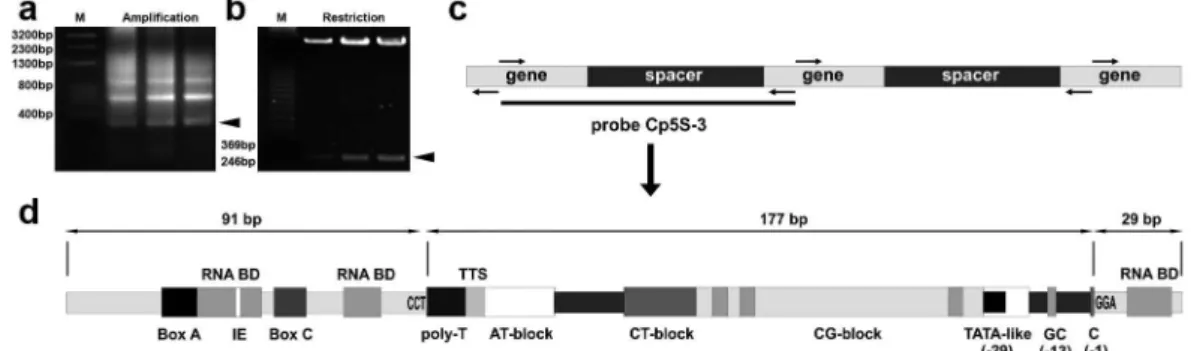
C. pubescens, 0.5 pmol of each primer, 200 mM of each dNTP, 5 μl of 10X reaction buffer and 1 unit of Taq DNA polymerase “Sequencing Grade” (Promega, USA). Thirty six amplifi cation cycles were performed, each involving denaturation at 94 °C for 1 min, primer annealing at 57 °C for 1 min, and extension at 72 °C for 1 min. Amplifi ed 5S rDNA fragments were separated in agarose 1.4% gel and then were excised from the gel and purifi ed by using the GFX kit (Amersham Pharmacia, USA). Amplifi ed fragments were cloned into the pCR2.1-TOPO vector (Invitrogen, USA) and transformed in Escherichia coli “TOP10 One Shot” (Invitrogen, USA), following the manufacturer`s instructions. The obtained clones were grown in LB liquid selective medium. Plasmidic DNA was isolated through mini-preparations, digested with restriction enzymes and visualized in agarose 1% gel to check the insert stability. The nucleotide sequences of the clones were determined (Macrogen, Korea) and Cp5S-3 was characterized (Fig. 1) and selected for further FISH analysis.
FLUORESCENCEin situ HYBRIDIZATION
FISH experiments were undertaken according to Moscone et al. (1996). The obtained clone Cp5S-3 was labeled by nick translation with digoxigenin-11-dUTP following the manufacturer instructions (Enzo, USA) to generate a ribosomal DNA probe. Slide preparations were subjected to RNAse and Proteinase K pretreatments, followed by steps of denaturalization, probe hybridization, blocking, probe detection by means of antibodies linked to fluorochromes [anti-digoxigenin to fluorescein (FITC)] (Dako, USA), washing, and DAPI staining for contrast.
FLUORESCENCE MICROSCOPYAND IMAGE ACQUISITION
Chromosomes were viewed and photographed with an Olympus BX50 fl uorescence microscope equipped with a computer-assisted digital camera system. Images were captured in black and white
using appropriate filters for FITC and DAPI excitation, respectively. Digital images were combined in Photoshop 7.0 (Adobe, San Jose, California, USA) for fi nal processing.
KARYOTYPE ANALYSIS
At least fi ve metaphase plates per taxa were used for chromosome measurements. The centromeric index (CI = short arm length x 100/chromosome length) was used to classify the chromosomes according to Levan et al. (1964) in metacentric (m; CI = 50-37.51), submetacentric (sm; CI = 37.50-25.10) and subtelocentric (st; CI = 25.00-12.51). Different lengths of the same arm (and band/locus, where applicable) from homologous chromosomes were combined to mean values and represented in the haploid complements of the idiograms. Intercalary markers were mapped using the index di = d x 100/a (d = distance of band center from the centromere; a = length of the corresponding chromosome arm) according to Greilhuber and Speta (1976).
RESULTS
GENUS SPECIFIC PROBE DEVELOPMENTAND
CHARACTERIZATION
The generation and molecular characterization of the 5S rDNA probe from C. pubescens is displayed in Figure 1a-d. Clone Cp5S-3 is 297 bp in length and exhibits, at the sequence level, all the specifi c features of functional 5S rDNA units.
FISH EXPERIMENTS
the 5S rDNA are also provided in Table I, i.e. the chromosome length (CL), the centromeric index (CI) and the relative chromosome length (RCL). All the studied taxa are diploid and have 2n = 24, except for C. rhomboideum (Dunal) Kuntze which has 2n = 26 chromosomes. Karyotype formula varied among taxa but symmetry is a core feature in Capsicum.
LOCI NUMBER, SIZEAND DISTRIBUTION
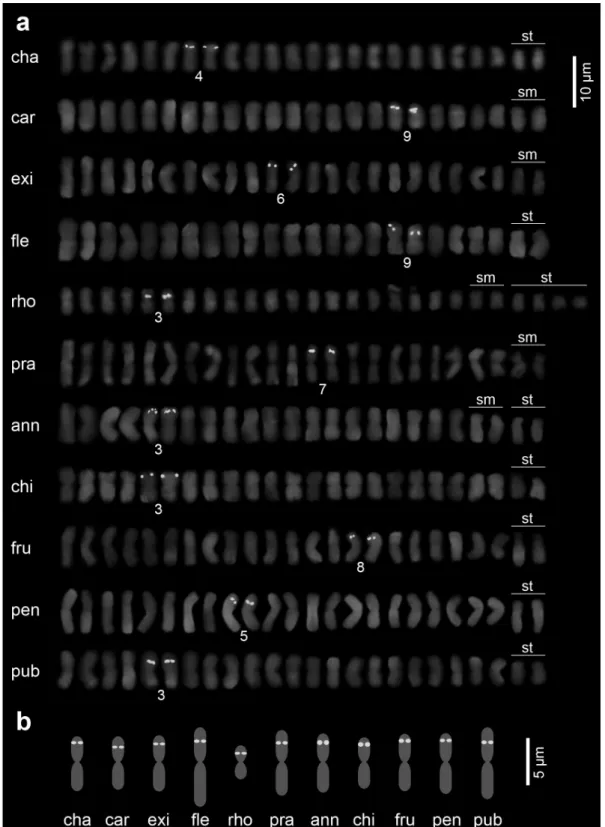
FISH experiments revealed a unique chromosome pair hybridized with the Cp5S-3 probe (green dots) in the eleven examined taxa (Fig. 2a). Polymorphisms for these loci within individuals or between taxa were not observed. Therefore, a single 5S locus per haploid genome was found in
Capsicum. 5S FISH signals of almost the same size and brightness intensity were observed in the studied taxa of Capsicum (Fig. 2a, b).In the analyzed taxa, the 5S rDNA locus persistently mapped onto the short arm of a unique metacentric chromosome pair, at intercalar position (Fig. 2a). Four species, i.e. C. rhomboideum, C. annuum var. annuum, C. chinense and C. pubescens, carried the 5S locus on the chromosome pair #3. Capsicum chacoense
Hunz. exhibited the 5S locus onto pair #4. In addition, C. baccatum var. pendulum, C. eximium
Hunz., C. baccatum var. praetermissum Heiser et Smith and C. frutescens bore the 5S locus in pairs #5, 6, 7 and 8, respectively. In C. cardenasii Heiser et Smith and C. fl exuosum Sendtn. 5S signals were located on pair #9. The distance of the 5S locus to the centromere, measured as the intercalar distance index (di), averaged 65.71 (±9.19) and ranged from 50.59 (in C. rhomboideum) to 77.24 (in C. frutescens) (Table I and Fig. 2b).
DISCUSSION
FISH PROBE CHARACTERIZATION
According to genic and non transcribed spacer (NTS) motives, the FISH probe derived clone
Cp5S-3 is fairly representative of functional 5S segments. Gene features, i.e. the internal control region (ICR) formed by the motives Box A, Box C and IE of Cloix et al. (2001) and the RNA binding domains (RNA BD) to the TFIIIA (Kellogg and Appels 1995), were identifi ed in the primary sequence and are represented in Figure 1d. Further structures in the NTS, i.e. the transcription termination site (TTS) and the TATA-like box (-29), the GC dinucleotides (-13) and the C (-1) at 3`end region, are also associated to functionality (Cloix et al. 2001).
FISH EXPERIMENTS
Cytological mapping of the 5S has been previously performed in several chili peppers. Scaldaferro et al. (2006) used a probe derived from Beta vulgaris
(pXV1) on wild and cultivated taxa. Furthermore, Park et al. (1999, 2000) used a wheat derived-probe (pScT7) and a Capsicum-related one, respectively, on cultivated taxa, the same as Kwon and Kim (2009). However, ours is the first report on the cytological characterization of the 5S in wild taxa of Capsicum by using a genus-specifi c FISH probe. Moreover, our results in C. eximium, C. fl exuosum,
C. rhomboideum and both wild and cultivated varieties of C. baccatum (praetermissum and
pendulum) are novel in the genus. Furthermore, considering the number of analyzed taxa, our contribution is the most exhaustive and extensive characterization of the 5S locus in chili peppers.
LOCI NUMBERAND DISTRIBUTION
Our results on the FISH location in the wild and cultivated taxa of Capsicum revealed a single 5S locus per haploid genome. This locus is regularly mapped onto the short arm of a unique metacentric chromosome pair of approximately the same size among taxa, with the exception of the CL of C.
arm, rather than to the centromere, except for the di value of C. rhomboideum. The metacentric chromosome pair that carries the 5S locus resulted homeologous among these taxa. These results are in agreement with previous reports in Capsicum. A sole and short arm intercalar 5S rDNA locus (two FISH signals) was also observed in C. annuum var.
annuum, C. chinense, C frutescens, C. baccatum
var. umbilicatum, C. pubescens, C. chacoense and
C. cardenasii, all of them of distinct provenance regarding our plant material (Park et al. 1999, 2000, Scaldaferro et al. 2006, Kwon and Kim 2009). Altogether, the combined results evidence the universality of this cytological feature in
Capsicum. Physical location of the 5S in the same chromosome pair regarding our accessions and those of Scaldaferro et al. (2006), was also found in
C. cardenasii (#9), C. pubescens (#3) and cultivated varieties of C. baccatum (#5). In contrast to the latter authors who found the 5S loci at the chromosome pair #6 of C. annuum var. annuum, we detected it at #3. According to Park et al. (2000), the 5S loci in the cultivated taxa of Capsicum was assigned to chromosome 1 by the synteny relationship with the corresponding linkage group of tomato, of Lapitan et al. (1991). Furthermore, Kwon and Kim (2009) assigned the 5S loci of C. annuum to the linkage group 7 of the genetic map of Kang et al. (1997). However, the 5S loci was not mapped in the recent contributions of the genome of chili peppers (Qin et al. 2014, Kim et al. 2014).
LOCI SIZE
5S FISH signals of almost the same size and brightness intensity were observed in the studied taxa of Capsicum. In essence, this feature suggests similar ribosomal copy number in the 5S per genome in the genus. However, Giemsa-C and fluorescence bandings revealed a Giemsa+ and CMA+DAPI- constitutive heterochromatic region (Het) located at the short arm of a unique metacentric chromosome pair at intercalar position,
in diverse chili peppers (Moscone et al. 2007 and references therein; Scaldaferro et al. 2013), that in fact co-localize with the 5S loci. This Het is polymorphic among taxa, regarding presence and size, suggesting variability in the 5S ribosomal copy number in Capsicum. In this regard, the expression level of the 5S rRNA gene is, in part, regulated by transcriptional inactivation, associated to citosine methylation, mediated by siRNAs, as occur in the 18S-25S rRNA and other repetitive sequences. The heterochromatic state of those loci is more conspicuous at higher copy numbers (Neves et al. 2005, Pontes et al. 2006, Daxinger et al. 2009). In addition, the only report on the copy number of the 5S in Capsicum is that of Kwon and Kim (2009) in extended DNA fi bers of C. annuum, who estimated it in 1453 copies per haploid genome.
5S IN SOLANACEAE
In addition to chili peppers, the family contains other economically important species such as tomato, potato, tobacco and eggplant. Considering all Solanaceae in the rDNA Plant database (www. plantrdnadatabase.com), a single 5S rDNA locus per haploid genome is common in diploid taxa, with some exceptions (Garcia et al. 2012). Particularly, the cultivated taxa exhibit a single (tomato), a single or double (petunia) and a double (tobacco, a polyploid taxon) 5S rDNA locus per haploid genome, however, this information is not available for the 5S of potato and eggplant (Garcia et al. 2012).
CONCLUSIONS
intraspecifi c cytogenetic variability. Additionally, the information reported here can be used to integrate physical, genetic and genomic maps already generated in the genus which undoubtedly will represent a valuable tool for breeding purposes of chili peppers.
RESUMO
Neste trabalho, apresentamos o mapeamento físico do locus 5S rDNA em seis taxa silvestres e cinco cultivados de Capsicum, obtido através do uso de uma sonda FISH gênero-específi ca. Em todos os taxa, um único locus 5S por genoma haplóide foi persistentemente mapeado no braço curto de um único par de cromossomos metacêntricos na posição intercalar, e foram observados sinais 5S de FISH de tamanho e intensidade de brilho quase semelhantes. Esta é a primeira caracterização citológica dos 5S nos taxa silvestres de Capsicum usando uma sonda gênero-específi ca e o estudo sobre o grupo das pimentas mais exaustivo e abrangente realizado até ao momento. A informação aqui fornecida irá ajudar a caracterização citomolecular do germoplasma das pimentas, permitindo avaliar a sua variabilidade e podendo ser usada para integrar mapas físicos, genéticos e genômicos já realizados no gênero.
Palavras-chave: Capsicum cultivados e silvestres, gene de rRNA 5S, sonda derivada do Capsicum, mapeamento FISH.
ACKNOWLEDGMENTS
This study was supported by Consejo Nacional de Investigaciones Científi cas y Técnicas (CONICET-Argentina) with a postdoctoral research fellowship to P.M.A. and M.A.S. and a career membership to M.G. and D.A.M. Additional support was provided by Instituto Nacional de Tecnología Agropecuaria (INTA-Argentina) to H.J.D. Authors would also like to thank Dr. Gloria E. Barboza who determined the plant material.
REFERENCES
CLOIX C, TUTOIS S, YUKAWA Y, MATHIEU O, CUVILLIER C, ESPAGNOL MC, PICARD G AND TOURMENTE S. 2001.
Analysis of the 5S RNA Pool in Arabidopsis thaliana: RNAs are heterogeneous and only two of the genomic 5S loci produce mature RNA. Genome Res 12: 132-144. DAXINGER L, KANNO T, BUCHER E, VAN DER WINDEN
J, NAUMANN U, MATZKE AJ AND MATZKE MA. 2009. Stepwise pathway for biogenesis of 24-nt secondary siRNAs and spreading of DNA methylation. EMBO J 28: 48-57.
FAOSTAT - FOOD AND AGRICULTURE ORGANIZATION OFTHE UNITED NATIONS. 2014. Food and Agriculture Organization (FAO) of the United Nations. http://faostat. fao.org/site/339/default.aspx. Accessed: 10/30/2014. GARCIA S, GARNATJE T AND KOVARIK A. 2012. Plant rDNA
database: ribosomal DNA loci Information goes online. Chromosoma 121: 389-394.
GREILHUBER J AND SPETA F. 1976. C-banded karyotypes in the Scilla hohenackeri group, S. persica, and Puschkinia
(Liliaceae). Plant Syst Evol 126: 149-188.
KANG BC, YU JW, LEE MH AND KIM BD. 1997. Applicabi-lity of AFLP on hot pepper genetic analysis. J Kor Soc Hort Sci 38: 698-703.
KELLOGG EA AND APPELS R. 1995. Intraspecific and inter-specific variation in 5S RNA genes are decoupled in diploid wheat relatives. Genetics 140: 325-343.
KIM S, PARK M, YEOM SI, KIM YM, LEE JM, LEE HA AND
SEO E. 2014. Genome sequence of the hot pepper provides insights into the evolution of pungency in Capsicum
species. Nat Genet 46: 270-278.
KWON JK AND KIM BD. 2009. Localization of 5S and 25S rRNA genes on somatic and meiotic chromosomes in
Capsicum species of chili pepper. Mol Cells 27: 205-209.
LAPITAN NL, GANAL MW AND TANKSLEY SD. 1991.
Organization of the 5S ribosomal RNA genes in the genome of tomato. Genome 34: 509-514.
LEVAN A, FREDGA KL AND SANDBERG AA. 1964. Nomen-clature for centromeric position on chromosomes. Hereditas 52: 201-220.
MOSCONE EA, MATZKE MA AND MATZKE AJ. 1996. The use of combined FISH/GISH in conjunction with DAPI coun-terstaining to identify chromosomes containing transgene inserts in amphidiploid tobacco. Chromosoma 105: 231-236.
MOSCONE EA, SCALDAFERRO MA, GRABIELE M, CECCHINI
NM, SÁNCHEZ GARCÍA Y, JARRET R, DAVIÑA JR, DUCASSE DA, BARBOZA GE AND EHRENDOFER F. 2007. The evolution of chili peppers (Capsicum–Solanaceae): a cytogenetic perspective. Acta Hortic 745: 137-169. NEVES N, DELGADO M, SILVA M, CAPERTA A, MORAIS
-CECÍLIO L AND VIEGAS W. 2005. Ribosomal DNA
heterochromatin in plants. Cytogenet Genome Res 109: 104-111.
PARK YK, KIM BD, KIM BS, ARMSTRONG KC AND KIM
in five different species in Capsicum. Genes Genet Syst 74: 149-157.
PARK YK, PARK KC, PARK CH AND KIM NS. 2000. Chromosomal localization and sequence variation of 5S rRNA gene in five Capsicum species. Mol Cells 10: 18-24. PONTES O, LI CF, COSTA NUNES P, HAAG J, REAM T,
VITINS A, JACOBSEN SE AND PIKAARD CS. 2006. The
Arabidopsis chromatin-modifying nuclear siRNA pathway involves a nucleolar RNA processing center. Cell 126: 79-92.
QIN C, YU C, SHEN Y, FANG X, CHEN L, MIN J AND CHENG
J. 2014. Whole-genome sequencing of cultivated and wild peppers provides insights into Capsicum domestication and specialization. Proc Natl Acad Sci USA 111: 5135-5140.
ROGERS SO AND BENDICH AJ. 1994. Extraction of total cel-lular DNA from plant, algae and fungi. In: Stanton BG and Schilperoort RA (Eds), A plant molecular biololgy manual. Kluwer Academic Publishers, Dordrecht, p. D1/1-8. SAMBROOK J, FRITSCH EF AND MANIATIS T. 1989. Molecular
cloning: a laboratory manual. 2nd
ed., Cold Spring Harbor Laboratory Press, Cold Spring Harbor, NY, 1626 p.
SCALDAFERRO MA, GRABIELE M AND MOSCONE EA. 2013. Heterochromatin type, amount and distribution in wild species of chili peppers (Capsicum, Solanaceae). Genet Resour Crop Evol60: 693-709.
SCALDAFERRO MA, SEIJO JG, ACOSTA MC, BARBOZA
GE, DUCASSE DA AND MOSCONE EA. 2006. Genomic characterization of the germplasm in peppers (
Capsicum-Solanaceae) by fluorescent in situ hybridization. Plant Sci 43: 291-297.
SCHWARZACHER T, AMBROS P AND SCHWEIZER D. 1980. Application of Giemsa banding to orchid karyotype analysis. Plant Syst Evol 134: 293-297.
TANKSLEY SD, BERNATZKY R, LAPITAN NL AND PRINCE JP. 1988. Conservation of gene repertoire but not gene order in pepper and tomato. Proc Natl Acad Sci USA 85: 6419-6423.