1 INTRODUCTION
Inspections of existing structures are a fundamental aspect of every structural management system. In fact, structural deterioration depends on such a wide range of factors, that direct observation must be con-sidered the prime source of accurate and reliable in-formation on the structure.
Inspections are not, however, free of errors and uncertainty (Phares et al. 2004). In fact, the result of an inspection depends on several factors such as the experience of the inspector, the deterioration mecha-nisms present, location of the bridge, and means available for the inspection. Moreover, the results of inspections alone do not allow a medium or long term planning, and any decisions based on the results of inspections alone will result in application of maintenance to very deteriorated structures, resulting in a very high life-cycle maintenance costs (Neves, Frangopol and Cruz 2006; Neves, Frangopol and Petcherdchoo 2006).
For these reasons, it is fundamental to integrate the results of inspection with a prediction model for the deterioration of existing civil infrastructure. In this manner, more accurate predictions of future de-terioration will be possible, and more efficient deci-sions can be made.
In this paper, the deterioration of existing struc-tures is analyzed considering the model developed by the authors (Neves and Frangopol 2005). In this model, the performance of structures is defined in terms of lifetime probabilistic condition, safety, and cost profiles. The main advantages of this model are the ability to consider the entire performance history of the structure, including deterioration and effects of maintenance actions as well as the ability to com-bine common performance indicators, namely the condition index, with more consistent indicators, such as the safety index.
The model proposed by the authors (Neves and Frangopol 2005) does not include any information resulting from inspections or tests in the analysis, as it bases the evolution over time of performance on expert judgment alone.
In this paper, a model for combining expert judgment in the form of the model proposed by Ne-ves and Frangopol (2005) with information from in-spections is proposed. This new approach is based on the use of Bayesian updating combined with simulation for improving expert judgment. The re-sults obtained in the examples analyzed show the significant impact on performance prediction of the inclusion of information obtained from inspections.
Life-cycle performance of structures: combining expert judgment and
results of inspection
L.C. Neves
New University of Lisbon, Caparica, Portugal
D.M. Frangopol
Lehigh University, Bethlehem, Pennsylvania, USA
2 CONDITION, SAFETY AND COST
In the model proposed by Neves and Frangopol (2005) life-cycle performance of an existing struc-ture is characterized by three different time-dependent probabilistic indicators: condition index, safety index, and the cumulative maintenance cost. The condition index is an indicator of deterioration as recorded by a bridge inspector. It might be asso-ciated with the severity of cracking in reinforced concrete structures, deterioration of painting and rusting in steel structures, or any other visually ob-servable deterioration effect. The safety index is a measure of the reliability or the safety margin of a structure, and can only result from a structural safety evaluation.
These two indicators are related, in the sense that both refer to the effects of deterioration on a certain structure. However, full knowledge on one of these factors is not enough to determine the value of the other. In fact, the condition index is only influenced by the observable defects, and only indirectly in-cludes the effects of corrosion, fatigue or cracking. The safety index includes all these aspects directly. In short, the safety index would be a much more in-teresting measure of performance. However, it is ex-tremely expensive to determine the safety margin of a structure, and the network system reliability analy-sis of all structures in a large network is close to im-possible.
In the model proposed by Frangopol (1998) and Neves and Frangopol (2005), the condition and safety indices under no maintenance are defined as bi-linear functions, in terms of 6 random parameters: initial condition, C0, initial safety index, S0, time of
initiation of deterioration of condition and safety, tic
and ti, respectively, and deterioration rate of
condi-tion and safety, αc and α, respectively. The effect of
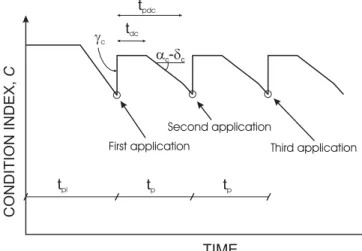
maintenance actions is defined in terms of 8 random parameters, as follows: (a) improvement in condition index and safety index immediately after applica-tion, γc and γ, respectively; (b) time during which the
deterioration processes of condition index and safety index are suppressed, tdc and td, respectively; (c)
time during which the deterioration rate in condition index and safety index are suppressed or reduced, tpdc and tpd, respectively; and (d) deterioration rate
reduction of condition index and safety index, δc and
δ, respectively. The meaning of each of these ran-dom variables is shown in Figure 1.
The mean, standard deviation, histograms and percentiles of the life-cycle condition index, safety index, and cumulative cost are computed using Monte-Carlo simulation. A detailed description of the computational platform employed can be found Neves and Frangopol (2005).
gc
tdc
a dc- c
TIME
CONDITION
INDEX,
C
tpdc
tpi tp tp
First application
Second application
Third application
Figure 1. Condition index profile
3 CONDITION AND SAFETY UPDATING When an inspection is executed, new information on the condition index of the structure at a certain point in time becomes available. If the inspection was per-fect, it would be possible to know, exactly, the con-dition index at that point in time. Since the inspec-tion is affected by errors and uncertainty, this new information must be regarded as probabilistic, and must be used as such.
At the time of an inspection, the condition index can be characterized as a probabilistic variable, with a probability density function dependent on the re-sults obtained by the inspector, but also on the qual-ity of the inspection. Common practice defines the results of an inspection in terms of a set of possible outcomes (0, 1,..., n). However, deterioration has, for most cases, a continuous or almost continuous evolution, and these results are a simplification of reality. We can consider that for a given condition index at time T, CT, the result of an inspection, Cins,
is given as a likelihood function
(
Cins CT) ( )
LCTP | = . This function can be approxi-mated by a normal distribution with mean μ and standard deviation σ. The mean will be equal to the result of inspection Cins, if the results of inspections
are unbiased, and lower or higher than Cins, if
in-spectors are consistently optimistic or pessimistic, respectively. In this paper, it is assumed that inspec-tions are unbiased and that a lower condition index is associated with a lower deterioration. The uncer-tainty in the results is measured by the standard de-viation σ, which is related to the quality of inspec-tion, dependent on the experience of the inspector and the conditions for inspection.
Based on Bayes theorem, the probability density function of the condition index, considering the re-sult of inspection and the information from expert judgment can be defined as (Ang and Tang 2007):
( )
'( )) (
'' CT K L CT f CT
where f ''
( )
CT is the probability density function ofthe condition index at time T considering both expert judgment and results of inspections, also designated posterior distribution, f'(CT) is the probability den-sity function of the condition index at time T consid-ering only expert judgment, also designated prior distributionL
( )
CT is the likelihood function, and K isa normalizing constant defined by:
( ) ( )
∫
∞ ∞ − ⋅ = T TT f C dC
C L K ' 1 (2)
Considering Monte-Carlo simulation was used to computed the probabilistic indicators of perform-ance, the mean and standard deviation of the condi-tion index at time τ, can be computed as (Chen and Ibrahim 2000, Frangopol and Neves 2008):
( )
( )
∑
∑
= = ⋅ = n i i T n i i T i C C L C L C 1 1 τ τ μ (3)( ) ( )
( )
( )
( )
2 1 1 1 1 2 ⎟ ⎟ ⎟ ⎟ ⎠ ⎞ ⎜ ⎜ ⎜ ⎜ ⎝ ⎛ ⋅ − ⋅ =∑
∑
∑
∑
= = = = n i i T n i i T i n i i T n i i T i C C L C L C C L C LCτ τ
τ
σ (4)
where μCτ and τ
σC are the mean and standard devia-tion of the condidevia-tion index at time τ considering both expert judgment and results of inspections, i
Cτ is the condition index at time τ associated with sam-ple i, i
T
C is the condition index at time of inspection T associated with sample i, and n is the number of samples.
In terms of the safety index, a similar approach can be employed, resulting in a mean and standard deviation given, respectively, as:
( )
( )
∑
∑
= = ⋅ = n i i T n i i T i S C L C L S 1 1 τ τ μ (5)( ) ( )
( )
( )
( )
2 1 1 1 1 2 ⎟ ⎟ ⎟ ⎟ ⎠ ⎞ ⎜ ⎜ ⎜ ⎜ ⎝ ⎛ ⋅ − ⋅ =∑
∑
∑
∑
= = = = n i i T n i i T i n i i T n i i T i S C L C L S C L C LSτ τ
τ
σ (6)
where μτS and τ
σS are the mean and standard
devia-tion of the safety index at time τ considering both expert judgment and results of inspections and i
Sτ is the safety index at time τ associated with sample i. In this manner, it is possible to obtain new updated condition and safety profiles. It must be noted that
the inspection only provides direct information on the condition index. If the safety index is considered independent of the condition index, then the prior and posterior safety profiles will coincide. Neverthe-less, since both the condition index and safety index depend on the deterioration, some correlation is to be expected, and some information on the safety of the structure can be extracted from an inspection.
4 EXAMPLES
As an example, the life-cycle condition and safety profiles of existing reinforced concrete bridge ele-ments are analyzed considering data provided in Denton (2002). This data is thoroughly analyzed in Neves and Frangopol (2005), considering the life-cycle performance under no maintenance and under different maintenance strategies. The condition and safety profiles under no maintenance obtained are presented in Figure 2.
As can be observed from these results, under no maintenance the performance presents very signifi-cant dispersion, as denoted by the difference be-tween the values of the 5 and 95 percentiles (C0.05
and C0.95, respectively).
4.0 3.5 3.0 2.5 2.0 1.5 1.0 0.5 0.0 0.0 0.5 0.91 1.5 2.5 C0.95 C0.75 C0.50 C0.25 ST. DEV. NO MAINTENANCE MEAN CONDITION INDEX , C TIME, Years 20000 SAMPLES C0.05 S0.50 S0.75 S0.95
S0.25S
0.05 SAFETY INDEX , S TIME, Years 20000 SAMPLES ST. DEV. NO MAINTENANCE MEAN
Figure 2. Condition and safety index under no maintenance
Quality Probability of mis-classification
Standard deviation
High 5% 0.255
Medium 10% 0.304
Low 20% 0.390
Very Low 40% 0.595
C = 4
C = 2
C = 3
St. Dev.
No Inspection Mean
0
1
2
3
4
5
6
0 10 20 30 40 50
Time, T
Condition Index, C
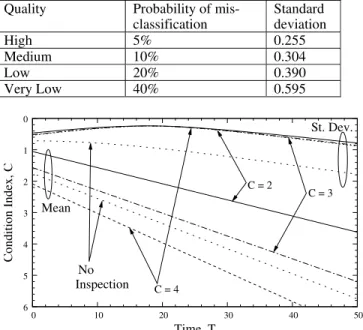
Figure 3. Comparison of the mean and standard deviation of condition index considering only prior knowledge and prior knowledge and inspection
Considering no correlation between the condition index and the safety index, this inspection does not affect the safety index. However, in terms of condi-tion, the updated condition index is significantly dif-ferent from the profile predicted based on expert judgment as shown in Figure 3, considering a high quality inspection.
These results show that an inspection has a sig-nificant impact of the predicted condition index. In fact, for different results of inspection, a significant reduction in the standard deviation of the condition index occurs. Moreover, an important change in the predicted mean condition is also observable. The lat-ter is more dramatic if the observed condition is 2.0, as this is significantly different from the mean pre-dicted value.
In Figures 4 and 5 the PDFs of the condition in-dex considering an inspection with an observed con-dition index equal to 2 and equal to 3, respectively, are shown.
No Inspection
Inspection C = 2
0
1
2 2.5 3
4 4.5 5 5.5 6
0 10 20 30 40
0.5
1.5
3.5
50
Condition Index, C
Time, T
Figure 4. Comparison of the PDFs of the condition index at 10 years time intervals considering only prior knowledge and
prior knowledge and inspection, C = 2
No Inspection
Inspection C = 3
0 0.5 1 1.5 2 2.5 3 3.5 4 4.5 5 5.5 6
0 10 20 30 40 50 60
Condition Index, C
Time, T
Figure 5. Comparison of the PDFs of the condition index at 10 years time intervals considering only prior knowledge and
prior knowledge and inspection, C = 3
These PDFs show the effect of maintenance on the degree of knowledge on the condition of a struc-ture. In fact, for both inspection results, the updated condition PDFs show a reduction in dispersion but also a large shift in the mode. In all cases, there is an important change in the distribution of the initial pa-rameters, namely the initial condition index and the deterioration rate.
4.1 Effect of quality of inspection
Mean
No Inspection
St. Dev.
50 0
0.5
1
1.5
2
3
3.5
4
0 10 20 30 40
2.5
Very Low Quality Medium Quality
High Quality
Condition Index, C
Time, T
Figure 6. Comparison of the mean and standard deviation of the condition index considering only prior knowledge and prior knowledge and inspection with different quality levels
Figure 6 shows that, even very low quality in-spections have a large impact on the condition index profiles, resulting in a reduction in the standard de-viation and an increase in mean condition. This is mostly a consequence of the initial data available. In fact, the data presented in Denton (2002) refers to a large set of bridges with very different ages, and not to a single bridge. As the inspection is conducted on a single bridge, the information gathered reduces significantly the uncertainty over present, past and future condition.
4.2 Effect of inspection on the safety index
Although an inspection yields no direct information on the safety index of a structure, this information can be obtained in an indirect manner. In fact, changes in the condition index and the safety index are both the result of deterioration, and, as a conse-quence, worst condition index is often associated with lower safety.
The probabilistic relation between the condition index and the safety index can be measured by the correlation between these two indicators at any point in time. If no maintenance is considered and the pa-rameters defining the profiles under no maintenance (i.e., the initial condition, initial safety, deterioration rate of condition index and deterioration rate of safety index) are assumed independent, the resulting condition index and safety index will be independ-ent.
If, on the other hand, the parameters defining the condition index and the safety index are correlated, the resulting profiles will also be correlated, and an inspection will improve the knowledge on the condi-tion index, but also on the safety index.
In general, no information on the correlation be-tween parameters defining the condition index and the safety index exists. Let's assume the correlations between these parameters as denoted in Table 1.
In this table, the correlation coefficient between parameters, ρ, is taken as 0, 0.2, 0.6, and 0.9.
Table 1. Correlation coefficient between parameters defining the condition index and the safety index under no maintenance
αc α C0 S0
αc 1 ρ 0 0
α ρ 1 0 0
C0 0 0 1 ρ
S0 0 0 ρ 1
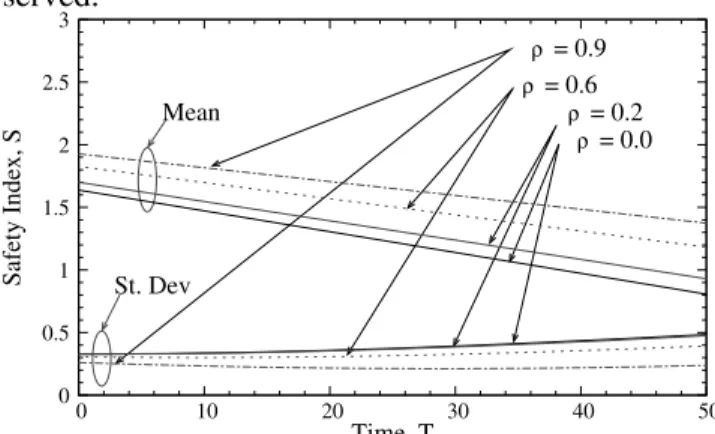
In Figure 7 the safety index profiles are obtained considering that an inspection is performed at year 20 and a condition index equal to 2.0 is observed. These results show that, even for relatively low cor-relation coefficients, there is a significant improve-ment in mean safety, as a consequence of the ob-served condition index being better than the initial prediction. Moreover, a reduction in the dispersion of the safety index over the entire lifetime is also ob-served.
ρ
ρ ρ
ρ
0 0.5 1 1.5 2 2.5 3
0 10 20 30 40 50
Mean
St. Dev
Time, T
Safety Index, S
= 0.6 = 0.2
= 0.0 = 0.9
Figure 7. Comparison of the mean and standard deviation of the safety index considering (a) only prior knowledge and (b) prior knowledge and inspection with different correlations
5 UPDATE OF INITIAL PARAMETERS
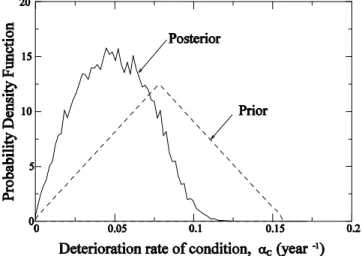
The condition index and safety index profiles are de-fined in terms of a set of random parameters. When updating is carried out, new information on these pa-rameters becomes available. This information can be used to make more accurate predictions for other structures.
Figure 8. Comparison of the deterioration rate of condition considering only prior knowledge and prior knowledge and in-spection
6 CONCLUSIONS
In the present study, a methodology to combine ex-pert judgment and results of inspection on the life-cycle prediction of deteriorating structures is pro-posed. The methodology uses the probabilistic dete-rioration model proposed by the authors. The effects on this prediction of inspections are defined in a Bayesian framework. The obtained results show that an inspection, even of low quality, results in a sig-nificant reduction in uncertainty.
The results obtained show the importance of in-corporating the outcome of inspections in the dete-rioration models in a consistent manner. As a result, more accurate predictions of performance can be ob-tained, and more sound decisions can be made.
7 ACKNOWLEDGMENTS
The support to Lehigh University from (a) the Na-tional Science Foundation through grants CMS-0638728 and CMS-0639428, (b) the Commonwealth of Pennsylvania, Department of Community and Economic Development, through the Pennsylvania Infrastructure Technology Alliance (PITA), and (c) the U.S. Federal Highway Administration Coopera-tive Agreement Award DTFH61-07-H-00040, are gratefully acknowledged. Also, the support of the Science and Technology Foundation to UNIC Re-search Center in the New University of Lisbon is gratefully acknowledged. The opinions and conclu-sions presented in this paper are those of the authors and do not necessarily reflect the views of the spon-soring organizations.
REFERENCES
Ang, A. andW. Tang (2007). Probability Concepts in
Engi-neering: Emphasis on Applications in Civil & Environ-mental Engineering. Wiley.
Chen, M. and J. Ibrahim (2000). Monte Carlo Methods in
Bayesian Computation. Spinger Series in Statistics. Springer.
Denton, S. (2002). Data estimates for different maintenance options for reinforced concrete cross-heads. Draft Report for Highways Agency, U.K., Brinckerhoff Ltd.
Frangopol, D. (1998). A probabilistic model based on eight random variables for preventive maintenance of bridges.
Technical report, Highways Agency, London, U.K.
Opti-mum Maintenance Strategies for Different Bridge Types. Frangopol, D. and L. Neves (2008). Structural performance
updating and optimization with conflicting objectives under
uncertainty. In 2008 Structures Congress - Crossing
Bor-ders. Vancouver, Canada, April (in press).
Neves, L. and D. Frangopol (2005). Condition, safety, and cost profiles for deteriorating structures with emphasis on
bridges. Reliability Engineering & System Safety 89, 185–
198.
Neves, L., D. Frangopol, and P. Cruz (2006). Probabilistic life-time-oriented multiobjective optimization of bridge
main-tenance: Single maintenance type. ASCE Journal of
Struc-tural Engineering: 132(6), 991–1005.
Neves, L., D. Frangopol, and A. Petcherdchoo (2006). Prob-abilistic lifetime-oriented Multiobjective optimization of brid ge maintenance: combination ofmaintenance types.
ASCE Journal of Structural Engineering 132(11), 1821– 1834.
Phares, B., G. Washer, D. Rolander, B. Graybeal, and M. Moore (2004). Routine Highway Bridge Inspection
Condi-tion DocumentaCondi-tion Accuracy and Reliability. Journal of