Analysis of a collective action:
communication and the mobilization for
women’s free decisions in childbirth
Aline Gonçalves & Celsi Silvestrin
Abstract
This paper presents some of the results of the research titled From the Internet to the
Streets: Marching in Defense of Homebirth. It is based on a discussion about the role of
com-munication and collective actors in Brazilian society. The aim was to observe whether people involved in movements for humanizing childbirth in Brazil were successful at increasing the social visibility of the theme through the use of the Internet and other mass media resources. The methodology consisted of the documentary analysis of online materials related to a conflict between people defending humanized childbirth on the one hand, and the Rio de Janeiro State’s Regional Medical Council (Cremerj) on the other. The study of the content of a Facebook page used in the organization of the March in Defense of Homebirth confirmed that the website had a crucial role in the process and justified the choice of focusing the analysis on the movement’s use of the Internet and social networks. Detailed interviews with articulators of the collective action were also conducted to elucidate some matters and to confirm or refute hypotheses. The people involved in the movement came together to defend a cause, i.e. women’s freedom of choice in childbirth. To that end, activists promoted communication and mobilization actions to sensitize society and to encourage people to demand the observation of the rights of pregnant women as well as the change of obstetric assistance models in Brazil.
Keywords
Communication; collective action; mobilization; childbirth; Facebook
Introduction
In 2012 the practice of homebirth as one of the choices for pregnant women gained visibility in Brazilian mass media. Departing from a discussion about the role of com-munication and collective actors in Brazilian society, this paper aims at observing if the people involved in defending the humanization of childbirth were able to foster more discussions around this theme, as well as to increase its visibility, making use of Internet and other mass media devices. Another goal was to present elements to help understand the reasons that make Brazilian women question the existing models of obstetric assis-tance, even causing them to mobilize and take to the streets in protest.
In medical terms, childbirth is seen as a physiological event that requires special-ized supervision and offers risks both for the pregnant woman and the child. People who defend homebirth and the humanization of the care for pregnant women believe that the current hospital-based model is centered on the needs of the medical team and does not respect the parturient woman’s own time and psycho-physical processes. For them, the lack of scientifically-based information and emotional support, among other details, can
discourage or even prevent vaginal birth. This led groups of women to mobilize and or-ganize the March in Defense of Homebirth, aiming at rescuing, to some degree, the cul-tural and social standing of childbirth in Brazilian society. As Torniquist argues, evidence shows that, besides being a physiological event, childbirth has a cultural role in society:
Parturition and childbirth are events that are biological, cultural and individ-ual at once: women give birth in different ways, according to their historical contexts, the particularities of their cultures and their personal experiences – which include the memories of narratives and experiences. With the ex-ception of cases where serious complications are involved, childbirth is not a disease, but a phenomenon involving the female body and health, and a rite of passage, pointing at bodily, as well as familial and social changes. (Torniquist, 2004, p. 65, our translation)
Therefore, the organized movement of hundreds of Brazilians in defense of preg-nant women’s autonomy and freedom of choice can be regarded as a sign of cultural and social change. The mobilized group claims that the main evidence of the curtailment of women’s freedom is the growing number of caesarean procedures being performed in Brazil, mainly by private healthcare providers. In 2010, according to data from the Brazil-ian Health Ministry, Brazil ranked first in the world regarding the proportion of caesarean births, as 52% of all births in that year happened by C-section. The proportion of caesar-ean procedures was 82% in the private sector and 37% in the public sector. The World Health Organization (WHO) recommends rates around 15%.
There are a few examples of public maternity hospitals, such as the Sofia Feld-man Hospital in Belo Horizonte (MG), that provide huFeld-manized assistance, but, accord-ing to the activists, in spite of federal government incentives, there is no evidence that such practices can become universally available. Facing those prospects, some Brazilian women opt for homebirths, even when they live in urban areas and have full access to public and private healthcare. For Ana Cristina Duarte, certified nurse midwife, one of the founders of the Active Maternity Support Group (Gama) and one of the main articu-lators of the March in Defense of Homebirth, “(…) the best place for a woman to have her baby is the one where she feels the safest. If she feels the safest at home, she needs to find options to have her baby at home” (IHU Unisinos, 2012). That point of view is in opposition to the one advocated by the Rio de Janeiro State’s Regional Medical Coun-cil (Cremerj), whose members classify homebirth as a high-risk procedure. Although homebirth routines are not covered by public or private healthcare insurances, there are no legal restrictions for the practice whatsoever. That adds to the polemic and complex nature of the matter, which involves public health, as well as cultural and social factors.
1. The role of communication and collective actors
The March in Defense of Homebirth shares characteristics with other movements promoted after the year 2000, i.e., the use of information technology devices, such as
the Internet and mobile telephones. Wide-ranging and expressive mobilizations around the world, such as the Jasmine Revolution in Tunisia (2010) and the Egyptian Revolution (2011), are examples of social mobilizations in which information and communication technology made it possible for citizens to send, share or exchange mutually relevant information. According to Shirky (2012), computer networking allows for the contact between people who share similar purposes without too much investment. Therefore, for him, actions that would be economically impracticable in a traditional organization-al pattern, can be developed with the support of sociorganization-al tools (2012, p.44). For Pleyers (2009), who studies social movements such as Zapatism,
[...]it is not about decadence or gaps on the part of immature movements, but a mutation of forms of participation and social actors who adopt a con-cept of social change centered on society, on people and on local organiza-tions more than on the decisions of political representatives or of interna-tional institutions. (Pleyers, 2009, p. 126, our translation)
As Pleyers argues, the pulverization and diversification of collective actions in con-temporaneity present theoretical and methodological challenges that go beyond political participation or previously known forms of civil society organization, such as political parties and social movements (Luke et al., 2013), and this is constantly bringing new input to theoretical discussions. The March in Defense of Homebirth was organized virtually, through social media channels, and carried out on June 16 and 17 2012 in 30 Brazilian cities. To study it, we opted for a qualitative methodological approach aiming at exploring, through case study, two main topics: communication and mobilization. Is-sues related to collective action, networks and means of communication informed the object of the investigation, with the purpose of identifying the mode of organization of individual participants, which, in turn, enabled them to act as a group. The corpus of this research is composed of (i) news reports about the movement – the technique used to study those texts was documental analysis; (ii) interviews with nine activists involved in the organization of the march – chosen for having been names of reference and for giving interviews to the press about the march in their respective states in Brazil, and (iii) information recorded and stored by the mobilized group on their Facebook website. Although all of this material was used to develop the object of study, content analysis (Bardin, 2011) was restricted to the event’s Facebook.com.br page, “Marcha do Parto em Casa”, which was pointed out by the participants as the main mobilization tool for the collective action.
In this work, the March in Defense of Homebirth has been considered a collective action inspired by Melucci, for whom conflict, solidarity and the breaching of the sys-tem’s limits are basic analytical dimensions for the study of such actions (Melucci, 1980, 1982 e 1983):
I define conflict as a relationship between opposing actors, seeking control of the same resources, to which both ascribe value. Solidarity is the capability
of an actor to share a collective identity (that is, the capability of recognizing
and being recognized as part of the same social unit). The limits of a system show the variation spectrum tolerated within its pre-existing structure. A breach of these limits pushes the system beyond the acceptable variation spectrum. (Melucci, 1989, p. 56, our translation)
In this case, dissent happened between groups who defend humanized (as well as less institutionalized or medicalized) childbirth and the Rio de Janeiro State’s Regional Medical Council (Cremerj), who set out to defend corporative interests. The formation of the collective actor, or collective identity, was observed in the capacity of the people in-volved to ascribe meaning to their actions. From that perspective the social actors would be defined for embracing a cause that generates conflict (against the establishment or hegemonic forces) and for their subjective wish to participate. These characteristics can lead to what Melucci terms collective identity: “collective identity is an interactive and shared definition produced by several interacting individuals who are concerned with the orientation of their action as well as the field of opportunities and constraints in which their action takes place.” (1988, p. 342).
Therefore, the collective identity is activated by the actor’s performance in the pres-ence of an opportunity, i.e., that identity can remain latent within a network and emerge in a moment of conflict. As Gamson (2011, pp. 28-29) explains, “Collective action re-quires a consciousness of human agents whose policies and practices must be changed and a ‘we’ who will help to bring about change.” For Melucci, the identity component refers to the process of definition of that “us”, typically in opposition to a “them” that has different interests or values. The network built by the defenders of humanized childbirth was woven throughout several years, starting with face-to-face meetings, and only more recently receiving the support of blogs and other online interaction tools (discussion groups and social network websites).
2. The process of mobilization
The process analyzed in this paper was initiated with the Youtube publication of the video titled Sabrina’s labor – the birth of Lucas, on February 21, 2012. Even before being featured in formal journalism websites or high-audience TV shows, the video had more than 2 million viewings1. This popularity, according to the creators of the video, can
be attributed to its dissemination in social networks and blogs dedicated to the theme “homebirth”.
On June 10, 2012, the video was featured on the weekly variety TV show Fantástico, broadcast by Globo Network, one of the most popular jounalism programs in Brazilian tel-evision. The feature “Humanized Homebirth” was polemic among health professionals2 1 In January 2014, one year and 11 months after its publication, the video had 7 310 775 viewings – and was still one of the
most popular childbirth videos on Youtube.
2 Available on http://globotv.globo.com/rede-globo/fantastico/v/
and lasted for almost five minutes, a considerably long piece for a television news report. In it the reporter emphasizes the fact that homebirth evokes diverging opinions among health professional and affirms that it is endorsed with restrictions by the National Nurs-ing Council, but it is opposed by the Federal Medical Council, the Federal Ginaechology and Obstetrics Union and the Health Ministry. Obstetrician Jorge Kuhn’s statement that caused objection from the Medical Council was the following:
[Reporter (in off): the Coordinator of the Obstretics Department of the Fed-eral University of São Paulo defends homebirth, but advises that it can only be performed when the pregnancy offers very low risk.]
Jorge Kuhn: those [pregnancies] that do not present any incidents, either clinical or obstetric, such as high blood pressure, diabetes, pre-eclampsia, or any circumstance that could increase the risk for the mother or the child. (Our translation)
On the next day, June 11, a news report on the Jornal do Brasil website announced that Cremerj released a press note with the following position regarding Jorge Kuhn’s statement featured in the Fantástico TV show:
The Rio de Janeiro State’s Regional Medical Council (Cremerj) will present a complaint to the São Paulo State’s Regional Medical Council against MD Jorge Francisco Kuhn, who was interviewed by Fantástico and defended homebirth3. (Our translation)
The same TV feature had evoked a great deal of commentary and praise on the social network Facebook by the women who defended humanized childbirth. However, the enthusiasm for having made the subject accessible to millions of Brazilians at prime television time was soon replaced by the feeling of indignation aroused by Cremerj’s attitude.
Motivated by these circumstances, on Monday, June 11, 2012, the biologist and doula Gisele Leal, from Sorocaba (SP), created a Facebook page for activists to organ-ize the March in Defense of Homebirth. In four days people from 30 cities in 17 states and from all Brazilian regions were mobilized. 9.322 people were invited, of which 1.964 confirmed attendance. Besides this nationwide page there were also specific Facebook pages for local events and for organized groups to orchestrate the march in specific cities. At the same time, dozens of institutions, associations and companies displayed publicly their support for the cause of homebirth. However, except for the Rio de Janeiro State’s Nursing Council (Coren – RJ) and some educational institutions, most of them were directly linked to professionals who performed services related to humanized birth. The marches occurred on June 16 and 17 and organizers believe that, in the city of São Paulo alone, the attendance was 1.500. São Paulo, Rio de Janeiro and Brasília were the
3 Available on
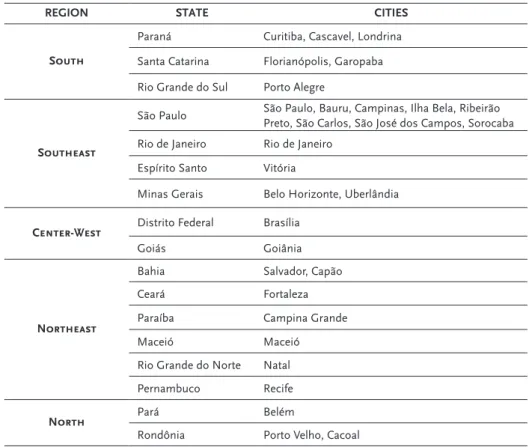
capital cities that had the most expressive number of participants. There were fewer than 10 people in some cities and a few dozens in others. The following table lists the cities where the march took place:
REGION STATE CITIES
South
Paraná Curitiba, Cascavel, Londrina Santa Catarina Florianópolis, Garopaba Rio Grande do Sul Porto Alegre
Southeast
São Paulo São Paulo, Bauru, Campinas, Ilha Bela, Ribeirão Preto, São Carlos, São José dos Campos, Sorocaba Rio de Janeiro Rio de Janeiro
Espírito Santo Vitória
Minas Gerais Belo Horizonte, Uberlândia Center-West Distrito Federal Brasília
Goiás Goiânia
Northeast
Bahia Salvador, Capão
Ceará Fortaleza
Paraíba Campina Grande
Maceió Maceió
Rio Grande do Norte Natal Pernambuco Recife
North Pará Belém
Rondônia Porto Velho, Cacoal
Table 1 – Cities where the March in Defense of Homebirth occurred. Source: Gonçalves, 2014, p.101
Images from the cities where the march attracted the largest crowds (hundreds or dozens) reveal women with children, pregnant women (many with their bellies exposed and painted) and some men carrying posters, banners and megaphones. The most popular slogans chanted during the marches were: “I don’t need a Council to give birth”, “My labor, my choices”, “It’s up to me”, “Let me give birth where I choose”, “I love Jorge Kuhn” and “My body, my labor, my choices”. Several children wore T-shirts with inscrip-tions: “I was born at home”. Participants ended their walk opposite the Cremerj building in Rio de Janeiro and the Cremesp headquarters in São Paulo, as symbolic acts of indig-nation against those institutions.
On Sunday (June 17, 2012), the Fantástico TV show ran a new three-and-a-half min-ute TV feature titled Women Organize a Movement for Homebirth4. It brought images
of the marches in some Brazilian cities such as Curitiba, Salvador and São Paulo, and the reporter commented that the movement happened in 12 cities5. Dr. Jorge Kuhn is 4 Access on
http://globotv.globo.com/rede-globo/fantastico/v/mulheres-fazem-manifestacao-a-favor-do-parto-em-ca-sa/1997988/.
5 Later, march organizers edited a video registering the march in 30 Brazilian cities, with photos and videos. Access on
interviewed once more, while the position of the Rio de Janeiro State’s Regional Medical Council is defended by the obstetrician Luis Fernando Moraes. Their speeches are tran-scribed below:
Luis Fernando Moraes: “We understand that his [Jorge Kuhn’s] statements to Fantástico are not ethical”.
Jorge Kuhn: “I imagined this could happen, but I think there is some ex-aggeration, because if we check the scientific evidence on the matter, the mortality rates are the same [among children delivered at home and in hospitals]”.
The movement and the conflict between Cremerj and Jorge Kunh had a great deal of repercussion in other national and local media channels. After the marches and the wide repercussion of the debate, on June 18, Cremerj published a formal complaint against Jorge Kuhn on their website. Cremerj’s position does not differ from Cremesp’s (the São Paulo State’s Medical Council), which had already prohibited health professionals from ex-ercising their activities in childbirth houses (a small maternity unit/primary maternity facil-ity). That theme had been featured on Cremesp’s website a few years before: doctors had previously been formally prevented from working in childbirth houses and private homes. After June 18, some medical institutions representing health workers, such as Cor-en-RJ (the Rio de Janeiro State’s Nursing Council), manifested their support for home-birth and against Cremerj’s ban.
On July 17, the Medical Council banned the participation of certified nurse mid-wives and doulas (people who follow the progress of pregnancy) from assisting preg-nant women before, during and after childbirth in hospitals. After that ruling, on July 27, Coren-RJ filed a class action in Federal Court against Cremerj’s decisions and obtained a positive sentence (suspending the Medical Council’s decisions) on July 30. The court granted Coren’s request and that decision led the mobilized group in defense of home-birth to organize a new nationwide movement, scheduled for August 5. This time the activists made use of their previous experience to improve their organizational skills, as well as to better articulate their scientific and political arguments.
As mentioned above, the use of social networks was crucial in the process. How-ever, without the visibility provided by TV broadcasting and the effect of thousands of people simultaneously taking to the streets in 30 cities, the discussion around childbirth might not have reached the same dimension. The defenders of homebirth showed famil-iarity with social networks and with the use of blogs, and that favored the dissemination of the movement in the virtual world. Furthermore, some of the participants understood the importance of making use of mass media to spread the idea.
The urge to leave virtual reality and make the movement more public through mass media is justifiable, as TV still has great power of dissemination and information. Ac-cording to Wolton (2011), the role of television is providing a subjects matter: “Television is a formidable means of communication among individuals. The most important thing is not what is seen, but the fact that it provides what to talk about.” (Wolton, 2011, p. 69,
our translation). For him, the essential problem regarding television is maintaining its two contradictory dimensions (that are also the reasons for its success): individual con-sumption and a collective activity. The idea is not that television determines what people will think, or how they are going to form their opinions, but that it can have influence on what people will think and talk about, as the agenda-setting theory developed by Donald Shaw and Maxwell McCombs (1972) points out. “Agenda-setting refers to the idea that there is a strong link between the emphasis given by the media to certain themes and the relevance attributed to them by the audiences”. (Scheufele & Tewksbury, 2007, p. 9, our translation). Empirical research based on this theoretical reference also points out the occurrence of a “counter-agenda setting”:
The presupposition of counter-agenda setting is that society does not ul-timately need mass media to become informed about what is hapenning. It can obtain this information from other sources, in information environ-ments outside traditional media. But one dimension stands out: interper-sonal relationships [...]. Public debate of such interperinterper-sonal relationships evokes a type of power able to influence the media (Cervi & Barreta, 2014, p. 138, our translation).
Thus, a symbiotic relationship between people grouped in networks, social media websites and mass media instigated the childbirth theme. The Facebook debate and the March in Defense of Homebirth were able to set the agenda for mass media once more. The initial move was the video depicting Sabrina’s labor and its repercussion, followed by the creation of the march. The conflict increased considerably and was taken beyond the mass media sphere, reaching juridical (the National Justice Council, the Department of Justice) and political (the National Congress, São Paulo State’s House of Representa-tives) dimensions. This provides evidence that the defenders of homebirth were able to set the agenda for mass media, reaching, to a certain degree, the desired result.
3. The Internet as an articulation tool
The contents of the March in Defense of Homebirth page6 show very clearly part of
the organization process for the movement. The event page displayed daily records of how the mobilization occurred. The page can be considered a large notice board about the collective action, built mainly by people directly involved in the cause, who published not only posts, but also comments related to the posts. This provided extensive recording of all the exchanges of information, discussions and interactions between the organizers
6 The biologist and doula Gisele Leal took charge of organizing the March in Defense of Homebirth by making use of a
specific resource on Facebook for creating events. That was the main tool used by participants to organize and mobilize people from all over Brazil to take part. The “event” tool on Facebook can generate a viral effect on the Internet: that hap-pens when a message is viewed and shared by thousands or millions of internet users in a certain period of time. Through an event page, organizers can invite all of their network friends. The people who were invited can also extend the invitation to their friends, exponentially increasing the number of invitees. This invitation chain can cause a message about an event to appear frequently on the timelines of people connected by the network (due to the algorithm applied by Facebooks’s management system).
of the march, as well as between the organizers and other people directly involved in the humanized childbirth movement. Our analysis rests on a print version of this Facebook page, which consists of a 331-page long PDF format document.
The content analysis follows the steps suggested by Bardin (2011): pre-analysis, ex-ploration of results and interpretation. In the first stage, after skimming the whole mate-rial, and with the support of the theory chosen, we created categories and sub-categories. After that, we selected representative excerpts from the conversations in each sub-cate-gory, which were then closely interpreted. The criteria for the selection of contents were the presence (or absence) of expressions or ideas related to the chosen categories. The following table summarizes the categories and sub-categories adopted7:
Categories Sub-categories
1. Communication 1.1 Media1.2 Interaction 1.3 Net-activism8
2. Identity 2.1 Collective identity: woman, mother, activist2.2 Feminisms 2.3 Articulators
3. Action 3.1 Organization3.2 Mobilization 3.3 Opportunity 4. Injustice 4.1 Opponents
4.2 Damage and suffering Table 2. Categories and sub-categories
Source: Gonçalves, 2014, p.112
4. Results
The collective action analyzed here presented the three analytical perspectives pointed out by Melucci: (i) conflict — with Cremerj; (ii) solidarity — participants were identified with the cause and motivated to sensitize and inform more people about child-birth methods; (iii) breaching the limits of the system — participants supported the practice of homebirth, which is not assisted or encouraged by public or private health care providers. It also fell within what Gamson defines as collective action frames: iden-tity, formation of an idea of “we”; action, “collective frames imply some sense of col-lective efficacy and deny the immutability of some undesirable situation” and injustice, “moral indignation expressed as political consciousness and related to expressions of emotions” (Maia quoted in Gamson, 2011, p. 19, our translation).
7 The complete description of the categories can be found in Gonçalves, 2014.
8 Proposing an approach that aims at analyzing in an integrated way networked actions and actions happening within
the World-Wide Web, Felice makes use of the concept of net-activism, “without restricting its meaning to the scope of electronic democracy and of citizen networks of political participation”(2012, p. 36). The author emphasizes that some characteristics of collective actions in conteporaneity, such as autonomy, creativity, glocal identity, bring new elements that need to be observed in relation to their appropriation of technologies. For him, “The form of citizenship and activism that characterizes such movements is the result of one fruitful interaction between subjects, groups, entities with information technologies, access to databases, informative networks and the many interfaces employed.” (Felice, 2012, p. 36).
By analyzing the Facebook posts classified under the topic “expressions of iden-tity”, it became clear that the collective identity was expressed at the moment the Rio de Janeiro State’s Regional Medical Council (Cremerj) placed itself in opposition to the ideas of those who defend women’s right to choose the place where they will give birth. Within “we” are included the individuals who share this point of view. Therefore, mo-mentarily, it was possible to verify the formation of a solidary collective identity. The indi-cators of that unity were: the quantitative and spatial reach of the movement, gathering people in 30 cities from all regions of Brazil; the synchrony, as all the outdoor activities occurred on June 16 and 17; and the uniformity of the language used in banners, posters and speeches during the movement and in the interviews to the press.
Still in relation to identity, the individual interviews that compose this study reveal the women’s recurrent complaint of having gone through a caesarian procedure that later they believed to be unnecessary. This motivated them to search information online or to join groups who defended humanized childbirth. Other frequent characteristics shared by those women were: they had access to private health assistance (insurance or private health care); they used the Internet frequently; they had college education; they provided services for pregnant women (doulas9, photographers, certified nurse
mid-wives); they were not involved with political parties – some of the interviewees claimed that their political action was the defense of their cause: humanized childbirth, i.e., most interviewees were not, at the time, participants in other social mobilizations, associa-tions or political parties besides being mobilizers for the march.
From the press records of the movement, it was possible to observe that many of the women on the streets were pregnant – there were also a large number of children, but only a few men. In Touraine’s opinion (2007, p. 65), the participation of pregnant women is not unusual, as he considers that women achieve a state of maximum powerfulness during pregnancy. As a sociologist, he came to that conclusion after conducting a series of interviews to try to understand the views and experiences of contemporary women in France. As for the participation of men, both on the streets and on Facebook, few of them expressed their opinions: some men who defend women’s freedom of choice in relation to childbirth on the social networks are doctors who defend the humanized approach. Only one man has been quoted as a press source during the organization of the march: Diego Vieira de Mattos, an obstetric nurse from Goiânia, in Goiás State.
As for the organization of the action, the recurrent opinion during the interviews was that the march was a collective initiative and that there were no leaders or represent-atives. These characteristics correspond to what Shirky (2012) defines as an alternative to institutional action or to no action at all: “Social tools provide a third alternative: action by
9 The word “doula”, in Greek, means the one who serves another woman, and refers to the person who assists a woman
in the labor and delivery process. She is especially trained to offer continuous physical and emotional support to the par-turient and her partner during childbirth, bringing them calm and security. Doulas do not substitute the person chosen by the parturient to accompany her or the obstetrician. They make use of breathing and relaxation techniques, massage and non-pharmacologic methods to relieve pain, helping the parturient to choose the most comfortable position for her delivery. Several scientific studies show the results of this continuous support, such as reducing the number of caesar-ian procedures, the length of the labor process and the use of analgesia. Access on http://www.institutoaurora.com.br/ produtos/livro_doula.
loosely structured groups, operating without managerial direction and outside the profit motive”. Ana Cristina Duarte, when interviewed for this work, expressed a similar view:
All the people who are on my Facebook, that is used exclusively for this work, all the people who are there are activists. And all of them are mobilized for this cause. But what starts a march is a specific question, somebody mak-ing a mistake (...). It was done in a terrible way and that provoked the ac-tivists. So, when there is a specific cause, a specific enemy, the swarming effect happens by itself. (Duarte, 2013, our translation)
The identification with certain institutions or even their representativeness was not directly observed. Organizations and companies to which some of the participants were linked appear only on a list of march supporters, i.e., they had a secondary role in the movement. The oldest and perhaps the most comprehensive institution for humanized childbirth – the National Network for the Humanization of Birth (Rehuna), was quoted a few times during the mobilization process, but its representatives were not featured among the articulators of the march.
The contents of the event page as well as the interviews confirm that the use of Facebook allowed participants to communicate instantly and to act articulately to defend their shared interests. Besides, it was possible to perceive the cohesiveness of the argu-ments adopted by the members of the group (who also had connections with people who work in mass media) and voluntarily contributed with financial resources to make the event happen. Facebook has been used since 2011 to publicize popular movements in Brazil. However, some of the organizers of the March in Defense of Homebirth were afraid that the enthusiasm shown online would not be repeated on the streets. In fact, many of the events proposed on Facebook were only attempts at street movements that gathered very few people in the actual physical locations of the rallies, although a large number of people had confirmed attendance. This could challenge the efficacy of this type of action or organizing technique. However, at the March in Defense of Homebirth in the cities of São Paulo and Rio de Janeiro the number of participants was expressive and close to the one recorded on the event page.
The language used on Facebook is very close to that adopted by groups in oral, informal contexts: spontaneous, direct, discontinuous and, sometimes, repetitive. The most intense conversations happened between the day of the creation of the page (June 11) and the days when the march occurred (June 16 and 17). As a space for conversation and dialogue, the event page acted mostly as an outlet for people who had some previ-ous contact with the cause. Most dialogues had a practical character towards the organi-zation of the protest and there were only a few conceptual discussions that attracted a significant number of replies, such as what to call the march.
There was no dialogue with people who maintained divergent positions in relation to those of the group. The few opinions contrary to the dominant position expressed on the page were discredited or ignored by users. Thus the group who defends humanized childbirth differentiates people who have the same point of view (the ones who defend
the humanized approach) from the ones who defend different practices (medicalization, elective caesarean births). This creates a polarization (into two groups, “us” and “them”) and complicates dialogue. But that does not exclude the possibility of exchanges of ex-perience and knowledge in other occasions and spaces, such as the streets, radio and TV programs, or even in other online discussion groups which were not analyzed here.
Although the main object of the page and of the exchanges between participants was not political, there were people concerned with political matters who used the page to point to other types of action, such as gathering examples of obstetric violence and alerting the Department of Justice; participating in the open court sessions promoted by the Health Ministry; joining forces with public servants on strike; joining forces with environment militants gathered in Rio for the International Conference Rio+2010. All of
the details related to organization, mobilization and opportunity made the collective ac-tion and its repercussion possible, allowing for some of the group’s goals to be achieved.
From the perspective of communication, this study elicited how the appropriation of mass media resources (knowledge, techniques and devices) contributed to the im-plementation of a collective action, corresponding to what Wolton (2004) points out to be the central role of communication in contemporary society. The crucial role of com-munication became evident; comcom-munication actions contributed to widen the discus-sions and the social visibility of the theme; collective and voluntary mobilization can be considered a form of political exercise, when politics is viewed in its broader sense. Con-sidering the means of communication as agents for the integration of social dynamics (Silverstone, 2002), the attention that the media gave to the childbirth theme may have started a change in scenery, an opportunity for the collective action to be set off. This opportunity was perceived by the organizers of the march, as they reported in their inter-views, and that could become, in terms of the media, “the conduit for the representation of public and private thought and action, and its stimulants.” (Silverstone, 2002, p. 266). According to the people interviewed for this research, and also to the Facebook event page analysis, the process of elaboration and distribution of media materials was implemented collaboratively, in an interactive process in which spontaneity and avail-ability prevailed. It is important to notice that, among the mobilized women there were some communication professionals helping adjust the activists’ language and make it more attractive to mass media. That may have contributed significantly to increase the visibility of the march. Documental studies revealed that some of the women were famil-iar with Internet resources that have been termed net-activism (Felici, 2012). They made use of resources such as: mass tweetting, collective blogging and virtual petitioning11. 10 The UNO Conference on Sustainable Development, Rio+20, was held from June 13 to 22 in Rio de Janeiro. It happened 20
years after Rio-92, the UNO Conference on Environment and Development, which contributed to set a sustainable develop-ment agenda for the following decades.
11 In Brazil, mass actions for a cause have different names in each of the technological platforms used. At Twitter, for
instance, a “twitaço” (mass tweeting) means several people publishing texts about the same theme at the same time. “Blogagem coletiva” (collective blogging) happens when the authors of different blogs publish texts about the same theme in a certain period of time. Other platforms, such as “Petição Pública” (Public Petition) and Avaaz aim at mobilizing Inter-net users in relation to themes that they see as relevant, encouraging them to virtually show their support, increasing the visibility of these matters and attempting to bring them to the attention of government of even international institutions.
These worked as complements to the demonstrations on the streets and alternatives for the participation of people who lived in cities where the march did not happen, or simply could not attend it in person.
The analysis revealed that there were several posts and comments in this category that aimed at attracting public attention and visibility by means of commercial media coverage and the association of the movement with celebrities (TV and movie stars, TV presenters and well-known journalists). The texts did not show the same intent in attract-ing the interest of social movements. The inference is that the mobilizers’ concerns were aimed mostly at a diversified public reached by mass media and at people who already showed some kind of interest in the theme.
The purpose of clarifying the problem or providing reliable information claimed by many women in the posts, puts them in a position of detainers of relevant knowledge and/or experiences that must be shared. Thus, their interlocutors could have been seen (by them) as people who still had not had the opportunity to get credible and updated information or to reflect more deeply about the problems surrounding childbirth in Bra-zil, i.e., they still needed to be informed. This attitude can be situated in a linear com-munication dynamics – in which the comcom-munication process is seen as the transmission of a message from an emitter to a receiver, without considering the interactions and the critical senses of all participants.
The appropriation of technological resources allowed for the immediacy and the nationwide reach of the movement; the high visibility was achieved through forms of pro-test traditionally used by social movements: street propro-tests, distribution of pamphlets, engagement of mass media and use of professional communication techniques. Melucci (1996) claims that discourse and language have a relevant role in the construction of col-lective actions, as, according to him, social changes go through cultural change and trans-formation of personal relations. The participants in the collective action used language to attempt to change reality, composing phrases for banners, posters and protest chants. A good example is the attempt to attribute a new connotation to the expression “parto” (Portuguese word for “labor” or “delivery”), a word that can have a pejorative sense in Brazil and even be used as abusive language. Some people even questioned the inclusion of the expression “parto em casa” (“homebirth”) to designate the movement, fearing that it might imprint an extremist character to the action and make some people reject it. This preoccupation can be understood as a form of evincing the main objectives of the collective action (defending freedom of choice for women in relation to childbirth and access to humanized care), propagating a point of view, without, however, getting involved in polemic disputes.
Some final considerations
It is possible to conclude that the main objective of the activists – sensitizing women to matters related to childbirth assistance – was achieved through communica-tion and mobilizacommunica-tion accommunica-tions. Also, the movement was only possible due to a group
of factors that included: the existence of a network of people who practiced, promoted and defended the humanization of childbirth in different cities and regions of Brazil; the change of scenery – after the Fantástico TV show broadcast the feature on childbirth, Cremerj became the common opponent; and access to the Internet, especially to the social network website Facebook, that allowed the replication of the mobilization in dif-ferent Brazilian cities in less than 24 hours. Therefore, the communication actions that made the theme childbirth be discussed in mass media and on the Internet may have contributed to increasing the popularity of the theme, i.e., the theme was discussed under public scrutiny, and that characterizes the exercise of democracy (Gomes, 2007).
The path to change pointed by the collective action demands cultural and behav-ioral changes, so that women can claim transformations in childbirth assistance and, as a consequence, in childbirth options. But, in order to change the system in an expres-sive way, it would be necessary to take the debate to the largest percentage of Brazilian women, the ones who are covered only by the Brazilian public health care system – SUS. One way of making this happen might be similar to what led most of the activists for humanized childbirth to get involved in the cause: searching for information on the Inter-net, or joining face-to-face support groups. This, in turn, might lead to the re-structuring of knowledge about childbirth, a knowledge that in other historical periods belonged to women, but that has been, in a way, stolen from them. These considerations bring forth Pleyers’s theories (2009) regarding the movements that attempt to operate changes in society without relying on a direct dialogue with formal political instances. Perspectives of change of women’s attitudes, according to the humanized childbirth cause, need to rely on subjectivity. This means the respect for their individual rights and convictions, so that their freedom of choice is guaranteed.
References
Bardin, L. (2011). Análise de conteúdo. Transl. Luís Antero Reto and Augusto Pinheiro. São Paulo: Edições 70. Castells, M. (Ed.) (2006). A era da informação: economia, sociedade e cultura. A sociedade em rede, v. 1. São
Paulo: Paz e Terra.
Castells, M. (Ed.) (2002). A era da informação: economia, sociedade e cultura. O poder da identidade. São Paulo: Paz e Terra.
Cervi, E. U & Barretta, L. M. (2014). Contra-agendamento na Folha de S.Paulo: opinião pública e presença dos candidatos a presidente do PSDB e PT no jornal (2006 e 2010). Revista Eptic Online, 16 (1), 135-151.
At http://www.seer.ufs.br/index.php/eptic/article/viewFile/1866/1637.
Davis-Floyd, R. (Ed.) (2003). Birth as an American rite of passage. Berkeley: University of California Press. Felice, M. (2012, jan/abr). Netativismo: novos aspectos da opinião pública em contextos digitais. Revista
Fameco Mídia, Cultura e Tecnologia. Porto Alegre, 19 (1), 27-45.
Gomes, W. (2007, junho). Publicidade, visibilidade, discutibilidade: para uma revisão do conceito de esfera pública
política. Comunicação apresentada no Encontro Anual da Compós, Curitiba.
Gonçalves, A. (2014). Da internet às ruas: a marcha do parto em casa. M. A. Dissertation, Universidade Federal do Paraná, Curitiba, Brasil. At http://hdl.handle.net/1884/36284.
Guerra, G. (2008, junho). Violencia obstétrica. RFM. Caracas, Venezuela. At http://www.scielo.org.ve/scielo. php?script=sci_arttext&pid=S0798-04692008000100001&lng=es&nrm=iso
IHU. Instituto Humanitas Unisinos. (2012, junho). Parto: a cultura médica ainda é muito intervencionista. Interview with Ana Cristina Duarte. At http://www.ihu.unisinos.br/entrevistas/510690-parto-a-cultura-medica-ainda-e-muito-intervencionista-entrevista-especial-com-ana-cristina-duarte.
Luke, S.; Cerdá, J.; Sánchez, M. (2013). O movimento 15M. Ações colectivas e voláteis no campo político.
Comunicação e Sociedade, 23, 56-68.
Maia, R. (2011). Preface to the Brazilian Edition. In W. Gamson, Falando de Política (pp. 17-19), Belo Horizonte: Autêntica.
Melucci, A. (1988). Getting involved: identity and mobilization in social movements. International Social
Movement Research, 1, 329-348.
Melucci, A. (1989). Um objetivo para os movimentos sociais?. Lua Nova: Revista de Cultura e Política, (17), 49-66.
Melucci, A. (1996). Challenging codes: collective action in the information age. Cambridge: Cambridge University Press.
Melucci, A. (2001). A invenção do presente. Rio de Janeiro: Vozes.
Pleyers, G. (2009). Autonomias locales y subjetividades em contra del neolideraliso hacia um novo paradigma para entender los movimentos sociales. In Mestries, F., Pleyers, G., & Zermeño, S., Los Movimientos Sociales: de lo Local a lo Global (pp. 29-156). Barcelona: Anthropos.
Scaggiante, V.; Shub, S. (2012, 21 de fevereiro) Parto Sabrina, Nascimento Lucas - Sabrina Homebirth, Lucas’
Birth. At http://www.youtube.com/watch?v=qiof5vYkPws.
Shirky, C. (2012). Lá vem todo mundo: o poder de organizar sem organizações. Rio de Janeiro: Zahar. Silverstone, R. (Ed.) (2012). Por que estudar a mídia? São Paulo: Loyola.
Touraine, A. (Ed.) (2007). O mundo das mulheres. Petrópolis: Vozes. Touraine, A. (Ed.) (2011) Um novo paradigma. Petrópolis: Vozes.
Tornquist, C. S. (2004). Parto e poder: o movimento pela humanização do parto no Brasil. 2004. PhD thesis, Universidade Federal de Santa Catarina, Florianópolis, Brasil. At http://repositorio.ufsc.br/xmlui/ handle/123456789/86639
Wolton, D. (2003). Internet e depois? Uma teoria crítica das novas mídias. Porto Alegre: Sulina. Wolton, D. (2004). Pensar a comunicação. Brasília: Universidade de Brasília, 2004.
Wolton, D. (2011). Informar não é comunicar. Porto Alegre: Sulinas.
Interviews
Leal, G. (2013, novembro). Interview given to the author via Skype. Curitiba/Sorocaba. Lotfi, I. (2013, outubro). Personal interview given to the author. Rio de Janeiro.
Duarte, A. (2013, dezembro). Interview given to the author via Skype. Curitiba/São Paulo. Carvalho, P. (2013, novembro). Interview given to the author via Skype. Curitiba/Recife. Carvalho, T. (2014, janeiro). Interview given to the author via Skype. Curitiba/Belém. Cavalcante, E. (2014, janeiro). Interview given to the author via e-mail. Curitiba/Brasília. Ferigato, S. (2014, julho). Interview given to the author via e-mail. Curitiba/Campinas. Monson, I. (2014, janeiro). Interview given to the author via Skype. Curitiba/Curitiba.
Aline de Oliveira Gonçalves holds a Master’s Degree in Communication from the Federal University of Paraná, an Undergraduate Degree in Media Studies and a Speciali-zation Degree in Political Sociology. She is a journalist at the Federal University of Par-aná. Curriculum vitae: http://lattes.cnpq.br/7026341552659511.
E-mail: [email protected]
Universidade Federal do Paraná Rua XV de Novembro, 1299 - Centro, Curitiba - PR, 80060-000, Brazil
Celsi Brönstrup Silvestrin, holds a PhD in Communication Sciences from the Uni-versity of São Paulo and a Master’s Degree in Communication Methodology from the Methodist Institute of Higher Education. She is a member of the following research groups: Studies on Iinstitutional Communication: strategies and processes, and Political Communication and Mobilization. She was a member of the Gender Studies Centre at the Federal University of Paraná. She is currently a senior lecturer at graduate level in Me-dia Studies at the Federal University of Paraná, where she researches Communication, politics and collective actors. Curriculum vitae: http://lattes.cnpq.br/4860427689856872
E-mail: [email protected]
Universidade Federal do Paraná Rua XV de Novembro, 1299 - Centro, Curitiba - PR, 80060-000, Brazil
* Submitted: 16-02-2015 * Accepted: 20-04-2015