RESEARCH ARTICLE
JIU-JITSU ATHLETES’ CARDIOVASCULAR RESPONSES IN AN ADAPTED BURPEE TEST
1*Felipe Carmo De Moura,
1André Accioly Nogueira Machado,
1Lucas Lima Vieira,
1Ewerton
Sousa de Abreu,
1,2Paula Matias Soares,
2Gerly Anne De Castro Brito,
3Patrick Simão Carlos
and
3
Eder Evangelista Costa
1
Superior Institute of Biomedical Science, Ceara State University, Fortaleza, Ceara, Brazil
2
Postgraduate Program in Morphofunctional Sciences, Department of Morphology, Faculty of Medicine,
Ceara Federal University, Fortaleza, CE, Brazil
3Ceara Estacio
Center University, Fortaleza, CE, Brazil
ARTICLE INFO
ABSTRACT
Sports combat practitioners number is increasing, and one of the most popular sports is Brazilian Jiu-Jitsu (BJJ), thus it is necessary to use cardiovascular monitoring methods to estimate heart effort. As sport combat a dynamic exercise, adaptation of sport test to resemble one increase its accuracy. The aim study is to determine cardiovascular responses in BJJ athletes through an adapted Burpee test. The sample selection was not probabilistic, for convenience, and comprised 54 fighters BJJ male 18-39 years old. Before, during and after test application were monitored: systolic blood pressure (SBP) and diastolic (DBP), resting heart rate (HRr), mean (HRm) and maximum (HRmax) by auscultation and
frequencymeter for calculation of mean BP (MBP), double product (DP) and effort percentage (% effort). After analysis, we observed a significant increase in SBP and HR pre and post-test (p<0.05) and DBP reduction (p<0.05). Regarding the DP and % effort, 25770+3707.6 mmHg.bpm and 87.0+6.3, respectively, they yielded values comparable to high-intensity continuous aerobic exercise. We conclude, therefore, that cardiovascular responses found suggest significant changes in the surveyed athletes, these ones being exposed to cardiac overload comparable to a continuous aerobic activity of high intensity, requiring adequate monitoring.
Copyright © 2016Felipe Carmo De Moura. This is an open access article distributed under the Creative Commons Attribution License, which permits
unrestricted use, distribution, and reproduction in any medium, provided the original work is properly cited.
INTRODUCTION
Brazilian Jiu-Jitsu (BJJ) is a combat form that requires intense training to increase physical fitness, using different factors control forms that can determine the success in competition (Jones and Ledford, 2012). This wrestling leads to adaptations in practitioners’ body due to training, including cardiovascular system, study object of our work. The importance of understand these changes can be an essential factor for cardiovascular prophylaxis and athletes’ sport performance. Factors such as exercise type, intensity, and duration are important for a better understanding of these athletes’
adaptations (Kovacs and Baggish, 2015). Thus, acute
cardiovascular responses control has fundamental importance in training correct prescription and safety monitoring of proposed activities, which itself is exposed to cardiac overload (Polito and Farinatti, 2003). In addition, it can highlight variations in blood pressure (BP) as one of the major responses and adaptations resulting from physical effort related to
cardiovascular system (Pal et al., 2013), besides heart rate
(HR).
*Corresponding author: Felipe Carmo De Moura
Superior Institute of Biomedical Science, Ceara State University, Fortaleza, Ceara, Brazil.
And double product (DP) has been used to estimate
myocardial performanceas non-invasive marker (Farinatti and
Assis, 2000).Bringing to our study, it is clear that an increasing number of athletes train and participate of combat competitions, such BJJ, and unfortunately many of these individuals are not accompanied by medical and/or physical trainers. Thus, due to sports combat popularization, the aim of this study is to determine BJJ practitioners’ cardiovascular responses of an adapted Burpee test.
MATERIALS AND METHODS
SampleThe sample consisted of 54 BJJ practitioners, selected by non-probability sampling and for convenience. Individuals should: practice BJJ for at least six months, minimum of thrice weekly frequency, being male and aged between 18 and 39 years old. Participants who used any ergogenic resource, possessing musculoskeletal problems that would prevent all or part of test run, used substances that could affect BP and HR (for example: caffeine, alcohol, etc.), and have done physical activity six hours before protocol’s implementation were excluded.
ISSN: 0976-3376
Vol.07, Issue, 01, pp.2208-2212, January,Asian Journal of Science and Technology 2016ASIAN JOURNAL OF
SCIENCE AND TECHNOLOGY
Article History:
Received 20th October, 2015
Received in revised form
18th November, 2015
Accepted 25th December, 2015
Published online 31st January,2016
Key words:
Protocol
Test was performed in mat placeholder BJJ gyms. After completing and signing free and informed consent term, participant was Five minutes at rest, while they receive guidance about test execution technique. Executions were collected by appraiser and computed those carried out correctly. The participant may stop at any time and return to perform repetitions, however the clock was not stopped. Every minute the evaluator informs elapsed time and repetitions performed number. All participants agree to be filmed during test, keeping the filming only to conference data collection, and then discarded.
Adapted burpee test
Burpee test is used to check the overall coordination(Marins,
1998). Because this test uses global movements and changes position, approaching BJJ movements, our study chose it as data collection basis, adaptations were made to adjust the proposed objective, as test duration, inclusion of upper limbs movement (“push-up”), a jump and the purpose execution (inducing changes in cardiovascular responses). An important element when choosing a physical effort assessment tool is to reduce execution and measurement error likelihood to increase
accuracy one(Ainsworth et al, 2015). First, test starts with BP
measurement with aneroid sphygmomanometer (Premium®), placed on right arm and a cardiologic stethoscope (Premium®), using conventional auscultation.
To this measurement, it was considered as systolic value The Korotkoff sound first phase and diastolic value the fourth one. The participant has put the frequencymeter (Polar FT4
model®) for resting HR record (HRr). After, position yourself
standing on mat and wait for signal evaluator to start test that was timed (stopwatch Vollo®) for seven minutes. Immediately after test, final and mean PA measurements have been performed and data recorded in frequencymeter (maximum
HR - HRmax and mean HR - HRm).
Ethical aspects
Our study is in accordance with Brazilian National Health Council Resolution 466/2012, having been informed to respondents in this research development that it was respected their anonymity and they could withdraw at any time without prejudice.
Statistical analysis
For data analysis, descriptive statistics were used by mean, standard derivation, minimum and maximum values. Inferential statistics were used by one-way ANOVA with Tukey as post hoc, or paired Student T test (when appropriate), besides using Pearson correlation test for surveying pertinent variables for linear regression use. For correlation qualitative analysis, it was considered the work Callegari-Jacques postulated (Callegari-Jacques, 2003).
RESULTS
Individuals surveyed by our study were Young adults who were extremely divergent as Sport practice time, not allowing segregate them into subgroups in attempt to verify hemodynamic parameters surveyed differences. When
considering age, two subgroups were formed: age between 18-29 years old and 30-39 years old (significant difference with p<0.05), but none of data collected showed significance when compared pre- and post-test (non exposed data). Thus, 54 subjects were evaluated as a single group, demonstrating relatively similar hemodynamic responses among themselves regarding: mean and maximum HR, DP, mean BP, and initial and final systolic and diastolic BP (SBP and DBP, respectively). The parameter that showed disparity between
assessed extremes was HRr, where there was a difference of
112.5% and high values (Table 1).
Table 1. Mean, standard deviation, minimum and maximum values of individual data (age and practice time) and executions
number in adapted Burpee test of Jiu-Jitsu athletes
Assessed Parameters Mean Minimum Maximum
Age (years old) 25.4±5.9 18.0 39.0
Practice Time (years) 3.2±3.9 0.5 20.0
Test Executions (repetitions) 80.0±18.6 43.0 127.0
Regarding pre, during and post-test cardiovascular responses, we identified significant differences between all assessed
values, as HRr, HRm and HRmax (p<0.0001), initial and final
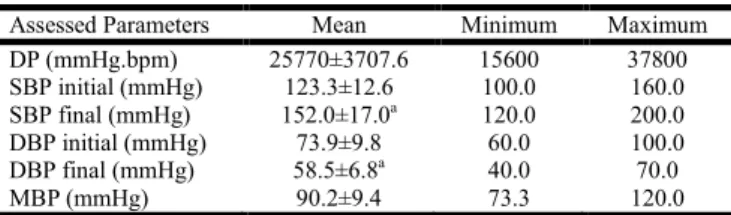
SBP (p<0.0001), with hypertensive response, and initial and final DBP (p<0.0001), com with hypotensive response. The effort percentage values (% effort) and DP gave to used test (adapted Burpee) a high intensity aerobic activity characteristic (Tables 2 e 3).
Table 2. Mean, standard deviation, minimum and maximum values of heart rate (HR) before, during, and
after Jiu-Jitsu athletes’ test
Assessed Parameters Mean Minimum Maximum
HR resting (bpm) 89.0±16.3 64.0 136.0
HR mean (bpm) 168.0±12.9a 120.0 195.0
HR maximum (bpm) 193.0±15.7a;b 164.0 223.0
% Effort 87.0± 6.3 72.0 97.0
HR – Heart rate; % Effort: effort percentage; asignificantly different (p<0.05) from restingHR;
bsignificantly different (p<0.05) from mean HR.
Table 3. Mean, standard deviation, minimum and maximum values from Double Product, Systolic, Diastolic, and Medium
Blood Pressure before and after test
Assessed Parameters Mean Minimum Maximum
DP (mmHg.bpm) 25770±3707.6 15600 37800
SBP initial (mmHg) 123.3±12.6 100.0 160.0
SBP final (mmHg) 152.0±17.0a 120.0 200.0
DBP initial (mmHg) 73.9±9.8 60.0 100.0
DBP final (mmHg) 58.5±6.8a 40.0 70.0
MBP (mmHg) 90.2±9.4 73.3 120.0
DP – Double Product; SBP– Systolic Blood Pressure; DBP – Diastolic Blood Pressure; MBP– Medium Blood Pressure; asignificantly different (p<0.05)
from their respective control (SBP initial or DBP initial).
(ordinate or y axis) with R2=0.2137. That is, the aim of
achieving this regression was verify a functional relationship existence between an independent (repetitions) and dependent (DP) variable.
Figure 1. Double Product dispersion diagram (y axis) based on repetitions performed number at adapted Burpee test (x axis) with Linear Trend Line (Linear Regression). y – Ordinate Axis
Value; x –Abscissa Axis Value; R2 – Determination Coefficient
DISCUSSION
In our study, sample characterization data showed a young group with high practice time and relatively good repetition mean (leaning on average value over maximum value). When we verify different groups in our sample by age and practice time, there was no statistically significant difference.
Ravagnani et al. (2005), in their study of maximal oxygen
consumption decline (VO2max) as an age function, they realized
that there was a decrease of approximately 10% in VO2max per
studied decade. However, Roger et al. (1990) assert that active
individuals can reduce aerobic capacity loss to 5% when they maintain constant their physical activity levels and body composition.
Farinatti and Assis (2000) in their study obtained much lower HR values and much higher BP (both systolic and diastolic), probably because we selected active to athletes individuals,
different from mentioned work group above. Passaglia et al.
(2013) mention that there seems to be a positive relationship between dose and response to physical training, which differs not active, active, and athletes individuals one to another. Another interesting finding in our study is that participants average resting heart rate was relatively high (89.0+16.3 bpm), which we believe to be related to emotional and/or
environmental factors. Ribeiro et al. (2000) argue that HR may
suffer multifactorial influences, and, among them, emotional part is closely related to changes in autonomic nervous system that directly intervene in heart functioning. Regarding resting and final HR, similar values were found in a work by
Rodrigues et al. (2012), where in an incremental test
performed on 24 normotensive young people (22.6+3.5 years old), it was identified, respectively, 110.25 and 187.23 bpm, resembling our findings. The effort percentage in our study was 87.0+6.3%, characterized like a high-intensity activity.
Farinatti et al. (2000), comparing aerobic and resistance
exercises on cardiac demand in 18 subjects of 23.0+6.0 years old, identified that resistance exercise, regardless of intensity, promote lower cardiac demand (DP) than aerobic exercise, and the smaller muscle mass requested, lower will be absolute DP, approaching our study DP values with ones obtained by authors above in group that performed up to 5 min cycling at 75-80% HR reserve.
Figueiredo et al. (2011) when comparing two resistance
training protocols with different intervals between sets, found that both HR, SBP, and DP increased similarly to our results, especially when they were compared to lowest interval group, however DBP remained unchanged (regardless of protocol). In this same work, DP value obtained was similar to that one found in our study in protocol with less rest between sets, probably to give a protocol continuity character, meaning a higher cardiac stress is given by intervals shorter recovery.
Gonçalves et al. (2015) conducted a study with 52 subjects
(active Young adults) in two different protocols: endurance and resistance, in both upper and lower limbs.
They identified in all applied protocols an increase in HR,
SBP, and VO2max, whereas DBP decreased only in endurance
protocol, using lower limbs, resembling our results, featuring our protocol as predominantly aerobic and high intensity (considering at this effort percentage). These same authors assert that any training protocol may influence cardiovascular parameters, however those ones whom use higher muscle quantity and demand more practice time promote more
pronounced changes. Kravchychyn et al. (2015) claim direct
tests are considered “gold standard for determining physiological variables, however costs are high and require specialized labour. Thus, most professionals use other tests as more affordable alternative, being advantageous to create protocols able to estimate cardiac stress just repeating predetermined movements. In our study, although various
Table 4. Pearson correlation values considering collected and calculated personal, physical practice, and hemodynamic data
R Age Repet PT HRr HRmax %Esf DP SBP f DBP f SBP i DBP i
Age - 0.23 -0.02 -0.08 -0.05 -0.06 0.13 0.26 0.33* 0.34* 0.49*
Repet - - -0.17 -0.07 0.07 0.13 0.46* 0.44* -0.23 0.24 0.11
PT - - - 0.07 0.05 -0.04 -0.11 -0.14 0.11 -0.15 -0.12
HRr - - - - 0.12 0.21 0.15 -0.03 -0.08 0.33* 0.16
HRmax - - - -0.48* 0.38* 0.12 -0.13 -0.13 -0.17
%Esf - - - - 0.24 0.03 0.00 0.26 0.02
DP - - - - 0.87* -0.09 0.47* 0.06
SBP f - - - -0.01 0.52* 0.16
DBP f - - - - 0.19 0.45*
SBP i - - - 0.51*
DBP i - - -
r – Correlation value; Repet – Test repetitions; PT – Practice time; HRr – Resting heart rate; HRmax – Maximum heart rate;
relationships have shown significance in Pearson test, it was considered just DP’s relationship to repetition performed number, finding a moderate to strong correlation, building up a linear regression graph that it might serve as a new test to be developed to estimate cardiac stress from simple and generalized request movements.
It is known acute cardiovascular responses vary depending on
exercise type, intensity, and duration (Brum et al., 2004).
D’Assunção et al. (2007) can be noticed this behaviour when
considering different work intensities and durations relating to SBP, HR and DP, even if DBP remained unchanged.
Aldenucci et al. (2010), in a paper about blood pressure
behaviour and other physiological variables in exercise response to 75% of 1RM dynamic force, assessed 16 males (26.3+1.1 years old) and found SBP initial values of 107.69+3.02 mmHg and final one of 127.31+3.82 mmHg, while DBP remained practically unchanged (initial: 68.75+2.39 mmHg and final: 70.0+3.41 mmHg). HR varied from 79.0+4.17 bpm to 136.62+2.23 bpm. These values were relatively different from our group, even if similar age,
probably because exercise performed type. Cunha et al. (2006)
argue that factors such exercise type, intensity and duration can interfere on different individuals’ cardiovascular responses.
Forjaz et al. (1998) identified that pressure drop magnitude
and duration caused by continuous exercise are dependent on exercise duration, which they have tested two different durations (cycle ergometer) and realized that mainly DBP responds with more pronounced reduction in longer protocol. Similar results were seen in our study which DBP significantly reduced, considering protocol used time (seven minutes). In
normotensive people, Paschoal et al. (2004) justify
post-exercise DBP drop by peripheral vascular resistance (PVR) reduction, which it could be explained by peripheral vasodilatation maintenance, and it seems to be related to person’s exposure time to exercise or abrupt reduction of this one.
Cunha et al. (2006), comparing different durations and
intensities exercises, realized in both exercises type (continuous intensity to 60% HR reserve and varied intensity) SBP and DBP behaviour were similar to our findings, which it was observed a SBP increase and DBP decrease after exercise, however HR value was closer more to interval exercise one (varied intensity) than continuous one, probably due to higher
intensity (142.0+7.63 bpm). According to Lopes et al.(2006),
in a study conducted after resistance exercise, a diastolic hypotension was detected. This fact is probably due to a large muscle mass mobilization, leading to a greater amount of vasodilatation blood vessels. Venous return may still be influenced by muscular pump interruption at test end.
In this same study (Lopes et al., 2006), comparing three
different exercise protocol (treadmill, stationary bike and bodybuilding circuit), it was also identified that DP was not significantly different between groups. However, hypotensive response was more pronounced in bodybuilding circuit group, probably indicating that greater muscular vasodilatation occurred in this group because it involves more muscle mass. At our work Burpee adaptation was made considering a greater muscles group actuation during its execution,
resembling the sport in question (BJJ). Also regarding DBP physiological mechanisms reduction, Polito and Farinatti (2006) argue that scientific literature does not yet provide consistent data on it. These authors suggest as a hypothesis sympathetic activity reduction on cardiovascular system (observed mainly in hypertensive individuals). Monteiro and
Sobral Filho(2004) and Legramante et al. (2002) suggest that
another associated mechanism is a PVR reduction, due to endothelial vasodilatation substances action (prostaglandins, nitric oxide) which they are released during effort physical.
Conclusion
Cardiovascular responses data found suggest significant changes, which all studied parameters (HR, SBP and DBP) had an increase when compared initial and final activity data, except for DBP that demonstrated a significant reduction, when they were exposed to a cardiac overload comparable to a high intensity continuous aerobic activity, serving as a screening proposal, and requiring adequate monitoring.
REFERENCES
Ainsworth, B., Cahalin, L., Buman, M., and Ross, R. 2015. The current state of physical activity assessment tools.
Progress in Cardiovascular Disease, Vol. 57, pp. 387-395.
Aldenucci, B. G., Camara, B., and Milistetd, M. 2010. Comportamento da pressão arterial e suas variáveis fisiológicas em resposta ao exercício para treino de força
dinâmica de membros inferiors. Cinergis, Vol. 11, No. 1,
pp. 22-27.
Brum, P. C., Forjaz, C. L. M., Tinucci, T., and Negrão, E. 2004. Adaptações agudas e crônicas do exercício físico no
sistema. Revista Paulista de Educação Física, Vol. 18, pp.
31-21.
Callegari-Jacques, S.M. 2003. Bioestatística: princípios e. Porto Alegre: Artmed.
Cunha, G. A., et al. 2006. Hipotensão pós-exercício em
hipertensos submetidos ao exercício aeróbio de intensidades variadas e exercício de intensidade constant.
Revista Brasileira de Medicina do Esporte, Vol. 12, pp.
313-317.
D’Assunção, W., Daltro, M., Simão, R., Polito, M., and Monteiro, W. 2007. Respostas cardiovasculares agudas no treinamento de força conduzido em exercícios para grandes
e pequenos grupamentos. Revista Brasileira de Medicina
do Esporte, Vol. 13, pp. 118-22.
Farinatti, P. T.V., and Assis, B. F.C. 2000. Estudo de frequência cardíaca, pressão arterial e duplo-produto em
exercícios contra-resistência e aeróbio contínuo. Revista
Brasileira Atividade Física & Saúde. Vol. 5, pp. 5-16.
Figueiredo, T., et al. 2011. Respostas cardiovasculares agudas
ao treinamento de força utilizando diferentes intervalos
entre series. Revista Brasileira de Prescrição e Fisiologia
do Exercício, Vol. 5, pp. 69-74.
Forjaz, C. L. M., Santaella, D. F., Rezende, L. O., Barretto, A. C. P., and Negrão, C. E. 1998. A duração do exercício determina a magnitude e a duração da hipotensão
pós-exercício. Arquivos Brasileiros de Cardiologia, Vol. 70,
pp. 99-104.
Gonçalves, A. C. C. R., et al. 2015. Effect of acute resistance
cardiovascular variables. International Archives of
Medicine, Vol. 8, pp. 1-12.
Jones, N. B., and Ledford, E. 2012. Strength and conditioning
for Brazilian jiu-jitsu. Strength and Conditioning Journal,
Vol. 34, pp. 60-69.
Kovacs, R., and Baggish, A. 2015. Cardiovascular adaptation
in athletes. Trends in Cardiovascular Medicine.
Kravchychyn, A. C. P., Alves, J. C.C., Kravchychyn, T. P., Nogueira, G. A., and Machado, F. A. 2015. Comparação entre os métodos direto e indireto de determinação do
VO2máx de praticantes de corrida. Revista Brasileira de
Medicina do Esporte, Vol. 21, No. 1, pp. 17-21.
Legramante, J. M., et al. 2002. Hemodynamic and autonomic
correlates of postexercise hypotension in patients with mild
hypertension. American Journal of Physiology-Regulatory,
Integrative and Comparative Physiology. Vol. 282, pp.
1037- 1043.
Lopes, L. T. P., Gonçalves, A., and Resende, E. S. 2006. Resposta do duplo produto e pressão arterial diastólica em exercício de esteira, bicicleta estacionária e circuito na
musculação. Revista Brasileira de Cineantropometria &
Desempenho Humano, Vol. 8, pp. 53-58.
Marins, J. C. B. 1998. Avaliação e prescrição de atividade física: guia prático. Rio de Janeiro: Shape.
Monteiro, M. F., and Filho, D. C. S. 2004. Exercício físico e
controle da pressão arterial. Revista Brasileira de Medicina
do Esporte, Vol. 10, pp. 513-516.
Pal, S., Radavelli-Bagatini, S., Ho, S. 2013. Potential benefits of exercise on blood pressure and vascular function.
Journal of the American Society of Hypertension, Vol. 7,
pp. 494-506.
Paschoal, M. A., Siqueira, J. P., Machado, R. V., Petrelluzzi, K. F. S., and Gonçalves, N. V. O. 2004. Efeitos agudos do exercício dinâmico de baixa intensidade sobre a
variabilidade da frequência cardíaca e pressão arterial de
indivíduos normotensos e hipertensos leves. Revista de
Ciências Médicas (Campinas), Vol. 13, pp. 223-34.
Passaglia, D.G., et al. 2013. Efeitos agudos do exercício físico
prolongado: avaliação após ultramaratona de 24 horas.
Arquivos Brasileiros de Cardiologia, Vol. 100, No. 1, pp.
21-28.
Polito, M. D., and Farinatti, P. T. V. 2003, Respostas de frequência cardíaca, pressão arterial e duplo-produto ao exercício contra-resistência: uma revisão da literatura.
Revista Portuguesa de Ciências do Desporto. Vol. 3, No.
1, pp. 79-91.
Polito, M. D., and Farinatti, P. T. V. 2006. Comparação da pressão arterial após exercícios contra-resistência: uma revisão sistemática sobre variáveis determinantes e
possíveis mecanismos. Revista Brasileira de Medicina do
Esporte, Vol. 12, pp. 386-392.
Ravagnani, F. C. P., Coelho, C.F., and Burini, R.C. 2005. Declínio do consumo máximo de oxigênio em função da idade em indivíduos adultos do sexo masculino submetidos
ao teste ergoespirométrico. Revista Brasileira de Ciência e
Movimento, Vol. 13, pp. 7-15.
Ribeiro, T. F., et al. 2000. Estudo da variabilidade da
frequência cardíaca em dois voluntários de meia-idade, um
coronariopata e outro saudável – relato de caso. Revista
SOCESP, Vol. 1, No. 1, pp. 1-10.
Rodrigues, E. Q., et al. 2012. Indicadores cardiovasculares em
repouso e durante um teste incremental em jovens do sexo
masculino. Revista Brasileira de Cineantropometria &
Desempenho Humano, Vol. 14, No. 1, pp. 32-40.
Roger, M. A., Hagberg, J. M., Martin, W.G., Ehsani, A. A.,
and Holloszy, J.O. 1990. Decline in VO2max with aging in
master athletes and sedentary men. Journal of Applied
Physiology, Vol. 68, pp. 2195-2199.