original article
RBCDH
Licence
Creative Commom CC
1 Instituto Federal de Educação Ciência e Tecnologia do Sul de Minas Gerais. Curso de Educação Física. Grupo de Estudos e Pesqui-sa em Ciências da Saúde. Campus Muzambinho, MG. Brasil.
2 Universidade Federal do Maranhão. Centro de Ciências Biológicas e da Saúde. Departa-mento de Educação Física. São Luís. MA. Brasil
Received: 28 March 2012 Aproved: 19 August 2012
Acute cardiovascular responses in a virtual
environment simulated by Nintendo Wii
Respostas cardiovasculares agudas em ambiente
virtualmente simulado pelo Nintendo Wii
Renato Aparecido de Souza1
Lucas Gonçalves da Cruz1
Priscila Silva de Carvalho1
Fabiano Fernandes da Silva1
Wellington Roberto Gomes de Carvalho2
Abstract – It has recently been veriied using the Nintendo Wii in the health context. he aim of this study was to analyze the acute cardiovascular responses monitored by the behavior of heart rate, systolic blood pressure, diastolic blood pressure and double product in an environment virtually simulated by Nintendo Wii. he sample was con-sisted of 18 health college students with mean age 22.07 ± 1.34 years. he variables were observed with use of delta analysis (post value – prior value) ater 25 basketball shoots in two experimental situations: (I) seating and (II) jumping vertically. he results sug-gest the physical activity in a virtual environment emulated by Nintendo Wii is able to change the acute cardiovascular responses, mainly when performed in association with vertical jumps. hus, the results support the feasibility use of the Nintendo Wii in training programs and favor its indication more securely.
Key words: Arterial blood pressure; Basketball; Heart rate.
INTRODUCTION
Virtual Reality (VR) is a computational technology that integrates several degrees of immersion, interaction and user engagement by using multisen-sory devices from a three-dimensional synthetic environment created in real time by the computer1. From this interface, the virtual environment
can be manipulated by combining user’s behaviors and reactions, which allows several applications in healthcare, such as surgical training, medical imaging, biosimulation, biomechanics, teaching, visualization with aug-mented reality, rehabilitation process and expansion of communication for people with special needs2.
Recently, a new class of video games called exergames (EXG) has used VR to provide to the user the possibility of perceptual and performance
emulation with potential for sensory and motor abilities development3.
Many studies have used interactive virtual games from Nintendo Wii, the world’s most popular EXG, to assess VR implications in
rehabilita-tion process and neuromuscular training4-6 as well as the impact of VR
on physiological parameters, especially concerning energy expenditure7-9.
To date there are insuicient scientiic descriptions about acute car-diovascular responses during physical exertion imposed by EXG. he premise of studying this phenomenon is explained by the fact that the understanding of cardiovascular responses during physical exertion is critical for developing strategies and to obtain parameters that allow us to adjust training programs as well as to guarantee the safety of practitioners, especially when their clinical conditions involve higher risks10. Moreover,
VR acts as a promoter of physical activity contents, allowing new possibili-ties for systematic exercise and movement.
Although acute cardiovascular responses have not yet been efectively described with the use of Nintendo Wii, it has been proposed that some Nintendo Wii games could facilitate the meeting of recommendations from the American College of Sports Medicine (ACSM) regarding the
improvement and maintenance of cardiorespiratory itness11,12. Miyachiet
al.11 evaluated metabolic equivalents (METs) of 12 adult volunteers who
performed approximately 70 matches on Wii Sports and Wii Fit Plus. Re-sults showed that 67% of activities were classiied as of light-intensity (< 3 METs), 33% as of moderate-intensity (3 – 6 METs), and no activity was considered as of vigorous-intensity (> 6 METs). Douris et al.12 compared
physiological and psychological responses of 21 college students, healthy and sedentary, with a mean age of 23.2 ± 1.8 years, ater they were subjected
to 30 minutes of exercise like brisk walking on the treadmill versus 30
minutes of Nintendo Wii Fit on Free Run mode. Regarding physiological
In this context, the aim of this study was to analyze acute cardiovas-cular responses by monitoring the behavior of HR, systolic blood pressure (SBP), diastolic blood pressure (DBP) and double product (DP) in college students aged between 20 and 24 years during basketball shots on Nin-tendo Wii virtually simulated environment in the following experimental situations: (I) with the volunteer seated, position traditionally adopted by users of video games, and (II) with the volunteer jumping vertically. We hypothesized that exercise in VR induces alterations in all studied variables, especially when shots are performed in association with vertical jumps. From results obtained in this study, we can compare the virtual exercise intensity level with recommendations for physical activity, in order to verify what should be the necessary adjustments for health promotion using the studied virtual game.
METHODOLOGICAL PROCEDURES
Study type and sample
his is a cross-sectional and self-paired study whose convenience sample was composed of 18 healthy college students considered active according
to the International Physical Activity Questionnaire (IPAQ) 13,
normo-tensives, of both sexes (9 men and 9 women), with a mean age of 22.07 ±
1.34 years and body mass index (BMI) of 21 ± 5 kg/cm2. All experimental
procedures adopted meet the requirements of Law 196/96 of Conselho Nacional de Saúde, which establishes guidelines and rules for research involving humans (Instituto Federal de Educação, Ciência e Tecnologia do Sul de Minas Gerais (IFSULDEMINAS), Protocol 029/2011).
We adopted the following inclusion criteria: (a) negative responses to the Physical Activity Readiness Questionnaire (PAR-Q)14; (b) be
clas-siied as moderately active or active according to the IPAQ; (c) have not consumed alcohol, cafeine, ergogenic and tobacco in the three days pre-ceding data collection; (d) have not practiced strenuous exercise 24 hours before collection; (e) be properly hydrated; (f) have slept 6-8 hours on the day preceding collection, and (g) have no prior experience with Nintendo Wii virtual games. Regarding to item “e”, all volunteers were instructed to consume approximately 500 to 600 ml of water two to three hours before the assessment. he checking of criteria for inclusion “c”, “d”, “e”, “f” and “g” was done through questions verbally answered by volunteers on the day of assessment.
Collection protocol
All subjects were evaluated at Laboratório para Atividade Física em Am-biente Virtual (LAFAV, IFSULDEMINAS – Muzambinho Campus, Minas Gerais, Brazil) in one day and individually.
on a backless bench during shots, and (II) with the volunteer jumping vertically for performing shots. In both tests, the shots’ motor behavior was emulated in a virtual environment using the basketball game from Nintendo Wii Sports Resort sotware. For executions of tasks, we used the visual instruction provided by the sotware associated with verbal instructions provided by a single researcher on the technical execution of the “free throw” during the two experimental situations. Figure 1 il-lustrates the expected kinematic behavior of the trunk and upper limbs during shots. For the experimental situation II, the volunteer associated this sequence of trunk and upper limbs movements with a vertical jump within a marked area on the lab’s loor, in order to avoid displacement in the anteroposterior and lateral-lateral plane greater than 15 cm. In the two experimental situations, if a volunteer shows a visually anomalous motor behavior, the entire sequence of shots is annulled and a new try is given 48 hours later.
Figure 1. Expected behavior for performing shots.
For experimental routine we adopted the following procedure: initially, subjects remained seated for 10 minutes and the lowest HR of this period was considered as the initial HR for the experimental situation I. hen, initial SBP and DBP were measured. At this moment, taking advantage of the volunteer seated position, the task began. Finally, ater performing 25 shots in the seated position, HR, SBP and DBP were measured again. Ater 10 minutes of recovery in the seated position, cardiovascular variables were similarly obtained for the beginning of the experimental situation II, in which 25 subjects performed shots in association with vertical jumps. Again, at the end of task 2, inal values for HR, SBP and DBP were obtained. In both tasks, 25 shots were performed within 60 seconds, synchronized with the visual and audible feedback from the basketball game, and each shot lasted approximately 2.4 sec.
HR was monitored using a frequency counter (Polar, RS800CX model). Blood pressure measuring was performed by auscultation as recommended
by the American Heart Association15, using a mercury sphygmomanometer
(Oxigel) and a stethoscope (Bic-Eternity). DP was obtained in both initial and inal situations of each test from the product between HR and SBP,
Virtual Environment
he virtual environment was simulated by Nintendo Wii. Input devices that allow the user-Wii interaction process are the Wii Remote and the Sensor Bar. he Wii Remote is equipped with an accelerometer capable of detecting motion in three dimensions and communicates via wireless (Bluetooth) with the Sensor Bar, which is responsible to detect and trans-mit to the console infrared signals generated by the Wii Remote. In the present study, we used the Wii Motion Plus accessory attached to the Wii Remote. Using this accessory, movements are reproduced more accurately, in real time (1:1) and with faithful reproduction of player’s movements on
the screen projection of the virtual environment17. he visual stimulus
was produced using a multimedia projector (Epson, Power Lite S5 model), with a projected image area of 1.5 x 2.5m on a white wall. Volunteers had a physical area of 25 m2 (5 x 5m) to perform shots and were located 1.5m
from the Sensor Bar.
Statistical analysis
Initially, we used the Shapiro-Wilk test to verify the normal distribution of continuous variables. Normality was observed for all variables. Data processing included the use of the Paired Student’s t test for dependent samples, which was applied to the mean delta-values (inal value – initial value) for all variables related to acute cardiovascular responses (HR, SBP, DBP and DP) in the two experimental situations. We adopted a signiicance level of 5% (p < 0.05) to reject the null hypothesis. All statistical analyses were performed on SPSS version 19.0.
RESULTS
Figure 2 shows the mean delta HR (inal HR – initial HR) for the two ex-perimental situations. We observed an increase of 129% in the delta HR when subjects performed the experimental situation II (vertical jumps) compared with the experimental situation I (seated position) (p = 0.02).
In estimating the maximum HR (HRmax) by equation 220 - age18, we
observed that volunteers showed a mean value of 51.62% of HRmax when shots were performed in the seated position, while during shots associated with vertical jumps the mean value was of 75.34% of HRmax.
Figure 3 shows the mean delta SBP (inal SBP – initial SBP) for the two experimental situations. Although not signiicantly diferent (p = 0.18), the mean delta SBP in the experimental situation II was 37% higher than the mean delta SBP observed in the experimental situation I.
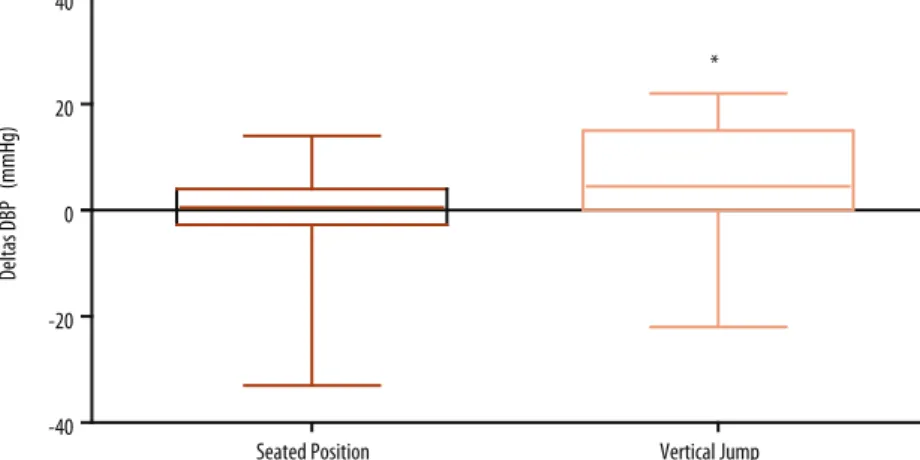
he mean deltas DBP (inal DBP – initial DBP) for the two experimental situations are shown in Figure 4. While the mean delta DBP in the experi-mental situation I was zero, the mean delta DBP in experiexperi-mental situation II was 5 mmHg. hese values were statistically diferent (p = 0.0052).
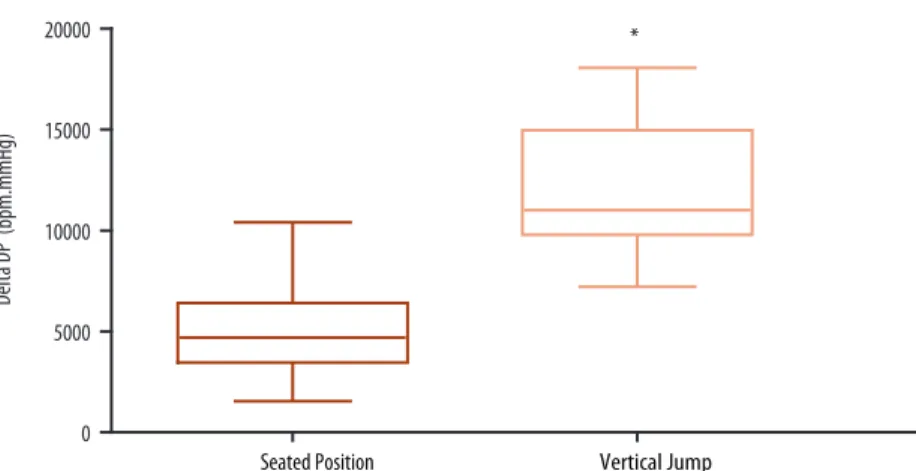
when subjects performed the experimental situation II compared with the experimental situation I (p = 0.001).
Seated Position Vertical Jump
0 20 40 60 80 100 120
*
Delta HR
(bpm
)
Figure 2. The mean delta HR (bpm) for the two experimental situations (seated position and vertical jumps) (n = 18). * indicates p < 0.05 when compared with the seated position experimental situation.
Seated Position Vertical Jump
-20 0 20 40 60
Delta SBP
(mmHg)
Figure 3. The mean delta SBP (mmHg) for the two experimental situations (seated position and vertical jumps) (n = 18).
Seated Position Vertical Jump
-40 -20 0 20 40
*
Deltas DBP
(mmHg)
Seated Position Vertical Jump 0
5000 10000 15000
20000 *
Delta DP
(bpm.mmHg)
Figure 5. The mean delta DP (bpm.mmHg) for the two experimental situations (seated position and vertical jumps) (n = 18). * indicates p < 0.05 when compared with the seated position experimental situation.
DISCUSSION
Nowadays, many health problems are related to physical inactivity. Al-though the exact mechanisms responsible for the beneits of regular physical activity are still unknown, there is a vast literature that supports the
recom-mendation of bodily movement to improve human health condition20-22.
hus, any tool that aims to improve the population’s physical activity level, especially in social-recreational environments and in activities at home, should be investigated, so that its use is encouraged from scientiic evidence. In view of this, the aim of this study was to investigate acute cardiovascular responses (HR, SBP, DBP and DP) during a sequence of 25 shots in the basketball game from Nintendo Wii Sports Resort sotware, which has a potential technology for favoring corporal practices: VR3.
VR allows the creation of synthetic and fun environments for the de-velopment of several sensorimotor skills by stimulants tasks that increase the interest and motivation of users for physical activity22. However, the
cost for building and maintaining labs or environments that use this technology is still very high, rendering moot this kind of approach for promoting health in the general population. On the other hand, feasibil-ity and therapeutic success has been veriied in the use of EXG, especially Nintendo Wii, which has tracking and performance technologies, providing a simple and of low cost VR5,23.
Cardiovascular monitoring is critical for better understanding of
physiological demands imposed by a determined physical exertion24. Ater
the clariication of cardiovascular demand, we can develop strategies and obtain parameters to adjust training programs, especially for individuals with higher cardiovascular risk10. In the present study, we observed that
promotes: (a) increase in HR and stroke volume, and consequently (b) increase in cardiac output, which increases myocardial oxygen demand
and extraction, increasing DP25. Furthermore, although SBP diferences
between the two experimental situations have not been considered statisti-cally, we observed that in the experimental situation II (vertical jumps) there was a certain upward trend in values when compared to those obtained in the experimental situation I (seated position).
It is important to highlight that values of blood pressure (BP) obtained by the auscultatory method tends to underestimate the absolute values
of BP during exercises, especially those of submaximal type26. However,
considering that the probable underestimation occurred systemically, SBP and DBP results of this study should not be considered unfeasible, but taken with that caveat. hus, when we analyze the generality of results, it appears, as initially hypothesized, that physical activity in VR induces alterations in acute cardiovascular variables, especially when greater dynamism is associated to the use of the Wii Remote, in this case, vertical jumps.
Physical activity with the purpose of health promotion should be performed according to speciic recommendations concerning duration,
frequency and moderate-intensity level27. Usually, ACSM categorizes
moderate-intensity level using parameters related to oxygen consumption (VO2), metabolic equivalents (METs), energy expenditure and HR, the last one being considered the most practical way to do it, especially when taking into account aspects like reliability, safety and cost28,29.
In this study, we adopted the HRmax prediction from the equation HRmax = 220 - age to verify the virtual exercise intensity level18. Although
individuals with a speciic age have variables values of HRmax, the inac-curacy resulting from individual variation (± 10 bpm standard deviation for any HRmax expected for the age) has little inluence in the establishment
of training programs for healthy people18. We observed HRmax values of
51.62% (during shots in the seated position) and 75.34% (during shots as-sociated with vertical jumps). hese results indicate that these experimental conditions reached percentages of physical activity considered of light and moderate-intensity, respectively.
We considered that performed exercises were of light and moderate-intensity, thus, being observed the viability of Nintendo Wii basketball game for the improvement and maintenance of cardiorespiratory itness, in accordance with ACSM’s guidelines. In a similar study, Guderian et al.30
evaluated cardiovascular and metabolic responses of games from Wii Fit sotware in adults of middle age and older to determine whether virtual games would meet ACSM guidelines for health promotion. Results showed that the exercises’ mean intensity level was of 43, 4 ± 16.7% of reserve HR, with a 3.5 ± 0.96 METs and energy expenditure of 116.2 ± 40.9 kcal/session, indicating that virtual games should be considered as an alternative tool for improving physical itness and health. his possibility has also been observed in other studies related to the interpretation of physiological
highlight that virtual activity alone should not replace an oriented training program. Additionally, virtual games should be seen as an auxiliary tool to help reduce the monotony, increasing entertainment and adherence to physical activity, always with the guidance of a professional.
Finally, we can mention some limiting factors of this study, such as the lack of more robust analyses on the number of participants (sample calculation), and more sensitive physiological monitoring, such as oxygen consumption and energy expenditure. However, the contribution to the state of the art and, above all, to the initial understanding of acute cardio-vascular responses using Nintendo Wii for corporal practice overcomes this study’s limitations, allowing us even to suggest prospects of studies investigating other games, observing chronic cardiovascular responses and assessing sedentary individuals or individuals sufering from diseases.
CONCLUSIONS
his study’s results suggest that physical activity in a virtual environment simulated by the Nintendo Wii is capable of altering acute cardiovascular responses, especially when associated with vertical jumps. However, these alterations do not exceed reference values of ACSM’s recommendations for physical exercise. hus, these results support the feasibility of using Nintendo Wii in training programs and help toward its safer prescription. hese results should also be considered as an initial source for the formula-tion of training protocols. However, further studies should be conducted to better clarify the phenomenon.
Acknowledge
Authors thank the inancial support (APQ-02744-11) given by Fundação de Amparo à Pesquisa do Estado de Minas Gerais (FAPEMIG).
REFERENCES
1. Pimentel K, Teixeira K. Virtual Reality: hrough the New Looking Glass. Blue
Ridge Summit, Pensilvânia: Windcrest/McGraw Hill; 1995.
2. Santos V, Hermosilla L. Realidade Virtual na Medicina. Revista Cientíica Eletrônica
de Sistemas de Informação 2005;1(2):1-3.
3. Vaghetti CAO, Botelho SSC. Ambientes Virtuais de Aprendizagem na Educação
Física: Uma revisão sobre a utilização de Exergames. Ciências & Cognição 2010;15(1):76-88.
4. Baumeister J, Reinecke K, Cordes M, Lerch C, Weiss MN. Brain activity in
goal-directed movements in a real compared to a virtual environment using the Nintendo Wii. Neurosci Lett 2010; 481(1):47-50.
5. Saposnik G, Mamdani M, Bayley M, horpe KE, Hall J, Cohen LG, et al.
Efective-ness of Virtual Reality Exercises in Stroke Rehabilitation (EVREST): Rationale, Design, and Protocol of a Pilot Randomized Clinical Trial Assessing the Wii Gaming System. Int J Stroke 2010; 5(1):47-51.
6. Yong JL, Soon YT, Xu D, hia E, Pei FC, Kuah CW, et al. A feasibility study using
7. Bailey BW, Mcinnis K. Energy cost of exergaming: a comparison of the energy cost of 6 forms of exergaming. Arch Pediatr Adolesc Med 2011;165(7):597-602.
8. Worley JR, Rogers SN, Kraemer RR. Metabolic responses to Wii Fit™ video games
at diferent game levels. J Strength Cond Res 2011;25(3):689-93.
9. Graves LE, Ridgers ND, Williams K, Stratton G, Atkinson G, Cable NT. he
physi-ological cost and enjoyment of Wii Fit in adolescents, young adults, and older adults. J Phys Act Health 2010;7(3):393-401.
10. hompson PD, Franklin BA, Balady GJ, Blair SN, Corrado D, Estes NA, et al.
Ex-ercise and acute cardiovascular events placing the risks into perspective: a scientiic statement from the American Heart Association Council on Nutrition, Physical Activity, and Metabolism and the Council on Clinical Cardiology. Circulation 2007;115(17):2358-68.
11. Miyachi M, Yamamoto K, Ohkawara K, Tanaka S. METs in adults while
play-ing active video games: a metabolic chamber study. Med Sci Sports Exerc 2010;42(6):1149-53.
12. Douris PC, McDonald B, Vespi F, Kelley NC, Herman L. Comparison between
Nintendo Wii Fit aerobics and traditional aerobic exercise in sedentary young adults. J Strength Cond Res 2012;26(4):1052-7.
13. Matsudo S, Araújo T, Matsudo V, Andrade D, Andrade E, Oliveira LC, et al.
Questionário Internacional de Atividade Física (IPAQ): Estudo de Validade e Reprodutibilidade no Brasil. Rev Bras Ativ Fís Saúde 2001; 6(2):5-18.
14. Shephard RJ. PAR-Q, Canadian Home Fitness Test and exercise screening
alterna-tives. Sports Med 1988; 5(3):185-95.
15. Pickering TG, Hall JE, Appel lJ, Falkner BE, Graves J, Hill MN, et al.
Recommenda-tions for blood pressure measurement in humans and experimental animals: Part 1: blood pressure measurement in humans: a statement for professionals from the Subcommittee of Professional and Public Education of the American Heart Asso-ciation Council on High Blood Pressure Research. Hypertension 2005;45(1):142-61.
16. White WB. Heart rate and the rate-pressure product as determinants of
cardio-vascular risk in patients with hypertension. Am J Hypertens 1999;12(2):50S-55S.
17. Nintendo. Wii Operations Manual. Wii System Play Guidelines. Nintendo of
America Inc., Redmond, WA, USA.
18. Robergs RA, Landwehr, R. he surprising history of the “HRmax=220-age”
equa-tion. J Exerc Physiol Online 2002;5(2):1-10.
19. Kruk J. Physical activity in the prevention of the most frequent chronic diseases:
an analysis of the recent evidence. Asian Pac J Cancer Prev 2007;8(3):325-38.
20. Warburton DE, Nicol, CW, Bredin SS. Health beneits of physical activity: the
evidence. CMAJ 2006;174( 6):801-9.
21. Bauman AE. Updating the evidence that physical activity is good for health: an
epidemiological review 2000-2003. J Sci Med Sport 2004;7(1Suppl):6-19.
22. Holden MK. Virtual environments for motor rehabilitation: review. Cyberpsychol
Behav 2005;8(3):187-211.
23. Williams MA, Soiza RL, Jenkinson AM, Stewart A. Exercising with Computers in
Later Life (EXCELL) - pilot and feasibility study of the acceptability of the Nintendo® WiiFit in community-dwelling fallers. BMC Res Notes 2010;3:238-25.
24. Murphy MH, Mcneilly AM, Murtagh EM. Session 1: Public health nutrition:
Physical activity prescription for public health. Proc Nutr Soc 2010;69(1):178-84.
25. Secher NH, Volianitis S. Are the arms and legs in competition for cardiac output?
Med Sci Sports Exerc 2006;38(10):1797-803.
26. Polito MD, Farinatti PTV, Lira VA, Nóbrega ACL. Blood pressure assessment
during resistance exercise: comparison between auscultation and Finapres. Blood Press Mon 2007;12(2):81-6.
27. Haskell WL, Lee IM, Pate RR, Powell KE, Blair SN, Franklin BA, et al. Physical
Corresponding author Renato Aparecido de Souza Instituto Federal de Educação Ciência e Tecnologia do Sul de Minas Gerais (IFSULDEMINAS), Rua Dinah, 75. CEP: 37890-000 - Muzambinho, MG. Brasil.
E-mail: [email protected]
28. Garber CE, Blissmer B, Deschenes MR, Franklin BA, Lamonte MJ, Lee IM, et
al. American College of Sports Medicine position stand. Quantity and quality of exercise for developing and maintaining cardiorespiratory, musculoskeletal, and neuromotor itness in apparently healthy adults: guidance for prescribing exercise. Med Sci Sports Exerc 2011;43(7):1334-59.
29. Marins JCB, Luiz A, Monteiro A, Jesus G. Validação do tempo de mensuração da
frequência cardíaca após esforço submáximo a 50 e 80%. Rev Bras Med Esporte 1998;4(4):114-9.
30. Guderian B, Borreson lA, Sletten lE, Cable K, Stecker TP, Probst MA, et al. he