Jebmh.com
Original Article
J. Evid. Based Med. Healthc., pISSN- 2349-2562, eISSN- 2349-2570/ Vol. 3/Issue 84/Oct. 20, 2016 Page 4561
COMPARISON OF SACRAL INDEX AND KIMURA BASE WING METHOD TO DETERMINE THE
SEX OF SACRUM
Bichitrananda Roul1, Mamita Nayak2, Bijay Kumar Dutta3, Sadananda Rath4, Manik Chatterjee5, Sagar Prusti6
1Assistant Professor, Department of Anatomy, Pt. J.N.M. Medical College, Raipur.
2Senior Resident, Department of Pathology, AIIMS, Bhubaneswar.
3Dean and Professor, Department of Anatomy, V.S.S. Medical College, Burla.
4Professor and HOD, Department of Anatomy, M.K.C.G. Medical College, Berhampur.
5Professor and HOD, Department of Anatomy, Pt. J.N.M. Medical College, Raipur.
6Associate Professor, Department of Anatomy, M.K.C.G. Medical College, Berhampur.
ABSTRACT
BACKGROUND
The sacrum (Vertebra Magnum) is a large, flattened, triangular bone present at the base of spine, which is formed by fusion of sacral vertebra S1 to S5 and the fusion occurs between the age group of 18 to 30 years. It forms the posterosuperior part of bony pelvis articulating on either side with the corresponding hip bone at the sacroiliac joint. The dimensions of sacra vary in different sexes. Determination of sex of sacrum can be done by using various methods. In our study, comparison was done between sacral index and Kimura base wing method.
MATERIALS AND METHODS
A study to determine the sex of sacrum was carried on 50 sacra (25 male and 25 female sacra) by two methods. One method used was sacral index and the other method was Kimura's base wing index. The measuring instrument used was sliding vernier caliper. Sacral index- the well-known method for determination of sex from sacrum and Kimura’s base wing method- another method for sex determination. Both are compared. The method of sacral index showed more accuracy rate as compared with Kimura's base wing index method.
RESULTS
By using sacral index, the % of bone identified as male sacrum was 64% and the % of bone identified as female sacrum was 68%. By using Kimura base wing method, 28% of male sacra and 24% of female sacra were identified in right side and 24% of male sacra and 20% of female sacra were identified in left side.
CONCLUSIONS
In our study, comparison was done between sacral index and Kimura base wing method in determining the sex of sacrum. From the above study, it was found that the method of sacral index showed more accuracy rate as compared with Kimura's base wing index method.
KEYWORDS
Sacrum, Sacral Index, Kimura's Base Wing Index.
HOW TO CITE THIS ARTICLE: Roul B, Nayak M, Dutta BK, et al. Comparison of sacral index and Kimura base wing method to determine the sex of sacrum. J. Evid. Based Med. Healthc. 2016; 3(84), 4561-4564. DOI: 10.18410/jebmh/2016/965
BACKGROUND
The sacrum (vertebra magnum) is a large, flattened, triangular bone present at the base of spine, which is formed by fusion of sacral vertebra S1 to S5.1 It forms the poster
superior part of bony pelvis articulating on either side with the corresponding hip bone at the sacroiliac joint.
The upper part of the sacrum is massive because it supports the body weight and transmits it to hip bones. The lower part is free from weight and therefore tapers rapidly.
The sacrum has a base, an apex or lower end. The base is directed upwards and forwards. It is formed by the upper surface of first sacral vertebra. The body is lumbar in type. The projecting anterior margin is called sacral promontory. The transverse process are highly modified. Each process is massive and fused with corresponding costal elements to form him lateral mass of the sacrum. The base of the lateral mass forms a broad slopping surface spreading fan wise from the side of the body. It is called ala of sacrum. The apex of the sacrum is formed by the inferior surface of the body of the fifth sacral vertebra. It bears an oval facet for articulation with coccyx. In establishing the identity of persons with respect to sex, anatomist, forensic experts and anthropologist use the skeletal materials for giving their opinion.
Being a part of axial skeleton, it supports erect spine, provides stability to bony pelvis, helps in weight transmission as per Frazer.2
Financial or Other, Competing Interest: None. Submission 13-09-2016, Peer Review 20-09-2016, Acceptance 12-10-2016, Published 18-10-2016. Corresponding Author:
Dr. Bichitrananda Roul, Assistant Professor, Department of Anatomy,
Pt. J.N.M. Medical College, Raipur-492001. E-mail: [email protected]
Jebmh.com
Original Article
J. Evid. Based Med. Healthc., pISSN- 2349-2562, eISSN- 2349-2570/ Vol. 3/Issue 84/Oct. 20, 2016 Page 4562
Sacrum is an important bone for identification of sex in human skeletal system apart from skull, pelvis. Since, it is an important component of axial skeleton and because of its contribution to the pelvic girdle and in turn to the functional differences in the region between the sexes.
The Main Differences between Male and Female Sacrum are
The width of the body of the first sacral vertebra is greater than that of each ala in male. In female, ala is greater than body or same in dimension. The concavity on ventral aspect of sacrum is more uniform and shallower in males. In females, the concavity is irregular especially between S1 and S2 and between S3 and S4.1 The relationship of the length
and breadth of the sacrum can be expressed quantitatively by using the sacral index. The male sacrum is longer and narrower than the female sacrum. The male sacrum is little bit heavier as compared to female sacrum. The muscular impression more marked over male sacrum as compared to female sacrum. In this study, we have compared the sacral index and Kimura base wing method to determine the sex of sacrum.
MATERIALS AND METHODS
The study was done in the Department of Anatomy, M.K.C.G. Medical College, Berhampur, during the period October 2009 to April 2010.
Materials - 50 human sacra (25 males, 25 females) are taken from the museum, Department of Anatomy, M.K.C.G. Medical College, Berhampur.
Inclusion Criteria
All the sacra were normal, fully ossified were devoid of any osteophytes, fully mature.
Exclusion Criteria
Broken, damaged sacrum, fused sacrum with coccyx.
Instrument used- Sliding vernier calipers.
Criteria for Sex Differentiation of Sacrum
Male Female Transverse
Diameter of Body and Ala
Body > Ala Ala ≥ Body
Curvature Gradual from
above downward
Lower Part Curves Abruptly
Auricular Process
Up to Upper Half of Third Sacral
Vertebra
Up to Second Sacral Vertebra
Weight Heavier Lighter
Muscular
Impression More Marked Less Marked
Determination of sex of the sacrum was done by using sacral index and Kimura’s base wing method and both the methods were compared, which method can determine the sex of the sacrum more accurately.
For calculating sacral index, breadth and length of individual sacrum taken with the help of vernier calipers and
adopting the method demonstrated in Hidaka’s practical
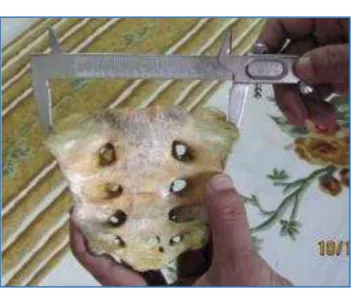
anthropometry.3 Stem of calipers was applied to upper
surface of the body of 1st sacral vertebra and measurement
of maximum breadth was taken across greatest expanse of lateral masses of bone as shown in Figure 1.
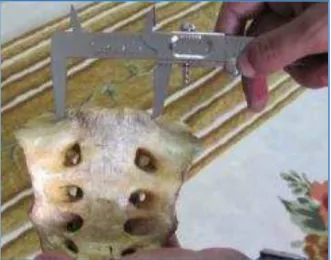
The maximum height or length is measured by applying the sliding calipers to middle of the promontory and middle of antero-inferior border of 5th sacral vertebra as shown in
Figure 2.
The second method- Kimura’s base wing method. To
calculate Kimura’s base wing index, transverse width of
sacral base taken. Max Width of base: It is transverse width of superior surface of body of 1st sacral vertebrae as in
Figure 3. Width of wing: It is distance between lateral margins of base to most lateral point on ala of sacrum as in
Figure 4. Kimura’s base wing index = width of wing X
100/width of base. Mean, standard deviation were calculated for both the methods and data was statistically analysed using t-test.
Figure 1. Measurement of Maximum Breadth
Jebmh.com
Original Article
J. Evid. Based Med. Healthc., pISSN- 2349-2562, eISSN- 2349-2570/ Vol. 3/Issue 84/Oct. 20, 2016 Page 4563
Figure 3. Transverse Width of Sacral Base taken as in this Figure
Figure 4. Transverse Width of the Wing Taken as in Figure 4
RESULTS AND DISCUSSION
Male Female
Range 90-105.5 104.2-130.9
Mean 98.35 113.5
S.D. 4.55 5.77
% of Bone
Identified 64 68
Table 1. Sacral Index Method
In our study, the sacral index in male sacrum ranges from 90 to 105.5 and in female sacrum ranges from 104.2 to 130.9. Mean in male sacrum was 98.35 and in female sacrum 113.5. According to Poornima et al4 in Andhra
Pradesh and Telangana regions related to southern part of India values of sacral index in males is 104.08 and females is 115.72. The % of bone identified as male sacrum was 64% and the % of bone identified as female sacrum was 68%. According to study by Mishra et al (2003)5 showed that
using sacral index method 39.2% of male sacra and 80.1% of female sacra were identified. Arpn et al6 study showed
that by using sacral index method, 53.33% of male sacra and 46.67% of female sacra were identified. According to
another study by Asthana et al,7 46.55% of male sacra and
57.14% of female sacra were identified. Patel et al8 found
that 62.5% of male sacra and 68.75% of female sacra were identified.
Male Female
Range 40-82.5 63.5-101.2
Mean 61.25 76.5
S.D. 11.2 11.24
% of Bone
Identified 28 24
Table 2.Kimura Base Wing Method Rt. Side
In our study in right side, the Kimura base wing method, the range in male sacra was between 40 to 82.5 and in female sacra it was 63.5 to 101.2. 28% of male sacra and 24% of female sacra were identified. According to Patel et al,8 18.75% of male sacra and 18.75% of female sacra were
identified. According to another study by Asthana et al,7
10.34% of male sacra and 9.52% of female sacra were identified. According to Arpan et al,6 10% of male sacra and
13.33% of female sacra were identified.
Male Female
Range 40-83.5 63-102.7
Mean 61.25 74.9
S.D. 11.2 8.9
% of Bone
Identified 24 20
Table 3. Kimura Base Wing Method Lt. Side
In our study in left side, the Kimura base wing method, the range in male sacra was between 40-83.5 and in female sacra it was 63.5 to 102.7. 24% of male sacra and 20% of female sacra were identified. According to Patel et al,8
18.75% of male sacra and 18.75% of female sacra were identified. According to another study by Asthana et al,7
10.34% of male sacra and 9.52% of female sacra were identified. According to Arpan et al,6 13.33% of male sacra
and 13.33% of female sacra were identified.
CONCLUSION
The sacrum is a large, flattened, triangular bone present at the base of spine, which is formed by fusion of sacral vertebra S1 to S5. Determination of sex of sacrum can be done by various methods. Most common index is sacral index. In our study, comparison was done between sacral index and Kimura base wing method in determining the sex of sacrum. From the above study, it was found that the method of sacral index showed more accuracy rate as compared with Kimura's base wing index method.
REFERENCES
1. Chaurasia BD. Human Anatomy. Vol. 2. 6th edn. New
Delhi: CBS 2012:187-190.
2. Frazer JE. Anatomy of human skeleton. 3rd edn.
Jebmh.com
Original Article
J. Evid. Based Med. Healthc., pISSN- 2349-2562, eISSN- 2349-2570/ Vol. 3/Issue 84/Oct. 20, 2016 Page 4564
3. Hrdlicka A, Stewart TD. Hrdlicka's practical anthropometry. 4th edn. Philadelphia: Wistar Institute
of Anatomy & Biology 1952:p. 172.
4. Janipati P, Kothapalli J, Rao SV. Study of sacral index: comparison between different regional populations of India and Abroad. Int J Anat Res 2014;2(4):640-644. 5. Mishra SR, Singh PJ, Agrawal AK, et al. Identification of sex of sacrum of Agra region. J Anat Soc India 2003;52(3):132-136.
6. Dubey A, Roy SS. A comparative study of sacral index vs. Kimura’s base wing index in sex determination through sacrum. Int J Anat Res 2016;4(2):2204-2206.
7. Asthana S, Gupta S, Khatri M, et al. Sacral index is more reliable than Kimura’s base wing index for sex determination of a sacrum. Natl J Med Res 2014;4(1):71-74.