Speech therapy in food transition from probe to breast in
newborn in kangaroo method
Intervenção fonoaudiológica na transição alimentar de sonda
para peito em recém-nascidos do Método Canguru
Andréa Monteiro Correia Medeiros1, Thalyta Prata Leite de Sá1, Conceição Lima Alvelos1, Deborah Sabina
Farias Novais1
ABSTRACT
Purpose: Verify the relationship between gestational age and duration of speech therapy to start oral feeding, when used the technique of feeding transition of the probe directly to the chest. Methods: This is a study of newborn medical/speech records of 38 risk in Kangaroo unit. Were collected: gestational age at birth and corrected days of life, birth weight and current, type and duration of speech therapy, enteral feeding volume. We used time use of antibiotics and ventilatory support as criteria for division of newborns into two groups (G1 and G2). At the statistical analysis was applied the nonparametric test of Mann-Whitney and the Pearson’s correlation coefficient. Results: Intervention time for newborns were discharged speech showed no significant results betwe-en groups (G1 = 9.35 days and G2 = 10.12 days), although the initial hypothesis of this study was that the newborn G1 would require fewer days of speech therapy than the G2. There was statistically significant difference in birth weight between G1 (1563.53 g) and G2 (1409.62 g).
Conclusion: It was observed that both groups started speech therapy and oral feeding practically medium of similar gestational ages and both speech intervention, demonstrating ability to coordinate sucking movements/breathing/swallowing, and consequently the effective and exclusive breastfeeding.
Keywords: Speech; Neonatology; Newborn; Premature; Feeding me-thods
RESUMO
Objetivo: Verificar a relação entre idade gestacional e tempo de inter-venção fonoaudiológica para início da alimentação via oral, quando utilizada a técnica de transição alimentar da sonda direta para o peito.
Métodos: Trata-se de um estudo do prontuário médico/fonoaudiológico de 38 recém-nascidos de risco em Unidade Canguru. Foram coletados os seguintes dados: idade gestacional ao nascimento e corrigida, dias de vida, peso ao nascimento e atual, tipo e duração da intervenção fono-audiológica, volume de dieta por sonda. Utilizou-se o tempo de uso de antibióticos e o suporte ventilatório como critérios de divisão dos recém--nascidos em dois grupos (G1 e G2). Na análise estatística, aplicou-se o teste não paramétrico de Mann-Whitney e o coeficiente de correlação de Pearson. Resultados: O tempo de intervenção para os recém-nascidos que receberem alta fonoaudiológica não apresentou resultados signi-ficativos entre os grupos (G1= 9,35 dias e G2= 10,12 dias), embora a hipótese inicial deste estudo fosse a de que os recém-nascidos do G1 necessitariam de menor período de atendimento fonoaudiológico que os do G2. Houve diferença estatisticamente significativa para o peso ao nascimento, entre G1 (1563,53 g) e G2 (1409,62 g). Conclusão: Quando utilizada a técnica de transição alimentar da sonda direta para o peito, em recém-nascidos de risco com média de idade gestacional semelhante e mesmo tempo de intervenção fonoaudiológica, os bebês demonstraram aptidão para coordenar os movimentos de sucção/respiração/deglutição, e consequentemente, a amamentação efetiva em seio materno exclusivo.
Descritores: Fonoaudiologia; Neonatologia; Recém-nascido; Prematuro; Métodos de Alimentação
Paper done at Universidade Federal de Sergipe – UFS – São Cristovão (SE) Brazil.
(1) Universidade Federal de Sergipe – UFS, Speech-Language, Pathology and Audiology Centre, São Cristovão (SE) Brazil.
Conflict of interests: No
Author’s contributions: AMCM elaborated the project; TPLS, CLA and DSFN gathered the data; TPLS, CLA, DSFN and AMCM developed the article. All the
listed authors were totally involved on the preparation of the manuscript and, approved the final version.
Correspondence address: Andréa Monteiro Correia Medeiros. Universidade Federal de Sergipe, Núcleo de Fonoaudiologia. R. Marechal Rondon s/n, Cidade Universitária Professor José Aloísio de Campos, Jardim Rosa Elze, São Cristovão (SE), Brazil, CEP: 49100-000. E-mail: [email protected]
INTRODUCTION
Breastfeeding brings many benefits, both for the baby and for the mother(1). Specifically regarding to speech therapy(2)
breastfeeding provides the proper development of the stoma-togmathic functions of the newborn (NB), since, while sucking breast, can establish adequate orofacial musclesstimulus(2,3).
The development of strategies to promote breastfeeding is extremely important, both to ensure the survival of the human species, favoring immunity, digestion and nutrients absorp-tion(4), and by the fact that breastfeeding be considered in
many cultural and social contexts, as an act of love. Authors(5)
state that the act of breastfeeding promotes greater interaction between mother-infant for bonding expanding purposes.
The birth of a baby in risk (low weight and/or premature) can cause numerous difficulties in adaption to extrauterine life, given the immaturity of respiratory, circulatory and gastrointestinal functions. Before the 60´s, it was rare the premature newborns (PN) in very low birth weight (VLBW) to survive. However, with technological advances and the me-dicine resources, the survival of this population has increased considerably(5-7).
About risk criterions, the Ministry of Health(8), ranks as
underweight newborns on less than 2500 g, and very low birth weight, those born with weight less than 1500 g and as extre-mely low birth weight newborns with weight less than 1000 g. Regarding to prematurity, the literature(9) considers the term all
newborn infants with gestational age (GA) between 37 and 41 weeks, as preterm, cases where the baby is born into less than 37 completed weeks(10); as post-term, with GA higher or the
same as 42 weeks(9), as limitrophes when his/her GA is between
35 and 37 weeks, and moderate with GA 31 and 34 weeks and as extreme, between 24 and 30 weeks(11).
The ninth week of pregnancy until birth (fetal growth pe-riod)(12,13), several behaviors are being developed. Swallowing
movements are initiated approximately at 11th week and then oral reflexes and lip movements. The beginning of suction occurs between the 17th and 24th week, however, no coordi-nation between these functions. It is approximately between 25th and 27th week happens the respiratory movements(13).
Several authors(14-17) indicate that only in the 34th or 35th week,
the suction will be globally coordinated with swallowing and breathing. However, some studies(18,19) suggest that clinically
stable preterm infants with feeding readiness, oral stimulation can start “training suction” with accompanying speech patho-logist and oral feed via earlier.
Difficulties in establishing the right time to start breastfe-eding can happen among health professionals and there have been times where only the gestational age and weight were used as indicators for early oral feeding. However, the readiness and success of oral feeding depends on, not only on the gestational age and weight, but other variables such as physiological and clinical stability, muscle tone, pertaining to weight gain, prior
sucking experience, oral motor skills, presence of searching reflexes during skin to skin contact, coordination between su-cking, swallowing and breathing functions (S/S/B), behavioral organization of the baby, the environment control and posture and coordination to ingest the prescribed diet volume(4,20,21).
In Brazil, the perinatal conditions that, in the beginning, contribute to neonatal and perinatal mortality and morbity, are very common problems in PTNBs and low birth weight(22).
Given the immaturity and the difficulties presented by the PTNBs, it is necessary to ensure a differentiated monitoring about the survival and quality of life of NB in risk.
Regarding to feeding, even if the offer of diet is done orally via (OV), especially breastfeeding, it is ideal and desired(1) to
be done by alternative ways such as gastric tubes, is, in some cases, the only way to ensure survival of preterm infants(1,22),
although prolonged use is considered by some authors(19-23)
detrimental to the coordination development on the S/S/B. In responsive disposition to low birth weight in” New Born Humanized Care Precept” from the Health Ministry(22)
and according to Decree nº 930 of May 10, 2012, the speech therapist is professionally trained(24) and must be inserted into
neonatal units and the Kangaroo method, integrated into the interdisciplinary team.
The can work in promoting the practice of early breas-tfeeding, promoting and stimulate, oral feeding, assist in the transition from using the probe to the breast, helping to improve the quality of the NB’s life, since such actions may decrease hospital stay, allowing earlier discharge(24).
The Kangaroo method is a neonatal care focused on the care of premature newborns, which consists on placing the baby in skin to skin contact with the mother´s(22). The method´s idea
is the placement of the NB by the mother´s breast being this contact the one who will provide greater thermal stability, and replace incubators, allowing early discharge, decrease the rate of nosocomial infection and, consequently, improve the quality of care with less cost to the health system.
The method is developed in three steps(22): the first begins
interaction and early detection of risk situations. It is presumed that the third step can only happens if the child is with the mi-nimum weight of 1600 g, clinically stable and gaining weight, preferably on exclusive breastfeeding.
In this context, the speech therapist can contribute to the monitoring and effectiveness of the transition from the gastric probe straight to breast technique (probe-breast). Sucking stimulation in (“empty breast”), concurrent to the provision of probe feeding is seen as the non-nutritive sucking technique (NNS), offering less risk to the infant, preventing him/her from chocking, while he/she doesn´t have S/R/D coordination. From the moment in while the RN acquires such coordination, he/ she takes the swallowing training and it is performed in “bre-ast partially filled”, simultaneously to the diet supplied by the probe. When is observed the effectiveness of weight gain, the amount of complement is decreased, until the infant is fed exclusively breastfed(22).
The aim of this study was to verify the corrected gestational age and kangaroo technique phases, as well as the time needed by the speech therapist for the diet feeding by exclusive oral vial and speech discharge, once this technique favors early bre-astfeeding and, thus, promotes discharge. As a specific aim, we tried to observe these aspects into the moment of oral feeding (“partially filled breast”) and the exclusive breastfeeding offer.
METHODS
The study was accomplished through approval by the Human Research Ethics Committee from Universidade Federal de Sergipe (UFS), under the nº PCEA – 02304812.0.0000.0058. All the newborn´s keepers were notified about the research and signed the Consent Form.
This is an observational and descriptive study, was conduc-ted by using collecconduc-ted data from medical and speech therapy records from 38 newborns of both genders admitted to Neonatal Intermediate Care Unit Kangaroo (NICUKA), in a public maternity in Aracaju (SE), from August 2012 to April 2013.
The subjects of this study were divided two groups, accor-ding to this Chart 1.
As important medical complications, were considered cases of neuropathy, heart disease and/or severe respiratory disease, congenital abnormalities, and sepsis syndromes and cases that required increased length of stay in the neonatal intensive care
unit, preventing the transfer of newborns in the kangaroo unit and early language intervention.
We opted for the division into groups according to the presence or absence of major medical complications from the assumption that this variable could affect the results, in relation to the type and length of speech therapy performed on newborns.
Term birth, post – term and those whose parents did not consent to their participation in research, the newborns who had at least one of the previous characteristics were excluded from the study.
From the consent of the parent or guardian, the study of medical and speech records of newborns, with some data ga-thering (Chart 2), recorded in a specific protocol (Appendix 1).
In the period preceding the assignment/release of supply from the breast, all newborns included in this study had to mandatorily have made use of exclusive probe feeding, with no prior experience with oral feeding. The onset of non-nutritive Chart 1. Criteria for division of newborns in groups 1 and 2
Group 1 (G1) Group 2 (G2)
- Early speech therapyu intervention
- Stable respiratory condition (without the use of O2 or by using the O2 than 14 days)
- Absence of infection that requires isolation - Absence of significant medical complications
- No antibiotic use or has used for a maximum of up to 6 days
- Delayed speech therapy intervention
- History of clinical respiratory instability (made use of O2 for more than 15 days)
- Presence of significant medical complications (neuropathies, diseases and/or severe respiratory diseases, congenital abnormalities, syndromes and sepsis)
- Use of antibiotics for 7 days or more
Chart 2. Study variables collected from medical records and speech
Variables Acronym
Medical diagnosis
--Use of antibiotics
--Ventilatory support
--Gestational age at birth GAB
Corrected gestational age at the time of speech evaluation
CGASE
Corrected gestational age on the initiation of the diet orally
CGAOV
Corrected gestational age at the onset of feeding in exclusive breastfeeding
CGAEB
Corrected gestational age at discharge speech CGADS
Days of life during the evaluation DLE
Birthweight BW
Weight during the speech evaluation WSE
Type of speech therapy received
--Duration of intervention DI
Supply type received
--Discounts offered for diet, when performed by this provision probe
--stimulation was given only after medical release, clinical sta-bility verified, since the weight did not contraindicated speech stimulation in that kangaroo unit. The technique of direct transition from probe to breast (probe-breast) is described below (Chart 3).
Note that the steps described in Chart 3 were carried out gradually and successively, according to the feeding schedule established by the physician/hospital routine. This occurred, in most cases, every three hours. As the team of speech therapists did not remain in full-time, there was support from the nursing staff for implementing the steps. The second step was essential for the NB, breast suction training, at the same time that the diet was offered through the probe, providing a feeling of sa-tiety while sucking, while not being able to coordinate S/S/B functions orally. We considered the presence of S/S/B functions when observed the balance between feeding efficiency and sucking, swallowing and breathing functions, without signs of stress (coughing, choking, fatigue, heart rate oscillation and 02 saturation). As the NB had adequacy of orofacial structures
and conditions to coordinate S/S/B, the breast was emptied only partially, and diet was administered by probe at a lower volume, after sucking training on breast.
Later (third step), with the improvement of the conditions of swallowing from these NBs, “full breastfeeding” (mother´s breast without milking) was released, upon addition of probe, if still needed, been volume gradually lowered, as medical pres-cription, ponderal daily weight gain and newborns nutritional needs. When the probe complement was not needed, the diet was offered through breast, the free demand (MBFD), exclusive mode (fourth step), enabling speech therapy discharge.
In statistical analysis, the nonparametric Mann-Whitney test was used to compare the groups G1 and G2. This test is indicated when one wants to compare different data sets with medical measurement, independent samples and do not want to take guesses about the distribution of the samples(25).
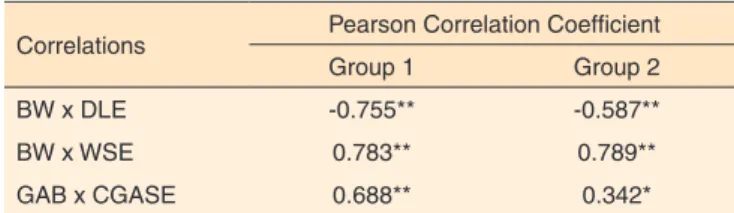
The Pearson correlation coefficient (c)(25) to the following
intersections was also used: birth weight with days of life, during the speech assessment, birth weight with weight during assessment, gestational age at birth with corrected gestational
age during the speech assessment. Data were considered at 0.05 or 0.01, been used, in this study, the following ranking correlation:
If | c | < 0,40 – weak correlation
If 0,40 < | c | < 0,70 – moderate correlation If 0,70 < | c | < 0,90 – good correlation If | c | > 0,90 – great correlation
RESULTS
During the period of data collection in Kangaroo Unit were assisted 96 underweight PNB, from which only 38, of both genders, met the inclusion criteria described above, and 17 of them were the G1 and 21, the G2.
The GAB average from G1 was higher than that found in G2.The WASS showed similar averages in both groups. At the assessment´s time, the NBs from G1 had corrected gestational age (CGAWASS) with a lower average than that from G2´s NBs. On the transition the offer of probe feeding to exclusively breastfed (probe-breast), in each of the steps, the training of non-nutritive sucking in “gloved finger” or “empty breast” (NNS GF/EB) was carried out for a longer period average period in G1 than in G2 (Table 1).
The offer of “partially filled breast”, which corresponds to the onset of supply given by oral via, was initiated by G1 averaging CGAOV lower than G2. Finally, on the step related to the offer from the breast without using the add-on probe, where OV diet was made exclusively from breast, G2 started averaging CGAMBE higher than G1 and the average time (in days) of the newborns subjected to the probe was higher in G2 than in G1, and G2 newborns remained in speech therapy (SPEECT) more days than G1 (Table 2).
At the moment of speech therapy discharge, G2 newborns showed CGAA higher than the G1s. The NBs were generally higher than that of G2. The G2 NBs presented, during the speech therapy, the average life-spawn (LSSTA) higher than the G1 (Table 3).
The Pearson correlation coefficient was used to correlate the BW with LSSTA, showing a reverse direction correlation between moderate to good. This result means that as higher the birth weight, lower life-spawn spent during the therapy. At the intersection between the GAB CGASTA was obtained from weak to moderate correlation in forward direction, meaning, the higher the gestational age at birth, the greater the corrected gestational age at the time of the speech evaluation. Importantly, all correlations were significant. Data on the Pearson correlation coefficient are shown on Table 4.
DISCUSSION
During the monitoring process technique in newborns, certain aspects restricted the recording of some data in the study protocol. One was the fact that, sometimes on the NBs Chart 3. Descriptive framework of standard speech therapy offered to
study participants
Step 1 Evaluation and medical clearance to start the supply of stimulation in the womb
Step 2 Training of non-nutritive sucking in "gloved finger" and/ or "empty breast " (mother emptying the breast as fully as possible or so later, partially emptying the breast) concomitant use of the probe (complement)
Step 3 Training of sucking in “full breastfeeding” (mother´s breast without milking) concomitant use of the probe (complement)
prompts does not showed the gloved finger stimulation recor-ding because the audiologist had not been the first professional to perform the procedure. In such cases, the beginning of NNS was made by empty breast. This made impossible to compare the techniques (gloved finger and empty breast) in this study. Another limiting aspect was the shortage of highly relevant recent literature, which addressed the feeding transition from probe straight to breast technique, with speech therapy inter-vention within the kangaroo unit.
In the present study, considering gestational age at bir-th (GAB), bir-there was not any significant difference, when comparing G1 and G2, it is not possible to establish a direct relationship between the classifying of prematurity and the incidence of major complications (neuropathy, heart disease and/or severe respiratory disease, congenital abnormalities, and sepsis syndromes) in this population. There was the expectation that the group 1 would present gestational age higher than the group 2, since the literature states that the higher the GAB, less complications(26), that being so premature birth can cause major
problems such as breathing diseases, but it did not.
According to the populations characterization, about the gestational age at birth, it was observed that newborns studied were not that premature, since the criteria to inclusion into the
Kangaroo Care Program concerns the underweight and not necessarily the prematurity.
The fact that the group 2 had 2 babies who required longer hospitalization to start speech therapy, being higher than the average from group 1, can be related to complications such as infections, respiratory distress syndrome, neonatal anoxia, hemorrhage, periintravencular, necrotina enterocolitis, as the lower birth weight average(27), whereas infants from group 2,
who were born with significantly lower weight, had his/her prolonged stay, until reaching proper weight, to be transferred to Kangaroo Unit to try feeding stimulation.
Also in relation to weight, the fact that was obtained moderate to good reverse direction correlation, meaning the higher the birth weight, fewer days of life spent at the moment of speech evaluation, can be considered an important fact be-cause despite the studied newborns be classified as very low birth weight, it was possible to start early speech therapy(22).
According to the Health Ministry(22), to a NB go to the second
step of Kangaroo Method, he/she must be with minimum weight of 1250 grams, which was observed in this population.
The fact that the babies were born with significant weight difference between the groups, but they presented similar weight and corrected gestational age at the time of assessment, Table 1. Data on gestational age at birth, weight at the time the evaluation, corrected gestational age of the newborn in during the evaluation. Training time of nonnutritive stimulation gloved finger or empty breast
Group
Total p-value Results
G1 G2
GAB
Mean 33.18 32.29 32.69
0.308 1 = 2
SD 2.01 1.88 1.96
Minimum 30 27.57 27.57
Maximum 38.42 35.57 38.42
n 17 21 38
WSE (g)
Mean 1502.06 1520.71 1512.37
0.750 1 = 2
SD 147.56 135.00 138.13
Minimum 1255 1310 1255
Maximum 1790 1720 1790
n 17 21 38
CGASE
Mean 34.68 35.43 35.10
0.136 1 = 2
SD 1.82 2.32 2.12
Minimum 32.14 30.28 30.28
Maximum 39.85 39.85 39.85
n 17 21 38
NS GF/EB (days)
Mean 0.65 0.57 0.61
0.663 1 = 2
SD 0.61 0.68 0.64
Minimum 0 0 0
Maximum 2 2 2
n 17 21 38
Mann-Whitney test (p<0.05)
Table 2. Data on corrected gestational age on the initiation of the diet orally (partially filled breast); corrected gestational age at the onset of feeding in exclusive oral breastfeeding (breast), time that the newborn was submitted to the use of probes, speech therapy time until discharge from the newborn submitted to the technical transition of the probe to the breast
Group
Total p-value Results
G1 G2
CGAOV
Mean 34.73 35.44 35.13
0.161 1 = 2
SD 1.82 2.32 2.11
Minimum 32.14 30.28 30.28
Maximum 39.85 40 40
n 17 21 38
CGAEB
Mean 35.79 36.94 36.4
0.052 1 = 2
SD 1.67 2.26 2.07
Minimum 33.57 31.85 31.85
Maximum 40.28 41.14 41.14
n 17 21 38
PROBE (days)
Mean 8.18 9.81 9.08
0.486 1 = 2
SD 4.45 6.92 5.92
Minimum 2 2 2
Maximum 17 36 36
n 17 21 38
DI (days)
Mean 9.35 12.10 10.85
0.308 1 = 2
SD 4.34 8.51 7.02
Minimum 3 3 3
Maximum 19 37 37
n 17 21 38
Mann-Whitney test (p<0.05)
Note: CGAOV = Corrected gestational age on the initiation of the diet orally; CGAEB = Corrected gestational age at the onset of feeding in exclusive breastfeeding; PROBE (days) = time (in days) that the newborn was submitted to the use of probes; DI = Duration of intervention; G1 = subjects belonging to group 1; G2 = subjects belonging to group 2; SD = standard deviation
Table 3. Data corrected gestational age at discharge speech, weight of the newborn at birth and days of life during the evaluation
Group
Total p-value Results
G1 G2
CGADS
Mean 36.41 37.60 37.07
0.068 1 = 2
SD 1.93 2.34 2.22
Minimum 34.14 32.14 32.14
Maximum 40.42 41.57 41.57
n 17 21 38
BW (g)
Mean 1563.53 1409.62 1478.47
0.033* 1 > 2
SD 275.97 247.63 268.50
Minimum 810 850 810
Maximum 1910 1795 1910
n 17 21 38
DLE
Mean 11.18 22.05 17.18
<0.001* 1 < 2
SD 10.09 15.12 14.06
Minimum 3 9 3
Maximum 47 54 54
n 17 21 38
*Significant values (p<0.05) - Mann-Whitney test
may be related to the circumstances than the clinical conditions and the weight itself (to belong o group 1 and 2), were not di-rectly linked to the initiation of speech therapy, although were considered important criteria for the entry of these babies in Kangaroo Unit in the maternity in question, which would start monitoring the probe-breast transition technique and speech therapy intervention.
Regarding weight, the literature(28,29), indicates an averaging
ranging between 1400 to 1800 grams, to start NNS stimulation, being the NB clinically stable, which agrees with what was found in this study, since the maternity follows the Health Ministry guidelines(22) and the NBs only go to kangaroo unit
when they reach the minimum weight of 1250 grams and clinical stability.
This study found that the weight gains is relevant for monitoring the transition technique in newborns in risk, it is important that the speech therapist is aware of the medical and nutritional requirements on the energy needs of this population, since most of healthy preterm infants usually gain weight ap-propriately, when he/she receives 120 cal/kg/day(22), as long as
they are not subjected to excessive energy expenditure during stimulation.
Regarding to gestational age, several authors(28,29) suggest
that the speech therapy performance in the transition from gas-tric feeding to oral feeding can start with corrected gestational age between the 32nd and 34th week and, in case of the
popu-lation here studied, the CGA average, both group 1 and group 2 were in agreement according with the literature. In contrast, in similar study(19) with preterm infants nonparticipants in
kangaroo method, were observed higher average (35,29 weeks) than indicated by the literature and in this study, in order to start the speech therapy, being this average considered late, since the method allows speech intervention on the transition probe removal to oral feeding offer occurs at an early age(22), and
consequently, the effective breastfeeding exclusively breastfed. However, as the weight seems to have been a major feature at the beginning of the assessment, gestational age was not a restriction parameter, given that this agrees with studies(18,19)
that indicate that there is a tendency to intervene at an early age in aspects that relate to sucking and feeding stimulations, already with corrected gestational age of 32 to 34 weeks coin-ciding precisely with the profile of the population studied here.
Some authors(5,15,29,30) believe, however, that before 34 weeks
of gestational age, there is no S/S/B coordination. Despite the low gestational age at birth during the assessment (CGASTA), the newborns had safe average weight gain for the intervention of 35,10 weeks, confirming the literature(5,15,29,30), and would
have appropriate maturational conditions to begin swallowing training.
Statistically, there was significant difference in the para-meters for the CGA during the assessment and CGA at the initiation of the diet by OV, coinciding with the literature(12,14),
which indicates that, from the 34th week, the baby would be
able to coordinate the S/S/B movements. In this study, both groups started in “partially filled breast”, gestational age close to what the authors claim as indicated.
Regarding to days in speech therapy, there was no difference between groups, as shown by the results. However, when the data are understood clinically, an average of three days apart spent in speech therapy can be important, when it comes to the sensory and motor abilities of the newborn. Early discharge may favor the decreasing of length of hospital stay, the risk of infection inherent in this environment, even influencing the mother/family’s psychological conditions and contributing to maternity´s cost reduction(5).
CONCLUSION
The study helped to clarify the importance of early speech therapy in neonatal units, specially in kangaroo units, once, when using the feeding transition technique from probe strai-ght to breast in newborns in risk with similar gestational age average and at the same time be on speech therapy, the infants demonstrated the ability to coordinate sucking/breathing and swallowing movements, and consequently, the effective exclu-sively breastfeeding.
It is suggested to conducted further studies using the tran-sition technique from probe to breast in neonates and low birth weight premature within the various neonatal units in order to attend to the importance of speech therapy in these units and thereby ensuring humanized care of these individuals and their families.
REFERENCES
1. Rocha MS, Delgado SE. Intervenção fonoaudiológica em recém-nascido pré-termo com Gastrosquise. Rev Soc Bras Fonoaudiol. 2007;12(1):55-62.
2. Varandas CPM, Campos LG, Motta AR. Adesão ao tratamento fonoaudiológico segundo a visão de ortodontistas e odontopediatras. Rev Soc Bras Fonoaudiol. 2008;13(3):233-9.
Table 4. Correlations between birthweight and days of life during speech evaluation; birth weight and weight during the speech evaluation, and gestational age at birth and gestational age corrected age during the speech assessment
Correlations Pearson Correlation Coefficient Group 1 Group 2
BW x DLE -0.755** -0.587**
BW x WSE 0.783** 0.789**
GAB x CGASE 0.688** 0.342*
Pearson Correlation Coefficient *Significant at 0.05
**Significant to 0.01
3. Pivante CM, Medeiros AMC. Intervenções fonoaudiológicas no aleitamento materno junto às mães de paridade zero. Mundo Saúde. 2006;30(1):87-95.
4. Fujinaga CI, Scochi CGS, Santos CB, Zamberlan NE, Leite AM. Validação do conteúdo de um instrumento para avaliação da prontidão do prematuro para início da alimentação oral. Rev Bras Saúde Matern Infant. 2008;8(4):391-9.
5. Delgado SE, Halpern R. Amamentação de prematuros com menos de 1500 gramas: funcionamento motor-oral e apego. Pró-Fono R Atual Cient. 2005;17(2):141-52.
6. Miranda AM, Cunha DIB, Gomes SMF. A influência da tecnologia na sobrevivência do recém-nascido prematuro extremo de muito baixo peso: revisão integrativa. Rev Min Enferm. 2010;14(3):435-42.
7. Zomignani AP, Zambelli HJL, Antonio MARG. Desenvolvimento cerebral em recém-nascidos prematuros. Rev Paul Pediatr. 2009;27(2):198-203.
8. Brasil, Ministério da Saúde, Secretaria de Vigilância em Saúde/ Secretaria de Atenção à Saúde. Manual de vigilância do óbito infantil e fetal e do comitê de prevenção do óbito infantil e fetal. 2nd. ed. Brasília:
Ministério da Saúde; 2009. (Série A. Normas e manuais técnicos). 9. WHO - World Health Organization. International statistical classification of disease and related health problems: 10th revision.
Geneva: World Health Organization; 2010 [cited 2013 Jun]. Available from: http://apps.who.int/classifications/icd10/browse/2010/en#/P07.2 10. Martins Filho J. Neonatologia: prioridade. In: Figueira F, Ferreira OS, Alves JGB. ediatria: Instituto Materno-Infantil de Pernambuco. 2nd. ed.
Rio de Janeiro: Medsi; 1996. p. 139-44.
11. Sousa MWCR, Silva WCR, Araújo SAN. Quantificação das manipulações em recém-nascidos pré-termo em Unidade de Terapia Intensiva: uma proposta de elaboração de protocolo. Conscientia e Saúde. 2008;7(2):269-74.
12. Almeida MNF, Siqueira TO, Ribeiro SMM. Avaliação da oclusão no período pré-dentário em prematuros nascidos na Fundação Santa Casa de Misericórdia do Pará. Rev Para Med. 2007;21(4):31-6.
13. Medeiros AMC. Contato das mãos com a região oral, protrusão de língua e movimentos de sucção em recém-nascidos humanos, a partir da estimulação oro gustativa [thesis]. São Paulo: Instituto de Psicologia, Universidade de São Paulo; 2002.
14. Calado DFB, Souza R. Intervenção fonoaudiológica em recém-nascido pré-termo: estimulação oromotora e sucção não-nutritiva. Rev CEFAC. 2012;14(1):176-81.
15. Lau C. [Development of oral feeding skills in the preterm infant]. Arch Pediatr 2007;14 Suppl 1:S35-41. Francês.
16. Neiva FCB, Leone CR. Sucção em recém-nascidos pré-termo e estimulação da sucção. Pró-Fono R Atual Cient. 2006;18(2):141-50.
17. Mizuno K, Ueda A. The maturation and coordination of sucking, swallowing, and respiration in preterm infants. J Pediatr. 2003;142(1):36-40.
18. Bühler KEB, Limongi SCO. Fatores associados à transição da alimentação via oral em recém-nascidos pré-termo. Pró-Fono R Atual Cient. 2004;16(3):301-10.
19. Medeiros AMC, Oliveira ARM, Fernandes AM, Guardachoni GAS, Aquino JPSP, Rubinick ML, et al. Caracterização da técnica de transição da alimentação por sonda enteral para seio materno em recém-nascidos prematuros. J Soc Bras Fonoaudiol. 2011;23(1):57-65.
20. Creger PJ, Browne JV, editors. Developmental interventions for preterm and high-risk infants: self-study modules for professionals. Denver: Therapy Skill Builders; 1995.
21. Medoff-Coper B. Changes in nutritive sucking patterns with increasing gestacional age. Nursing Research. 1991;40(4):245-7. 22. Brasil, Ministério da Saúde, Secretaria de Atenção à Saúde. Atenção humanizada ao recém-nascido de baixo peso - Método Canguru: 2nd.
ed. Brasília: Ministério da Saúde; 2011. (Série A. Normas e manuais técnicos, 145).
23. Simpson C, Schanler RJ, Lau C. Early introduction of oral feeding in preterm infants. Pediatrics. 2002;110(3):517-22.
24. Barros APB, Querija DS, Marinho MCCR. Caracterização do atendimento fonoaudiológico em pacientes internados. Rev Méd Ana Costa. 2007;12(2):34-7.
25. Siegel S, Castellan Junior N. Estatística não-paramétrica para ciências do comportamento. 2nd. ed. Porto Alegre: Artmed/Bookman; 2006.
26. Chalfun G, Mello RR, Dutra MVP, Andreozzi VL, Silva KS. Fatores associados à morbidade respiratória entre 12 e 36 meses de vida de crianças nascidas de muito baixo peso oriundas de uma UTI neonatal pública. Cad Saúde Pública. 2009;25(6):1399-408.
27. Malveira SS, Moraes AN, Chermont AG, Costa DLF, Silva TF. Recém-nascidos de muito baixo peso em um hospital de referência. Rev Para Med. 2006;20(1):41-6.
28. Caetano LC, Fujinaga CI, Scochi CGS. Sucção não nutritiva em bebês prematuros: estudo bibliográfico. Rev Latino-Am Enfermagem. 2003;11(2):232-6.
29. Neiva FCB, Leone CR. Efeitos da sucção não-nutritiva na idade de início da alimentação via oral em recém-nascidos pré-termo. Rev Paul Pediatria. 2007;25(2):129-34.
Appendix 1. Data collection on how to offer diet in the transition from gastric tube feeding for breastfed newborns in the Kangaroo Care Protocol
1. Identification and Clinical History:
Mother’s name:__________________________________ Date: _______________ Newborn nº:______ Newborn’s name: ________________ Bad: ___________ Date of birth.:_______________ GAB:__________ DO: __________ CGA.:______ BW:_________ Medical diagnosis: _________________________________________________________________ ________________________________________________________________________________
G1 ( ) – stable respiratory condition (not using O2 or O2 use of less than 14 days), no infections (isolation), absence of neuropathy and/or cardiomyopathy without antibiotic use or use by up to 6 days.
G2 ( ) – major medical complications, respiratory instability (using O2 for 15 days or more), infection/sepsis, neuropathy, cardiac, antibiotic therapy for 7 days or more.
Day CGAC DO CW ∆W NNS GF NNS EB PFB+PROBE MB + PROBE EMB Glass Baby bottle AM Probe/Glass/ Baby bottle
1
2
3
4
5
6
7
8
9
10
11
12
13
14
15
16
17
18