*Correspondence: J. G. Avari. Department of Pharmaceutical Sciences. RTM Nagpur University. Nagpur - 33. India. E-mail: [email protected]
A
vol. 51, n. 3, jul./sep., 2015 http://dx.doi.org/10.1590/S1984-82502015000300009
Formulation and evaluation of taste mask pellets of granisetron
hydrochloride as oro dispersible tablet
Nilesh Choudhary, Jasmine Avari
*Department of Pharmaceutical Sciences, R. T. M. Nagpur University, Mahatma Jyotiba Fule Educational Campus, Nagpur, India
Orally disintegrating systems have carved a niche amongst the oral drug delivery systems due to the highest compliance of the patients, especially the geriatrics and pediatrics. In addition, patients sufering from dysphagia, motion sickness, repeated emesis and mental disorders prefer these medications because they cannot swallow large quantity of water. Further, drugs exhibiting satisfactory absorption from the oral mucosa or intended for immediate pharmacological action can be advantageously formulated in these dosage forms. However, the requirements of formulating these dosage forms with mechanical strength suicient to withstand the rigors of handling and capable of disintegrating within a few seconds on contact with saliva are inextricable. The purpose of this research was to mask the bitter taste of granisetron hydrochloride. To mask the taste Kollicoat® Smartseal 30D was used as coating polymer for pellet coating. The coated pellets of the drug was directly compressed with diferent superdisintegrant as AC-Di-Sol, Explotab and Kollidon CL in diferent concentration 5.0-7.5% w/w into an ODT. The prepared tablets were evaluated for hardness, friability, weight variation, wetting time, wet absorption ratio, in-vitro disintegration time and in vitro dissolution studies. Tablets exhibited quick disintegration characteristics with Kollidon CL in concentration 7.5% w/w i.e., within 20 seconds, which is characteristic of orally disintegrating dosage forms. More than 98% of drug was released from the formulations within 15 minutes. Formulations subjected to stability testing as per the ICH guidelines for 3 months, indicated stability with no change in taste, hardness, drug content, disintegration time and dissolution proiles. Thus, the results conclusively demonstrated successful masking of taste and rapid disintegration of the formulated dosage forms in the oral cavity.
Uniterms: Granisetron hydrochloride/taste masking. Oro Dispersible Tablet (ODT). Pellets/coating.
Oral drugs/delivery system.
da ICH por 3 meses indicaram estabilidade sem alteração no sabor, dureza, teor de fármaco, tempo de desintegração e peris de dissolução. Assim, os resultados demonstraram que o mascaramento de gosto foi bem-sucedido e atingiu-se rápida desintegração das formas de dosagem na cavidade oral.
Unitermos: Cloridrato granisetrona/mascaramento de sabor. Comprimidos de Dispersão Oral. Grânulos/
revestimento. Medicamentos de via oral/sistemas de administração.
INTRODUCTION
Orally disintegrating tablets also called as fast dissolving or mouth dissolving tablets are such kind of dosage forms which when placed in mouth disintegrate
rapidly in a matter of seconds. They are diferent from
lozenges or buccal tablets which require more than a
minute to get dissolved in mouth (William, Tapash, 2005). Any dosage form or a novel drug delivery system
which improves patient compliance is of great interest to
scientists in which orally disintegrating tablets stands irst among them. Market studies indicated that 70% of the
population ask their doctors or prefer to purchase orally disintegrating tablets over conventional tablets or liquids
(William, Tapash, 2005). They are more advantageous in case of geriatric or paediatric patients who feel diiculty
in swallowing tablets or capsules. They are also useful in disease conditions like motion sickness, repeated emesis
or coughing where it is diicult to swallow tablet (William, Tapash, 2005). A vast variety of pharmaceutical research
is directed at developing new dosage forms. Most of these efforts have focused on either formulating novel drug delivery systems or increasing the patient compliance. Among the dosage forms developed for facilitating ease of medication, the orally disintegrating systems have been the favorite of product development scientists.
The strategy of compressing multiparticulates into an orally disintegrating tablet is of more interest due to its ease in technology and cost effectiveness. Taste masking is of prime importance in formulating an orally disintegrating tablet. One of the applications of coating
of multiparticulate is taste masking (Honey et al., 2008). Multiparticulate or pellets can be compressed into a tablet
that can disintegrate in less than a minute (Honey et al.,
2008). The concept of orally disintegrating dosage forms
has emerged from the desire to provide patients with more conventional means of taking their medication. Interestingly, the demand for ODT has enormously increased during the last decade, particularly for geriatric and paediatric patients who experience difficulty in swallowing conventional tablets and capsules. Hence, they do not comply with prescription, which results in
high incidence of ineffective therapy (Seager, 1998).
In disease conditions such as motion sickness, sudden
episodes of attacks of coughing and repeated emesis
swallowing conventional tablets become diicult. Orally
disintegrating dosage forms can serve as an effective alternative mode of drug delivery in such situations.
When put in the mouth, these dosage forms disintegrate
instantly to release the drug, which dissolves or disperses in the saliva. Thereafter, the drug may get absorbed from the pharynx and oesophagus or from other sections of gastrointestinal tract as the saliva travels down. In such cases, bioavailability is significantly greater than that
observed from conventional tablet dosage form (Dobetti, 2001, Ghosh, 2005). Hence, orally disintegrating systems
may be anticipated to result in achievement of the required peak plasma concentration rapidly for drugs unstable in the gastric pH.
Taste is a perception on which lies the fate of oral pharmaceuticals. Administration of bitter drugs orally with acceptable level of palatability is a key issue for health care providers, especially for paediatric patients
(Patel, Prajapati, Raval, 2010). Though adults might think
that bitter tasting medicine work better, this is not the
case for children (Matsui, 2007). Children might refuse
to take their medication completely due to taste issues
(Shishu, Kashyap, 2008). Pharmaceutical manufacturers
of pediatric medicine need to be aware of children’s taste
preferences, as the product taste will greatly afect the
child’s willingness to take the medication repeatedly. Various chemical and physical methods are involved in taste masking, which prevent the drug substance from interacting with taste buds. The simplest method
involves use of lavour enhancers (Reddy et al., 2010). A well-constructed lavour system is crucial to mask or
hide any medicinal tastes for oral drug formulations,
because it inluences patient acceptability and compliance
and thereby makes the product more tolerable. Children
generally prefer sweet preparations with fruity lavours.
Flavouring agents are generally present in amounts
of from about 0.01 to about 5%. Examples of suitable lavouring agents include cherry lavour, orange-lemon
flavour, strawberry flavour, chocolate, peppermint oil, double distilled eucalyptol, anethol, methyl salicylate,
oil cassia (Gavaskar et al., 2010). In addition to the lavouring agents, sweetening agents may also be added
include sucrose, fructose, glucose, sodium saccharin,
aspartame (Sharma, Lewis, 2010). Colour is a vital means of identiication for many pharmaceutical tablets and is also usually important for consumer acceptance (Saroha et al, 2010).
The recent approaches for taste masking are:
1) Reduction of drug solubility in saliva, where a bal -ance between reduced solubility and bioavailability must be achieved.
2) To alter the ability of the drug to interact with taste receptor (Jha, Sharma, Surendra, 2008).
MATERIAL AND METHODS
Material
Granisetron hydrochloride was received as research sample from Ajanta Pharma Pvt. Ltd, Mumbai, India. Kollicoat®Smartseal 30 D and Kollidon CL (crospovidone) procured fromBASF India Ltd. Mumbai,
India. Croscarmellose sodium (Ac-Di-Sol) by FMC India Ltd. Banglore, India. Avicel PH 101(Microcrystalline cellulose) was supplied by Signet Chemical Corporation Pvt. Ltd., Mumbai, India. Aerosil 200 and Magnesium
stearate were obtained by Evonik Degussa India Pvt. Ltd., Mumbai, India and Loba Chemie Pvt. Ltd., Mumbai, India respectively. All other chemicals were of analytical grade and were used as received.
METHODS
Preliminary studies on screening of plasticizer
Tri ethyl citrate, Polyethylene Glycol 400 (PEG 400), Propylene Glycol (PG) and Dibutyl Phthalate (DBP) are used as a plasticizer in the concentration range 5-70%, 5-30%, 5-40% and 5-50% respectively in order to study their efect on the tensile strength, % elongation
and folding endurance of matrix type patch prepared by using single polymer.
Physical evaluations of patches
Thickness
The thickness of prepared patches was measured using digital vernier callipus with least count 0.01 mm
(Mitutoyo, Japan) at three diferent places and the mean
value was calculated.
Tensile strength
The instrument was designed such that it had
horizontal wooden platform with fixed scale and attachments for two clips that holds transdermal patch
under test. Out of the two clips one was ixed and other was movable. Weights were hanged to one end of pulley
and the other end of pulley was attached with movable
clip. The wooden platform was itted such that it would
not dislocate while the test is running. Three strips of patch
were cut having 2cm length and 2cm width. The thickness
and breadth of strips were noted at three sites and average value was taken for calculation. The rate of change of
stress was kept constant with the increment of 0.5g per 2
minutes. The elongation was observed and the total load was used for calculation.
The tensile strength was calculated by using following formula:
Tensile Stress (S) = Applied force/Cross sectional area = m × g/b × t
where S = tensile strength in Kg/mm2; m = mass in grams;
g = acceleration due to gravity; b = width of strip in centimeters;t = thickness of strip in centimeters.
The strain is change resulting in size of strip after the force was applied to its original size. Therefore, the strain can be given as,
Strain (E) = Total Elongation/ Original Length = L-L0 / L0
where L = length after force was applied; L0 = original
length.
Percent elongation
The percent elongation at break was measured by formula given below.
Percent Elongation = Total Elongation/Original Length × 100 = L-L0 / L0 × 100
where, L = length after force was applied.
Weight variation study
For weight variation test, 3 ilms from each batch
were weighed individually and the average weight was calculated. The test was performed to check the uniformity of weight and to avoid batch- to- batch variation.
Folding endurance
Folding endurance of patches was determined by
could be folded at the same place without breaking was the folding endurance value.
Method of preparation of granisetron pellets
Granisetron Hydrochloride and other ingredients
i.e MCC PH 101(70% w/w) and Lactose (30%w/w) were
mixed properly in a mortar according to compositions. The resulting mixture or blend was passed through sieve
(40#). This blend was granulate with water as binder to form dump mass which were extrude and spheronise (R & D Extruder & Spheronizer, Anish Pharma, Nashik, India)
to form pellets of required size.
Coating of pellets with kollicoat smartseal 30 D
Pellets of required size were used for the coating. Kollicoat Smartseal 30D disperse in water along with talc, colorant and plasticizer of required amount on dried
basis. The dispersion was allowed to stir for 2h obtain a homogeneous dispersion and inally pass through 200 µm
sieve. The coating dispersion was then layered onto the
core pellets in Fluidized bed processor (APCG Series Fluid Bed Processor Anish Pharma, Nashik, India). The coated pellets were further dried in the dryer for 15 min at 40 ̊C
after the coating process was inished.
Curing of pellets
Immediately after the coating process the coated
pellets were oven-cured at temperatures 40° and 65°C for the 24 hours. Additionally, samples of coated but uncured
pellets were prepared.
Evaluation of pellets
Prepared pellets were evaluated for diferent physical
parameters like moisture content, drug content, shape, angle of repose, bulk density, tapped density, compressibility index, Hausner ratio. The pellets size was measured under
compound microscope (Metzer, India) at 10X magniication
for shape deter mination. Drug content of pellets was
determined by U.V spectrophotometer at 244 nm. In-vitro disintegration time was measured by dropping a little quantity of the pellets in a measuring cylinder containing 6
ml of simulated salivary luid of pH 6.8. Moisture content
of pellets was measured using halogen moisture analyzer
(MB50C, Citizen Scale India Pvt. Ltd., Mumbai, India) at 105 °C. Angle of repose was measured using ixed funnel
method. A funnel with 10 mm inner diameter of stem was
ixed at a height of 2.5 cm over the platform. About 10 g
of sample was slowly passed along the wall of funnel till the tip of the pile formed touches the stem of the funnel. A circle was drawn around the pile base and the radius of cone was measured. Angle of repose was calculated from
three averages using formula, q = tan-1(Height/Radius).
Bulk and tapped density determinations were carried out
as per method (Method II) described in United States Pharmacopoeia (USP) 24.
Formulation of granisetron hydrochloride orally dispersible release tablets
Granisetron Hydrochloride coated pellets and Micro
crystalline cellulose (MCC PH 200) were mixed with diferent disintegrant in a mortar according to compositions given in Table I. The three diferent disintegrants at varying
levels were used for the preparation of ODT tablets. Desired quantity of lubricated blend was weighed and fed manually to a pilot press tablet compression machine
(Chamunda Pharma Machinery Pvt. Ltd.)and compressed
using 6 mm lat faced round shaped punches at a weight
of 138 mg. By direct compression method. Compression force was kept constant for all formulations.
Evaluation of granisetron hydrochloride orally dispersible tablets
Granisetron Hydrochloridetablets were evaluated for post compression parameters like hardness, weight variation, thickness, friability, disintegration time, drug content and in vitro drug release.
Hardness test
Tablets require a certain amount of strength or hardness and resistance to withstand mechanical shock of handling in manufacture, packing and shipping. To perform this test tablets were placed between two anvils, force to the anvils and the crushing strength that just causes the tablets to break was recorded. Monsanto hardness tester was used to measure the hardness of tablets. The
results were expressed in kg/cm2.
Thickness
The thickness of a tablet is only dimensional variable related to the compression process. The thickness of the tablets was determined by the Digital Vernier Caliper instrument. Ten tablets were used for the determination of thickness from each batch. Results were expressed in
Friability test
The friability (%) of tablets was determined by using
Roche type friability testing apparatus. The tablets were
subjected to the combined efect of abrasion and shock by utilizing a plastic chamber that revolves at 25 rpm,
dropping the tablets at a distance of six inch with each revolution. Twenty tablets were weighed and placed in the Roche friability test apparatus. After 100 revolutions, the tablets were dedusted and weighed again. The friability was determined as the percent loss in weight of the tablets.
Friability (5) = 1 – × 100
Weight of tablets after 100 revolutions
Initial weight of tablets
The acceptable % friability limit of conventional compressed tablet is 0.5 to 1.0 % (USP 2000).
Dispersion time (Bhardwaj et al., 2010)
In vitro dispersion time was measured by dropping a tablet in a 10 ml measuring cylinder containing 6 ml of
bufer solution simulating saliva luid (pH 6.8)
Wetting time (Hindustan et al., 2010)
The wetting time of the tablet was measured using simple procedure. Five circular tissue paper of 10 cm diameter were placed in petridish with 10 cm diameter. Ten milliliter of water containing eosin a water soluble dye, was added to the petri dish. A tablet was carefully placed on the surface of tissue paper. The time required for water to reach upper surface of tablet was noted as wetting time.
Wetting volume (Hindustan et al., 2010)
The tablet is placed in center of petridish and with
the help of 5 mL pipette distilled water was added drop
wise on the tablet. The volume required to completely disintegrate the tablet was noted as wetting volume.
Water absorption ratio (R) (Battu et al., 2007)
The weight of the tablet prior to placement in the
Petri dish was noted (Wb) utilizing a digital balance. The wetted tablet was removed and reweighed (Wa). Water
absorption ratio, R, was then determined according to the
following equation. Where Wb and Wa were tablet weights
before and after water absorption, respectively.
R = (Wb – Wa) × 100 Wa
Disintegration test
Six tablets were selected randomly from each batch for the disintegration test. Disintegration test was performed in purified water using Electro lab
Disintegration tester. Disintegration time (DT) was
measured for all tabletsand expressed as Mean ± SD.
In vitro drug release study
The USP type II dissolution apparatus (Electro lab, India) were used for dissolution having media of pH 1.2
HCl buffer with 900 ml volume and rotation speed of
50rpm. 10 mL sample was withdrawn at predetermined
time intervals and replaced with same dissolution
TABLE I - Compositions of orally dispersible tablet (138 mg)
Sr. No. Ingredients(mg) C1 C2 C3 C4 C5 C6
1 Granisetron Hydrochloride 50 50 50 50 50 50
2 MCC PH 200 55 52.5 55 52.5 55 52.5
3 Sodium starch glycolate 5.0 7.5 - -
-4 Cross carmellose sodium - - 5.0 7.5 -
-5 Crospovidon - - - - 5.0 7.5
6 Mannitol NF (Pearlitol SD200) 20.0 20.0 20.0 20.0 20.0 20.0
7 Aspartame 2.0 2.0 2.0 2.0 2.0 2.0
8 Peppermint Flavor 2.5 2.5 2.5 2.5 2.5 2.5
9 Magnesium stearate 1.5 1.5 1.5 1.5 1.5 1.5
media. The withdrawn samples were diluted 100 times,
iltered and analyzed by using UV spectrophotometer at λmax 263 nm of granisetron hydrochloride.This test was
performed on 3 tablets and mean ± SD was calculated. The amount of drug release was determined using calibration curve.
Taste evaluation study
The objective of this study is to conduct and evaluate the palatability of granisetron hydrochloride oral disintegrating tablets. Reference product is not available in market for comparison of the taste evaluation study. Total eight formulations were selected for taste evaluation
study, six test formulations, one positive control (Placebo for drug) and one is negative control (Placebo for Taste enhancers like aspartame and peppermint flavor). All formulation batches (C1- C6) were randomized. Each
randomization order was assigned with sequence code.
For this study we have selected ive healthy human male
volunteers and were assigned volunteer code.
Stability studies
The stability studies were performed on the optimized formulation batches to check the effect of environmental or storage conditions. Optimized batch C6
was kept in environmental stability chamber (Remi Lab, Bombay) for accelerated stability condition at 40oC ± 2oC temperature and 75 ± 5% relative humidity for a period 3 months. The samples were withdrawn at end of 1, 2 and
3 months interval and evaluated for physical parameters, drug content and in-vitro drug release
RESULT AND DISCUSSION
After studying the effect of triethyl citrate, polyethylene glycol 400, propylene glycol and dibutyl
phthalate as plasticizers on tensile strength, % elongation
and folding endurance of matrix type patch prepared
by casting on mercury base, good results obtained with triethyl citrate with respect to percent elongation as shown in Table II which help the pellet to withstand in stress condition during compression. Also SEM image of
the compressed tablet with diferent plastisizer revel that triethyl citrate having good plasticizing efect shows no
rupture under compression as compared to other plastisizer
as shown in Figure 1 and 2.
Angle of repose is less than 30° suggesting that
pellets have good lowability. Bulk density is an indication
of packing properties of material. Variations in the
bulk density can cause change in ill volume. The bulk
density of the pellets depends primarily on particle size
TABLE II - Evaluation of patches prepared by using single polymer containing optimized concentration of diferent plasticizer
Sr. No. Type of Plasticizer
% w/w of Kollicoat Smartseal 30D
Thickness (mm)
Tensile Strength
Kg/mm2 % Elongation
Folding Endurance (No. of times)
1 Tri Ethyl Citrate 20 6.0 10.8746 77.93% 259
2 Di butyl Pthalate 20 6.2 11.0652 69.26% 220
3 Propylene Glycol 20 6.0 10.823 68.15% 205
4 Poly ethylene Glycol 400 20 6.1 10.7054 65.17% 195
FIGURE 1 - SEM Image of Cross-sections of tablet using PEG
400 as plasticizer.
FIGURE 2 - SEM Image of Cross-sections of tablet using TEC
distribution, particle shape and frequency of particles to adhere together. The particles may pack in such a way so as to leave large gaps between their surfaces resulting in a light powder of low bulk density. On the other hand, the smaller particles may pack between the larger ones to form a heavy powder or one of high bulk density. It has been
reported that bulk density less than 1.25 g/cm3 indicates good lowability. It is evident from table that pellets with all the batches have bulk density in the range 0.3-0.5 g/
cm3. Carr’s index (CI) is an important measure that can
be obtained from the bulk and tapped densities. The less
compressible a material the more lowable it is. Hausner’s
ratio is the ratio of tapped density and bulk density and is related to interparticle friction and, as such, could be
used to predict powder low properties. Generally a value less than 1.25 indicates good low properties, which is equivalent to 10% of Carr’s index.When compressibility ranges from 5 to 16 and Hausner’s ratio closer to 1.25, the materials have acceptable low property and packing
ability. All pellets have shown good compression properties as shown in Table III.
The compressed tablets were evaluated for weight variation, thickness hardness, friability, disintegration and
drug content. All the weights were within ± 5% deviation
range and passed the weight variation test according to USP. The hardness of the tablets was found to be about
3.0 – 4.0 kg/cm2. Friability index is a measure of integrity
of the material, which is a function of cohesiveness. It is an indication of endurance of material during various operations like packaging, transportation and handling.
The generally agreed upper limit for friability is 1%. The
friability of the tablets was found within the desirable range
0.1- 0.3%, hence the tablets passed the friability. Wetting time was determined for all of the formulations. Wetting
time of all the formulation was more than 30 sec, except
C6 (7.5% w/w) having the wetting time 24 sec was less
compared to all formulations due to its rapid water absorbing nature involving both capillary and swelling mechanisms
of crospovidone. Water absorption ratio ‘R’ increased
with an increase in superdisintegrants’ concentrations
from 5 - 10 %. A linear relationship was observed for each of the superdisintegrant types. The increase in ‘R’ was
most likely due to increased water uptake capacity of the superdisintegrants at higher concentrations. The tablets were assayed and the drug content was found to be in the
range of 90-110 % as per USP standards. Disintegration time (DT) stands satisfactory with the time limit of <1 min for
all the batches, as shown in Table IV. However DT of batch
no. C6 found to be 22 sec which was lowest as compared to
other formulations. It is considered that the disintegration is the first step in the dissolution of immediate release tablets. The lower the disintegration time, higher the rate of dissolution Hence, for the comparative study, one with
the same percentage was selected (5%).
TABLE III - Evaluation ofFlow properties of coated pellets with Kollicoat® Smartseal 30D D with triethyl citrate as plasticizer
(Mean ± SD) (Three number each of C1- C6, n=3)
Test C1 C2 C3 C4 C5 C6
Angle of repose (°) 26.67±0.33 29.68±0.57 27.32±0.61 27.63±0.51 26.42±0.43 28.51±0.38
Bulk density (g/mL) 0.39±0.025 0.38±0.052 0.38±0.024 0.38±0.035 0.38±0.062 0.38±0.058
Tapped Density (g/ml) 0.44±0.084 0.44±0.012 0.44±0.032 0.44±0.021 0.44±0.039 0.44±0.085
Carr’s index 11.11±0.057 11.15±0.022 11.10±0.011 11.13±0.053 11.15±0.020 11.11±0.018 Hausner’s ratio 1.125±0.034 1.210±0.043 1.120±0.010 1.126±0.008 1.212±0.034 1.112±0.031
TABLE IV - Diferent evaluation parameters of granisetron hydrochlorideODTtablets (mean ± SD) n=3
Test C1 C2 C3 C4 C5 C6
Hardness (Kg/cm²) 3.5± 0.5 4.0± 0.5 4.5± 0.5 3.5± 0.5 4.0± 0.5 3.0± 0.5
Friability (%) 0.2 ± 0.004 0.13 ± 0.014 0.14 ± 0.008 0.13 ± 0.007 0.22 ± 0.009 0.21 ± 0.011
Thickness (mm) 4.38 ± 0.40 4.31± 0.45 4.39 ± 0.25 4.37 ± 0.48 4.39 ± 0.14 4.34 ± 0.64
Drug content (%) 97.24 ± 0.24 97.36 ± 0.81 98.20 ± 0.53 97.52 ± 0.82 99.20 ± 0.79 98.62 ± 0.61
Weight variation (%) 3.75 ± 0.20 3.26 ± 0.30 3.49 ± 0.26 4.56 ± 0.60 3.48 ± 0.40 4.64 ± 0.30
Disintegration (in sec) 35 ± 1.0 30 ± 1.0 32± 1.0 28 ± 2.0 28 ± 1.0 22 ± 1.0
Wetting time (in sec) 37± 1.0 33± 1.0 34± 1.0 31± 1.0 31± 1.0 24± 1.0
In vitro drug release studies of granisetron
hydrochloride ODT tablets
Drug release of C1-C6 batch containing various
superdisintegrants in diferent concentration of 5 and 7.5% w/w was compared, it was found that C6 batch containing
Crospovidon releases drug more promptly and completely within 30 min. Hence, C6 batch is considered as optimized batch for granisetron hydrochloride orodispersible tablets as shown in Figure 3.
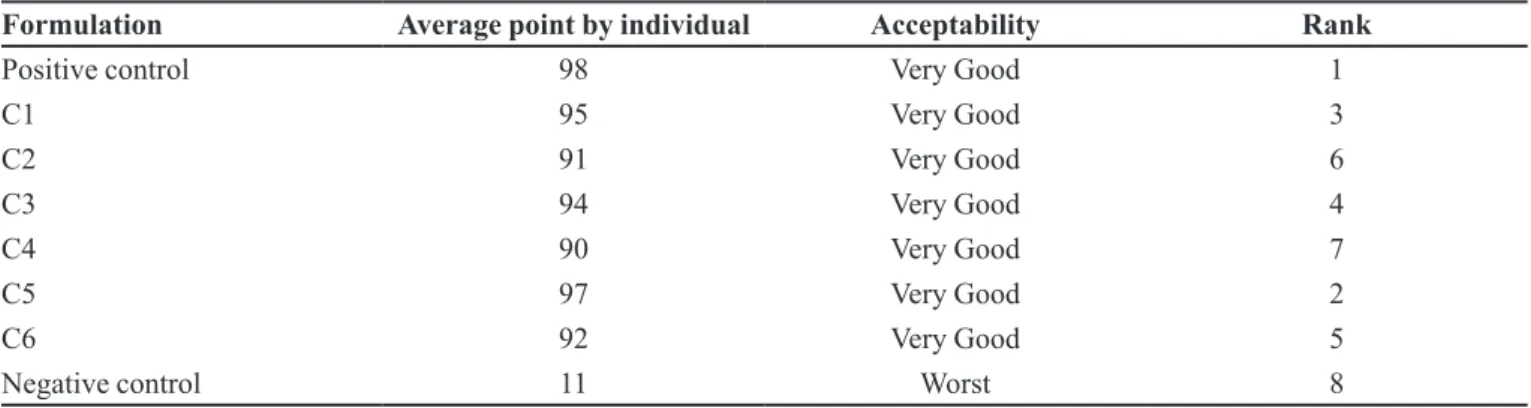
The results shown in Table V indicate that all the prepared formulation were similar in terms of patient acceptability, it was observed in prepared
formulations using peppermint lavor, mannitol as a lavor
enhancing agent, aspartame as a taste enhancing agents are responsible for good acceptability by the volunteers.
Stability study
S t a b i l i t y t e s t i n g o n o p t i m i z e d b a t c h e s o f orodispersible tablets as per ICH guidelines was carried
out. After checking the parameters, no signiicant change
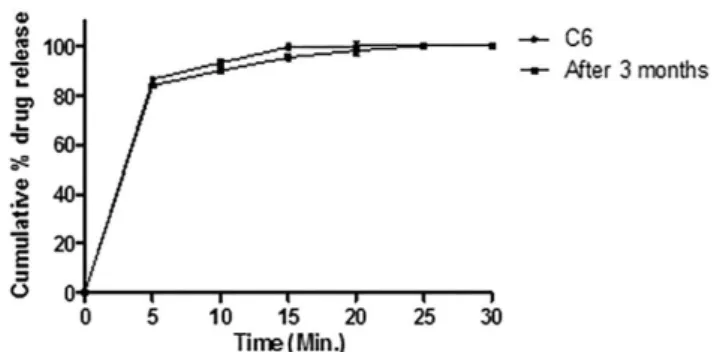
was found in all the batches before and after stability study. The results obtained as shown in Table VI. The in vitro
drug release study of optimised batch C6 was carried out
and no signiicant changes were found in release patter of
drug as shown in Figure 4.
CONCLUSION
Taste masked orally disintegrating granisetron
TABLE V - Summary report of taste evaluation study report
Formulation Average point by individual Acceptability Rank
Positive control 98 Very Good 1
C1 95 Very Good 3
C2 91 Very Good 6
C3 94 Very Good 4
C4 90 Very Good 7
C5 97 Very Good 2
C6 92 Very Good 5
Negative control 11 Worst 8
Scale range: 81-100 – Very Good, 71-80 – Good, 61 – 70 – Acceptable, 41-60 – Poor, 11-40 – worst and 0-10 – not tolerable
FIGURE 3 - Efect of diferent Superdisintegrant Sodium starch
glycolate(C1 & C2), cross carmellose sodium (C3 & C4) and crospovidone (C5 & C6)in diferent concentration (5% & 7.5%) on in vitro release of granisetron hydrochloride (n = 3, mean ± SD).
TABLE VI - Evaluation parameters of stability batch (C6)
Evaluation parameters Before stability
storage
After1 month storage
After2 months storage
After3 months storage
Hardness (kg/cm2) 3.0 ± 0.4 3.0 ± 0.6 2.5 ± 0.6 2.5 ± 0.8
Friability (%) 0.21 ± 0.06 0.23 ± 0.06 0.26 ± 0.03 0.26 ± 0.04
Weight variation (%) 4.64 ± 0.30 4.67± 0.50 4.70± 0.43 4.69± 0.35
Drug content (%) 98.62 ± 0.61 97.64 ± 1.3 96.89 ± 1.5 96.18 ± 1.9
% drug release of at the end of 30 min 99.75±1.5 98.98 ± 1.4 97.97 ± 2.2 97.59 ± 1.9
hydrochloride tablets were formulated for more palatable and compliance disin tegration in oral cavity. By using
Kollicoat® Smartseal 30D masked efectively bitter taste
of granisetron hydrochloride. Triethyl citrate was found
to be the best plasticiser having high lexibility with no
rupture during compression of pellets. The formula tions containing Crospovidon as disintegrant have shown tablets
with desired physical parameters and about 93% of drug was released within 10 minutes when used at 7.5% w/w
level. The formulation of Granisetron hydrochloride orally disintegrating tablet was successfully developed with following attributes,
• Rapid Disintegration in mouth
• Desired Dissolution Proile
• Taste mask with smoother mouth feel
• Stable and robust formulation
ACKNOWLEDGEMENT
Authors would like to thank Ajanta Pharmaceuticals
Ltd. (Kandivali Mumbai, India) for providing drug sample. We are also thankful to Head of the Department
for providing us with the necessary requirements for the research activity.
REFERENCES
BATTU, S.K.; REPKA, M.A.; MAJUMDAR, S.; RAO, M.Y. Formulation and evaluation of rapidly disintegrating tablet
Fenoverine tablets: efect of superdisintegrants. Drug Dev.
Ind. Pharm., v.33, n.11, p.1225-1232, 2007.
BHARDWAJ, S.; VINAY, J.; JAT, R.C.; MANGAL, A.; JAIN, S. Formulation and evalution of fast dissolving tablet of aceclofenac. Int. J. Drug Deliv., v.2, n.1, p.93-97, 2010.
DOBETTI, L. Fast melting tablets: developments and technologies. Pharm. Technol. Drug Deliv., p.44-50,
2001. Available at: <http://images.alfresco.advanstar.com/ alfresco_images/pharma/2014/08/22/e45df9c6-e7d5-4588-8f1d-94c924c72f9/article-5137.pdf>.
GAVASKAR, B.; KUMAR, S.V.; SHARAN, G.; RAO, Y.M.
Overview on fast dissolving ilms. Int. J. Pharm. Pharm.
Sci., v.2, n.3, p.29-33, 2010.
GHOSH, T.K.; PFISTER, W.R. Quick dissolving oral dosage forms: scientific and regulatory considerations from a clinical pharmacology and biopharmaceuticals perspective. In: Drug delivery to the oral cavity: molecules to market. New York: CRC Press, 2005. p.337-356.
HINDUSTAN, A.A.; ANURADHA, C.M.; KUMAR, C.S.; REDDY, K.K.; KUMAR, J.D. Novel approach in formulation and evaluation of mouth dissolving tablets of ondansetorn hydrochloride. Int. J. Appl. Biol. Pharm. Tech., v.2, n.1, p.582-588, 2010.
HONEY, G.; PARSHURAM, R.; VIKAS, R.; ASHOK, T. Orally disintegrating systems: innovations in formulation and technology recent patents. Drug Deliv. Formul., v.2, n.3,
p.258-274, 2008.
JHA, S.K.; SHARMA, U.R.; SURENDRA, V. Taste masking in pharmaceuticals: an update. J. Pharm. Res., v.1, n.2,
p.126-130, 2008.
MATSUI, D. Assessing the palatability of medications in children. Paediatr. Perinat. Drug Ther., v.8, n.2, p.55-60,
2007.
PATEL, A.R.; PRAJAPATI, D.S.; RAVAL, J.A. Fast dissolving ilms (Fdfs) as a newer venture in fast dissolving dosage forms. Int. J. Drug Dev. Res., v.2, n.2, p.232-234, 2010.
REDD Y, V.R.S.; DONDETI, S.; MANAVALAN, R.; SREEKANTH, J. Palatability evaluation study of oral disintegrating tablets by Human. Int. J. Pharm. Sci. Res., v.1, n.8, p.326-346, 2010.
SAROHA, K.; MATHUR, P.; VERMA, S.; SYAN, N.; KUMAR, A. Mouth dissolving tablets: an overview on future compaction in oral formulation technologies. Pelagia research library. Pharmacia Sinica, v.1, n.1,
p.179-87, 2010.
FIGURE 4 - In vitro drug release study of granisetron
SEAGER, H. Drug delivery products and the Zydis fast-dissolving dosage form. J. Pharm. Pharmacol., v.50, n.4,
p.375-382, 1998.
SHARMA, S.; LEWIS, S. Taste masking technologies: a review. Int. J. Pharm. Pharm. Sci., v.2, n.2, p.6-13, 2010.
SHISHU, N.; KASHYAP, N. Taste-masking and development of pediatric formulation of nalidixic acid. The IUP J. Chem., v.11, n.2, p.39-45, 2008.
WILLIAM, R.P.; TAPASH, K.G. Orally disintegrating tablets.
Pharm. Technol., 2005.
Received for publication on 08th June 2014