*Correspondence: N. A. Bou-Chacra. Departamento de Farmácia. Faculdade de Ciências Farmacêuticas. Universidade de São Paulo. Av. Prof. Lineu Prestes, 580 - 05508-900 - São Paulo - SP, Brasil. E-mail: [email protected]
A
vol. 51, n. 3, jul./sep., 2015 http://dx.doi.org/10.1590/S1984-82502015000300008
Reverse phase high-performance liquid chromatography for
quantification of hydroxymethylnitrofurazone in polymeric
nanoparticles
Lis Marie Monteiro
1, Guilherme Diniz Tavares
2, Elizabeth Igne Ferreira
1, Vladi Olga Consiglieri
1,
Nadia Araci Bou-Chacra
1,*, Raimar Löbenberg
31Departmento de Farmácia, Faculdade de Farmácia, Universidade de São Paulo, São Paulo, SP, Brazil, 2Departamento de
Ciências Farmacêuticas, Faculdade de Farmácia, Universidade Federal de Juiz de Fora, Juiz de Fora, MG, Brazil, 3Faculty
of Pharmacy and Pharmaceutical Sciences, University of Alberta, Edmonton, Alberta, Canadá
Hydroxymethylnitrofurazone (NFOH) is a new compound with potential leishmanicidal and trypanocidal
activity. Despite its efectiveness, the formulators have to overcome its poor aqueous solubility. Recently,
polymeric nano-scale drug delivery systems have proposed for the treatment of neglected diseases.
As several studies have conirmed the advantages of such formulations, and this approach provides
new analytical challenges, including the need to detect trace amounts of the drug. A suitable method was developed and validated for NFOH determination bound to poly (n-butylcyanoacrylate) (PBCA) nanoparticles. The chromatographic separation was achieved using a C18 column maintained at 25 ºC
and an isocratic mobile phase consisting of water and acetonitrile: 80:20 (v/v) at a low rate of 1.2 mL
min-1 and UV-detection at 265 nm. Investigated validation parameters included selectivity, linearity,
accuracy, precision and robustness (changes in column temperature, mobile phase composition and
low). The method was speciic, the peak of NFOH had no interference with any nanoparticle excipients
and no co-elution with main degradation product (nitrofurazone). Linearity was over the range of
0.94‑13.11 μg mL-1 (r2=0.999). The method was accurate and precise, recovery of 100.7%, RSD of
0.4%; intra‑day and inter‑day RSD range 9.98–9.99 μg mL-1 and 0.3% to 0.5%, respectively. Robustness
conirmed that method could resist the applied changes. Application of the optimized method revealed an encapsulation eiciency of 64.4% (n=3). Therefore, the method was successfully developed and validated for the determination of the encapsulation eiciency of NFOH‑PBCA nanoparticles.
Uniterms: Hydroxymethylnitrofurazone/determinação. Nanoparticle. High‑performance liquid
chromatography/reverse phase/quantitative analysis. Poly(n‑butylcyanoacrylate)/nanoparticles/
encapsulation.
Hidroximetilnitrofural (NFOH) é um novo composto que possui atividade leishmanicida e tripanomicida
potencial. Um método apropriado foi desenvolvido e validado para a determinação de NFOH em nanopartículas de poli(n‑butil cianoacrilato) (PBCA). A separação cromatográica foi obtida usando uma
coluna C18 (5 µm de tamanho de partícula, 4,6 mm de diâmetro e 150 mm de comprimento), mantida a 25 °C, fase móvel composta de água e acetonitrila 80:20 (v/v), luxo de 1,2 mL min- 1 e detecção
por UV a 265 nm. Investigaram-se os seguintes parâmetros de validação: seletividade, linearidade,
exatidão, precisão e robustez (mudanças na temperatura de coluna, proporção da fase móvel e luxo). O método mostrou‑se especíico, o pico de NFOH não apresentou interferência dos picos provenientes dos
excipientes das nanopartículas e separado do principal produto de degradação (nitrofural). A linearidade foi obtida na faixa de 0,94-13,11 μg mL- 1 (r2=0,999). O método mostrou exatidão (recuperação de 100,7%,
DPR de 0,4 %) e precisão (intra‑dia e inter‑dia, 9,98‑9,99 μg mL- 1 e DPR 0,3% a 0,5%, respectivamente).
A robustez provou que o método pode resistir às mudanças propostas. Aplicação do método otimizado
revelou eiciência de encapsulação de 64,4% (n=3). Portanto, o método foi desenvolvido e validado
com sucesso para a determinação da eiciência de encapsulação de nanopartículas de NFOH‑PBCA.
Unitermos: Hidroximetilnitrofural/determinação. Nanopartículas. Cromatografia líquida de alta
INTRODUCTION
The hydroxymethylnitrofurazone (NFOH) (Figure 1) is a new compound with potential use to treat two neglected tropical diseases (NTDs): Chagas’ disease (Chung et al., 2003) and leishmaniasis. The treatment of both diseases requires parenteral administration for a prolonged period, causing severe adverse efects, such as cardiac, renal, pancreatic and liver impairment (World Health Organization, 2010; Schlossberg, 2008).
Chung and colleagues first obtained the NFOH using a molecular modiication from its parent compound nitrofurazone (NF). The NFOH showed high activity in cell cultures infected with Trypanosoma cruzi and significant less toxicity than NF (Chung et al., 2003). Our group, using L. amazonensis, conirmed NFOH in vitro activity against Leishmania sp. Both parasites have similar metabolism and they belong to the same family: Trypanosomatidae (order Kinetoplastida) (Teixeira et al., 2012). Despite its efectiveness, the formulators have to overcome its poor aqueous solubility (Grillo et al., 2008) aiming for the development of a new generation of antileismaniasis medicines. In this sense, nano-scale drug delivery systems can enable such medicines. This approach might have remarkable advantages over conventional formulations such as improving component solubility, enhancement of bioavailability, reducing dose, achieving constant therapeutic levels over an extend period of time, enhancement of stability and protection from physical and chemical degradation, among others (Bamrungsap et al., 2012; Faraji, Wipf, 2009; Parveen, Misra, Sahoo, 2012; Singh, Lillard Jr, 2009).
As several studies have conirmed, such formulations provide new analytical challenges, including the need to detect small amounts of drug. A significant number of techniques, especially high‑performance liquid chromatography (HPLC) are described for the quantification of drug encapsulation in PBCA nanoparticles (Shabir et al., 2007).
To the best of our knowledge, no previous reports exist in the literature outlining the concurrently development and validation of an HPLC method for the quantiication of NFOH encapsulated with polymeric nanoparticles. Grillo et al. (2008) described a HPLC method for quantiication of free NFOH and in an inclusion complex of NFOH and β‑cyclodextrin. When this method was applied to NFOH‑PBCA nanoparticles, one low response peak near the void volume time was found for all samples. These preliminary results showed the inadequacy of this method for the quantiication of NFOH in PBCA. In the present work, we describe the development,
validation and application of an analytical reversed-phase HPLC‑UV method for the speciic quantiication of hydroxymethylnitrofurazone encapsulated in poly (n-butylcyanoacrylate) nanoparticles.
MATERIAL AND METHODS
Chemical and reagents
PBCA nanoparticles loaded with NFOH were obtained by emulsion polymerization as previously described (Tavares et al., 2011; Sham et al., 2004). Prof. Elizabeth Igne Ferreira, from FCF-USP (São Paulo, Brazil) provided hydroxymethylnitrofurazone from LAPEN (Laboratory of Design and Synthesis of Chemotherapeutic Agents Potentially Active on Neglected Diseases). The cyanoacrylate monomer was purchased from B. Braun Laboratories (Tuttlingen, Baden‑Württemberg, Germany) and dextran 70 from Sigma-Aldrich Corporation (St Louis, MO, USA). HPLC‑grade acetonitrile was acquired from EMD Chemicals Inc. (USA) and purified water from Milli-Q system (Millipore). All other chemicals and solvents were at least analytical grade.
Apparatus and chromatographic conditions
The chromatographic system was a Waters Alliance 2695, equipped with a quaternary pump, a diode array detector and an automatic injector. For data collection and calculation, Empower 3 software was used. The analysis was performed under isocratic elution, using a Hypersyl Column, C18, 5 µm particle size, 4.6 X150 mm (Thermo, Waltham, MA, EUA), the improved mobile phase was composed of water and acetonitrile at a ratio 80:20 (v/v) maintained at 25 ºC. Measurements were performed at 265nm at a flow rate 1.2 mL min−1 with an injection volume of 20 µL. The NFOH peak was conirmed by its characteristic retention time of 4.9 minutes and spectrum.
Sample, standard solution and system suitability preparation
The sample solution for quantification of the
encapsulated compound was prepared transferring an aliquot of nanoparticles to an Eppendorf tube and centrifuged at 16.800 RFC (x g) 60 minutes, 25 ºC. The supernatant was filtered with 0.45 μm pore size PVDF-membrane (Millipore, Barcelona) and used for measurements. Unloaded nanoparticles solution was prepared transferring an aliquot of 1.0 mL of the PBCA nanoparticles suspension without NFOH to a 100 mL volumetric lask added with mobile phase.
NFOH and NF standard stock solution (200 µg mL-1, 50 μg mL-1) were prepared weighting NFOH and NF accurately and dissolving them, separately, in acetonitrile. NFOH standard solution (10 µg mL-1) was prepared from the NFOH stock solution, using mobile phase as diluent. System suitability solution (NFOH 10 µg mL-1, NF 1 µg mL-1) was prepared diluting the NFOH and NF stock solutions together with mobile phase.
Before injecting the solutions, the following parameters were evaluated: resolution between NFOH and NF at least 2.0, the NFOH asymmetry peak less than 1.5, theoretical plates more or equal than 2000 and NFOH retention time of 4.9 ±0.5 minutes.
Method development
Grillo et al.(2008) method was modified and the adjustments provided proper separation of NFOH from NF (main hydrolysis degradation product) and from the nanoparticle excipients. Additionally, the improved response made it possible to assess diluted solutions, since high encapsulation eiciency was expected (low amounts of NFOH in the supernatant).
Validation study
The validation process was performed according to the guideline outlined in The International Conference on Harmonization of Technical Requirements for Registration of Pharmaceuticals for Human Use. Quality Guidelines. Analytical Validation Q2. Q2 (R1) ‑ validation of analytical procedures: text and methodology (ICH, 2005).
Selectivity
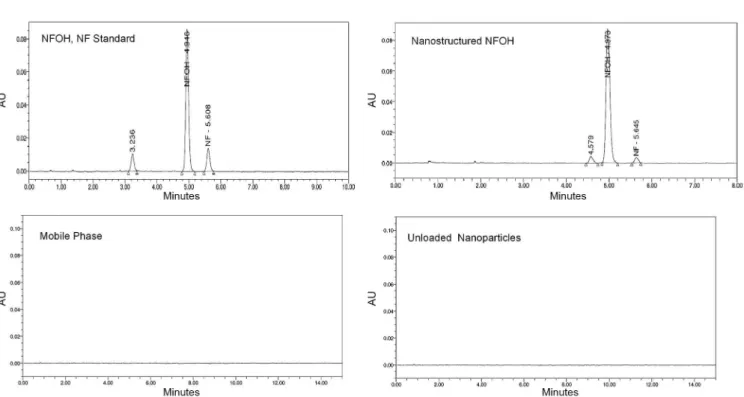
The selectivity of the method was evaluated in four diferent solutions: unloaded nanoparticle solution, nanostructured NFOH sample, mobile phase and standard NFOH. Spectral homogeneity was evaluated for all NFOH peaks in order to verify the absence of co‑elution of NFOH, NF and nanoparticle excipients.
Linearity
Linearity was evaluated using six NFOH standard solutions of 1.0, 4.0, 8.0, 10.0, 12.0 and 14.0 μg mL‑1 added to unloaded nanoparticles. Each solution was prepared in three replicates. The experimental results were graphically plotted, obtaining a calibration curve and calculating y‑intercept, slope, VIF (variance inlation factor), correlation coefficients (r) and determination (r2), lack of it test, PRESS (prediction sum of squares), standard deviation and Durbin –Watson statistic using Minitab® 16 and GraphPad Prim® 6.
Precision
T h e p r e c i s i o n w a s a s s e s s e d b y t e s t i n g t h e repeatability of six sample solutions once on the same day (intra-day), and on a different day (inter-day). The two-sample t-test was applied to compare the means.
Accuracy
The recovery studies were conducted at three diferent levels of standard NFOH added with unloaded nanoparticles. The samples were prepared accordingly to the “sample preparation,” and the theoretical drug concentrations of 1.0, 10.0, and 14.0 μg mL-1 were prepared in three replicates each. The method accuracy was expressed as the average recovery and relative standard deviation (RSD).
Robustness
The robustness was evaluated using six replicates prepared according to the sample preparation described previously. The following variations were selected: column temperature (20 to 30 °C), mobile phase (75:25 and 85:15, water and acetonitrile), low (1.1 and 1.3 mL min-1). The statistical evaluation was performed using ANOVA, after assuming the normality and equal variance of the data.
PBCA nanoparticles encapsulation efficiency (EE%)
EE% =
–
total amount of drug
drug recovered from supernatant total amount of drug × 100
(
) (
)
(1)
RESULTS AND DISCUSSION
Method development and optimization
Initially the samples were analyzed using a mobile phase consisting of water: acetonitrile (20:80, v/v) as proposed by Grillo et al. (2008). Under these conditions, the resolution and peak symmetry were not acceptable. Therefore, an alternative mobile phase was investigated. After testing several proportions, the inal composition was water: acetonitrile (80:20, v/v), under which a sharp peaks with suitable resolution of NFOH and NF (R≥2.0) were obtained (Figure 3D).
Although the peaks were well separated and symmetric, the NFOH peak height could not reach 0.04 AU, even when 50 µL were injected, the response was not improved and the NFOH and NF peaks were co‑eluted. Further, the NFOH peak spectrum (Figure 2) revealed the wavelength could be altered from λ=210 nm (as proposed by Grillo et al., 2008) to maximum absorbance λ (λ = 265 nm). When applying the wavelength of 265 nm, the nanostructured NFOH sample reached 0.08AU. Thus, this wavelength was chosen as the best chromatographic response for this work.
Method validation
Selectivity
As recommended by ICH Q2(R1), a chromatographic method is considered selective when each peak within the chromatogram corresponds to only one substance (peak purity evaluation). In present work DAD analysis revealed peak purity for all NFOH samples.
Moreover, a mixture of NFOH and NF standards and nanostructured NFOH samples chromatograms did not show any interferences (Figure 3). Likewise, unloaded nanoparticles and the mobile phase revealed no peak around NFOH retention time (4.9 min) (Figure 3).
Therefore, the optimized method revealed itself selective for the quantiication of NFOH.
Linearity
Although the method which has a correlation coeicient (r) greater than 0,99 can be accepted as linear, other statistics should be used to determine the quality of fit of the calibration curve, for example, the Durbin-Watson statistic and the lack of it test (Loco et al., 2002). The statistics presented in Table I exposes the linear characteristic of the method. With regard to the coeicients of determination and correlation, these were 0.999 and 0.9999, respectively. These values, close to 1, and the results obtained for the test of lack of it (p‑value> 0.1; α = 0.05) and the Durbin-Watson statistic (2.03826), indicate the suitability of proposed linear model. Additionally, the value of 1.00 for the variance inlation factor (VIF) showed the absence of multicollinearity. With regard to the PRESS statistic, the value was equal to 0.767 and therefore considered adequate (value <1.0) (Montgomery, Peck, Vining, 2001).
Precision
The measurement precision was evaluated by performing six replicate samples of nanostructured NFOH at 100% of the method concentration (10 µg mL-1) in the same day (day) and after 2 days (inter-day). For intra-day analysis the precision was 0.34%; as for inter-intra-day, CV was 0.49%, (Table II) which complies with the acceptance criteria proposed by the ICH Q2(R1) (CV < 2.0%). The p-value of the two-sample t-test was 0.692 (α=0.05), which means that the null hypothesis was accepted. Thus, these values have no signiicant diference between their means. Therefore, these results indicate that the proposed method presented adequate precision.
Accuracy
The average recoveries percentage of the spiked
NFOH was 100.7%, while %RSD value was 0.6% (Table 4) indicating accuracy of the reported method, once it met the acceptance ICH Q2(R1) criteria (RSD<2%).
Robustness
Minor deliberate changes in diferent experimental parameters did not signiicantly affect the recoveries (Table IV). This outcome was confirmed when the mean values were compared through ANOVA. The null hypothesis was accepted (p‑value equal to 0.053, α=0.05). Therefore, no signiicant diference between means was found, reiterating the method robustness.
Method application
Encapsulation efficiency (EE)
The application of the proposed method for the quantification of NFOH in PBCA nanoparticles revealed encapsulation efficiency of NFOH in PBCA nanoparticles of 64.4 RSD 0.4% (n=3). No alterations in the chromatograms or unusual peaks were observed during validation.
CONCLUSION
A RP‑HPLC method was successfully developed and validated for the quantification of NFOH bound to PBCA nanoparticles. The described method has no FIGURE 3 - Selectivity chromatograms. Mobile phase: water and acetonitrile 80:20 (v/v), low: 1.2 mL min-1, λ: UV 265 nm, injection volume: 20 μL, column temperature: 25ºC. NFOH: hydroxymethylnitrofurazone, NF: nitrofurazone.
TABLE I - Statistical analysis evaluation of the linear regression, N=3
Statistical Regression
Analysis
Slope 57254
Intercept - 3265
Coeicient of correlation (r) 0,9999
VIF (variance inlation factor) 1.000 Coeicient of determination (r2) 0.9990 Durbin – Watson
Lack of it
PRESS (prediction sum of squares) Standard deviation
2,0355 p‑value> 0.1
0.0767 0.0453
TABLE II - Precision results for diferent levels of nanostructured NFOH
Precision
NFOH concentration
(μg mL-1)*
Two-Sample t-test
Intra-day 9.98 p- value 0.692
CV (%) 0.34
Inter-day 9.99
CV (%) 0.49
interference from excipients, allowing the quantiication of NFOH in these formulations with highy accuracy. The method revealed to be simple, accurate and precise and could be easily applied in the determination of NFOH and its main degradation product when used with nanoparticles as drug carrier.
ACKNOWLEDGMENTS
The authors are grateful to CNPq (National Council for Scientiic and Technological Development) for inancial support and to United States Pharmacopeia (Tamboré, Brazil), for material, equipment and installations.
REFERENCES
BAMRUNGSAP, S.; ZHAO, Z.; CHEN, T.; WANG, L.; LI, C.; FU, T.; TAN, W. Nanotechnology in therapeutics: a focus on nanoparticles as a drug delivery system. Nanomedicine (London), v.7, n.8, p.1253-1271, 2012.
CHUNG, M.C.; GÜIDO, R.V.; MARTINELLI, T.F.; GONÇALVES, M.F.; POLLI, M.C.; BOTELHO, K.C.; VARANDA, E.A.; COLLI, W.; MIRANDA, M.T.; FERREIRA, E.I. Synthesis and in Vitro evaluation of potential antichagasic hydroxymethylnitrofurazone (NFOH-121): a new nitrofurazone prodrug. Bioorg. Med. Chem., v.11, n.22, p.4779-4783, 2003.
COURNARIE, F.; CHERON, M.; BESNARD, M.; VAUTHIER, C. Evidence for restrictive parameters in formulation of insulin-loaded nanocapsules. Eur. J. Pharm. Biopharm., v.57, n.2, p.171-179, 2004.
FARAJI, A.H.; WIPF, P. Nanoparticles in cellular drug delivery. Bioorg. Med. Chem., v.17, n.8, p.2950-2962, 2009.
ICH. International conference on harmonisation of technical requirements for registration of pharmaceuticals for human use. Quality Guideline. View All Quality Guidelines. Analytical Validation Q2. Q2 (R1) ‑ validation of analytical procedures: text and methodology. S.l.: ICH, 2005. Available at: <http://www.ich.org/ileadmin/Public_Web_ Site/ICH_Products/Guidelines/Quality/Q2_R1/Step4/ Q2_R1__Guideline.pdf>. Accessed on: 23 Jan. 2012.
GRILLO, R.; DE MELO, N.F.; MORAES, C.M.; DE LIMA, R.; MENEZES, C.M.; FERREIRA, E.I.; ROSA, A.H.; FRACETO, L.F. Study of the interaction between hydroxymethylnitrofurazone and 2-hydroxypropyl-beta-cyclodextrin. J. Pharm. Biomed. Anal., v.47, n.2, p.295-302, 2008.
LOPES, R.; ELEUTÉRIO, C.V.; GONÇALVES, L.M.D.; CRUZ, M.E.M.; ALMEIDA, A.J. Lipid nanoparticles containing oryzalin for the treatment of leishmaniasis. Eur. J. Pharm. Sci., v.45, n.4, p.442-450, 2012.
LOCO, J.V.; ELSKENS, M.; CROUX, C.; BEERNAERT, H. Linearity of calibration curves: use and misuse of the correlation coeicient. Accred. Qual. Assur., v.7, p.281-285, 2002.
MONTGOMERY, D.C.; PECK, E.A.; VINING, G.G. Introduction to linear regression analysis. 3.ed. New York: Wiley, 2001. 612 p.
PARVEEN, S.; MISRA, R.; SAHOO, S.K. Nanoparticles: a boon to drug delivery, therapeutics, diagnostics and imaging. Nanomedicine, v.8, n.2, p.147-166, 2012. TABLE III - Accuracy results for diferent levels of NFOH in standard solutions
Amount added (μg mL-1)*
Amount recovered (μg mL-1)*
Recovery (%)*
Average Recovery (%)
NFOH 0.9363 0.9372 100.1
100.7 RSD 0.6
9.3633 9.4476 100.9
13.1082 13.2655 101.2
*Expressed as the mean of three replicates
TABLE IV - Variations in the chromatographic conditions evaluation the robustness
Condition Mean (%) RSD (%)
Initial 100.3 0.3
Water acetonitrile 75:25 100.7 0.2 Water acetonitrile 85:15 100.7 0.2
Flow 1.1 mL min-1 100.8 0.2
Flow 1.3 mL min-1 100.7 0.3
Column 20 °C 100.7 0.2
SCHLOSSBERG, D.Clinical infectious disease. 1ed. New York: Cambridge University Press, 2008. 1392 p.
SHABIR, G.A.; LOUGH, J.W.; ARAIN, S.A.; BRADSHAW, T.K. Evaluation and application of best practice in analytical method validation. J. Liq. Chromatogr. Relat. Technol., v.30, n.3, p.311-333, 2007.
SHAM, J.O.; ZHANG, Y.; FINLAY, W.H.; ROA, W.H.; LOBENBERG, R. Formulation and characterization of spray-dried powders containing nanoparticles for aerosol delivery to the lung. Int. J. Pharm., v.28, n.269, p.457-467, 2004.
SINGH, R.; LILLARD JR, J.W. Nanoparticle-based targeted drug delivery. Exp. Mol. Pathol., v.86, n.3, p.215-223, 2009.
TAVARES, G.M.; ISHIKAWA, G.M.; MONTEIRO, T.F.; ZANOLINI, C.; KEDOR‑HACKMANN, E.R.M.; BOU‑CHACRA, N.A.; CONSIGLIERI, V.O. Derivative spectrophotometric method for determination of acyclovir in polymeric nanoparticles. Quím. Nova, v.35, n.1, p.203-206, 2011.
TEIXEIRA, S.M.; PAIVA, R.M.C.; KANGUSSU‑ MARCOLINO, M.M.; ROCHA, W. Trypanosomatid comparative genomics: contributions to the study of parasite biology and diferent parasitic diseases. Genet. Mol. Biol., v.35, n.1, p.1-17, 2012.
WORLD HEALTH ORGANIZATION. WHO. Control of the Leishmaniasis: report of a meeting of the WHO expert committee on the control of leishmaniases. Geneva: WHO, 2010. 186 p. (WHO technical report series, 949).