*Correspondence: F.C Cansian. Departamento de Farmácia, Laboratório de Farmacotécnica. Universidade Federal do Paraná. Rua Pref. Lothário Meissner, 3400, Jardim Botânico - 80210-170 - Curitiba - PR, Brasil. E-mail: [email protected]
R
e
vol. 51, n. 3, jul./sep., 2015 http://dx.doi.org/10.1590/S1984-82502015000300003
Chemical review and studies related to species from the genus
Tynanthus
(Bignoniaceae)
Fernanda Colombi Cansian
1,*, Francis José Zortéa Merino
2, Josiane de Fátima Gaspari Dias
1,
Sandra Maria Warumby Zanin
1, Obdulio Gomes Miguel
2, Marilis Dallarmi Miguel
11Pharmacy Department, Pharmacotechnics Laboratory, Federal University of Paraná, Curitiba, PR, Brazil, 2Pharmacy
Department, Phytochemical Laboratory, Federal University of Paraná, Curitiba, PR, Brazil
Species from the Bignoniaceae Family, including the genus Tynanthus, are very prevalent in the tropical Americas, with specimens found in a large part of the Brazilian territory. These plants are commonly used in traditional medicine for several purposes, and some studies have described their chemical structure, in addition to other reports related to some species from this genus. This review aimed to gather information from published works concerning species of the genus Tynanthus, as well as to detect laws in research
related to these plants, which may have great biological and pharmaceutical importance. Also, this review points out some common chemical characteristics of these species, providing information that may help new researchers to improve their knowledge about these plants.
Uniterms: Tynanthus/pharmacognosy. Tynanthus/phytochemistry. Tynanthus/biological activity. Bignoniaceae/pharmacognosy. Bignoniaceae/phytochemistry. Medicinal plants.
As espécies da família Bignoniaceae possuem grande predominância na região da América tropical e entre elas, as espécies do gênero Tynanthus, com representantes em grande parte do território brasileiro. Estas
plantas são comumente utilizadas na medicina tradicional para os mais diversos ins e algumas pesquisas já descrevem a constituição química além de outros estudos relacionados a alguns integrantes deste gênero.
Este trabalho de revisão teve como objetivo reunir informações de trabalhos publicados a respeito das espécies do gênero Tynanthus e permitiu detectar a deiciência nas pesquisas relacionadas a estas plantas, que podem trazer consigo grande importância biológica e farmacológica. Além disto, este trabalho tornou possível apontar algumas características químicas em comum entre as espécies, trazendo informações que podem auxiliar novos pesquisadores que procuram melhorar seus conhecimentos acerca destas plantas.
Unitermos: Tynanthus/pharmacognosy. Tynanthus/phytochemistry. Tynanthus/biological activity. Bignoniaceae/pharmacognosy. Bignoniaceae/phytochemistry. Medicinal plants.
INTRODUCTION
The Bignoniaceae family gathers 82 genus and 827 species (Lohmann, Ulloa, 2007), which are usually spontaneous tropical species in South America, including trees, vines, bushes and rarely herbs (Di Stasi, 2002).
Gentry (1980) was a pioneer in detailing the taxonomy of the family, later reviewed by Spangler and Olmstead (1999). In a more recent description by Fischer
et al. (2004), there are seven of the eight clades, which
were proposed before: Bignonieae, Coleeae, Crescentieae, Eccremocarpeae, Oroxyleae, Tecomeae and Tourrettieae. Two clades, Bignonieae and Crescentiinae, represent more than 80% of the species from the family (Olmstead
et al., 2009). Lohmann (2006) organizes genus Tynanthus
species within the Bignonieae tribe.
The species of this genus are vines, popularly known as clove vine (cipó-cravo), due to the strong smell of Indian clove that emanates when the stems or leaves are cut or macerated (Lopes et al., 2008). Lohman (2006), in his description of the morphological synapomorphy of
Tynanthus, noted that besides its smell, it shows bilabiate
lowers with two upper lobes fused and fruits with raised
margins, information that helped in the phylogeny reconstruction of these species.
In traditional medicine, Tynanthus species are used for several purposes, for example, for the treatment of rheumatism and diabetes, besides their application as a stimulant, aphrodisiac, carminative and anthelmintic, Most of these properties have been already verified by specialists (Vilegas et al., 1993; Brack, 1999).
Because of their already known popular use, this review had the objective of gathering information from scientific studies related to the genus Tynanthus, aiming to improve the knowledge about their chemical constitution, biological activities and other issues related to these species. With this information, it will be
possible to identify deiciencies in studies involving the
members of this genus, and ultimately serve as a tool for research aiming to assess the unstudied properties of these plants.
RESEARCH METHODOLOGY
The references were tracked based on a 20-year period, and were obtained from databases such as
Biological Abstract and Chemical Abstract. In addition, references in the Scientific Electronic Library Online
(Scielo), Medline/Pubmed and other internet sites were searched, without a time limitation.
Recognized species from the genus Tynanthus
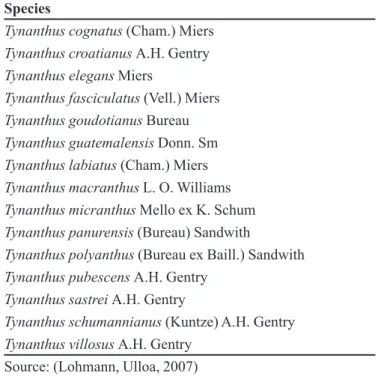
According to the Missouri Botanical Garden, The New York Botanical Garden and The Board of Trustees of the Royal Botanic Gardens (Lohmann, Ulloa, 2007), 15 recognized species in this genus are registered, and are listed in Table I.
SPECIES WITHOUT STUDIES
When searching for studies related to the genus
Tynanthus, no results were found for the following species:
Tynanthus croatianus A.H. Gentry, Tynanthus goudotianus
Bureau, Tynanthus labiatus (Cham.) Miers, Tynanthus macranthus L. O. Williams, Tynanthus polyanthus
(Bureau ex Baill.) Sandwith, Tynanthus pubescens A.H. Gentry, Tynanthus sastrei A.H. Gentry and Tynanthus villosus A.H. Gentry.
Tynanthus cognatus (Cham.) Miers
This species is commonly found in Brazil, in the northeastern (Bahia), southeastern (Espírito Santo, Minas Gerais, Rio de Janeiro and São Paulo) and southern regions (Paraná, Rio Grande do Sul and Santa Catarina) (Lohmann, 2014a).
Lima, Pace and Angyalossy (2010), who studied issues concerning environmental and morphoanatomical
aspects, especially those inluencing vine growth, based
their work on the characteristics of T. cognatus, and compared them to 31 other Bignonieae species. Thus, the stem anatomy, the seasonality of the formation and differentiation of secondary tissues and the influence on the change rate in xylem development were studied this species in order to identify general growth standards in vines from this tribe. Some discoveries were made, among them the change activity during the end of the rainy season, in contrast to what is known about tropical trees and bushes. It was concluded that the change is a response to the environmental changes and that the growth rings are annual, happening in a period of roughly two months, which may explain the fact that the vines possess narrow rods.
TABLE I -Recognized species from the genus Tynanthus
Species
Tynanthus cognatus (Cham.) Miers
Tynanthus croatianus A.H. Gentry
Tynanthus elegans Miers
Tynanthus fasciculatus (Vell.) Miers
Tynanthus goudotianus Bureau
Tynanthus guatemalensis Donn. Sm
Tynanthus labiatus (Cham.) Miers
Tynanthus macranthus L. O. Williams
Tynanthus micranthus Mello ex K. Schum
Tynanthus panurensis (Bureau) Sandwith
Tynanthus polyanthus (Bureau ex Baill.) Sandwith
Tynanthus pubescens A.H. Gentry
Tynanthus sastrei A.H. Gentry
Tynanthus schumannianus (Kuntze) A.H. Gentry
Tynanthus elegans Miers
T. elegans Miers is a native plant of Brazil, found in the southeastern (Espírito Santo, Minas Gerais, Rio de Janeiro and São Paulo) and southern (Paraná, Rio Grande do Sul and Santa Catarina) regions (Lohmann, 2014b).
This species was highlighted in a phytosociological survey of a liana community in a seasonal semideciduous forest, located in São Carlos, São Paulo, Brazil, which showed a prevalence of species from the Bignoniaceae, Malpighiaceae, Sapindaceae and Apocynaceae families. The Bignoniaceae family comprised a major percentage in terms of species numbers, and T. elegans was had the third highest importance value (IV), a parameter which is directly related to the relative dominance (RD) in the
studied region (Hora, Soares, 2002), which justiies, at
least in part, its prevalence in the southeastern region of Brazil.
Tynanthus fasciculatus (Vell.) Miers
T. fasciculatus shows a relatively restricted distribution, occurring in the Brazilian southeast, in Minas Gerais, São Paulo and Rio de Janeiro (Lohmann, 2014c).
The Brazilian Pharmacopoeia (Farmacopéia, 1929) describes T. fasciculatus and T. elegans as carminative plants, and Correa (1974) reports that the population uses these plants for aphrodisiac purposes, also citing their
toxic efects.
Vilegas and colleagues (1993) showed in their studies the presence of coumarins, phenylpropanoids and steroids (β-sitosterol-β-D-glucoside) (Figure 1) in the chemical constitution of T. fasciculatus, citing its use in traditional medicine as a stimulant, aphrodisiac, carminative and anthelmintic, the latter based on studies by Amorim et al. (1991), who demonstrated anthelmintic action in reducing the number of Oxyuridae in mice naturally infected by this parasite.
A report from Vilegas et al. (1994) reinforced the presence of coumarins in all parts of the plant. Besides coumarin, melilotic acid and its derivatives were identified, as well as the phytosteroid stigmasterol, in the hexanic extract from roots. According to Carvalho
et al. (2009), T. fasciculatus also contains flavonoids, cardiotonic heterosides and tannins. This same study
showed high toxicity of the stem’s aqueous extract to the
microcrustacean Artemia salina.
The growth of T. fasciculatus seedlings was evaluated with the purpose of showing the location and characteristics of the forest where this plant develops best.
It was veriied that the forest edge was the location where
the seedlings developed best, showing 100% survival and the greatest lengths and numbers of leaves. Only in this treatment was there development of tendrils in seedlings, which exceeded 80 cm in length (Lopes et al., 2008).
Because of the traditional application of this plant as an aphrodisiac, Melo et al. (2010) proposed in their study to evaluate the morphometry of male reproductive organs in adult male Wistar rats after treatment with an infusion of T. fasciculatus stems. In dose of 200 mg/animal/day, a
signiicant increase in testicular parenchyma weight was
observed, as well as an increase in the volume and total
length of the seminiferous tubules and, as a consequence
of this, an increase in sperm production.
Tynanthus guatemalensis Donn. Sm
T. guatemalensis is distributed from Mexico to Guatemala (Tropicos, 2014a). It presents in its chemical
constitution saponins, anthocyanins and lavonoids in the
stem, as demonstrated in a study by Miranda-Cruz et al.
(2012), which also showed the antimicrobial activity of a hexane extract of its leaves against Bacillus cereus ATCC 11778.
Besides the antimicrobial activity of T. guatemalensis,
Ferrier and colleagues (2013) reported its eicacy for the
treatment of diabetes, based on ethnobotanical information from Mayan healers in the Mesoamerica region. Such
activity was conirmed by in vitro tests which evaluated the inhibition of the formation of advanced glycation end-products (AGE), substances which are considered to be important pathogenic mediators of diabetic complications. Extractions of milled T. guatemalensis wood were made with solvents of increasing polarity (hexane, ethyl acetate, and methanol). The extracts were assayed, and activity was found mainly in the ethyl acetate fraction, in a comparable
way to the positive control, quercetin, known to possess
activity as an AGE inhibitor.
UPLC-MS-QToF analysis of the crude extract of T. FIGURE 1 - Chemical and structural formula of β-sitosterol-β
guatemalensis conirmed the presence of katchimoside
analogs, 4-hydroxybenzoate and salicylic acid. In addition,
verbacoside was identiied by HPLC-MS-QTRAP in the
ethyl-acetate extract and eugenol was detected by GC-MS in the essential oil (Ferrier, 2014).
Tynanthus micranthus Mello ex K. Schum
This plant is commonly found in Brazil, in the state of Paraná, as well as in the southeastern (São Paulo) and midwestern (Mato Grosso do Sul) regions (Lohmann, 2014d).
The study from Souza, Santos and Moscheta (2010) reported the morphoanatomical flower characteristics of three Bignoniaceae family species, including T. micranthus in the comparative study. They concluded
that, although the lowers are structurally similar, there
are significant differences in some characters, which
allow their identiication, for example the color and shape
of the corolla, the number of cell layers in the perianth, and the types of trichomes in the perianth, among other characteristics.
The substances β-sitosterol and apigenin were
isolated from T. micranthus, as well as chemical groups such as flavonoids (dihidroflavonoids and leucoanthocyanidins), steroids and/or triterpenoids,
heterosidic anthraquinones (Cansian et al., 2012) and eugenol in the essential oil (Custódio et al., 2010).
The same study by Cansian et al. (2012) showed that some fractions are toxic against Artemia salina in a number of concentrations, suggesting care in the administration of the extracts of this plant. These preparations were also tested against some bacterial strains, and the results showed activity of the crude extract from the root against
E. coli, whereas the crude extract from the stem was
efective against S. aureus, P. aeruginosa and E. coli and
the crude extract from the leaves was efective against S. aureus and P. aeruginosa, all of them with a minimal
inhibitory concentration of 1000 μg/mL. Custódio et al., 2010 had previously evaluated the antimicrobial activity of the essential oil of T. micranthus, whose bioautography indicated eugenol as the substance responsible for its activity against Cladosporium herbarum.
Cansian et al. (2013) confirmed the influence of the chloroform fraction of the stem of T. micranthus on
Lactuca sativa seeds hypocotyl germination and growth, indicating its allelopathic potential. More recently, another research group, also led by Cansian, showed that the residual hydroalcoholic fraction from T. micranthus
protects erythrocytes against oxidative damage, using an enzymatic in vitro assay to evaluate the action of
the enzyme tyrosinase, suggesting its application in hypopigmentation disorders (Cansian et al., 2014a).
More recently, Cansian et al., (2014b) showed
that mice treated with the extract presented a signiicant
reduction in the latency time for mounts and an increased
frequency of mounts, especially after three hours of
treatment, in a dose-related manner, as compared to the
control group. These results demonstrate the inluence of T. micranthus on the sexual behavior of mice and allow the inclusion of this species in the list of aphrodisiac plants of the genus.
Tynanthus panurensis (Bureau) Sandwith
In the Peruvian Amazon, T. panurensis has been traditionally used as an aphrodisiac, energizing tonic and analgesic, as well as for the treatment of rheumatism and diabetes (Brack, 1999). In Brazil, this species is found in the northern region (Amazonas and Pará) (Lohmann, 2014e).
Studies by Plaza and colleagues (2005) have revealed, by LC-MS of the methanolic extract, the presence of the phenylpropanoid glycosides eugenol-O -[β-D- xylopyranosyl-(1→5)-O-β-D-apiofuranosyl-(1→
6)-O-β-D-glucopyranosideverbascoside, leucosceptoside, isoverbascoside and the lavonoid katchimoside,
apigenin-8-C-[β-D-xylopyranosyl-(1→6)-β-D-glucopyranoside
(Figure 2).
Based on reports about the use of T. panurensis
for the treatment of rheumatism, Morales et al. (2011)
FIGURE 2 - Compounds isolated from the bark of Tynanthus panurensis. (1) Eugenol-O-[β-D-xylopyranosyl-(1→ 5)-O-β-D-apiofuranosyl- (1→6)-O-β-D-glucopyranoside, (2)
verbascoside, (3) leucosceptoside, (4) isoverbascoside and (5) katchimoside (apigenin 8-C-[β-D-xylopyranosyl-(1→6)-β
(Quintana, Vargas, 1995). This traditional use indication motivated Muñoz et al. (2000) to include this species in their research, which evaluated the anti-malarial activity of some Bolivian plants used by the Mosetene Indians for the cure of several diseases. The residue from the fruit extract of T. schumannianus, obtained from maceration with ethanol-water, showed moderate activity in vivo
(49% with 510 mg/kg) in rodents with malaria caused by
Plasmodium vinckei petteri, and excellent in vitro activity (98% with 10 mg/mL) against Plasmodium falciparum,
comparable to the standard drug, chloroquine.
DISCUSSION
Of the 15 recognized species, only T. fasciculatus, T.guatemalensis, T. micranthus and T. panurenses have information about their chemical characteristics, allowing the detection of some common chemical groups, such as
lavonoids, phenylpropanoids and steroids (Table II).
Eugenol and its derivatives are found in the majority
of species with a delineated phytochemical proile. Studies
TABLE II - Chemical groups and isolated substances of species from the genus Tynanthus
Species Chemical groups Identiied substances References
T. fasciculatus (Vell.) Miers
Tannins, lavonoids
and cardiotonic heterosides, coumarins,
phenylpropanoids and steroids
β-sitosterol-β-D-glucoside, coumarin, stigmasterol, melilotic acid ethyl ester,
melilotic acid, melilotic acid-O- β- D- glucopyranoside
(melilotoside)
Carvalho et al., 2009; Vilegas et al., 1993;
Vilegas et al., 1994
T. guatemalensis Donn. Sm
Saponins, anthocyanins
and lavonoids, in the stem;
benzoic acid derivatives,
C-glycosyl lavonoids and
phenylpropenes
katchimoside analogs, 4-hydroxybenzoate, salicylic
acid and eugenol
Miranda-Cruz, et al., 2012; Ferrier, 2014
T. micranthus Mello ex K. Schum
Flavonoids
(dihidrolavonoids and
leucoanthocyanins), steroids and/ or triterpenes,
anthraquinones heterosides,
eugenol
β-sitosterol, apigenin Cansian et al., 2012;
Custódio et al., 2010
T. panurensis (Bureau) Sandwith
Phenylpropanoid glycoside
and lavonoid
Eugenol-O-[β -D-xylopyranosyl-(1→5)-O-β
-D-apiofuranosyl- (1→6)-O-β
-D-glucopyranoside, verbascoside, leucosceptoside,
isoverbascoside and katchimoside (apigenin 8-C-[β -D-xylopyranosyl-(1→6)-β-D-glucopyranoside)
Plaza et al., 2005 performed a study that aimed to demonstrate the
anti-inlammatory and antioxidant activity of the extract from
the bark of this plant. In vitro assays showed that the extract possessed antioxidant properties and reduced microsomal lipid peroxidation, as well as uric acid and tumor necrosis
factor (TNF) synthesis. Its powerful anti-inlammatory
property was confirmed by the in vivo carrageenan-induced paw edema tests in rats, indicating that the bark extracts of T. panurensis actually have a beneicial efect in the treatment of inlammation, in accordance with the
main traditional uses of this plant.
Tynanthus schumannianus (Kuntze) A.H. Gentry
This species is found in Bolivia, in the La Paz and Santa Cruz regions (Tropicos, 2014b) and in Brazil, in the northern (Acre, Amazonas, Pará and Rondônia) and northeastern (Maranhão) regions (Lohmann, 2014f).
have shown aphrodisiac activity in some plants such as cloves (Syzygium aromaticum) and nutmeg (Myristica fragrans). These plants have eugenol-rich essential oils, as do some species of the genus Tynanthus. Despite this evidence, no study has related the aphrodisiac activity of these species with the eugenol content.
In addition, T. guatemalensis and T. panurenses have both exhibited verbascoside and katchimoside in their chemical composition; the latter is an apigenin-derived
lavonoid, a substance which is present on T. micranthus.
T. guatemalensis and T. panurenses have traditional uses for the treatment of diabetes; however, there have been no studies relating this activity to compounds common to these species.
The chemical constitution of the genus Tynanthus
follows the same pattern described for the Bignoniaceae family, as shown by Cipriani et al. (2012), who performed
data collection on the chemical proile of this family. This
study lists the most predominant metabolites in the studied species, starting with terpenoids, followed by special
aromatic derivatives, quinones and lavonoids.
Some plant groups show a variety of chemical components, which can be used as taxonomic markers, since common characteristics in secondary metabolism can indicate kinship among species, beyond morphological similarities (Hegnauer, 1986). Although the number of publications is continually increasing, only a small proportion of plants have been chemically investigated, such as the genus studied in this review, rendering the available information insufficient. Hence, this study
contributes to future investigations on the chemical taxonomic aspects of species of the genus Tynanthus.
The species T. fasciculatus, T.guatemalensis, T. micranthus and T. panurenses, besides having their phytochemical profile delineated, have been studied regarding their biological and pharmacological activities. Most of these studies were based on their traditional uses; for example, T. fasciculatus is an aphrodisiac plant whose
application promoted studies that evaluated the inluence
of its extracts on the male reproductive organs of adult Wistar rats (Melo et al. 2010). Besides T. fasciculatus, T. micranthus and T. panurenses are also traditionally used for aphrodisiac purposes, although no study has demonstrated the chemical component and the mechanism responsible for this activity.
Table III shows a list of species, which have biological and pharmacological studies and their
relationship between traditional and scientiic uses.
Among all studied species, T. cognatus (Cham.) Miersand T. elegans Miers have related studies, although they do not mention their chemical composition, and only refer to morphological and phytosociological aspects.
This analysis allowed us to appreciate the deiciency
of studies involving the toxicity of plants of the genus
Tynanthus, a very important parameter when the subjects are plants which are routinely used by the population. Only
T. fasciculatus and T. micranthus have been evaluated and showed a certain degree of toxicity against the microcrustacean Artemia salina, which may argue against the indiscriminate use of these plants.
TABLE III - List of species from the genus Tynanthus with traditional use indications, as well as studies related to biological and pharmacological activities
Species Traditional Use Biological and pharmacological
studied activities References
Tynanthus fasciculatus (Vell.) Miers
Carminative, anthelmintic, stimulant and aphrodisiac
Male reproductive organs morphometry anthelmintic
activity
Farmacopéia, 1929; Correa, 1974; Vilegas et al., 1993; Melo et al., 2010; Amorim et
al., 1991
Tynanthus guatemalensis Donn.
Sm Diabetes
Antimicrobial activity and diabetes
Ferrier, 2013; Miranda-Cruz et al., 2012
Tynanthus micranthus Mello ex
K. Schum Aphrodisiac
Antimicrobial, allelopathic and antioxidant activity, tyrosinase
stimulant and aphrodisiac activity
Custódio et al., 2010; Cansian
et al., 2012; Cansian, et al., 2013; Cansian et al., 2014a;
Cansian et al., 2014b
Tynanthus panurensis (Bureau) Sandwith
Aphrodisiac, energizing tonic, analgesic, for the treatment of
rheumatism and diabetes
Antioxidant and
anti-inlammatory activity Brack, 1999; Morales 2011 et al.,
Tynanthus schumannianus
(Kuntze) A.H. Gentry Anti-diarrheal Anti-malarial activity
Quintana,Vargas, 1995; Muñoz
CONCLUSION
During the assessment of all the data incorporated
into this review, it became possible to verify the deiciency
of studies involving the majority of species of the genus
Tynanthus. Also, it was observed that some members have potential for their use, because they are already known and traditionally used, but need to be better evaluated with respect to their toxicity.
Hence, this work contributes significantly to research fields which aim to identify potential plants
which are insuiciently explored, in order to delineate their chemical proile and possible biological activities
and thus contribute to the discovery of natural substances which may serve as the basis for the development of new
drugs and cosmetics, among other beneicial products for
the population.
ACKNOWLEDGMENTS
The authors thank CAPES for the inancial support,
and are grateful for support from the Pharmaceutical S c i e n c e s P o s t - G r a d u a t i o n C o u r s e D e p a r t m e n t Coordination of the Federal University of Paraná.
CONFLICTS OF INTEREST
There have been no conlicts of interest in carrying
out this work.
REFERENCES
AMORIM, A.; BORBA, H.R.; AMANO, L.M. Ação
anti-helmíntica de plantas IV. Inluência da casca do caule do
cipó-cravo (Tynnantus fasciculatus, Miers, Bignoniaceae) na eliminação de Vampirolepis nana e oxiurídeos em camundongos. Rev. Bras. Farm., v.72, n.4, p.92-94, 1991.
BRACK, E.A. Diccionario enciclopédico de plantas utiles del Perú. Cusco: Centro de Estudios Regionales, Andinos Bartolomé de las Casas, 1999. p.508-509.
BUREAU, M.E. Revisión des genres Tynanthus et Lundia. Adansonia (Baillon). Adansonia, v.8, p.270-294, 1868.
CANSIAN, F.C.; MIGUEL, M.D.; MIGUEL, O.G.; MIYASAKI, C.M.S.; LIMA, C.P.; KALEGARI, M.; MERINO, F.J.Z.; SOUZA, A.M.; COGO, L.L. Phytochemical, toxicity and microbiological activity study of Tynanthus micranthus
Corr. Mello ex Schum. (Bignoniaceae). Lat. Am. J. Pharm., v.31, n.3, p.487-491, 2012.
CANSIAN, F.C.; LIMA, C.P.; ZORTÉA, F.M.; MIGUEL, O.G.; MIGUEL, M.D. Potencial alelopático de Tynanthus micranthus Corr. Mello ex. Schum. (Bignoniaceae) sobre diásporos de Lactuca sativa L. Rev. Ciênc. Farm.Básica Apl., v.34, n.4, p.137-140, 2013.
CANSIAN, F.C.; SILVA, C.B.; LIMA, C.P.; MERINO, F.J.Z.; RECH, K.S.; OTUKI, M.F.; CAMPOS, P.M.; MIGUEL, O.G.; MIGUEL, M.D. Tynanthus micranthus: an eicient antioxidant and tyrosinase activity inductor. Afr. J. Pharm. Pharmacol., v.8, n.23, p.651-657, 2014a.
CANSIAN, F.C., MERINO, F.J.Z., AMARAL, V.L.L., SALVADOR, R.A., CAMPOS, P.M., MONTRUCCHIO, D.P., MIGUEL, O.G., MIGUEL, M.D. Aphrodisiac properties of Tynanthus micranthus Corr. & Mello ex. Schum in male mice. Afr. J. Pharm. Pharmacol., v.8, n.47, p.1200-1204, 2014b.
CARVALHO, C.A.; MATTA, S.L.P.; MELO, F.C.S.A.; A N D R A D E , D . C . F. ; C A RVA L H O , L . M . C . ; NASCIMENTO, P.C; SILVA. M.B.; ROSA, M.B. Cipó-cravo (Tynnanthus fasciculatus Miers - Bignoniaceae):
estudo fitoquímico e toxicológico envolvendo Artemia salina.Rev. Elet. Farm., v.6, n.1, p.51-57, 2009.
CIPRIANI, F.A.; FIGUEIREDO, M.R.; SOARES, G.L.G.;
KAPLAN, M.A.C. Implicações químicas na sistemática e ilogenia de Bignoniaceae. Quím. Nova, v.35, n.11, p.2125-2131, 2012.
CORREA, M.P. Dicionário das plantas úteis do brasil e das exóticas cultivadas. 1.ed. Rio de Janeiro: IBDF, 1974. 687 p.
CUSTÓDIO, D.L.; BURGO, R.P.; MORIEL, B.; BARBOSA, A.M.; REZENDE, M.I.; DANIEL, J.F.S.; PINTO, J.P.; BIANCHINI, E.; FARIA, T.J. Antimicrobial activity of essential oils from Piment pseudocaryophyllus and
Tynanthus micranthus. Braz.Arch. Biol. Technol., v.53, n.6, p.1363-1369, 2010.
DI STASI, L.C.; HIRUMA-LIMA, C.A. Plantas medicinais na amazônia e na mata atlântica. 2.ed. São Paulo: UNESP, 2002. p.449-450.
FERRIER, J.; CARTER-RAMIREZ, A.; PESEK, T.; CAL, V.; BALICK, M.J.; ARNASON, J.T. K’an, Tynanthus guatemalensis Donn. Sm.: the taxonomic and archeological mystery behind a maya antidiabetic medicinal plant (Invited). In: Natural health product research society of Canada, 2013. Ontario, 2013. Available at: <https://www. mendeley.com/research/kan-tynanthus-guatemalensis- donnsm-taxonomic-archeological-mystery-behind-maya-antidiabetic-medicina>. Accessed on: 27 June 2013.
FERRIER, J. Ethnobotany, pharmacology, and metabolomics of antidiabetic plants used by the Eeyou Istchee Cree, Lukomir Highlanders, and Q’eqchi’ Maya. Canada, 2014. 193 p. [Dissertation of master degree. Faculty of Graduate and Postdoctoral Studies. University of Ottawa].
FISCHER, E.; THEISEN, I.; LOHMANN, L.G. Bignoniaceae.
In: KADEREIT, J.W. The families and genera of vascular plants. Lamiales, v.VII, p.9-38. Berlin: Springer-Verlag, 2004.
GENTRY, A.H. Bignoniaceae. Part I: Crescentieae and Tourrettieae. New York: The New York Botanical Garden, 1980. 130 p. (Monograph number, 25).
HEGNAUER, R. Phytochemistry and plant taxonomy-an essay on the chemotaxonomy of higher plants. Phytochemistry, v.25, n.7, p.1519-1535, 1986.
HORA, R.C.; SOARES, J.J. Estrutura fitossociológica da comunidade de lianas em uma floresta estacional semidecidual na Fazenda Canchim, São Carlos, SP. Rev. Bras. Bot., v.25, n.3, p.323-329, 2002.
LIMA, A.; PACE, M.; ANGYALOSSY, V. Seasonality and growth rings in lianas of Bignoniaceae. Trees, v.24, n.6, p.1045-1060, 2010.
LOHMANN, L.G. Untangling the phylogeny of neotropical lianas (Bignonieae, Bignoniaceae). Am. J. Bot., v.93, n.2, p.304-318, 2006.
LOHMANN, L.G.; ULLOA, C.U. Bignoniaceae. In: iPlants prototype checklist, 2007. Available at: http://www.iplants. org. Accessed on: 21 Apr. 2013.
LOHMANN, L.G. Bignoniaceae. In: List of species of the Brazilian flora. Rio de Janeiro Botanical Garden.
Available at: <http://relora.jbrj.gov.br/jabot/loradobrasil/
FB113967>. Accessed on: 30 July 2014a.
LOHMANN, L.G. Bignoniaceae. In: List of species of the Brazilian flora. Rio de Janeiro Botanical Garden.
Available at: <http://relora.jbrj.gov.br/jabot/loradobrasil/
FB113968>. Accessed on: 30 July 2014b.
LOHMANN, L.G. Bignoniaceae. In: List of Species of the Brazilian flora. Rio de Janeiro Botanical Garden.
Available at: <http://relora.jbrj.gov.br/jabot/loradobrasil/
FB113969>. Accessed on: 30 July 2014c.
LOHMANN, L.G. Bignoniaceae. In: List of species of the Brazilian flora. Rio de Janeiro Botanical Garden.
Available at: <http://relora.jbrj.gov.br/jabot/loradobrasil/
FB113974>. Accessed on: 30 July 2014d.
LOHMANN, L.G. Bignoniaceae. In: List of species of the Brazilian flora. Rio de Janeiro Botanical Garden.
Available at: <http://relora.jbrj.gov.br/jabot/loradobrasil/
FB113976>. Accessed on: 30 July 2014e.
LOHMANN, L.G. Bignoniaceae. In: List of species of the Brazilian flora. Rio de Janeiro Botanical Garden.
Available at: <http://relora.jbrj.gov.br/jabot/loradobrasil/
FB113979>. Accessed on: 30 July 2014f.
LOPES, M.M.M.; CARVALHO-OKANO, R.M.; SOUZA, A.L.; PAIVA, H.N. Seedling growth of clove vine (Tynanthus fasciculatus miers), a liana with medicinal potential. Rev. Árvore, v.32, n.2, p.211-216, 2008.
MELO, F.C.S.A.; MATTA, S.L.P; PAULA, T.A.R.; GOMES, M.L.M.; OLIVEIRA, L.C. The effects of Tynnanthus fasciculatus (Bignoniaceae) infusion on testicular parenchyma of adult Wistar rats. Biol. Res., v.43, n.4, p.445-450, 2010.
MIERS, J. Report on the plants collected by Mr. Weir, especially the Bignoniaceae. Proceedings of the Royal Horticultural Society of London, v.3, p.193, 1863.
MIRANDA-CRUZ, E.; CENTURIÓN-HIDALGO, D.; VELÁZQUEZ-MARTÍNEZ, J.R.; ALOR-CHÁVEZ, M.J. Antimicrobial activity of Psidium friedrichsthalianum L.,
Pterocarpus hayesii L., Tynanthus guatemalensis L. and
MORALES, L.; ACERO, N.; GALÁN, A.; PÉREZ-GARCIA, C.; ALGUACIL, L.F.; MUÑOZ-MINGARRO, D. Bioactive properties of Tynanthus panurensis (Bureau) Sanwith bark extract, the Amazonian “clavo huasca”. J. Med. Food, v.14, n.9, p.939-943, 2011.
MUÑOZ, V.; SAUVAIN, M.; BOURDY, G.; CALLAPA, J.; ROJAS, I.; VARGAS, L.; TAE, A.; DEHARO, E. The search for natural bioactive compounds through a multidisciplinary approach in Bolivia. Part II. Antimalarial activity of some plants used by Mosetene Indians. J. Ethnopharm., v.69, n.2, p.139-155, 2000.
OLMSTEAD, R.G.; ZJHRA, M.L.; LOHMANN, L.G; GROSE, S.O.; ECKERT, A.J. A molecular phylogeny
and classiication of Bignoniaceae. Am. J. Bot.,v. 96, n.9, p.1731-1743, 2009.
PLAZA, A.; MONTORO, P.; BENAVIDES, A.; PIZZA, C.; PIACENTE, S. Phenylpropanoid glycosides from
Tynanthus panurensis: characterization and LC-MS
quantitative analysis. J. Agric. Food Chem., v.53, n.8, p.2853-2858, 2005.
QUINTANA, P.G.; VARGAS, R.L. Guía popular de plantas utilizadas por los Mosetenes de Covendo, Santa Ana, y Muchanes. (Alto Beni, Bolivia). La Paz: Fonama, 1995. 186p. apud MUÑOZ, V.; SAUVAIN, M.; BOURDY, G.; CALLAPA, J.; ROJAS, I.; VARGAS, L.; TAE, A.; DEHARO, E. The search for natural bioactive compounds through a multidisciplinary approach in Bolivia. Part II. Antimalarial activity of some plants used by Mosetene Indians. J. Ethnopharmacol., v.69, n.2, p.139-155, 2000.
REITZ, P.R. Bignoniaceae. In: Flora catarinense. Itajaí: Herbário Barbosa Rodrigues, 1974. 172 p.
S O U Z A , L . A . ; S A N T O S , G . O . ; M O S C H E TA , I . S . Morfoanatomia floral de espécies lianescentes de Bignoniaceae. Iheringia, Sér. Bot., v.65, n.1, p.5-15, 2010.
SPANGLER, R.E.; OLMSTEAD, R.G. Phylogenetic analysis of
Bignoniaceae based on the cpDNA gene sequences of, rbc
L and ndh F. Ann. Missouri Bot. Gard., v.86, p.33-46, 1999.
TAJUDDIN, S.A.; LATIF, A.; QASMI, I.A. Aphrodisiac activity of 50% ethanolic extracts of Myristica fragrans
Houtt. (nutmeg) and Syzygium aromaticum (L) Merr. & Perry. (clove) in male mice: a comparative study. BMC Complement. Altern. Med., v.3, n.6,p.1-5, 2003.
TROPICOS. Missouri Botanical Garden. Available at: <http:// www.tropicos.org/Name/3701480>. Accessed on: 30 July 2014a.
TROPICOS. Missouri Botanical Garden. Available at: <http:// www.tropicos.org/Name/3701425>. Accessed on: 30 July 2014b.
VILEGAS, J.H.Y.; VILEGAS, W.; POZETTI, G.L.; LLABRES, G. Constituents of Tynanthus fasciculatus. Fitoterapia, v.64, n.5, p.476, 1993.
VILEGAS, W.; VILEGAS, H.Y.; POZETTI, G.L.; MORENO, R.M.S. The chemistry of “cipócravo”- Tynanthus fasciculatus. Rev. Latinoam. Quím., v.23, n.2, p.47-49, 1994.
Received for publication on 08th September 2014