*Correspondence: F. R. Lourenço. Universidade de São Paulo. Av. Prof. Lineu Prestes, 580 – Bloco 13ª, 05508-900 - São Paulo - SP, Brasil. Phone: 55-11-3091-2218; Fax: 55-11-3091-3626. E-mail: [email protected]
A
vol. 49, n. 2, apr./jun., 2013
Comparison of dissolution profile of extended-release oral dosage
forms – Two one-sided equivalence test
Felipe Rebello Lourenço
*, Daniela Dal Molim Ghisleni, Rosa Noriko Yamamoto,
Terezinha de Jesus Andreoli Pinto
Department of Pharmacy, Faculty of Pharmaceutical Sciences, University of São Paulo
The aim of this work is to present the two one-sided test (TOST) as an alternative approach to compare
dissolution proiles of release dosage forms. The dissolution proiles of oxycodone extended-release tablets containing 10 mg, 20 mg and 40 mg (reference and generic) were evaluated according to the requirements described in United States Pharmacopeia. These dissolution proiles were compared using the conventional similarity factor (f2) and the proposed TOST as an equivalence test. TOST is a simple and alternative approach to compare dissolution proiles of extended-release dosage forms. It allows us to identify the time-point (or time-points) that did not show similarity. We concluded that the two one-sided test performed at a signiicance level of 5% and deined as ∆ = 10 showed results
comparable to those obtained by the conventional similarity factor (f2).
Uniterms: Dissolution proile. Extended-release tablets. Similarity factor. Two one-sided test. Equivalence test.
O objetivo deste trabalho é apresentar o teste uni-caudal duplo (TOST) como uma abordagem alternativa na comparação do peril de dissolução de formas farmacêuticas de liberação prolongada. Os peris de dissolução de comprimidos de liberação prolongada de oxicodona contendo 10 mg, 20 mg e 40 mg (genérico e referência) foram avaliados de acordo com os requisitos descritos na Farmacopeia Americana. Estes peris de dissolução foram comparados empregando-se o fator de semelhança convencional (f2) e o método TOST como teste de equivalência. TOST é uma abordagem simples e alternativa para a comparação de peris de dissolução de formas farmacêuticas de liberação prolongada. Este permite identiicar o ponto (ou pontos) que não apresentou semelhança. Considerando-se ∆ = 10, concluímos
que o teste uni-caudal duplo num nível de signiicância de 5% apresenta resultados comparáveis àqueles
obtidos com o fator de semelhança convencional (f2).
Unitermos: Peril de dissolução. Comprimidos de liberação prolongada. Fator de semelhança. Test
uni-caudal duplo. Teste de equivalência.
INTRODUCTION
The absorption of a solid dosage form after oral administration depends on three factors: the release of the substance taken, the dissolution of the drug under physiological conditions and the permeability across the gastrointestinal tract. Due to the critical nature of the irst two of these steps, an in vitro dissolution may be relevant to the prediction of an in vivo performance (Amidon et al.,
1995; FDA, 1997; Siewert et al.; 2003).
Dissolution studies can, among other useful purposes, be used as tools in the control of quality to demonstrate consistency in manufacture as well as similarity between different products/formulations. The dissolution proile comparison may be carried out using model independent or model dependent methods (EMEA, 2001).
to deine the in vitro release proile of the dosage form; a inal time point is related to the complete release of the drug. Test times and speciications are usually established taking the evaluation of drug release proile data as a basis (USP 35, 2012a).
A simple model independent approach used a difference factor (f1) and a similarity factor (f2) to compare dissolution proiles (Moore, Flanner, 1996). The difference factor (f1) calculates the percentage (%) of difference between the two curves at each time point, there being a measurement of relative error between the two curves. The similarity factor (f2) is a logarithmic reciprocal square root transformation of the sum of squared error and works as a measurement of the similarity in the dissolution percentage between the two curves (FDA, 1997).
This model independent method becomes the most suitable for dissolution profile comparison when the following recommendations are taken into account: (a) ive or more dissolution time points must be available; (b) dissolution measurements of the test and reference batches must be made under the same conditions; (c) only one measurement must be considered after an 85% dissolution of both products; (d) the use of a mean will only be possible if the relative standard deviation (RSD) at the earlier time points is not superior to 20% and to 10% at other time points (FDA, 1997; O’Hara et al., 1998; Shah et al., 1998). An f2 value between 50 and 100 generally
suggests similarity between the two dissolution proiles. Studies carried out by several researchers demonstrated that the similarity factor (f2) is a useful tool to conirm similarity between two dissolution proiles. However, according to our practical experience, similarity factor f2 does not allow point-to-point comparison, occasionally not showing which point (or time-points) is not similar. These limitations are critical, particularly regarding extended-release dosage forms.
The aim of this work is to present the two one-sided test (TOST) as an alternative approach to compare dissolution profiles of extended-release dosage forms. Similarity factor f2 and two one-sided test (TOST) were compared, taking the results of dissolution profiles of oxycodone extended-release tablets as a basis. The two one-sided test has been employed in the assessment of pharmaceutical equivalence (Lourenço, Pinto, 2012).
MATERIAL AND METHODS
Extended-Release Tablets and Reference Standard
Oxycodone extended-release tablets of 10 mg, 20 mg and 40 mg (reference and generic) were purchased
from Brazilian suppliers. Oxycodone hydrochloride reference standard (Batch: KOG276, Potency: 99.6%) was provided by United States Pharmacopeia.
Instrumentation
The dissolution tests were conducted using a VanKel system (VanKel VK 7010) ̶ comprising a bath with six vessels ̶ and meeting the physical and mechanical speciications required by the USP chapter <711> (USP 35, 2012b). The instrument was mechanically calibrated using a paddle and baskets, according to the USP requirements. An Agilent liquid chromatograph (Agilent 1200 Series) equipped with a binary pump, auto-sampler and UV variable wavelength detector was employed in the quantiications of dissolved oxycodone.
Dissolution test
The tests were conducted using 900 mL of simulated gastric luid (without enzymes) maintained at 37.0 ± 0.5 ºC, using USP baskets at a rotation speed of 100 rpm. Aliquots of dissolution medium were withdrawn after 1, 2, 4, 8 and 12 hours of dissolution. Samples were iltered using 0.45 µm syringe ilters, being their oxycodone content then analyzed by liquid chromatography.
The liquid chromatograph was equipped with a 230 nm detector and a 3.9 mm x 30 cm column containing 10 µm packing L1. It was maintained at a temperature of 60 ºC with a low rate of about 1.0 mL per minute. Aliquots of 50 µL of oxycodone reference standard and sample solutions were injected into the chromatograph, having the amounts of dissolved oxycodone been calculated taking the areas obtained in the chromatograms as a basis (USP 35, 2012c).
Statistical analysis
dissolution test of extended-release dosage forms as a basis.
RESULTS AND DISCUSSION
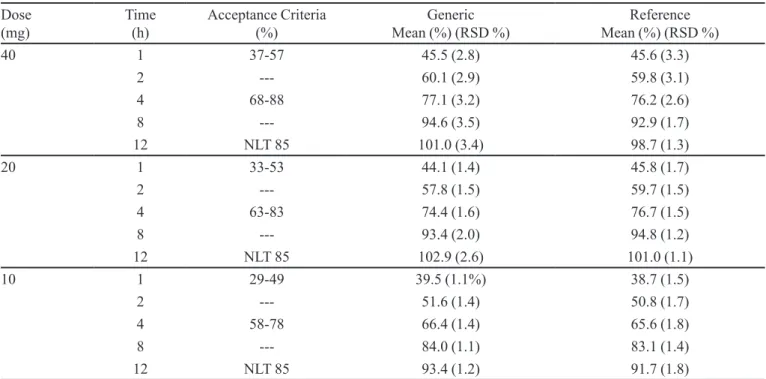
The dissolution profile of oxycodone extended-release tablets containing 40 mg, 20 mg and 10 mg is shown in Figure 1. All the evaluated products comply with the acceptance criteria ̶ shown in Table I ̶ described in the United States Pharmacopeia (USP 35).
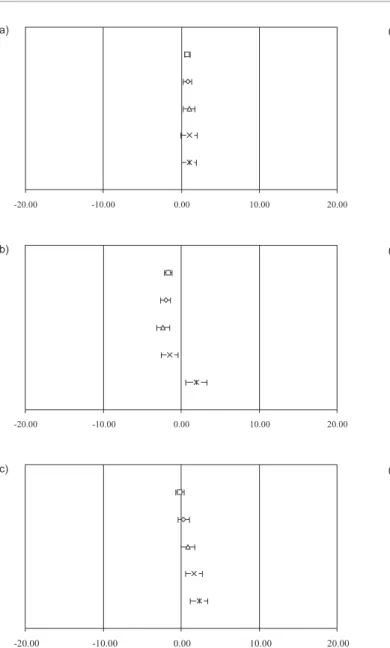
The two one-sided equivalence test showed that in all time-points evaluated the generic and reference
products were found similar (Figure 2). According to the comparison results among doses, the two one-sided test showed that for some point-times there is not similarity (Figure 3). In the comparison between 10 mg and 40 mg generics we veriied that the dissolution rates were not similar in 4 and 8hours. The same happened in the point-times of 8 and 12 hours when comparing 10 mg and 20 mg generics. These results are in accordance with the similarity factor (f2) obtained in each comparison, as shown in Table II.
The similarity factors (f2) obtained for the comparisons between generic 10 mg and generic 20 mg and between generic 10 mg and generic 40 mg reached a score above 52.6 and 55.3, respectively. In spite of this, these values were signiicantly lower than those obtained in the other comparisons, what might be a hint that the two one-sided test (TOST) is more rigorous (conservative) than the similarity factor (f2).
The two one-sided test (TOST) allowed us to identify the time-point (or time-points) that did not show similarity, what may help in the development of new products. This information is mistaken in the conventional similarity factor (f2) approach. One of the most important issues regarding the two one-sided test (TOST) is the deinition of ∆. This acceptance criteria (±∆) is the limit beyond which the difference in mean values should be considered scientiically signiicant. Its deinition requires prior knowledge as well as its intended application. We TABLE I - Dissolution results of oxycodone extended-release tablets
Dose
(mg) Time (h)
Acceptance Criteria
(%) Mean (%) (RSD %)Generic Mean (%) (RSD %)Reference
40 1 37-57 45.5 (2.8) 45.6 (3.3)
2 --- 60.1 (2.9) 59.8 (3.1)
4 68-88 77.1 (3.2) 76.2 (2.6)
8 --- 94.6 (3.5) 92.9 (1.7)
12 NLT 85 101.0 (3.4) 98.7 (1.3)
20 1 33-53 44.1 (1.4) 45.8 (1.7)
2 --- 57.8 (1.5) 59.7 (1.5)
4 63-83 74.4 (1.6) 76.7 (1.5)
8 --- 93.4 (2.0) 94.8 (1.2)
12 NLT 85 102.9 (2.6) 101.0 (1.1)
10 1 29-49 39.5 (1.1%) 38.7 (1.5)
2 --- 51.6 (1.4) 50.8 (1.7)
4 58-78 66.4 (1.4) 65.6 (1.8)
8 --- 84.0 (1.1) 83.1 (1.4)
12 NLT 85 93.4 (1.2) 91.7 (1.8)
NLT: Not less than
FIGURE 1 - Dissolution proiles for generic 10 mg (), generic
FIGURE 2- Equivalence test (two one-sided test) for dissolution proiles of 10 mg generic versus reference 10 mg (a), 20 mg generic versus reference 20 mg (b) and 40 mg generic versus reference 40 mg (c). Dissolution time-point of 1 (), 2 (),
4 (), 8 () and 12 hours ().
FIGURE 3 - Equivalence test (two one-sided test) for dissolution profiles of 10 mg generic versus 40 mg generic (a), 20 mg generic versus 40 mg generic (b) and 10 mg generic versus 20 mg generic (c). Dissolution time-point of 1 (), 2 (), 4 (),
8 () and 12 hours ().
TABLE II - Results of similarity factor (f2) and two one-sided test (TOST) for dissolution proile comparison of oxycodone
extended-release tablets
Comparisons Similarity factor (f2) Two one-sided test (TOST)
Generic 10 mg vs Reference 10 mg 91.8 Similar
Generic 20 mg vs Reference 20 mg 83.5 Similar
Generic 40 mg vs Reference 40 mg 88.8 Similar
Generic 10 mg vs Generic 40 mg 52.6 Not similar*
Generic 20 mg vs Generic 40 mg 82.9 Similar
Generic 10 mg vs Generic 20 mg 55.3 Not similar**
defined ∆ = 10 as an appropriate range to equivalence testing, based on the speciications of the dissolution test of extended-release dosage forms.
CONCLUSION
The two one - sided equivalency test (TOST) is a simple and alternative approach to compare dissolution proiles of extended-release dosage forms. It allows us to identify the time-point (or time-points) that did not show similarity. We concluded that the two one-sided test performed at a signiicance level of 5% and deined as ∆ = 10 presents results comparable to those obtained by the conventional similarity factor (f2).
REFERENCES
AMIDON, G.L.; LENNERNAS, H.; SHAH, V.P.; CRISON, J.R. A theoretical basis for a biopharmaceutic drug classiication:
the correlation of in vitro drug product dissolution and In
Vivo Bioavailability. Pharm. Res., v.12, p.413-420, 1995.
EMEA. European Medicines Agency. Note for guidance on the investigation of bioavailability and bioequivalence. London: European Medicines Agency, 2001. v. 1, 18p.
FDA. Food and Drug Administration. Guidance for industry: dissolution testing of immediate release solid oral dosage forms. Rockville: Food and Drug Administration, 1997. v. 1, 11p.
LOURENÇO, F.R.; PINTO, T.J.A. Assessment of pharmaceutical
equivalence: difference test or equivalence test? Lat. Am. J.
Pharm., v.31, n.4, p.591-604, 2012.
MOORE, J.W.; FLANNER, H.H. Mathematical Comparison of Dissolution Proiles. Pharm. Technol., v.20, p.64-74, 1996.
O’HARA, T.; DUNNE, A.; BUTLER, J.; DEVANE, J. A review of methods used to compare dissolution proile data. Pharm. Sci. Technol. To., v.1, p.214-223, 1998.
SHAH, V.P.; TSONG, Y.; SATHE, P.; LIU, J.P. In vitro dissolution proile comparison – statistics and analysis of the similarity factor, f2. Pharm. Res., v.15, p.889-896, 1998.
SIEWERT, M.; DRESSMAN, J.; BROWN, C.K.; SHAH, V.P. FIP/AAPS guidelines to dissolution/in vitro release testing of novel/special dosage forms. AAPS PharmSciTech, v.4, p.1-10, 2003.
UNITED States Pharmacopeia. 35th ed. The dissolution
procedure: development and validation. Rockville: United
States Pharmacopeia, 2012a. p. 675-681 USP 35. <1092>
UNITED States Pharmacopeia. 35th ed. Dissolution test.
Rockville:United States Pharmacopeia, 2012b. p.295-301.
USP 35. <711>
U N I T E D S t a t e s P h a r m a c o p e i a . 3 5t h ed. Oxycodone
hydrochloride extended-release tablets. Rockville: United States Pharmacopeia, 2012c. p.4173-4175. USP 35.
Received for publication on 04th June 2012