121 Carvalho FHG et al. Intrathoracic rib: a case report
Radiol Bras. 2012 Mar/Abr;45(2):121–122
Intrathoracic rib: a case report
*
Costela intratorácica: relato de caso
Fernando Henrique Guimarães de Carvalho1, Gesner Pereira Lopes2
Intrathoracic rib is defined as a rare congenital anomaly, possibly caused by an incomplete fusion of cephalic and caudal processes of sclerotomes during embryogenesis. Frequently, such abnormality is incidentally found, but may be associated with vertebral malformation and some symptoms such as chest pain. The authors report the case of a patient with left-sided intrathoracic rib in association with vertebral malformation, with a non-specific clinical picture.
Keywords: Intrathoracic rib; Costal anomaly; Computed tomography.
Costela intratorácica é definida como uma anomalia congênita rara, possivelmente causada por uma fusão incompleta dos processos cefálico e caudal dos esclerótomos durante a embriogênese. Frequentemente é achado incidental, porém, pode estar associada a malformações vertebrais e a alguns sintomas como dor torácica. O quadro apresentado é de costela intratorácica à esquerda, associada a malformação vertebral, com quadro clínico inespecífico.
Unitermos: Costela intratorácica; Anomalia costal; Tomografia computadorizada. Abstract
Resumo
* Study developed at Universidade Federal do Triângulo Mi-neiro (UFTM), Uberaba, MG, Brazil.
1. MD, Resident of Radiology and Imaging Diagnosis, Universi-dade Federal do Triângulo Mineiro (UFTM), Uberaba, MG, Brazil. 2. Master, Titular Member of Colégio Brasileiro de Radiologia e Diagnóstico por Imagem (CBR), Head of Division of Radiology and Imaging Diagnosis, Universidade Federal do Triângulo Mi-neiro (UFTM), Uberaba, MG, Brazil.
Mailing Address: Dr. Fernando Henrique Guimarães de Carva-lho. Praça Frei Eugênio, 444, ap. 702, São Benedito. Uberaba, MG, Brazil, 38010-280. E-mail: [email protected]
Received August 16, 2011. Accepted after revision October 7, 2011.
Carvalho FHG, Lopes GP. Intrathoracic rib: a case report. Radiol Bras. 2012 Mar/Abr;45(2):121–122.
0100-3984 © Colégio Brasileiro de Radiologia e Diagnóstico por Imagem
CASE REPORT
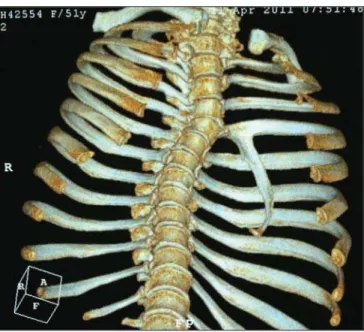
aid of 3D reconstruction, it was possible to thoroughly visualize a vertical bone im-age joining the fourth rib posteriorly at left (Figure 2), better identified on oblique view (Figure 3). Coronal reconstruction of the thoracic spine allowed characterization of dextroconcave scoliosis in association with structural deformity at T4-T5 level (Figure 4).
DISCUSSION
Despite the 45 cases reported in the English literature(4), the mechanism of
de-velopment of such anomaly is still to be understood. The most accepted hypothesis two years with progressive development to
cervicobrachialgia associated with a subtle thoracic scoliosis. After consultations with an orthopedist and recurrence of the pain-ful condition, radiography of the chest and cervical spine was requested to elucidate the diagnosis.
Chest radiography demonstrated bone density image, with bone cortex and me-dulla, lateral convexity, progressive reduc-tion of craniocaudal dimensions, located in the upper and middle thirds of the left hemithorax, associated with thoracic scoliosis (Figure 1). Once the presence of intrathoracic rib was observed, CT was suggested for a better evaluation. With the INTRODUCTION
Anatomic rib variants are found in 2% of the population(1) and include bone
dys-plasias, focal abnormalities, cervical rib, intercostal synostosis, bifid anterior ex-tremity, either in association or not with thoracic vertebral malformations. Intratho-racic rib was first described in 1947 by Lutz, and since then it is presented as a rare, generally symptomatic congenital abnor-mality, most of times diagnosed as an ad-ditional finding at chest radiography(2–4).
However, in cases where the abnormality arises from a vertebral body, the diagnosis by conventional radiography becomes more difficult and in such cases computed tomography (CT) is required, principally for diagnostic differentiation from hilar or mediastinal masses(5–7).
CASE REPORT
Female, 51-year-old patient with left-sided sharp chest pain for approximately
122
Carvalho FHG et al. Intrathoracic rib: a case report
Radiol Bras. 2012 Mar/Abr;45(2):121–122 would be that of a failure in the fusion of
cephalic and caudal processes of sclero-tomes between the fourth and sixth em-bryogenesis weeks(1,4). With no sex
preva-lence, most frequently at right, and with morphology similar to a normal rib extend-ing laterally downwards in the extrapleural space, intrathoracic rib may reach the dia-phragm.
The range of differential diagnosis in-cludes: exostosis, bone tumors, chest drain and calcified pleural plaques. The condi-tion is generally asymptomatic, but chest pain and dyspnea have already been re-ported(3). It is strongly suggested that the
risk for pulmonary injury is enhanced if these patients are affected by chest trauma. The early diagnosis based on either an additional finding or any sign/symptom related to the malformation is extremely relevant, principally because it rules out differentially diagnosed conditions which would require follow-up and a possible definitive treatment.
It can be affirmed that, in spite of being a rare malformation, intrathoracic rib is relatively easy to diagnose by means of conventional radiography in cases where it arises from an otherwise normal rib. How-ever, in cases where the rib arises from a vertebral body, CT becomes essential for a correct diagnosis, avoiding not only
unnec-essary interventions, but also avoiding that differentially diagnosed conditions go un-treated.
REFERENCES
1. Kelleher J, O’Connell DJ, MacMahon H. Intratho-racic rib: radiographic features of two cases. Br J Radiol. 1979;52:181–3.
2. Lutz,P. Über eine ungewöhnliche Rippenanoma-lie zugleich ein Beitrag zur distalen Rippengabe-lung. Wien Klin Wochenschr. 1947;59:846–9. 3. Laufer L, Schulman H, Hertzanu Y. Intrathoracic
rib demonstrated by helical CT with three-dimen-sional reconstruction. Eur Radiol. 1999;9:60–1.
4. Hasan I, Mahajan P, Ahamad N, et al. A rare case of left bifid intrathoracic rib associated with super-numerary rib and block vertebrae. Kuwait Radiol J. 2011;2:21–7.
5. Trigaux JP, Sibille Y, Van Beers B. Intrathoracic rib: CT features. J Comput Assist Tomogr. 1990;14: 133–5.
6. Freed C. Intrathoracic rib: a case report. S Afr Med J. 1972;46:1165–7.
7. Weinstein AS, Mueller CF. Intrathoracic rib. Am J Roentgenol Radium Ther Nucl Med. 1965;94: 587–90.
Figure 2. Computed tomography 3D reconstruction demonstrating vertical bone image joining the fourth rib posteriorly at left.
Figure 3. Computed tomography 3D reconstruction. Oblique view providing a better visualization of the bone image insertion into the anteroinferior aspect of the fourth costal arch posteriorly.