Chronic myeloid leukemia: an overview of the determinants of effectiveness and therapeutic
response in the irst decade of treatment with imatinib mesylate in a Brazilian hospital
Danielle Maria Camelo Cid1 Silvia Maria Meira Magalhães1 Acy Telles de Souza Quixadá1 Rita Paiva Pereira Honório1
Paola Franssinetti Torres Ferreira Costa1 Samuel Roosevelt Campos dos Reis1 Selda Maria de Aguiar Carvalho1 David Antonio Camelo Cid1 Rafael Moura e Sucupira1
Mariana Fátima Cabral de Oliveira2
1Universidade Federal do Ceará, Fortaleza – UFC, Fortaleza, CE, Brazil
2Universidade Estadual do Ceará - UECE, Fortaleza, CE, Brazil
Conlict-of-interest disclosure:
The authors declare no competing inancial interest
Submitted: 9/19/2012 Accepted: 8/19/2013
Corresponding Author: Danielle Maria Camelo Cid
Hospital Universitário Walter Cantídio – HUWC da Universidade Federal do Ceará, Fortaleza – UFC Rua Capitão Francisco Pedro, 1290 -Rodolfo Teóilo
60430-370 Fortaleza, CE, Brazil Phone: 55 85 3366.8167 [email protected]
www.rbhh.org or www.scielo.br/rbhh
DOI: 10.5581/1516-8484.20130120
Introduction
Chronic myeloid leukemia (CML) is a disease associated with a characteristic chromosomal translocation between chromosomes 9 and 22, the Philadelphia chromosome (Ph+), resulting in an increased and unregulated growth of myeloid cells(1).
In the last decade, there has been a revolution in CML treatment with the introduction of tyrosine kinase inhibitors (TKIs)(2). Imatinib mesylate (IM) has become the frontline therapy for CML(3,4). Treatment eficacy is determined by the drug itself, adhesion to therapy and intrinsic characteristics of patients, which directly impact on therapeutic response(5,6). Periodic assessment of response is important to assure an effective treatment regimen. This study evaluated the therapeutic eficacy of IM treatment in patients with CML and identiied its determinants.
Methods
This retrospective study was based on information obtained from patients’ records in the Hematology Service of Hospital Universitário Walter Cantídio of Universidade Federal
do Ceará (HUWC / UFC), in northeast Brazil. The study was approved by that institution’s
Ethics Research Committee.
Population and Sample
All patients diagnosed with CML that took IM for a minimum of 12 months in the period from January 2001 to January 2011 were included in the study. From a population of 160 patients, 100 were eligible for analysis. In the assessment of factors related to treatment response, two patients were excluded because they were referred for bone marrow transplantation (BMT) before response evaluation. A special form was used to collect sociodemographic characteristics and data related to diagnosis and therapeutic response based on the LeukemiaNet criteria(7) (hematologic, cytogenetic and molecular), as well as time to response and adherence to treatment.
Background: In the last decade, there has been a revolution in chronic myeloid leukemia treatment with the introduction of tyrosine kinase inhibitors with imatinib mesylate becoming the frontline therapy.
Objective: To evaluate the therapeutic eficacy of imatinib mesylate in treating chronic myeloid leukemia
patients and to identify factors related to therapeutic eficacy.
Methods: This retrospective study was based on information obtained from patients’ records in the Hematology Service of Hospital Universitário Walter Cantídio of the Universidade Federal do Ceará (HUWC / UFC). All patients diagnosed with chronic myeloid leukemia that took imatinib mesylate for a minimum of 12 months in the period from January 2001 to January 2011 were included. From a population of 160 patients, 100 were eligible for analysis.
Results: The study population consisted of 100 patients who were mostly male (51%) with ages ranging between 21 and 40 years (42%), from the countryside (59%), in the chronic phase (95%), with high-risk prognostic factors (40%); the prognosis of high risk was not associated with complete hematologic response or complete cytogenetic response, but correlated to complete molecular response or major molecular response. Reticulin condensation was associated with complete hematologic response and complete cytogenetic response. It was found that 53% of patients had greater than 90% adherence to treatment. The high adherence was correlated to attaining complete cytogenetic response in less than 12 months. Moreover, 20% of patients had good response.
Conclusion: Signiicant changes are indispensable in the monitoring of patients with chronic myeloid leukemia.
Thus, the multidisciplinary team is important as it provides access to the full treatment and not just to medications.
Prognostic factors
The risk factors at diagnosis were based on Brazilian Health authorities recommendations(8) as adopted by the Hematology Service of the hospital. The Sokal score(9) was used to stratify patients in low-risk, intermediate-risk and high-risk groups based on the following criteria for poor prognosis: 60 years of age, splenomegaly 10 cm below the costal margin, platelet count of 700 x 109/L, 3% blasts in the bone marrow or peripheral blood and 7% of blood basophils or 3% in bone marrow. The low risk group was characterized by 0 and 1 of these criteria, the intermediate risk by 2 and high risk by three criteria.
Adhesion
The medication possession ratio (MPR), often adopted to evaluate compliance was used, taking into consideration the days without medication in intervals between drug dispensation(10).
Reticulin condensation
Reticulin condensation, evaluated by bone marrow biopsy at diagnosis, was categorized in two groups: positive for any degree of ibrosis or negative for no ibrosis.
Response analysis
The criteria for response analysis were based on the LeukemiaNet guidelines(7). On several occasions protocol follow-up examinations were missing due to inancial dificulties and limited availability in Brazilian National Healthcare System (SUS) institutions.
Outcome
Patients were categorized in two groups regarding the outcome: positive or negative. The group with positive outcomes obtained therapeutic success. Negative outcomes were characterized if either failure, loss of response, death, suspension because of myelotoxicity or gastrointestinal intolerance, noncompliance or adherence < 90% was observed(11).
Statistical analyses
Statistical analyses were performed using the R software (version 2.15). A p-value < 0.05 was considered signiicant. Categorical data were analyzed using the Fisher’s exact test.
Results
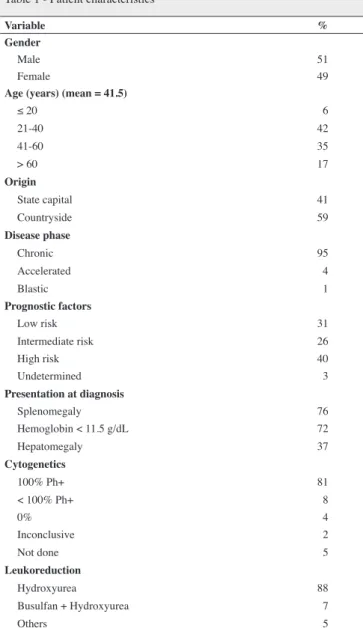
The population consisted of 100 patients who were mostly male (51%) with, in general, ages ranging from 21 to 40 years (42%) and a median of 41.5 years, from the countryside (59%), in the chronic phase (95%), with high-risk prognostic factors (40%), presenting with splenomegaly (76%), Hemoglobin < 11.5 g/dL (72%), asthenia (44%), pallor (38%) and hepatomegaly (37%), cytogenetics at diagnosis with 100% Ph+ (81%) and that had made leukoreduction only with hydroxyurea (88%) (Table 1).
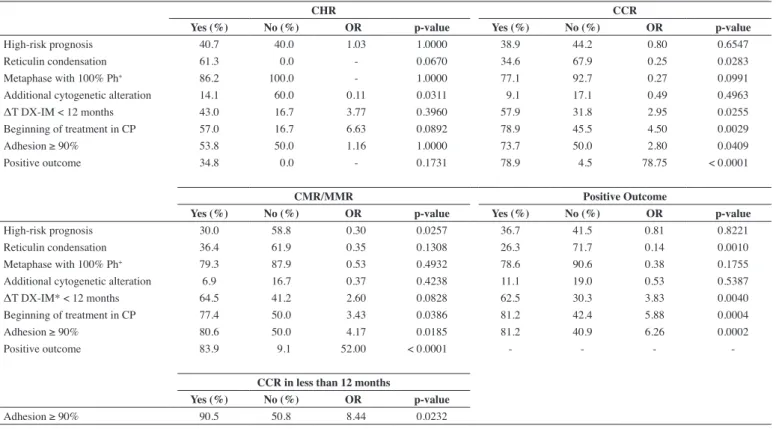
Table 2 shows that the prognosis of high risk was not associated with complete hematologic response (CHR) or complete cytogenetic response (CCR), but correlated to complete molecular response (CMR) or major molecular response (MMR). Reticulin condensation was associated with CHR and CCR. However there was no associated with CMR or MMR. Furthermore, there was no association between metaphases with 100% Ph+ and diagnosis or response achieved. The other cytogenetic changes at diagnosis correlated only with CHR. The time between diagnosis and the beginning of IM treatment of less than 12 months was only correlated to CCR.
Adherence > 90% was correlated with CCR and CMR or MMR. The positive outcome was strongly associated with CCR and CMR or MMR.
Ph+: Philadelphia chromosome Table 1 - Patient characteristics
Variable %
Gender
Male 51
Female 49
Age (years) (mean = 41.5)
≤ 20 06
21-40 42
41-60 35
> 60 17
Origin
State capital 41
Countryside 59
Disease phase
Chronic 95
Accelerated 04
Blastic 01
Prognostic factors
Low risk 31
Intermediate risk 26
High risk 40
Undetermined 03
Presentation at diagnosis
Splenomegaly 76
Hemoglobin < 11.5 g/dL 72
Hepatomegaly 37
Cytogenetics
100% Ph+ 81
< 100% Ph+ 08
0% 04
Inconclusive 02
Not done 05
Leukoreduction
Hydroxyurea 88
Busulfan + Hydroxyurea 07
Two patients were excluded who did not complete the monitoring of therapeutic response, although they had been treated with IM for 12 months before being referred for BMT.
In this study, 53% of patients had greater than 90% adherence. Among the patients with CCR (38%), twenty-seven (71%) had adherence ≥ 90% as shown in Table 2. The high adherence was correlated to achieving CCR within 12 months. Of the 23 patients that achieved CCR within 12 months, nineteen (82.6%) had ≥ 90% adherence. Some patients did not perform the cytogenetic (20%) and molecular exams (35%) to monitor therapeutic response.
Table 3 shows that 20% of patients had good response, 26% failure, 19% no response, 13% suspended treatment due to myelotoxicity/intolerance, the response was lost in 4%, 4% abandoned treatment and 2% were referred for BMT.
At the end of the study, 65% of the population was under treatment using medications, 22% died with one suicide and 2% had been referred for BMT (Table 3).
Of the patients on treatment, 34% were treated with IM and 27% with 2nd generation TKI as follows: 18% with dasatinib, 9% with nilotinib and 4% with hydroxyurea.
There was a correlation between a positive outcome and early use of IM within 12 months of diagnosis (62.5%) and the beginning of treatment in chronic phase (81.2%). Figure 1 shows that the proportion of patients with good therapeutic response
over time is greater in the group of patients that started treatment with TKIs within 12 months after diagnosis (p-value = 0.0001: log-rank test - Kaplan Meier curve).
Of the 100 patients, 12% had additional cytogenetic changes at diagnosis that were possibly related to an unfavorable outcome (Table 4). One patient presented the change i(17) at diagnosis and evolved with the T315I mutation.
TKI: tyrosine kinase inhibitors
Suspension was due to myelotoxicity/intolerance CHR: Complete hematologic response; CCR: Complete cytogenetic response; CMR: Complete molecular response; MMR: major molecular response;
Ph+: Philadelphia chromosome positive; IM: imatinib; ΔT DX-IM: Time between diagnosis and starting imatinib treatment; CP: chronic phase
Table 3 - Treatment outcome Table 2 - Factors associated with therapeutic response
Treatment outcome with imatinib Condition in January 2011
Response % Treatment %
Optimal 20
Sub-optimal 12 Imatinib 35
Failure 26 Dasatinib 18
No response 19 Nilotinib 9
Suspended 13 Hydroxyurea 4
Loss of best response possible 4 Subtotal 66
Abandoned treatment 4 Death 21
Bone marrow transplantation 2 Loss to follow-up 11
Watch and see 1
Second-generation TKI 1
Total 100 Total 100
CHR CCR
Yes (%) No (%) OR p-value Yes (%) No (%) OR p-value
High-risk prognosis 40.7 040.0 01.03 1.0000 38.9 44.2 00.80 0.6547
Reticulin condensation 61.3 000.0 0- 0.0670 34.6 67.9 00.25 0.0283
Metaphase with 100% Ph+ 86.2 100.0 0- 1.0000 77.1 92.7 00.27 0.0991
Additional cytogenetic alteration 14.1 060.0 00.11 0.0311 09.1 17.1 00.49 0.4963
ΔT DX-IM < 12 months 43.0 016.7 03.77 0.3960 57.9 31.8 02.95 0.0255
Beginning of treatment in CP 57.0 016.7 06.63 0.0892 78.9 45.5 04.50 0.0029
Adhesion ≥ 90% 53.8 050.0 01.16 1.0000 73.7 50.0 02.80 0.0409
Positive outcome 34.8 000.0 0- 0.1731 78.9 04.5 78.75 < 0.000100
CMR/MMR Positive Outcome
Yes (%) No (%) OR p-value Yes (%) No (%) OR p-value
High-risk prognosis 30.0 58.8 00.30 0.0257 36.7 41.5 0.81 0.8221
Reticulin condensation 36.4 61.9 00.35 0.1308 26.3 71.7 0.14 0.0010
Metaphase with 100% Ph+ 79.3 87.9 00.53 0.4932 78.6 90.6 0.38 0.1755
Additional cytogenetic alteration 6.9 16.7 00.37 0.4238 11.1 19.0 0.53 0.5387
ΔT DX-IM* < 12 months 64.5 41.2 02.60 0.0828 62.5 30.3 3.83 0.0040
Beginning of treatment in CP 77.4 50.0 03.43 0.0386 81.2 42.4 5.88 0.0004
Adhesion ≥ 90% 80.6 50.0 04.17 0.0185 81.2 40.9 6.26 0.0002
Positive outcome 83.9 09.1 52.00 < 0.000100 - - -
-CCR in less than 12 months
Yes (%) No (%) OR p-value
Discussion
Most cases of CML occur in adults between 40 and 60 years old, with an incidence of about 1 case in 100,000 individuals(12). In the present study, the most prevalent age group was between 21 and 40 years. Splenomegaly, hemoglobin < 11.5 g/dL and hepatomegaly were the main features at presentation. Most patients presented disease in the chronic phase with high-risk prognostic factors at diagnosis (Table 1).
The chronic phase, adhesion ≥ 90%, time between diagnosis and initiation of IM treatment of less than 12 months and absence of reticulin condensation were strongly associated with CCR and
Figure 1 - Kaplan-Meier curve presenting freedom from therapeutic failure with regard to starting time of TKIs
a favorable outcome in this series (Table 2). Patients who started treatment within 12 months after diagnosis, initiated treatment in the chronic phase and had adhesion ≥ 90% presented lower failure and loss of response rates.
In the last decade, several studies demonstrated the eficacy and determinants of therapeutic response to IM. The ability to calculate high risk rates for individual patients will make it possible to examine the patient groups for status and initial risk and to stratify the patients according to the prognosis classiication. The effects of treatment on survival can then be evaluated with greater precision, both in retrospective reviews of completed studies and in potential therapeutic trials(9).
The Sokal score was not used in this series but one based on Brazilian health ministry determinations(8); there was no association between high risk prognosis and CHR or CCR (Table 2) or negative outcomes (Table 3.) Probably these results are related to the risk stratiication used in Brazilian patients.
Treatment response to IM varies among patients. The principle for this variation is unknown and lack of adherence is a relevant problem(13). Compliance has been demonstrated as one of the most important factors. Non-adherence to long-term oral therapies leads to a decrease in plasma levels of the drug. There is a correlation between low plasma levels of IM and failure to achieve a cytogenetic response(14). A sub analysis of the International Randomized Study of Interferon and STI571 study (IRIS) showed that patients whose plasma concentrations of IM were higher than 1000 ng/mL showed higher rates of CCR(15). A similar result was demonstrated in the present study with the association between adhesion ≥ 90% and CCR and a shorter time to response (Tables 2). Furthermore, adherence was strongly associated with positive outcomes and related to therapeutic eficacy.
Previous studies have shown that better IM compliance is also associated with a substantially lower medical care need and lower costs in health care compared to poor compliance(16,17).
The database of the Brazilian Heath Ministry, DATASUS, showed that from 2001 to 2007, there was an increase of 40% of high-complexity procedures in oncology representing a 63% increase in expenses for outpatient chemotherapy. In the speciic
CCR: Complete cytogenetic response; PCR: Partial cytogenetic response
Table 4 - Cytogenetic alterations at diagnosis and outcome
Cytogenetic changes at diagnosis n Outcome Occurrence
t(9;14;22) 1 No response Clonal evolution
t(9;22;17) 1 No response L364I mutation
t(9;21;22) 2 Failure Clonal evolution
t(2;9;19;20;22) 1 CCR Slow and progressive response
double Ph+ 1 No response Cytopenias
1 Suspended due to myelotoxicity Blastic crisis
i(17) 1 Failure T315I mutation
46, XX,+22 1 Failure Clonal evolution
inv(9) 1 Suspended due to myelotoxicity Clonal evolution
del(9)(q34) 1 PCR Cytopenias
loss chromosomal casual 1 Suspended due to myelotoxicity Blastic crisis
case of CML, the increase in costs was 307%, mainly due to the introduction of IM in the Brazilian National Health System in 2001(18). At this time, according to Brazilian guidelines, IM was prescribed as irst-line treatment for patients in accelerated phase (AP) or blast crisis (BC) and as a second-line for patients in chronic phase and intolerant to interferon. Only in 2008, IM was adopted as irst-line treatment for CML in chronic phase, with this greatly impacting the prescription of IM in our clinic. It is possible that two-week prescriptions had a negative impact on adherence in our institution.
Any degree of myeloibrosis is historically associated with poor prognosis of CML. There is a change in the distribution of elements in the extracellular matrix of the bone marrow and it has been suggested that the leukemia cells are protected or “hidden” by these elements. Some studies have shown that IM acts on bone marrow stroma(19,20). The drug acts by blocking binding to the adenosine triphosphate (ATP), the binding site of the tyrosine kinase domain in the breakpoint cluster region/Abelson (BCR/ ABL) protein and has also an independent anti-ibrotic effect in patients with CML. However, an increase of ibrosis could prevent the drug to act by not allowing apoptosis of Ph+ cells(20). A recent study demonstrated a signiicant correlation between cytogenetic response and the degree of reticulin thickening. In our study, reticulin condensation was negatively associated with CCR (Table 2) and a positive outcome (Table 2) showing that myeloibrosis works as an unfavorable prognostic factor to response and prognosis(21).
The use of IM in more advanced phases of disease is associated with higher frequency of drug resistance. In addition, some negative outcomes were related to the presence of speciic mutations (Table 4).
Most cases of failure to treatment with IM unrelated to excessive toxicity are the result of one or more resistance mechanisms(22). The variability in the pharmacokinetics of IM has also been mentioned as a possible mechanism to explain suboptimal response or treatment failure. Patients with lower plasma levels are less likely to respond to therapy(14,15). Resistance to IM can be multifactorial as rapid detection of primary resistance or intolerance provides rescue response and increased survival in patients with CML(23).
The most common cause of secondary resistance is a loss of inhibition of BCR-ABL resulting from mutations of ABL present in 50-90% of cases(24,25). Mutations are more frequent in secondary resistance than the primary (57% vs. 30%) and also in advanced stages (80% in the blast phase vs. 14% in the chronic phase) (25). Other known mechanisms of resistance include secondary overproduction of BCR-ABL due to genetic ampliication(24), the appearance of additional Ph+ chromosomes or other chromosomal abnormalities (clonal evolution)(26).
In our series, among patients with mutations at diagnosis, only two had a favorable outcome (16.6%) with an optimal response. Patients who showed intolerance or resistance to IM received second-generation TKI such as dasatinib (18%) and nilotinib (9%). Many of them presented a successful outcome. However, some patients had no access to second-generation TKIs due to inancial dificulties and limited availability in Brazilian healthcare institutions.
Conclusions
Several factors were correlated to the success of IM therapy in our population, especially starting treatment in the chronic phase and less than 12 months after diagnosis, adhesion ≥ 90% and absence of reticulin condensation. All these factors showed a strong association with CCR, but it is evident that the number of adverse outcomes was greater than the positive outcomes. This fact possibly occurred due to the start of treatment with IM in more advanced stages of the disease, poor access to medication and the monitoring of therapeutic responses as consequences of the inancial dificulties faced by Brazilian institutions.
The monitoring of reticulin condensation seems to contribute to future therapeutic decisions considering the lower performance of IM in cases with a high-degree ibrosis.
The score adopted in our institution showed no correlation with the extent of CCR.
Signiicant changes to monitoring of patients with CML are necessary, as are the development of strategies to manage patients with failure not only in respect to the medication supply, but also to monitor therapeutic responses. In our series few patients performed cytogenetic and molecular analyses as recommended.
The importance of a multidisciplinary team to provide patients with the full treatment was also evident. Nevertheless, even with a large percentage of negative outcomes, the improvement in the quality of life of patients with CML is remarkable.
References
1. Alvarenga TF, Carvalho LO, Lucenas SB, Dobbins J, Azevedo A,
Fernandez TS, et al. Adverse events and cytogenetc response in patients with chronic myeloid leukemia treated with imatinib. Rev Bras Hematol Hemoter. 2010;32(2):116-22.
2. Nonino A. Problems and perspectives for the treatment of Chronic Myeloid Leukemia in Brazil. Rev Bras Hematol Hemoter. 2008;30(Supl 1):66-9.
3. Druker BJ, Guilhot F, O’Brien SG, Gathmann I, Kantarjian H, Gattermann N, Deininger MW, Silver RT, Goldman JM, Stone RM, Cervantes F, Hochhaus A, Powell BL, Gabrilove JL, Rousselot P, Reiffers J, Cornelissen JJ, Hughes T, Agis H, Fischer T, Verhoef G, Shepherd J, Saglio G, Gratwohl
A, Nielsen JL, Radich JP, Simonsson B, Taylor K, Baccarani M, So C, Letvak L, Larson RA; IRIS Investigators. Five-year follow-up of patients receiving imatinib for chronic myeloid leukemia. N Engl J Med. 2006;355(23):2408-17. N Engl J Med. 2007;356(17):1780; author reply 1780.
4. Hamerschlak N. Leukemia: genetics and prognostic factors. J Pediatr (Rio J). 2008;84(4 Suppl):S52-7.
5. Baccarani M, Saglio G, Goldman J, Hochhaus A, Simonsson B, Appelbaum F, Apperley J, Cervantes F, Cortes J, Deininger M, Gratwohl A, Guilhot F, Horowitz M, Hughes T, Kantarjian H, Larson R, Niederwieser D, Silver R, Hehlmann R; European LeukemiaNet.
Evolving concepts in the management of chronic myeloid leukemia: recommendations from an expert panel on behalf of the European LeukemiaNet. Blood. 2006;108(6):1809-20.
6. Sabaté E. Adherence to long-term therapies: evidence for action
[Internet]. Geneva: World Health Organization; 2003. [cited 2012 Jan
Cervantes F, Deininger M, Gratwohl A, Guilhot F, Hochhaus A, Horowitz
M, Hughes T, Kantarjian H, Larson R, Radich J, Simonsson B, Silver
RT, Goldman J, Hehlmann R; European LeukemiaNet. Chronic myeloid
leukemia: an update of concepts and management recommendations of European LeukemiaNet. J Clin Oncol. 2009;27(35):6041-51. Comment in: J Clin Oncol. 2010;28(18):e310; author reply e311.
8. Ministério da Saúde (BR). Portaria nº. 431, de 3 de outubro de 2001.
Aprova o Protocolo Clínico e Diretrizes Terapêuticas - Tratamento da
Leucemia Mielóide Crônica do Adulto [Internet]. Brasília: MS; 5 out 2001. [cited 2012 Nov 21]. Available from: http://dtr2001.saude.gov.br/ sas/PORTARIAS/Port2001/PT-431.htm
9. Sokal JE, Cox EB, Baccarani M, Tura S, Gomez GA, Robertson JE, et al.
Prognostic discrimination in “good-risk” chronic granulocytic leukemia. Blood. 1984;63(4):789-99.
10. Peterson AM, Nau DP, Cramer JA, Benner J, Gwadry-Sridhar F, Nichol
M. A checklist for medication compliance and persistence studies using retrospective databases. Value Health. 2007;10(1):3-12.
11. Marin D, Bazeos A, Mahon FX, Eliasson L, Milojkovic D, Bua M, et
al. Adherence is the critical factor for achieving molecular responses in patients with chronic myeloid leukemia who achieve complete cytogenetic responses on imatinib. J Clin Oncol. 2010;28(14):2381-8.
12. National Comprehensive Cancer Network. Chronic myelogenous leukemia clinical practice guidelines in oncology (version 1.2011) [Internet]. Philadelphia; NCCN; 2011. [cited 2011 Jul 1]. Avaliable from: http://www.nccn.org/patients/guidelines/cml/index.html
13. Yoshida C, Komeno T, Hori M, Kimura T, Fujii M, Okoshi Y, et al. Adherence to the standard dose of imatinib, rather than dose adjustment based on its plasma concentration, is critical to achieve a deep molecular response in patients with chronic myeloid leukemia. Int J Hematol. 2011;93(5):618-23.
14. O’Brien SG, Guilhot F, Larson RA, Gathmann I, Baccarani M, Cervantes
F, Cornelissen JJ, Fischer T, Hochhaus A, Hughes T, Lechner K,
Nielsen JL, Rousselot P, Reiffers J, Saglio G, Shepherd J, Simonsson B, Gratwohl A, Goldman JM, Kantarjian H, Taylor K, Verhoef G, Bolton AE, Capdeville R, Druker BJ; IRIS Investigators. Imatinib compared
with interferon and lowdose cytarabine for newly diagnosed chronic-phase chronic myeloid leukemia. N Engl J Med. 2003; 348:994-1004. Comment in: N Engl J Med. 2003;48(11):1048-50; Clin Lab Haematol. 2005;27(6):416-7; Curr Hematol Rep. 2004;3(1):37-8.
oral anticancer treatment. CA Cancer J Clin. 2009;59(1):56-66.
16. Ministério da Saúde (BR). Sistema de Informações Hospitalares do SUS [Internet]. Brasília; MS. [cited 2011 Jul 1]. Available from: http://tabnet. datasus.gov.br/cgi/deftohtm.exe?sia/cnv/pauf.def
17. Ministério da Saúde (BR). Portaria nº. 437, de 23 de junho de 2008.
Estabelece protocolos clínicos e diretrizes terapêuticas para o tratamento
da anemia e reposição e manutenção de estoques de ferro em pacientes
portadores de insuiciência renal crônica. Diário Oicial da União, Brasília (DF), 25 jun. 2008.
18. Zago MA, Falcão RP, Pasquini R. Hematologia - fundamentos e práticas.
São Paulo: Atheneu; 2001.
19. Hasselbach HC, Bjerrum OW, Jensen BA, Clausen NT, Hansen PB, Birgens H, et al. Imatinib mesylate in idiopathic and postpolycythemic
myeloibrosis. Am J Hematol. 2003;74(4):238-42.
20. Jesus CR, I-Ching L, Neiva TJC, Vituri CL. Assessment of ibrosis and
vascularization of bone marrow stroma of Chronic Myeloid Leukemia patients treated with imatinib mesylate and their relationship with the cytogenetic response. Braz J Pharm Sci. 2011;47(2):313-22.
21. Quintás-Cardama A, Kantarjian HM, Cortes JE. Mechanisms of primary
and secondary resistance to imatinib in chronic myeloid leukemia. Cancer Control. 2009;16(2):122-31.
22. Apperley JF. Part I: Mechanisms of resistance to imatinib in chronic myeloid leukaemia. Lancet Oncol. 2007;8(11):1018-29.
23. Jabbour E, Kantarjian HM, O’Brien S, Shan J, Garcia-Manero G,
Wierda W, et al. Predictive factors for outcome and response in patients treated with second-generation tyrosine kinase inhibitors for chronic myeloid leukemia in chronic phase after imatinib failure. Blood. 2011;117(6):1822-7.
24. Branford S, Rudzki Z, Walsh S, Grigg A, Arthur C, Taylor K, et al. High
frequency of point mutations clustered within the adenosine triphosphate-binding region of BCR/ABL in patients with chronic myeloid leukemia or Ph-positive acute lymphoblastic leukemia who develop imatinib (STI571) resistance. Blood. 2002; 99(9):3472-5.
25. Khorashad JS, Milojkovic D, Mehta P, Anand M, Ghorashian S, Reid AG, et al. In vivo kinetics of kinase domain mutations in CML patients
treated with dasatinib after failing imatinib. Blood. 2008;111(4):2378-81.
26. Redaelli S, Piazza R, Rostagno R, Magistroni V, Perini P, Marega M, et al. Activity of bosutinib, dasatinib, and nilotinib against 18 imatinib-resistant BCR/ABL mutants. J Clin Oncol. 2009;27(3):469-71.