Article
ISSN 0102-695X
doi: 10.1590/S0102-695X2011005000079 Received 3 Jan 2011
Accepted 18 Jan 2011 Available online 13 May 2011
terpenoids metabolites from Dictyotaceae
(Phaeophyceae)
Joel Campos De Paula,
*,1Magui A. Vallim,
2Valéria Laneuville
Teixeira
21Programa de Pós-graduação em Biodiversidade Neotropical, Instituto de Biociências, Universidade Federal do Estado do Rio de Janeiro, Brazil, 2Programa de Pós-graduação em Biologia Marinha, Instituto de Biologia,
Universidade Federal Fluminense, Brazil.
Abstract: Dictyotaceae are a rich source of secondary metabolites, especially terpenes. These natural products have been studied for their bioactivity for human and for their ecological role in nature. The present work highlights de diversity of the Dictyotaceae terpenes, emphasizing their bioactivities and the biogeography of their sources. The sesquiterpenes are found in Padina, Dictyopteris and Taonia. Although Dictyopteris and Padina can be found in all oceans, Taonia has a more restricted distribution. Diterpenes of mixed origin have been reported in Lobophora, Taonia and Stypopodium. Stypopodium is a typically tropical and warm temperate genus. Diterpenes with the spatane and seco-spatanes skeletons are known from Spatoglossum, Stoechospermum and Rugulopteryx. Spatoglossum is distributed over all the tropical marine world. Stoechospermum is known to occur in the Indian Ocean and Rugulopteryx is distributed mainly in Asia and on the Pacific Coast of Australia. The genus Dictyota contains diterpenes as the major metabolite and are present in all oceans, reaching even the cold temperate regions of northern and southern hemispheres. The terpenoids from Dictyotaceae exhibit bioactivities such as inhibition of herbivores and antifungal, cytotoxic, antibiotic, anti-inflammatory, insecticidal and antiviral activities.
Keywords:
Dictyotaceae
secondary metabolites terpenes
biogeography bioactivities
Introduction
Many marine organisms are able to produce
substances derived from secondary metabolism. These
metabolites, also called natural products, are present
from bacteria and algae to echinoderms, mollusks,
tunicates and vertebrates, through the sponges and
corals (Blunt et al., 2010).
The knowledge of metabolites has helped to
characterize the algae at different hierarchical levels
(divisions, classes etc.) down to species (De Paula
et al., 2007), and has importance for phytochemical,
phylogenetic and ecological studies (Teixeira et
al., 1991). Moreover, these substances have a high
biotechnological potential, as evidenced by their use
in the food and pharmaceutical industris that generates
billions of dollars (Smit, 2004).
Technological advances in disease diagnosis,
combined with democratization of access to this
technology, are reflected in the increase in the number
of people diagnosed with diseases caused by biological
agents. In response to this scenario, the search for
with only one plumose flagellum, while the other
Phaeophyceae possess a pair of flagella. The chemistry
of Dictyotaceae natural products include a rich
production of terpenoids molecules of different origins
and are therefore important in studies of metabolites of
marine origin.
Two biogenic pathways have been described
for the terpenoid formation, the mevalonate pathway
and
the
mevalonate-independent
pathway
via
deoxyxylulose phosphate (Dewick, 2002). Terpenoids
are composed of five carbon subunits (an isoprenoid)
disposed in a configuration called head and tail and are
classified according to the number of isoprenoid units
incorporated. In Dictyotaceae and in particular in this
paper, the most bioactive products have three or four
isoprenoid units, corresponding to the sesquiterpenes
and diterpenes, respectively. These two classes of
terpenoids can have many different structures and
variants, including the addition of halogen atoms (the
most common being chlorine or bromine) or fragments
from other biogenic pathways. In this latter case,
they are called terpenes of mixed origin, an example
being the incorporation of a phloroglucinol unit into a
diterpene.
As a natural source, the terpenes are strongly
influenced by population distributions. For example,
Freitas et al., (2007) and Vallim et al. (2007) found
differences in the diterpene expression by
Dictyota
mertensii
in different distant beaches and Ali & Pervez
(2003a, 2003b) and Ali et al. (2003; 2004) described
highly oxidized diterpenes from a seco-dolastane and
related dolastane producing
Canistrocarpus
population
from the Karachi coast of the Arabian Sea.
The present work is a bried description
of terpenoid diversity in Dictyotaceae and their
bioactivity, algae source and distribution in the oceans.
These results were presented at the II Workshop on
New Bioactivies from Macroalgae.
Materials and Methods
The Dictyotaceae bioactivities were taken
from the original papers and/or the annual review series
Marine Natural Products, published by
Natural Product
Reports
and covering the literature from 1977 (Faulkner,
1984) to 2009 (Blunt et al., 2011). Only bioactivities
for which the active substance was described were
selected. No information was used from studies limited
to extracts or enriched fractions. The scientific names
of the Dictyotaceae and their geographical distribution
were based on information from the site algaebase
(Guiry & Guiry, 2011).
Results
Halogenated sesquiterpenes (whose main
sources are the red algae) are reported in
Padina
antillarum
(Parameswaran et al., 1994, 1996)
and
Dictyopteris divaricata
(Ji et al., 2009), and
sesquiterpenes without halogens in
Dictyopteris
divaricata
(Song et al., 2005, 2006; Qiao et al., 2009;
Wen et al., 2009),
D. undulata
(Song et al., 2004a)
and
Taonia atomaria
(De Rosa et al., 1994). For the
latter two genera, 36 and six species are recognized,
respectively, while for
Padina
37 species are still
valid. The sesquiterpenes in which a phloroglucinol
unit is added were reported in
Dictyopteris undulata
(Ochi et al., 1979a; 1979b; Cortés et al., 2001; Dave
et al., 1984) and
Dictyopteris divaricata
(Song et al.,
2004b). Alhough
Dictyopteris
and
Padina
can be found
in all oceans with predominant occurrence in tropical
areas,
Taonia
is more restricted to the North Atlantic
Ocean, Caribbean, Mediterranean, South Australia
and Pakistan (Figure 1). The sesquiterpenes of these
genera are known to exhibit activity as an inhibitor of
herbivores and antifungal, cytotoxic, antibiotic and
ichthyotoxic activities. Table 1 illustrates some of the
products and their activities.
Meroditerpenes,
i.e
., polycyclic diterpenes of
mixed biogenesis characterized by a methyl hydroquinone
nucleus linked to a diterpenic chain, have been reported in
Lobophora papenfussii
(Gerwick & Fenical, 1982),
Taonia
atomaria
(Ishitsuka et al., 1990),
Stypopodium zonale
(Gerwick & Fenical, 1981),
S. labelliforme
(Gerwick et
al., 1979) and
S. schimperii
(Sampli et al., 2000). These
metabolites can be linear, similar to those found in Fucales
(Ishitsuka et al., 1979; Kusumi et al., 1979; Amico et al.,
1982a,b;, Banaigs et al. 1982; 1983), or have polycyclic
skeletons similar to each other, which may reveal a
phylogenetic similarity between
Stypopodium
and
Taonia.
Meroditerpene compounds were reported in
Stypopodium
labelliforme
(Areche et al., 2009). This is a typically
tropical and warm temperate genus (Figure 2) with six
currently accepted species, including
S. labelliforme,
S. schimperii
and
S. zonale
that have been studied
chemically. The meroditerpenes of these genera are known
to exhibit cytotoxic, anti-inlammatory, insecticidal, and
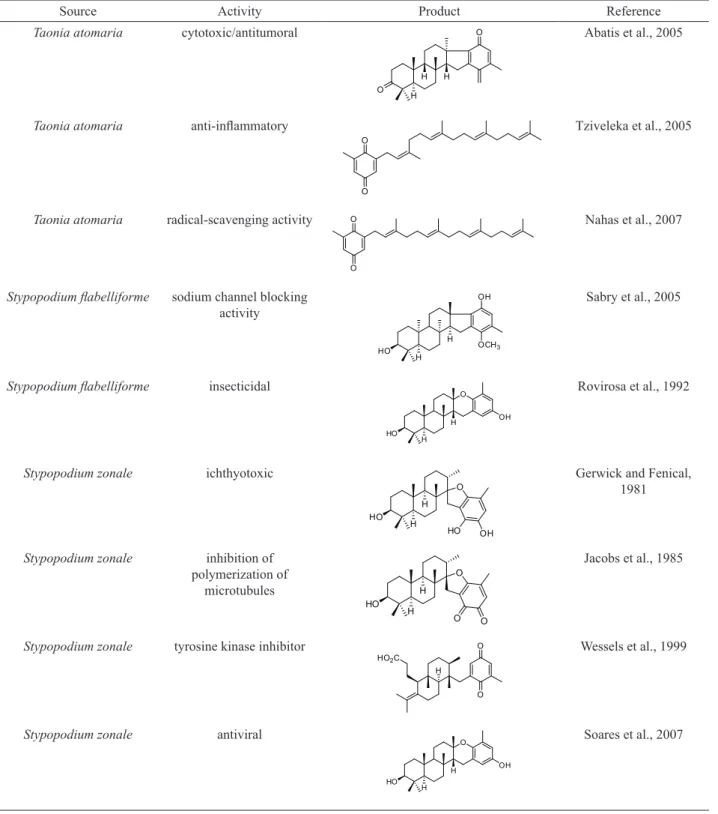
antivira activities. Table 2 illustrates some of the activities
of meroditerpenes.
twenty known species of which only the diterpenoid
content of
S. howlleii
and
S. schmittii
have been reported
(Gerwick & Fenical, 1983; Gerwick et al., 1983). This
genus is distributed over the entire tropical marine
world, also reaching some warm temperate regions.
Stoechospermum polypodioides
is the only species of
the genus known in the Indian Ocean.
Rugulopteryx
,
with its four species, is distributed mainly in Asia and
the Pacific Coast of Australia and, in a few instances,
in the Mexican Pacific, Indian, Atlantic and eastern
Mediterranean (Figure 3). These diterpenes exhibit
great structural similarity, even from different genera.
and there are reports of antiherbivory, antibiotic,
cytotoxic, cell division inhibition and HSV antiviral
activities. Table 3 shows some spatanes and related
products and their bioactivities.
Table 1. Bioactive sesquiterpenes.
Source Activity Product Reference
Dictyopteris undulata antiherbivory O
O
H
Kurata et al., 1996
Dictyopteris zonaroides antifungal HO
OH
Fenical et al., 1973
Dictyopteris zonaroides citotoxic/antitumoral HO
OH
Fenical et al., 1973
Dictyopteris undulata antibiotic
OH
OH Ochi et al., 1979a
Dictyopteris undulata ichthyotoxic O Dave et al., 1984
Table 2. Bioactive meroditerpenes.
Source Activity Product Reference
Taonia atomaria cytotoxic/antitumoral O
H
H O
H
Abatis et al., 2005
Taonia atomaria anti-inlammatory
O
O
Tziveleka et al., 2005
Taonia atomaria radical-scavenging activity O
O
Nahas et al., 2007
Stypopodium labelliforme sodium channel blocking activity
H
H HO
OH
OCH3
Sabry et al., 2005
Stypopodium labelliforme insecticidal
H
H HO
OH
O Rovirosa et al., 1992
Stypopodium zonale ichthyotoxic
H HO
H O
HO OH
Gerwick and Fenical, 1981
Stypopodium zonale inhibition of polymerization of
microtubules
H HO
H O
O O
Jacobs et al., 1985
Stypopodium zonale tyrosine kinase inhibitor
H O
O HO2C
Wessels et al., 1999
Stypopodium zonale antiviral
H
H HO
OH
O Soares et al., 2007
The genus
Dictyota
has two distinct species
groups: (1) one in which the major diterpenes
have prenylated guaiane skeletons associated with
xenianes, crenulidanes or dichotomanes, with other
related skeletons present in lower abundance; and (2)
another in which the major products are dolabellanes
and related dolastanes with other related skeletons in
lower abundance. There is no co-occurrence of these
hemispheres (Figure 4). Among the biological activities
described are anti-retroviral, cytotoxic, antibiotic, and
anti-herbivory activities. Table 4 illustrates prenylated
guaiane and related products and their bioactivities.
Table 3. Bioactivity of spatane and related metabolites.
Source Activity Product Reference
Spatoglossum schmittii inhibitor of cell division H
H H OH
O
O
Gerwick & Fenical, 1983
Spatoglossum schmittii cytotoxic/antitumoral H
H H OH
O
O
Gerwick & Fenical, 1983
Stoechospermum polypodioides
anti-bacterial activity H
H H OH
OH
OAc OH
De Silva et al., 1982
Rugulopteryx okamurae anti-herbivory
O HH
CHO Suzuki et al., 2002
Figure 4. Places where prenylated guaiane species were studied chemically (A) and the known distribution of the genus Dictyota (B).
The
Dictyota
species
that
produce
dolabellanes have a geographical distribution
that is somewhat more restricted to tropical
regions, extending to the subtropics compared
to their prenylated guaiane counterparts (Figure
5). Natural products of these species are reported
to have antiviral, chemical defense, bactericidal
and ichthyotoxic activities. Table 5 illustrates
dolabellanes and their bioactivities.
The
Dictyota
species that produce
seco-dolastanes and seco-dolastanes were transferred by De
Table 4: Bioactivity of prenylated guaianes and related metabolites.
Source Activity Product Reference
Dictyota dichotoma citotoxic/antitumoral
H H
HO H
Durán et al., 1997
Dictyota coriacea antibiotic activity
H H
HO H
Hirschfeld et al., 1973
Dictyota ligulata citotoxic/antitumoral OAc O
O
Bouaicha et al., 1993
Dictyota ligulata antibacterial activity
O
HO OH
OAc
Tringali et al., 1988
Dictyota menstrualis antiviral
H H
OH OHC OHC
Pereira et al., 2004
Table 5. Dolabellane bioactivity
Source Activity Product Reference
Dictyota fasciola ichthyotoxic
H
HO OH
OAc
OAc
De Rosa et al., 1984
Dictyota friabilis antiherbivory activity
AcO
AcO OH
Barbosa et al., 2004b
Dictyota friabilis antiviral
AcO
HO OH
H Barbosa et al., 2004a
Table 6. Bioactivity of seco-dolastanes and related dolastanes.
Source Activity Product Reference
Canistrocarpus cervicornis ATPase inhibitory OH
OAc
OH
Garcia et al., 2009
Canistrocarpus cervicornis anti-herbivory
OH
O OH
O De Paula et al., 2001
Canistrocarpus cervicornis antiviral OH
OH OH
Vallim et al., 2010
The Dictyotaceae are a rich source of
bioactive terpenes (Vallim et al., 2010).
Feeding-deterrence activity could be found for the
sesquiterpenes in
Dictyopteris
(Kurata et al., 1996),
for spatanes in
Rugulopteryx
(Kurata et al., 1988;
1989), for prenylated guaianes and dolabellanes
in
Dictyota
(Hardt et al., 1996; Barbosa et al.,
2004b) and for secodolastanes in
Canistrocarpus
(De Paula et al., 2001). Several of these compounds
found in Dictyotaceae exhibit a broad spectrum of
feeding deterrence against herbivores (Pereira et
al., 2000a; 2000b), including mollusks, fishes, sea
urchins, amphipods and crabs. The biogeographical
distribution
of
secondary
metabolites
from
Dictyotaceae could be the result of different
evolutionary herbivore pressures (Pereira et al.,
2000a; Vallim et al., 2005).
must be adequately protected in order to preserve
them for future research.
Antifungal activity was found only for
sesquiterpenes from
Dictyopteris
. The terpene from
another Phaeophyceae,
Lobophora variegata
, did
not exhibit this activity (Kubanek et al., 2003).
Compounds with anti-inflammatory activity
were found in
Taonia
(Tziveleka et al., 2005) and
inhibition of microtubules (Jacobs et al., 1985) and
enzymes (Wessels et al., 1999) was exhibited by
meroditerpenes from
Stypopodium
. This last activity
was also shown by
Canistrocarpus
dolastanes
(Garcia et al., 2009).
Antiviral
activity,
in
particular
that
against HIV and HSV, was exhibited by several
Meroditerpenes from
Stypopodium
(Soares et al.,
2007), by dichotomane (Pereira et al., 2004), and by
dolabellane (Barbosa et al., 2004a). Although not from
a Dictyotaceae, a halogenated sesquiterpene from the
red alga
Peyssonelia
also exhibit antiviral activity
(Loya et al., 1995). Because
Padina
(Parameswaran
et al., 1994; 1996) and
Dictyopteris
(Ji et al., 2009)
also contain halogenated sesquiterpenes, these algae
could become a source of antiviral molecules.
Comparing the places in the world where
these algae have been chemically studied with those
where the presence of terpenoids is known and with
the species distribution, it is easy to recognize that
bioactivies of metabolites from Dictyotaceae have a
vast potential, given the changes that might occur in
gene expression in local populations. In this context,
greater attention to preservation of coastal areas is
necessary in places where human pressures have
increased and where seaweeds and their metabolites
are found, given their importance for marine ecology
and human health.
Acknowledgment
VLT is grateful to the CNPq for a productivity
fellowship.
References
Abatis D, Vagias C, Galanakis D, Norris JN, Moreau D, Roussakis C, Roussis V 2005. Atomarianones A and B: two cytotoxic meroditerpenes from the brown alga Taonia atomaria. Tetrahedron Lett 46: 8525-8529.
Ali MS, Pervez MK 2003a. Seco-dolastanes from the marine brown alga Dictyota dichotoma (Huds.) Lamour. ZNaturforschung 58b: 438-442.
Ali M S, Pervez MK 2003b. Ring-A hydroxylated
283.
Ali MS, Pervez MK, Saleem M, Ahmed F 2003. Dichotenone-A and -B: two new enones from the marine brown alga Dictyota dichotoma (Hudson) Lamour. Nat Prod Res 17: 301-306.
Ali M S, Pervez M K, Ahmed F, Saleem M 2004. Dichotenol-A, B and C: the C-16 oxidized seco-dolastanes from the marine brown alga Dictyota dichotoma (Huds.) Lamour. Nat Prod Res 18: 543-549.
Amico V, Oriente G, Piattelli M, Ruberto G, Tringali C 1982a. 2 novel phenolic-compounds from the brown alga Cystoseira caespitosa. J Chem Res 9: 262-263.
Amico V, Oriente G, Piattelli M, Ruberto G, Tringali C 1982b. A quinone-hydroquinone couple from the Brown alga Cystoseira stricta. Phytochemistry 21: 421-424.
Areche C, San-Martín A, Rovirosa J, Soto-Delgado J, Contreras R 2009. An unusual halogenated meroditerpenoid from Stypopodium flabelliforme: Studies by NMR spectroscopic and computational methods. Phytochemistry 70: 1315-1320.
Awad NE, Selim MA, Metawe HM, Matloub AA 2008. Cytotoxic xenicane diterpenes from the brown alga Padina pavonia (L.) Gaill. Phytother Res 22: 1610-1613.
Banaigs B, Francisco C, Gonzalez E, Codomier L, Fenical W 1982. Hydroxylated diterpenoid-hydroquinones from cystoseira elegans: significant products or artifacts? Tetrahedron Lett 23: 3271-3272. Banaigs B, Francisco C, Gonzalez E, Fenical W 1983.
Diterpenoid metabolites from the marine alga Cystoseira elegans. Tetrahedron 39: 629-638. Barbosa JP, Pereira, RC, Abrantes JL, Cirne-Santos CC,
Rebello MA, Frugulhetti ICPP, Teixeira, VL 2004a. In vitro antiviral diterpenes from Brazilian brown alga Dictyota pfaffii. Planta Med 70: 856-860. Barbosa JP, Teixeira, VL, Pereira, RC 2004b. A dolabellane
diterpene from the brown alga Dictyota pfaffii as chemical defense against herbivores. Bot Mar 47: 147-151.
Blunt JW, Copp BR, Munro MHG, Northcotec PT, Prinsep MR 2010. Marine natural products. Nat Prod Rep 27: 165-237.
Blunt JW, Copp BR, Munro Murray HG, Northcotec PT, Prinsep MR 2011. Marine natural products. Nat Prod Rep 28: on line published.
Bouaicha N, Pesando D, Puel D, Tringali C 1993. Cytotoxic diterpenoids from the brown alga Dilophus ligulatus. J Nat Prod 56: 1747-1752. Cortés M, Valderrama JA, Cuellar M, Armstrong V, Preite
Dave M-N, Kusumi T, Ishitsuka M, Iwashita T, Kakisawa H 1984. A piscicidal chromanol and a chromenol from the brown alga Dictyopteris undulata. Heterocycles 22: 2301-2307.
De Clerck O, Leliaert F, Verbruggen H, Lane CE, De Paula JC, Payo DA, Coppejans E 2006. A revised classification of the dictyoteae (Dictyotales, Phaeophyceae) based on rbcL and 26S ribosomal DNA sequence analyses. J Phycol 42: 1271-1288. De Paula JC, Pedrini AG, Pinheiro MD, Pereira RC,
Teixeira VL 2001. Chemical similarity between the brown algae Dictyota cervicornis and D. pardalis (Dictyotales, Phaeophyta). Biochem Syst Ecol 29: 425-427.
De Paula JC, Bueno LB, Frugulhetti ICPP, Yoneshigue-Valentin Y, Teixeira VL 2007. Dictyota dolabellana sp. nov. (Dictyotaceae, Phaeophyceae) based on morphological and chemical data. Bot Mar 50: 288-293.
De Rosa S, De Giulio A, Iodice C, Zavodink N 1994. Sesquiterpenes from the brown alga Taonia atomaria. Phytochemistry 37: 1327-1330.
De Rosa S, De Stefano S, Macura S, Trivellone E, Zavodnik N 1984. Chemical studies of north adriatic seaweeds-I. New dolabellane diterpenes from the brown alga Dilophus fasciola. Tetrahedron 40: 4991-4995.
De Silva SSM, Gamage SKT, Kumar NS, Balasubramaniam S 1982. Anti-bacterial activity of extracts from the Brown seaweed stoechospermum marginatum. Phytochemistry 21: 944-945.
Dewick PM 2002. The biosynthesis of C5-C25 terpenoid compounds. Nat Prod Rep 19: 181-222.
Dorta E, Cueto M, Bito I, Darias J 2002. New terpenoids from the brown alga Stypopodium zonale. J Nat Prod 65: 1727-1730.
Durán R, Zubía E, Ortega MJ, Salvá J 1997. New diterpenoids from the alga Dictyota dichotoma. Tetrahedron 53: 8675-8688.
Faulkner JD 1984. Marine natural products: metabolites of marine algae and herbivorous marine molluscs. Nat Prod Rep 1: 251-280.
Fenical W, Sims JJ, Squatrito D, Wing RM, Radlick P 1973. Zonarol and isozonarol, fungitoxic hydroquinones from the brown seaweed Dictyopteris zonarioides. J Org Chem 38: 2383-2386.
Freitas OSP, Oliveira AS, De Paula JC, Pereira, RC, Cavalcanti DN, Teixeira, VL 2007. Chemical variation in the diterpenes from the Brazilian brown alga Dictyota mertensii (Dictyotaceae, Phaeophyta). Nat Prod Commun 2: 13-15.
Garcia DG, Bianco EM, Santos MCB, Pereira RC, Faria MVC, Teixeira VL, Burth P 2009. Inhibition of mammal Na+K+-ATPase by diterpenes extracted from the Brazilian brown alga Dictyota cervicornis.
Phytother Res 23: 943-947.
Gerwick WH, Fenical W, Fritsch N, Clardy J 1979. Stypotriol and stypoldione - ichthyotoxins of mixed biogenesis from the marine alga Stypopodium zonale. Tetrahedron Lett 2: 145-148.
Gerwick WH, Fenical W 1981. Ichthyotoxic and cytotoxic metabolites of the tropical brown alga Stypopodium zonale (Lamouroux) Papenfuss. J Org Chem 46: 22-27.
Gerwick WH, Fenical W 1982. Phenolic lipids from related marine algae of the order Dictyotales. Phytochemistry 21: 633-637.
Gerwick WH, Fenical W 1983. Spatane diterpenoids from the tropical marine algae Spatoglossum schmittii and Spatoglossum howleii (Dictyotaceae). J Org Chem 48: 3325-3329.
Gerwick WH, Fenical W, Engen DV, Clardy J 1983. Isolation and structure of spatol, a potent inhibitor of cell replication from the brown seaweed Spatoglossum schmittii. J Am Chem Soc 102: 7991-7993.
Guiry, MD, Guiry GM 2011. Algae Base. World-wide electronic publication, National University of Ireland, Galway. http://www.algaebase.org. Hardt IH, Fenical W, Cronin G, Hay ME 1996. Acutilols, potent
herbivore feeding deterrents from the tropical brown alga, Dictyota acutiloba. Phytochemistry 43: 71-73. Hirschfeld DR, Fenical W, Lin GHY, Wing RM, Radlick
P, Sims JJ 1973. Marine natural products. VIII. Pachydictyol A, an exceptional diterpene alcohol from the brown alga, Pachydictyon coriaceum. J Am Chem Soc 95: 4049-4050.
Ishitsuka M, Kusumi T, Nomura Y, Konno T, Kakisawa H 1979. New geranylgeranylbenzoquinone derivatives from Sargassum tortile. Chem Lett 10: 1269-1272.
Ishitsuka MO, Kusumi T, Ichikawa A, Kakisawa H 1990. Bicyclic diterpenes from two species of brown algae of the Dictyotaceae. Phytochemistry 29: 2605-2610.
Jacobs RS, Culver P, Langdon R, O’Brien T, White S 1985. Some pharmacological observations on marine natural products. Tetrahedron 41: 981-984. Ji N-Y, Wen W, Li X-M, Xue Q-Z, Xiao H-L, Wang B-G
2009. Brominated selinane sesquiterpenes from the marine brown alga Dictyopteris divaricata. Mar Drugs 7: 355-360.
Kubanek J, Jensen PR, Keifer PA, Sullards MC, Collins DO, Fenical W 2003. Seaweed resistance to microbial attack: a targeted chemical defense against marine fungi. Proc Nat Acad Sci USA 100: 6916-6921.
Kurata K, Taniguchi K, Shiraishi K, Suzuki M 1989. Structures of secospapane-type diterpene with feeding-deterrent activity from the brown alga Dilophus okamurae. Tetrahedron Lett 30: 1567-1570.
Kurata K, Taniguchi K, Suzuki M 1996. Cyclozonarone, a sesquiterpene-substituted benzoquinone derivative from the brown alga dictyopteris undulata. Phytochemistry 41: 749-752.
Kusumi T, Shibata Y, Ishitsuka M, Kinoshita T, Kakisawa H 1979. Structures of new plastoquinones from the brown alga Sargassum serratifolium. Chem Lett 3: 277-278.
Loya S, Bakhanashvili M, Kashman Y, Hizi A 1995. Peyssonols A e B, two novel inhibitors of the reverse transcriptases of human immunodeficiency virus types 1 and 2. Arch Biochem Biophys 316: 789-796.
Ochi M, Kotsuki H, Inoue S, Taniguchi M, Tokoroyama T 1979a. Isolation of 2-(3,7,11-trimethyl-2,6,10-dodecatrienyl) hydroquinone from the brown seaweed Dictyopteris undulate. Chem Lett 7: 831-832.
Ochi M, Kotsuki H, Muraoka K, Tokoroyama T 1979b. Structure of yahazunol, a new sesquiterpene-substituted hydroquinone from the brown seaweed Dictyopteris undulata Okamura. Bull Chem Soc Jpn 52: 629-630.
Parameswaran PS, Bhat KL, Das B, Kamat SY, Harnos S 1994. Halogenated terpenoids from the brown alga Padina tetrastromatica (Hauck). Indian J Chem Sect B 33: 1006.
Parameswaran PS, Naik CG, Das B, Kamat SY, Bose AK, Nair MSR 1996. Constituents of the brown alga Padina tetrastromatica (Hauck). Indian J Chem Sect B 35: 463-467.
Pereira RC, Cavalcanti DN, Teixeira VL 2000a. Effect of secondary metabolites from the tropical Brazilian brown alga Dictyota menstrualis on the feeding by amphipod herbivores. Mar Ecol Prog Ser 205: 95-100.
Pereira RC, Donato R, Cavalcanti DN, Teixeira VL 2000b. Chemotaxis and chemical defenses in seaweed susceptibility to herbivory. Rev Bras Biol 59: 407-419.
Pereira HS, Leão-Ferreira LR, Moussatché N, Teixeira VL, Cavalcanti DN, Costa LJ, Diaz R, Frugulhetti ICPP 2004. Antiviral activity of diterpenes isolated from the Brazilian marine alga Dictyota menstrualis against human immunodeficiency virus type 1 (HIV-1). Antiviral Res 64: 69-76.
Qiao Y-Y, Ji N-Y, Wen W, Yin X-L, Xue Q-Z 2009. A new epoxy-cadinane sesquiterpene from the marine brown alga Dictyopteris divaricata. Mar Drugs 7:
Rovirosa J, Sepúlveda M, Quezada E, San-Martín A 1992. Isoepitaondiol, a diterpenoid of Stypopodium flabelliforme and the insecticidal activity of stypotriol, epitaondiol and derivatives. Phytochemistry 31: 2679-2681.
Sabry OMM, Andrews S, McPhail KL, Goeger DE, Yokochi A, LePage KT, Murray TF, Gerwick WH 2005. neurotoxic meroditerpenoids from the tropical marine brown alga Stypopodium flabelliforme. J Nat Prod 68: 1022-1030.
Sampli P, Tsitsimpikou C, Vagias C, Harvala C, Roussis V 2000. Schimperiol, a new meroterpenoid from the brown alga Stypopodium schimperi. Nat Prod Lett 14: 365-372.
Smit AJ 2004. Medicinal and pharmaceutical uses of seaweed natural products: A review. J Appl Phycol 16: 245-262.
Soares AR, Abrantes JL, Souza TML, Fontes CFL, Pereira RC, Frugulhetti ICDP, Teixeira VL 2007. In vitro antiviral effect of meroditerpenes isolated from the Brazilian seaweed Stypopodium zonale (Dictyotales). Planta Med 73: 1221-1224.
Song F, Fan X, Xu XL, Zhao JL, Yang Y, Shi JG 2004a. Cadinane sesquiterpenes from the brown alga Dictyopteris divaricata. J Nat Prod 67: 1644-1649.
Song FH, Fan X, Xu XL, Zhao JL, Han LJ, Shi JG 2004b. A new sesquiterpene-substituted benzoic acid from the brown alga Dictyopteris divaricata. Chin Chem Lett 15: 316-318.
Song F, Xu X, Li S, Wang S, Zhao J, Cao P, Yang Y, Fan X, Shi J, He L, Lü Y 2005. Norsesquiterpenes from the brown alga Dictyopteris divaricata. J Nat Prod 68: 1309-1313.
Song F, Xu X, Li S, Wang S, Zhao J, Yang Y, Fan X, Shi J, He L 2006. Minor sesquiterpenes with new carbon skeletons from the brown alga Dictyopteris divaricata. J Nat Prod 69: 1261-1266.
Teixeira VL, Kelecom, A, Gottlieb OR 1991. Produtos Naturais de algas Marinhas. Quim Nova 14: 83-90. Tringali C, Oriente G, Piattelli M, Geraci C, Nicolosi G,
Breitmaier E 1988. Crenuladial, an antimicrobial diterpenoid from the brown alga Dilophus ligulatus. Can J Chem 66: 2799-2802.
Tringali C, Oriente G, Piatelli M, Nicolosi G 1984. Structure and conformation of two new dolabellane-based diterpenes from Dictyota sp. J Nat Prod 47: 615-619.
Tziveleka L-A, Abatis D, Paulus K, Bauer R, Vagias C, Roussis V 2005. Marine polyprenylated hydroquinones, quinones, and chromenols with inhibitory effects on leukotriene formation. Chem Biodivers 2: 901-909.
algae in the Tropical Atlantic American region. Biochem System Ecol 33: 1-16.
Vallim MA, Teixeira VL, Pereira RC 2007. Feeding-deterrent properties of diterpenes of Dictyota mertensii (Phaeophyceae, Dictyotales). Braz J Ocean 55: 223-229.
Vallim MA, Barbosa JE, Cavalcanti DN, De Paula JC, Silva, VAGG, Teixeira VL, Paixão ICNP 2010. In vitro antiviral activity of diterpenes isolated from the Brazilian brown alga Canistrocarpus cervicornis. J Med Plant Res 4: 2379-2382. Wen W, Li F, Ji N-Y, Li X-M, Cui C-M, Li X-D, Zhang
L-N, Xue Q-Z, Wang B-G 2009. A new cadinane sesquiterpene from the marine brown alga Dictyopteris divaricata. Molecules 14: 2273-2277.
Wessels M, König GM, Wright AD 1999. A new tyrosine kinase inhibitor from the marine brown alga Stypopodium Zonale. J Nat Prod 62: 927-930.
*Correspondence
Joel Campos De Paula
Programa de Pós-graduação em Biodiversidade Neotropical, Instituto de Biociências, Universidade Federal do Estado do Rio de Janeiro
Avenida Pasteur 458, Urca, 22.290-240 Rio de Janeiro-RJ, Brazil