Factors associated with
overweight and central adiposity
in urban workers covered by the
Workers´ Food Program of the
Brazilian Amazon Region
Fatores associados ao sobrepeso
e adiposidade central em
trabalhadores urbanos assistidos
pelo Programa de Alimentação do
Trabalhador da região amazônica
do Brasil
Marília S. Araújo
ITeresa H.M. da Costa
IIBethsáida A.S. Schmitz
IILiliane M.M. Machado
IIIWallace R.A. dos Santos
IVI Faculty of Medicine, Institute of Health Sciences, Federal University of Para, Belém, PA.
II Department of Nutrition, Faculty of Health Sciences, University of Brasilia, Brazil.
III Graduate Course in Health Sciences, Faculty of Health Sciences, University of Brasilia, Brazil
IV Department of Pharmacy, Federal University of Para, Belém, PA, Brazil
The research was sponsored by the Pará State Foundation for Science and Technology Fund “FUNTEC- Fundo Estadual de Ciência e Tecnológia do Governo do Estado do Pará” (Proc. n. 060/01). MSA acknowledges the scholarship grant given by the Coordinating Body for Training Level Personnel/CAPES (PICDT), Brazil.
Correspondence: Teresa H. M. da Costa, Departamento de Nutrição da Universidade de Brasília, Campus Universitário Darcy Ribeiro, Asa Norte, CEP 70.910-900, Brasília, DF. Brasil. E-mail: [email protected], [email protected]
Abstract
Objective: To investigate factors associated with overweight and abdominal obesity in male and female workers. Methods:This is a cross-sectional population-based study. A representative sample of 1,054 workers ranging from 18 to 74 years of age, selected among individuals covered by the Workers´ Food Program living in the Metropolitan region of Belém, Northern Brazil. Health-related behavior and anthropometry were assessed. Fasting blood samples were col-lected. Results: Overweight prevalence was 38.0% among women and 50.4% among men. Among overweight subjects, there were 6.1% obese women and 10.7% obese men. Multivariate analysis was used to iden-tify social behavior and clinical-biochemical factors associated with increased body adiposity (BMI > 25 kg/m2 and increased
waist circumference: > 80 cm for women and > 94 cm for men). Variables positively and signiicantly associated with overweight and abdominal obesity in men according to prevalence ratio (PR) values were: age (1.02), high family income (1.05), smoking (1.36), hypertension (systolic blood pressu-re, 1.41; diastolic blood pressupressu-re, 1.85) and hypertriglyceridemia (2.29). In women, the PR of increased body adiposity was associa-ted with: age (1.02), alcohol intake (1.42), hypertriglyceridemia (1.44), diastolic blood pressure (1.65) and hyperglycemia (1.71). Conclusions: The association of overweight and abdominal obesity with social behavior variables should be corrected with preventi-ve and educational measures. Furthermore, association of overweight and abdominal obesity with clinical and biochemical va-riables places the urban workers from the Amazon region assisted by the Workers´ Food Program at a possible risk for mor-bidity and mortality from increased body adiposity.
Introduction
Increased urbanization and industriali-zation in recent decades are considered the main causes of diminished physical activity and increased consumption of energy-dense foods1. In Brazil, the demographic
changes seen between the 1960s and the 1980s were concomitant with changes in occupation. At irst, labor was concentrated in the primary sectors of the economy, and it eventually shifted to the secondary and tertiary sectors. These changes played a central role in transforming the Brazilian socioeconomic structure, generating new lifestyle demands and nutritional needs2.
The population of the Amazon Region presents unique socio-cultural characte-ristics. In the State of Pará there is a strong influence of the peoples who began the miscegenation seen today: the indigenous people, and immigrants from European and African origin. These three different cultures determined the local eating habits that per-sist to this day3. Just like other cities in Brazil,
the metropolitan region of Belém has also undergone extensive sociodemographic changes in the last decade4.
The main consequence of this process has been the change in the epidemiologic proile of this population, with an incre-ased prevalence of non-communicable chronic diseases, especially obesity5,6. In
Brazil, the 2002-2003 Family Budget Survey (POF) performed by the Brazilian Institute of Geography and Statistics (IBGE)7 shows
that overweight among Brazilians is alre-ady a problem of greater magnitude than malnutrition.
This increased prevalence of overweight and obesity has been observed in distinct regions of the country and in many social strata. This situation is worrying since it is usually associated with cardiovascular com-plications, dyslipidemia, type 2 diabetes, osteoarticular diseases and some kinds of cancers. All these comorbidities have high treatment costs5,6.
The distribution of body fat, especially in the abdominal region, has been associated
Resumo
Objetivo: Investigar os fatores associados ao sobrepeso e a obesidade abdominal em trabalhadores de ambos os sexos. Método: Estudo transversal de base populacional, de uma amostra representativa de 1054 tra-balhadores, com idade entre 18 e 74 anos, assistidos pelo Programa de Alimentação do Trabalhador na região metropolitana de Belém do Pará, na região norte do Brasil. Parâmetros relacionados à saúde e medidas antropométricas foram obtidas e amostra de sangue foram coletadas. Resultados: A preva-lência de sobrepeso foi de 38% nas mulheres e 50,4% nos homens. Dentre os indivíduos com sobrepeso, 6,1% das mulheres eram obesas e 10,7% dos homens tinham obesi-dade. Análise multivariada foi utilizada para identiicar os fatores sociocomportamentais e clínico-bioquímicos associados com o au-mento da adiposidade corporal (IMC > 25kg/ m2 e circunferência de cintura > 80cm para mulheres e >94cm para homens). As variáveis e a razão de prevalência (PR) associadas ao sobrepeso e adiposidade abdominal nos homens foram: idade (1,02), renda familiar alta (1,05), fumo (1,36), hipertensão (pressão arterial sistólica 1,41 e pressão arterial dias-tólica 1,85) e hipertrigliceridemia (2,29). Nas mulheres as razões de chance para sobrepeso e adiposidade abdominal foram: idade (1,02), consumo de álcool (1,42), hipertrigliceride-mia (1,44), pressão arterial diastólilca (1,65) e hiperglicemia (1,71). Conclusão: A asso-ciação do sobrepeso e obesidade abdominal com parâmetros sociocomportamentais devem ser corrigidos com medidas educa-tivas e preveneduca-tivas. Além disso, a associação de sobrepeso e obesidade abdominal com parâmetros clínicos e bioquímicos coloca os trabalhadores de Belém do Pará, assistidos pelo Programa de Alimentação do Traba-lhador, em possível risco de morbidades e mortalidade precoce pelo aumento de adiposidade corporal.
with the etiology of many metabolic chan-ges among the obese8. In this context, many
studies have demonstrated that visceral fat, characterized by the accumulation of adipose tissue in the abdominal region, is also an important risk factor for the develo-pment of cardiovascular diseases and type 2 diabetes9,10. Excess of visceral adipose tissue
alters the glucose-insulin homeostasis, tri-ggering insulin resistance 8. Abdominal fat
build-up also leads to hypertriglyceridemia, which is usually accompanied by a low concentration of high density lipoproteins (HDL)10. This set of metabolic disorders
associated with arterial blood hypertension is called the metabolic syndrome. Weight maintenance, increased physical activity and decreased sodium consumption are important ways to control and prevent this syndrome10,11.
The increased prevalence of overweight and obesity along with the increase in their associated comorbidities are responsible for an ever increasing number of debilita-ting diseases which may take workers away from their jobs temporarily or permanently. Bearing this in mind, the present study evaluated workers’ nutritional status, iden-tifying the association between overweight and distribution of body fat with metabolic and behavioral changes. This research was performed in a metropolitan region of the Brazilian Amazon, where diagnoses for this population are non-existent.
Methods
Study design and sampling
This is a cross-sectional population-based study that evaluated workers from companies located in the metropolitan re-gion of the city of Belém, in northern Brazil. Workers were covered by the Programa de Alimentação do Trabalhador – PAT (Workers’ Food Program) of the Brazilian Ministry of Labor and Employment. Field research was performed between February and August 2003 and included workers eating at 55 di-fferent food-service units. The sample was
stratiied according to the number of meals served in each unit. Hierarchical clustering was used for the sampling design, obtained with the software developed by the SAS Institute. As the area where the survey was performed did not have data on overweight prevalence, the estimated prevalence used to calculate the sample size was 50%, with a p-value < 0.05. A sample with 1,084 workers was thus calculated (about 8% of all 13,337 workers). Overweight prevalence in the city of Belém has recently been found to be 41.8%, a value below the one established for the calculation12, which guarantees an
adequate sample size.
A total of 1,111 workers participated in the survey, with a 5.1% loss of individuals who did not show for blood collection. Thus, the final sample totaled 1,054 workers. Workers were informed of the objectives and methodology of the stu-dy and those who agreed to participate signed an Informed Consent Form. This study was approved by the Research Ethics Committee of the School of Health Scien-ces of the University of Brasília, according to Resolution # 196/9613.
Measurement variables
Measurements, team training, adjust-ment of ield instruadjust-ments, and question-naire pre-testing were irst done in a pilot study, with a sample of workers who were not included in the research. The precision and accuracy of the anthropometric measu-rements were tested by the standardization method proposed by the Department of Nutrition of the School of Public Health of the University of Sao Paulo14.
Information on socioeconomic aspects was obtained by interviews. The variables collected were: gender, age, origin, nationa-lity, educational level, marital status, num-ber of children, working hours, occupation, and family income.
Plenna Lithium scale (São Paulo – Brazil), with 150kg capacity and 100g readability, was used to determine weight. A portable Alturexata stadiometer (Belo Horizonte – Brazil), with a total length of 213cm and 0.1cm grades, was used to determine height. Body mass index (BMI) was deined as the ratio between weight (kg) and height (m) squared, and values ranging from 18.5 to 25kg/m2 were considered normal, according
to the criteria proposed by the WHO15. Waist
circumference was determined with an ine-lastic measure tape TBW (São Paulo – Bra-zil), 150cm, with 0.1 cm grades, positioned at the mid-point between the bottom of the rib cage and the top of the iliac crest. One anthropometrist was responsible for waist measurements. Values of < 80cm for women and < 94cm for men were considered nor-mal, according to the WHO15.
Systemic arterial blood pressure was determined, according to the Brazilian Guidelines for Arterial Pressure16 criteria
and technical norms. Measurements were taken in the sitting position. A digital Techli-ne WS-500 blood pressure monitor (Hong Kong – China) was used for this purpose. Cutoff points for systemic arterial blood hypertension were: systolic arterial blood pressure (SAP) equal to or above 140mmHg and/or diastolic arterial blood pressure (DAP) equal to or above 70mmHg.
Blood was collected after 10-12h fas-ting to determine the following serum constituents: triacylglycerol (TAG); total cholesterol (TC); HDL cholesterol (HDL-c), and fasting glucose. TAG, TC and HDL were determined by enzymatic colorimetric me-thods with Doles Reagentes kits (Doles, Goi-ás, Brazil), and spectrophotometric readings were done according to the manufacturer’s instructions. HDL-c was determined in the supernatant obtained by centrifugation after treating the sample with buffered polyethylene glycol (PEG 6000, Doles, Goi-ás – Brazil), which selectively precipitates low-density fractions (VLDL-c and LDL-c). Fasting glucose was determined by the co-lorimetric glucose oxidase method using the
Doles Reagentes kits (Doles, Goiás – Brazil)
following the manufacturer’s instructions. The coeficient of variation (inter-assays CV) was determined with Qualitrol 1 CAT (Labtest Diagnóstica, Minas Gerais – Brazil) run in all determination batches. The coefi-cients of variation for TC, HDL-c, TAG and glucose tests were below 1.0%.
Statistical analysis
Data input was carried out in Epi-Info 6.04 software17 and the statistical analysis
was performed with the Statistic Analysis System software (SAS Institute Inc., Cary, NS, USA)18. Student’s t-test was used to
compare mean values for each gender. A multivariable analysis was performed to identify possible factors associated with obesity and central adiposity. At first, all variables were included in the multiple regression model. The final model was ob-tained by the stepwise method of variable selection. Dependent variables were BMI and waist circumference. Independent variables were: age, smoking status, al-coholic beverage consumption, systolic arterial blood pressure, diastolic arterial blood pressure, triacylglycerides, choles-terol, HDL-c, fasting glucose levels, and family income. Behavioral variables were smoking status and alcoholic beverage consumption. Age in years was treated as continuous. The cut-off points for bioche-mical variables and arterial blood pressure were the values determined by the Bra-zilian Guidelines on Dyslipidemia19 and
the Brazilian Societies of Hypertension16
and Diabetes20, which follow
Results
Table 1 shows the sample distribution of age, arterial blood pressure and biochemical variables by gender. Of the 1,054 workers who participated in this study, 728 (69%) were males and 326 (31%) were females. The mean age for women was 35.1 + 9.3 years and their ages ranged from 18 to 74 years. The mean age for men was 35.1 + 9.6 years and their ages ranged from 18 to 73 years. However, the ages of 63% of men and women in the sample ranged from 20 to 50 years.
Table 1 also shows the comparative analysis of the means by gender for the anthropometric and clinical-biochemical characteristics. The mean BMI value for men was signiicantly different from the one for women. The mean BMI observed for men reached the level of overweight (p < 0.05). This higher mean BMI for men relected the higher prevalence of overwei-ght and obesity among them, where 50.4% of the men presented this characteristic. Among women, 38.0% presented this characteristic. Mean waist circumference
between men and women also presented a significant difference (p < 0.05). Mean diastolic arterial blood pressure for men was also signiicantly higher than for women (p < 0.05). Mean total cholesterol and HDL-c for men and women were similar. However, mean triacylglycerols and glucose for men were significantly higher than those for women (p < 0.05).
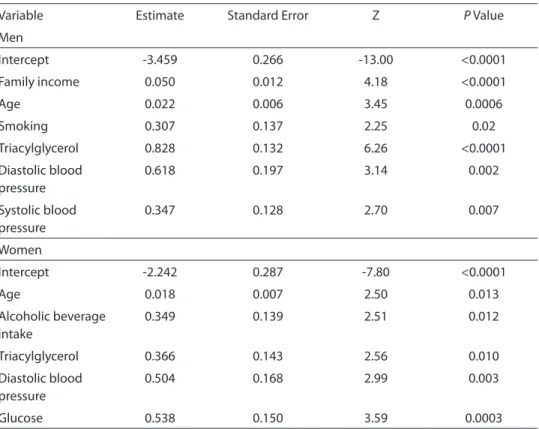
Table 2 shows the model for multiple regression analysis. This model showed that older women who consumed alcoholic beverages and who presented triacylglycerol levels > 150 mg/dL, diastolic arterial blood pressure > 70 mmHg and fasting glucose > 110 mg/dL were signiicantly associated with excess adiposity.
Table 2 also shows that older men who smoke and who presented triacylglycerol levels > 150 mg/dL, diastolic arterial blood pressure > 70 mmHg, systolic arterial blood pressure > 140 mmHg and higher family income were signiicantly associated with overweight and central obesity.
Prevalence ratio (PR) estimates seen in Table 3 show that women who presented fasting glucose levels above 110mg/dL had
Table 1 - Anthropometric and clinical-biochemical characteristics of workers. Belém, Brazil, 2003.
Tabela 1 - Características antropométricas e clinicas e bioquímicas de trabalhadores de Belém do Pará, Brasil, 2003.
Variable Women (n=326) Men (n=728)
Mean SD Mean SD
Age (years) 35.1 9.6 35.1 9.3
Body mass index (Kg/m2)
24.2 3.5 25.4* 3.7
Waist
circumference (cm)
81.0 9.0 87.4* 10.6
Diastolic blood pressure (mmHg)
69.3 12.0 76.1* 12.9
Blood Cholesterol (mg/dL)
190.8 20.9 192.6 24.2
HDL- c (mg/dL) 46.9 20.8 47.3 24.3
Triacylglycerol (mg/dL)
103.9 61.8 146.1* 101.0
Glucose (mg/dL) 92.9 18.0 96.0* 20.4
SD= standard deviation. *mean with statistical signiicance by Student t test (p<0.05).
the highest prevalence for overweight and increased waist circumference (central obe-sity). This means that a glucose level above 110mg/dL was 71% more prevalent among overweight women than among women with BMI < 25 and waist circumference under 80cm. Consumption of alcoholic beverages, increase in triacylglyceride levels and diastolic arterial blood pressure were also observed to increase the prevalence for overweight and abdominal obesity among women. Additionally, each year in a woman’s life increases her prevalence of being overweight and presenting central adiposity by 2.0%.
Table 3 also shows prevalence ratio (PR) estimates for overweight and abdominal obesity for men. Among all analyzed va-riables, triacylglycerol levels above 150mg/ dL placed men at the highest prevalence of presenting excess weight and abdominal obesity, and this occurrence was 129%
gre-ater than that for men whose triacylglycerol levels were below 150mg/dL. Smoking also increased men’s prevalence of presenting excess weight and central adiposity (abdo-minal obesity) by roughly 36%. Diastolic and systolic arterial blood pressures above 70 and 140mmHg, respectively, were more prevalent among men with overweight and central obesity. Each year of life increased men’s prevalence for increasing adiposity by 2.0%. As for each increase in family income level, there was a 5.0% increase in the prevalence of overweight and central obesity in men.
Discussion
This study revealed a young popula-tion, with 50.8% of the adults being under 35 years of age. Data from the Monthly Employment Survey conducted by IBGE21
showed that 82.1% of economically active
Table 2 - Multivariate analysis of factors associated with overweight and abdominal obesity in workers. Belém, Brazil, 2003
Tabela 2 - Analise multivariada dos fatores associados com o sobrepeso e a obesidade abdominal de trabalhadores de Belém do Pará, Brasil, 2003.
Variable Estimate Standard Error Z P Value
Men
Intercept -3.459 0.266 -13.00 <0.0001
Family income 0.050 0.012 4.18 <0.0001
Age 0.022 0.006 3.45 0.0006
Smoking 0.307 0.137 2.25 0.02
Triacylglycerol 0.828 0.132 6.26 <0.0001
Diastolic blood pressure
0.618 0.197 3.14 0.002
Systolic blood pressure
0.347 0.128 2.70 0.007
Women
Intercept -2.242 0.287 -7.80 <0.0001
Age 0.018 0.007 2.50 0.013
Alcoholic beverage intake
0.349 0.139 2.51 0.012
Triacylglycerol 0.366 0.143 2.56 0.010
Diastolic blood pressure
0.504 0.168 2.99 0.003
Brazilians are less than 50 years old, and the results obtained in this study conirm this trend, with 92.5% of the workers being under 50 years of age.
The anthropometric data obtained in this study show a high prevalence of overweight among the studied population, reflecting the current scenario reported in other studies performed in Brazil. The 2002-2003 Family Budget Survey (POF)7,
also conducted by IBGE, shows that excess weight among Brazilians is now more preva-lent than malnutrition. Regarding workers, Sávio et al.22 found a similar overweight
prevalence in the Federal District, Brazil, in which overweight was also more prevalent in men than in women.
It is possible to predict cardiovascular diseases with reasonable accuracy by com-bining BMI and body fat distribution8,11. For
this reason, the results found here indicate an unfavorable cardiovascular proile for workers who are overweight and present increased waist circumference.
The results of this study revealed that, for both genders, age was signiicantly
as-sociated with the dependent variables of the model, BMI and waist circumference. This same trend was observed by Pereira, who ve-riied that BMI increases with age regardless of gender, while evaluating the prevalence of overweight among adults living in the city of Rio de Janeiro25. In addition to age,
income was also associated with obesity in men, where those with a higher income also present a high prevalence. A similar result was found by Castanheira et al. in a sample of 3,464 adults living in the urban area of Pelotas, Rio Grande do Sul, Brazil, where they found that older men with higher family income presented higher means of abdominal circumference9.
However, the indings of this study differ in some points from one of the few studies evaluating the Workers’ Food Program nutri-tional status. The study of Veloso & Santana26,
with a retrospective cohort, showed that workers who were well nourished or pre-obese and belonged to a low socioeconomic class faced a greater risk of gaining weight26.
Alcoholic beverage consumption was signiicantly associated with weight gain
Table 3 - Social behavior and clinical-biochemical variables associated with overweight and abdominal obesity among workers. Belém. Brazil. 2003.
Tabela 3 - Variáveis sociocomportamentais e clínico-bioquímicas associadas com o sobrepeso e a obesidade abdominal de trabalhadores de Belém do Pará. Brasil. 2003.
Variable PR 95% CI
Men
Age 1.02 1.009 – 1.035
Family income 1.05 1.027 – 1.077
Smoking 1.36 1.040 – 1.777
Systolic blood pressure 1.41 1.100 – 1.820
Diastolic blood pressure 1.85 1.262 – 2.729
Triacylglycerol 2.29 1.767 – 2.967
Women
Age 1.02 1.004 – 1.033
Alcoholic beverage intake 1.42 1.079 – 1.862
Triacylglycerol 1.44 1.090 – 1.908
Diastolic blood pressure 1.65 1.190 – 2.302
Glucose 1.71 1.277 – 2.299
*PR– prevalence ratio. CI – conidence interval.
and central adiposity among women and this fact is corroborated by the results ob-tained by Feinman and Lieber, who state that alcoholic beverage consumption and a sedentary lifestyle favor the development of obesity, especially among women27.
The results of this study also show that men who smoke had a high prevalence of being obese. Wang et al. have veriied a high prevalence of smoking associated with overweight among individuals with corona-ry artecorona-ry disease in a rural area of China28.
The increased prevalence of overweight and central obesity among women with glucose levels above 110mg/dL shows that effective actions to promote weight loss or even reduce the rate of weight gain in this population will have a very good repercus-sion. However, if no measure is taken, the maintenance or increase in body fat can lead to a higher incidence of type 2 diabetes in this group. Sartorelli and Franco consider that obesity and aging of the population are currently regarded as the main risk factors for type 2 diabetes in Brazil29.
According to data from the 2002-2003 POF, the great nutritional challenge in Brazil is to control and prevent excess weight in the population7. After the publication of these
na-tional data and assessment of workers’ nutri-tional status22,26 a review of the Workers’ Food
Program parameters was implemented which reduced in half, the main (from 1,400kcal to 700 kcal) and small meal energy content, as a measure to protect against overweight30.
Addi-tionally, further actions must also be taken in order to ameliorate this scenario, such as: controlling the marketing and advertising of unhealthy foods, strategies to promote healthier eating habits with special emphasis
on the consumption of fruits and vegetables, and encouraging workers to engage in more physical and leisure activities by creating areas and conditions for this purpose15.
The results obtained in this study are in agreement with those found among workers of other Brazilian cities22,26. It is possible
that, because of socio-cultural characteris-tics unique to the Amazon population, this situation may have further deleterious con-sequences. These individuals are exposed to changes in lifestyle and westernization of dietary habits; while at the same time maintain the traditional dietary practices of the various peoples who inluenced their eating habits. Furthermore, the publication of these data is of interest in order to assess the impact of changes approved to the Workers’ Food Program since 2005 and to further our understanding of how health-related programs developed by companies or government agencies in Belém affects workers nutritional status.
In conclusion, the association betwe-en anthropometric parameters (BMI and waist circumference), serum levels of lipid fractions and glucose, and arterial blood pressure are a strong sign of the need to adopt programs that promote health in the work environment.
Acknowledgements
The authors thank Dr Edina Miazaki and Dr. Eduardo Freitas da Silva for performing the statistical analysis. We also thank the undergraduates who participated in the in-terviews and laboratory analysis. We declare no conlict of interest.
References
1. Barría PRM, Amigo CH. Transición nutricional: una
revisión del peril latinoamericano. Arch Latinoam Nut
2006; 56(1): 3-11.
2. Batista ta Filho M, Rissin A. Nutritional transition in
Brazil: geographic and temporal trends. Cad Saúde
Pública 2003; 19(1): 181-91.
3. Cascudo L da C. História da Alimentação no Brasil. Belo
Horizonte: Itatiaia; 1983.
5. Monteiro CA, Benício MH D’A, Conde WL, Popkin BM.
Shifting obesity trends in Brazil. Eur J Clin Nutr 2000; 54:
342-6.
6. Popkin BM The nutrition transition and obesity in the
developing world. J Nutr 2001; 131(S3): 871-3.
7. Instituto Brasileiro de Geograia e Estatística (IBGE). Pesquisa de Orçamento Familiar (POF), Pesquisa Nacional de Amostra por domicilio 2002-2003. Rio de Janeiro: IBGE; 2004.
8. Martins IS, Marinho SP. The potential of central obesity
anthropometric indicators as diagnostic tools. Rev
Saúde Pública 2003; 37(6): 760-7.
9. Castanheira M, Olinto MTA, Gigante DP. Socio-demographic and lifestyle factors associated with abdominal fat distribution in adults: a population-based
survey in Southern Brazil. Cad Saúde Pública 2003;
19(1): 55-65.
10. Scarsella C, Després JP. Treatment of obesity: the need to target attention on high-risk patients characterized by
abdominal obesity. Cad Saúde Pública 2003; 19(1): 7-19.
11. Lerario DDG, Gimeno SG, Franco LJ, Iunes M, Ferreira SRG. Weight excess and abdominal fat in the metabolic
syndrome among Japanese-Brazilians. Rev Saúde
Pública 2002; 36(1): 4-11.
12. Ministério da Saúde (2008). Vigitel Brasil 2007.
Disponible in http://portal.saude.gov.br/ portal/ arquivos/pdf/vigitel2007_inal_web.pdf .[Acessado em 19 de março de 2009].
13. Ministério da Saúde, Conselho Nacional de Saúde (MS/
CNS). Resolução n° 196/96 sobre Pesquisa Envolvendo
Seres Humanos. Brasilia: MS/CNS; 1996.
14. Universidade de São Paulo (USP). Faculdade de
Saúde Pública. Departamento de Nutrição. Avaliação
antropométrica como instrumento de avaliação de saúde e estado nutricional. São Paulo: University of São Paulo; 1988.
15. World Health Organization (WHO). Obesity: preventing
and managing the global epidemic. Geneva: WHO; 1997.
16. Sociedade Brasileira de Hipertensão (SBH). V Consenso
Brasileiro sobre Pressão Arterial. Rev Bras Hipertens
2006; 13(S4): 260-312.
17. World Health Organization (WHO). Software Epi Info
Version 6.04b. [s.l: s.n.]; 2000.
18. Statistic Analysis System (SAS). SAS User’s guide:
Statistics. SAS Institute Inc., Cary, NS, USA; 2001.
19. Sociedade Brasileira de Cardiologia (SBC). IV Consenso
Brasileiro de Dislipidemia. Arq Bras Cardiol 2007; 88(S1):
3-12.
20. Sociedade Brasileira de Diabetes (SBD). Consenso
Brasileiro sobre Diabetes 2007: diagnóstico e classiicação do diabetes mellitus e do tratamento do diabetes mellitus tipo 2. Rio de Janeiro: Diagraphic; 2007.
21. Instituto Brasileiro de Geograia e Estatística (IBGE). Pesquisa mensal de empregos. Rio de Janeiro: IBGE; 2004.
22. Sávio KEO, da Costa THM, Miazaki E, Schmitz BAS. Assessment of lunch served in the Workers’ Food
Program, Brazil. Rev Saúde Pública 2005; 39(2): 148-55.
23. World Health Organization (WHO). Reducing risks to
health: promotion healthy life. Geneva: WHO; 2002.
24. França Júnior I, Monteiro CA. The analysis of secular
trends of health indicators in epidemiology. Rev Saúde
Pública 2000; 34(S6): 5-7.
25. Pereira RA. Anthropometric evaluation of the nutritional
status. In: Sichieri R. Epidemiology of the obesity. Rio de
Janeiro: EdUERJ; 1998. p. 43-64.
26. Veloso IS, Santana VS. Impact of the worker food
program in Brazil. Rev Panam Salud Publica 2002; 11(1):
24-31.
27. Feinman L, Lieber C. Nutrition and diet in alcoholism.
In: Shils ME, Olson JA, Shike M, Ross AC. Modern
nutrition in health and disease. 9. ed. São Paulo: Manole; 2003. p. 1631-51.
28. Wang L, Yao D, Wu T. Prevalence of overweight and smoking patients with coronary heart disease in rural
China. Austr J Rural Health 2004; 12(1): 17-21.
29. Sartorelli DS, Franco LJ. Trends in diabetes mellitus in
Brazil: the role of the nutritional transition. Cad Saúde
Pública 2003; 19(1): 29-36.
30. Ministério do Trabalho e Emprego (Brazil). Programa de
Alimentação do Trabalhador. Portaria Interministerial n.6. Brasília: TEM; 2005.