Teixeira FR, Teixeira GR, Santos TC, Torres Neto JR. Laparoscopic colorectal surgery: what to expect from an initial experience. J Coloproctol, 2012;32(x):154-162.
ABSTRACT: Laparoscopic colorectal surgery is less traumatic when compared to traditional surgery techniques, with well-established ad-vantages. The objective of this study was to report the experience in laparoscopic surgical treatment of colorectal diseases. Method: Catalog all patients submitted to laparoscopic colorectal surgery performed by one surgeon and perform a descriptive analysis of key data from these records. Results: The study analyzed data from 43 patients who underwent laparoscopic colorectal surgery. Most were females (n=30; 69.77%) in relation to males (n=13; 30.23%), mean age of 57.21 years old. Among the indications for surgery, diverticular disease was the most frequent (n=20; 46.51%), followed by malignancy (n=13; 30.23%). Most patients underwent rectosigmoidectomy (n=28; 65.12%),
fol-lowed by right hemicolectomy (n=6; 13.95%), with conversions in ive cases (11.63%). The study observed a tendency towards increased
number of surgeries, reduced average operative time as well as decreased conversions to laparotomy along the studied period. Conclusion: Laparoscopic colorectal surgery is a safe procedure, and with the technical development of the team, the results have been increasingly good.
Keywords: surgery; colorectal surgery; laparoscopy.
RESUMO: A videolaparoscopia colorretal apresenta-se como uma tática operatória menos traumática com vantagens bem-estabelecidas. O objetivo deste trabalho foi apresentar a experiência no tratamento cirúrgico videolaparoscópico das afecções colorretais. Método: Catalogar todos os pacientes submetidos à cirurgia colorretal videolaparoscópica realizadas por um único cirurgião e realizar uma análise descritiva dos principais dados a partir dos prontuários destes. Resultados: O estudo analisou dados de 43 pacientes que foram submetidos à cirurgia colorretal por videolaparoscopia. A maioria era do gênero feminino (n=30; 69,77%) em relação ao masculino (n=13; 30,23%) com média de idade de 57,21 anos. Dentre as indicações cirúrgicas, doença diverticular foi a mais frequente (n=20; 46,51%), seguido de doença maligna (n=13; 30,23%). A maioria dos pacientes foi submetida a retossigmoidectomia (n=28; 65,12%), seguido de colectomia direita (n=6; 13,95%), com conversões em cinco casos (11,63%). Houve uma tendência crescente no número de cirurgias, na proporção de cânceres removidos por laparoscopia ao longo dos anos em estudo, assim como uma diminuição crescente na média do tempo operatório e nas conversões para la-parotomia. Conclusão: A videolaparoscopia colorretal é um procedimento seguro e, com a evolução técnica da equipe, os resultados vão se tornando cada vez mais satisfatórios.
Palavras-chave: cirurgia; cirurgia colorretal; laparoscopia.
Laparoscopic colorectal surgery: what to expect
from an initial experience
Fábio Ramos Teixeira1, Gustavo Ramos Teixeira2, Thiago Costa dos Santos3, Juvenal da Rocha Torres Neto4
1Resident Physician in Coloproctology, Hospital Universitário da Universidade Federal de Sergipe (UFS) – São
Cristóvão (SE), Brazil. 2Academician in Medicine, Universidade Federal de Alagoas (UFAL) – Maceió (AL), Brazil. 3Resident Physician in Coloproctology, UFS – São Cristóvão (SE), Brazil. 4Doctor and Head of the Service of
Coloproctology, UFS – São Cristóvão (SE), Brazil.
Study carried out at the Centro de Ciências Biológicas e da Saúde, Departamento de Medicina da Universidade Federal de Sergipe (UFS) – São Cristóvão (SE), Brazil.
Financing source: none.
Conlict of interest: nothing to declare.
INTRODUCTION
In the 1990s, the laparoscopic access was intro-duced in colorectal surgeries. Of reintro-duced indications, limited to a small group of surgeons at the time, the access is today employed by innumerous coloproctol-ogists, and the indications have been expanded to any type of colorectal procedure1-4.
The advantages of laparoscopic colorectal sur-gery have been consolidated by innumerous scientiic studies, as this method involves a minimally invasive technique and reduced surgical trauma. Less postop-erative pain, shorter hospitalization and earlier return to activities have been some of the great beneits lead -ing to the selection of this access4-8. However, some
factors make it dificult to expand this technique to an even greater number of coloproctologists, such as: learning curve, voluminous tumors or tumors iniltrat -ing into adjacent structures, multiple intracavitary ad-hesions, voluminous incisional hernias, preservation of oncological principles, among others9.
In cancer, laparoscopic resections were post-poned, and were adopted only after surgeons acquired more experience. Published studies that presented im-plantation due to trocar injury criticized at irst the adoption of this access in oncological surgeries10, but
other studies demonstrated similar incidence of im-plantation in the abdominal wall when using laparot-omy11. With the improvements in surgical techniques
and materials, the principles of oncological radical-ity have been really preserved, as indicated in several publications comparing specimens resected through laparoscopy and laparotomy6,8,12.
With this new access, new complications ap-peared, not only regarding the surgery itself, but also related to the pneumoperitoneum and puncture and trocars. Some authors report greater incidence of com-plications in the surgeon’s initial experience, with the frequency of complications inversely proportional to the medical team’s experience13.
The purpose of this study was to report the expe-rience in laparoscopic colorectal surgery.
PATIENTS AND METHODS
This is a retrospective observational study of all patients submitted to laparoscopic colorectal
surgery performed by only one surgeon and treated at the Service of Coloproctology at Torres Centro Médico.
The information was collected according to a protocol (Annex I), with the following main variables: type of site of treated diseases, procedures performed, surgery duration and hospitalization period, conver-sion rate and causes, intraoperative and postoperative complications, anatomopathological data of tumors, mortality and recurrence rates.
The information was collected from the pa-tients’ records, after obtaining the authorization from the institution’s management, through a document (Annex II) ensuring secrecy of the patients’ identity and no damage to the institution. The Informed Con-sent Term signed by the patients was not required, as the study only collected data contained in the pa-tients’ medical records.
A descriptive analysis of main data was per-formed using spreadsheets elaborated in Microsoft Excel® 2007.
The study was approved by the Research Ethics Committed of the Universidade Federal de Sergipe.
RESULTS
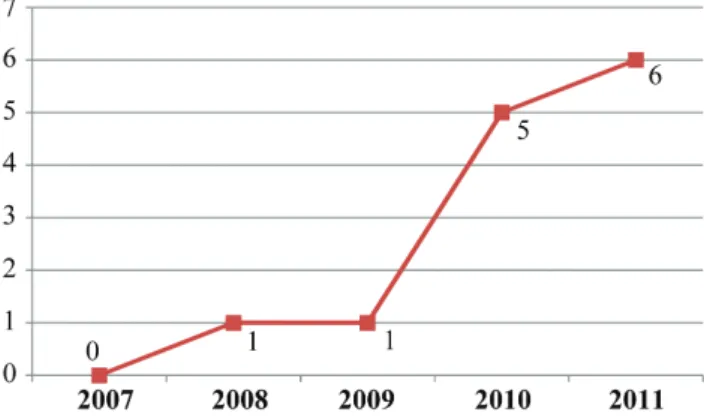
From May 2007 to October 2011, 43 patients were submitted to laparoscopic colorectal surgery. Most of them were females (n=30; 69.77%) in re-lation to males (n=13; 30.23%). Age varied from 17 to 83 years old, with mean age of 57.21, and, most of them were from Aracaju (n=36; 83.72%). A growing number of surgeries was observed along the years (3 in 2007; 7 in 2008; 8 in 2009; 11 in 2010; 14 in 2011) (Figure 1), as well as an increas-ing proportion of cancer removed through laparos-copy (1 in 2008; 1 in 2009; 5 in 2010; 6 in 2011) (Figure 2). The mean period of hospitalization was 7.63 days (varying from 3 to 33 days) and the mean duration of surgery was 229.30 minutes (varying from 105 to 450 minutes).
reconstruction after Hartmann intervention (n=1; 2.33%) (Figure 3). Two cases (4.65%) presented two simultaneous indications: one case with diverticular disease associated with endometriosis and one case with diverticular disease associated with adenocar-cinomas of the ascending and transverse colon. The tumor site distribution in colorectal diseases showed that most of them occurred in the sigmoid colon (n=24; 55.81%), followed by the ascending colon (n=4; 9.30%), rectosigmoid junction (n=3; 6.98%), rectum (n=3; 6.98%), diffuse disease (n=3; 6.98%), descending colon (n=2; 4.65%), transverse colon (n=2; 4.65%), cecum (n=1; 2.33%) and cecal appen-dix (n=1; 2.33%).
Regarding the procedures performed, most pa-tients were submitted to rectosigmoidectomy (n=28; 65.12%), followed by right colectomy (n=6; 13.95%),
total colectomy (n=3; 6.98%), left colectomy (n=2; 4.65%), transversectomy (n=2; 4.65%), intestinal reconstruction after a Hartmann intervention (n=1; 2.33%) and rectal amputation (n=1; 2.33%) (Fig-ure 4). Five cases (11.63%) presented conversion and the causes were: presacral bleeding, anastomotic bleeding, tumor in the left ureter and left external il-iac artery, lesion in the left ureter and adhesions with lesions in the small bowel. Besides these ive intra -operative complications, three other occurred but no conversion was required: fault in mechanical suture, peripancreatic bleeding and another with lesion in the small bowel, totaling eight cases with intraopera-tive complications (18.60%).
Postoperative complications were observed in 12 patients (27.91%), which were: 1) rectal bleed-ing associated with wall hematoma and deep venous thrombosis; 2) respiratory failure associated with he-modynamic instability and extended ileum; 3) wall hematoma progressing to incisional hernia; 4) anas-tomotic bleeding; 5) obstruction with small bowel necrosis, with reoperation required for resection, and progressing to short-bowel syndrome; 6) necrosis of Figure 1. Number of surgeries performed between 2007 and 2011.
Figure 2. Number of surgeries for malignant neoplasm removal from 2007 to 2011.
Figure 3. Distribution by surgical indication.
Diverticular disease Mallignant neoplasm Endometriosis 20
13 2
Inflammatory bowel disease Benign tumors
Others 2 2 3
Figure 4. Distribution of surgical procedures performed.
Rectosigmoidectomy Right colectomy 3
Total colectomy Left colectomy Transversectomy Intestinal reconstruction Rectal amputation 6
3 2
the lowered colon associated with intracavitary col-lections and non-lithiasic cholecystitis; 7) bowel ob-struction due to recurrent neoplasm with carcino-matosis; 8) obstruction due to adhesion and stenotic anastomosis, with recurrent neoplasm; 9) hernia at the trocar site, as well as stenotic colorectal anastomosis; 10) rectal bleeding; 11) rectal bleeding, progression to stenotic anastomosis; 12) anastomotic dehiscence and peritonitis, requiring multiple surgeries, progressing to death on the 33rd hospitalization day.
When analyzing the groups of 2 most frequent surgical indications, we have the following results: in patients that had diverticular disease as the surgical indication, the mean period of hospitalization was 6 days (ranging from 3 to 21 days) and the mean du-ration of surgery was 237.95 minutes (ranging from 105 to 400 minutes). The most frequent surgical pro-cedure in this group of patients was rectosigmoidec-tomy (n=20), followed by total colecrectosigmoidec-tomy (n=2). Con-version to laparotomy was required in 3 patients. In patients with malignant neoplasm, the mean hospital-ization was 11.85 days (ranging from 4 to 33 days) and the mean duration of surgery was 232.69 minutes (ranging from 150 to 450 minutes). The most frequent surgical procedure was rectosigmoidectomy (n=6), followed by right colectomy (n=4), left colectomy (n=1), transversectomy (n=1) and rectal amputation (n=1). Conversion was required in two patients, two presented recurrent neoplasm and one died after surgi-cal complications. The most frequent histologisurgi-cal type was adenocarcinoma (n=12), followed by carcinoid tumor (n=1). It was possible to obtain information regarding the degree of differentiation and complete disease staging in 10 cases; 80% were moderately dif-ferentiated and 20% well difdif-ferentiated. Regarding the disease staging, 50% were stage II, 40% stage III and 10% stage I. Mean resected ganglia were 16.33 (rang-ing from 8 to 38).
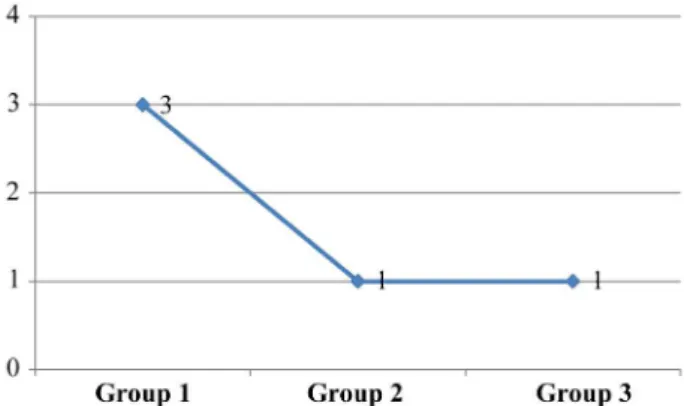
When dividing all 43 patients into 3 groups of 14 irst surgeries (group 1), 14 intermediate surger -ies (group 2) and 15 last surger-ies (group 3), we ob-tained the following results: 1) growing reduction was observed in the mean duration of surgery (Figure 5), group 1 presenting 246.07 minutes (ranging from 170 to 450 minutes), group 2 with 225.36 minutes (105 to 400 min.) and group 3 with 217.33 minutes (105 to 360 min.); 2) growing number of surgeries for
malig-Figure 5. Mean duration of surgery in the three groups of surgery.
Figure 6. Number of surgeries for malignant neoplasm removal in the three groups.
Figure 7. Number of conversions to laparotomy in the three groups of surgery.
cas-es, group 2 with 1 case and group 3 with 1 case. Mean hospitalization was 6.07 days in group 1, 10.29 days in group 2 and 6.60 in group 3.
When dividing the groups of the 2 most fre-quent surgical procedures into subgroups, we had the following results: from total 28 rectosigmoidectomy procedures, the 14 irst interventions (subgroup 1) had mean duration of surgery of 250.36 minutes (ranging from 170 to 450 minutes), while the 14 last interventions (subgroup 2) presented mean duration of 206.79 minutes (105 to 300 minutes). Subgroup 1 had 3 conversions, while subgroup 2 had no conver-sion. From total 6 right colectomy procedures, the 3 irst interventions (subgroup 1) had mean duration of surgery of 186.67 minutes (ranging from 170 to 210 minutes), while the 3 last interventions (subgroup 2) presented mean duration of 171.67 minutes (120 to 200 minutes). No conversions were performed in this group of surgeries (Table 1).
DISCUSSION
The study analyzed 43 patients submitted to laparoscopic colorretal surgery in the State of Ser-gipe. Most were females (n=30; 69.77%) in relation to males (n=13; 30.23%); age varied from 17 to 83 years old, with mean age of 57.21. The national Bra-zilian record of colorectal videosurgery in 20073,
which gathered data from 28 medical teams from different Brazilian states, also presented a greater number of female patients (n=2,750; 58.6%), at similar mean age (57.7 years old). The study ob-served increasing number of surgeries along the years, which is also demonstrated in this national record of 2007, as well as in studies conducted in other countries14.
Most patients had benign disease, with malig-nant neoplasm leading to surgery observed in 13 cases (30.23%). The study also observed increased number of cancer removed through laparoscopy during the analyzed period, also reported in other national and international studies3,14. Diverticular
disease was the most frequent indication (n=20; 46.51%), and 2 other cases had diverticular disease associated with another pathology, totaling 22 cases (51.16%). At the Service of Coloproctology at the Hospital das Clínicas da Universidade Federal do
Ceará and at the Hospital São Carlos, in the City of Fortaleza7, cancer treatment occurred in 141 cases
(35.1%), with this as the most frequent indication, followed by diverticular disease in 107 (26.7%). The national Brazilian record of colorectal video-surgery in 20073 also showed malignant disease
(n=2,389; 49.6%) as the most frequent indication, with diverticular disease in 961 cases (20.2%).
Among the surgical procedures, rectosigmoid-ectomy was the most frequent intervention (n=28; 65.12%), followed by right colectomy (n=6; 13.95%). A similar pattern was observed in national records3,4.
Results of records from laparoscopic colorectal sur-geries performed in the State of Minas Gerais – Bra-zil, from 1996 to 20094,showed rectosigmoidectomy
as the most frequent procedure (n=207; 41.1%), fol-lowed by right colectomy (n=63; 12.5%). Conver-sion was observed in ive cases (11.63%) out of eight cases with intraoperative complications (18.60%) in our study. One analysis performed in Singapore14, the
rate of conversions was 10.5%. The Brazilian medical literature3 reports conversions to laparotomy in 5.5%,
with rates ranging from 0 to 16.5% among the medi-cal teams.
When analyzing the group of patients with malignant neoplasm, the most frequent histologi-cal type was adenocarcinoma (n=12; 92.31%), fol-lowed by carcinoid tumor (n=1; 7.69%). Most of
Table 1. Mean duration of surgery and number of conversions in the procedures of rectosigmoidectomy and right colectomy.
Mean duration of
rectosigmoidectomy 228.57 minutes
14 irst surgeries 250.36 min
14 last surgeries 206.79 min
Conversions in
rectosigmoidectomy 3
14 irst surgeries 3
14 last surgeries 0
Mean duration of right colectomy 179.17 min
3 irst surgeries 186.67 min
3 last surgeries 171.67 min
REFERENCES
1 Corman ML, Sackier JM. Laparoscopic-assisted colon e rectal surgery. In: Corman ML, editor. Colon & Rectal Surgery. Philadelphia: Lippincott-Raven; 1998.
2 Regadas FSP, Averbach M, Campos FGCM, Pandini LC, Reis Neto AJ, Ramos JR. Experiência brasileira em cirurgia laparoscópica colorretal: [Mesa-redonda]. Rev bras videocir 2004;2(2):93-97.
3 Valarini R, Campos FGCM. Resultados do registro nacional brasileiro em vídeo-cirurgia colorretal 2007. Rev Bras Coloproct 2008;28(2):145-55.
4 Queiroz FL, Cortes MGW, Neto PR, Alves AC, Freitas AHA, Lacerda-Filho A, et al. Resultados do registro de cirurgias colorretais videolaparoscópicas realizadas no Estado de Minas Gerais – Brasil de 1996 a 2009. Rev Bras Coloproct 2010;30(1):61-7.
5 Chen HH, Wexner SD, Iroatulam AJ, Pikarsky AJ, Alabaz O, Nogueras JJ, et al. Laparoscopic colectomy compares favorably with colectomy by laparotomy for reduction of postoperative ileus. Dis Colon Rectum 2000;43(1):61-5. 6 Franklin ME Jr, Rosenthal D, Abrego-Medina D.
Prospective comparison of open versus laparoscopic colon surgery for carcinoma: five-year results. Dis Colon
Rectum 1996;39(10 Suppl):S35-46.
7 Regadas FSP, Regadas SMM, Rodrigues LV, Lima D, Silva FR, Regadas Filho FSP. Cirurgia colorretal laparoscópica. Experiência com 401 casos. Rev bras videocir.2005;3(4):191-5
8 Reis Neto JA, Cordeiro F, Quilici FA, Reis JA Jr. Cirurgia colorretal por videolaparoscopia versus cirurgia convencional. In: Ramos JR, Regadas FSP e Souza JS. Cirurgia colorretal por videolaparoscopia. Revinter: Rio de Janeiro; 1997. p. 29-33.
9 Pinho M. Por que a cirurgia colorretal por via laparoscópica ainda não se consolidou? In: Tópicos em gastroenterologia 11. Avanços em coloproctologia; 2001. p. 287-95.
10 Wexner SD, Cohen SM. Port site metastases after laparoscopic colorectal surgery for cure of malignancy. Br J Surg 1995;82:295-8.
11 Ramos JM, Gupta S, Anthone GJ, Ortega AE, Simons AJ, Beart RW Jr. Laparoscopy and colon cancer: is the port site at risk? A preliminary report. Arch Surg 1994;129(9):897-9.
12 Buchmann P, Christen D, Flury R, Luthy A, Bischofberger U. Does laparoscopic colonic carcinoma surgery satisfy the radicality criteria of open surgery? Schweiz Med Wochenschr 1995;125(39):1825-9.
them were moderately differentiated (80%) and were classified as stage II (50%) and III (40%) of the disease. Mean resected ganglia were 16.33 (ranging from 8 to 38). The record of surgeries performed in Minas Gerais4, the national record of
colorectal videosurgery in 20073 and the
interna-tional medical literature14 report similar results in
their studies.
Our study enabled to analyze the learn-ing curve in several evaluations. When dividlearn-ing all 43 patients into 3 groups of 14 first surgeries (group 1), 14 intermediate surgeries (group 2) and 15 last surgeries (group 3), we observed growing reduction in the mean duration of surgery, growing proportion of surgeries for malignant neoplasm re-moval and reduced number of conversions to lap-arotomy. When dividing the groups of two most frequent surgical procedures into subgroups with the first half of surgeries (subgroup 1) and the sec-ond half of surgeries (subgroup 2), we observed reduced mean duration of surgery and reduced rate of conversions. In the study conducted by Bruch
et al.15, the learning curve in laparoscopic
colorec-tal surgery was analyzed by dividing 300 patients into 3 groups of 100, for the period of 5 years. Conversion was observed in 22 cases (7.3%). The incidence of conversion reduced from 8.0% (first and second groups) to 6.0% (third group), and the mean duration of surgeries also reduced in the 3 groups: from 251.4 to 213.5 minutes (first and sec-ond groups) and to 196.9 minutes (third group).
CONCLUSION
13 Pandini LC, Gonçalves CA, Neto RC. Complicações da cirurgia colorretal laparoscópica. Tópicos em gastroenterologia 11. Avanços em coloproctologia; 2011. p. 319-27.
14 Wong MTC, Ng KH, Lim JF, Ooi BS, Tang CL, Eu KW. 418 cases of laparoscopic colorectal resections: a single-institution experience and literature review. Singapore Med J 2010;51(8):650-4.
15 Bruch H, Schiedeck Th, Schwandner O. Laparoscopic
colorectal surgery: a five-year experience. Dig Surg 1999;16(1):45-54.
Correspondence to: Fábio Ramos Teixeira
Avenida Oceânica, 1077, apt. 401, bloco A – Atalaia Velha CEP: 49035-000 – Aracaju (SE), Brazil
RESEARCH Protocol
LAPAROSCOPIC COLORRETAL SURGERY: iniTial EXPERIENCE
Name: Registration:
Age: Birth Date: Gender:
Marital Status: Occupation:
Origin: Place of Birth:
Date of Surgery: Hospitalization period:
Duration of Surgery:
1. Surgical indication:
( ) Malignant neoplasm ( ) Diverticular disease
( ) Inlammatory bowel disease ( ) Benign tumors
( ) Intestinal reconstruction after Hartmann procedure ( ) Others:____________________
2. Tumor site:
( ) Cecum ( ) Ascending colon
( ) Transverse colon ( ) Descending colon
( ) Sigmoid colon ( ) Rectum
( ) Cecal appendix ( ) Anal canal
3. Surgery performed:
( ) Rectosigmoidectomy ( ) Right colectomy
( ) Left colectomy ( ) Total colectomy
( ) Rectal amputation ( ) Others:____________________
4. Conversion: ( ) Yes ( ) No
4.1. Conversion causes:
( ) Technical dificulty ( ) Fixed tumor
( ) Adhesions ( ) Visceral lesion
( ) Bleeding ( ) Others:____________________
5. Intraoperative complications:
( ) Lesion of the ureter ( ) Vascular lesion
( ) Lesion of the small bowel ( ) Lesion in the colon
( ) Fault in mechanical suture ( ) Hypercapnia
( ) Others:____________________
6. Postoperative complications:
( ) Infection in surgical injury ( ) Anastomotic dehiscence or istula
( ) Extended ileum ( ) Bowel obstruction
( ) Bleeding ( ) Peritonitis
( ) Others:____________________
7. Anatomopathological analysis:
7.1. Diverticular Disease of Colons: ( ) Yes ( ) No
( ) Diverticulitis ( ) Diverticulosis
AUTHORIZATION
I, head of the _____________________, authorize chief investigator Dr. Fábio Ramos Teixeira to perform data search in the records of patients submitted to laparoscopic colorretal surgery.
The investigator guarantees that the execution of this study will not bring any type of damage to this institution, and that the identify and moral integrity of the patients, whose records will be analyzed in this study, will be preserved. Under no circumstance should public disclosures mention names.
The researcher will clarify any doubt about the study, and for this reason, should always be found at the address and telephone number below.
________________________________________________ HEAD OF THE INSTITUTION
_________________________________________________________________ FÁBIO RAMOS TEIXEIRA
HOSPITAL UNIVERSITÁRIO
Address: Rua Cláudio Batista, S/N – 49060-100 – Aracaju (SE), Brazil – Tel.: (55 79) 2105-1700, Fax: (55 79) 2105-1743
ATTENTION:
For this study, no Informed Consent Term will be required, as the study has no direct contact with the patients, only having the access to data from their medical records!
7.2. Cancer:
Histological type: ____________________________________
7.2.1. Degree of differentiation:
( ) Well differentiated ( ) Poorly differentiated
( ) Moderately differentiated ( ) Undifferentiated
7.2.2. Number of dissected ganglia:________
( ) Negative ( ) Positives How many:_____
7.2.3. Staging:
TNM (primary tumor extension, metastasis in regional lymph node, distant metastasis) _________________ ___________________________
8. Mortality: ( ) Yes ( ) No
8.1. Cause of surgical mortality:
( ) Intra-abdominal sepsis ( ) Heart failure
( ) Acute anemia (bleeding) ( ) Respiratory infection ( ) Others:____________________
9. Recurrent neoplasm: ( ) Yes ( ) No
Annex I - Continuation