(1) Hospital ULBRA – Mãe de Deus, Canoas, RS, Brasil.
(2) Departamento de Odontologia Preventiva e Social da Faculdade de Odontologia da Universidade Federal do Rio Grande do Sul, Porto Alegre, RS, Brasil.
(3) Universidade Federal de Santa Catarina, Florianópolis, SC, Brasil.
Conlict of interest: non-existent
Correlation between speech pathology screening
and diagnosis of children aged 0-12 years
Concordância entre classificação das queixas obtidas nas triagens
e diagnóstico fonoaudiológico de crianças de 0-12 anos
Liane Ribeiro Cesar(1) Roberta Alvarenga Reis(2) Fabiane Miron Stefani(3)
Received on: June 11, 2015 Accepted on: October 21, 2015
Mailing address: Fabiane Miron Stefani Rua Reverendo Gelson dos Santos Castro, 413 Florianópolis – SC - Brasil CEP: 88048-340
E-mail: [email protected]
doi: 10.1590/1982-021620161818115
ABSTRACT
Purpose: to analyze the correlation between the classiication of speech therapy indings on screening
with the results of speciic assessments of each area in a speech therapy school clinic in southern Brazil.
Methods: a descriptive, retrospective study of the cross-sectional cut from secondary data collected from
medical records of 133 children under 12 years old. The complaints classiication found during screening were compared with the diagnoses assigned after evaluation. They were classiied into 3 groups: Group 1 - totally in agreement: When the complaints and diagnoses identical in number and classiication, Group 2 - Partially disagree: Equal complaints and diagnoses, however, are others disagreeing in number or in the area of Speech Therapy and Group 3 - Complete disagreement: When there was disagreement on complaints and / or diagnosis, in number and classiication.
Results: the prevalence was 61 % for males. The average age was seven years and two months. There
was no signiicant difference between the values of groups 1 and 2, 47.4 % and 46.6 % respectively. Group 3 had only 6 %. The complaints that were reported during screening were classiied in Orofacial Motricity (34.9 %) , Speech (23.1 %) , Language (13.4%) and Phonology (8.6%). The most frequent diagnoses were : Orofacial Motricity (39.8%) , Phonology (20.4%), Language (11.8%), Speech (6.5%) . The complaints and diagnoses that had higher agreement were: Phonology, Orofacial Motricity, Stuttering and Language. The complaint of voice showed a greater disagreement.
Conclusion: there was agreement between the results of the screening and diagnosis, in number and
speech therapy areas, with the highest concerning the classiication of complaints and diagnoses related to Orofacial Motricity.
Keywords: Speech, Language and Hearing Sciences; Health Services Needs and Demand; Health
Sciences; Diagnosis; Triage
RESUMO
Objetivo: analisar a concordância entre a classiicação das queixas fonoaudiológicas encontradas na
tria-gem com os resultados das avaliações especíicas de cada área em uma clínica-escola de Fonoaudiologia
no sul do Brasil.
Métodos: estudo descritivo, retrospectivo, de corte transversal, a partir de dados secundários, coletados
de 133 prontuários das crianças com idade até 12 anos. A classiicação das queixas encontradas nas triagens foi comparada com os diagnósticos atribuídos após a avaliação. Foram classiicados 3 grupos: Grupo 1 - totalmente em acordo: Quando houve queixas e diagnósticos idênticos em número e clas-siicação; Grupo 2 – Parcialmente em desacordo: Queixas e diagnósticos iguais, mas havendo outros discordando em número ou em área da Fonoaudiologia; e Grupo 3 - Totalmente em desacordo: Quando houvesse discordância entre queixas e diagnósticos, em número e classiicação.
Resultados: a prevalência foi de 61% para o sexo masculino. A média de idade foi de sete anos e dois
meses. Não houve diferença signiicante entre os valores dos grupos 1 e 2, 47,4% e 46,6% respectiva-mente. O grupo 3 teve apenas 6%. As queixas que mais foram relatadas na triagem foram classiicadas em Motricidade Orofacial (34,9%), Fala (23,1%), Linguagem (13,4%) e Fonologia (8,6%). Os diagnósticos mais encontrados foram: Motricidade Orofacial (39,8%), Fonologia (20,4%), Linguagem (11,8%), Fala (6,5%). A classiicação das queixas e diagnósticos que obtiveram maior concordância foram: Fonologia, Motricidade Orofacial, Disluência e Linguagem. Apresentou maior discordância a queixa de voz.
Conclusão: houve concordância entre os resultados da triagem e do diagnóstico, em número e área
fono-audiológica, sendo que a maior foi referente à classiicação de queixas e diagnósticos em Motricidade Orofacial.
Descritores: Fonoaudiologia; Necessidades e Demandas de Serviços de Saúde; Ciências da Saúde;
Diagnóstico; Triagem
Original articles
INTRODUCTION
The fundamental starting point for any kind of
speech therapy is to ind out a person’s complaint or reason for seeking a speech therapist. A patient’s
complaint should be the core of treatment planned by the therapists, since it is the motivation for people to seek and adhere to treatment. It is essential that patients cooperate because speech therapists work with changing previously acquired habits and/or patterns1,2.
Many people looking for speech therapists are referred by other health professionals (dentists, doctors, etc.) or by teachers without knowledge of how to speech therapy is performed and if there is real need for it. More importantly, the complaint is actually not made by the patient or guardian, but by
the professional who referred the patient. By inding out patients’ complaints, these issues are addressed in
order to understand how interested and involved in the treatment patients are1,2.
Often, a patient is undergoing speech therapy, but they are not aware of what this science deals with and what it can contribute to their quality of life. A survey on the knowledge of caregivers of patients in a speech pathology university clinic on the work of speech thera-pists, showed that there was a narrow perception of the role of speech therapists in their profession and what they can offer to the population in terms of health promotion and disease prevention. In that survey, most participants answered that a speech therapist is someone who is working with speech and hearing, to
improve people’s communication, quality of life and
social relationships3.
The medical history interview has an important role
in enunciating the complaint, and it must be conigured
as a space for listening and making patients feel comfortable, because at this point they should explain their suffering as related to symptom(s)4. A complaint is understood as the spontaneous demonstration by the patient of physical injuries and harm caused by
any change in the ield of speech therapy. Being aware and sensitive to patients’ complaints helps prioritize the
care given to people seeking speech therapy.
The result of clinical assessment, in turn, should
provide suficient conditions for diagnosis, prognosis,
treatment plan and possible referrals for effectively
solving the problems identiied2,5. Thus, a speech therapist must determine whether or not the patient
needs therapy; deine a unique treatment plan; identify
the needs and limitations of intervention, necessary
additional tests, referrals and partnerships with other
professionals, and discuss patients’ conditions to start
treatment, if they need referrals to other professionals, and in the case of starting a speech therapy, what the limits of this work are2.
The objective of this study is to analyze the corre
-lation between the classiication of speech and hearing
complaints reported in screenings with the results of
speciic assessments of each speech and hearing
area in a university speech pathology clinic in southern
Brazil.
METHODS
This is a descriptive, retrospective, cross-sectional study. It was developed in the speech and hearing university clinic of the Speech Therapy Program of the Federal University of Rio Grande do Sul (UFRGS), located at the School of Dentistry. It was approved under protocol number 137.238 by the Research Ethics Committee - CEP / UFRGS, which dismissed the
signing of IC due to the proile of the research.
Data were collected from medical records of children aged under 12, who received care from speech thera-pists and interns in the above-mentioned university clinic, from March 2010 to October 2012. Patients who seek speech therapy university clinics do so spontane-ously or are referred by other professionals, researchers and other university clinics. The dental clinics, which operate in the same building, make the most referrals.
Out of a total of 702 screenings carried out, 544 were cataloged in a database, while the others (22.5%)
were not illed in correctly or were incomplete, hence
they were excluded from the sample. Only 133 records met the selection criteria - children up to 12 years of age and complete screening and assessment. These records were included in the sample.
Data were taken from the screening protocols available in the Speech Pathology Clinic at UFRGS and from assessment/ therapy data, contained in the speech-language records belonging to the above-mentioned clinic.
The variables identiied for the study were gender,
age, education (at the time of screening), origin, result
of screening, identiication number of speech and
hearing complaints and speech and hearing diagnosis.
Speech and hearing complaints were classiied
according to the various aspects of competence for speech therapists: Orofacial Motricity, Cleft Lip and Palate, Phonological Disorder, Hearing
Temporomandibular Disorder (TMD), Autistic Spectrum Disorders, Oral Language, Speech, Stuttering, People with Disabilities (PwD), Voice, Dysphagia and others.
The same classiication was used to categorize the
speech and hearing diagnosis.
Complaints found in every medical records were compared with the diagnoses given after assessment. The presence or absence of correlation was observed between the complaints and the respective diagnoses. The result of this survey was compared using the
following variables: number and identiication of
identical complaints and diagnosis.
Thus, three groups were classiied: Group 1 (G1) - Full agreement: When the number and classiication
of complaints and diagnoses were similar; Group 2 - Partial disagreement: Many complaints and diagnosis were identical, but there were others that disagreed on number or area of speech therapy. Group 3 - Total
disagreement: When there was disagreement between complaints and diagnoses in terms of number and
classiication.
Based on the analysis of the information contained in the medical records of patients, the data stored in a Microsoft Excel® spreadsheet were transposed into the statistical analysis software Statistical Program for Social Sciences (SPSS) version 17, and descriptive statistics was performed (frequency and percentage).
RESULTS
Out of the 133 records analyzed, there were 61%
male patients and 39% females.
The mean age was 7.2 months (standard deviation
2.75), with a minimum age of two years and ive months
and a maximum age of 12.9.
Table 1 shows data on gender, education and origin of the study population.
Table 1.Proile of patients who receive care in the Speech Pathology university clinic, Federal University of Rio Grande do Sul - gender,
education and origin. (Porto Alegre, 2013)
Variables N %
Sex
Male 81 60.9
Female 52 39.1
Education
Incomplete Elementary School 86 64.7
Early Childhood Education 3 2.3
Not reported 44 33.1
Municipality of Origin
Porto Alegre 75 56.4
Viamão 23 17.3
Gravataí 2 1.5
Other 23 17.3
Not reported 10 7.5
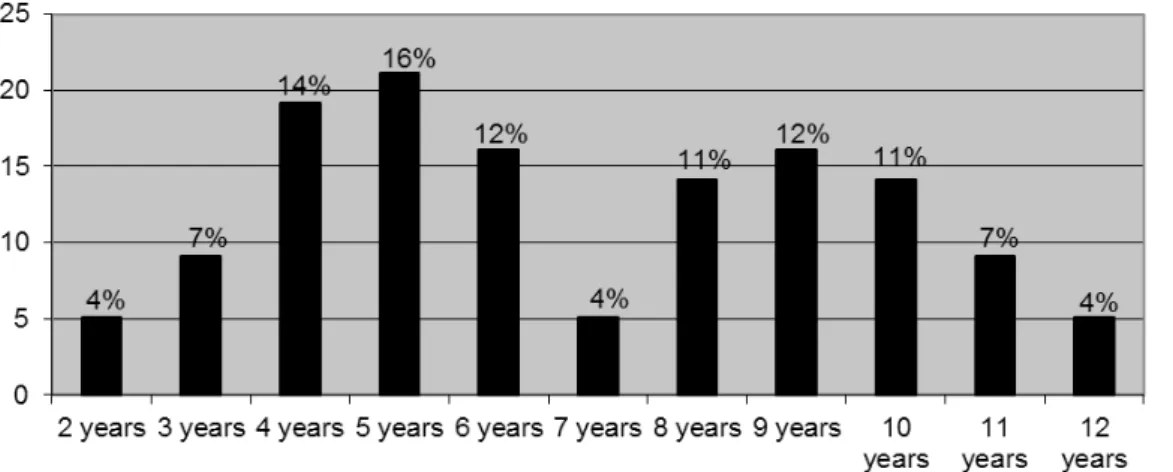
Figure 1 shows the absolute and percentage values of children that received care at the university clinic as far as age is concerned.
As shown in Figure 2, groups 1, 2 and 3 show the
classiication for screening and diagnosis. There was
little difference between the values of groups 1 and 2. Group 2 is worth of notice as it has high values; this shows partial agreement between the results of screening and assessment. Group 3 shows the results
of the disagreement, numbers and classiication,
between complaint and diagnosis. Figure 3 shows the distribution of the number of reported complaints per patient.
Figure 1. Distribution of screened and assessed patients at the Speech Pathology Clinic, as per age (Porto Alegre, 2013).
Figure 2. Distribution of patients screened and assessed according to the classiiers of correlation between complaint and diagnosis
(Porto Alegre, 2013).
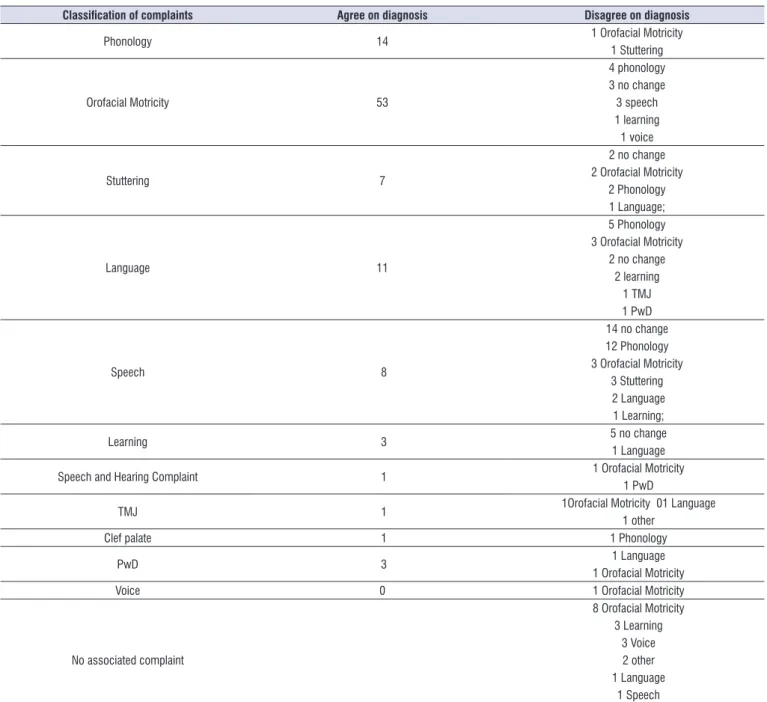
Table 2. Correlation between the classiication of complaints and diagnoses made in the Speech Pathology university clinic, Federal
University of Rio Grande do Sul. (Porto Alegre, 2013)
Classiication of complaints Agree on diagnosis Disagree on diagnosis
Phonology 14 1 Orofacial Motricity
1 Stuttering
Orofacial Motricity 53
4 phonology 3 no change 3 speech 1 learning 1 voice
Stuttering 7
2 no change
2 Orofacial Motricity
2 Phonology 1 Language;
Language 11
5 Phonology 3 Orofacial Motricity
2 no change 2 learning
1 TMJ 1 PwD
Speech 8
14 no change 12 Phonology
3 Orofacial Motricity
3 Stuttering 2 Language 1 Learning;
Learning 3 5 no change
1 Language
Speech and Hearing Complaint 1 1 Orofacial Motricity
1 PwD
TMJ 1 1Orofacial Motricity 01 Language
1 other
Clef palate 1 1 Phonology
PwD 3 1 Language
1 Orofacial Motricity
Voice 0 1 Orofacial Motricity
No associated complaint
8 Orofacial Motricity
3 Learning 3 Voice 2 other 1 Language
1 Speech 1 Autism
The frequency test showed the correlation
between classiication of complaints by patients and
the diagnosis made after the clinical assessment,
which can be seen in Table 2. The classiication of
complaints that were mostly related to the diagnoses were: Orofacial Motricity, Phonology, Language,
Speech and Stuttering. The classiication of complaints
The authors suggested that the speech-language disorders found (Language, Voice, Orofacial Motricity
and speeach and hearing complaints) are inluenced
by the environment where people live17.
In the present study, the area of Language was divided didactically into a few points: Phonology, Language, Speech, Speech and Hearing Complaints,
Stuttering, Autism and PwD. People classiied as others
had low frequency of complaints and were grouped together.
Studies show the prevalence in diagnosis of language8 and speech7,17,18 in the population. In two studies, the most common diagnosis was change in speech and the second, changes in language 7,8. The present study shows the most frequent diagnoses: Orofacial Motricity, Phonology and Language. Thus, the most frequent diagnosis does not agree on the
indings of the literature cited, but the second and third
agree on the reports of this literature.
The classiication of voice complaints in the
screening was not correlated with the diagnosis obtained in the assessment, since patients with this complaint had actually changes in Orofacial Motricity.
Although there are no similar data in Brazilian literature
to data in the present study, there is common sense about the scope of the term “voice”, which people in general associate with any problem related to “speaking”, from voice itself to problems in language,
luency and even speech articulation.
At the School of Dentistry X, the speech pathology clinic receives patients who come spontaneously, but also those referred by external projects and activities
(internships, research). However, a signiicant portion
of patients come from speech therapy provided in pediatric and orthodontic clinics and also to PwD. PwD patients receive care from a university extension project of the School of Speech Therapy from the institution of origin.
Thus, the emphasis on diagnosis of Orofacial
Motricity can be justiied by the sample, which includes
many patients referred by the university clinic of the School of Dentistry to the university clinic of the School of Speech Therapy.
To obtain data more accurately, it would be
inter-esting to standardize medical records, with speciic
options for classifying complaints and diagnoses
within the school clinic because these data were illed
by several students and various professionals. It is suggested that during the education and training of speech therapists, they practice using at least the quick
DISCUSSION
Most research previously reviewed agrees on the
indings of the present study, whereby there is higher
incidence of referrals to speech therapy for males6-13.
The explanations for this inding are not consensual,
and an author states that the brains of boys have slower maturation than those of girls6. Other studies point to genetic factors that determine the prevalence
of speciic language disorders in males14,15.
There was a higher incidence of ages 4-6 years, followed by 8-10 years, i.e., 42.1% of screenings and assessments occurred in children at pre-school and school age. Other authors described the relationship between speech-language disorders at similar ages7,11,12,16. It is noteworthy that at the age of ive, there was the largest number of complaints (15.8%). This result had been found previously and agrees on the literature13.
Most patients live in the city of Porto Alegre, where the speech pathology clinic is located. In a similar study conducted in Salvador, Bahia8, the researchers found a similar result to the one in the present study as regards place of residence of patients who sought for the speech theraphy clinic: 94.9% lived in the capital and only 5.1% lived in neighboring towns. In another study with similar objectives11, the authors found that 84.5% of patients who sought the speech pathology clinic at the University Hospital of the University of São Paulo (Ribeirão Preto campus) were from Ribeirão Preto, and the rest lived in other locations in the state of São Paulo.
This information suggests that services linked to universities are important references for the
munici-pality, in different regions of Brazil. However, the role of these clinics has not been identiied on the network of
speech therapy care associated with local SUS units, nor in neighboring municipalities. Thus, the impact
of the service on people’s access to speech therapy
treatment cannot be assessed.
Studies show speech disorders as the most common complaints in speech therapy7-9,12,16 offered in public services. In some studies, Orofacial Motricity is the second most frequent complaint 7-9. A survey
conducted in a clinic specializing in Language showed
records of institutions is also crucial, in order to survey more reliable information to allow comparison between the different services.
REFERENCES
1. Goulart BNG. A fonoaudiologia no tratamento das
issuras labiopalatinas: da infância a idade adulta. In: Marchesan I, Zorzi J, organizadores. Tópicos
em fonoaudiologia 2002/2003. Rio de Janeiro: Revinter; 2003. p.309-13.
2. Junqueira P. Avaliação Miofuncional IN: Marchesan IQ. Fundamentos em Fonoaudiologia: Aspectos Clínicos da Motricidade Oral. 2ª edição. Rio de Janeiro: Editora Guanabara Koogan; 2005. p. 19-27.
3. Pimentel AGL, Lopes- Herrera SA, Duarte TF. Conhecimento que acompanhantes de pacientes de uma clínica-escola de Fonoaudiologia tem
sobre a atuação fonoaudiológica. Rev Soc Bras
Fonoaudiol. 2010;15(1):40-6.
4. Ieto V, Cunha MC. Queixa, demanda e desejo na
clínica fonoaudiológica: um estudo de caso clínico.
Rev Soc Bras Fonoaudiol. 2007;12(4):329-34.
5. Goulart BNG, Chiari BM. Avaliação
clínica fonoaudiológica, integralidade e humanização:perspectivas gerais e contribuições para relexão. Rev Soc Bras Fonoaudiol.
2007;12(4):335-40.
6. Hage SRV, Faiad LN. Peril de Pacientes com alteração de Linguagem atendidos na Clínica de
Diagnósticos dos distúrbios da comunicação – Universidade de São Paulo – Campus Bauru. Rev
CEFAC. 2005;7(4):433-40.
7. César AM, Maksud, SS. Caracterização da
demanda de Fonoaudiologia no Serviço Público Municipal de Ribeirão das Neves – MG. Rev
CEFAC. 2007;9(1):133-8.
8. Costa RG, Souza LBR. Peril dos usuários e a demanda pelo serviço da clínica-escola de Fonoaudiologia da UFBA. R. Ci. Méd. biol., 2009;8(1):53-9.
9. Barros PML, Oliveira PN. Peril dos Pacientes atendidos no setor de Fonoaudiologia de um
Serviço Público de Recife-PE. Rev CEFAC.
2010;12(1):128-33.
10. Marques SRLM, Friche AAL, Motta AR. Adesão à
terapia em motricidade orofacial no ambulatório
de Fonoaudiologia do hospital das Clínicas da Universidade Federal de Minas Gerais. Rev Soc Bras Fonoaudiol. 2010;15(2):54-62.
reference guide to the ICD-10, prepared by the Federal Council of Speech Therapy19.
There is a different nomenclature in each article for the study speech pathologies, suggesting the
need for standardization of the nomenclature in each
area of speech therapy8,19. The literature consulted used different nomenclatures such as: phonological disorder9,13 phonetic deviation12, language delay9, language change7, abnormal speech7,12, ield of
Language8. The Federal Board of Speech Therapy
published a practical reference guide to the ICD-10, in which much of the speech-language disorders are cataloged19. Therefore, speech therapists should refer
to the classiication so that speech pathology can be uniformly registered throughout the Brazilian territory.
In addition, other data were absent in patients’
records. It would be interesting to continue the record of the activities for conducting research with a wider
range of records. Other studies have reported dificulty
accessing data from medical records for the same reason10-16. There should be uniformity in medical records in institutions for more adequate records of the procedures, production and conduction of more reliable research.
CONCLUSION
This study investigated the correlation between the
classiication of complaints reported on the results
of screening and speech pathology assessments
performed in a university clinic in southern Brazil. These indings indicate higher incidence for males,
aged 4-6 years, living in the city of Porto Alegre.
There was a larger number of complaints and diagnoses for Orofacial Motricity probably because the service was located next to the dental clinics. The second most frequent complaints and diagnoses occur in the area of Language, corroborating the literature.
There was correlation between the results
of screening classiication and diagnosis. The
complaints that were correlated with the diagnosis were: Phonology, Orofacial Motricity, Stuttering and Language. In some sub-areas of speech therapy, there was little correlation regarding complaints and
diagnoses. The classiication of complaints about voice
in the screenings showed partial or no correlation with the diagnosis obtained in the assessment.
11. Mandrá PP, Diniz MV. Caracterização do peril
diagnóstico e luxo de um ambulatório de Fonoaudiologia hospitalar na área de Linguagem
infantil. Rev Soc Bras Fonoaudiol. 2011;16(2):121-5. 12. Diniz RD, Bordin R. Demanda em Fonoaudiologia
em um serviço público municipal da região Sul do
Brasil. Rev Soc Bras Fonoaudiol. 2011;16(2):126-31. 13. Cavalheiro LG, Brancalioni AR, Keske-Soares M.
Prevalência de desvio fonológico em crianças
da cidade de Salvador, Bahia. Rev Soc Bras Fonoaudiol. 2012;17(4):441-6.
14. Lai CS, Fisher SE, Hurst JA, Vargha-Khadem F, Monaco AP. A forkhead-domain gene in mutatedin a severe speech and language disorder. Nature. 2001;413(6855):519-23.
15. O´Brien EK, Zhang X, Nishimura C, Tomblin
JB, Murray JC. Association of speciic language
impairment (SLI) to the region of 7q31. Am J Hum Genet. 2003;72(6):1536-43.
16. Antunes DK. Peril fonoaudiológico da comunidade
do Dendê: perspectiva para ações futuras. Rev Soc
Bras Fonoaudiol. 2010;15(2):264-9.
17. Ceballos AGC, Cardoso C. Determinantes sociais
de alterações fonoaudiológicas. Rev Soc Bras
Fonoaudiol. 2009;14(3):441-5.
18. Goulart BNG; Chiari BM. Prevalência de desordens de fala em escolares e fatores associados. Rev
Saúde Públ. 2007;41(5):726-31.
19. Conselho Federal de Fonoaudiologia. Guia Prático
de Consulta Rápida da CID-10 pelo fonoaudiólogo.