The use of an anTagonisT 5-hT2a/c
for depression and moTor funcTion
in parkinson’s disease
Antonio Luiz dos Santos Werneck
1, Ana Lucia Rosso
2, Maurice Borges Vincent
3abstract – Objective: To test the ability of a 5HT2a/c (trazodone) antagonist, to improve depression and motor function in Parkinson’s disease (PD). Method: Twenty PD patients with and without depression were randomly assigned to receive trazodone (group 1) or not (group 2). They were evaluated through UPDRS and Hamilton Depression Rating Scale (HAM-D). Results: For the UPDRS the mean score of group 2 was 33.1±19.7 and 37.1±18.0 at the end. For the group 1, the corresponding scores were 31.4±11.3 and 25.9±13.7. The variations in the Mann-Whitney test were 0.734 at the initial moment and 0.208 at the final moment. The variation in the comparison of the initial moment with the final moment was 0.005 providing statistical significance. For the HAM-D, the mean score went up 4 points in group 2, contrary to a 5.5 points decrease in group 1. Conclusion: Data analysis shows that this agent significantly improves depression, but the motor function improved only in the depressed patients. Because of the known anti-dopaminergic property of the 5-HT2c receptors, a possible approach for depression in PD could be the use of 5-HT2c antagonists, similarly to the use of atypical neuroleptics in case of psychotic symptoms.
KEY WORDS: trazodone, depression, Parkinson’s disease phases of PD.
uso de um antagonista 5-hT 2a/c na depressão e na função motora de pacientes com doença de parkinson resumo – Objetivo: Avaliar a eficácia de um antagonista 5-HT2a/c (trazodona) na depressão e na função motora de pacientes com doença de Parkinson (DP). Método: Vinte pacientes com DP com e sem depressão foram randomizados e divididos em 2 grupos com e sem a trazodona (grupos 1 e 2). Foram avaliados pela escala UPDRS e a de depressão de Hamilton (EDH). Resultados: A média inicial do grupo 2 na UPDRS foi 33,1±19,7 no momento inicial e 37,1±18,0 no final. Para o grupo 1 as médias correspondentes foram 31,4±11,3 e 25,9±13,7. As variações no teste de Mann-Whitney foram 0,734 no momento inicial e de 0,208 no final. A variação na comparação entre o momento inicial e o final foi 0,005, caracterizando significância estatística. Para a EDH a média subiu 4 pontos no grupo 2, e desceu 5,5 pontos no grupo 1. Conclusão: A análise estatística revelou melhora da depressão, porém o benefício na função motora foi obtido apenas entre os deprimidos. Do mesmo modo que os neurolépticos atípicos atuam nos sintomas psicóticos, a ação secundária dopaminérgica do antagonista 5-HT2c pode ser útil no tratamento da depressão na DP.
PALAVRAS-CHAVE: trazodona, depressão, doença de Parkinson.
Hospital Universitário Clementino Fraga Filho da Universidade Federal do Rio de Janeiro (HUCCF/UFRJ), Rio de Janeiro RJ, Brazil: 1Professor de Neuro-logia da Universidade Estácio de Sá, Médico do Setor de NeuroNeuro-logia do HUCCF/UFRJ; 2Doutora em Neurologia (UFRJ), Médica do Setor de Neurologia do HUCFF/UFRJ; 3Doutor (Noruega), Professor Adjunto do Departamento de Clínica Médica (Serviço de Neurologia) do HUCCF/UFRJ.
Received 20 October 2008, received in inal form 8 January 2009. Accepted 2 April 2009.
Dr. Antonio Luiz dos Santos Werneck – Rua México 70 / 902 - 20031-140 Rio de Janeiro RJ - Brasil. E-mail: [email protected]
Non-motor symptoms make a significant contribu-tion to the morbidity rates of Parkinson’s disease (PD). Meta analytic data on the prevalence of depressive symp-toms ranks to 31%1. Two previous series in Brazil found
depression occurring in 38.33% and 24% of parkinsonian patients2,3. Surprisingly enough, the irst studies on
PD-re-lated depression management date back to the end of the
ifties, when Sigwald et al.4 related isolated cases of motor
worsening during imipramine treatment in depressed pa-tients with PD. Besides, out of 43 studies carried out dur-ing 35 years of research, there were only three random-ized trials on this matter5. The leuchine-rich repeat kinase
the LRRK2 p.G2019S among Brazilian PD patients6. A
pos-sible susceptibility to develop depression in PD may be linked to a genetic condition. A recent animal model for PD showed that the engrailed1 gene might be implicated in some cases of PD depressive patients7.
Selective serotonin reuptake inhibitors (SSRIs) have been used to treat depression in PD. However, study evi-dence on the eficacy and safety of antidepressants in PD is lacking. There are several 5-HT receptor subtypes, in-cluding the 5-HT1a, 5-HT1b, 5-HT2a, 5-HT3 and 5-HT4 re-ceptors. 5-HT2c receptors located to the substantia nigra
and the ventral tegmental area may affect the dopaminer-gic activity, possibly interfering with motor control, moti-vation and rewarding mechanisms in the brain. In keeping with its ability to modulate dopamine (DA) neuron func-tion in the brain, the 5-HT2C is currently considered as a major target for improved treatments of neuropsychiatric disorders related to DA neuron dysfunction, such as de-pression, schizophrenia, Parkinson’s disease or drug addic-tion. It has been shown that the receptor 5-HT2a increas-es the dopaminergic activity, contrary to the reduced ac-tion evoked by the 5-HT2c receptor activaac-tion8. Despite
these antagonistic actions, the much bigger anatomical, functional expressivity of 5-HT2c on 5-HT2a has become the inhibition of 5-HT2c as representative of the second-ary dopaminergic function9,10.
The objective of this study was to test the hypothesis that oral trazodone, a 5-HT2a/c antagonist/reuptake in-hibitor, improve motor phases and depression in PD.
meThod
This randomized study was approved by the HUCFF-UFRJ ethics committee. Twenty PD patients classiied in the category
3 (clinically deinite: plastic rigidity, bradykinesia, postural distur-bance and rest tremor) according to Calne et al.11 with and
with-out depression were randomized in two groups. During 5 months (from T0 to T5), apart from usual PD care, group 1 (G1) received 50 mg trazodone orally twice a day, contrary to group 2 (G2), with no trazodone. The individuals all came from the Movement Disorders Sector at the Clementino Fraga Filho University Hos-pital (Federal University of Rio de Janeiro).
All the individuals were blind examined every month by two examiners: one ranked the scales, without knowing if the drug was applied or not, and the other did the randomizing, not stratiied, without knowing the categories of the scales. Subjects were examined every month and ranked by an independent phy-sician according to different scales: Uniied Parkinson’s Disease Rating Scale Score (UPDRS), Hoehn and Yahr (HY), Schwab and England (SE) and the Hamilton Depression Rating Scale (HAM-D). The UPDRS was carried out for parts II and III. Depressive symp-toms were assessed through the HAM-D 17 scale with a cut point of 10 (HAM-D≥10)4. No other antiparkinsonian drug was added.
Baseline exclusion criteria were: (1) secondary or atypical Par-kinsonism; (2) organic mental syndrome related to cognitive and non-cognitive symptoms; (3) PD diagnosis before the age of 45 or after 75. Follow-up exclusion criteria were: (1) change in the dose or type of the antiparkinsonian drug; (2) signs or symptoms potentially interfering with the results.
All the analysis was conducted in observed case type and in a comparison between groups. The p-values were two tailed. Wil-coxon test was used to compare different groups with baseline. The Mann-Whitney test was employed comparing the groups.
resulTs
Fifteen men (75%) and ive women (25%) entered the protocol. Ages ranged between 45 and 75 years old
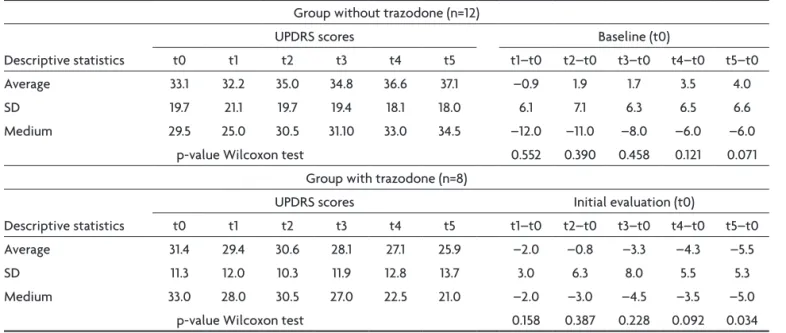
(av-Table 1. UPDRS of groups with and without medication.
Group without trazodone (n=12)
Descriptive statistics
UPDRS scores Baseline (t0)
t0 t1 t2 t3 t4 t5 t1–t0 t2–t0 t3–t0 t4–t0 t5–t0
Average 33.1 32.2 35.0 34.8 36.6 37.1 –0.9 1.9 1.7 3.5 4.0
SD 19.7 21.1 19.7 19.4 18.1 18.0 6.1 7.1 6.3 6.5 6.6
Medium 29.5 25.0 30.5 31.10 33.0 34.5 –12.0 –11.0 –8.0 –6.0 –6.0
p-value Wilcoxon test 0.552 0.390 0.458 0.121 0.071
Group with trazodone (n=8)
Descriptive statistics
UPDRS scores Initial evaluation (t0)
t0 t1 t2 t3 t4 t5 t1–t0 t2–t0 t3–t0 t4–t0 t5–t0
Average 31.4 29.4 30.6 28.1 27.1 25.9 –2.0 –0.8 –3.3 –4.3 –5.5
SD 11.3 12.0 10.3 11.9 12.8 13.7 3.0 6.3 8.0 5.5 5.3
Medium 33.0 28.0 30.5 27.0 22.5 21.0 –2.0 –3.0 –4.5 –3.5 –5.0
p-value Wilcoxon test 0.158 0.387 0.228 0.092 0.034
erage 62.3). The length of the illness varied between 1.6 to 16.3 years. Randomization for the use of trazodone se-lected twelve patients without trazodone (G2) and eight with the drug (G1). The percentage of depressed patients in G1 was 75% (6/8) and 58,3% (7/12) in G2.
The scales of HY and SE provided an average and stan-dard deviation without statistical signiicance. The illness time span varied from 1.6 to 16.3 years. In the trazodone group three patients left the protocol: Two due to sleep-iness and one because of postural vertiginous sensation. These three patients were not included in the analysis performed. All patients took at least one of the follow-ing antiparkinsonian drugs: carbidopa + levodopa (250/25 mg), amantadine (100 mg) and/or pramipexole (0.25–1g). Table 1 shows the UPDRS variation and the corre-sponding p values for the moment-to-moment
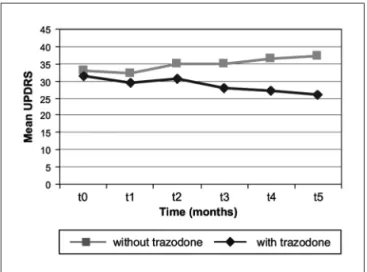
compari-sons, separating the groups with and without trazodone. To make things clearer the variation was analyzed from an initial time T0 to an ending time T5. The initial average of the group G2 was of 33.1 (SD 19.7) rising to 37.1 (σ=18.0) at the end. The initial average of the group G1 was 31.4 (σ=11.3) ending in 25.9 (σ=13.7). The result was stability in the group G2 and a slight decline in the group G1. The Wil-coxon test of 0.034 only showed results during the last period (T5), even so there was a reduction tendency. Fig-ure shows the average value of the UPDRS by month. The variations in the Mann-Whitney test were 0.734 at the ini-tial moment and 0.208 at the inal moment. The variation in the comparison of the initial moment with the inal moment was 0.005 providing statistical signiicance.
A moderate fall in the average of the UPDRS in the group G1was observed, though no variation of this aver-age in the group G2. The variation in the HAM-D from the initial moment until the inal moment showed in the group G2 that the average varied from 11.4 (SD=7.2) to 10.2 (SD=7.4). The p-value of the Wilcoxon test was 0.235 in the T5-T0 variation, with statistical signiicance. In the group G1 the initial average was 12.4 (SD=6.3) and inal av-erage 6.0 (SD=4.6). The p-value of the Wilcoxon test was of 0.062 in variation T5-T0. The average of the HAM-D went up by 4 points in the group G2 and went down by 5.5 points in the group G1.
The groups at the initial moment and the inal mo-ment were analyzed, showing a fall on average of 12.4 at the initial moment to 6.0 at the inal moment in the group G1. The p-value of the Wilcoxon test was 0.115 in the T5-T0 variation, demonstrating a tendency to drop. In the group G2 the patients at the cutting off point of ten points had remained unchanged in the points of the HAM-D until the
Figure. Mean UPDRS analysis in all patients.
Table 2. Statistics of the HAM-D according to time.
Without medication (n=12)
Descriptive statistics
HAM–D Initial evaluation (t0)
t0 t1 t2 t3 t4 t5 t1–t0 t2–t0 t3–t0 t4–t0 t5–t0
Average 11.4 10.0 11.0 10.8 10.2 10.2 –1.4 –0.4 –0.7 –1.3 –1.3
SD 7.2 7.8 7.7 7.4 6.9 7.4 2.6 2.2 3.0 2.9 3.1
Medium 11.5 7.0 11.0 10.0 10.0 9.5 –0.5 –0.5 –2.0 –2.0 –2.0
P-value Wilcoxon test 0.083 0.486 0.398 0.218 0.235
With medication (n=8)
Descriptive statistics
HAM–D Initial evaluatiom (t0)
t0 t1 t2 t3 t4 t5 t1–t0 t2–t0 t3–t0 t4–t0 t5–t0
Average 12.4 10.0 8.5 6.6 5.9 6.0 –2.4 –3.9 –5.8 –6.5 –6.4
SD 6.3 6.8 5.7 5.0 4.6 4.6 5.2 6.8 6.7 6.7 6.8
Medium 14.0 8.5 7.5 5.0 4.0 4.0 –1.5 –2.0 –3.5 –6.0 –6.0
p-value Wilcoxon test 0.248 0.104 0.034 0.045 0.062
end. In the medicated patients only one, of a total of six, remained unchanged
In Table 2, the group at the initial moment and the i-nal moment is ai-nalyzed, showing a fall on average of 12.4 at the initial moment to 6.0 at the inal moment in the group G1. The p-value of the Wilcoxon test was 0.115 in the T5–T0 variation, demonstrating a tendency to drop. In the group G2 the patients at the cutting off point of ten points had remained unchanged in the points of the HAM-D until the end. In the medicated patients only one, of a total of six, remained unchanged. Table 3 shows the Spearman correlation coeficients on the variables of the HAM-D and the UPDRS scales. The UPDRS inding of 0,895 is highly correlated and signiicant as it is so close to 1.
discussion
From the existing literature, reporting on both in vivo and postmortem data in animal models and in humans, it is apparent that the serotonergic neurotransmitter sys-tem is involved in the pathophysiology of PD. The exper-imental evidence supporting the role of serotonin in mo-tor control was irstly found in 199312. Prospective survey
suggested that depression associates psychomotor dis-turbances to some type of dopaminergic dysfunction13-15.
A strong correlation between the depression severi-ty and degree of motor dysfunction was demonstrated in PD16. The authors speculated that the reduced serotonin
levels in PD could be related to the reduced motor activ-ity in depressed patients with PD, which is observed es-pecially when these are compared to the non-depressed patients. They also described an association of depression with the severity of bradykinesia and axial rigidity.
Other studies also associated motor function and de-pressive symptoms in PD14,17. In a revision of these studies
Di Giovanni et al.8 reported that the exposition of
stria-tum and nucleus accumbens to serotonin causes an in-crease in dopamine release. After checking that drugs acting on the receptors 5-HT2c can diminish the levodo-pa-induced diskynesias, concluded that these receptors participate in the functions of the basal ganglia and the pathophysiology of parkinsonism.
In animal models of PD serotonergic research has mainly focused on the 5-HT1 and 5-HT2 receptor sub-type. According to Scholtissen and cols.18, the most
rele-Table 3. Spearman correlation coeficients for UPDRS and HAM-D. G2 (n=12)
UPDRS and HAM-D
UPDRS HAM-D
Initial (t0) Final (t5) Variation (D) Initial (t0) Final (t5)
Final UPDRS correlation
p-value
0.895
<0.001
1
D UPDRS correlation
p-value –0.140 0.664 0.175 0.586 1
Initial HAM-D correlation
p-value 0.748 0.005 0.695 0.012 –0.041 0.900 1
Final HAM-D correlation
p-value 0.867 <0.001 0.839 0.001 0.158 0.623 0.881 <0.001 1
D HAM-D correlation
p-value 0.430 0.163 0.349 0.266 –0.069 0.831 –0.016 0.961 0.358 0.254 G1 (n=8)
UPDRS and HAM-D
UPDRS HAM–D
Initial (t0) Final (t5) Variation (D) Initial (t0) Final (t5)
Final UPDRS correlation
p-value
0.946
<0.001
1
D UPDRS correlation
p-value 0.323 0.435 0.530 0.177 1
Initial HAM-D correlation
p-value 0.479 0.230 0.452 0.261 –0.398 0.329 1
Final HAM-D correlation
p-value 0.166 0.694 0.238 0.571 0.295 0.477 0.045 0.916 1
D HAM-D correlation
p-value 0.740 0.036 0.799 0.017 0.744 0.034 –0.744 0.034 0.423 0.297
vant aspects of the serotonin-dopamine relationship are the following: (A) The 5-HT2a receptor is excitatory for dopamine release, while 5-HT2c is inhibitory; (B) the pro-gressive degeneration of the dopaminergic neurons causes the dopamine synthesis to occur in serotoninergic termi-nals; (C) Neuroimagings show reduction of serotonin in some cortical and subcortical areas in PD; (D) there is a re-duction in 5-HT2a receptors density in the premotorcor-tex contralaterally to the side of motor symptoms onset in PD. The compensatory reduction of the serotonin sec-ondary to the dopaminergic neuronal loss may contribute to the improvement of the motor function, but this may increase the risk of depression signiicantly.
Two previous reports19,20 showed that trazodone may
improve tremor in PD. However, these studies were not randomized, not blind, and patients were not submitted to the HAM-D or UPDRS scales. In our study the choice of not doing a double-blind study or not treating the con-trol group with placebo, possibly restricts the signiicance of the inding. However, studies involving placebo in PD might generate conlicting results. In PD dopaminergic ac-tivation of pathways mediating reward may be responsible for a positive placebo response in up to 50% of patients21.
Same results have been seen in depression, where place-bo partially reproduces selective reuptake inhibitor-me-diated brain activation.
Trazodone is a serotonin reuptake inhibitor with spe-ciic antagonistic action at 5-HT2a/2c receptors. A do-paminergic burst while the system suffers an antagonist action is apparently a paradox. However, Balsara et al.10
signaled that the antagonistic action of trazodone at re-ceptors 5-HT2c clearly predominates. The trazodone do-paminergic action at 5-HT2c receptors is observed with doses varying from 5 to 20 mg/kg/day. Larger doses de-termining contrary effects may be related to lower toler-ance. This could also occur with antidepressants because of desensitization of serotoninergic autoreceptors at neu-rons in the raphei nucleus22.
Di Matteo et al.23 reported that the disinhibition of the
mesocorticolimbic function induced by 5-HT2c receptors antagonism may treat psychotic symptoms in PD, since second generation neuroleptics produce fewer extrapy-ramidal effects and have an inverse 5-HT2c agonist action. The antidepressive performance of the receptors 5-HT2c could therefore serve as a model for the treatment of de-pression in PD. Based on the principle that the activation of 5-HT2c receptors increases the activity in the substan-tia nigra, it is possible that the stimulation of these re-ceptors contributes to an increase in basal ganglia output which would favour parkinsonian symptoms. The expres-sion of 5-HT2c receptors in the substantia nigra pars re-ticulata and in the medial pallidal complex supports this hypothesis24. Moreover, 5-HT2c receptors binding was
in-creased in a model of parkinsonism developed in rats25,
as well as in parkinsonian patients26.
In an open study27, where an average dose of
nefa-zodone for a period of four months on three depressive patients with PD, was used, there were improvements in the motor symptoms submitted previously to luoxetine. The results showed reduction of tremor in the three pa-tients, and a discrete improvement, at the beginning and in the development of gait in another two.
This comment would be repeated in the following year by Avila et al.28, who compared motor improvement
following nefazodone in nine depressed parkinsonian pa-tients, with a luoxetine treated control. Motor improve-ment following nefazodone was reported in parkinsonian patients and not in luoxetine treated group. According to Avila and colleagues, blocking 5-HT2 receptors promotes dopamine release and a subsequent reduction of D2 re-ceptor blockade, resulting in a reduction of extrapyrami-dal symptoms.
Experimental studies suggest a primary relationship and the importance of dopaminergic mechanisms in PD and depression. Thus, treatment with dopamine agonists promises to reduce motor complications as well as de-pressive symptoms, avoiding multiple drug interactions as well as possible antidepressant medication side effects29.
There are case reports and echocardiographic studies sug-gesting that the ergot-derived dopamine agonists, per-golide and cabergoline, increase the relative risk of cardi-ac-valve regurgitation30. No cases were attributed to
ro-pinirole or pramipexole, but like antidepressants these non-ergoline substances most commonly causes nausea and sleep disturbances. Also, drug-induced psychosis may complicate the course and management of PD and are as-sociated with dopamine agonists.
Several reports show that non-5-HT2c antagonistic SSRIs may abruptly unleash parkinsonism. However, PD evolves slowly over many years. There is no report on the motor evolution of PD patients under these drugs for a period longer than seven months. The chronic use of SS-RIs with this type of action may perhaps lead to a wors-ening of the motor function in this context.
Based on available data, trazodone signiicantly im-proved motor symptoms only in depressed patients. This result also favors the hypothesis that depressed PD patients may gain a beneit in the motor symptoms when treated by antidepressants, and that this effect may be related, at least in part, to the inhibition of the 5-HT2c receptor.
references
1. Giupponi G, Pycha R, Erfurrth A, Hausmann A, Conca A. De-pressive symptoms and the idiopathic Parkinson’s syndrome (IPS): a review. Neuropsychiatr 2008;22:71-82.
2. Prado RC, Barbosa ER. Depression in Parkinson’s disease. Arq Neuropsiquiatr 2005;63:766-771.
3. Tumas V, Rodrigues GG, Ricioppo F, Tarsis LA, Crippa JAS. The accuracy of diagnosis of major depression in patients with Parkinson’s disease: a comparative study among the UPDRS, the geriatric depression scale and the Beck depression inven-tory. Arq Neuropsiquiatr 2008;63:152-156.
4. Sigwald J, Bouttier CI, Raymondeaud M, Marquez Mlle, Gal J.-C. Étude de l’action sur l’akinésie parkinsonienne de deux derives de l’iminodibenzyle: imipramine ou 8307 RP. Presse Medical 1959;67:1697-1698.
5. Chung TH, Deane KH, Ghazi-Noori S, Rickards H, Clarke CE. Systematic review of antidepressant therapies in Parkinson’s disease. Parkinsonism Relat Disord 2003;10:59-65.
6. Pimentel MM, Moura KC, Abdalla CB, et al. A study of LKRR2 mutations in Brazil. Neurosci Lett 2008; 433:17-21.
7. Le Pen G, Sonnier L, Hartmann A, et al. Progressive loss of dopaminergic neurons in the ventral midbrain of adult mice heterozygote for Engrailed1: a new genetic model for Parkin-son’s disease? Parkinson Relat Disord 2008;14:107-111. 8. Di Giovanni G, Di Matteo V, Pierucci M, Benigno A, Esposito
E. Central serotonin 2C: From physiology to pathology. Curr Top Med Chem 2006;6:1909-1925.
9. Lucas G, De Deurwaerdere P, Caccia S, Umberto S. The effect of serotonergic agents on haloperidol-induced striatal dop-amine release in vivo: opposite role of 5-HT(2A) and 5-HT(2C) receptor subtypes and signiicance of the haloperidol dose used. Neuropharmacology 2000;39:1053-1063.
10. Balsara JJ, Jahdav SA, Gaonkar RK, Gaikwad RV, Jahdav JH. Effects of the antidepressant trazodone, a 5-HT2a/2c antago-nist, on dopamine-dependent behavior in rats. Psychophar-macology 2005;179:597-605.
11. Calne DB, Snow BJ, Lee C. Criteria for diagnosing Parkinson’s disease. Ann Neurol 1992;32:125-127.
12. Jacobs BL, Fornal CA. 5-HT and motor control: a hypothesis. Trends Neurosci 1972;16:346-352.
13. Sachdev P, Aniss AM. Slowness of movement in melancholic depression. Biol Psychiatry 1994;35:253-262.
14. Kuhn W, Heye N, Muller T, et al. The motor performance test series in Parkinson’s disease is inluenced by depression. J Neural Transm 1996;103:349-354.
15. Malhi GS, Berk M. Does dopamine dysfunction drive depres-sion? Acta Psychiatr Scand 2007;433:116-124.
16. Papapetropoulos S, Ellul J, Argyriou AA, Chroni E, Lekka NP.
The effect of depression on motor function and disease severity of Parkinson’s disease. Clin Neurol Neurosurg 2006;108:465-469. 17. Mayeux R, Stern Y, Cote L, Williams JBW. Altered serotonin
metabolism in depressed patients with Parkinson’s disease. Neurology 1984;34:642-646.
18. Scholtissen B, Verley FRJ, Steinbush HWM, Leetjens AFG. Sero-tonergic mechanisms in Parkinson’s disease: opposing results from preclinical and clinical data. J Neural Transm 2006;113:59-73. 19. Mastrosimone F, Coluci d’Amato C, De Angelis G, Iaccarino
C, Giordano L, Armo E. Personal experience with a combina-tion of drugs in subjects with dopa resistant Parkinson’s dis-ease. J Med 1980;11:377-383.
20. Piccinin GL, Piccirilli M, Agostini L. La terapia del Parkin-son com l’associazione L-dopa (più carbidopa) e trazodone. Cl Terap 1981;96:621-626.
21. Diederich NJ, Goetz CG. The placebo treatment in neurosci-ences: new insights from clinical and neuroimaging studies. Neurology 2008;71:677-684.
22. Blier P, deMontigny C, Chaput Y. Modiication of the serotonin system by antidepressant treatment: implications for the re-sponse in major depression. J Clin Psychopharmacol 1987;7:24-35. 23. Di Matteo V, Cacchio M, Di Giulio C, Esposito E. Role of sero-tonin (2C) receptors in the control of brain dopaminergic func-tion. Pharmacol Biochem Behav 2002;71:727-734.
24. Abramowski D, Rigo M, Due D, Hoyer D, Staunfebiel M. Lo-calization of 5- hydroxytryptamine 2c receptor protein in
hu-man and rat brain using speciic antisera. Neuropharmacolo
-gy 1995;34:1635-1645.
25. Radja F, Descarries L, Dewar KM, Reader TA. Serotonin 5-HT1 and 5-HT2 receptors in adult rat brain after destruction of ni-grostratal dopamine neurons: a quantitative autoradiograph-ic study. Brain Res 1993;606:273-285.
26. Fox SH, Brotchie JM. 5-HT2c receptor binding is increased in the substantia nigra pars reticulata in Parkinson’s disease. Mov Disord 2000;15:1064-1069.
27. Werneck ALS, Gonçalves AFS. Nefazodona no parkinsonismo secundário à luoxetina. Arq Neuropsiquiatr 2002;60:1:114. 28. Avila A, Cardona X, Martin-Baranera M, Maho P, Sastre F,
Bel-lo J. Does nefazodone improve both depression and Parkin-son’s disease? A pilot randomized trial. J Clin Psychopharma-col 2003;23:509-513.
29. Lemke MR, Brecht HM, Koester J, Reichmann H. Effects of the dopamine agonist pramipexole on depression, anhedonia and motor functioning in Parkinson’s disease. J Neurol Sci 2006;25:266-270.