Nat. Hazards Earth Syst. Sci., 16, 2577–2591, 2016 www.nat-hazards-earth-syst-sci.net/16/2577/2016/ doi:10.5194/nhess-16-2577-2016
© Author(s) 2016. CC Attribution 3.0 License.
INSYDE: a synthetic, probabilistic flood damage model based on
explicit cost analysis
Francesco Dottori1,*, Rui Figueiredo2,*, Mario L. V. Martina2,*, Daniela Molinari3,*, and Anna Rita Scorzini4,*
1European Commission, Joint Research Centre, Ispra, Italy 2Scuola Universitaria Superiore IUSS Pavia, Pavia, Italy
3Dipartimento di Ingegneria Civile e Ambientale, Politecnico di Milano, Milano, Italy
4Dipartimento di Ingegneria Civile, Edile-Architettura e Ambientale, Università degli Studi dell’Aquila, L’Aquila, Italy *These authors contributed equally to this work.
Correspondence to:Rui Figueiredo ([email protected])
Received: 11 May 2016 – Published in Nat. Hazards Earth Syst. Sci. Discuss.: 17 May 2016 Revised: 3 October 2016 – Accepted: 24 October 2016 – Published: 2 December 2016
Abstract. Methodologies to estimate economic flood dam-ages are increasingly important for flood risk assessment and management. In this work, we present a new synthetic flood damage model based on a component-by-component anal-ysis of physical damage to buildings. The damage functions are designed using an expert-based approach with the support of existing scientific and technical literature, loss adjustment studies, and damage surveys carried out for past flood events in Italy. The model structure is designed to be transparent and flexible, and therefore it can be applied in different ge-ographical contexts and adapted to the actual knowledge of hazard and vulnerability variables.
The model has been tested in a recent flood event in north-ern Italy. Validation results provided good estimates of post-event damages, with similar or superior performances when compared with other damage models available in the litera-ture. In addition, a local sensitivity analysis was performed in order to identify the hazard variables that have more influ-ence on damage assessment results.
1 Introduction
Flood damage evaluation today is a crucial component of any strategy for flood risk mitigation and management (Messner and Meyer, 2006; Messner et al., 2007; Merz et al., 2010). In particular, models and methodologies for estimating eco-nomic damages are key for evaluating and comparing flood
mitigation measures and for defining flood risk management plans (Bouwer et al., 2013; Schröter et al., 2014).
Available damage models can be classified into two main classes: empirical and synthetic models (Smith, 1994; Merz et al., 2010). Empirical models use damage datasets col-lected from past flood events to link vulnerability and haz-ard variables to damage (data-driven approaches), while syn-thetic models adopt a more conceptual expert-based ap-proach using hypotheses and assumptions about damage mechanisms (what-if analysis). Empirical and synthetic dam-age models can be employed for a variety of applications (e.g. Papathoma-Köhle et al., 2015), such as the derivation of damage functions for different types of assets, post-event damage estimation, and analysis of uncertainty sources in damage assessments.
Despite their growing importance, there are still relevant issues in the application of flood damage models (Handmer, 2003; Meyer et al., 2013). First, the relative scarcity of ob-served damage data is often a relevant obstacle in developing and improving existing models. Models based on data-driven approaches are especially prone to this issue because they require specific calibration to be applied in different con-texts (Merz et al., 2010; Bubeck and Kreibich, 2011). Syn-thetic models, adopting expert-based assumptions of hazard– damage relationships, are less dependent on datasets for model derivation, though they still require additional data for calibration and validation (Smith, 1994; Merz et al., 2010).
Second, even when reliable and comprehensive datasets are available, it is generally not possible to extrapolate
quate damage functions due to the well-known complexity of damage mechanisms (Andrè et al., 2013; Cammerer et al., 2013; Scorzini and Frank, 2015). Damage computation methods based on probabilistic approaches might offer a so-lution to this issue (Schröter et al., 2014), yet this research topic is still relatively unanswered in literature.
Third, the evaluation of flood mitigation measures requires methodologies for estimating economic damages at both the micro-scale (e.g. building-scale strategies for vulnerability reduction) and the mesoscale (e.g. spatial planning strate-gies) (Schröter et al., 2014). When micro-scale strategies are considered, empirical models are less suitable because the model structure generally considers few explicative vari-ables. For residential buildings these typically include the water depth, the building structure, and the number of floors (Messner and Meyer, 2006; Schröter et al., 2014); as a con-sequence, it is not possible to evaluate the effect of the full range of mitigation strategies available, such as the use of permeable materials, the moving of vulnerable components, etc. Synthetic models can overcome this limitation since their level of complexity can be designed to adapt to the required detail. Still, subjectivity in what-if analyses may result in un-certain damage estimates (Gissing and Blong, 2004). In ad-dition, these models are often affected by a lack of trans-parency, which limits their applicability and transferability, as well as possible improvements (Scorzini and Frank, 2015). Indeed, in many cases the rationale behind model develop-ment (e.g. assumptions, mechanisms considered, built-in pa-rameters) is not clearly presented and relevant variables to be used are not well explained.
Given this framework, in this paper we propose a prob-abilistic methodology to derive synthetic damage curves for residential buildings called INSYDE (In-depth Synthetic Model for Flood Damage Estimation). The method is based on an explicit component-by-component analysis of physi-cal damages to buildings, which takes into account available knowledge on damage mechanisms. INSYDE is transparent and can be applied in different contexts. Implemented func-tions and values are clearly explained so that they can be to-tally or partly modified according to the physical context in which the model is applied. Conversely, the methodology al-lows for different levels of detail in the analysis, hence the damage model can be adapted to the actual knowledge of relevant hazard and vulnerability variables.
The damage functions composing the model have been designed using an expert-based approach with the support of existing scientific and technical literature, loss adjustment studies, and damage surveys carried out for past flood events in Italy. It is important to note that the current version pre-sented in this paper is limited to residential building damage estimation. The general methodology, however, can be ex-tended to other types of assets, such as commercial or indus-trial buildings.
Subsequently, the model was validated against loss data collected for a recent flood event in northern Italy and
com-pared with the results provided by several damage models in the literature. Finally, we performed a sensitivity analysis of the model hazard parameters in order to explore in more de-tail the model behaviour and quantify the influence of each hazard parameter. The results and relevant findings are dis-cussed in order to highlight strengths and weaknesses of the proposed model.
2 Model description
INSYDE adopts a synthetic approach consisting of the simu-lated, step-by-step inundation of residential buildings, and in the evaluation of the corresponding damage based on build-ing and hazard features. Such a methodology can also be re-ferred to as a what-if analysis.
Damages are first modelled on a component-by-component basis using physically based mathematical func-tions and are then converted into monetary terms using full replacement costs derived from reference price lists. The overall economic damage to each buildingDis obtained by summing each of the different damage componentsCias fol-lows:
D=
n X
i=1
Ci=
n X
i=1
mi
X
j=1
Cij, (1)
where Ci includes clean-up and removal costs, structural damage, non-structural damage, damage to finishing ele-ments, damage to windows and doors, and damage to build-ing systems, andnis the total number of components used to define the damage. Each componentCi is subdivided into mi different subcomponentsCij, specifically referring to the reparation of the damaged elements or to their removal and replacement. The complete list of components and subcom-ponents is presented in Table 1.
For each subcomponent, a mathematical function describ-ing the damage mechanism and associated cost is formu-lated, considering expert-based knowledge as well as avail-able technical and scientific documentation. The general for-mulation can be described as follows:
Cij=f
event features,building characteristics,
unit prices
, (2)
F . Dottori et al.: INSYDE: a flood damage model based on explicit cost analysis 2579
Table 1.Damage components and subcomponents considered in INSYDE, and relationships with event features and building characteristics parameters.
Event features Building characteristics
External w ater depth ( he ) Internal w ater depth ( h ) Flo w v elocity ( v ) Sediment load ( s ) Duration ( d ) W ater quality ( q ) Internal area (IA) Basement area (B A) External perimeter (EP) Internal perimeter (IP) Basement perimeter (BP) Number of floors (NF) Interfloor height (IH) Basement height (BH) Ground floor le v el (GL) Basement le v el (BL) Building type (BT) Building structure (BS) Finishing le v el (FL) Le v el of maintenance (LM) Y ear of construction (YY) Heat. system distrib ution (PD) Heat. system type (PT) Damage components Clean-up
C1 – Pumping x x x x x
C2 – Waste disposal x x x x x x x
C3 – Cleaning x x x x x x x x x
C4 – Dehumidification x x x x x x x
Removal
R1 – Screed x x x x x x
R2 – Pavement x x x x x x
R3 – Skirting x x x x x
R4 – Partition walls x x x x x x
R5 – Plasterboard x x x x x
R6 – External plaster x x x x x x x
R7 – Internal plaster x x x x x x x x
R8 – Doors x x x x x x x
R9 – Windows x x x x x x
R10 – Boiler x x x x x x
Non- N1 – Partition replacements x x x x x x
structural N2 – Screed replacement x x x x x x
N3 – Plasterboard replacement x x x x x
Structural
S1 – Soil consolidation x x x x x x x
S2 – Local repair x x x x x x
S3 – Pillar repair x x x x x x
Finishing
F1 – External plaster replacement x x x x x x x
F2 – Internal plaster replacement x x x x x x x x
F3 – External painting x x x x x
F4 – Internal painting x x x x x x x
F5 – Pavement replacement x x x x x x
F6 – Skirting replacement x x x x x
Windows W1 – Door replacements x x x x x x x x
and doors W2 – Window replacements x x x x x x x
P1 – Boiler replacement x x x x x x
Building P2 – Radiator painting x x x x x
systems P3 – Underfl. heating replacement x x x x x x x
P4 – Electrical system replacement x x x x x
P5 – Plumbing system replacement x x x x x x x
Table 2.Event features parameters considered in INSYDE.
Variable Description Unit of Range of Default values measurement values
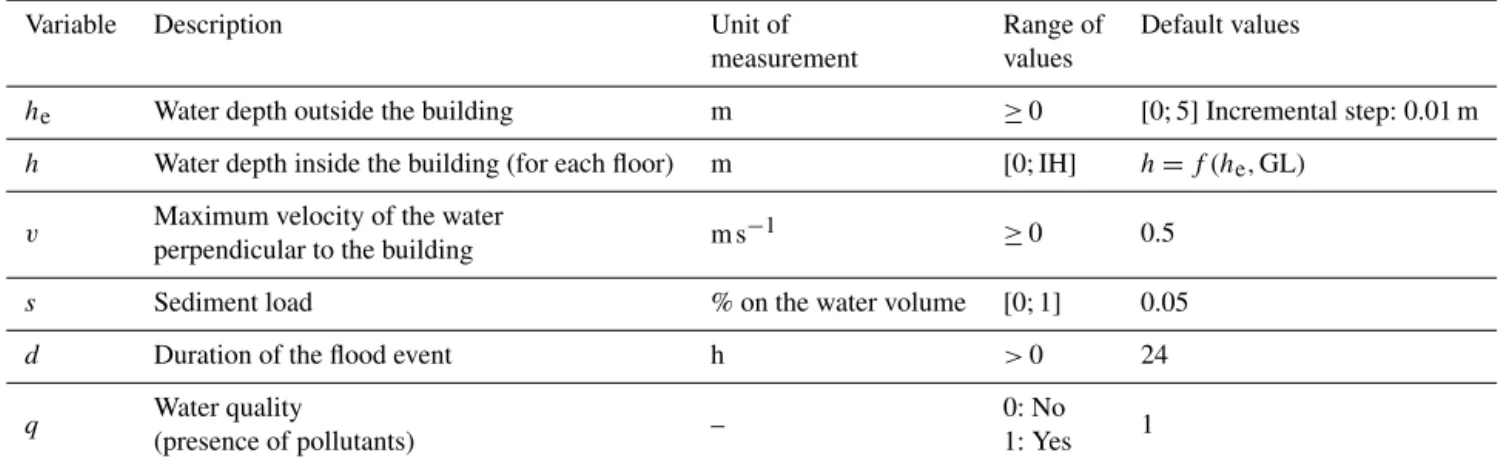
he Water depth outside the building m ≥0 [0; 5] Incremental step: 0.01 m
h Water depth inside the building (for each floor) m [0; IH] h=f (he,GL)
v Maximum velocity of the water m s−1 ≥0 0.5 perpendicular to the building
s Sediment load % on the water volume [0; 1] 0.05
d Duration of the flood event h >0 24
q Water quality – 0: No 1
(presence of pollutants) 1: Yes
level). Conversely, the geometrical properties of the building (e.g. footprint area, number of floors) are used in the esti-mation of the extension of damage to each of the building components. Unit prices refer to the cost of replacement or reparation of the building components per unit of measure (e.g. door removal cost per square metre, pavement replace-ment cost per square metre). For the present study, unit prices are derived from Italian price lists for the year 2013 (default values are shown in Table S1 in the Supplement).
The cost for each subcomponent is determined by the unit price (up) and the extension (ext). The latter is the measure of the physical dimension of the damage (e.g. m2 of plas-ter damaged) and depends on the event features and building characteristics. We can therefore refer to
Cij=unit priceij·extensionij=upij·extij. (3) This distinction is useful for model generalization. The ex-tension of the damage is determined only by the physical ef-fects that the flood event causes to the building; therefore, the same approach can be applied in different countries or geo-graphic areas, provided that the local characteristics of the buildings are accounted for. Unit prices, instead, vary from country to country or even within a country, they can also be referred to standard or default unit prices in official publica-tions. Therefore, local price values are well identified and can be easily replaced with more suitable ones in this approach.
Tables 2 and 3 describe in detail the event features and building characteristics parameters, their unit of measure-ment, their range, and the default values in case no informa-tion is supplied to the model. When some of the input data are missing, another option available in the model is to sam-ple these parameters from distributions, which also allows uncertainty analysis in input data. The damage functions and the general assumptions for all the damage subcomponents are reported in the Supplement, while Table 1 synthesizes the event features and building characteristics considered for each subcomponent function. The variables listed in Tables 2 and 3 can directly affect damage estimation in terms of
ex-tension or indirectly by influencing other variables. An exam-ple of the latter case is YY (year of construction), which, as shown in Table 1, has no direct impact on the damage mecha-nisms of the different building subcomponents but indirectly influences the selection of other variables such as PD (heat-ing system distribution) and PT (heat(heat-ing system type). An-other example is NF (number of floors), which only directly affects soil consolidation despite indirectly influencing many other building components because damage on upper floors can only occur if the floors actually exist in the building. The number of flooded floors is then calculated as a function of inundation depth and interfloor height of the building (IH). Please refer to the Supplement for more details on assump-tions and a description of considered damage mechanisms.
Another important aspect of the proposed approach is that several of the damage mechanisms are modelled using prob-abilistic functions rather than deterministic ones. The choice of the type of function is based on the authors’ knowledge, consistent with the expert-based approach of INSYDE, and on the availability of information in literature. Some damage processes are well understood and, in our opinion, do not require a probabilistic treatment. For instance, we suppose that if a building is flooded then the basement will always be flooded, under the assumption that flood-proof measures to prevent this are rarely implemented. Other damage mech-anisms can also be well explained, even though there is a degree of uncertainty due to building characteristics. For in-stance, electrical systems are considered to be damaged if some of their components are reached by flood water, but the height of these components may vary depending on the build-ing. In this case however, we decided to overlook this uncer-tainty and use deterministic functions since the variability of the height of these components is usually small.
de-F. Dottori et al.: INSYDE: a flood damage model based on explicit cost analysis 2581 Table 3.Building characteristics parameters considered in INSYDE.
Variable Description Unit of measurement Range of values Default values
FA Footprint area m2 >0 100
IA Internal area m2 >0 0.9·FA
BA Basement area m2 ≥0 0.5·FA
EP External perimeter m >0 4·√FA
IP Internal perimeter m >0 2.5·EP
BP Basement perimeter m >0 4·√BA
NF Number of floors – ≥1 2
IH Interfloor height m >0 3.5
BH Basement height m >0 3.2
GL Ground floor level m [−IH;>0] 0.1
BL Basement level m <0 −GL−BH−0.3
1: Detached house
BT Building type – 2: Semi-detached house 1 3: Apartment house
BS Building structure – 1: Reinforced concrete 2 2: Masonry
FL Finishing level – 0.8: low
(i.e. building quality) – 1: medium 1.2 1.2: high
0.9: low
LM Level of maintenance – 1: medium 1.1
1.1: high
YY Year of construction – ≥0 1994
PD Heating system distribution – 1: centralized 1 if YY≤1990 2: distributed 2 otherwise
1: radiator 2 if YY>2000 PT Heating system type – 2: pavement and FL>1
1 otherwise
terministically define, for certain hazard variables, a thresh-old below which no damage occurs and above which it does. For instance, it is known that plaster is usually not damaged for short duration flood events, while replacement might be necessary in case of a long duration flood (Penning-Rowsell et al., 2005). However, it is not possible to define a deter-ministic threshold for the variable “flood duration” because it depends on variables like the type of plaster, the season in which the flood occurs, and so on. In practice, these types of variables are usually not obtainable, or if they are, it is not possible to have a clear understanding of how they affect the damage mechanism. One could assume, for example, that the threshold value for plaster replacement is 18 h. However, it might happen that in reality the plaster needs to be replaced
even if the flood duration is less than that (e.g. 16 h); con-versely, it is possible that the plaster is not damaged for a flood with a longer duration (20 h, for example) because of the factors described above.
To account for these uncertainties, the model considers that for some of the building components, given a certain flood hazard intensity measure IM, there are two possible damage states DS, not damaged (ds0) and damaged (ds1),
each with a probability of occurrence p(ds)=P (DS= ds|IM=im). A similar approach is typically used in the field of seismic vulnerability assessment (e.g. Rossetto and El-nashai, 2003; Rota et al., 2008). Each damage state is as-sociated with a damage ratioR, which represents the repair cost of the component divided by its replacement cost. In the
case of INSYDE, for most components it is assumed that if damage occurs, full repair or replacement is necessary. Thus, when DS=ds1, thenR=r1=1.0.
Within this probabilistic framework, the INSYDE model can be used to estimate building damage in two ways depend-ing on the user’s requirements. The first consists of simply calculating the expected loss of each component according to Eq. (4), using the expected damage ratio E[R], which is given directly byp(ds1)as shown in Eq. (5). This approach
can be used in simpler applications where the quantification of uncertainty related to component damage states is not re-quired.
Cij=unit priceij·extensionij·E[R] (4)
E[R]=r0p(ds0)+r1p(ds1)=p(ds1) (5)
The second consists of taking into account the probabilities of occurrence of damage to the different components in or-der to obtain a distribution of the total building damage rather than a single value, enabling the treatment of uncertainties in the damage mechanisms considered in the model. The pro-cedure to do this is analogous to the one presented by Porter et al. (2001). First, for each building component a number
u∼ [0,1]is sampled from the standard uniform distribution, and the corresponding damage state is evaluated using the in-verse cumulative distribution ds=FDS−1
|im(u). The lossCij is
then calculated according to Eq. (6):
Cij=unit priceij·extensionij·rds. (6)
The losses to each of the components are summed in order to obtain one realization of the total economic damage to the building. This process is repeated a large number of times, and a building damage distribution is computed.
It should be mentioned that the distribution of P (DS= ds1|IM), which can be referred to as a fragility function, is
not as simple to define as in the case of a simple thresh-old mentioned above. On the one hand, to our knowledge, no studies have been carried out on this topic in the flood damage modelling field. On the other hand, an expert-based definition of a complete fragility function is not a straight-forward task. It is, however, possible to define reasonable lower and upper thresholds for IM, below which one can be reasonably sure that the probability of damage is close to 0 and above which it is approximately 1. Following this line of thought, truncated normal distributions between those two values were adopted as fragility functions for different build-ing components. Although this is a simplified approach, it should be viewed in light of its intended purpose, which is to integrate the probabilistic framework into INSYDE, mak-ing it more robust and realistic than a simple threshold-based model. The adopted fragility functions can easily be replaced by the user, according to each specific case and/or his/her knowledge about the behaviour of a specific building com-ponent, for example. This follows the open and transparent philosophy behind the development of the model.
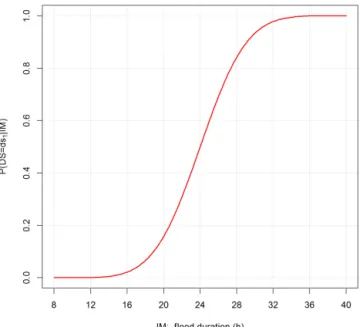
Figure 1.Fragility function for internal plaster. Here, the intensity measure of flood hazard IM is given by flood duration.
The fragility functions adopted in INSYDE can be found in the Supplement. An example is shown in Fig. 1.
F. Dottori et al.: INSYDE: a flood damage model based on explicit cost analysis 2583 It is important to underline that during the model design,
observed damage data were essentially used to analyse the relations between hazard parameters and damage mecha-nisms in order to improve physical damage functions. For instance, the functions for structural damage found in liter-ature were implemented in the model after some modifica-tions, as they were not in line with the observed damages. Such a usage is consistent with an expert-based approach be-cause observed data were first interpreted and then used to modify parts of the model structure rather than applied to calibrate the parameters of existing functions.
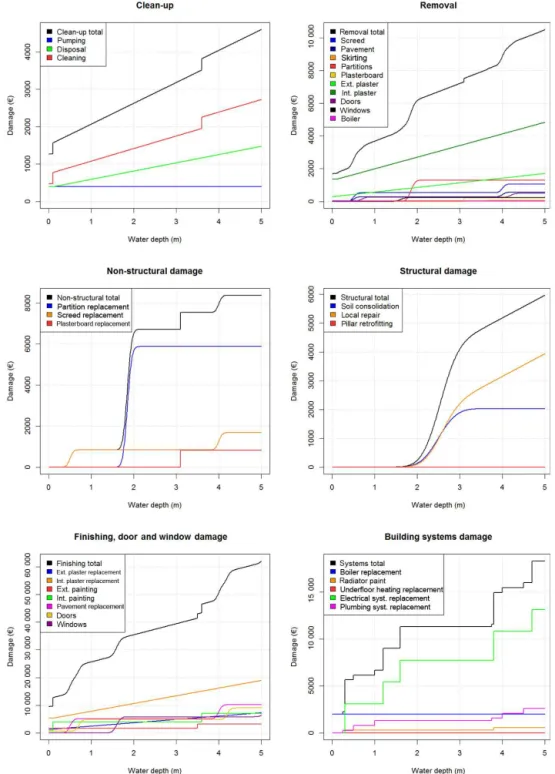
Figures 2 and 3 provide an example of damage functions developed for a default building in the case of a flood with a duration d=24 h, flow velocityv=2.0 m s−1, sediment concentrations=0.05, and presence of pollutants (q=1).
To complete the INSYDE methodology, the absolute dam-age figures computed can be converted into relative value by dividing them by the replacement value of the building. This value is given as a function of the building type and structure and year of construction of the building based on existing literature and official studies (Cresme-Cineas-Ania, 2014).
3 Validation
The model was validated using loss data of the 2010 flood collected by the municipality of Caldogno in the Veneto gion in northeastern Italy. Available building loss data, re-lated to about 300 affected buildings, were based on the “quantification of damage” forms sent out by the authorities, in the frame of the loss compensation process by the state. These data consisted of actual restoration costs, certified by original receipts and invoices. The total reported loss was es-timated to be approximately EUR 7.5 million.
Aside from registered losses, the following event and building information was available (Scorzini and Frank, 2015):
– external water depth (he) and flow velocity (v) at
build-ings locations, resulting from 1-D and 2-D hydraulic modelling of the flood event;
– sediment load (s): fine-grained sediment,s=0.05; – floor area (FA) and number of floors (NF) of damaged
buildings;
– structural type of damaged buildings (BS): almost equally distributed among reinforced concrete and ma-sonry buildings;
– typology of damaged buildings (BT): 151 detached houses, 70 semi-detached houses, and 75 apartment buildings. A further distinction between elements with and without basements was available. In addition, a fin-ishing level (FL) was attributed to each single building based on its quality;
– year of construction (YY) of the buildings.
The first part of the validation exercise consisted of apply-ing INSYDE deterministically (i.e. without considerapply-ing any source of uncertainty) with the previous data as input, assum-ing the default values in Tables 2 and 3 for missassum-ing variables. Calculated total loss was equal to EUR 7.42 million, with a relative error of−1.7 %.
Figure 3, showing estimated losses against observed ones, provides a more in-depth analysis of the results. The model tended to overestimate low damages and to underestimate high ones (Fig. 3a), with a root mean square error (RMSE) equal to EUR 28 996. Nevertheless, there was a high degree of agreement between the two distributions (Fig. 3b).
The results presented above were compared with those obtained by applying other deterministic micro-scale dam-age functions from the literature (Scorzini and Frank, 2015). These included: Debo (1982), Dutta et al. (2003), FLEMOps (Thieken et al., 2008), and others specifically applied in damage assessment studies in Italy, i.e. Oliveri and Santoro (2000), Luino et al. (2009), and Arrighi et al. (2013).
Table 4 summarizes total loss estimates and RMSE calcu-lated by using the selected micro-scale models and INSYDE. The output from these functions ranged from EUR 5.8 to 13 million, resulting in a maximum relative error from the reported building losses (EUR 7.5 million) of about 73.6 % (RMSE=EUR 34 990), obtained with the curve of Dutta et al. (2003). The others gave similar results, with rela-tive errors in the order of 12–23 % (RMSE≈EUR 28 000– 29 600), excluding the function of Luino et al. (2009), which overestimated the total loss by more than 45 % (RMSE=EUR 30 230). The relatively high value of the RMSE obtained from the application of the different models was mainly due to the intrinsic natural spread of damage data (Smith, 1994), which makes a perfect fit of a damage model practically impossible. From this perspective, INSYDE, sup-ported by a physically based methodology, provided encour-aging results, with a relatively small observed RMSE and minimum relative error (−1.7 %) on the total damage figure. It should be noted that the latter result is arguably the most important measure since at spatial scales such as the one in this case study, it is usually more relevant to capture the over-all damage distribution and total value than the individual, building-by-building damage.
Notwithstanding, the second part of the validation exercise consisted of performing a building-by-building comparison of observed and modelled losses, with the objective of deter-mining the degree of agreement between them after consid-ering in a simplified manner some of the potential sources of uncertainty. This was done by estimating loss ranges – both observed and modelled – for each building, and then com-puting the hit rate (HR) as the fraction between the number of cases in which there was an overlap between them and the total number of buildings.
Figure 2.Example of INSYDE damage functions for all building subcomponents, considering the following event variables: flow velocity
=2.0 m s−1, flood duration=24 h, sediment concentration=0.05, and water quality=presence of pollutants.
Table 4.Comparison of loss estimates produced by INSYDE and other models in literature.
Debo Dutta et al. FLEMOps Oliveri and Santoro Luino et al. Arrighi et al. INSYDE
(1982) (2003) (2000) (2009) (2013)
F. Dottori et al.: INSYDE: a flood damage model based on explicit cost analysis 2585
Figure 3.Example of INSYDE damage functions considering the following event variables: flow velocity=2.0 m s−1, flood duration= 24 h, sediment concentration=0.05, and water quality= presence of pollutants.(a)Damage functions for entire building and different building components.(b)Total building damage function with 5th and 95th percentiles of modelled damages representing uncertainty due to damage mechanisms.
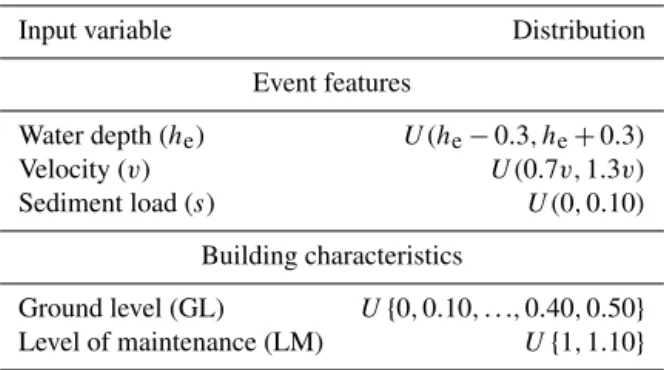
In order to reflect the uncertainty in damage data, the ob-served loss range for each building was assumed to be±25 % of the reported value. This assumption was related to the large degree of subjectivity and heterogeneous criteria of assessment that usually characterize loss estimations based on the restoration costs, even if certified by receipts and in-voices. In fact, in each building, the judgment on the opportu-nity and the economic convenience of an intervention is often performed by a different construction company. Regarding modelled loss, the 5-95th percentile interval of loss distribu-tions were considered. The distribudistribu-tions were computed us-ing a Monte Carlo approach, accountus-ing for uncertainties not only in the damage mechanisms (as described in Sect. 2) but also in input data (Table 5).
Given these assumptions, the hit rate for the 2010 flood event was 56 %. This is a reasonably good result, consider-ing that only a limited number of sources of uncertainty were considered and that their quantification was done in a simpli-fied and rather conservative manner. In addition, it should be mentioned that this part of the validation exercise is ex-tremely demanding in the sense that a simplified model of reality is used to estimate losses on a building-by-building basis. Even with its detailed, probabilistic structure, INSYDE simply cannot account for some of the building-to-building variability. There is a level of detail past which uncertain-ties become aleatory, meaning it is not reasonably possible to reduce them using damage models such as this (Der Ki-ureghian and Ditlevsen, 2009), and those uncertainties are not accounted for.
To conclude, the obtained validation results unequivocally show that INSYDE is able to produce accurate damage esti-mations and explain reasonably well a part of the uncertainty that inherently exists in flood damage estimations.
Table 5.Distributions adopted for the input variables in the valida-tion exercise.
Input variable Distribution
Event features
Water depth (he) U (he−0.3, he+0.3) Velocity (v) U (0.7v,1.3v) Sediment load (s) U (0,0.10)
Building characteristics
Ground level (GL) U{0,0.10, . . .,0.40,0.50}
Level of maintenance (LM) U{1,1.10}
4 Sensitivity analysis
The damage dataset used to validate the model in Sect. 3 did not allow full investigation of the model behaviour. The limited total flood extent and the slow flow processes that occurred in the study area resulted in low values of hazard variables like water depth, flow velocity, and sediment load. Therefore, the test did not allow assessment of the influence of these parameters in determining the damage, that is the sensitivity of the model structure to high values of the hazard variables. To further explore the importance of each of these parameters, we performed a local sensitivity analysis. In this application, the damage was computed by varying alternately each hazard parameter while the others were kept constant. The building characteristics variables have not been analysed at this stage, nor has the uncertainty related with the proba-bilistic modelling of some of the damage mechanisms (see Sect. 5 for a more detailed discussion).
Figure 4.Comparison of observed against modelled loss for the buildings affected by the 2010 flood in Caldogno.(a)Scatter plot.(b)Kernel density plots.
Figure 5.Results of the local sensitivity analysis in case of low velocity, long duration flood.
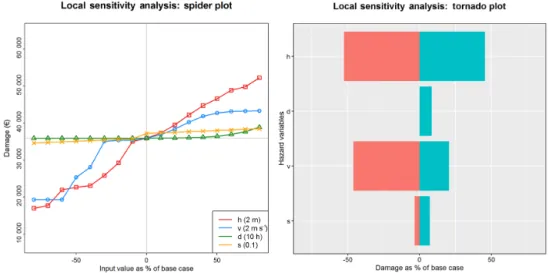
Two different flood conditions have been considered to ex-plore the model behaviour in different conditions: a low ve-locity, long duration flood and, conversely, a high veve-locity, short duration flood event. For the first case, the fixed values of depth, velocity, duration, and sediment load were respec-tively h=1.5 m,v=1.0 m s−1,d
=24 h ands=0.10. For the second case, the values were h=2.0 m, v=2.0 m s−1,
d=10 h ands=0.10.
Computations were performed considering a standard re-inforced concrete building with two floors and a basement, 100 m2 of floor area, and a high finishing level. The other building characteristics were set using the previously men-tioned default values.
Figures 5 and 6 summarize the results of the local sensitiv-ity analysis in the two chosen flood conditions, showing the relative influence of each hazard variable in determining the total economic damage. As expected, water depth is the most
F
.
Dottori
et
al.:
INSYDE:
a
flood
damage
model
based
on
explicit
cost
analysis
2587
Table 6.Review of existing synthetic damage models.
Model or authors Hazard Vulnerability Type of damage Monetary evaluation Validation Sensitivity Weaknesses Strengths
parameters parameters considered analysis
Oliveri and Santoro Water depth Two typical buildings – Building fabric Building price books No No – Only two building
(2000) classified according to and systems types are considered
– number of storey – Building inventory – No explicit analysis
– finishing level – Dismantling costs of of damage to different
building components building components
– Not validated
Multi Coloured Water depth 140 typical buildings – Building fabric Building price books No No Not validated – Large building dataset
Manual (MCM) Flood duration according to and systems – In-depth analysis
(Penning-Rowsell – construction type – Building inventory of vulnerability
et al., 2005) – period of construction – External areas – Possibility of analysing
– social class of occupants (gardens, fences, sheds) damage on individual
– Clean-up costs components
Gersonius et Water depth Five typical buildings – Partial collapse – Past experience No No Not validated
al. (2008) Flow velocity according to – Building fabric – Expert interviews
– construction type and systems
– ground floor area – Clean-up and
disinfection costs
Nadal et Water depth 28 typical buildings – Building fabric Not specified No No Not validated – Use of a probabilistic approach
al. (2010) Flow velocity according to – Building collapse Monetary – Possibility of analysing
Debris content – construction type – Building utilities evaluation damage on individual
– height of the building and finishes not explained components
– floor area – Local soil scour
FloodProBE Water depth Possibility of defining – Building fabric – Building price books Yes Yes, Huge amount of – In-depth analysis of vulnerability
(Walliman et Flow velocity the specific features and systems – Databases used by only for input variables – Adjustment factor for
al., 2013) Debris content of the affected – Clean-up costs quantity surveyors hazard (no default values) regional differences
Flood duration building – Drying costs parameters – Valid for non-residential building
Contamination – Possibility of analysing damage
on individual components
Velasco et Water depth One typical building – Building fabric Past experience Yes+ No – Only one building Embedded in
al. (2016) and systems calibration type is considered a GIS tool
– Building inventory with – Only influence of
– Clean-up costs past event water depth
– Water pumping costs is considered
HOWAD Water depth 12–14 typical buildings – Building fabric – Building price books Only influence Embedded in
(Neubert et according to: and systems – Expert interviews of water depth a GIS tool
al., 2016) – building material – Building inventory Yes No is considered
– construction type – Drying costs
– design issues – period of construction
www
.nat-hazards-earth-syst-sci.net/16/2577/2016/
Nat.
Hazards
Earth
Syst.
Sci.,
16,
2577–
2591
,
Figure 6.Results of the local sensitivity analysis in the case of high velocity, short duration flood.
5 Critical analysis
As introduced in Sect. 2, the approach followed in INSYDE was derived from a detailed analysis of present state-of-the-art synthetic flood damage modelling for the residential sec-tor, as depicted in Table 6. The table reports, for the main models found in the literature: considered hazard and vul-nerability parameters, the estimated types of damage, the ap-proach for the monetary evaluation of damage, whether or not models have been validated, and whether or not a sensi-tivity analysis has been performed. Starting from this analy-sis, the main strengths of existing models were identified and incorporated in INSYDE. Likewise, INSYDE tries to over-come the limitations of available approaches.
As far as hazard and vulnerability are concerned, similar to the model developed within the FloodProBE project (Wal-liman et al., 2013), INSYDE allows consideration of all the hazard parameters that were found to be significant in the lit-erature, namely water depth, velocity, sediment and contam-inant loads, and flood duration (Kelman and Spence, 2004; Thieken et al., 2005; Kreibich et al., 2009; Merz et al., 2010). Moreover, the vulnerability features of any specific build-ing can be defined by means of a set of parameters (such as building size, type, structure, finishing level, maintenance level, etc.), allowing for an in-depth analysis of vulnerability (see the FloodProBE and the MCM models). This helps over-come the problem of representing the entire building stock by means of a set of predefined building types presently char-acterizing the majority of models. Conversely, in practical flood damage assessments, collecting all the required infor-mation on event and building features necessary for defining the input parameters used in INSYDE (Tables 2, 3) may not always be straightforward. Nevertheless, when some of these data are missing, the flexibility of the model allows the user to choose between two different options. The first, which can be suitable for rapid flood damage estimations, consists of
applying the default values for the different parameters listed in Tables 2 and 3. This approach, however, may result in esti-mation errors and does not allow the treatment of uncertain-ties related to input data. These problems can be overcome by using the more detailed option of sampling these parame-ters from distributions instead (defined beforehand on a case-by-case basis), taking advantage of the probabilistic structure implemented in the model.
In regard to estimated damages, INSYDE presents two main strengths. First, like the FloodProBE and MCM (Penning-Rowsell et al., 2005) models, damage functions are derived component by component, which allows an in-depth analysis and description of damage mechanisms (Sect. 2 and Supplement). Second, not only losses to the building fabric and functions (e.g. systems) are modelled, but also costs re-lated to cleaning the building, removing water and waste, and drying, which can represent an important share of the total economic damage in some cases. Damage to inven-tories is not considered at the moment because inveninven-tories present a higher variability than the building fabric, requir-ing a mixed empirical–synthetic approach. It is also impor-tant to note that in the current version the model considers only the potential damage, while factors that can affect dam-age, such as flood warning, preparedness, and precautionary measures, are not incorporated. Additional corrective coef-ficients should be used in order to adjust potential for ac-tual losses (Smith, 1994; Thieken et al., 2005; Messner and Meyer, 2006; Poussin et al., 2015).
F. Dottori et al.: INSYDE: a flood damage model based on explicit cost analysis 2589 out by using building price books that can be updated and
adapted to the region of implementation of the model. This way, the model can be easily applied to different geographi-cal regions.
Another important feature of INSYDE regards the possi-ble treatment of uncertainty embodied in the model structure. While the contribution of hazard components of risk to total damage uncertainty has been highlighted in several research works (Merz and Thieken, 2009; Merz et al., 2010; de Moel and Aerts, 2011; Thieken et al., 2014), relatively few studies present methods to explicitly account for uncertainty in dam-age estimations. Egorova et al. (2008) assessed uncertainties in the value of elements at risk and developed a methodol-ogy for incorporating uncertainties in depth–damage curves. Schröter et al. (2014) applied eight flood damage models with different levels of complexity to predict relative building damage in residential sectors for five historic flood events in Germany. The authors observed that the use of additional ex-planatory variables aside from the water depth improved the predictive capability of models, especially in applications to different regions and different flood events. In addition, mod-els based on probabilistic structure (e.g. Bayesian networks) were more reliable than deterministic models.
In such a context, the main findings from the literature were taken into account in the development of the INSYDE model structure and respective R program, which enables the explicit analysis of input data and damage mechanism uncer-tainties, as previously described. It should be noted that it is the first time that uncertainty in damage mechanisms is in-cluded in a synthetic damage model. From this point of view, the probabilistic approach adopted in the model is an innova-tion in these types of models.
In this article, we have included a local sensitivity anal-ysis of individual hazard parameters with the aim of illus-trating the behaviour of the model and performing a “san-ity check” on model results. An in-depth analysis of model uncertainty was not performed since we felt it would be un-practical and beyond the scope of this paper, which is focused on model structure. Indeed, for a comprehensive analysis of all possible sources of uncertainty we should take into ac-count physical damage mechanisms together with the other model components such as economic damage functions, in-fluence of hazard and vulnerability parameters, and proba-bilistic functions. Therefore, an in-depth analysis of model sensitivity and uncertainty is planned as a follow-up to the present research work.
6 Conclusions
In this paper, we present a new synthetic damage model called INSYDE. The model incorporates the latest develop-ments in flood damage modelling and has been designed to be a flexible and transparent methodology, suitable for a vari-ety of applications regarding damage assessment,
vulnerabil-ity analysis of buildings, and analysis of uncertainty sources. In particular, the adopted probabilistic approach represents a first attempt to address the uncertainty issues regarding model damage mechanisms and parameters.
Model validation in a test case in Italy showed that IN-SYDE can provide good estimates of post-event flood losses, with similar or superior performances when compared with other damage models available in the literature. The valida-tion exercise also showed that the model is able to explain a part of the uncertainty that inherently exists in flood loss estimations reasonably well.
Despite having been developed and tested with Italian case studies, the flexibility of the model structures allows for easy modification of both the model structure (i.e. damage func-tions) and the model parameters (such as building charac-teristics and unitary prices) for application in other coun-tries. For the same reason, the structure of INSYDE makes it adaptable, with appropriate modifications, for flood damage assessment of other types of assets, such as building contents or commercial and industrial buildings.
7 Data availability
In order to increase the transparency and reproducibility of the methodology, the model functions are available for down-load as R open source code, currently hosted on GitHub (https://github.com/ruipcfig/insyde/). Thus, users have the possibility of applying INSYDE to compute flood damage for the different building types of interest and for any ref-erence flood scenario. Furthermore, the model can be fully customized as users can change the value of model parame-ters and reference prices for the monetary evaluation of dam-age, as well as the different damage functions themselves. We believe that the use of open-access, transparent damage models can greatly improve the existing vulnerability models and help vulnerability assessment studies in areas where few damage datasets and models are available.
The Supplement related to this article is available online at doi:10.5194/nhess-16-2577-2016-supplement.
Acknowledgements. The authors gratefully acknowledge the region of Umbria for providing damage data for the 2012 flood.
Edited by: B. Merz
Reviewed by: S. Fuchs and one anonymous referee
References
André, C., Monfort, D., Bouzit, M., and Vinchon, C.: Contribution of insurance data to cost assessment of coastal flood damage to residential buildings: insights gained from Johanna (2008) and
Xynthia (2010) storm events, Nat. Hazards Earth Syst. Sci., 13, 2003–2012, doi:10.5194/nhess-13-2003-2013, 2013.
Arrighi, C., Brugioni, M., Castelli, F., Franceschini, S., and Maz-zanti, B.: Urban micro-scale flood risk estimation with parsi-monious hydraulic modelling and census data, Nat. Hazards Earth Syst. Sci., 13, 1375–1391, doi:10.5194/nhess-13-1375-2013, 2013.
Bouwer, L. M., Papyrakis, E., Poussin, J., Pfurtscheller, C., and Thieken, A. H.: The Costing of Measures for Natural Hazard Mitigation in Europe, Natural Hazards Review, 15, 04014010, doi:10.1061/(ASCE)NH.1527-6996.0000133, 2013.
Bubeck, P. and Kreibich, H.: Natural Hazards: direct costs and losses due to the disruption of production processes, CONHAZ, Report WP1, D1.2, 2011.
Cammerer, H., Thieken, A. H., and Lammel, J.: Adaptability and transferability of flood loss functions in residential areas, Nat. Hazards Earth Syst. Sci., 13, 3063–3081, doi:10.5194/nhess-13-3063-2013, 2013.
Cresme-Cineas-Ania: Definizione dei costi di (ri)costruzione nell’edilizia, Cineas (Ed.), 1, 1–247, 2014.
Debo, T. N.: Urban flood damage estimation curves, J. Hydr. Eng. Div.-ASCE, 108, 1059–1069, 1982.
de Moel, H. and Aerts, J. C. J. H.: Effect of uncertainty in land use, damage models and inundation depth on flood damage es-timates, Nat. Hazards, 58, 407–425, doi:10.1007/s11069-010-9675-6, 2011.
Der Kiureghian, A. and Ditlevsen, O.: Aleatory or epis-temic? Does it matter?, Struct. Saf., 31, 105–112, doi:10.1016/j.strusafe.2008.06.020, 2009.
Dutta, D., Herath, S., and Musiake, K.: A mathematical model for flood loss estimation, J. Hydrol., 277, 24–49, doi:10.1016/S0022-1694(03)00084-2, 2003.
Egorova, R., Van Noortwuk, J. M., and Holterman, S. R.: Uncertainty in flood damage estimation, International Journal of River Basin Management, 6, 139–148, doi:10.1080/15715124.2008.9635343, 2008.
Gersonius, B., Zevenbergen, C., Puyan, N., and Billah, M. M. M.: Efficiency of private flood proofing of new buildings-adapted re-development of a floodplain in the Netherlands, WIT Trans. Ecol. Envir., 118, 247–259, doi:10.2495/FRIAR080241, 2008. Gissing, A. and Blong, R.: Accounting for variability in commercial
flood damage estimation, Aust. Geogr., 35, 209–222, 2004. Handmer, J.: The chimera of precision: Inherent uncertainties in
dis-aster loss assessment, Australian Journal of Emergency Manage-ment, 18, 88–97, 2003.
Kelman, I. and Spence, R.: An overview of flood actions on buildings, Eng. Geol., 73, 297–309, doi:10.1016/j.enggeo.2004.01.010, 2004.
Kreibich, H., Piroth, K., Seifert, I., Maiwald, H., Kunert, U., Schwarz, J., Merz, B., and Thieken, A. H.: Is flow velocity a significant parameter in flood damage modelling?, Nat. Hazards Earth Syst. Sci., 9, 1679–1692, doi:10.5194/nhess-9-1679-2009, 2009.
Luino, F., Bidoccu, M., Cirio, C. G., Agangi, A., Giulietto, W., Godone, F., and Nigrelli, G.: Application of a model to the evaluation of flood damage, Geoinformatica, 13, 339–353, doi:10.1007/s10707-008-0070-3, 2009.
Merz, B. and Thieken, A. H.: Flood risk curves and uncertainty bounds, Nat. Hazards, 51, 437–458, doi:10.1007/s11069-009-9452-6, 2009.
Merz, B., Kreibich, H., Schwarze, R., and Thieken, A.: Review article “Assessment of economic flood damage”, Nat. Hazards Earth Syst. Sci., 10, 1697–1724, doi:10.5194/nhess-10-1697-2010, 2010.
Messner, F. and Meyer, V.: Flood damage, vulnerability and risk perception: challenges for flood damage research, in: Flood Risk Management: Hazards, Vulnerability and Mitigation Mea-sures, edited by: Schanze, J., Zeman, E., and Marsalek, J., Springer Netherlands, 149–167, doi:10.1007/978-1-4020-4598-1_13, 2006.
Messner, F., Penning-Rowsell, E., Green, C., Meyer, V., Tunstall, S., and van der Veen, A.: Evaluating Flood damages: guidance and recommendations on principles and methods, FLOODsite, Report Number T09-06-01, 178 pp., 2007.
Meyer, V., Becker, N., Markantonis, V., Schwarze, R., van den Bergh, J. C. J. M., Bouwer, L. M., Bubeck, P., Ciavola, P., Genovese, E., Green, C., Hallegatte, S., Kreibich, H., Lequeux, Q., Logar, I., Papyrakis, E., Pfurtscheller, C., Poussin, J., Przy-luski, V., Thieken, A. H., and Viavattene, C.: Review article: Assessing the costs of natural hazards – state of the art and knowledge gaps, Nat. Hazards Earth Syst. Sci., 13, 1351–1373, doi:10.5194/nhess-13-1351-2013, 2013.
Molinari, D., Menoni, S., Aronica, G. T., Ballio, F., Berni, N., Pan-dolfo, C., Stelluti, M., and Minucci, G.: Ex post damage assess-ment: an Italian experience, Nat. Hazards Earth Syst. Sci., 14, 901–916, doi:10.5194/nhess-14-901-2014, 2014.
Nadal, N. C., Zapata, R. E., Pagàn, I., Lopez, R., and Agudelo, J.: Building damage due to riverine and coastal floods, J. Water Res. Pl.-ASCE, 136, 327–336, doi:10.1061/(ASCE)WR.1943-5452.0000036, 2010.
Neubert, M., Naumann, T., Hennersdorf, J., and Nikolowski, J.: The Geographic Information System-based flood damagesimulation model HOWAD, Journal of Flood Risk Management, 9, 36–49, doi:10.1111/jfr3.12109, 2016.
Oliveri, E. and Santoro, M.: Estimation of urban structural flood damages: the case study of Palermo, Urban Water, 2, 223–234, doi:10.1016/S1462-0758(00)00062-5, 2000.
Papathoma-Köhle, M., Zischg, A., Fuchs, S., Glade, T., and Keiler, M.: Loss estimation for landslides in mountain ar-eas – An integrated toolbox for vulnerability assessment and damage documentation, Environ. Modell. Softw., 63, 156–169, doi:10.1016/j.envsoft.2014.10.003, 2015.
Penning-Rowsell, E., Johnson, C., Tunstall, S., Tapsell, S., Morris, J., Chatterton, J., and Green, C.: The benefits of flood and coastal risk management: a handbook of assessment techniques, Middle-sex University Press, UK, 2005.
Porter, K. A., Kiremidjian, A. S., and LeGrue, J. S.: Assembly-based vulnerability of buildings and its use in performance eval-uation, Earthq. Spectra, 17, 291–312, doi:10.1193/1.1586176, 2001.
Poussin, J. K., Botzen, W. W., and Aerts, J. C.: Effectiveness of flood damage mitigation measures: Empirical evidence from French flood disasters, Global Environ. Chang., 31, 74–84, doi:10.1016/j.gloenvcha.2014.12.007, 2015.
observa-F. Dottori et al.: INSYDE: a flood damage model based on explicit cost analysis 2591
tional data, Eng. Struct., 25, 1241–1263, doi:10.1016/S0141-0296(03)00060-9, 2003.
Rota, M., Penna, A., and Strobbia, C. L.: Processing Italian dam-age data to derive typological fragility curves, Soil Dyn. Earthq. Eng., 28, 933–947, doi:10.1016/j.soildyn.2007.10.010, 2008. Schröter, K., Kreibich, H., Vogel, K., Riggelsen, C.,
Scherbaum, F., and Merz, B.: How useful are complex flood damage models?, Water Resour. Res., 50, 3378–3395, doi:10.1002/2013WR014396, 2014.
Scorzini, A. R. and Frank, E.: Flood damage curves: new insights from the 2010 flood in Veneto, Italy, Journal of Flood Risk Man-agement, doi:10.1111/jfr3.12163, online first, 2015.
Smith, D. I.: Flood damage estimation – A review of urban stage-damage curves and loss functions, Water SA, 20, 231–238, 1994. Thieken, A. H., Müller, M., Kreibich, H., and Merz, B.: Flood damage and influencing factors: New insights from the Au-gust 2002 flood in Germany, Water Resour. Res., 41, W12430, doi:10.1029/2005WR004177, 2005.
Thieken, A. H., Olschewski, A., Kreibich, H., Kobsch, S., and Merz, B.: Development and evaluation of FLEMOps – a new flood loss estimation MOdel for the private sector, in: Flood recovery, inno-vation and response, edited by: Proverbs, D., Brebbia, C. A., and Penning-Rowsell, E., WIT Press, Southampton, UK, 315–324, 2008.
Thieken, A. H., Apel, H., and Merz, B.: Assessing the probabil-ity of large-scale flood loss events: a case study for the river Rhine, Germany, Journal of Flood Risk Management, 8, 247– 262, doi:10.1111/jfr3.12091, 2014.
Velasco, M., Cabello, A., and Russo, B.: Flood damage assessment in urban areas. Application to the Raval district of Barcelona us-ing synthetic depth damage curves, Urban Water J., 13, 426–440, doi:10.1080/1573062X.2014.994005, 2016.
Walliman, N., Baiche, B., Odgen, R., Tagg, A., and Escarameia, M.: Estimation of repair costs of individual non-domestic buildings damaged by floods, International Journal of Safety and Security Engineering, 3, 289–305, doi:10.2495/SAFE-V0-N0-1-16, 2013.