Introduction, transmission and aggravation of malaria in desert
ecosystem of Rajasthan, India
Vinod Joshi, Sandeep Adha, Himmat Singh, Manju Singhi & P.K. Dam
Desert Medicine Research Centre, Indian Council of Medical Research, Jodhpur, Rajasthan, India
Abstract
Background & objectives: Malaria is an important public health problem in northwestern desert part of Rajasthan. Since desert malaria is seasonal or unstable, there is a need to study its epidemiology in the totality to address factors like how malaria is introduced into desert every year and what are desert-specific transmission risk factors leading to epidemics?
Methods: Twenty-six villages in irrigated, semi-irrigated and non-irrigated settings of the desert have been selected. Periodic investigations were undertaken in all the seasons from 2001 through 2002 to determine causes of introduction of disease, the factors involved in its transmission and the epidemic risk factors. Standard methods/procedures for mosquito collection, preservation and identification and for parasitological studies were employed. Rainfall data were analysed and correlated.
Results:Importation of malaria infection through individuals was the major cause of introduction of disease in all the 12 villages showing some initial load of infection. Areas having higher population of cattle in relation to humans (human to cattle ratio of 1:25) had less transmission of disease (ratio of primary to secondary cases 1:3) as compared to relatively less cattle (human to cattle ratio 1:3) resulting into high transmission of disease with 1:47 ratio of primary to secondary cases. Introduced through migration, prospective transmission of malaria was observed as a resultant interaction of density of three components namely malaria cases, vector density and cattle to human ratio. Rainfall more than average when coupled with more cases of imported malaria leads to the eruption of malar-ia epidemics.
Interpretation & conclusion:Importation of malaria cases was the major cause of seasonal introduc-tion of malaria in the desert. This initial or primary parasitic load available in a village leads to a particular transmission quantum depending upon the density of vectors, human and cattle population at a particular time. Areas with more imported cases when coupled with profuse vector population lead to epidemic malaria situations in the desert.
Key words Desert – epidemiology – importation of cases – malaria
Introduction
Malaria is a major public health problem in all the districts including desert part of Rajasthan. The dis-ease appears in this region as a seasonal outbreak. Moreover, as the ecology of desert does not support
time-to-time 1,2. Earlier workers on malaria3–11 have
empha-sised the need to overview malaria as interacting system of man, mosquito and environment in the form of what has been termed as anthropoecosystem of malaria.
Thus, a comprehensive study was started in 26 villag-es reprvillag-esenting irrigated, semi-irrigated and non-ir-rigated areas of Jaisalmer and Jodhpur districts of Rajasthan from August 2001 through July 2002 to study the means of introduction of disease into desert, factors associated with its prospective transmission and causal factors for epidemic outbreaks.
In the present study the epidemiology of malaria in desert has been studied with respect to three distinct research questions: what is the source of malaria?; in unstable or seasonal malaria foci of desert where year round transmission does not take place, what controls transmission of malaria in desert ecology?; and what aggravates this situation of malaria to present in ep-idemic form?
Material & Methods
Study areas: The present investigation was conduct-ed in three different areas— (a) canal irrigatconduct-ed area for more than 20 years (setting I), (b) canal irrigated area for 10 years (setting II) and (c) an area without any irrigation system (setting III). Periodic investiga-tions were undertaken from August 2001 to July 2002. Details of each study setting are given below:
Setting I: The area called Jaisalmer district is situat-ed at 26.18 oN latitude and 73.04 oE longitude, rep-resents a true desert ecosystem with irrigation through Indira Gandhi canal system for about 20 years. Ten study villages have been selected from this area. The area is characterised by extremes of temper-ature, lowest relative humidity in entire country and sparse far-flung population pockets in the vicinity of sand dunes. Rearing of cattle is a common means of earning and native human population migrate to
ad-jacent states during months of March–April and re-turn to their homes sometime during August. Ambi-ent temperature ranges from as low as 1–2oC in win-ters (January) to as high as 49oC in summer (April to
June). Soil is sandy composed of silica quartz pre-dominantly and is loose and shifting type along with flow of winds.
Setting II:This area represents a desert area called Phalodi region situated at about 26.55oN latitude and 70.57oE longitudes. From irrigation point of view this
area is supplied with branches of main canal present in setting I. This study was conducted in 11 villages from this area. This area represents desert ecology with less degree of desertification as compared to setting I and is having access to irrigation system for past ten years. Cattle rearing is the main source of livelihood and the population is of migratory type with almost similar timings of migration as in setting I. This area also exhibits extremes of ambient temper-ature and relative humidity like setting I.
Setting III:This study area called Balesar region is also desert ecosystem but unlike other settings and does not have any canal irrigation system. From this area five study villages were chosen. This area is also having sparse and migrating human population, cat-tle rearing as main source of livelihood and erratic rainfall, extremes of temperature and low relative humidity.
In all the 26 villages, three point investigations were conducted as first study, first follow-up and second follow-up covering each season, with a gap of 15 days. The observations for rainy season were recorded in August to October, for winter season in December to February and for summer season in April to July.
enquired to determine whether initial infection in the village is imported or indigenous. After completing the studies regarding origin of introduction of infec-tion, the subsequent observations in all the villages were made with respect to the type of vector species and its density, number of secondary cases and asso-ciated details of human and cattle density in the study villages. These investigations were made to under-stand interaction of components participating in the transmission of malaria in each village. The density of vector species with particular initial or primary load of infection was recorded in each village and secondary cases resulting by virtue of their interac-tion were observed during subsequent investigainterac-tions. In addition, corresponding densities of humans and cattles in study villages were also recorded. Since all the details required to study the transmission factors of malaria in all the villages could not be collected we present here the data of 10 villages only in Setting I and II where all the required information was avail-able. Of the four anopheline species encountered during field investigations, only densities of known vector species in the area— Anopheles stephensi, An. culicifacies and An. annularis have been taken into account, while density of An. subpictus has not been included.
For determining the causal risk factors for erupting epidemics in the desert, retrospective data of malaria incidence were analysed in relation to rainfall, magni-tude of imported malaria, increasing or decreasing trend of slide positivity rate and mosquito density.
Mosquito collection and identification: Mosquitoes were collected with the help of suction tube and a torch during early morning (dawn) and evening (dusk) hours. The resting and bait collections were made from human dwellings as well as from cattle sheds. Density of mosquitoes was calculated in terms of adults caught per man hour (PMH). Field collect-ed specimens were preservcollect-ed dry and brought to the laboratory for species identification using standard keys12.
Blood meal source analysis: In all the study villages wherever fed anopheline mosquitoes were collected, these were subjected to precipitin test following Gel-diffusion method13 to identify blood meal taken by
mosquitoes.
Parasitic examination: Blood slide examination re-ports of all the fever cases present in each study vil-lage were recorded from the hospital or subcentre of the study village.
Statistical analysis: Correlation coefficient was calcu-lated for the association between imported malaria and total number of cases present during the beginning of the season in study villages. Chi-squareanalysis was done for the different associations in study villages between cattle density and malaria transmission.
Results
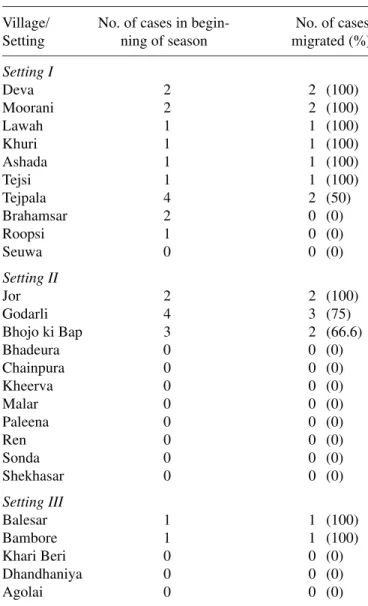
It was observed that in villages in setting I, in six out of 10 villages (60% of villages studied) all of malaria positive patients were inward migrants in last 2–3 days. In one village (10% of villages studied), one out of two patients showed history of inward migration and in two villages the current patients did not show any history of migration. In the villages of Setting II, out of three villages with some load of initial malaria, in one vil-lage 100%; in the second vilvil-lage 75% and in the third village 66% of initial load of disease was contributed by imported infection. In all other villages of this set-ting, no malaria incidence was observed during initial phase of season. In the villages of setting III, all the two villages which showed malaria in the beginning of season, 100% patients were inward migrants. The details are furnished in Table 1.
transmission, which was not observed in the present study (Table 1). Correlation coefficient applied be-tween the association of total cases and migrated fever cases showed significant statistical association (r = 0.86). To exclude the possibility of malaria persistence in the region due to asymptomatic carriers of infection, 100 subjects at random were examined from normal population (without any clinical symptom of malaria) that showed no evidence of malaria parasite.
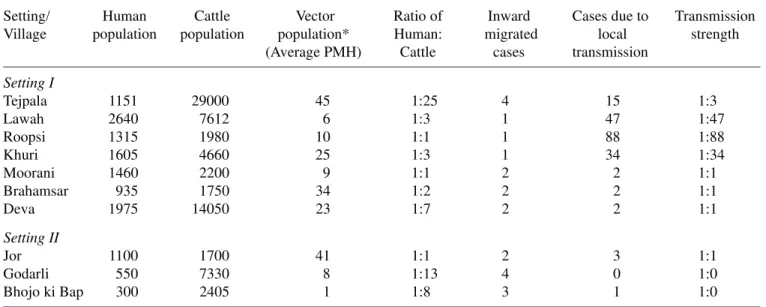
Table 2 shows observations on the association of human and cattle population and average vector
den-sity with transmission strength of malaria in the study villages. In village Tejpala vector density was high-est (45 PMH) of all the study villages but malaria transmission ratio was 1:3 only. This low transmis-sion strength was associated with high cattle density (1:25) in the village (Table 2). In village Lawah vec-tor density was 6 PMH but due to less cattle in the village (1:3) the transmission of malaria was high (1:47). When human to cattle ratio was further less (1:1) in the village Roopsi even with 10 PMH densi-ty of vector, malaria transmission strength rose to 1:88. Almost in all the villages more cattle density was associated with low transmission strength of the disease and vice versa (Table 2).
The observations with respect to association of ma-laria transmission strength with cattle density was further probed with the question whether more avail-ability of cattle increases zoophilic index (ZI) of vector species or vice versa to exert a corresponding influence on malaria transmission strength in the study villages. The blood-fed mosquitoes could be collected from only six villages (from four in setting I and two in setting II) and hence data are depicted for six villages in Table 3. The observations show that more cattle lead to increased ZI which reduces trans-mission strength in spite of higher vector density (Table 3).
Table 4 shows malaria situation in two subsequent years—2001 and 2002 with former being the year of normal rainfall and latter a drought year. In setting I during the year 2001 outbreak of malaria had taken place. In this setting when average annual rainfall was 341 cm, average mosquito density in the villages was 70 PMH associated with 60% of malaria cases being imported from outside. As a result, annual SPR was 12.8% in this setting during the year (Table 4). In the same area during 2002 (drought year), when average annual rainfall was 63 cm only, mosquito density was reduced to 50 PMH, the corresponding value of mi-grated malaria was zero (SPR 0) throughout the year (Table 4). Similar trend of association of rainfall,
Table 1. Study of introduction of malaria in study villages during August to December 2001
Village/ No. of cases in begin- No. of cases
Setting ning of season migrated (%)
Setting I
Deva 2 2 (100)
Moorani 2 2 (100)
Lawah 1 1 (100)
Khuri 1 1 (100)
Ashada 1 1 (100)
Tejsi 1 1 (100)
Tejpala 4 2 (50)
Brahamsar 2 0 (0)
Roopsi 1 0 (0)
Seuwa 0 0 (0)
Setting II
Jor 2 2 (100)
Godarli 4 3 (75)
Bhojo ki Bap 3 2 (66.6)
Bhadeura 0 0 (0)
Chainpura 0 0 (0)
Kheerva 0 0 (0)
Malar 0 0 (0)
Paleena 0 0 (0)
Ren 0 0 (0)
Sonda 0 0 (0)
Shekhasar 0 0 (0)
Setting III
Balesar 1 1 (100)
Bambore 1 1 (100)
Khari Beri 0 0 (0)
Dhandhaniya 0 0 (0)
anopheline density and migrated malaria with annu-al mannu-alaria magnitude (SPR) was observed in settings II and III also (Table 4). These observations show that normal or excessive rainfall combined with in-creased imported cases of malaria formed a combi-nation of epidemic risk factors in desert situations.
Discussion
The data clearly show that in the beginning of malaria
season in the desert, infection was predominantly introduced by inward migrated population. The other possible means of disease appearance such as asymptomatic cases or relapse cases of preceding months, were also studied and excluded. Desert area represents a single crop region and due to frequent droughts, natives tend to migrate to adjacent states and as a result possibility of malaria being imported into regions is increased when these natives return to their homes at the onset of good rains next year.
Sim-Table 2. Transmission of malaria in relation to densities of man, vector and cattle
Setting/ Human Cattle Vector Ratio of Inward Cases due to Transmission
Village population population population* Human: migrated local strength
(Average PMH) Cattle cases transmission
Setting I
Tejpala 1151 29000 45 1:25 4 15 1:3
Lawah 2640 7612 6 1:3 1 47 1:47
Roopsi 1315 1980 10 1:1 1 88 1:88
Khuri 1605 4660 25 1:3 1 34 1:34
Moorani 1460 2200 9 1:1 2 2 1:1
Brahamsar 935 1750 34 1:2 2 2 1:1
Deva 1975 14050 23 1:7 2 2 1:1
Setting II
Jor 1100 1700 41 1:1 2 3 1:1
Godarli 550 7330 8 1:13 4 0 1:0
Bhojo ki Bap 300 2405 1 1:8 3 1 1:0
*Densities of An. stephensi, An. culicifacies and An. annularis.
Table 3. Association of malaria transmission, human and cattle population densities and blood meal preference of vector species
Setting/Village Human to Average Blood meal preference Transmission strength
cattle ratio vector primary to secondary
density (PMH) AI ZI MBI (%) cases ratio
Setting I
Tejpala 1:25 45 0 44.44 55.5 1:3
Khuri 1:3 25 0 0 100.0 1:34
Roopsi 1:1 10 0 24.8 55.1 1:88
Lawah 1:3 6 0 20.0 80.0 1:47
Setting II
Godarli 1:1 8 100 0 0 1:0
Jor 1:1 41 4.4 44.44 51.1 1:1
ilar views on the migration as possible risk factors of desert malaria have been made by earlier workers also4,5. However, epidemiological significance of this
aspect in unstable malaria zones such as Rajasthan has not yet been realised. In fact, identification of such cases and their management could serve as an effective preventive measure against disease. Such entry of infection can be checked through a check post at a central place in the group of some adjacent villages and each inward-migrant can be examined for the presence of malaria parasite through exami-nation of a blood film during beginning of rainy sea-son and can be treated to ensure interruption at pos-sible dissemination of parasite by them. Adoption of this strategy may be feasible and cost-effective.
Study of association of malaria transmission with density of the vector, human host and cattle has been made for the first time assuming that a village repre-sents a malaria system and in this system primary cases of malaria, interact with density of vector and bait population (cattle and human) to lead to a
partic-ular quantum of secondary infection. It was also observed that transmission of malaria in a given set-ting is associated with the density of cattle, human and vector species. This interesting association is understandable because risk of malaria transmission has to be associated with the biting preference of available mosquito species on vertebrate host (man or cattle). Abundance of non-human or cattle bait in a village will reduce transmission risk indirectly by protecting humans from the bites of zoophilic spe-cies6—An. stephensi and An. culicifacies. The asso-ciation emerging here may not be enough to serve as confirmed predictor of transmission potential of an area but it opens a new way of thinking in which in addition to vector density, cattle population density may also be considered to evaluate transmission risk potential of an area. The point that emerges is that for effective control strategy of malaria in a desert setting an overall or anthropoecological view of the disease has to be kept in mind to treat the components of disease cycle as per their merit. The determinants of transmission could sometimes be those factors which have indirect association with the disease cycle rather than directly related factors such as causative organ-ism, vector and parasitic density.
It has been a common observation that increased rain-fall is frequently associated with epidemics of malaria in desert. The contention studied in the present paper was that can rain be the predictor of malaria epidem-ics in desert? Excess rains may provide more breed-ing sites for mosquitoes and better ambient humidi-ty for adults to survive but it may be an infection amplifying factor only in the presence of parasite in the community in unstable malaria zone, the presence of parasite is not ensured throughout the year. There-fore, density of mosquito vectors in these areas is a dependent risk factor on the availability of parasite in the settings as far as its role as disease aggravation agent is concerned. Our studies made in two subse-quent years one of which was a year of normal rain-fall and other was a drought year, showed that con-ditions where more rainfalls meet more imported
Table 4. Association of rainfall, mosquito densities, migrated malaria cases and resultant malaria
magnitude in study villages during the years 2001–02
Years/Study Rainfall in Average % Malaria setting setting (cm) anopheline migrated magnitude
density malaria (SPR)
(PMH) cases
2001
Setting I 341 70 60.0 12.8
Setting II 430 79 70.0 9.8
Setting III 430 100 100.0 18.1
2002
Setting I 63 50 0 0
Setting II 38.5 27 0 0
Setting III 38.5 30 0 0
malaria cases will actually serve as the set of epidem-ic risk factors. Following inferences can be drawn on the basis of the studies reported in the present paper: In unstable malaria zones which are characterised by well-marked beginning and ending of morbidity, sequence of studying epidemiology of disease should be; study of introduction of disease, its prospective transmission and determination of factors aggravat-ing malaria to epidemic levels. The studies of isolat-ed factors of irrigation canals, mosquitoes some pe-culiar mosquito habitats or El-Nino effects, etc. as reported in past1,2 may not serve the purpose of
for-mulating an effective malaria control strategy for desert ecosystem. Our observations suggest that in desert, primary risk factor or introducing agent of malaria is the inward-migration of diseased popula-tion which can be treated as the preventive tool against malaria. Our studies further suggest that once introduced into desert villages through inward-migra-tion, quantum of prospective malaria transmission is controlled as combined action of vector density and density of vertebrate blood meal baits, man and cat-tle. Present study further suggests that less rainfall in desert, in addition to exert influence on mosquito density, also influences inward-migration of human population. More rains, thus, combined with more migrated population forms epidemic risk factors of malaria in the Indian desert.
Acknowledgement
Financial support received from WHO country bud-get biennium funds, WR, India is gratefully acknowl-edged. Authors thank the useful suggestions by Sh. N.L. Kalra, Emeritus Scientist, Malaria Research Centre, Delhi, in preparing this paper.
References
1. Tyagi BK, Chaudhary RC, Yadav SP. Epidemic malaria in Thar desert, India. Lancet 1995; 346: 634–5.
2. Bouma MJ, Vander-kay, HJ. Epidemic malaria in India and EL-Nino southern oscillation. Lancet 1994; 344:
1638–40.
3. Kondrashin AV, Kalra NL. Malaria as anthropo-eco-system, pt I. General concept. J Com Dis 1987; 20: 607– 13.
4. Kondrashin AV, Kalra NL. Malaria as anthropo-eco-system, pt II. Diversity of malaria infection sub-system. J Com Dis 1988; 20:349–59.
5. Kondrashin AV, Kalra NL. Malaria as anthropo-ecosystem, pt III. Diversity of MAES. J Com Dis 1988;
21: 62–70.
6. Kondrashin AV, Kalra NL. Malaria as anthropo-eco-system, pt IV. Adaptations of elements of MAES. J Com Dis 1989; 21: 171–82.
7. Kondrashin AV, Kalra NL. Malaria as anthropo-eco-system, pt V. Self regulations and stability of MAES. J Com Dis 1990; 22: 12–22.
8. Kondrashin AV, Kalra NL. Malaria as anthropo-eco-system, pt VI. Demographic sub-systems. J Com Dis
1991; 23: 89–99.
9. Sharma VP. Reemerging of malaria in India. Indian J Med Res 1996; 103: 26–45.
10. Sharma RC, Sharma VP. Epidemiological implication of migration in malaria. Pt I: Imported malaria in Kheda district, Gujarat. Indian J Malariol 1988; 25: 113–8. 11. Ramachandra Rao T. The Anophelines of India. Rev
edn. Delhi: Malaria Research Centre (ICMR) 1984; p. 1–518.
12. Christophers SR. The fauna of British India including Burma and Ceylon. v IV (Diptera; Culicidae). London : Taylor and Francis 1933; p. 463.
13. Collins RT, Dash BK, Agarwal RS. An adaptation of gel-diffusion technique for identifying source of blood meals.
WHO Vect Biol Contr 1983; 83: 79–85.
Corresponding author: Dr. Vinod Joshi, Desert Medicine Research Centre, Indian Council of Medical Research, Jodhpur–342 005, Rajasthan, India.
E-mail: [email protected]