ACPD
13, 4637–4685, 2013Coherent uncertainty analysis of aerosol
measurements
M. Petrenko and C. Ichoku
Title Page
Abstract Introduction
Conclusions References
Tables Figures
◭ ◮
◭ ◮
Back Close
Full Screen / Esc
Printer-friendly Version
Interactive Discussion
Discussion
P
a
per
|
Dis
cussion
P
a
per
|
Discussion
P
a
per
|
Discussio
n
P
a
per
|
Atmos. Chem. Phys. Discuss., 13, 4637–4685, 2013 www.atmos-chem-phys-discuss.net/13/4637/2013/ doi:10.5194/acpd-13-4637-2013
© Author(s) 2013. CC Attribution 3.0 License.
Atmospheric Chemistry and Physics
Open Access
Discussions
Geoscientiic Geoscientiic
Geoscientiic Geoscientiic
This discussion paper is/has been under review for the journal Atmospheric Chemistry and Physics (ACP). Please refer to the corresponding final paper in ACP if available.
Coherent uncertainty analysis of aerosol
measurements from multiple satellite
sensors
M. Petrenko1,2and C. Ichoku2
1
Earth System Science Interdisciplinary Center, University of Maryland, College Park, MD, USA
2
NASA Goddard Space Flight Center, Greenbelt, MD, USA
Received: 31 January 2013 – Accepted: 1 February 2013 – Published: 18 February 2013 Correspondence to: M. Petrenko ([email protected])
ACPD
13, 4637–4685, 2013Coherent uncertainty analysis of aerosol
measurements
M. Petrenko and C. Ichoku
Title Page
Abstract Introduction
Conclusions References
Tables Figures
◭ ◮
◭ ◮
Back Close
Full Screen / Esc
Printer-friendly Version
Interactive Discussion
Discussion
P
a
per
|
Dis
cussion
P
a
per
|
Discussion
P
a
per
|
Discussio
n
P
a
per
Abstract
Aerosol retrievals from multiple spaceborne sensors, including MODIS (on Terra and
Aqua), MISR, OMI, POLDER, CALIOP, and SeaWiFS – altogether, a total of 11 different
aerosol products – were comparatively analyzed using data collocated with ground-based aerosol observations from the Aerosol Robotic Network (AERONET) stations 5
within the Multi-sensor Aerosol Products Sampling System (MAPSS, http://giovanni. gsfc.nasa.gov/mapss/ and http://giovanni.gsfc.nasa.gov/aerostat/). The analysis was performed by comparing quality-screened satellite aerosol optical depth or thickness (AOD or AOT) retrievals during 2006–2010 to available collocated AERONET mea-surements globally, regionally, and seasonally, and deriving a number of statistical 10
measures of accuracy. We used a robust statistical approach to detect and remove possible outliers in the collocated data that can bias the results of the analysis. Over-all, the proportion of outliers in each of the quality-screened AOD products was within
12 %. Squared correlation coefficient (R2) values of the satellite AOD retrievals relative
to AERONET exceeded 0.6, withR2for most of the products exceeding 0.7 over land
15
and 0.8 over ocean. Root mean square error (RMSE) values for most of the AOD prod-ucts were within 0.15 over land and 0.09 over ocean. We have been able to generate
global maps showing regions where the different products present advantages over
the others, as well as the relative performance of each product over different landcover
types. It was observed that while MODIS, MISR, and SeaWiFS provide accurate re-20
trievals over most of the landcover types, multi-angle capabilities make MISR the only sensor to retrieve reliable AOD over barren and snow/ice surfaces. Likewise, active sensing enables CALIOP to retrieve aerosol properties over bright-surface shrublands more accurately than the other sensors, while POLDER, which is the only one of the sensors capable of measuring polarized aerosols, outperforms other sensors in certain 25
ACPD
13, 4637–4685, 2013Coherent uncertainty analysis of aerosol
measurements
M. Petrenko and C. Ichoku
Title Page
Abstract Introduction
Conclusions References
Tables Figures
◭ ◮
◭ ◮
Back Close
Full Screen / Esc
Printer-friendly Version
Interactive Discussion
Discussion
P
a
per
|
Dis
cussion
P
a
per
|
Discussion
P
a
per
|
Discussio
n
P
a
per
|
1 Introduction
Remote sensing of aerosols from space has been a subject of extensive research, with multiple sensors retrieving global aerosol properties on a daily or weekly basis. During the past decade, the retrievals of atmospheric aerosol parameters have been available from a multitude of spaceborne sensors (Lee et al., 2009; Yu et al., 2006). The diverse 5
algorithms used for these retrievals operate on different types of the remotely-sensed
signals and rely on different assumptions about the underlying physical phenomena.
Significant effort has been made by the various aerosol algorithm teams to
progres-sively refine these assumptions, from algorithm version to version, in order to derive
and provide the most accurate products possible. However despite these efforts,
mea-10
surements of identical aerosol parameters from different sensors, including the most
common observable and widely used aerosol optical depth or thickness (AOD or AOT
orτa) parameter, often disagree with each other due to a variety of reasons including
differences in the underlying surface properties at different locations, intrinsic sensor
observation characteristics and retrieval approaches (Li et al., 2009). Therefore, it has 15
become necessary to consistently analyze the available aerosol products wherever possible in order to establish the geographical locations where and under what circum-stances each of these products provide the greatest accuracy.
The unique attributes of a particular sensor may be advantageous for aerosol re-trievals, depending on the parameter(s) being retrieved, especially under favorable at-20
mospheric conditions. However, aerosol retrieval accuracy can also be affected by
nu-merous other factors, including the retrieval algorithm’s assumptions and parameteriza-tions, the instrument characteristics (intrinsic design, calibration, and time-dependent degradation), the measurement configurations (solar and view geometry), the atmo-spheric conditions (cloudiness, aerosol mixing, layer height, and humidity), the surface 25
ACPD
13, 4637–4685, 2013Coherent uncertainty analysis of aerosol
measurements
M. Petrenko and C. Ichoku
Title Page
Abstract Introduction
Conclusions References
Tables Figures
◭ ◮
◭ ◮
Back Close
Full Screen / Esc
Printer-friendly Version
Interactive Discussion
Discussion
P
a
per
|
Dis
cussion
P
a
per
|
Discussion
P
a
per
|
Discussio
n
P
a
per
Since the accuracy of aerosol retrieval from a sensor may be affected positively or
negatively by these factors and conditions in different ways and to varying degrees,
a synergetic use of similar aerosol parameters across the sensors is non-trivial and the data synergy research is instead focused on combining orthogonal (i.e. non-conflicting) aerosol measurements. For example, the aerosol layer height information from the 5
Cloud-Aerosol Lidar with Orthogonal Polarization (CALIOP) has been used to enhance aerosol retrievals from other sensors (Oo and Holz, 2011; Torres et al., 2012; Zhang et al., 2011), while the geometry information from the Advanced Along Track Scanning Radiometer (AATSR) was used to initialize the Moderate Resolution Imaging Spectro-radiometer (MODIS) Bi-Directional Reflection Distribution Function (BRDF) in order to 10
derive AATSR AOD (Guo et al., 2009).
To better characterize the differences and uncertainties that exist between the
aerosol retrievals from different sensors, several studies compared a limited number of
sensors, e.g. AOD retrievals from MODIS were separately compared to retrievals from the MISR Multi-angle Imaging Spectroradiometer (Kahn et al., 2007, 2011; Mishchenko 15
et al., 2010; Zhang and Reid, 2010), the POLDER POLarization and Directionality of the Earth’s Reflectances sensor (G ´erard et al., 2005), and CALIOP (Kittaka et al., 2011; Redemann et al., 2012). A larger set of sensors was intercompared using a syn-thetic benchmark (Kokhanovsky et al., 2010), and also based on a detailed analysis of limited geographical regions (Cheng et al., 2012; Yu et al., 2012). In addition, a set 20
of 9 aerosol products was evaluated over ocean and coastal AERONET sites during the period of 1997–2000, highlighting regions of the high retrieval agreement and dis-agreement (Myhre et al., 2005). However, all the satellite data used in that study had
already undergone post-retrieval spatio-temporal aggregation at 1×1 degree grid
res-olution on a monthly mean basis (so-called Level 3 products) before they were used in 25
the comparisons.
ACPD
13, 4637–4685, 2013Coherent uncertainty analysis of aerosol
measurements
M. Petrenko and C. Ichoku
Title Page
Abstract Introduction
Conclusions References
Tables Figures
◭ ◮
◭ ◮
Back Close
Full Screen / Esc
Printer-friendly Version
Interactive Discussion
Discussion
P
a
per
|
Dis
cussion
P
a
per
|
Discussion
P
a
per
|
Discussio
n
P
a
per
|
aerosols concurrently. Specifically, we focus on aerosol products retrieved over land and ocean from MODIS on Terra and Aqua, MISR on Terra, the Ozone Monitoring Instrument (OMI) on Aura, POLDER on PARASOL, CALIOP on CALIPSO, and the Sea-viewing Wide Field of view Sensor (SeaWiFS) aboard the SeaStar spacecraft. At the time of this study (January 2013), all of the studied sensors are still active, with 5
the exception of SeaWiFS, whose operation ended in December 2010. The analysis is based on the collocation of the satellite data products using the Multi-sensor Aerosol Products Sampling System (MAPSS) framework (Petrenko et al., 2012) that samples these satellite products relatively uniformly over the global AERosol Robotic NETwork (AERONET) of sun-photometers and other important ground-based stations both over 10
land and ocean.
The details of the MAPSS sampling approach are explained in Sect. 2, while the
relevant characteristics of the aerosol data products from the different sensors and the
corresponding data quality screening techniques are described in Sects. 3 and 4. Sec-tion 5 describes a novel statistical approach for detecting and removing possible data 15
outliers that can exist in the collocated data and, as a result, bias the statistical anal-ysis of these data. Section 6 presents the detailed analanal-ysis of the compared aerosol products, while Sect. 7 examines the accuracy of these products based on land cover type. Conclusions are presented in Sect. 8.
2 Sampling method
20
The different aerosol-measuring sensors have different spatial resolutions, of which
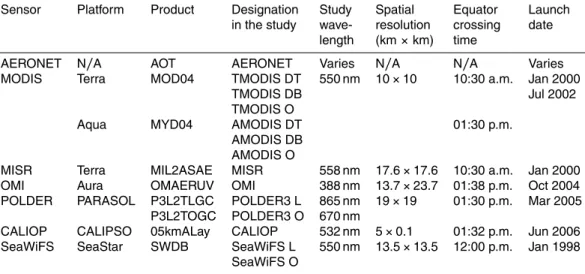
some have square-shaped footprints while others have rectangular pixel shapes. The nominal ground pixel sizes of the analyzed aerosol products at nadir are summarized in Table 1 and these sizes become progressively larger away from nadir. To ensure a uni-form and fair sampling of the aerosol products for cross-evaluation with AERONET and 25
ACPD
13, 4637–4685, 2013Coherent uncertainty analysis of aerosol
measurements
M. Petrenko and C. Ichoku
Title Page
Abstract Introduction
Conclusions References
Tables Figures
◭ ◮
◭ ◮
Back Close
Full Screen / Esc
Printer-friendly Version
Interactive Discussion
Discussion
P
a
per
|
Dis
cussion
P
a
per
|
Discussion
P
a
per
|
Discussio
n
P
a
per
et al., 2002) for validation and analysis of MODIS aerosol products (Chu et al., 2002; Ichoku et al., 2003, 2005; Levy et al., 2010; Remer, 2002) and later expanded to sup-port aerosol products retrieved by other spaceborne sensors (Petrenko et al., 2012). MAPSS subsets the aerosol products by extracting pixels covering approximately the same area on the ground centered over AERONET sun photometer measurement sites 5
and over certain other point locations that are not addressed in this study.
Assuming an imaginary circle of 55-km diameter whose center coincides with each AERONET station, all spaceborne aerosol product pixels falling within the circle are extracted. An aerosol pixel is regarded as being within the circle if the coordinates of the pixel center fall within 27.5 km from the coordinates of the circle center, where the 10
distance between the coordinates of the two points is determined using the Haversine formula (Sinnott, 1984). Based on the nominal spatial resolution of the sensors in Ta-ble 1, the approximate maximum number of pixels within the 55-km diameter sample
space at nadir for the different sensors is as follows: MODIS – 25, MISR – 9, OMI – 8,
POLDER – 9, CALIOP – 11, and SeaWiFS – 16. The actual number of pixels within 15
the sampling circle decreases for the aerosol retrievals away from the nadir of the satellite scene, and can be further reduced in the presence of clouds or other factors preventing retrieval of aerosol parameters. Based on the extracted sample, statistics of each aerosol parameter retrieved within the sampling areas are calculated and include mean, median, standard deviation, as well as the value of the central pixel over the 20
ground station. In this paper, results are reported based on the analysis of the mean values; although not reported in this paper because of the space considerations, a sim-ilar analysis was performed based on the central values and is reported in the digital supplement to this paper. It is appropriate to use the mean values in this paper, so as
to maintain the uniform sampling criterion across the different sensors to facilitate a fair
25
intercomparison. Analysis based on central pixel values can provide further details on
the effect of difference in sampling aerosol products from individual sensors.
To collocate AERONET data in time and space with the satellite data, AERONET
ex-ACPD
13, 4637–4685, 2013Coherent uncertainty analysis of aerosol
measurements
M. Petrenko and C. Ichoku
Title Page
Abstract Introduction
Conclusions References
Tables Figures
◭ ◮
◭ ◮
Back Close
Full Screen / Esc
Printer-friendly Version
Interactive Discussion
Discussion
P
a
per
|
Dis
cussion
P
a
per
|
Discussion
P
a
per
|
Discussio
n
P
a
per
|
tracted and the corresponding statistics are derived. Additionally, for the convenience of aerosol data intercomparison and validation, AERONET AOD are interpolated or (where necessary) extrapolated to the wavelengths of spaceborne sensors in Table 1 based on the established wavelength dependence of AOD (Eck et al., 1999). It is pertinent to note that this interpolation (and particularly) extrapolation process might 5
introduce an additional source of uncertainty when intercomparing the aerosol prod-ucts, especially for certain stations, where AERONET AOD observations in the range of 440–1200 nm have to be extrapolated by 52 nm to match OMI AOD at 388 nm.
Each AERONET station has a different period of operation and the quantity of
avail-able AOD data points is not uniform across all stations; while many stations are still 10
active, certain stations were active in the past and only for a short period of time. The overall availability of the collocated data during the analysis period of 7 June 2006 to 11 December 2010 is shown in Fig. 2, where for the purposes of this study the stations are classified as land-only, ocean-only, or land-and-ocean. This classification is based on analyzing collocated data of separate aerosol retrievals over land and ocean from 15
the MODIS, SeaWiFS, and POLDER sensors and identifying stations that have AOD data points from the land datasets, ocean datasets, or both; note that the MISR, OMI, and CALIOP sensors provide only joint land-and-ocean datasets.
3 Aerosol products
The key properties of the 11 analyzed aerosol products are summarized in Table 1, 20
while the original science data set (SDS) names of the spaceborne aerosol products are outlined in the first column of Table 2, except for the POLDER products that do not have an established SDS product naming convention. The sampled satellite data products are derived directly from the retrieval level aerosol products (Level 2) that represent the highest available spatial resolution for each product/sensor combination 25
ACPD
13, 4637–4685, 2013Coherent uncertainty analysis of aerosol
measurements
M. Petrenko and C. Ichoku
Title Page
Abstract Introduction
Conclusions References
Tables Figures
◭ ◮
◭ ◮
Back Close
Full Screen / Esc
Printer-friendly Version
Interactive Discussion
Discussion
P
a
per
|
Dis
cussion
P
a
per
|
Discussion
P
a
per
|
Discussio
n
P
a
per
Of the 11 sampled products, 3 are combined and-ocean products, 6 are land-only products, and 4 are ocean-land-only products. Furthermore, 6 aerosol products are retrieved from the twin MODIS-Terra and MODIS-Aqua sensors using the same set of 3 algorithms: the ocean algorithm is used for the retrievals over oceans and other large bodies of water, the land Dark Target (DT) algorithm is used over vegetated regions 5
and other dark surfaces (Remer et al., 2005), and the land Deep Blue (DB) algorithm is used for deserts and barren lands (Hsu et al., 2004). Although the results between
the two MODIS sensors are expected to be very close, they might still differ due to the
different times of scene observation during the day and other factors summarized in
(Ichoku et al., 2005; Remer et al., 2008). 10
The remainder of this section provides a brief description of the analyzed prod-ucts and highlights some of the unique aerosol properties reported in these prodprod-ucts. A more detailed overview can be found in the theoretical and validation works of the respective science teams of the products as cited below, while a general comparative overview of multiple products and retrieval algorithms are in (Kokhanovsky et al., 2007; 15
Lee et al., 2009; Li et al., 2009; Yu et al., 2006).
AERONET (http://aeronet.gsfc.nasa.gov) sun-photometers measure aerosol
prop-erties using ground-based observations of solar direct and diffuse irradiances. In this
work, the AERONET product used is the aerosol optical depth or thickness (AOD or AOT), which is retrieved from the AERONET direct measurements of solar irradiance. 20
Since AERONET measurements are made from the ground looking up, they present
a distinct advantage over spaceborne retrievals in that they are not affected by
uncer-tainties associated with the effects of surface properties as much as satellite
measure-ments are (Dubovik et al., 2002; Holben et al., 1998, 2001). Furthermore, the Level 2.0 AERONET data used in this work are carefully calibrated, cloud screened, and quality 25
ACPD
13, 4637–4685, 2013Coherent uncertainty analysis of aerosol
measurements
M. Petrenko and C. Ichoku
Title Page
Abstract Introduction
Conclusions References
Tables Figures
◭ ◮
◭ ◮
Back Close
Full Screen / Esc
Printer-friendly Version
Interactive Discussion
Discussion
P
a
per
|
Dis
cussion
P
a
per
|
Discussion
P
a
per
|
Discussio
n
P
a
per
|
retrieved globally over land and ocean (Chu et al., 2002; Hsu et al., 2004; Ichoku et al., 2005; Levy et al., 2010; Remer, 2002; Remer et al., 2005).
The MISR (http://www-misr.jpl.nasa.gov) aerosol product (MIL2ASAE) features aerosol retrievals based on observations from 9 independent camera angles. Multiple viewing angles allow MISR to measure certain aerosol properties that are not available 5
from the other instruments (e.g. aerosol particle size). Furthermore, MISR multiple cameras enable retrievals under conditions that are unfavorable to single-view (e.g. nadir) instruments, such as over bright surfaces or sun glint, where the other instru-ments are unable to make reliable retrievals in the visible wavelengths (Kahn, 2005; Kahn et al., 2010a; Martonchik et al., 2009).
10
The OMI (http://www.knmi.nl/omi/research/instrument/index.php) aerosol product (OMAERUV) measures the near-UV (near ultraviolet) aerosol absorption and extinc-tion optical depth, as well as single scattering albedo, among other aerosol properties (Torres et al., 1998, 2007). Moreover, OMI is capable of retrieving absorption optical depth in partially cloudy conditions that usually pose a challenge to other aerosol in-15
struments.
The POLDER onboard PARASOL (http://www.icare.univ-lille1.fr/parasol) aerosol land product (P3L2TLGC) and aerosol ocean product (P3L2TOGC) are derived from measuring spectral, directional, and polarized properties of reflected solar radiation. One of the main features of the POLDER instrument is its utilization of polarization 20
properties of the measured radiation for retrieving anthropogenic aerosol optical depth (Br ´eon et al., 2002; Buriez et al., 2002; Deuz ´e et al., 1999, 2001; Herman et al., 1997). It is important to note that the POLDER operational algorithm retrieves AOD at 2 wave-lengths (670 and 865 nm) over ocean and only at 1 wavelength (865 nm) over land. Furthermore over land, the POLDER algorithm retrieves only AOD that corresponds 25
to polarized particles, i.e. mainly fine mode particles originating from anthropogenic activities.
distri-ACPD
13, 4637–4685, 2013Coherent uncertainty analysis of aerosol
measurements
M. Petrenko and C. Ichoku
Title Page
Abstract Introduction
Conclusions References
Tables Figures
◭ ◮
◭ ◮
Back Close
Full Screen / Esc
Printer-friendly Version
Interactive Discussion
Discussion
P
a
per
|
Dis
cussion
P
a
per
|
Discussion
P
a
per
|
Discussio
n
P
a
per
bution of aerosols and clouds in the atmosphere, including the density and certain properties of individual aerosol layers (Omar et al., 2009; Winker et al., 2007).
The SeaWiFS (http://disc.sci.gsfc.nasa.gov/dust/) aerosol product (SWDB) uses the
Deep Blue algorithm to derive aerosol optical thickness and ˚Angstr ¨om exponent. The
key features of this product are the retrievals of aerosol properties over both bright 5
desert and vegetated surfaces, avoidance of sun glint that improves aerosol retrievals over ocean, and a highly precise calibration of the SeaWiFS sensor (Hsu et al., 2004, 2012).
Since each of the foregoing data sets has a few versions because of the periodic revisions and updates of their retrieval algorithms over time, the data versions that 10
were current at the time of writing this paper (January 2013) were sampled, although the study has been designed in a highly flexible way to enable rapid re-analysis as the new versions become available. The respective data versions used in this paper are: Terra and Aqua MODIS (Collection 051), MISR (Version 002), OMI (Version 003), CALIOP (Version 3-01), POLDER (Versions L and K), SeaWiFS (Version 003), and 15
AERONET AOD (Version 2). Therefore, all of the illustrations and analyses shown in this paper are based on these data versions for the respective aerosol sensors.
4 Data quality screening
While the AERONET Level-2 data are manually inspected to be free of retrieval defects and anomalies (Smirnov et al., 2000), such approach is not feasible for the voluminous 20
spaceborne data. Instead, all Level-2 aerosol products analyzed in this paper assign to AOD pixels one or more quality assurance (QA) flags that indicate a degree of “confi-dence” of the retrieval algorithms in their results. For MODIS and SeaWiFS, aerosol QA flags are integer numbers ranging from 0 to 3, with 3 representing the highest quality. For MISR and OMI data, the reverse is the case (i.e. 0 is the highest quality). Finally, for 25
ACPD
13, 4637–4685, 2013Coherent uncertainty analysis of aerosol
measurements
M. Petrenko and C. Ichoku
Title Page
Abstract Introduction
Conclusions References
Tables Figures
◭ ◮
◭ ◮
Back Close
Full Screen / Esc
Printer-friendly Version
Interactive Discussion
Discussion
P
a
per
|
Dis
cussion
P
a
per
|
Discussion
P
a
per
|
Discussio
n
P
a
per
|
means of these QA flags, certain aerosol retrievals are identified as “bad quality” and are considered to be not trustworthy enough for certain analyses. Therefore, users of these aerosol products have been advised to choose data corresponding to a range of QA values that is most appropriate for their specific needs.
To establish similar yet valid QA thresholds for the analyzed products, we consulted 5
science teams of the analyzed products as well as data product validation results re-ported by these teams and other research groups. Based on this inquiry, we chose the acceptable QA values as described in Table 2. For the majority of the products, the thresholds are set based on selecting a limited subset of the possible QA values. An important exception is the POLDER aerosol products, where the QA flags are ex-10
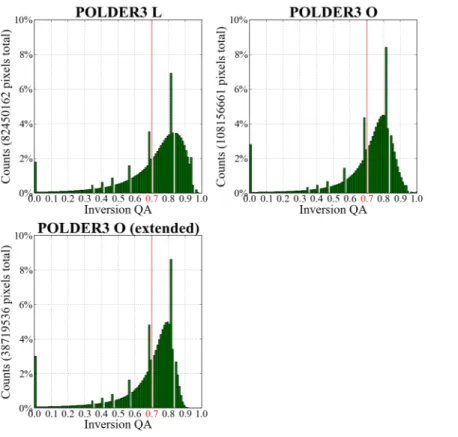
pressed as real numbers between 0 (“bad retrieval”) and 1 (“excellent retrieval”). Since there are no formal recommendations on the acceptable range of the flag values, we
empirically set its threshold to ≥0.7, which selects data of a reasonable quality yet
discards the minimal number of data pixels (see Fig. 3).
The original MAPSS framework was designed to facilitate data analysis experiments 15
based on different values of QA flags. For this, MAPSS extracts QA flags over the
sampling area and computes the statistical mode for integer QA flags and mean for real QA flags. These statistical modes of the integer QA flags and means of the real QA flags provide a single number for the quality assessment of each sample set, and can be used to screen the corresponding subset statistics while providing a convenient 20
alternative compared to screening individual pixels, e.g. see (Levy et al., 2010; Remer et al., 2008). However, it was observed that this approach has an unequal impact on
the statistical properties of the different aerosol products (Petrenko et al., 2012).
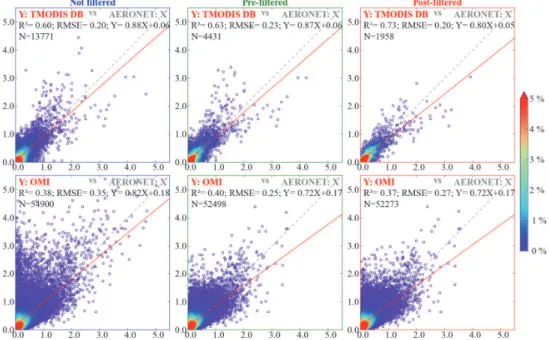
As an example, consider Fig. 4, where the global collocated subset mean AOD val-ues from OMI and Terra MODIS Deep Blue (TMODIS DB) are compared to the cor-25
responding subset mean AOD values from AERONET. It can be observed that while filtering the mean TMODIS DB AOD values by the mode of QA flags improves the
R2 and RMSE statistics, when compared to computing the mean values based on
ACPD
13, 4637–4685, 2013Coherent uncertainty analysis of aerosol
measurements
M. Petrenko and C. Ichoku
Title Page
Abstract Introduction
Conclusions References
Tables Figures
◭ ◮
◭ ◮
Back Close
Full Screen / Esc
Printer-friendly Version
Interactive Discussion
Discussion
P
a
per
|
Dis
cussion
P
a
per
|
Discussion
P
a
per
|
Discussio
n
P
a
per
distribution of the collocated data. Specifically, compared to screening individual pixels, QA mode filtering removes 50 % more of the collocated data points and degrades the slope of the fitted regression line as a result of removing certain high-biased points. The opposite behavior can be observed in the collocated OMI AOD and AERONET AOD
datasets, where screening by QA mode degradesR2of the collocated data when
com-5
pared to screening individual pixels, although RMSE is still improved and the slope of the fitted regression line remains the same, since both screening approaches produce approximately the same number of the OMI subset data points.
This observation indicates a certain inhomogeneity in the uncertainties that are present in the aerosol products, as in some cases high biases in individual pixels might 10
overwhelm the statistics derived from the sample set. Therefore, to avoid such biases and ensure a fair comparison between the analyzed aerosol products, the rest of this study is based on the QA “pre-filtering” approach, where individual pixels in a spatial sample are screened by their QA values before computing the statistics of this sam-ple. This approach also closely models a typical use of the spaceborne aerosol data, 15
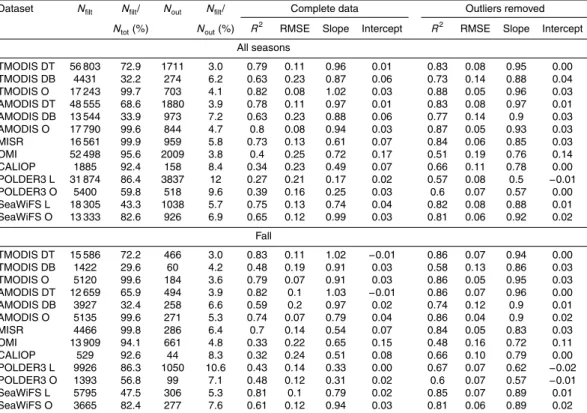
where data users screen each pixel individually and do not consider QA values of its neighboring pixels. The data quantity impact of the described QA screening approach can be observed in Table 3 that provides the sizes of the analyzed datasets before and after the screening. It is noticeable that, depending on the product, the impact is quite
different, with the two MODIS ocean AOD datasets and the MISR AOD dataset
retain-20
ing almost all of their available datasets whereas the two MODIS DT datasets retained only one-fourth of the complete collocated datasets.
It is important however to keep in mind that the QA values reported by the retrieval algorithms are to a large degree subjective to these algorithms and do not always re-flect the actual quality of the retrievals. For example, in an absence of a proper aerosol 25
ACPD
13, 4637–4685, 2013Coherent uncertainty analysis of aerosol
measurements
M. Petrenko and C. Ichoku
Title Page
Abstract Introduction
Conclusions References
Tables Figures
◭ ◮
◭ ◮
Back Close
Full Screen / Esc
Printer-friendly Version
Interactive Discussion
Discussion
P
a
per
|
Dis
cussion
P
a
per
|
Discussion
P
a
per
|
Discussio
n
P
a
per
|
unfavorable for aerosol retrieval, e.g. sub-pixel cloud contamination in OMI retrievals (Torres et al., 1998). In yet another situation, an aerosol scene can be observed in only a portion of the available observation modes of a sensor, e.g. in only a few of the available observation directions in POLDER (Herman et al., 1997), which can lead to more confident yet less reliable results. The opposite case can also be true, where an 5
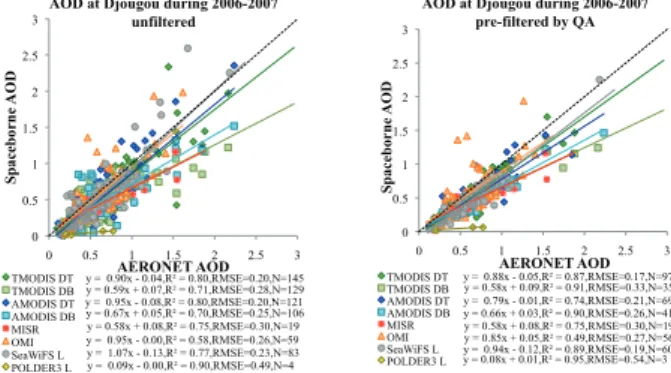
algorithm correctly retrieves aerosol properties but is not confident about the retrieval. As an example, consider Fig. 5 that explores how QA screening degrades the statistics of OMI AOD and Aqua MODIS Deep Blue AOD datasets when compared to AERONET
AOD over Djougou, Benin, as a result of assigning a “bad” QA flag to sufficiently “good”
retrievals. 10
5 Possible data outliers
Under rare circumstances, aerosol retrievals from spaceborne observations can pro-duce aerosol properties that do not reflect the actual physical state of aerosol in the atmosphere. Some of the reasons for such retrievals were discussed in the previous section and might include, but are not limited to, such factors as the lack of a proper 15
aerosol model, incorrect assumptions about boundary conditions, cloud contamination, and several other factors. In Fig. 6, the possible abnormal retrievals can be visually identified by observing points that have a minimal data density and lie abnormally far from the fitted regression lines. Even though an actual fraction of such data points in a complete collocated data set can be relatively minor, the extreme deviations of such 20
points from the overall trend might significantly bias and misrepresent the overall statis-tics of the data. Therefore, when computing the overall statisstatis-tics and inter-comparing the aerosol products, such data points should be treated as possible outliers and ana-lyzed separately from the rest of the data.
In order to identify and separate the possible data outliers, we analyzed AOD resid-25
uals, i.e. the difference between spaceborne AOD and AERONET AOD observations,
Stan-ACPD
13, 4637–4685, 2013Coherent uncertainty analysis of aerosol
measurements
M. Petrenko and C. Ichoku
Title Page
Abstract Introduction
Conclusions References
Tables Figures
◭ ◮
◭ ◮
Back Close
Full Screen / Esc
Printer-friendly Version
Interactive Discussion
Discussion
P
a
per
|
Dis
cussion
P
a
per
|
Discussion
P
a
per
|
Discussio
n
P
a
per
dards and Technology, 2012). This test is designed for testing data for multiple outliers
in approximately normal data sets and works by finding data points that differ from the
mean value by more than 5 median absolute deviations. Unlike the standard devia-tion used in the tradidevia-tional Z-Score test, the median absolute deviadevia-tion in the Modified Z-Score test is calculated based on the median of the data and is less sensitive to 5
extreme values.
It is pertinent to note that even though AOD data are known to follow the lognormal distribution (O’Neill et al., 2000), the AOD residuals of the analyzed products follow an approximately normal distribution as shown in Figs. 7 and 8, with the exception of the POLDER products that mostly underestimate AOD, because their retrievals focus on 10
anthropogenic aerosols, and thus represent only the negative portion of the distribution. In the figures, it can be seen that the distributions have long tails, strongly indicating a presence of outliers. Furthermore, it can be observed that the slopes of the fitted lines
are different from the slope of the 1 : 1 line. This indicates that the standard deviation
of the analyzed residuals is different from 1, showing that these data do not follow the
15
standard normal distribution, although this difference does not affect the test since the
Modified Z-Score test normalizes residuals by the median absolute deviation of the data.
The overall effect of removing the possible outliers can be observed in the
bottom-right sub-plots of Figs. 6–8, as highlighted by the green frames, showing that 926 20
(6.9 %) outliers are removed from the SeaWiFS Ocean AOD dataset. The total num-bers of the removed outliers are provided in Table 3 and do not exceed 12% of the total QA-screened data for any of the datasets when considering the all-season data. The global distribution of the possible data outliers is depicted in Fig. 9 and generally corre-sponds to the outlier locations reported by the science teams of the aerosol products, 25
ACPD
13, 4637–4685, 2013Coherent uncertainty analysis of aerosol
measurements
M. Petrenko and C. Ichoku
Title Page
Abstract Introduction
Conclusions References
Tables Figures
◭ ◮
◭ ◮
Back Close
Full Screen / Esc
Printer-friendly Version
Interactive Discussion
Discussion
P
a
per
|
Dis
cussion
P
a
per
|
Discussion
P
a
per
|
Discussio
n
P
a
per
|
Levy et al., 2010), although a more detailed study is needed to determine the specific factors that lead to these outliers and their spatio-temporal distributions, in order to de-velop appropriate mitigation measures in the retrieval algorithms for each of the prod-ucts. In the remainder of this paper, the reported results are based on the QA-screened data with the outliers removed.
5
6 Analysis
The overall data distribution for the analyzed spaceborne aerosol products is presented in Fig. 6, whereas the detailed linear regression fit statistics (Fox, 1997) for the products based on the treatment of the possible data outliers and the nominal delimiters of the four boreal seasons, namely, spring (March–May), summer (June–August), autumn 10
(September–November), and winter (December–February), are listed in Table 3. The statistics are presented based on a seasonal timeframes rather than monthly or shorter
time periods because there may not be sufficient coincident data for a scatter plot over
such shorter time periods, due to the infrequency of satellite aerosol retrieval caused by cloud cover and other issues. Fortunately, many climatic events that are relevant 15
to aerosol emission, transport, and distribution are often roughly aligned with these seasons.
In the presented statistics, the slope value indicates by how much the satellite re-trieval for the parameter under consideration is relatively underestimated or
overesti-mated across different magnitudes, depending on whether the slope value is less than
20
or greater than unity. The offset parameter indicates the extent to which the satellite
retrieval is biased. The squared linear correlation coefficient (R2) indicates how
consis-tent the parameter retrieval is across its magnitude range, that is how tightly the points are aligned close to the 1-to-1 line. Finally, the root mean square error (RMSE) indi-cates the accuracy of the retrievals measured as the average error in the spaceborne 25
ACPD
13, 4637–4685, 2013Coherent uncertainty analysis of aerosol
measurements
M. Petrenko and C. Ichoku
Title Page
Abstract Introduction
Conclusions References
Tables Figures
◭ ◮
◭ ◮
Back Close
Full Screen / Esc
Printer-friendly Version
Interactive Discussion
Discussion
P
a
per
|
Dis
cussion
P
a
per
|
Discussion
P
a
per
|
Discussio
n
P
a
per
In Table 3, it can be seen that all MODIS, MISR, and SeaWiFS aerosol products
cor-relate to AERONET observations withR2≥0.6. Furthermore, MISR, SeaWiFS Land,
and MODIS Dark Target products have R2≥0.7 and MODIS Ocean products have
R2≥0.8. Also, once the possible outliers are removed, the SeaWiFS, MISR, and
MODIS Dark Target products reachR2≥0.8, while the MODIS Deep Blue products
5
exceed R2≥0.7. All the best-performing Land products have RMSE values of about
0.15 (measured in the same units as AOD), with the exception of MODIS Deep Blue products that have RMSE of 0.23. Removing possible outliers improves (reduces) the RMSE of all products by 25–50 %, with the exception of OMI for which the improvement is the smallest. This indicates an opportunity for improvement of the aerosol data prod-10
ucts by adjusting the retrieval algorithms in the areas with the highest concentrations of the possible outliers.
Figure 10 charts the seasonal dependence ofR2and RMSE of the spaceborne
prod-ucts based on the data in Table 3. While all of the prodprod-ucts demonstrate the high sea-sonal variations in the statistical parameters, the OMI, CALIOP, POLDER, SeaWiFS, 15
and MODIS Deep Blue are the most sensitive to the seasonal changes in the retrieval conditions, perhaps because of the uncertainties associated with cloud screening (Li et al., 2009), although collocating spaceborne observations with AERONET introduces certain bias towards cloud-free scenes because of the comprehensive AERONET cloud screening procedures (Smirnov et al., 2000). Furthermore, it can be seen that 20
while removing the data outliers greatly reduces the RMSE and removes sensitivity to the seasonal changes in CALIOP, POLDER, and SeaWiFS, the sensitivity remains the same for OMI and MODIS Deep Blue indicating that the retrieval errors reflected by the RMSE of these products likely stem from the regular retrievals rather than the anomalous retrievals.
25
ACPD
13, 4637–4685, 2013Coherent uncertainty analysis of aerosol
measurements
M. Petrenko and C. Ichoku
Title Page
Abstract Introduction
Conclusions References
Tables Figures
◭ ◮
◭ ◮
Back Close
Full Screen / Esc
Printer-friendly Version
Interactive Discussion
Discussion
P
a
per
|
Dis
cussion
P
a
per
|
Discussion
P
a
per
|
Discussio
n
P
a
per
|
the best retrievals at all sites. Furthermore, as indicated by the lighter shading in Fig.
11 (e.g. Southern Australia) and also in the histogram ofR2inset in this figure, some
sites are not covered by high-correlation (i.e. R2≥0.75) retrievals at all or have no
collocated retrievals from the most accurate of the products.
Furthermore, it can be observed that the best-performing aerosol products differ
5
between Figs. 11 and 12 and the products providing the best RMSE are oftentimes
those with the lowerR2. Therefore, when choosing an aerosol product for a specific
analysis goal and at a specific region, it is necessary to consider a balance between a variety of seasonal, statistical, and spatial factors.
7 Accuracy of aerosol data products based on land cover type
10
Aerosol properties are derived from satellite observations based on a set of assump-tions about the type and the optical properties of the underlying terrestrial surfaces. Therefore, it can be beneficial to compare the accuracy of the considered aerosol data products based on the land cover types of the sites over which the data subsets were extracted. As a reference for land cover types and their spatial extent, we used the 15
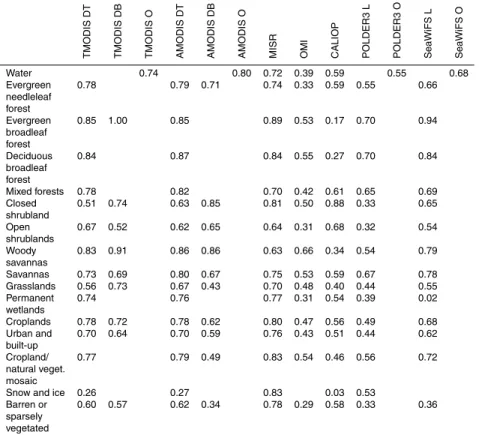
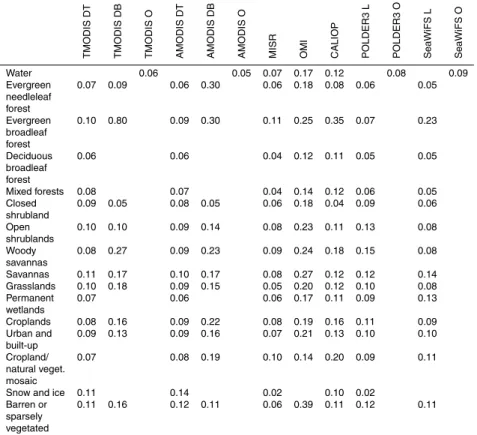
global data set that is based on the International Geosphere-Biosphere Programme (IGBP) classification scheme and is available from the suite of MODIS products (Friedl et al., 2002). For each land cover type, we identified coincident AERONET stations and averaged their corresponding statistical results from Sect. 6. Tables 4 and 5 list the re-sults of this aggregation, while Figs. 13 and 14 outline these rere-sults on a geographical 20
map.
Generally, these aggregated results corroborate the findings of Sect. 6 and the aerosol products from MODIS and MISR sensors produce the most accurate results for the majority of the land cover types, although there are some peculiarities that should be discussed in greater detail in order to better understand the best areas of application 25
ACPD
13, 4637–4685, 2013Coherent uncertainty analysis of aerosol
measurements
M. Petrenko and C. Ichoku
Title Page
Abstract Introduction
Conclusions References
Tables Figures
◭ ◮
◭ ◮
Back Close
Full Screen / Esc
Printer-friendly Version
Interactive Discussion
Discussion
P
a
per
|
Dis
cussion
P
a
per
|
Discussion
P
a
per
|
Discussio
n
P
a
per
Specifically, IGBPwater surface locations include 36 AERONET stations out of 154
stations with collocated ocean retrievals identified in Fig. 2. At these 36 locations,
MODIS, MISR, and SeaWiFS demonstrate the best results withR2≈0.7. Furthermore,
POLDER Ocean data set has a good RMSE=0.08 (Deuz ´e et al., 1999) that is
compa-rable to the best performing sensors in this region, albeit it has a relatively low squared 5
correlation coefficient value of R2=0.55; note that these statistics are different from
POLDER Ocean statistics in Fig. 6 that analyzes a more complete set of AERONET stations. It is interesting to note that the correlation between AERONET and Aqua
MODIS AOD withR2=0.8 is higher than the correlation between AERONET and Terra
MODIS AOD withR2=0.74. A detailed inspection of the data showed that this diff
er-10
ence stems from several AERONET sites with relatively small numbers of collocated
data points (N <35) and the average AOD below 0.2. Under such low-AOD conditions,
MODIS Ocean algorithm has difficulty in retrieving the precise AOD values and, as
a result, is subject to an increased rate of errors (Kleidman et al., 2005; Remer, 2002).
Evergreen broadleaf forestregions provide conditions that are favorable for retrieving 15
AOD and multiple sensors demonstrate the high correlation with AERONET, including
MODIS Dark Target with R2=0.85, MISR with R2=0.89, SeaWiFS with R2=0.94,
and POLDER withR2=0.7. However, since these regions are also susceptible to
com-plex smoke events (e.g. Ji Parana, Brazil), sometimes combined with dust and pollution events (e.g. Anmyon, S. Korea, Hong Kong, China), most of the sensors demonstrate 20
a rather poor RMSE (Hyer et al., 2011). The important exception is POLDER dataset
that has RMSE=0.07, possibly because POLDER is especially sensitive to small
par-ticles produced by biomass burning and anthropogenic pollution sources (Fan et al., 2008), thereby retrieving fairly accurate AOD values at Ji Parana and Lulin, Taiwan. It should be also noted that together with deciduous broadleaf forests and savannas, ev-25
ergreen broadleaf forest is one of the 3 land cover types where POLDER demonstrates
very good results withR2≈0.7, indicating the advantage of polarization measurements
ACPD
13, 4637–4685, 2013Coherent uncertainty analysis of aerosol
measurements
M. Petrenko and C. Ichoku
Title Page
Abstract Introduction
Conclusions References
Tables Figures
◭ ◮
◭ ◮
Back Close
Full Screen / Esc
Printer-friendly Version
Interactive Discussion
Discussion
P
a
per
|
Dis
cussion
P
a
per
|
Discussion
P
a
per
|
Discussio
n
P
a
per
|
Formixed forests, MODIS Dark Target products provide the highest retrieval
accu-racy with R2=0.78 for Terra and 0.82 for Aqua, while MISR data is somewhat less
accurate withR2=0.7 as a result of underestimating high AODs during summertime
biomass burning events (Kahn et al., 2010b), although RMSE=0.04 of MISR is almost
a factor of two better than RMSE=0.08 of Terra MODIS and RMSE=0.07 of Aqua
5
MODIS. Sufficiently reliable aerosol data are also retrieved by SeaWiFS withR2=0.69
and by POLDER withR2=0.65.
For closed shrubland, CALIOP with R2=0.88 MISR with R2=0.81, and MODIS
Deep Blue with R2=0.74 for Terra and R2=0.85 for Aqua produce the best results.
Although MODIS Deep Blue shows a better performance than MODIS Dark Target for 10
this land-cover type, the Deep Blue products are retrieved only over a single Lake Ar-gyle AERONET site in northern Australia, whereas Dark Target products are retrieved over 7 sites and have a significantly larger number of data points. Likewise, the best result demonstrated by CALIOP also originates exclusively from the Lake Argyle
re-trievals. The difference of 0.1 in R2 between MODIS Terra Deep Blue and MODIS
15
Aqua Deep Blue can be partly explained by the difference in the data availability of
these two data sets, as MODIS Terra Deep Blue at the time of this work is availably
only through 2007; this effect can be also observed for several other land cover types,
where MODIS Aqua Deep Blue tends to have a lower correlation to AERONET and produces results that are closer to the results of SeaWiFS, probably because the latter 20
is also based on the Deep Blue retrieval algorithm (Hsu et al., 2006).
Over wooded savannas, both Dark Target and Deep Blue products from MODIS,
and SeaWiFS produce very good results withR2≈0.85. MISR withR2=0.63 and OMI
withR2=0.66 produce lower, but still reasonable results. The reduced performance of
MISR in this region can be explained by the lack of region-specific aerosol mixtures 25
ACPD
13, 4637–4685, 2013Coherent uncertainty analysis of aerosol
measurements
M. Petrenko and C. Ichoku
Title Page
Abstract Introduction
Conclusions References
Tables Figures
◭ ◮
◭ ◮
Back Close
Full Screen / Esc
Printer-friendly Version
Interactive Discussion
Discussion
P
a
per
|
Dis
cussion
P
a
per
|
Discussion
P
a
per
|
Discussio
n
P
a
per
favorable cloud-free conditions in sub-Saharan Africa (Ahn et al., 2008; Torres et al., 2007).
Open shrublands are very dry and sparsely vegetated regions that are character-ized by bright surfaces. Such regions present a great challenge for remote retrieval of aerosol properties (Kahn et al., 2009) and none of the analyzed products exceeded the 5
correlation coefficient of 0.7. Among the best-performing products, CALIOP produced
the best results withR2=0.68, closely followed by MODIS Dark Target withR2=0.67
for Terra and R2=0.62 for Aqua, MISR with R2=0.64, and MODIS Deep Blue with
R2=0.52 for Terra and R2=0.65 for Aqua. It should be noted that open shrublands
and closed shrublands are the two areas where CALIOP outperforms other sensors, 10
possibly indicating the advantage of active aerosol sensing over these bright-surface regions.
Similar to open shrublands,grasslandswere challenging to all of the sensors, where
Terra MODIS Deep Blue withR2=0.73 and MISR withR2=0.7 demonstrated the best
results. Even more challenging weresnow and iceand alsobarren or sparsely
vege-15
tated areas, where MISR was the only highly accurate aerosol product withR2=0.83
for snow/ice and R2=0.78 for barren lands, thanks to its multi-angle measurement
capabilities that allow retrieving aerosol properties over bright surfaces and enable the advanced cloud and ice detection capabilities (Kahn et al., 2009).
8 Conclusions
20
In this paper, we analyzed and intercompared 11 spaceborne aerosol products from MODIS, MISR, OMI, SeaWiFS, POLDER, and CALIOP sensors, which were sampled fairly uniformly based on the MAPSS framework that was used to collocate these spaceborne observations with ground-based AERONET observations during the pe-riod of 7 June 2006 and 11 December 2010, when all the sensors were operational. 25
Based on this analysis, for each of the AERONET stations, we identified products
ACPD
13, 4637–4685, 2013Coherent uncertainty analysis of aerosol
measurements
M. Petrenko and C. Ichoku
Title Page
Abstract Introduction
Conclusions References
Tables Figures
◭ ◮
◭ ◮
Back Close
Full Screen / Esc
Printer-friendly Version
Interactive Discussion
Discussion
P
a
per
|
Dis
cussion
P
a
per
|
Discussion
P
a
per
|
Discussio
n
P
a
per
|
found that no single product provides the best retrieval over all sites, and certain sites are not covered by accurate retrievals at all. Furthermore, it was observed that a
prod-uct providing the bestR2at a certain location does not always provide the best RMSE
at the same location. Therefore, to facilitate the multivariate analysis that is neces-sary when choosing the most suitable spaceborne aerosol product at a specific region, 5
we plan to develop an interactive tool that would allow exploration of the multi-sensor collocated data on an interactive map.
Further, a statistical approach based on the statistical Modified Z-Score test has been used to automatically identify possible data outliers in collocated data sets. The reported analysis shows that even though such atypical data points constitute a rela-10
tively minor portion (3 %–12 %) of the analyzed data sets, they can significantly bias the results of the statistical analysis. For this reason, it is suggested that such data points be set aside when analyzing collocated data sets and inspected separately.
Finally, we assessed the accuracy of the spaceborne aerosol products based on IGBP land cover classification scheme. This analysis identified sensors that retrieve 15
the most accurate aerosol properties over each of the defined land cover types and
highlighted the differences that exists between the sensors, providing an advantage or
disadvantage in retrieving AOD over the areas of a particular land cover type. Notably, some of the land cover types, including open shrublands and grasslands, had only moderately accurate retrievals, indicating the need for improved spaceborne aerosol 20
remote sensing instrumentation/approaches and/or retrieval algorithms.
Supplementary material related to this article is available online at: http://www.atmos-chem-phys-discuss.net/13/4637/2013/
ACPD
13, 4637–4685, 2013Coherent uncertainty analysis of aerosol
measurements
M. Petrenko and C. Ichoku
Title Page
Abstract Introduction
Conclusions References
Tables Figures
◭ ◮
◭ ◮
Back Close
Full Screen / Esc
Printer-friendly Version
Interactive Discussion
Discussion
P
a
per
|
Dis
cussion
P
a
per
|
Discussion
P
a
per
|
Discussio
n
P
a
per
Acknowledgements. Support for the development of this project has been provided by NASA
HQ under Grant Number NNX08AN39A through the ROSES 2007 ACCESS Program based on a proposal entitled: “Integrated validation, intercomparison, and analysis of aerosol prod-ucts from multiple satellites” and also under Grant NNH10ZDA001N-ESDRERR through the ROSES 2009 Earth System Data Records Uncertainty Analysis Program based on a pro-5
posal titled “Coherent uncertainty analysis of aerosol data products from multiple satellites”. We thank the science and support teams of MODIS, MISR, OMI, POLDER, CALIOP, SeaW-iFS, and AERONET for retrieving and making available their respective aerosol products, as well as for providing assistance during the development of MAPSS sampling for these prod-ucts. Specifically, we are grateful to certain individual members of the aerosol product teams 10
for their insight and willingness to provide us answers to various questions related to their respective products, namely: AERONET (Brent Holben, Thomas Eck, Oleg Dubovik, Alexan-der Smirnov, David Giles), MODIS-DT (Lorraine Remer, Robert Levy, Shana Mattoo, Claire Salustro), MODIS-DB (Christina Hsu, Corey Bettenhausen, Jingfeng Huang), MISR (Ralph Kahn, Falguni Patadia, James Limbacher), OMI (Omar Torres, Changwoo Ahn, Suraiya Ah-15
mad), CALIOP (David Winker, Ali Omar, Mark Vaughan), SeaWiFS (Christina Hsu, Andrew Sayer), and POLDER (Didier Tanre, Jacques Descloitres, Fabrice Ducos). We also give special thanks to the PIs of the global AERONET sites and their stafffor establishing and maintaining these sites. Finally, we would like to honor the memory of our colleague, Gregory Leptoukh, who passed away suddenly in January 2012, as we had a long-term collaboration with him 20
that resulted in the implementation of the MAPSS framework on the GIOVANNI data analysis system, and he was part of the initial discussions of the ideas that led to this study.
References
Ahn, C., Torres, O., and Bhartia, P. K.: Comparison of ozone monitoring instrument UV aerosol products with aqua/moderate resolution imaging spectroradiometer and multian-25
gle imaging spectroradiometer observations in 2006, J. Geophys. Res., 113, D16S27, doi:10.1029/2007JD008832, 2008.
ACPD
13, 4637–4685, 2013Coherent uncertainty analysis of aerosol
measurements
M. Petrenko and C. Ichoku
Title Page
Abstract Introduction
Conclusions References
Tables Figures
◭ ◮
◭ ◮
Back Close
Full Screen / Esc
Printer-friendly Version
Interactive Discussion
Discussion
P
a
per
|
Dis
cussion
P
a
per
|
Discussion
P
a
per
|
Discussio
n
P
a
per
|
the Earth’s Reflectances (POLDER), Adv. Space Res., 30, 2383–2386, doi:10.1016/S0273-1177(02)80282-4, 2002.
Cheng, T., Chen, H., Gu, X., Yu, T., Guo, J., and Guo, H.: The inter-comparison of MODIS, MISR and GOCART aerosol products against AERONET data over China, J. Quant. Spectrosc. Ra., doi:10.1016/j.jqsrt.2012.06.016, 2012.
5
Chu, D. A., Kaufman, Y. J., Ichoku, C., Remer, L. A., Tanr ´e, D., and Holben, B. N.: Valida-tion of MODIS aerosol optical depth retrieval over land, Geophys. Res. Lett., 29, 8007, doi:10.1029/2001GL013205, 2002.
Deuz ´e, J. L., Herman, M., Goloub, P., Tanr ´e, D., and Marchand, A.: Characterization of aerosols over ocean from POLDER/ADEOS-1, Geophys. Res. Lett., 26, 1421–1424, 10
doi:10.1029/1999GL900168, 1999.
Deuz ´e, J. L., Br ´eon, F. M., Devaux, C., Goloub, P., Herman, M., Lafrance, B., Maignan, F., Marchand, A., Nadal, F., Perry, G., and Tanr ´e, D.: Remote sensing of aerosols over land surfaces from POLDER-ADEOS-1 polarized measurements, J. Geophys. Res., 106, 4913– 4926, doi:10.1029/2000JD900364, 2001.
15
Dubovik, O., Holben, B., Eck, T. F., Smirnov, A., Kaufman, Y. J., King, M. D., Tanr ´e, D., and Slutsker, I.: Variability of absorption and optical properties of key aerosol types observed in worldwide locations, J. Atmos. Sci., 59, 590–608, doi:10.1175/1520-0469(2002)059<0590:VOAAOP>2.0.CO;2, 2002.
Eck, T. F., Holben, B. N., Reid, J. S., Dubovik, O., Smirnov, A., O’Neill, N. T., Slutsker, I., and 20
Kinne, S.: Wavelength dependence of the optical depth of biomass burning, urban, and desert dust aerosols, J. Geophys. Res., 104, 31333–31349, doi:10.1029/1999JD900923, 1999.
Fan, X., Goloub, P., Deuz ´e, J.-L., Chen, H., Zhang, W., Tanr ´e, D., and Li, Z.: Evaluation of PARASOL aerosol retrieval over North East Asia, Remote Sens. Environ., 112, 697–707, 25
doi:10.1016/j.rse.2007.06.010, 2008.
Fox, J.: Applied Regression Analysis, Linear Models, and Related Methods, Sage Publications, Inc., Newbury Park, CA, USA, 1997.
Friedl, M., McIver, D., Hodges, J. C., Zhang, X., Muchoney, D., Strahler, A., Woodcock, C., Gopal, S., Schneider, A., Cooper, A., Baccini, A., Gao, F., and Schaaf, C.: Global land cover 30
ACPD
13, 4637–4685, 2013Coherent uncertainty analysis of aerosol
measurements
M. Petrenko and C. Ichoku
Title Page
Abstract Introduction
Conclusions References
Tables Figures
◭ ◮
◭ ◮
Back Close
Full Screen / Esc
Printer-friendly Version
Interactive Discussion
Discussion
P
a
per
|
Dis
cussion
P
a
per
|
Discussion
P
a
per
|
Discussio
n
P
a
per
G ´erard, B., Deuz ´e, J.-L., Herman, M., Kaufman, Y. J., Lallart, P., Oudard, C., Remer, L. A., Roger, B., Six, B., and Tanr ´e, D.: Comparisons between POLDER 2 and MODIS/Terra aerosol retrievals over ocean, J. Geophys. Res., 110, 1–15, doi:10.1029/2005JD006218, 2005.
Guo, J., Xue, Y., Cao, C., Zhang, H., Guang, J., Zhang, X., and Li, X.: A synergic algorithm for re-5
trieval of aerosol optical depth over land, Adv. Atmos. Sci., 26, 973–983, doi:10.1007/s00376-009-7218-4, 2009.
Herman, M., Deuz ´e, J. L., Devaux, C., Goloub, P., Br ´eon, F. M., and Tanr ´e, D.: Remote sens-ing of aerosols over land surfaces includsens-ing polarization measurements and application to POLDER measurements, J. Geophys. Res., 102, 17039–17049, doi:10.1029/96JD02109, 10
1997.
Holben, B. N., Eck, T. F., Slutsker, I., Tanr ´e, D., Buis, J. P., Setzer, A., Vermote, E., Reagan, J. A., Kaufman, Y. J., Nakajima, T., Lavenu, F., Jankowiak, I., and Smirnov, A.: AERONET – a fed-erated instrument network and data archive for aerosol characterization, Remote Sens. En-viron., 66, 1–16, doi:10.1016/S0034-4257(98)00031-5, 1998.
15
Holben, B. N., Tanr ´e, D., Smirnov, A., Eck, T. F., Slutsker, I., Abuhassan, N., Newcomb, W. W., Schafer, J. S., Chatenet, B., Lavenu, F., Kaufman, Y. J., Castle, J. Vande, Setzer, A., Markham, B., Clark, D., Frouin, R., Halthore, R., Karneli, A., O’Neill, N. T., Pietras, C., Pinker, R. T., Voss, K., and Zibordi, G.: An emerging ground-based aerosol clima-tology: Aerosol optical depth from AERONET, J. Geophys. Res., 106, 12067–12097, 20
doi:10.1029/2001JD900014, 2001.
Hsu, N. C., Tsay, S.-C., King, M. D., and Herman, J. R.: Aerosol properties over bright-reflecting source regions, IEEE T. Geosci. Remote Sens., 42, 557–569, doi:10.1109/TGRS.2004.824067, 2004.
Hsu, N. C., Gautam, R., Sayer, a. M., Bettenhausen, C., Li, C., Jeong, M. J., Tsay, S.-C., and 25
Holben, B. N.: Global and regional trends of aerosol optical depth over land and ocean using SeaWiFS measurements from 1997 to 2010, Atmos. Chem. Phys. Discuss., 12, 8465–8501, doi:10.5194/acpd-12-8465-2012, 2012.
Hyer, E. J., Reid, J. S., and Zhang, J.: An over-land aerosol optical depth data set for data assimilation by filtering, correction, and aggregation of MODIS Collection 5 optical depth 30
ACPD
13, 4637–4685, 2013Coherent uncertainty analysis of aerosol
measurements
M. Petrenko and C. Ichoku
Title Page
Abstract Introduction
Conclusions References
Tables Figures
◭ ◮
◭ ◮
Back Close
Full Screen / Esc
Printer-friendly Version
Interactive Discussion
Discussion
P
a
per
|
Dis
cussion
P
a
per
|
Discussion
P
a
per
|
Discussio
n
P
a
per
|
Ichoku, C., Chu, D. A., Mattoo, S., Kaufman, Y. J., Remer, L. A., Tanr ´e, D., Slutsker, I., and Hol-ben, B. N.: A spatio-temporal approach for global validation and analysis of MODIS aerosol products, Geophys. Res. Lett., 29, 1–4, doi:10.1029/2001GL013206, 2002.
Ichoku, C., Remer, L. A., Kaufman, Y. J., Levy, R., Chu, D. A., Tanr ´e, D., and Holben, B. N.: MODIS observation of aerosols and estimation of aerosol radiative forcing over south-5
ern Africa during SAFARI 2000, J. Geophys. Res., 108, 8499, doi:10.1029/2002JD002366, 2003.
Ichoku, C., Remer, L. A., and Eck, T. F.: Quantitative evaluation and intercomparison of morning and afternoon Moderate Resolution Imaging Spectroradiometer (MODIS) aerosol measure-ments from Terra and Aqua, J. Geophys. Res., 110, doi:10.1029/2004JD004987, 2005. 10
Iglewicz, B. and Hoaglin, D. C.: How to Detect and Handle Outliers, American Society for Quality Control, Milwaukee, WI, 1993.
Kahn, R. A.: Multiangle Imaging Spectroradiometer (MISR) global aerosol optical depth valida-tion based on 2 years of coincident Aerosol Robotic Network (AERONET) observavalida-tions, J. Geophys. Res., 110, 1–16, doi:10.1029/2004JD004706, 2005.
15
Kahn, R. A., Garay, M. J., Nelson, D. L., Yau, K. K., Bull, M. A., Gaitley, B. J., Martonchik, J. V., and Levy, R. C.: Satellite-derived aerosol optical depth over dark water from MISR and MODIS: Comparisons with AERONET and implications for climatological studies, J. Geo-phys. Res., 112, D18205, doi:10.1029/2006JD008175, 2007.
Kahn, R. A., Nelson, D. L., Garay, M. J., Levy, R. C., Bull, M. A., Diner, D. J., Martonchik, J. V., 20
Paradise, S. R., Hansen, E. G., and Remer, L. A.: MISR Aerosol Product Attributes and Statistical Comparisons With MODIS, IEEE Trans. Geosci. Remote Sens., 47, 4095–4114, doi:10.1109/TGRS.2009.2023115, 2009.
Kahn, R. A., Gaitley, B. J., Garay, M. J., Diner, D. J., Eck, T. F., Smirnov, A., and Holben, B. N.: Multiangle Imaging SpectroRadiometer global aerosol product assessment by compari-25
son with the Aerosol Robotic Network, J. Geophys. Res., 115, doi:10.1029/2010JD014601, 2010a.
Kahn, R. A., Gaitley, B. J., Garay, M. J., Diner, D. J., Eck, T. F., Smirnov, A., and Holben, B. N.: Multiangle Imaging SpectroRadiometer global aerosol product assessment by compari-son with the Aerosol Robotic Network, J. Geophys. Res., 115, doi:10.1029/2010JD014601, 30
2010b.
ACPD
13, 4637–4685, 2013Coherent uncertainty analysis of aerosol
measurements
M. Petrenko and C. Ichoku
Title Page
Abstract Introduction
Conclusions References
Tables Figures
◭ ◮
◭ ◮
Back Close
Full Screen / Esc
Printer-friendly Version
Interactive Discussion
Discussion
P
a
per
|
Dis
cussion
P
a
per
|
Discussion
P
a
per
|
Discussio
n
P
a
per
of aerosol properties. 3. MODIS versus MISR versus AERONET”, J. Quant. Spectrosc. Ra., 112, 901–909, doi:10.1016/j.jqsrt.2010.11.001, 2011.
Kittaka, C., Winker, D. M., Vaughan, M. A., Omar, A., and Remer, L. A.: Intercomparison of column aerosol optical depths from CALIPSO and MODIS-Aqua, Atmos. Meas. Tech., 4, 131–141, doi:10.5194/amt-4-131-2011, 2011.
5
Kleidman, R. G., O’Neill, N. T., Remer, L. a., Kaufman, Y. J., Eck, T. F., Tanr ´e, D., Dubovik, O., and Holben, B. N.: Comparison of Moderate Resolution Imaging Spectroradiometer (MODIS) and Aerosol Robotic Network (AERONET) remote-sensing retrievals of aerosol fine mode fraction over ocean, J. Geophys. Res., 110, D22205, doi:10.1029/2005JD005760, 2005. Kokhanovsky, A. A., Breon, F.-M., Cacciari, A., Carboni, E., Diner, D., Di Nicolantonio, W., 10
Grainger, R. G., Grey, W. M. F., H ¨oller, R., Lee, K.-H., Li, Z., North, P. R. J., Sayer, A. M., Thomas, G. E., and Von Hoyningen-Huene, W.: Aerosol remote sensing over land: a com-parison of satellite retrievals using different algorithms and instruments, Atmos. Res., 85, 372–394, doi:10.1016/j.atmosres.2007.02.008, 2007.
Kokhanovsky, A. A., Deuz ´e, J. L., Diner, D. J., Dubovik, O., Ducos, F., Emde, C., Garay, M. J., 15
Grainger, R. G., Heckel, A., Herman, M., Katsev, I. L., Keller, J., Levy, R., North, P. R. J., Prikhach, A. S., Rozanov, V. V., Sayer, A. M., Ota, Y., Tanr ´e, D., Thomas, G. E., and Zege, E. P.: The inter-comparison of major satellite aerosol retrieval algorithms using sim-ulated intensity and polarization characteristics of reflected light, Atmos. Meas. Tech., 3, 909–932, doi:10.5194/amt-3-909-2010, 2010.
20
Lee, K., Li, Z., and Kim, Y.: Atmospheric aerosol monitoring from satellite observations: A his-tory of three decades, in: Proceedings of Atmospheric and Biological Environmental Moni-toring, edited by: Kim, Y. J., Platt, U., Gu, M. B., and Iwahashi, H., Berlin, Germany, Springer, doi:10.1007/978-1-4020-9674-7, 13–38, 2009.
Levy, R. C., Leptoukh, G. G., Kahn, R., Zubko, V., Gopalan, A., and Remer, L. A.: A critical look 25
at deriving monthly aerosol optical depth from satellite data, IEEE Trans. Geosci. Remote Sens., 47, 2942–2956, doi:10.1109/TGRS.2009.2013842, 2009.
Levy, R. C., Remer, L. A., Kleidman, R. G., Mattoo, S., Ichoku, C., Kahn, R., and Eck, T. F.: Global evaluation of the Collection 5 MODIS dark-target aerosol products over land, Atmos. Chem. Phys., 10, 10399–10420, doi:10.5194/acp-10-10399-2010, 2010.
30