Angio te nsin-(1 -7 ) incre ase s o sm o tic
wate r pe rm e ability in iso late d to ad skin
Facultad de Ciencias Naturales e Instituto Miguel Lillo, INSIBIO and Fundación INELCO , Tucumán, Argentina
J.C. Santos, S. Jerez, M. Peral de Bruno and A. Coviello
Abstract
Angiotensin-(1-7) (Ang-(1-7)) increased osmotic water permeability in the isolated toad skin, a tissue with functional properties similar to those of the distal mammalian nephron. Concentrations of 0.1 to 10 µM were effective, with a peak at 20 min. This effect was similar in magnitude to that of frog skin angiotensin II (Ang II) and oxytocin but lower than that of human Ang II and arginine-vasotocin. The AT2 angiotensin receptor antagonist PD 123319 (1.0 µM) fully inhibited the response to 0.1 µM Ang-(1-7) but had no effect on the response to Ang II at the same concentration. The specific receptor antagonist of 7), A-779, was ineffective in blocking the response to Ang-(1-7) and to frog skin Ang II. The AT1 receptor subtype antagonist losartan, which blocked the response to frog skin Ang II, was ineffec-tive in blocking the response to Ang-(1-7). The present results support the view of an antidiuretic action of Ang-(1-7) in the mammalian nephron.
Co rre spo nde nce
A. Coviello Fundación INELCO Av. Mitre 35 4000 Tucumán Argentina
Fax: + 54-381-421-4497 E-mail: acoviello@ tucbbs.com.ar
Research supported by the Consejo Nacional de Investigaciones Científicas y Técnicas, Argentina (P.I.P. 5008) and Program I-106 from the Consejo de Investigaciones
de la Universidad Nacional de Tucumán, Argentina.
An Abstract of this work was presented to the XVth International Congress of Nephrology, May 2-6, 1999, Buenos Aires, Argentina.
Received February 24, 1999 Accepted May 8, 2000
Ke y wo rds ·Angiotensin-(1-7)
·Toad skin
·O smotic water permeability
·Receptor subtypes
Intro ductio n
Angiotensin-(1-7) (Ang-(1-7)) is a bio-logically active peptide of the renin-angio-tensin system produced from angiorenin-angio-tensin I by an independent pathway of the angio-tensin-converting enzyme with cellular func-tions that differ from angiotensin II (Ang II) (1,2). Several renal actions of Ang-(1-7) have been reported, indicating that the peptide has a role in hydromineral balance. In water-loaded rats it produces marked antidiuresis (3) by a direct effect on inner medullary collecting ducts (4). This effect is not blocked by the V2 receptor antagonist (4) but is blocked by the specific antagonist A-779 (5,6) and losartan (7). Ang-(1-7) may play a role during dehydration and hemorrhage in rats (8). In the rat proximal straight tubules a
ob-tained with other Ang II and neurohypophy-seal peptides (oxytocin and arginine-vasoto-cin).
Mate rial and Me tho ds
Toads (Bufo arenarum) hydrated over-night were used. After pithing, the ventral pelvic skin was dissected and divided into two symmetrical parts which were mounted (dermal surface outward) over the bottom of plastic tubes (surface area 1.77 cm2) and
immersed in a bath of 10 ml of aerated Ringer solution. The inner epidermal sur-face was bathed with the same solution di-luted 1/5 in distilled water and Posm was measured gravimetrically by weighing the tube on a scale (Mettler H10) to the nearest 0.1 mg. After an equilibration period of 1 h in which the solutions were changed twice, one or two control periods of 20 min were allowed to elapse, followed by an experi-mental one in which the Posm response to the hormone added to the dermal bath was measured. In some experiments, an antago-nist was added to the paired half-skin 10 min before the addition of the hormone (Ang II) to both halves. In another experiment the preparation was weighed during several pe-riods of 20 min in order to determine the time course of the response. Results are re-ported as mg cm-2 h-1 and the hormonal
effect as the mean and standard error (SEM) of the difference between the experimental period and the previous control one. The
Ringer solution contained 90 mM NaCl, 2 mM KCl, 1 mM MgSO4, 1 mM CaCl2, 25 mM Tris-HCl buffer, and 5 mM glucose, pH 7.4, 220 mOsmol/kg H2O.
D rugs
Ang-(1-7) (Asp-Arg-Val-Tyr-Ile-His-Pro) was synthesized by Dr. Clara Peña, Departa-mento de Química Biológica, Facultad de Farmacia y Bioquímica, Universidad Nacio-nal de Buenos Aires, Argentina, and also obtained from Bachem (Torrance, CA, USA); frog skin Ang II (Ala-Pro-Gly [Ile3,Val5]
angiotensin II), human Ang II (Asp-Arg-Val-Tyr-Ile-His-Pro-Phe), oxytocin and ar-ginine-vasotocin were purchased from Sigma Chemical Co. (St. Louis, MO, USA); losar-tan (DuP 753) was a gift from Dr. Ronald D. Smith (DuPont Merck, Wilmington, DE, USA); PD 123319 (P-186) was obtained from Research Biochemicals Int. (Natick, MA, USA); A-779 (Asp-Arg-Val-Tyr-Ile-His-D-Ala) was a gift from Professor Robson A.S. Santos (Belo Horizonte, MG, Brazil).
Statistical analysis
Results are reported as the mean ± SEM and the Student t-test for paired samples was used for statistical analysis. When more than two means were compared, one-way ANOVA was performed, followed by the Newman-Keuls test. The level of signifi-cance was set at P<0.05.
Re sults
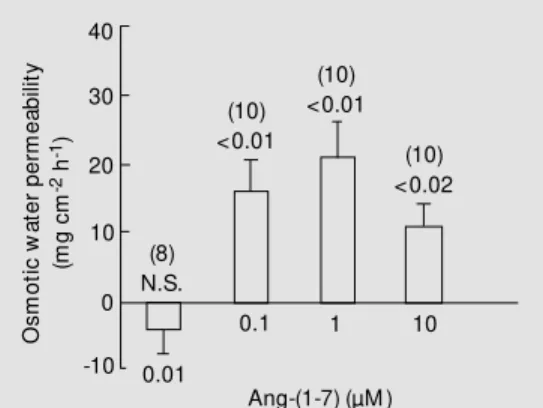
Ang-(1-7) significantly increased Posm over basal flow at concentrations of 0.1 to 10 µM (Figure 1). The higher concentration (10 µM) elicited a lower response that was not statistically different from 1 µM. Ang-(1-7) obtained from two different sources did not differ in the response elicited (data not shown). Figure 2 comparatively shows the response to different angiotensins and neu-Figure 1 - Effect of different
Ang-(1-7) concentrations on osmotic w ater permeability in isolated toad skin. The number of experi-ments is indicated in parenthe-ses. N.S. Not significant; the P values are given above the col-um ns. In t his and f ollow ing graphs the mean effect and its standard error (SEM ) w ere ob-tained from the difference be-tw een the experimental period and the preceding control one
and the Student t-test for paired
samples w as applied. One-w ay ANOVA follow ed by the Duncan t est dem onst rat ed t hat t he mean effects of different Ang-(1-7) concentrations producing significant increases in osmotic w ater permeability did not differ from one another.
O
s
m
o
ti
c
w
a
te
r
p
e
rm
e
a
b
ili
ty
(m
g
c
m
-2 h -1)
40
30
20
10
0
-10
(10) <0.01
(10) <0.01
(10) <0.02
(8) N.S.
0.1 1 10
0.01
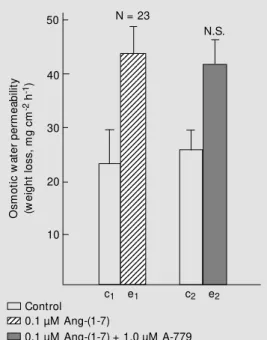
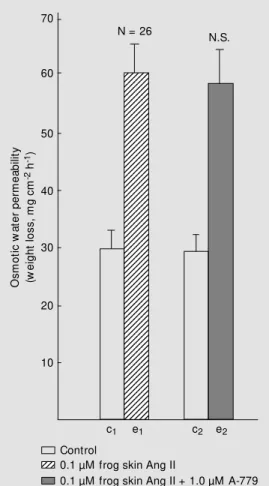
rohypophyseal hormones (oxytocin and ar-ginine-vasotocin). Arginine-vasotocin, the antidiuretic neurohypophyseal hormone of Amphibia, was by far more potent in in-creasing Posm. The time course of the re-sponse to Ang-(1-7) showed a peak at 20 min after addition of the hormone to the dermal bathing solution (Figure 3A,B). The response of the skins varied widely. Figure 3B shows the response of a highly reactive skin. A-779 (1 µM), a specific antagonist of Ang-(1-7), had no effect on the response of toad skin to 0.1 µM Ang-(1-7) (Figure 4) and to 0.1 µM frog skin Ang II (Figure 5). However, the Posm response to Ang-(1-7) was com-pletely blocked by the AT2 antagonist PD 123319 (Figure 6). The AT1 antagonist losartan (Figure 7) was unable to block the response to Ang-(1-7). The antago-nists used (A-779, PD 123319 and losar-tan) had no effect on basal osmotic water permeability (data not shown).
D iscussio n
Ang-(1-7) significantly increased toad skin Posm at concentrations of 0.1 to 10 µM with a peak at 20 min similar to that observed with Ang II (15). There was a wide variabil-ity in the response between animals with non-responsive skins and others showing a clear response (Figure 3B). Human Ang II was more potent than Ang-(1-7), whose ef-fect was similar to that of frog skin Ang II, an angiotensin peptide found in the skin of the frog Crinia georgiana (21). Arginine-vaso-tocin, the naturally neurohypophyseal pep-tide existing in Amphibia, had the highest effect. Doses of 10 µM Ang-(1-7) elicited responses of lower magnitude, although with-out being statistically significant. This may be attributed to the release of inhibitory sub-stances such as prostaglandins at these con-centrations since PGE1 inhibited the effect of Ang II on toad skin Posm (22). No effect of Ang-(1-7) on Posm was found in the isolated toad bladder (data not shown).
Figure 2 - Comparative effects of different angiotensins (Ang) and neurohypophyseal hormones on osmotic w ater permeability in isolated toad skin. Data are re-ported as means ± SEM . The numbers in parentheses indicate the number of experiments and the P values are given above the columns. One-w ay ANOVA fol-low ed by the New man-Keuls test demonstrated that the effect of Ang-(1-7) w as significantly low er than that of human Ang II, oxyto-cin and arginine-vasotooxyto-cin but did not differ from that of frog Ang II. Oxyt, Oxytocin; AVT, arginine-va-sotocin. O s m o ti c w a te r p e rm e a b ili ty (w e ig h t lo s s , m g c m
-2 2
0
m
in
-1)
30
1 µM Ang-(1-7)
N = 10
1 µM Ang-(1-7)
N = 1 25 20 15 10 5 0 30 25 20 15 10 5 0 O s m o ti c w a te r p e rm e a b ili ty (w e ig h t lo s s , m g c m
-2 2
0
m
in
-1)
0 20 40 60 80 100 0 20 40 60 80 100
Time (min) Time (min)
Figure 3 - Time course of the response to Ang-(1-7). A, M ean ± SEM for 10 experiments; B
show s the response of a single reactive skin. The maximal responses occurred 20 min after the addition of 1.0 µM Ang-(1-7) to the dermal surface of the skins.
Figure 4 - Lack of effect of the specific Ang-(1-7) antagonist (A-779) on osmotic w ater perme-ability stimulated w ith Ang-(1-7). Data are reported as means ± SEM . One-w ay ANOVA follow ed by t he New m an-Keuls t est show ed no signif icant dif f
er-ences (N.S.) betw een e1 and e2
or c1 and c2. In this and the
fol-low ing figures c1 and e1 are the
control and experimental periods
of one skin half and c2 and e2 the
control and experimental periods of the other paired half.
A B O s m o ti c w a te r p e rm e a b ili ty (w e ig h t lo s s , m g c m
-2 h -1) 50 40 30 20 10 123456 123456 123456 123456 123456 123456 123456 123456 123456 123456 123456 123456 123456 123456 123456 123456 123456 123456 123456 123456 123456 123456 123456 123456 123456 123456 123456 123456 123456 123456 123456 123456 123456 123456 123456 123456 123456 123456 123456 123456 123456 123456 123456 123456 123456 123456 123456
c1 e1 c2 e2
N.S. N = 23
1234 1234
Control 0.1 µM Ang-(1-7)
0.1 µM Ang-(1-7) + 1.0 µM A-779
O s m o ti c w a te r p e rm e a b ili ty (m g c m
Figure 5 - Lack of effect of the specific Ang-(1-7) antagonist (A-779) on osmotic w ater perme-ability stimulated w ith frog skin Ang II. Data are reported as means ± SEM . One-w ay ANOVA follow ed by the New man-Keuls test show ed no significant
dif-ferences (N.S.) betw een e1 and
e2 or c1 and c2.
The response of toad skin to Ang II is mediated by an AT1 receptor subtype since the effect of Ang II on Posm is blocked by losartan but not by PD 123319 (17). The fact that antidiuretic hormone antagonists blocked the stimulating effect of Ang II on Posm (18) and that losartan blocked the Posm response to antidiuretic hormone in toad skin (19) supports the view of a common receptor for Ang II and antidiuretic hormone in toad skin. In the present experiments, we unexpectedly obtained a complete inhibition of the Posm response to Ang-(1-7) by PD 123319 whereas A-779, considered to be a specific antago-nist of Ang-(1-7) (5,6), had no effect. Losar-tan was also unable to block the response to Ang-(1-7). A-779 completely blocked the antidiuretic effect of Ang-(1-7) on water-loaded rats, suggesting the existence of a non-AT1 angiotensin receptor that is recog-nized by losartan (7). Our results using PD 123319 showed that Ang-(1-7) increased Posm mainly through an AT2 receptor which in this case was not recognized by losartan, an AT1 receptor subtype antagonist. Our data concerning toad skin did not show a specific receptor for Ang-(1-7), in contrast to the ventrolateral medulla of rats (23,24), porcine coronary artery rings (25) and bo-vine aortic endothelial cells (26).
Blockade of the Ang-(1-7) receptor by PD 123319 and losartan has been described in studies on the release of [3H]
norepineph-rine from rat atria (27), suggesting that Ang-(1-7) may act on receptor subtypes 1 and 2. Also, in dog coronary arteries the release of nitrites by Ang-(1-7) was reduced by losar-tan and PD 123319 (28), as also was the relaxing effect on preconstricted pig coro-nary arteries in the presence of bradykinin (29). In C6 glioma cells the effect of Ang-(1-7) on prostaglandin synthesis was mediated by subtype 1 angiotensin receptors (30).
Ang II may be converted to Ang-(1-7) by carboxypeptidases and prolylcarboxypepti-dase (31). If this were the case in our prepa-ration, PD 123319, the specific antagonist of
O
s
m
o
ti
c
w
a
te
r
p
e
rm
e
a
b
ili
ty
(w
e
ig
h
t
lo
s
s
,
m
g
c
m
-2 h -1)
70
123456 123456 123456 123456 123456 123456 123456 123456 123456 123456 123456 123456 123456 123456 123456 123456 123456 123456 123456 123456 123456 123456 123456 123456 123456 123456 123456 123456 123456 123456 123456 123456 123456 123456 123456 123456 123456 123456 123456 123456 123456 123456 123456 123456 123456 123456 123456 123456 123456 123456 123456 123456 123456 123456 123456 123456 123456 123456 123456 123456 123456 123456 123456 123456 123456 123456 123456 123456 123456 123456 60
50
40
30
20
10
N = 26 N.S.
c1 e1 c2 e2
O
s
m
o
ti
c
w
a
te
r
p
e
rm
e
a
b
ili
ty
(w
e
ig
h
t
lo
s
s
,
m
g
c
m
-2 h -1)
40
30
20
10
N = 21
*
c1 e1 c2 e2
123456 123456 123456 123456 123456 123456 123456 123456 123456 123456 123456 123456 123456 123456 123456 123456 123456 123456 123456 123456 123456 123456 123456 123456 123456 123456 123456 123456 123456 123456 123456 123456 123456 123456 123456 123456 123456
123 123
Control 0.1 µM Ang-(1-7)
0.1 µM Ang-(1-7) + 1.0 µM PD 123319 123
123 Control
0.1 µM frog skin Ang II
0.1 µM frog skin Ang II + 1.0 µM A-779
Figure 6 - Inhibition of the re-sponse of toad skin to Ang-(1-7)
by the AT2 receptor antagonist
PD 123319. Data are reported as means ± SEM . One-w ay ANOVA follow ed by the New man-Keuls test show ed a significant differ-ence (* P<0.01) betw een the
ex-perimental periods e1 and e2.
There w as no significant
the AT2 receptor subtype which blocks the effect of Ang-(1-7), would also block at least partially the effect of Ang II on osmotic water permeability in toad skin, but this inhi-bition was not observed.
The results obtained here with toad skin, a tissue with functional properties similar to those of the distal mammalian nephron, sup-port the antidiuretic effect of Ang-(1-7) ob-served in the rat (3) and the increase in hydraulic conductivity of mammalian inner medullary collecting tubules (4). We dem-onstrated for the first time the effect of an angiotensin on Posm in isolated toad skin mediated by an AT2 receptor subtype which is not recognized by losartan.
Ackno wle dgm e nts
We thank Dr. Clara Peña, Departamento de Química Biológica, Facultad de Farmacia y Bioquímica, Universidad Nacional de Buenos Aires, Argentina, for providing Ang-(1-7), Dr. Ronald D. Smith, DuPont Merck, Wilmington, DE, USA, for losartan, and Pro-fessor Robson A.S. Santos, Laboratório de
O
s
m
o
ti
c
w
a
te
r
p
e
rm
e
a
b
ili
ty
(w
e
ig
h
t
lo
s
s
,
m
g
c
m
-2 h -1)
50
40
30
20
10
N = 15
N.S.
c1 e1 c2 e2
Hipertensão, Departamento de Fisiologia e Biofísica, Instituto de Ciências Biológicas, Universidade Federal de Minas Gerais, Belo Horizonte, MG, Brazil, for providing the specific Ang-(1-7) antagonist A-779.
123456 123456 123456 123456 123456 123456 123456 123456 123456 123456 123456 123456 123456 123456 123456 123456 123456 123456 123456 123456 123456 123456 123456 123456 123456 123456 123456 123456 123456 123456 123456 123456 123456 123456 123456 123456 123456 123456 123456 123456 123456 123456 123456 123456 123456 123456 123456
1234 1234
Control 0.1 µM Ang-(1-7)
0.1 µM Ang-(1-7) + 1.0 µM losartan
Figure 7 - Lack of effect of the
specific antagonist of the AT1
receptor losartan on osmotic w ater permeability stimulated w ith Ang-(1-7). Data are reported as m eans ± SEM . One-w ay ANOVA follow ed by the New -man-Keuls test show ed no sig-nificant differences (N.S.)
be-tw een e1 and e2 or c1 and c2.
Re fe re nce s
1. Ferrario CM , Brosnihan KB, Diz DI, Jaisw al N, Khosla M C, M ilsted A & Tallant EA (1991). Angiotensin-(1-7): a new hormone
of the angiotensin system. Hypertension,
18 (Suppl 5): III-126-III-133.
2. Santos RAS & Campagnole-Santos M J (1994). Central and peripheral actions of
angiot ensin-(1-7). Brazilian Journal of
M edical and Biological Research, 27: 1033-1047.
3. Santos RAS & Baracho NCV (1992). An-giotensin-(1-7) is a potent antidiuretic
pep-tide in rats. Brazilian Journal of M edical
and Biological Research, 25: 651-654. 4. Santos RAS, Simões e Silva AC, M agaldi
AJ, Khosla M C, Cesar KR, Passaglio KT & Baracho NCV (1996). Evidence for a physi-ological role of angiotensin-(1-7) in the
control of hydroelectrolyte balance.
Hy-pertension, 27: 875-884.
5. Santos RAS, Cam pagnole-Santos M J, Baracho NCV, Fontes M AP, Silva LCS,
Neves LAA, Oliveira DR, Caligiorne SM , Rodrigues ARV, Gropen Jr C, Carvalho WS, Simões e Silva AC & Khosla M C (1994). Characterization of a new tensin antagonist selective for angio-tensin-(1-7): evidence that the actions of angiotensin-(1-7) are mediated by specific
angiotensin receptors. Brain Research
Bulletin, 35: 293-298.
6. Ambuhl P, Felix D & Khosla M C (1994). [7-D-Ala]-angiotensin-(1-7): selective antago-nism of angiotensin-(1-7) in the rat
para-ventricular nucleus. Brain Research
Bulle-tin, 35: 289-291.
7. Baracho NCV, Simões-e-Silva AC, Khosla M C & Santos RAS (1998). Effect of selec-tive angiotensin antagonists on the antidi-uresis produced by angiotensin-(1-7) in
w ater-loaded rats. Brazilian Journal of
M edical and Biological Research, 31: 1221-1227.
8. Botelho LM , Block CH, Khosla M C &
Santos RAS (1994). Plasma angiotensin (1-7) immunoreactivity is increased by salt load, w ater deprivation and hemorrhage.
Peptides, 15: 723-729.
9. Garcia NH & Garvin JL (1994). Angiotensin (1-7) has a biphasic effect on fluid
absorp-tion in the proximal straight tubule.
Jour-nal of the American Society of
Nephrol-ogy, 5: 1133-1138.
10. Andreatta van Leyen S, Romero M F, Khosla M C & Douglas JG (1993). M
odula-tion of phospholipase A2 activity and
so-dium transport by angiotensin-(1-7).
Kid-ney International, 44: 932-936.
11. Handa RK, Ferrario CM & Strandhoy JW (1996). Renal actions of angiotensin-(1-7):
in vivo and in vitro studies. American Jour-nal of Physiology, 270: F141-F147. 12. Delli Pizzi AM , Hilchey SD & Bell-Quilley
CP (1994). Natriuretic action of
angio-tensin-(1-7). British Journal of
13. Hilchey SD & Bell-Quilley CP (1995). As-sociation betw een the natriuretic action of angiotensin-(1-7) and selective
stimula-tion of renal prostaglandin I2 release.
Hy-pertension, 25: 1238-1244.
14. Dicker SE (1970). The skin and bladder of amphibians as models for the mammalian
nephron. Hormones, 1: 352-363.
15. Coviello A & Brauckm ann ES (1973). Hydrosmotic effect of angiotensin II:
iso-lated toad skin. Acta Physiologica
Latino-americana, 23: 18-25.
16. Coviello A, Orce G & Causarano J (1974). Effect of a competitive antagonist (8-Leu-angiotensin II) of (8-Leu-angiotensin II on sodium
and w ater transport in toad skin. Acta
Physiologica Latinoamericana, 24: 409-413.
17. Peral de Bruno M & Coviello A (1996). Effects of angiotensin II antagonists on the contractile and hydrosmotic effect of
AT II and AT III in the toad (Bufo
arena-rum). Journal of Comparative Physiology,
B, 165: 565-570.
18. Peral de Bruno M , Romano L & Coviello A (1996). Interaction betw een antagonists of angiotensin II and antidiuretic hormone
in isolated toad tissues. Comparative
Bio-chemistry and Physiology, 113A: 307-314. 19. Peral de Bruno M , Romano L, Jerez S & Coviello A (1997). El Losartan inhibe el efecto de la hormona antidiurética en un
modelo funcional de nefrón distal. Revista
Argentina de Cardiología, 65 (Suppl III):
35-38.
20. Levens NR, Peach NJ, Darracott Vaughan ED & Carey RM (1981). Demonstration of a primary antidiuretic action of angiotensin II: effects of intrarenal converting enzyme
inhibition in the conscious dog.
Endocri-nology, 108: 318-330.
21. Proto M C, Coviello A, Khosla M C & Bumpus FM (1983). Effects of frog-skin
angiotensin II in amphibians.
Hyperten-sion, 5 (Suppl V): V101-V104.
22. Coviello A, Brauckmann ES, Budeguer de Atenor M S, Apud JA & Causarano J (1975). Hydrosmotic effect of angiotensin
II in the toad skin: role of cyclic AM P. Acta
Physiologica Latinoamericana, 25: 379-386.
23. Fontes M A, Silva LC, Campagnole-Santos M J, Khosla M C, Guertzenstein PG & Santos RAS (1994). Evidence that angio-tensin-(1-7) plays a role in the central con-trol of blood pressure at the ventro-lateral medulla acting through specific receptors.
Brain Research, 665: 175-180.
24. Lim a DX, Font es M A, Oliveira RC, Campagnole-Santos M J, Khosla M C & Santos RAS (1996). Pressor action of an-giotensin I at the ventrolateral medulla: effect of selective angiotensin blockade.
Immunopharmacology, 33: 305-307. 25. Porsti I, Bara AT, Busse R & Hecker M
(1994). Release of nitric oxide by angio-tensin-(1-7) from porcine coronary endo-thelium: implications for a novel
angio-tensin receptor. British Journal of
Phar-macology, 111: 652-654.
26. Tallant EA, Lu X, Weiss RB, Chappell M C & Ferrario CM (1997). Bovine aortic endo-thelial cells contain an angiotensin-(1-7)
receptor. Hypertension, 29: 388-393.
27. Gironacci M M , Adler Graschinsky E, Peña C & Enero M A (1994). Effects of angio-tensin II and angioangio-tensin-(1-7) on the
re-lease of [3H] norepinephrine from rat atria.
Hypertension, 24: 457-460.
28. Seyedi N, Xu X, Nasjletti A & Hintze TH (1995). Coronary kinin generation medi-ates nitric oxide release after angiotensin
receptor stimulation. Hypertension, 26:
164-170.
29. Gorelik G, Carbini LA & Scicli AG (1998). Angiotensin 1-7 induces bradykinin-medi-ated relaxation in porcine coronary artery.
Journal of Pharmacology and Experimen-tal Therapeutics, 286: 403-410.
30. Jaisw al N, Diz DI, Tallant EA, Khosla M C & Ferrario CM (1991). Characterization of angiotensin receptors mediating
prosta-glandin synthesis in C6 glioma cells.
A-m erican Journal of Physiology, 260: R1000-R1006.
31. Ferrario CM , Chappell M C, Dean RH & Iyer SN (1998). Novel angiotensin pep-tides regulate blood pressure, endothelial
function, and natriuresis. Journal of the