Article
J. Braz. Chem. Soc., Vol. 26, No. 4, 790-796, 2015. Printed in Brazil - ©2015 Sociedade Brasileira de Química 0103 - 5053 $6.00+0.00
A
*e-mail: [email protected]
Kinetics and Product Analysis of the Electrochemical Dehalogenation of
Hexachlorobenzene
Nohra V. Gallardo-Rivas,a Javier Guzman,b Silvia Gutierrez-Granados,c Maria Guadalupe Garcia-Jimenez,c Jorge G. Ibanezd and Ulises Paramo-Garcia*,a
aDivisión de Estudios de Posgrado e Investigación, Instituto Tecnológico de Cd. Madero,
89440 Tamaulipas, Mexico
bInstituto Mexicano del Petróleo, 07730 Mexico City, Mexico
cDivisión de Ciencias Naturales y Exactas, Depto. de Química, Universidad de Guanajuato,
36050 Guanajuato, México
dDepto. ICQ, Universidad Iberoamericana, 01219 Mexico City, Mexico
A method for establishing the kinetics and products of the electrochemical degradation of hexachlorobenzene (HCB) is described. One plausible way of reducing HCB´s toxicity is through cathodic dehalogenation. The characterization of products formed during the electrochemical reduction and the reaction kinetics are both reported. Pentachlorobenzene (PCB), tetrachlorobenzene (TCB) and trichlorobenzene (TriCB) were identified among the degradation products by high performance liquid chromatography (HPLC) with ultraviolet (UV) detection. The kinetics is analyzed under different electrolysis conditions.
Keywords: hexachlorobenzene, electrochemical dehalogenation, kinetics
Introduction
Hexachlorobenzene (HCB) is mainly used as a fungicide to prevent wheat from being attacked by common bunt and for soil treatment. It is also used as a plasticizer. It forms the basis for pentachlorophenol production and can be found as
a by-product of some industrial hydrocarbon processes.1,2
HCB finds its way into the environment either through the combustion of chlorinated compounds (during waste
incineration) or the use of HCB-containing pesticides.2
HCB is completely re-absorbed from food in the gastrointestinal tract; it is then metabolized and accumulates
in adipose tissues.2,3 As it is adsorbed strongly to suspended
particles in water, it accumulates in sediments; its estimated half-life (abiotic and biotic) is longer than one year and it
does not degrade naturally in surface water reservoirs.4
Common metabolites include 2,3,5-trichlorophenol,
tetrachlorobenzene and pentachlorobenzene.2
From available knowledge of the possible products1,2,5
the likely HCB dehalogenation route is shown in Scheme 1. Under specific experimental conditions one can control
the dehalogenation degree so as to yield a specific desired product; alternatively, the reaction may be allowed to proceed to total dehalogenation.
Electrochemical methods offer important alternatives for the treatment and remediation of waste streams containing organic and inorganic pollutants and may offer distinct advantages in specific cases over other
technologies.6 They are environmentally friendly since the
main reagent is the electron, and additional reagents are seldom necessary. They are safe and energetically efficient, since extreme conditions of temperature and pressure are not required. In addition, potential control may allow for the selective activation of specific bonds so as to prevent secondary products which are normally undesirable. From an operational stand point these methods typically require simple equipment, are easily automated, and their cost is
comparatively low.6,7
T h e e l e c t r o c h e m i c a l d e h a l o g e n a t i o n o f organochlorinated compounds such as lindane, aldrin, dieldrin, DDT (dichlorodiphenyltrichloroethane), and HCB
has proven feasible.5,8,9 HCB can be reduced in methanol
differential pulse voltammetry, DPP) at –1.33, –1.57 and
–1.84 V/NHE, respectively.5,10
Binary aqueous/non aqueous solvents can also be
used for example in the electrochemical reduction of CCl4
in order to diminish the amount of solvent required.11 In
addition, the electrochemical reduction of halogenated organic compounds can be facilitated by redox mediators. This concept has been applied to the reduction of chlorinated biphenyls with several types of catalysts such as anthracene, zinc phthalocyanines and Schiff bases of
cobalt (II) complexes.12
A crucial step in HCB dehalogenation is the characterization of products. Chromatographic methods generally allow for the separation, identification and quantitation of products in mixtures of organochlorinated compounds generated from diverse environmental samples
(e.g., HCB, aldrin, dieldrin, DDT, endosulphan).13-17
The chromatographic method most commonly used for the characterization of HCB and its products is gas chromatography with mass spectrometric detection. The development of an HPLC with spectrophotometric detection method as an alternative for the analysis of the products is now reported, together with a study of the reaction kinetics of the electrochemical dehalogenation of HCB in different reaction media, in the presence or absence of CoSalen as a homogeneous catalyst. This species has the ability to reversibly bind oxygen and is often used in dehalogenation processes.
Experimental
Reagents and chemicals
Analytical-grade reagents (Baker, Aldrich, Fluka) were used throughout this work. Aqueous solutions were prepared
with milli-Q water (18 Ω cm-1). For the electrochemical
study a three-electrode, 50 mL electrochemical cell was
used. The high initial HCB concentration was 20 mg L-1.
The working electrode was a 1 × 1 × 0.6 cm3 piece of
RVC (reticulated vitreous carbon) (Oakland, USA) provided by ERG, Inc. with 60 ppi (pores per inch), here called RVC-60 ppi. The Goodfellow Cambridge Ltd. counter electrode was a Ti mesh (purity > 99.6%, nominal aperture 0.19 mm, wire diameter 0.23 mm, open area of
20% (Huntingdon, UK) and the reference electrode was a saturated calomel electrode (SCE) provided by Taccussel. The supporting electrolyte in the aqueous solutions
was 0.05 mol L-1 Na
2SO4 (Baker), or 0.1 mol L-1
tetrabutylammonium tetrafluoroborate (TBAF) Aldrich (St. Louis, USA) in organic acetonitrile medium (ACN)
provided by J. T. Baker (Phillipsburg, USA), 0.5 mmol L-1
N,N’-Bis(salicylidene)ethylenediaminocobalt(II) (CoSalen)
was purchased from Aldrich (St. Louis, USA) and used as
dehalogenation catalyst,10,18 and J. T. Baker methanol
(MeOH) was used as co-solvent (Phillipsburg, USA). The Fluka HCB (Buchs, Switzerland) samples were prepared in ACN at different concentrations.
The following standards were prepared with HPLC-grade acetonitrile: pentachlorobenzene (PCB), pentachlorophenol (PCP), 1,2,4,5-tetrachlorobenzene (1,2,4,5-TCB), and 1,3-dichlorobenzene (1,3-DCB) provided by Sigma-Aldrich, (St. Louis, USA) and 1,2,3,4-tetrachlorobenzene (1,2,3,4-TCB), 1,2,3-trichlorobenzene (1,2,3-TriCB), 1,3,5-trichlorobenzene (1,3,5-TriCB) and chlorobenzene were from Supelco (St. Louis, USA). Benzene was from J. T. Baker (Phillipsburg, USA).
Apparatus
A 273A PAR potentiostat/galvanostat with a PAR 276 interface and a PAR M270 data processor was used for the electrochemical dehalogenation. For the chromatographic determinations, a BAS-UV-116A HPLC equipped with spectrophotometric detection, an Epsilon integrator and a
BAS-LC-22C temperature controller (set at 30 oC) were
used. 20 µL samples were injected into a Hypersil column (C18 ODS 100 mm x 4.6 mm, 3 µm) purchased from Supelco (St. Louis, USA) by means of a Rheodyne 7125 valve (Cotati, USA).
The HPLC operation conditions were as follows: the mobile phase was an acetonitrile/methanol/water mixture (30/30/40, v/v/v), and a gradient was used during the separation. This phase was degassed with a BAS LC-26B
vacuum degasser. A nitrogen flow of 0.4 mL min-1 (Praxair,
99.99%) was used and the injected sample volume was 20 µL. Product identification was performed through the addition of known standards. UV detection was tested at different wavelengths, and that at 227 nm was selected.
C6Cl6 2e
-, H+
2e-, H+
2e-, H+ 2e-, H+ 2e-, H+
2e-, H+
C6HCl5 C6H2Cl4 C6H3Cl3
C6H6
C6H4Cl2
C6H5Cl
- Cl- - Cl- - Cl- - Cl
-- Cl
-- Cl
HCB and CoSalen determination with HPLC-UV
Initial conditions for the chromatographic separation of
the reduced species were those proposed by Ross et al.,17 for
the study of the products of the electrochemical reduction of PCP (i.e., an acetonitrile/methanol/water, 30/30/40, v/v/v, as mobile phase). The composition gradient, detector wavelength, and flow rate of the mobile phase were tuned so as to get a respectable chromatographic peak separation.
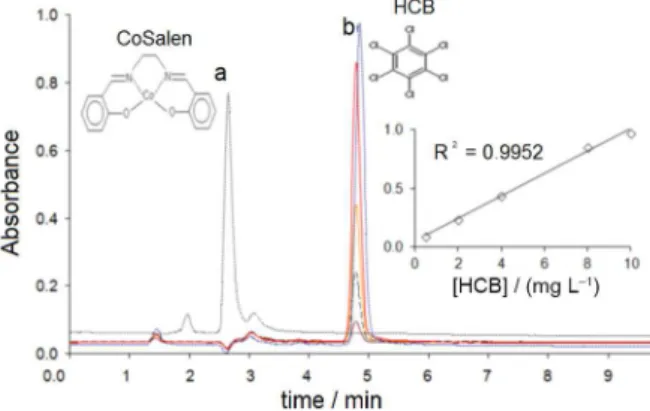
CoSalen was analyzed before and after the electrochemical treatment for HCB dehalogenation so as to observe its possible degradation. Figure 1 shows
the chromatograms for CoSalen (curve a, retention
time = 2.8 min) and HCB (curve b, retention time = 4.9 min).
A calibration line for HCB was obtained under the present separation conditions with an associated linear correlation coefficient (0.9952).
Identification of the degradation products with HPLC-UV
This technique was used for the determination of the products from the electrochemical transformation of HCB under different electrolysis conditions. Likely products of the electrolysis of halogenated compounds include those shown in Scheme 1 (i.e., PCB, TCB, TriCB, DCB, CB and B).
Figure 2 shows the chromatograms of the standards utilized under the chromatographic separation conditions (ACN/MeOH 70/30, v/v). The different compounds and their retention times obtained are listed in Table 1. The study of compounds such as 1,2,3-TriCB and 1,3,5-TriCB requires a modification of the mobile phase in order to achieve a better chromatographic peak separation since isomers are known to display similar retention times.
The mobile phase was modified at will by adding water to the system up to a 10% v/v composition, and the acetonitrile (ACN) concentration decreased accordingly.
With this, the polarity of the mobile phase was increased and the elution times tended to increase. For example in the case of HCB, when the aqueous medium is increased the sample elutes at retention times of up to 7 min and shows better separation. With the obtained results one can identify the species generated during the constant potential electrolysis of HCB.
Takamuku et al.,19 suggest that the solubility of the
mixture is better at molar fractions ranging from 0.3 to 0.4, and presents a lower solubility at molar fractions of 0.1, 0.6 and 0.8. This is obtained based on the correlations
defined by Szydlowski and Szykula.20 The highest
micro-heterogeneity or aggregation that these authors obtained was at a fraction of 0.4. The results obtained in the present
work coincide with their observations19-22 since there are
severe solubility limitations in some of the media utilized.
Results and Discussion
Kinetics of the HCB electrochemical dehalogenation
These systems were studied: (i) in the presence, and
(ii) in the absence of the CoSalen catalyst. In each case
four electrochemical potential values were used: −1.8,
Table 1. Dehalogenation products and retention times
Compound Retention time / min
CB 2.7
1,3-DCB 2.8
1,2,3-TriCB 3.7
1,2,5-TriCB 4.0
1,2,3,4-TCB 4.1
1,2,4,5-TCB 4.2
PCB 4.7
HCB 5.1
Figure 1. Chromatogram for the characterization of: (a) CoSalen catalyst and (b) HCB in the organic medium.
−1.6, −1.4 and −1.2 V/SCE. HCB concentrations varied
between 10 and 17 mg L-1.
The most representative cases regarding the behavior of the concentration as a function of time are shown in Figures 3 to 6. Figure 3 features the reaction kinetics in the organic medium (acetonitrile) at –1.8 V/SCE in the absence of CoSalen. After 60 min, the HCB concentration
decreases down to 1.1 mg L-1 (i.e., 92.3% with respect to
the initial value of 14.3 mg L-1). The prevailing species
after 3 h of electrolysis is TCB, followed by the signal corresponding to the compounds with lower halogenation degree.
Figure 4 shows the behavior of the HCB dehalogenation at –1.8V/SCE without catalyst in an aqueous-organic medium (10% v/v acetonitrile/water). The result is similar to the previous case in that a 90% dehalogenation
(from an initial HCB concentration of 10 mg L-1 to a final
concentration of 1 mg L-1) is obtained in approximately
60 min. In addition, the proportion of less halogenated species is higher than that of polyhalogenated species.
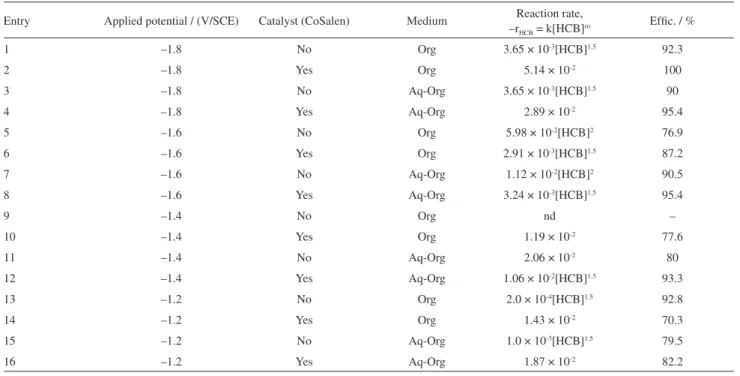
The reaction rate remains essentially constant. The organic medium favors the appearance, identification, and quantitation of all the halogenated species, whereas in the aqueous-organic medium the signals corresponding to each species tend to overlap. This effect does not limit the HCB dehalogenation, but it hampers the quantitation of species. Table 2 shows the kinetic variables of the studied
systems. Entries 1 and 3 show the rate constant values (k),
the reaction order (ro), and the percent of HCB reduction as compared to similar systems where the same potential was applied (i.e., –1.8 V/SCE). In the present case the aquo-organic medium (10% v/v acetonitrile/water) is combined with the use of the CoSalen catalyst (see entries 2 and 4 in Table 2). In general, the rate constant increases with the use
of the catalyst from 3.65 × 10⁻³ to 5.14 × 10⁻². At the same
time, the use of an organic or an aqueous-organic medium does not impact in the kinetics of the reaction (i.e., neither in the reaction rate nor in the reaction order). A similar conclusion was obtained when comparing the effect of dimethylformamide vs. acetonitrile on the reduction of
chlorinated compounds.5,8,9 In spite of the low impact on
kinetics, all of the systems evaluated at –1.8 V/SCE yielded HCB reduction percentages higher than 90% when using CoSalen in an organic medium.
Figure 5 shows the behavior of the HCB dehalogenation at –1.2 V/SCE in the organic medium (acetonitrile) without catalyst. A decrease of more than 93% of the initial HCB
content (initial = 12.5 mg L-1; final = 0.9 mg L-1) is observed
at 60 min as well as a clear trend towards the generation of the less halogenated species by the end of the electrolytic process. The reaction order is 1.5 and the reaction rate constant decreases with respect to those at higher potentials (Table 2).
Figure 6 features the reaction kinetics under the same conditions as those in Figure 5, but now in an aqueous-organic medium (10% v/v acetonitrile/water). At 60 min of electrolysis, 82% of HCB dehalogenation
(initial = 16.6 mg L-1; final = 3.0 mg L-1) is obtained and
the less halogenated species are found predominantly by the end of the electrolytic process, closely followed by the PCB species. The reaction order is again 1.5, but the reaction rate constant increases one order of magnitude. Therefore the aqueous-organic medium presents advantages over the organic medium. In summary, HCB dehalogenation is achieved at all the potentials studied here.
The reaction orders in the systems shown in Table 2 can be interpreted to mean that HCB dehalogenation in systems without catalyst does not follow a simple dehalogenation process (i.e., successive reactions), but consists of the
simultaneous transformation of various species.5 This
means that HCB is transformed into PCB, and then PCB is Figure 3. Reaction kinetics of the HCB electrolysis at -1.8 V/SCE in the
absence of CoSalen in the organic medium (acetonitrile).
transformed into TCB (several isomers are possible here), and so on. The importance of each simultaneous reaction is a function of the concentration of its precursor species. In the presence of the CoSalen catalyst the reaction rate tends to be constant and becomes greater at higher reduction potentials (Table 2). The application of a higher potential improves the HCB transformation into the next successive dehalogenation species (PCB); likewise, the transformation of PCB into TCB is improved at higher potentials and so on with the rest of the species, which offers a transformation scheme that favors those species with fewer chlorine atoms especially at longer electrolysis times.
Table 2 also shows the values of k, ro and HCB reduction percentages at –1.6 and –1.4 V/SCE. At –1.6 V/SCE (entries 5, 6, 7 and 8) the rate constant decreases in the presence of CoSalen (e.g., in organic media)
from 5.98 × 10⁻² (entry 5) to 2.91 × 10⁻³ (entry 6). CoSalen
promotes a reaction order change from 2 to 1.5. Such changes are related to the number of species present in the reduction process, i.e. CoSalen limits the number of HCB species available to be reduced to PCB, and this to TCB. Reduction percentages varied from 76.9% up to 95.4%. The best conditions, at –1.6 V/SCE, were found when using CoSalen in an aqueous-organic medium (entry 8).
Table 2. Kinetic variables of the studied systems (ro = reaction order)
Entry Applied potential / (V/SCE) Catalyst (CoSalen) Medium –rReaction rate,
HCB = k[HCB]ro
Effic. / %
1 –1.8 No Org 3.65 × 10⁻³[HCB]1.5 92.3
2 –1.8 Yes Org 5.14 × 10⁻² 100
3 –1.8 No Aq-Org 3.65 × 10⁻³[HCB]1.5 90
4 –1.8 Yes Aq-Org 2.89 × 10⁻² 95.4
5 –1.6 No Org 5.98 × 10⁻²[HCB]2 76.9
6 –1.6 Yes Org 2.91 × 10⁻³[HCB]1.5 87.2
7 –1.6 No Aq-Org 1.12 × 10⁻²[HCB]2 90.5
8 –1.6 Yes Aq-Org 3.24 × 10⁻³[HCB]1.5 95.4
9 –1.4 No Org nd –
10 –1.4 Yes Org 1.19 × 10⁻² 77.6
11 –1.4 No Aq-Org 2.06 × 10⁻² 80
12 –1.4 Yes Aq-Org 1.06 × 10⁻²[HCB]1.5 93.3
13 –1.2 No Org 2.0 × 10⁻⁴[HCB]1.5 92.8
14 –1.2 Yes Org 1.43 × 10⁻² 70.3
15 –1.2 No Aq-Org 1.0 × 10⁻³[HCB]1.5 79.5
16 –1.2 Yes Aq-Org 1.87 × 10⁻² 82.2
nd: not determined
Figure 5. Reaction kinetics of the HCB electrolysis at –1.2V/SCE in the
absence of CoSalen in the organic medium (acetonitrile).
In the case at –1.4 V/SCE, systems 10, 11 and 12 do not experience significant changes in rate constans, while the reaction order changes again due to the presence of CoSalen (Table 2). HCB reduction percentages vary more widely (i.e., from 77.6% to 93.3%) than those at –1.8 and –1.6 V/SCE. The best conditions were obtained when using CoSalen and an aqueous-organic medium (entry 12). The experiment in an aqueous-organic medium and in the absence of CoSalen (entry 9) did not yield a consistent result.
From data in Table 2 it is possible to analyze the effect of the three study parameters: the reaction medium (organic
vs. aqueous-organic), the use or absence of the CoSalen
catalyst, and the effect of potential (–1.8, –1.6, –1.4 and –1.2 V/SCE).
When the reaction medium is changed from organic to aqueous-organic the reaction order is not affected. Likewise, the value of the rate constant stays at the same order of magnitude when these systems are compared. Changes are prompted when both factors are combined simultaneously, i.e., the presence of the catalyst and the change of reaction medium. Another factor to be emphasized is that the efficacy of the dehalogenation process is not affected by the use of
an aqueous-organic medium. Some authors23,24 suggest
that the degradation kinetics and efficiency increased with increasing water content and the dechlorination followed
pseudo-first order kinetics.25 However, the signals obtained
in the organic medium are clear and well-defined, whereas in the aqueous-organic medium they tend to overlap. This effect complicates the analysis of the spectra of the species with fewer halogen atoms (i.e., benzene, chlorobenzene, and dichlorobenzene).
As for the use of CoSalen catalyst there is a remarkable effect on both the rate constant and on the reaction order. When the nature of the reaction medium is maintained, the presence of the catalyst tends to increase the reaction constant up to one order of magnitude and decrease the reaction order down to zero. In addition, the reaction rate remains essentially constant (within an order of magnitude) at all the applied potentials (except at –1.6 V/SCE, where the reaction order was 1.5).
Conclusions
The products of the electrochemical reduction of HCB are evidenced and quantified by HPLC-UV and include PCB, TCB, TriCB and the appearance of compounds such as DCB, MCB and B. Reaction kinetics was also followed by HPLC. The dehalogenation reaction occurred at all the applied potentials.
Acknowledgements
We acknowledge funding through PROMEP-Mexico (103.5/12/3413) and the University of Guanajuato.
References
1. Paramo-Garcia, U.; Gutierrez-Granados, S.; Garcia-Jimenez, M. G.; Ibanez, J. G.; J. New Mat. Electrochem. Syst.2010,13, 356.
2. Páramo-García, U.; Ávila-Rodríguez, M.; García-Jiménez, M. G.; Gutiérrez-Granados, S.; Ibanez, J. G.; Electroanalysis 2006, 18, 904.
3. Mrema, E. J.; Rubino, F. M.; Brambilla, G.; Meretto, A.; Tsatsakis, A. M.; Colosio, C.; Toxicology 2013, 307, 74. 4. Tong, M.; Yuan, S.; J. Hazard. Mater. 2012, 229-230, 1.
5. Gach, P.; Karty, J.; Peters, D.; J. Electroanal. Chem. 2008, 612, 22. 6. Rajeshwar, K.; Ibanez, J. G.; Environmental Electrochemistry:
Fundamentals and Applications in Pollution Abatement,
Academic Press: San Diego, 1997.
7. Pletcher, D.; Walsh, F.; Industrial Electrochemistry, 2nd ed.;
Chapman and Hall: New York, 1990.
8. Wagoner, E.; Karty, J.; Peters, D; J. Electroanal. Chem. 2013,
706, 55.
9. McGuire, C.; Peters, D.; Electrochim. Acta2014, 137, 423. 10. Merica, S. G.; Bunce, N. J.; Jedral, W.; Lipkowski, J.; J. Appl.
Electrochem. 1998, 28,645.
11. Prasad, M. A.; Sangaranarayanan, M.V.; J. Electroanal. Chem. 2004, 569,127.
12. Rusling, J. F.; In Modern Aspects of Electrochemistry; Conway,
B. E.; Bockris, J. M.; White, R. E., eds.; Plenum Press: New York, 1994, No. 26.
13. Ramos, L.; Eljarrat, E.; Hernández, L.; Rivera, J.; González, M.;
Anal. Chim. Acta 1999,402, 241.
14. García-Alonso, S.; Pérez-Pastor, R.; Quejido-Cabezas, A.; Anal. Chim. Acta 2001, 440,223.
15. Glausch, A.; Blanch, G.; Schuring, V.; J. Chromatogr. A 1996,
723,399.
16. Hui, X.; Xu, X.; Zheng, M.; Meng, Q.; Fu, S.; Talanta 2000,
52,3972.
17. Ross, N. C.; Spackman, R. A.; Hitchman, M. L.; White, P. C.;
J. Appl. Electrochem. 1997, 27,51.
18. Gach, P. C.; Karty, J. A.; Peters, D. G.; J. Electroanal. Chem. 2008, 612, 22.
19. Takamuku, T.; Yamaguchi, A.; Matsuo, D.; Tabata, M.; Kumamoto, M.; Nishimoto, J.; Yoshida, K.; Yamaguchi, T.; Nagao, M.; Otomo, T.; Adachi, T.; J. Phys. Chem. B 2001,105, 6236.
20. Szydlowski, J.; Szykula, M.; Fluid Phase Equilib. 1999, 54, 79. 21. Acosta, J.; Arce, A.; Rodil, E.; Soto, A.; Fluid Phase Equilib.
22. Zhou, Y.; Tigane, T.; Li, X.; Truu, Marika, Truu, J.; Mander, Ü.;
Water Res.2013, 47, 102.
23. Shih, Y.-S.; Hsu, C.-Y.; Su, Y.-F.; Sep. Purif. Technol.2011, 76, 268.
24. Shih, Y.-S.; Chen, Y.-C.; Chen, M.-Y.; Tai, Y.-T.; Tso, C.-P.;
Colloids Surf., A. 2009, 332, 84.
25. Nie, X.; Liu, J.; Yue, D.; Zeng, X.; Nie, Y.; Chemosphere2013,
90, 2403.
Submitted: October 8, 2014