Synthesis of Some 3-Aryl-1,2,4-oxadiazoles Carrying a Protected
L-Alanine Side Chain
Sebastião J. de Meloa*, Antônio D. Sobralb, Heron de Lima Lopesa, and R.M. Srivastavac*
a
Universidade Federal de Pernambuco, Departamento de Antibióticos, Av.Prof.
Moraes Rego s/n, Cidade Universitária, 50670-901 Recife - PE, Brazil b
Universidade Federal de Pernambuco, Departamento de Engenharia Química, Rua
Tereza Mélia, s/n,Cidade Universitária, 50740-521 Recife - PE, Brazil c
Universidade Federal de Pernambuco, Departamento de Química Fundamental,
Cidade Universitária, 50670-901 Recife - PE, Brazil
Received: May 19, 1997
A síntese de alguns derivados dos 1,2,4-oxadiazóis (4a-d) partindo das arilamidoximas apro-priadas (1a-d) e do ácido N-t-butoxycarbonil-O-benzil-L-aspártico é descrita. As estruturas destes novos compostos foram determinadas por meios espectroscópicos.
The synthesis of some 1,2,4-oxadiazole derivatives (4a-d) starting from arylamidoximes 1a-d
and N-t-butoxycarbonyl-O-benzyl-L-aspartic acid is described. The structures of these new products have been determined by spectroscopic methods.
Keywords: arylamidoximes, L-aspartic acid, 1,2,4-oxadiazoles, L-alanine derivatives
Introduction
1,2,4-Oxadiazoles are an important class of com-pounds1. Many of them have been found to possess biologi-cal activity. For example, some are analgesics, anti-inflammatory agents2,3, antimicrobials3, antivirals4,5, pesticides and insecticides6,7. Some have pronounced β -ad-renoreceptor blocking activity combined with moderate α-adrenoreceptor blocking properties8 among others1.
Recently, emphasis has been given to synthesize oxadiazoles having novel functional groups attached either to C-3 or C-5 of the 1,2,4-oxadiazole ring. Sokolov et al.9 prepared 1,2,4-oxadiazoles by the reaction of lactone 1,4-benzodioxin-2(3H)-one with amidoximes in an aprotic po-lar solvent such as DMSO or dioxane at 90-140 °C esp. 100-105 °C. A generalized and efficient synthesis of 1,2,4-oxadiazoles from 1,2,5 1,2,4-oxadiazoles has also been described by Buscemi and collaborators10. Synthesis and reaction of lithiated oxadiazoles have been reviewed by Grimmet and Iddon11. Improved synthesis of oxadiazoles under
micro-wave irradiation conditions was also studied by Oussaid et
al.12a and Srivastava and colaborators12b,c.
In our continuing program to discover more biologi-cally potent 1,2,4-oxadiazoles12b,c, we attempted to synthe-size oxadiazoles having an amino acid function attached at C-5 from benzamidoximes 1a-d with N- and O- protected aspartic acid having a terminal carboxyl function free (2). These products might be potential compounds for biologi-cal activity tests. A literature search revealed that no such oxadiazoles have yet been prepared. This paper therefore describes the synthesis of four oxadiazoles 4a-d having an alanine moiety attached to C-5 of the heterocyclic ring.
Results and Discussion
When amidoximes 1a-d were reacted with N- and O-protected aspartic acid 2 in the presence of dicyclohexyl-carbodiimide (DCC) in dichloromethane at room temperature, the starting amidoxime was consumed in a short time as evidenced by thin-layer chromatography. Article
J. Braz. Chem. Soc., Vol. 9, No. 5, 465-468, 1998. © 1998 Soc. Bras. Química
Purification by liquid chromatography on a silica gel col-umn using n-hexane-ethyl acetate (9:1) as eluent provided the products presumably 3a-d with have Rf values (≤ 0.6), slightly higher than benzamidoximes (Rf ≤ 0.4). Com-pounds 3a-d were obtained as solids. However, no effort was made to identify them with precision. It is common that an amidoxime forms an O-acyl product when allowed to react with a carboxylic acid13. Therefore, it is safe to assume that the structures of 3a-d are the ones as shown in the Scheme 1.
When 3a-d were heated (100-110 °C) separately for 5 to 15 h, they lost water and formed oxadiazoles 4a-d.
The IR spectra of compounds 4a-d showed the follow-ing absorptions: 1733 (-COO-), 1685 (-NHCOO-), 3354.5 (NH), 1594.7 cm-1 (C=N of the five membred ring)3.
An examination of the 1H-NMR spectrum of compound 4a showed the following signals: H-2’ at δ 5.42 as a broad multiplet. This is due to the coupling with two protons attached on C-3’ and the NH proton. The benzylic protons appeared at δ 5.12 as a singlet. The protons on C-3’ are not equivalent and provided two sets of signals - one at δ 3.29 (ddd, 1H, J ≈ 17.00 Hz, J ≈ 3.00 Hz and J ≤ l.00 Hz) and the other at δ 3.12 (dd, 1H, J = 17.00 Hz, J = 5.04 Hz). The NH proton gave a broad unresolved doublet at δ 5.75 indicating its coupling with H-2’. Addition of D2O caused the disappearance of this signal thus confirming its identity. 1
H-NMR chemical shifts of compounds 4a-d are given in Table 1.
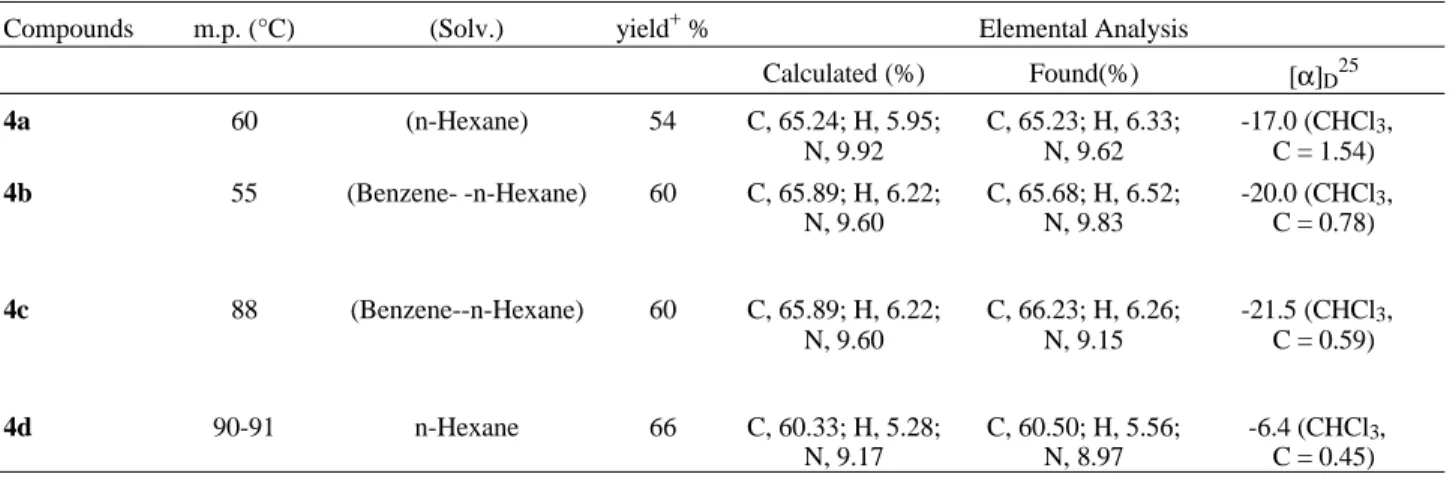
It is necessary to comment about compounds 4a-d. All four compounds gave negative specific rotations (Table 2). Three of them, 4a-c, have rotations between -17.0° to - 21.5°, but 4d showed [α]D25 equal to -6.4°. Since the intermedi-ates 3a-d were heated at an elevated temperature for cycli-zation, there existed the posibility of either partial or total racemization of 4a-d. In order to clarify this point, we carried out the experiment by adding the chiral shift re-agent,
tris[3-(trifluoromethylhydroxymethylene(+)cam-phorato]3 europium derivatiave, directly in the NMR tube and obtained the spectrum each time after adding the shift
466 Melo et al. J. Braz. Chem. Soc.
Table 1. 300 MHz 1H-NMR chemical shifts (in ppm) of compounds 4a-d in CDCl3.
Compounds CH -CH2 Ar-CH2 (CH3)3 NH Ph Ar
4a 5.42(m) 3.29(ddd) 3.12(dd) 5.12(s) 1.43(9H,s) 5.75(d) 7.31(s) 7.43-7.54 (3H, m, meta and para protons)
8.02-8.08 (2H, m, ortho protons) 4b* 5.41(m) 3.29(ddd) 3.12(dd) 5.16(s) 1.42(9H,s) 5.79(d) 7.30(s) 7.74-7.90 (2H, m, ortho protons) 7.26-7.40 (2H,m, meta and para protons)
4c* 5.41(m) 3.29(ddd) 3.11(dd) 5.12(s) 1.43(9H,s) 5.79(d) 7.27(s) 7.61(AA’BB" system, J = 8.24 Hz)
4d 5.40(m) 3.24(ddd) 5.12(s) 1.43(9h,S) 5.79(d) 7.29(s) 7.69(AA"BB" system, J = 8,70 Hz)
+ Chemical shift at mid-point. ArCH3 appeared at δ 2.42 ppm.
CH2Cl2
R.T. DCC
(S) - 2
HOOCCH2CHCOOCH2Ph
NHBoc +
Ar
NH2
N
OH
NH2
N O
O
CH2CHCOOCH2Ph Ar
NHBoc (S) - 3a - d
N
N O Ar
CH2CHCOOCH2Ph
NHBoc
1 2
3
4
5
1' 2' 3'
(S) - 4a - d
Ar
a : Ph b: m - CH3Ph
c: p - CH3Ph
d: p - ClPh 1a-d
reagent. The object was to see if H-2 gives two signals after the complexation occurs. The H-2’ signal of compound 4a moved 45.0Hz downfield after two such additions. The NH proton also moved to lower field by 21.0 Hz. At each small addition of the shift reagent, we tried to amplifly the region between δ 5.6-5.0 ppm. However, no separation of the H-2’ signal was observed. Compound 4d showed similar down-field shift without any separation of the H-2’ signal. With this observation, we feel that there was no racemization of compounds 4a-d.
Experimental
Melting points were determined with a Thomas Hoover apparatus and are uncorrected. Elemental analyses of com-pounds 4a,b,d were performed in the Laboratoire de Spec-trométrie de masse de 1’ Université de Montpellier II, France, and 4c was done by Luzia Narimatsu of Instituto de Química da Universidade de São Paulo, SP. Infrared spectra were recorded on a Bruker spectrophotometer Model IFS66. 300 MHz 1H-NMR spectra were recorded on a Varian Unity plus instrument, using CDCl3 as solvent and TMS as internal reference. Thin-layer chromatography (tlc) was done on plates coated with silica gel having flluorescent indicator (Merck) and the spots were detected under ultraviolet light. Specific rotations were measured on JASCO polarimeter Model DIP-370.
Arylamidoximes
These compounds were obtained by the method re-ported in the literature14.
O-(N-t-Butyloxycarbonyl-O-benzyl-L-alanylcarbonyl) arylamidoximes (3a-d)
The appropriate arylamidoxime (2.13 mmol) in dry dichloromethane (10 mL) was allowed to react with N-bu-toxycarbonyl-O-benzyl-L-aspartic acid15 (2.13 mmol), in the presence of dicyclohexylcarbodiimide (2.35 mmol) for
l h at room temperature. The product obtained was chroma-tographed on a silica gel column using hexane-ethyl acetate (6:4) as eluent. The fractions having the desired product were combined and the solvent removed under reduced pressure. The yields were approximately 80%.
N-t-Butoxycarbonyl-O-benzyl-3-[3-(aryl)-1,2,4-oxadiazol-5-yl]L-alanine (4a-d)
The compounds 3a-c were heated individually at 100-110 °C for 5 h. Tlc showed the disappearance of the starting compound. The products obtained were chromatographed on a silica gel column using hexane-ethyl acetate (9:1) and were purified by crystallization (see Table 2). Compound 3d required heating for 15 h to complete cyclization. The physical properties and elemental analyses of all com-pounds are given in Table 2.
Conclusions
We have been able to show that O- and N-protected aspartic acid having a free terminal carboxyl function reacts with arylamidoximes at room temperature to give the inter-mediates 3a-d. These interinter-mediates are easily transformed to 4a-d by heating at 100-110 °C. It is also concluded that the heating conditions which we employed did not cause any noticiable racemization.
Acknoweledgments
We are grateful to Conselho Nacional de Desen-volvimento Científico e Tecnológico (CNPq) and Fun-dação de Amparo à Ciência e Tecnologia (FACEPE) of Pernambuco state for financial help. We are grateful to Prof. Joel Jones Jr. of the Institute of Chemistry, Federal University of Rio de Janeiro, for obtaining the specific rotations of all compounds. Our thanks are also due to Maria da Conceição Pereira for her help in the laboratory.
Vol. 9, No. 5, 1998 Synthesis of 3-Aryl-1,2,4-oxadiazoles 467
Table 2. Some physical data of compounds 4a-d.
Compounds m.p. (°C) (Solv.) yield+ % Elemental Analysis
Calculated (%) Found(%) [α]D25
4a 60 (n-Hexane) 54 C, 65.24; H, 5.95;
N, 9.92
C, 65.23; H, 6.33; N, 9.62
-17.0 (CHCl3, C = 1.54) 4b 55 (Benzene- -n-Hexane) 60 C, 65.89; H, 6.22;
N, 9.60
C, 65.68; H, 6.52; N, 9.83
-20.0 (CHCl3, C = 0.78)
4c 88 (Benzene--n-Hexane) 60 C, 65.89; H, 6.22; N, 9.60
C, 66.23; H, 6.26; N, 9.15
-21.5 (CHCl3, C = 0.59)
4d 90-91 n-Hexane 66 C, 60.33; H, 5.28;
N, 9.17
C, 60.50; H, 5.56; N, 8.97
-6.4 (CHCl3, C = 0.45) +
References
1. Clapp, L.B. In Comprehensive Heterocyclic
Chemis-try; Katritzky, A.R.; Rees, C.W; Eds., Pergamom
Press, 1984; v. 6 p. 365 and references cited therein. 2. Afiatpour, P.; Srivastava, R.M.; de Oliveira, M.L.;
Barreiro, E.J. Braz. J. Med. Biol. Res. 1994, 27, 1403. 3. Lima, A.A. M.S. Thesis 1994, Departamento de Química Fundamental - Universidade Federal de Per-nambuco, Recife.
4. Diana, G.D.; Nitz, T.J. U.S. Pat. 5,464,848 (Cl.514-364; C07D413/12), 7 Nov. 1995, US Appl. 869,287, 15 Apr. 1992, 34 pp; Chem. Abstr. 1996, 124, 176114h.
5. Aldous, D.J.; Bailey, T.R.; Diana, G.D.; Nitz, T.J.; Kuo, G.-H. PCT Int. Appl. WO 95 31,452 (Cl.C07D403/12), 23 Nov. 1995, US appl 242,752, 13 May 1994, 74pp; Chem. Abstr. 1996, 124, 232462j. 6. Jeschke, P.; Wachendorff-Neumann, U.; Erdelen, C.;
Mencke, N.; Turberg, A. Ger. Offen. DE 4;401,107 (Cl.C07D271/06), 20 Jul 1995, Appl. 17 Jan 1994, 40pp; Chem Abstr. 1995, 123, 340135t.
7. Jeschke, P.; Wachendorff-Neumann, U.; Erdelen, C.; Turberg, A.; Mencke, N. Ger. Offen. DE 4, 401,108 (Cl.C07D271/06), 20 Jul 1995, Appl. 17 Jan 1994, 35 pp, Chem. Abstr. 1995, 123, 340136u.
8. Sokolov, S.D.; Vinogradov, S.M.; Azarevich, O.G.; Berg, M.V.; Mashkovskii, M.D.; Yuzhakov, S.D.; Anisimova, O.S.; Turchin, K.F. Khimi-Farm. Zh. 1995, 29, 36-40; Chem. Abstr. 1996, 124, 76195s.
9. Sokolov, S.D.; Vinogradova, S.M.; Azarevich, O.G.U.S.S.R. SU 1,139,129 (Cl.C07D271/06) 10 May 1995, Appl.3,656,147,28 Oct 1983; Chem. Abstr. 1996, 124, 176108j.
10. Buscemi, S.; Vivona, N.; Caronna, T. Synthesis 1995, 917-19, Chem. Abstr. 1995, 123, 339934w.
11. Grimmett, M.R.; Iddon, B. Heterocycles 1995, 41, 525-74.
12. a) Oussaid, B.; Mocini, L.; Martins, B.; Villemin, D.; Garrigues, B. Synth. Commun. 1995, 25 1451-9; b) Srivastava, R.M.; Silva, A.J.C.N.; Oliveira, M.L. J.
Braz. Chem. Soc. 1993, 4, 84; c) Srivastava, R.M.;
Seabra, G.M. J. Braz. Chem. Soc. 1997, 8, 397. 13. Kawashima, E.; Tabei, K. J. Heterocycl. Chem. 1986,
23, 1657.
14. Srivastava, R.M.; Brinn, I.M.; Machuca-Herrera, J.O.; Faria, H.B.; Carpenter, G.B.; Andrade, D.; Venkatesh, C.G.; de Morais, L.P.F. J. Mol. Struct. 1997, 206, 159-167.
15. One of us (A.D.S.) prepared N- and O- protected L-aspartic acid in the laboratory of Chimie-Therapeu-tique de l’Université de Montpellier I, where it is prepared routinely; crystallized from benzene-hex-ane, m.p. 98-99 °C. [α]D25 + 16.33 (CHCl3, c = 4.5%).
The compound appears to be one enantiomer as shown by the 1H-NMR experiment using tris[3- trifluorome-thylhydroxymethylene(+)camphorato]3 europium
de-rivative as a shift reagent.