Large Amplitude Vibrations in the HFClF Complex
Stella M. Resende, Josefredo R. Pliego Jr, and Wagner B. De Almeida
Laboratório de Química Computacional e Modelagem Molecular, Depto de Química, ICEx, UFMG, 31270-901 Belo Horizonte - MG, Brazil
Received: January 1, 1997
Os movimentos de grande amplitude no complexo HF...ClF foram estudados teoricamente. Na solução das equações dinâmicas foi utilizada uma superfície de energia potencial ab initio calculada a nível MP2/DZ+(2d1f/2p1d)//HF/DZP, incluindo a correção para o erro de superposição do conjunto de bases (BSSE). A freqüência para o estiramento da ligação de van der Waals e a freqüência e a intensidade da deformação HF...Cl foram calculadas e comparadas com valores experimentais harmônicos teóricos e experimentais disponíveis. A freqüência de estiramento calculada é 97,60 cm-1, a qual está em excelente acordo com o valor experimental harmônico de 100 ± 2 cm-1. O valor para esta freqüência incluindo a anarmonicidade é 89,38 cm-1. A freqüência fundamental calculada para a deformação HF...Cl é 13,12 cm-1, enquanto cálculos ab initio considerando a aproximação harmônica prevêem um valor de 72 cm-1. Esta diferença significativa é devida ao movimento de tunelamento através do ângulo HF...Cl, o qual tem uma barreira para esta rotação interna de 151 cm-1. As intensidades destas transições foram calculadas em duas tempera-turas. Em 10 K, apenas a transição fundamental é significativa, enquanto que a 300 K uma banda quente em 81,30 cm-1, resultante de uma transição entre o terceiro e o quarto nível, domina o espectro.
The intermolecular large amplitude motions of the HF...ClF complex were studied theoretically. The ab initio intermolecular potential energy surface, calculated at the MP2/DZ+(2d1f/2p1d)//HF/ DZP level of theory including BSSE correction, was used in the solution of the dynamical equations. The frequency for the van der Waals stretching and the frequency and the intensity of the HF...Cl bending were calculated. The frequency results were compared with reported theoretical and the experimental harmonic values. The harmonic stretching frequency calculated is 97.60 cm-1, which is in excellent agreement with the experimental harmonic value of 100 ± 2 cm-1. The frequency value calculated including anharmonicity is 89.38 cm-1. The calculated fundamental frequency of the HF...Cl bending vibration is 13.12 cm-1, while harmonic ab initio calculations predicted a value of 72 cm-1. This significant difference is due to tunneling motion through the HF...Cl angle, which has a barrier to internal rotation of 151 cm-1. The intensities of these transitions at two temperatures have also been calculated. At 10 K, only the fundamental transition is significant, whereas the hot band transition of 81.30 cm-1 between the third and fourth levels dominates the spectrum at 300 K.
Keywords: tunneling, van der Waals complexes, spectroscopy, ab initio calculations
Introduction
Large amplitude motions are very common in van der Waals complexes, where harmonic analysis usually em-ployed in ab initio calculations may not be adequate. Rather, the use of more accurate methods is recommended to calculate the rovibrational levels and the respective transitions. In many situations, there is considerable
cou-pling of rotational and vibrational motions, and the use of higher dimensional calculations is necessary. For example, in the case of the (HF)2 dimer, the presence of two light
was studied theoretically with different degrees of approxi-mation. In 1988, Kofranek et al5 published a work where the potential energy surface for this dimer was investigated by the coupled pair functional approach. More than 1000 points were evaluated on the 6D energy surface, and the stationary points were characterized by harmonic vibra-tional analysis. Althorpe and Clary6 used an analytical ab initio potential energy surface of Bunker et al.7, and the infra-red spectrum was predicted diagonalising the Hamil-tonian for the dimer with the intra and intermolecular bond lengths held fixed. The tunneling splitting was emphasized in the work of Zhang et al.8, where a fitting of Quack and Suhm9 for the 6D potential energy surface of Kofranek et al. was employed in a calculation using the discrete vari-able representation (DVR). Their study provided a compre-hensive description of the bound state properties of the (HF)2 dimer and its isotopomers, including their
dissocia-tion energies, frequencies of intermolecular vibradissocia-tions, tun-neling splittings, and a quite complete review about the history of this dimer was presented. Necoechea and Truh-lar10 published a new fitting of the potential energy surface of Quack and Sun and new quantum mechanical nine-di-mensional calculations of the vibrational energy levels on this surface. The 6D result of Zhang et al for splitting by tunneling is 0.44 cm-1, while the 9D results of Necoechea and Truhlar is 0.65 cm-1, which is in excellent agreement with the experimental value of 0.659 cm-1. These facts show that the coupling of the intermolecular motions may be very important in the full description of the rovibrational motions in weakly bound complexes.
However, in some cases a low dimensional approxima-tion works fairly well, as for complexes where the tunneling motion is not significantly coupled with other intermolecu-lar modes. Four good examples are the C2H4...SO2 11,
(HCCH)212, H2O...CO213 and the H2O...H2CO 14 dimers.
For the C2H4...SO2 dimer, the possibilities of rotations of
the two subunits were investigated using ab initio calcula-tions, and the structural and energetic features lead to the determination of the subunit responsible for internal rota-tion. The tunneling motion was studied by an one-dimen-sional approach, and the comparison of the calculated splitting with the experimental value showed that this pro-cedure is efficient. Although the highly dispersive charac-ter of the bonding in the (HCCH)2 complex made
calculations a difficult task, the use of a one-dimensional calculation followed by a two-dimensional correction is a faster and simpler procedure than the two-dimensional calculations, producing comparable results12. In the H2O...CO2 and H2O...H2CO complexes the authors used
one, two and three dimensional potential energy functions to calculate the vibrational energy levels of large amplitude motions. They considered only coupling between two or three modes, and the results were found to be in reasonable agreement with the reported experimental results.
There are also several experimental works that use low dimensional approaches to describe the tunneling motions observed in the rotational spectrum15-18. For example, in their study of the HF...Cl2 dimer, Stockman and Blake15
measured the HF...Cl bending frequencies and fitted an one-dimensional quartic-quadratic potential where the pa-rameters were adjusted to predict the energy level splittings determined experimentally. Thus, the energy barrier for interconversion and the bending wavefunctions were ob-tained. The calculated energy levels are comparable with the experimentally measured values. Therefore, the low dimensional approximation is very useful in some cases and it may encompass the principal features of the large amplitude vibrations in several complexes.
Other interesting situations occur with the HF...ClF complex, which has a low energy barrier for interconver-sion between two isoenergetic forms that have the hydro-gen atom below and above the line connecting the three heavy atoms19. Of the four intermolecular vibrational modes, the bending motion through the HF...Cl angle cor-responds to a very large amplitude vibration. In their ex-perimental work, Novick et al.20 used a harmonic pseudo-diatomic model to predict the van der Waals stretching motion and also estimated the in-plane and out-of-plane F...ClF bending frequency, considering it to be degenerate. The proton in plane bending was not studied. Rendell et al.21 and De Almeida et al.22 have performed ab initio calculations using the harmonic approximation.
In a recent theoretical investigation of the intermolecu-lar potential energy surface for this complex, Pliego et al.23 calculated the barrier for interconversion through the bend-ing motion of the HF...Cl angle. This value was estimated to be 133 cm-1 at the MP2/DZ+(2d1f/2p1d)//HF/DZP level including the basis set superposition error (BSSE) correc-tion, what seems low to allow a tunneling from one isoen-ergetic form to another.
In this article, we have studied the large amplitude HF...Cl bending and the van der Waals stretching for the HF...ClF dimer, using an ab initio intermolecular potential energy surface and a one dimensional treatment of internal motion. For the bending motion, we have calculated the eigenvalues and the eigenfunctions variationally, leading to the determination of the transition dipole moments and absorption intensities involving the four lowest levels. The frequency for van der Waals stretching was calculated using a fit for the potential energy surface and the Dunham expansion. These results are compared with the previously reported results.
Calculation of the Intermolecular Potential
Energy Surface
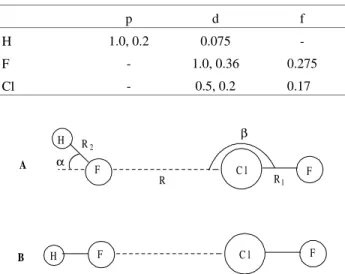
calcu-lated using the DZ+(2d1f,2p1d) basis set with the polariza-tion exponents24 given in Table 1. The electronic correla-tion was taken into account at the MP2 level and the BSSE correction was included using the counterpoise method of Boys and Bernardi25. All ab initio calculations were per-formed with the GAMESS package26. The intra and inter-molecular parameters used in the calculations were obtained from the equilibrium geometries for the minimum and linear transition state anti-H bonded structures reported by Pliego et al., at the HF/DZP level of calculation. The geometrical parameters are defined in Fig. 1, and given in Table 2, along with the energy values obtained.
For the bending motion, the distance between the mass centers of the two monomers (3.406 Å), was frozen, as well as the intramolecular bond distances (R1 and R2). These
restrictions can be justified observing Table 2. The values of R1 and R2 do not alter on going from the minimum
energy structure to the transition state structure, and the intermolecular distance R changes by just 0.05 angstrom. The α and β angles were varied concertedly, starting from the values in the minimum structure until those of the transition structure, performing a total of 33 points ranging from -π to π radians. Since the distance between the mass centers was frozen, it is smaller in our calculation than in the fully optimized transition state structure, leading to a higher energy barrier (151.24 cm-1). The calculated points are represented by dots in Fig. 2, for the α angle. This function was fitted to a polynomial form using the least squares method, resulting in:
Vbend(α)= 152.280 − 271.951 α2+ 147.387 α4−
− 25.387 α6+
3.308 α8− 0.123 α10−
0.004 α12 (1)
represented in Fig. 2 by a solid line. Comparing the calcu-lated points with the fitted curve, it can be seen that there is excellent agreement. The inclusion of higher terms does not significantly alter the fitting.
Table 1. Polarization exponents24 of the DZ basis set used in the ab initio
calculations for the HF...ClF complex.
p d f
H 1.0, 0.2 0.075
-F - 1.0, 0.36 0.275
Cl - 0.5, 0.2 0.17
H
F C l F
α
β
R R
R
F C l
F H
A
B
2
1
Figure 1. Schematic representation of the equilibrium minimum (A) and
transition state (B) optimized structures of the anti H-bonded HF...ClF complex.
Table 2. Intra and intermolecular parameters and energetic values for the minimum and the linear transition state structures of the ant i-hydrogen bonded
HF...ClF complex, obtained with the DZP basis set23. All energy values are BSSE corrected.
Parameters Minimum structure Linear TS structure
R/Å 2.82 2.87
R1/Å 1.61 1.61
R2/Å 0.90 0.90
α/deg 54 0
β/deg 177 180
De (HF/DZP)/cm-1 -718 -670
De (MP2/DZ+(2d1f/2p1d)//HF/DZP)/cm-1 -763 -630
h (MP2/DZ+(2d1f/2p1d)//HF/DZP)/cm-1 133
V
(
) (
cm
)
α
-1
be
n
d
-3 -2 -1 0 1 2 3
1 0 0 0
8 0 0
6 0 0
4 0 0
2 0 0
0
α (ra d )
Figure 2. Intermolecular potential energy surface for the HF...Cl bending
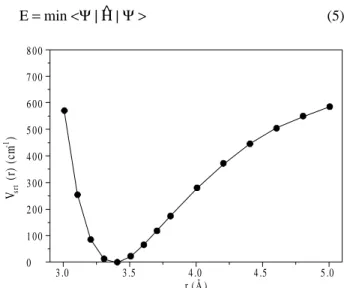
For the stretching motion, the potential energy surface was constructed by variation of the distance between mass centers, keeping the intramolecular and the remaining in-termolecular parameters constant. The curve obtained is shown in Fig. 3 by the dots, and the fitted polynomial (least squares) of order six is represented in Fig. 3 by a solid line. The fitted expression is:
Vstr(r)= 1726378.4 − 2445996.7r + 1440475.6 r2−
− 451599.42 r3+ 79519.721 r4− 7457.1228 r5+
+ 290.39824 r6 (2)
Although the fitted curve do not represent the real curve in the asymptotic region, the function should work well because we are interested in the lowest eigenvalues that are deep in the well.
Calculation of the Vibrational Spectrum
The eigenvalue/eigenfunction problem for the bending motion can be solved using the variational method. The Hamiltonian is:
H^ = −h
2
2IHF .
∂2
∂α2+ Vbend(α) (3)
In this approach, the wavefunction Ψ is expanded in a linear combination of basis functions χ:
Ψ=
∑
ciχi (4)and the coefficients and the energies are obtained by mini-mizing the following functional:
E = min <Ψ| H^ |Ψ> (5)
The eigenvectors and the respective eigenvalues that minimize the functional are obtained by solving the follow-ing matricial problem:
HC = E C (6)
where C is the coefficients vector and H is the Hamiltonian matrix, with elements:
Hij=<χi| H^ |χj> (7)
We have chosen χ to be the eigenfunctions of a particle in a box of length 2a to make the expansion. Owing to the symmetry of the problem, the eigenfunctions will have odd (-) and even (+) symmetry. So, the wavefunction can be expanded as:
Ψ−=
∑
i
ci 1
√a sin[i πα]
Ψ+=
∑
i
ci 1
√a cos[(i − 1⁄
2)πα] (8)
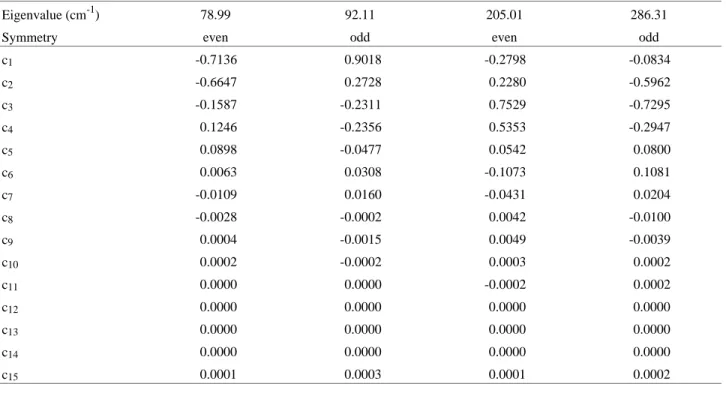
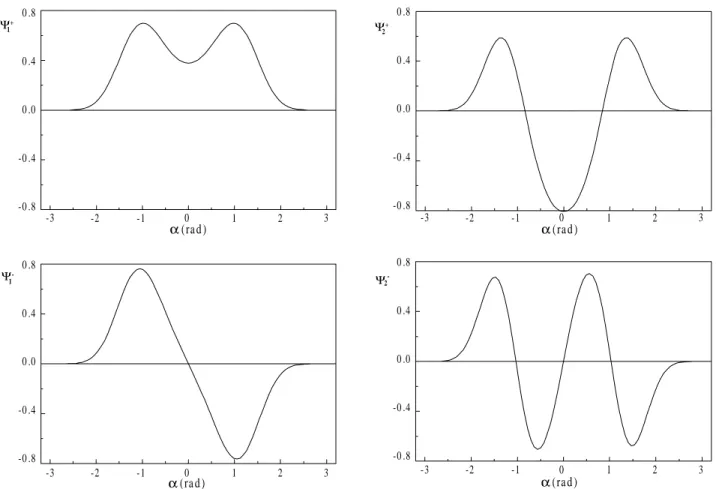
This choice of this basis set is suitable because we are using the boundary conditions Ψ(± a) = 0. This is a reason-able form to solve the problem because the lowest vibra-tional bending modes will be limited to the double well region. We have used the value of radians for the a con-stant, since it is the physical limit for the α angle in this complex. The number of basis functions χ necessary for convergence is 15, and the eigenvalues obtained are given in Table 3, along with the coefficients for their respective eigenfunctions. The eigenvalues are shown with the poten-tial energy surface in Fig. 4, and the eigenfunctions are in Fig. 5. The behavior of these functions near the potential wall is a test for the correctness of the value used for the a constant. It shows that before reaching π radians the eigen-functions are practically null. Therefore, the use of the particle in a box wavefunctions as a basis set is fully satisfactory to obtain the lowest eigenvalues for this prob-lem.
The form of the wavefunction for these four lowest levels is consistent with the energies of each level in relation to the energy barrier. The first wavefunction of even symmetry does not present a node but has one well, which was caused by the barrier. The energy for this level is near the barrier top, and the wavefunction has a consid-erable penetration into the barrier. The first wavefunction of odd symmetry presents one node and two peaks. The proximity of its energy with that of the even wavefunction is an effect caused by the barrier. These functions are located in the same region, and its oscillations are close, resulting in a near-degenerescency. Increasing the barrier will lead the amplitude of wavefunction in the barrier
V
(r
) (c
m
)
-1
sr
t
8 0 0
7 0 0
6 0 0
5 0 0
4 0 0
3 0 0
2 0 0
1 0 0
0
r ( Å )
3 .0 3 .5 4 .0 4 .5 5 .0
Figure 3. Intermolecular potential energy surface for the van der Waals
region to tend to zero, the even and odd symmetry will have much more similar oscillatory characteristics, so their en-ergy levels will be closer. At the other extreme, with the disappearing of the barrier, the levels will be splitted, and their behaviors will be like harmonic oscilators.
For the calculations of the intensities of the transitions we have used the following expression:
κ=8π3Na
3hc νij(Ni− Nj)|<ψi|µ^ |ψj>|
2 (9)
where νij is the frequency of the transition between the i
and j states, Ni and Nj their populations and |<ψi|µ^|ψj>| the dipole transition integral. The population of each state
was calculated using Boltzmann law, and the dipole tran-sition integral was obtained by:
<ψi|µ^ |ψj>2=<ψi|µ^x|ψj>2+<ψi|µ^y|ψj>2+
+<ψi|µ^z|ψj>2
µ^
x=µHF cos(α)
µ^
y=µHF sin(α)
µ^
z= 0
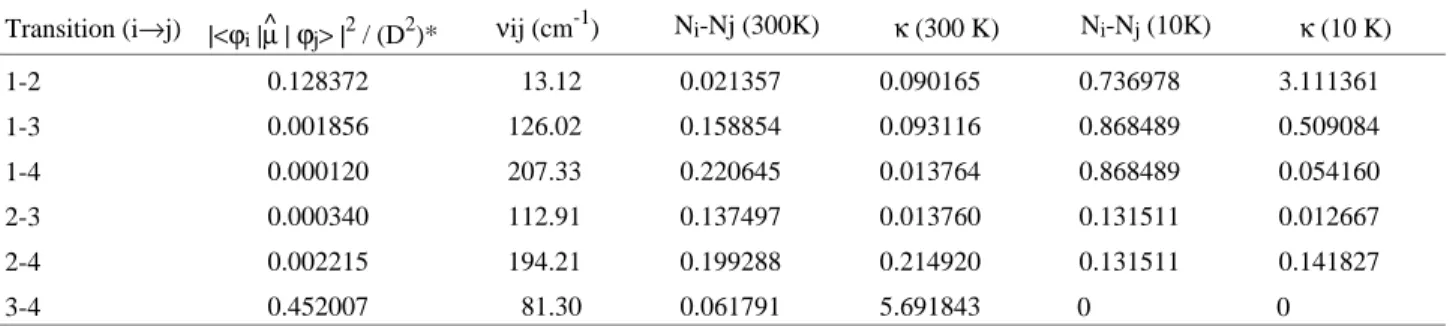
The integrals given above were evaluated in an interval of -π to π radians, and the results are given in Table 4, along with the values of N and ν used for every transition at two different temperatures, 10 K and 300 K.
For the calculation of the stretching frequency, we have used the Dunham expansion27, performing the derivatives analytically with the Eq. 2. The values obtained were:
νstretc. harm = 97.5964 cm-1
νstretc. anarm = 89.3787 cm-1
Discussion
Figure 4 shows the first four energy levels on the intermolecular energy surface for the HF...Cl bending mo-tion of the HF...ClF complex. The levels are designated according to the symmetry of the wavefunctions as even (+) or odd (-)28. The two lowest eigenvalues are below the barrier top, with a splitting of 13.12 cm-1. Their wavefunc-tions are located in the two sides of the double well region, and exhibit a reasonable penetration into the barrier. The
Table 3. Eigenvalues and coefficients for the eigenfunctions obtained by the variational solution of the Eq. 3 with the basis set funct ions (4).
Eigenvalue (cm-1) 78.99 92.11 205.01 286.31
Symmetry even odd even odd
c1 -0.7136 0.9018 -0.2798 -0.0834
c2 -0.6647 0.2728 0.2280 -0.5962
c3 -0.1587 -0.2311 0.7529 -0.7295
c4 0.1246 -0.2356 0.5353 -0.2947
c5 0.0898 -0.0477 0.0542 0.0800
c6 0.0063 0.0308 -0.1073 0.1081
c7 -0.0109 0.0160 -0.0431 0.0204
c8 -0.0028 -0.0002 0.0042 -0.0100
c9 0.0004 -0.0015 0.0049 -0.0039
c10 0.0002 -0.0002 0.0003 0.0002
c11 0.0000 0.0000 -0.0002 0.0002
c12 0.0000 0.0000 0.0000 0.0000
c13 0.0000 0.0000 0.0000 0.0000
c14 0.0000 0.0000 0.0000 0.0000
c15 0.0001 0.0003 0.0001 0.0002
V
(
c
m
)
-1
be
n
d
2
-Ψ
2+
Ψ
1
-Ψ
1+
Ψ
-2 -1 0 1 2
4 0 0
3 0 0
2 0 0
1 0 0
0
α ( ra d )
Figure 4. The first four energy levels obtained for the bending motion,
other two levels lie well above the barrier and have an accentuated separation.
Many van der Waals complexes, where tunneling mo-tions occur, present more than one set of near-degenerate energy levels below the barrier, so the splitting of the transitions in the spectrum is generally observed. In the HF...ClF case, the situation is different. Just one doublet is below the energy barrier, and the other two levels are well above it, and exhibit characteristics very different from those of the doublet, so that the wavefunctions of these different sets of levels do not overlap in a satisfactory way. As a consequence, the transition from the doublet to the levels above of the barrier is almost forbidden, as can be seen in the second column of Table 4. The dipole transition integral for the 1 → 2 transition is about one hundred times greater than the value for transitions between one level of the doublet (1 or 2) and one of the levels above of the barrier (3 or 4). The 3 → 4 dipole transition integral is the most significant, i.e. three times greater than the doublet value. So, this system will present one intense absorption at 13.12 cm-1, due to the 1 → 2 transition, and another at 81.30 cm-1, due to the 3 → 4 transition (hot band). The transitions involving levels above of the barrier will
prob-ably follow the harmonic oscillator rule, ∆ν = ±1, because for these levels, the presence of the barrier is just a small perturbation, so that the transitions would be allowed for adjacent levels.
We have calculated the intensity of the transitions in-cluding the temperature effect, using the Boltzmann distri-bution law to estimate the population of each level. At 10 K, only the first two energy levels are significantly populated, resulting in the 1 → 2 transition to be the major one, because transitions of the levels below the barrier to those above it are almost forbidden owing to the low value of the transition dipole integral. Nevertheless, the 1 → 3 transition has a reasonable intensity in relation to 1 → 2 transition, because the former is ten times more energetic (νij) than the latter. At 300 K, it can be seen that the
populations of the first four levels are significant, and in this situation, the first and second levels have almost the same population. As a consequence, the intensity of the 1 → 2 transition is low (forbidden transition), and the inten-sity of the 3b → 4 transition is the largest one.
Table 5 presents the intermolecular harmonic frequen-cies obtained for previous theoretical and experimental studies. The 1 → 2 transition of the HF...Cl bending mode
Figure 5. Eigenfunctions for the first four eigenvalues of the HF...Cl bending large amplitude vibration calculated by the variational method.
2
-Ψ
0 .8
0 .4
0 .0
-0 .4
-0 .8
-3 -2 -1 0 1 2 3
α (ra d )
2+
Ψ
0 .8
0 .4
0 .0
-0 .4
-0 .8
-3 -2 -1 0 1 2 3
α (ra d )
1
-Ψ 0 .8
0 .4
0 .0
-0 .4
-0 .8
-3 -2 -1 0 1 2 3
α (ra d )
1+
Ψ 0 .8
0 .4
0 .0
-0 .4
-0 .8
-3 -2 -1 0 1 2 3
was not discussed in the experimental work, but theoretical ab initio calculations21,22 reported frequency values of 72 cm-1 and 78 cm-1 in the harmonic approximation. It is of interest to note that these predicted frequencies are very similar to the value calculated in this work for the 3 → 4 transition. However, our value is for a hot band, not for the fundamental frequency.
Another point to be considered is the behavior of the wavefunctions shown in Fig. 5. It can be seen that when the α angle is near of ±π radians, the magnitude of the wave-function falls quickly to zero. So, it reinforces our idea that the imposition of the boundary condition Ψ(±π) = 0 is fully adequate to obtain the lowest energy levels for the bending motion of this weakly bound complex.
We have used the Dunham expansion to calculate the transition frequency of the intermolecular stretching mo-tion. Our result for the harmonic frequency, 97.60 cm-1, is in excellent agreement with the experimental findings of 100 ± 2 cm-1, and is better than the previously reported harmonic theoretical results of 106 cm-1 and 105 cm-1. However, van der Waals complexes in general present very accentuated anharmonicity. In fact, the calculated anhar-monic correction to the vibrational motion decrease the transition frequency for the stretching motion to 89.38 cm-1.
Conclusions
The stretching and the HF...Cl bending vibrational mo-tions in the HF...ClF van der Waals complex were studied using one dimensional approximations and a potential en-ergy surface obtained by the ab initio MP2 method using a very extended basis set. The bending motion corresponds to a vibration in the double well, with a barrier of 151 cm-1 (frozen core approximation), resulting in only one doublet with its energy below thar of the barrier. We have predicted an absorption at 13.12 cm-1 at 10 K due the 1 → 2 transition, and at 81.30 cm-1 at 300 K due the 3 → 4 transition. For the stretching motion, our predicted harmonic frequency is 97.60 cm-1, compared with 100 ±2 cm-1 determined experi-mentally. However, owing to the accentuated anharmonic-ity in this motion, the transition frequency is predicted to occur at 89.38 cm-1.
Acknowledgments
We wish to thank the Conselho Nacional de Desen-volvimento Científico e Tecnológico (CNPq) for providing the research grants, and the Fundação de Amparo à Pes-quisa no Estado de Minas Gerais (FAPEMIG), the Pro-grama de Apoio ao Desenvolvimento Científico e Tecnológico (PADCT-Proc. No 62.0241/95.0) and the Pró-Reitoria de Pesquisa (PRPq - UFMG) for supporting this project.
Table 5.Ab initio (harmonic approximation) and experimental intermolecular frequencies (in cm-1) for the anti-H bonded minimum structure of the
HF...ClF dimer.
HF...ClF stretching HF...Cl bending F...ClF in plane bending F...ClF out of plane bending
Novick et al.a 100.5±2 - 170±20
Rendell et al. b 106 72 212 68
De Almeida et al.c 105 78 237 90
a - Ref. 20. Experimental work.
b - Ref. 21. Ab initio calculations with the TZP basis set using the coupled pair functional theory. c - Ref. 22. Ab initio MP2 calculations with the 6-31+G** basis set.
Table 4. Dipole transition moments, relative populations, frequencies and intensities (in km/mol) for each possible transition of the bending motion in
the HF...ClF complex, evaluated at two distinct temperatures.
Transition (i→j) |<ϕi|µ^ |ϕj>|2 / (D2
)* νij (cm-1) Ni-Nj (300K) κ (300 K) Ni-Nj (10K) κ (10 K)
1-2 0.128372 13.12 0.021357 0.090165 0.736978 3.111361
1-3 0.001856 126.02 0.158854 0.093116 0.868489 0.509084
1-4 0.000120 207.33 0.220645 0.013764 0.868489 0.054160
2-3 0.000340 112.91 0.137497 0.013760 0.131511 0.012667
2-4 0.002215 194.21 0.199288 0.214920 0.131511 0.141827
3-4 0.452007 81.30 0.061791 5.691843 0 0
References
1. Dyke, T.R.; Howard, B.J.; Klemperer, W. J. Chem. Phys. 1972, 56, 2442.
2. Bohac, E.J.; Miller, R. E. J. Chem. Phys. 1993, 99, 1537.
3. Chang, H.C.; Kemplerer, W. J. Chem Phys. 1993, 98, 9266.
4. Fraser, G.T. J. Chem. Phys. 1989, 90, 2097.
5. Kofranek, M.; Lischka, H.; Karpfen, A. Chem. Phys. 1988, 121, 137.
6. Althorpe, S.C.; Clary D.C. Chem. Phys. Letters 1991, 187, 345.
7. Bunker, P.R.; Epa, V.C.; Jensen, P.; Karpfen, A. J. Mol. Spectry. 1991, 146, 200.
8. Zhang, D.H.; Wu, Q.; Zhang, J.Z.H.; von Dirke, M.; Bacic, Z. J. Chem. Phys. 1995, 102, 2315.
9. Quack, M.; Suhm, M.A. J. Chem. Phys. 1991, 95, 28. 10. Necoechea, W.; Truhlar, D. Chem. Phys. 1996, 248,
182.
11. Resende, S.M.; De Almeida, W.B. J. Chem. Phys. 1995, 102, 4184.
12. Resende, S.M.; De Almeida, W.B. Chem. Phys. 1996, 206, 1.
13. Makarewicz, J.; Ha, T.; Bauder, A. J. Chem. Phys. 1993, 99, 3694.
14. Ha, T.; Makarewicz, J.; Bauder, A. J. Phys. Chem. 1993, 97, 11415.
15. Stockman, P.A.; Blake, G.A. Chem. Phys. Lett. 1993, 212, 298.
16. Tan, X.; Xu, L.; Tubergen, M.J.; Kuczkowski, R. J. Chem. Phys. 1994, 101, 6512.
17. Fraser, G.T.; Lovas, F.J.; Suenram., R.D.; Gillies, J.Z.; Gillies, C.W. Chem. Phys. 1992, 163, 91.
18. Bumgarner, R.E.; Suzuki, S.; Stockman, P.A.; Green, P.G.; Blake, G.A. Chem. Phys. Lett. 1991, 176, 123. 19. De Almeida, W.B.; Barker, D.A.; Hinchliffe, A. J.
Chem. Phys. 1993, 99, 5917.
20. Novick, S.E.; Janda, K.; Klemperer, W. J. Chem. Phys. 1976, 65, 5115.
21. Rendell, A.P.L.; Bacskay, G.B.; Hush, N.S. J. Chem. Phys. 1987, 87, 535.
22. De Almeida, W.B.; Barker, D.A.; Hinchliffe, A.; Craw, J.S. Theochem 1993, 285, 277.
23. Pliego Jr, J.R.; Resende, S.M.; De Almeida, W.B. Theor. Chim. Acta. 1996, 93, 333.
24. Hobza, P.; Zahradnik, R. Chem. Rev. 1988, 88, 871. 25. Boys, S.F.; Bernardi, F. Mol. Phys. 1970, 19, 533. 26. Gamess, Schmidt, M.; Baldridge, K.; Boatz, J.; Elbert,
S.; Gordon, M.; Jensen, J.; Koseki, S.; Matsunaga, N.; Nguyen, K.; Su, S.J.; Windus, T.; Dupuis, M.; Montgomery, J. J. Comput. Chem. 1993, 14, 1346. 27. Dunham, J.L. Phys. Rev. 1932, 41, 721.
28. Lewis, J.D.; Malloy, T.B.; Chao, T.H.; Laane, J. J. Mol. Structure 1972, 12, 427.