A HF/CI-SD Study of the Low-Lying States of Nitroprusside Ion
Eduardo Hollauer*a, and José A. Olabeb
a
Universidade Federal Fluminense, Instituto de Química, Departamento de
Físico-Química, Morro do Valonguinho s/n, Centro,
24210-150 Niterói - RJ, Brazil; e-mail [email protected] b
Departamento de Química Inórganica, Analítica y Química Física (Inquimae),
Faculdad de Ciencias Exactas y Naturales, Universidad de Buenos Aires, Pabellón 2,
Ciudad Universitaria, Capital Federal 1428, Argentina;
e-mail [email protected]
Received: August 23, 1996
Desde a descoberta de dois estado meta-estáveis gerados por excitação ótica do nitroprussiato de sódio cristalino, Na2[Fe(CN)5NO].2H2O (SNP), exibindo longa meia-vida a temperaturas
abaixo de 160 K, grande esforço vem sendo realizado no sentido de entender a estrutura eletrônica de sistemas correlatos. Apesar deste esforço, a natureza dos orbitais de fronteira e dos processos de excitação eletrônica de baixa energia são, ainda hoje, controversos. Cálculos iniciais EHT mostram que o HOMO possuia caráter do orbital 3d metálico, enquanto o LUMO possuia uma contribuição
dominantemente π* (NO). Entretanto, cálculos INDO definiram o orbital metálido d como orbital
de valência interna com vários elétron-volts em energia de Koopmans. O espectro vertical foi estimado através de cálculos HF/Cl-SD com bases de qualidade double-zeta e potenciais de caroço.
As energias de Koopmans para os resultados ab initio estão de acordo com os resultados de
Bottomley e Grein, e atribuem as primeiras excitações a processos de transferência de carga (TC) do trans-cyano para os ligantes nitrosila. Forças de oscilador foram calculadas e os resultados mostraram intensidades comparáveis com os resultados experimentais. A energia de excitação para o processo de transferência de carga metal → NO, 8e → 13e (dxz,dyz→ π* NO) foi estimada em 4.52 eV e exibindo intensa banda de absorção. A segunda excitação de transferência de carga, 1b2 → 13e (dxy → π* NO), apontada por trabalhos prévios como uma típica banda de transferência de carga (TC) mostra uma pequena intensidade em 5.04 eV. Nos cálculos foi observado que o ordenamento SCF é muito independente do conjunto de base utilizado para o metal. Bases metálicas de caráter mínimo mostram resultados em grande concordância com os resultados EHT, enquanto as bases double-zeta empurram os orbitais d metálicos para os orbitais de valência interna. O
ordenamento das energias HF foi empregado no sentido de interpretar resultados de experimentos fotoquímicos e de termoanálise do SNP e os resultados parecem mostrar boa concordância com as propriedades calculadas.
Since the discovering of two photoexcited metastable states of crystalline sodium nitroprusside, Na2[Fe(CN)5NO].2H2O (SNP), showing rather long lifetimes at temperatures below 160 K, much
effort has been devoted toward the study of its electronic structure. Despite this tremendous effort the nature of the frontier orbitals and the related low energy excitations remains controversial. Early calculations, EHT, showed the HOMO as mainly the metallic 3d orbital while the LUMO had a major π* (NO) contribution. However INDO calculations, clearly set the metal d orbital many electron-volts deep in core. The vertical electronic spectrum have been estimated through ab initio HF/CI-SD with a double-zeta quality basis set. The ab initio results support Bottomley and Grein’s interpretations and assign the first electronic transitions to ligand-to-ligand charge-transfer excita-tion from trans-cyano to nitrosyl ligands. The corresponding oscillator strengths have been
lated showing comparable intensity with the experimental results. The excitation energy of the metal → NO charge-transfer transition, 8e → 13e (dxz,dyz → π* NO) have been estimated to be at 4.52 eV and show a rather intense absorption band. The second CT excitation, 1b2 → 13e (dxy → π* NO), pointed by previous works as a typical CT band, exhibits a small intensity at 5.04 eV. In the calculations it was observed that SCF orbital ordering are rather dependent on the metal basis set used. Metallic minimal basis set show results in close agreement with EHT early calculations while double-zeta basis set pushes the metallic d orbitals deep away from the HOMO’s. The HF orbital ordering has been used to interpret photochemical and thermoanalysis experiments on SNP and the results seem to fit properly with the calculated properties.
Keywords: ab initio (SCF,CI-SD), nitroprusside, excited states, metastable states, Na2[Fe(CN)5NO], pentacyanonitrosylferrate
Introduction
The disodium pentacyanonitrosylferrate (sodium nitro-prusside), Na2[Fe(CN)5NO].2H2O (SNP) is a dark red
crystal which structure is well known to be ortorhombic
Pnnm with four molecules per unit cell1. The
[Fe(CN)5NO]-2anion shows an approximate 4m local
sym-metry and the octahedra structure slightly distorts in the crystal with the angle NC-Fe-NO departing from linearity by about 3°. This complex shows a rather unusual Fe-NO distance, 1.653 Å, and a slightly extended N-O distance, 1.124 Å, typical of a strong NO → metalσ electron dona-tion followed by intense metal→ NO back-donation. An-other point of interest are the Fe-CN distances that have nearly the same value for the equatorial (1.933 Å; averaged; cis hereafter) and axial ligands (1.918 Å; trans hereafter). For complexes of the type [M(CN)5NO]-2, where M is a
metal of group VIII, the trans Fe-CN distance is usually longer than cis distances. The trans Fe-CN is nearly linear with the Fe-NO bond but two possible orientations are found for the Fe-NO bond in the crystal. They form an angle of 112°10’ in an almost anti-parallel orientation, both
±33°55’ apart from a axis. Its UV-visible spectrum does not change qualitatively in solution supporting that envi-ronmental effects do not break the qualitative picture ob-tained from calculations on the isolated anion2.
Recently interest in elucidating the electronic structure of SNP has been reinforced by the discovery of similar long-living metastable states and to the increasing biologi-cal importance of this ion, kindly pointed by the referees. Following their suggestion is important to remark that nitroprusside is a drug, being presently commercialized in the USA under the name of Nipride, and takes important hole activating guanylyl cyclase, either via release of nitric oxide or via direct stimulation of the enzyme. The result is increased intracellular cBMP, which relaxes vascular smooth muscle by decreasing calcium levels in the cell. Nitroprusside acts as a vasodilator, decreases blood pres-sure and increases cardiac output. However, metabolism of
nitroprusside results in the cyanide release, a very serious side effect. As such, nitroprusside is used parentally in treating hypertensive emergencies and severe cardiac fail-ure.
Early calculations on the electronic structure of SNP have been carried out by Manoharan and Gray2 at
SCCC-EHT level. The ten highest occupied molecular orbitals (HOMO) obtained were [(core) 8e4 5b12 6b12 9e4 21a12 1a22
10e4 11e4 12e4 2b22 ] with the 2b2 showing a major
contri-bution of 3d(xy) metal orbitals and the 13e appearing as a mixture of 3d(xz,yz) with the dominant contribution of π* NO. The average energy difference between the ten highest orbitals, is around 0.5 eV with the two HOMO’s lying within 0.56 eV, and apart by 2.3 eV from the others in Koopmans’ energy. Among the first virtual orbitals (LUMO) we find, in increasing energy order, [13e 7b1 22a1
14e 23a1 ], well separated in energy (≅ 4 eV) and with a
HOMO-LUMO gap of around 2.54 eV. This pattern clearly indicates a spectrum dominantly governed by one-electron excitations from the two HOMO’s to the first LUMO’s. Based on this pattern Manoharan and Gray proposed the transition assignment presented in Table 1, for which the low energy excitations are clearly low-intensity CT transi-tions. These results were confirmed by Fenske and
DeK-ock3 with a modified CNDO method and other
experimental works on the optical electronic spectrum, in solution and with polarized light in crystals4, ESR
experi-ments3, XPS experiments5 and by Mossbauer6
spectros-copy claim these assignments to be correct.
However there exist evidences towards a different pos-sibility. Chemical reactions of this complex with nucleo-philes lead most often to substitution on nitrosyl despite the Fe-NO distance is the shortest one in the complex. Photo-chemical studies do not support metal orbitals as the HOMO since irradiation on these bands show nitrosyl exchange rather than metal oxidation products. Partially based on these informations E. Wasielewska7 suggested that Manoharan2 assignment was inconsistent with some
fol-lowing Wasielewska, relates to the observed intensity in the low energy excitations of SNP, which showed rather small intensity transitions, something in disagreement with the usual intense and broad CT bands in similar compounds. A re-interpretation of thermal analysis of SNP, here pre-sented, seems not to support metal orbitals as the HOMO. Bottomley and Grein8 at New Brunswick and
Gole-biewski and Wasielewska7,9 at Cracow, independently
car-ried out semi-empirical calculations for these transitions. The results are somehow conflicting but showed both, rather different results from the previous SCCC-EHT cal-culation. Carrying INDO calculations the first authors found a minor contribution of metal d orbitals among the frontier orbitals. The results support the idea that NO ligand strengths the trans-Fe-CN bond and the resulting orbital energy diagram shows the metallic d orbitals too stable. Most of the occupied frontier orbitals are composed by trans and cis CN contributions. These authors claim the CN ligands role essentially as σ-donors while NO acts as a strong π-acceptor. As a consequence the first transitions are of a ligand-to-ligand type. According to SINDO calcula-tions carried out by Golebiewski and Wasielewska7,9
how-ever, the HOMO orbitals are of mixed character with about 40% of metal and 60% of cis-CN. All methods agree placing the 13e orbital (π* NO) as the first LUMO, the 3b1
as a 3d (x2-y2), and the 5a1 as the 3d (z2). We report the
SINDO assignments in Table 1 compared to the SCCC results.
Results obtained with SCCC, INDO and SINDO meth-ods seem to provide rather different representations for the orbital diagram. Therefore the primary question in this study concerns the characterization of the nature of the involved orbitals.
Meanwhile this theoretical discussion was taking place, Mossbauer11 experiments indicated a metastable state gen-erated through laser pumping in the 400-530 nm range at 160 K. Below this temperature the metastable state is a long-living state which decays upon irradiation with red light. Violet light does not lead to depopulation of the metastable state. With longer wavelengths or at higher temperatures the metastable states cannot be populated. For a matter of convenience this state will be denoted as HMS-NP (high-temperature metastable state nitroprusside).
Fol-lowing Manoharan and Gray2 this state have been assigned
to the 2b2(xy) → 13eπ* (NO) orbital excitation. Due to the
remarkable long life of this metastable state its Raman12,13
and IR spectrum15,16, polarized or not, optical UV-visible
absorption spectra11,14, Mossbauer6 and ESR spectra have
been obtained for many SNP salts. These experiments revealed the existence of a second metastable state below 90 K, hereafter called as LMS-NP (low-temperature metas-table state nitroprusside). ESR experiments do not support high-spin paramagnetism but after X-ray irradiation a dou-blet signal was attributed to the presence of [Fe(CN)5NO]-3.
Based on these results the authors proposed the switching of the first LUMO’s, 13e and 22a1(dZ2), one of the
remain-ing few points in agreement over the several articles related to this study. Indeed this is consistent with the reduced Fe-NO bending angle found in the metastable state.
Recently similar complexes have been found to exhibit long living electronic states. In the specific case of sodium nitroprusside, calorimetric and Raman experiments indi-cated LMS-NP and HMS-NP to lye 1.0 and 1.1 eV above SNP. The authors point out the possibility of Jahn-Teller distortion caused the 12e orbital splitting that would origi-nate two possible metastable states. The intense depletion of metal dxy orbitals observed by Pressprich et al through
X-ray experiments favors the Manoharan-Gray energy lev-els but the significant increase of d(z2) metal population in the metastable state is difficult to understand under the same scheme.
Despite the tremendous effort in the generation of wide experimental information there is no clear understanding on the nature of these excited states. Following Terrile17et al. the data obtained point out to some clear contradictions; a) The observed optical absorption for the first bands does not show an intensity consistent to a CT process and besides is not polarized along the charge flux as it should be; b) The observed trans effect leading to short trans CN bonds by the NO presence should significantly change the Fe-CN vibrational frequencies in the metastable state but this is not observed; c) The Mossbauer and ESR experi-ments indicate a possible exchange between the two LUMO of the system as well as to an increase of the metal d orbital population, something that is inconsistent with a CT exci-tation and all calculations reported so far; d) No splitting Table 1. Experimental excitation energies, intensities and proposed assignments for the eletronic spectrum of sodium nitroprusside.
Band energy4 eV (λnm) SCCC2 SINDO7,9 εmax4 polariz.
I 2.49 (497) 2b2 → 13e 2b2 → 13e 8 ⊥
II 3.15 (394) 12e → 13e 12e → 13e 25
III 3.75 (330) 2b2 → 4b1 12e → 13e 40 ⊥
IV 4.68 (265) 12e → 4b1 1a2→ 13e 900 —
in the vibrational modes are observed; e) The metastable state X-ray spectra does not show appreciably bent Fe-NO bonds, what is in clear conflict with the well establish nature of the first LUMO of the system.
Clearly there are a lot of misunderstanding and the calculation most of these results are based is a sixties EHT-SCCC calculation. M.R. Pressprich20et al. reported
an ab initio calculation in close agreement with INDO8 results, that was judged as an unphysical result?!. Consid-ering the wide successful results obtained with ab initio methods in organic and inorganic compounds and the great controlability offered by this method is surprising how simply these results were discarded. Indeed many authors have been carring out HF/CI calculations on several metal transition compounds claiming an error smaller21,22 than
0.5 eV to the experimental energies. The goal of this work, considering our limited computational resources, is to pre-sent simple, economical and balanced HF/CI-SD calcula-tions designed to establish the correct qualitative orbital picture. The following section will present our results for SNP excitation energies while in the next some chemical evidences will be discussed.
Calculations
All the calculations performed employed an effective core potential (ECP) developed by Stevens, Jasien, Krauss and Basch23 and a metal basis set containing four
sp shells plus three contracted d functions [4sp,3d] suggested by Rappe, Smedley and Goddard24. With this ECP just ten
metal electrons are removed from the calculations which keeps a good compromise between the deformation of the metal orbitals upon the bond formation and the computa-tional cost. Care must be taken with ECP27 calculations
when metal-ligand bond distances became too short due to the break of the central field approximation and our results have been checked upon this problem. For the ligands two basis sets were used. The first, for monitoring purposes only, was a minimal STO-3G basis set, hereafter called MNSL (minimal basis set for the ligands). The final results rely on Dunning’s25 contraction of Huzinaga double zeta basis set, called through this article as DZSL (double-zeta basis set for the ligands). The total number of basis func-tions amounts 94 contracted gaussian funcfunc-tions for the MNSL and 142 basis functions for the DZSL. Due to the well-know tendency of ab-initio, as well when used with ECP’s27, to generate extended geometries, all calculations
employed DFT optimized geometry10 through a
Kohn-Sham SCF with gradient-corrected Becke functional. The geometry was properly symmetrized to C4ν geometry
al-though all calculations employed the largest abelian sub-group, C2ν . This geometry shows fairly good agreement
with X-ray diffraction data and some important geometri-cal parameters used are listed below with the X-ray values between parenthesis; Fe-NO distance of 1.65 Å (1.653 Å),
NO of 1.17 Å (1.124 Å), trans Fe-CN distance of 1.948 Å (1.918 Å), trans CN of 1.18 Å (1.150 Å), cis Fe-CN distance of 1.948 Å (1.933 Å), cis CN of 1.18 Å (1.152 Å). The ON-Fe-CN(cis) angle was set to 94.6° but all others, due to the point group constrain, were set to 90° or 180°.
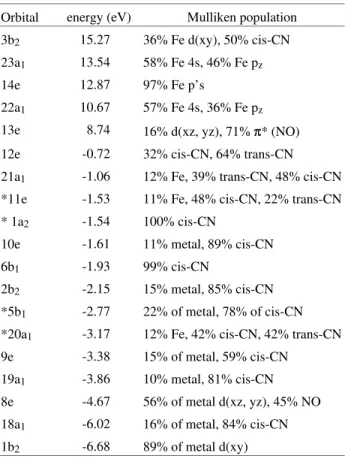
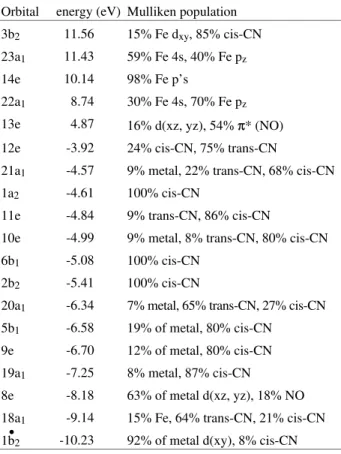
Ground state Hartree-Fock calculation indicated a high density of states close to the HOMO-LUMO threshold. For the MNSL set it was found eleven orbitals within 2.8 eV while for the DZSL these numbers are expanded to lye within 6.3 eV. Tables 2 and 3 present the Koopmans’ energy and Mulliken orbital analysis for the basis set used. Both calculations indicate HOMO orbitals much closer in energy than expected from previous calculations. The ten upper energy levels determined in the DZSL calculation are [(core) 9e4 5b12 20a12 2b22 6b12 10e4 11e4 1a22 21a12 12e4]
while the six lowest energy unoccupied orbitals are defined as [13e 22a1 14e 23a1 3b2 24a1 ]. The HOMO-LUMO
Koopmans’ energy gap have values around 8.8 eV and the average energy spacing is 4 levels/eV for the occupied and around 0.55 levels/eV for the virtuals. A simple Mulliken analysis shows the metal d orbitals around 8.2-10.0 eV deep
Table 2. Koopmans‘ energy and Mulliken population analysis for the frontier orbitals. Calculations done with the MNSL basis. Interchanges with respect to the DZSL calculations are marked.
Orbital energy (eV) Mulliken population 3b2 15.27 36% Fe d(xy), 50% cis-CN 23a1 13.54 58% Fe 4s, 46% Fe pz
14e 12.87 97% Fe p’s
22a1 10.67 57% Fe 4s, 36% Fe pz 13e 8.74 16% d(xz, yz), 71% π* (NO) 12e -0.72 32% cis-CN, 64% trans-CN 21a1 -1.06 12% Fe, 39% trans-CN, 48% cis-CN *11e -1.53 11% Fe, 48% cis-CN, 22% trans-CN * 1a2 -1.54 100% cis-CN
10e -1.61 11% metal, 89% cis-CN
6b1 -1.93 99% cis-CN
2b2 -2.15 15% metal, 85% cis-CN *5b1 -2.77 22% of metal, 78% of cis-CN *20a1 -3.17 12% Fe, 42% cis-CN, 42% trans-CN 9e -3.38 15% of metal, 59% cis-CN
19a1 -3.86 10% metal, 81% cis-CN 8e -4.67 56% of metal d(xz, yz), 45% NO 18a1 -6.02 16% of metal, 84% cis-CN 1b2 -6.68 89% of metal d(xy)
Atomic Mulliken population.
in Koopmans’ energy with the highest energy orbital of b2
symmetry, pointed as the HOMO by SCCC calculations, lying far from the HOMO-LUMO threshold by about 5.4 eV. The HOMO shows dominant contributions from equatorial and trans CN bonds in agreement with INDO results and the first LUMO, 13e, shows an intense mixture between 3d(xz,yz) and the dominant π* NO contribution. The next two orbitals have a dominant metallic s and p character with many virtual orbitals showing negative Mul-liken populations, an effect known as counter-intuitive orbital mixing (CIOM)28.
The MNSL calculation, although showing minor inter-changes (11e/1a2and 20a1/5b1), confirmed the previous
energy level ordering. These changes occur due the ligand character of these orbitals and its dependence on the basis set. Among the virtual orbitals minor differences were found, most of them, due to the limited variational freedom in MNSL calculation. However there is no chance, within the ab initio methodology, for the configuration or the nature of the frontier orbitals to be qualitatively changed due to the large energies involved.
At this point it is important to remark that the close proximity between these energy levels makes one-electron excitation assignments of minor use, as already pointed out by Calabrese and Hayes5. Such case requires an explicit calculation of many-body interactions and relaxation ef-fects through SCF/CI calculations in order to provide reli-able transition assignments. How dependent these excitation energies are on the ECP quality, basis set and electron correlation treatment must be well understood since the orbital scheme is dependent on these technicali-ties. To check this point out two calculations were carried out without ECP but still keeping the same basis set (1s, 2s and 2p functions were added in order to replace the ECP). Both calculations, MNSL and DZSL, generated similar orbital ordering with the metal d orbitals deep in core and Table 3. Koopmans‘ energy and Mulliken population analysis for the
frontier orbitals. Calculation done with the DZSL basis.
Orbital energy (eV) Mulliken population 3b2 11.56 15% Fe dxy, 85% cis-CN 23a1 11.43 59% Fe 4s, 40% Fe pz 14e 10.14 98% Fe p’s
22a1 8.74 30% Fe 4s, 70% Fe pz 13e 4.87 16% d(xz, yz), 54% π* (NO) 12e -3.92 24% cis-CN, 75% trans-CN
21a1 -4.57 9% metal, 22% trans-CN, 68% cis-CN 1a2 -4.61 100% cis-CN
11e -4.84 9% trans-CN, 86% cis-CN
10e -4.99 9% metal, 8% trans-CN, 80% cis-CN 6b1 -5.08 100% cis-CN
2b2 -5.41 100% cis-CN
20a1 -6.34 7% metal, 65% trans-CN, 27% cis-CN 5b1 -6.58 19% of metal, 80% cis-CN
9e -6.70 12% of metal, 80% cis-CN 19a1 -7.25 8% metal, 87% cis-CN
8e -8.18 63% of metal d(xz, yz), 18% NO 18a1 -9.14 15% Fe, 64% trans-CN, 21% cis-CN 1b2 -10.23 92% of metal d(xy), 8% cis-CN
Atomic Mulliken population.
-0.25 for Fe, +0.02 for trans-C, -0.35 for trans-N, -0.06 for cis-C, -0.32 for cis-N, +0.29 for N(NO), -0.13 for O(NO).
•
Table 4. Ionization energies for nitroprusside calculated at SCF and CI levels with the DZSL basis set. The CI weigth refers to the following orbital list {2b2 6b1 10e 11e 1a2 21a1 12e}.
State SCF CI(eV) dominant
configuration 1A1 -712.8984 -713.2376 0.913 (2244224)
2E 1.98 2.58 0.914 (2244223)
2A1 3.47 4.45 0.920 (2244214)
2A2 4.09 4.24 0.911 (2244124)
Table 5. Singlet excitation energies calculated at SCF/CI levels with the DZSL basis set. The CI weigths and configurations refer to the following orbital list {2b2 6b110e 11e 1a2 21a1 12e/13e}.
State SCF CI dominant
configuration X 1A1 -712.8984 -713.2376 0.913 (2244224/0)
a 1E - 2.8 0.929 (2244214/1)
b 1E - 3.1 0.917 (2244124/1)
a 1B2 (xy)* - 3.2 0.932 (2244223/1)
* other components of this excitation have been calculated but they suffer from balance problems in CI calculation (see text).
Table 6. Excitation energies calculated at SCF and CI levels with the DZSL basis for the triplet spin states. The configurations refer to the following orbital list {2b2 6b110e 11e 1a2 21a1 12e/13e}.
State SCF CI dominant
configuration X 1A1 -712.8984 -713.2376 0.913 (2244224/0)
A 3E 0.9 2.8 0.929 (2244214/1)
B 3E 1.9 3.1 0.917 (2244124/1)
A 3B2 (xy)* 0.03 3.06 0.930 (2244223/1)
the highest b2 orbital few eV below the HOMO-LUMO
threshold. Note that in both calculations the metal basis set contained the same three 3d functions! However when the metal basis was replaced, in another calculation, by a minimal one with just a single d function the results turned to be completely different with the metal d functions ap-pearing as the HOMO! The orbital interpretation resulting from this calculation shows the same pattern as SCCC calculations. The lack of variational freedom in the metal d orbital seems to push it to be the HOMO. Therefore an extended and balanced basis set is very important to achieve reliable results in these calculations. This seems to be clearly valid in ab initio calculations and suggest how reliable minimal basis based semi-empirical (or ab initio!) calculations could be in this situation. However the picture is not completely clear since recently Dr. Estrin brought to our knowledge that DFT calculations10 that support the
HOMO orbital as a mixture in which the metal d orbital have a dominant contribution. Some tests have been per-formed, like the use of the same geometry and basis set, but the results seem to indicate no basis set dependence on these calculations. The energy levels close to the HOMO-LUMO threshold are similarly packed. Considering the excellent geometries and vibrational frequencies generated by this method work still have to be made to understand these difficulties. Another test carried out was to run the same RHF calculations with the Hay and Wadt’s ECP’s. No significant difference was found between these calcu-lations and the ones carried out in this article. This particu-lar test have been previously reported by Pressprich et al.20 and confirm our results.
The Mulliken atomic charges confirmed well known tendencies10 showing the cyano nitrogens negatively
charged and the nitrosyl nitrogen largely positively charged. It is believed these charges are responsible for the intense solvatochromic effects observed in many bands of SNP, thus influencing the nitrosyl electrophilic reactivity.
Ionization potentials
Calculations have been carried out to check the reliabil-ity of Koopmans’ energy as the ionization potential (IP) of SNP. Two major errors affect the Koopmans’ energy, the relaxation energy and the correlation energy. The first might be treated through a specific ion SCF calculation while the correlation energy should be estimated through some post-SCF methodology. Calculations for the first IP are presented at SCF/CI-SD level for DZSL. It should be observed that at SCF level the 12e orbital appears as the HOMO followed by the 21a1 and 1a2 orbitals. However at
CI level an intense differential correlation energy showed the 21a1 more stable than 1a2due to an extra stabilization
of about 0.83 eV. Considering that further calculations indicated the 21a1 orbital to became more stable with the
increasing the basis set we should expect an error around
one electron-volt for the IP assignment based on the Koop-mans’ energy.
Electronic spectra
Concerning the vertical electronic spectrum, self con-sistent field calculations were carried out for all low-lying triplet states. Although there is no expectancy that singlet-triplet energies would be well described at SCF level, due to the Fermi correlation energy, this run was a necessary step towards the CI calculations. Unfortunately the singlet SCF convergence proved to be too difficult to achieve with our tools and all singlet CI calculations had to be carried out with a triplet orbital set. Therefore the singlets are expected to be few milihartrees below the values here reported. In order to search all possibilities with respect to the low energy spectrum excitations from the HOMO’s to the 13e level were studied; 12e → 13e, 21a1→ 13e, 1a2→
13e, 11e → 13e at CI level. The calculations were carried out at SCF and CI levels with both basis set but only the DZSL results will be reported since the MNSL showed fairly good qualitative agreement.
The CI calculations were carried out with all singles and doubles excitations from the ten highest orbitals to the full set of virtuals. The CI calculations employed the interact-ing space approximation where just the nonvanishing spin couplings with the reference were used. Use was made of GAMESS29 program. The number of spin-coupled
con-figurations (CSF’s) goes from 25661 CSF’s in the MNSL calculation for the ground state to 70877 CSF’s in an equivalent calculation with DZSL basis set. At this point it is important to remark that under the approximations em-ployed, interacting space in CI calculations, excited states with a clear multi-reference character, our limited basis set and the ECP’s use this work should be considered as a prospective ab initio calculation on the vertical spectrum of this system. Further calculations are been carried out in order to provide accurate results for the vertical spectra of SNP. These employ extended basis sets, MC-SCF wave function and multi-reference CI (MRCI) calculations. The results so far confirm the present ones.
Even if the HOMO is the 12e orbital, the first excited state results from 21a1→ 13e excitation and have a
transi-tion energy of 2.8 eV at CI-SD level. The polarizatransi-tion pattern is consistent with band I being perpendicularly polarized to the NC-Fe-NO plane. The second excitation, 1a2→ 13e, shows the same final symmetry, E, and was
wavefunctions are often underestimated the CI results usu-allly offer reliablle results for the excitation energies. How-ever our final results rely on CI calculations that usually show a reasonable estimative of this property. In both calculations the CI roots are represented by the correspond-ing SCF dominant determinant slightly perturbed by scorrespond-ingle and double excitations. Further calculations, not reported here, indicate the intense dependence of the a2 energy level
with the ligand basis set. Such dependence makes this assignment possibly interchanged with respect to the 21a1 → 13e transition as already pointed out based on the differential correlation energy in the IP calculations. Both transitions appear with small oscillator strengths, similar polarization pattern and may share together a common envelope within band I.
The next band comes from the 12e → 13e excitation and expands four different components, B2 (xy and yx),
B1(x2-y2 ) and A1(x2+y2). The B2 (xy or yx) is well described
by a single-reference SCF wave function, however the two others, B1(x2-y2) and A1(x2+y2), require at least a
two-de-terminant wave function in the triplet spin case. Therefore we decided to run simple ROHF/CI-SD calculations for the
3B
2 state and use its orbitals to carry out the singlet CI
calculation. The transition energy obtained, 3.1 eV, seems to provide an accurate estimate of the 12e → 13e excitation in good agreement with Bottomley and Grein’s results. The problem remain on the two other states since they corre-spond to higher roots in the CI calculation of the fundamen-tal state and cannot be calculated at SCF level neither can be ensured that the configuration list actually represent single and doubles excitation from the dominant configu-ration, due to the single-reference character of our excita-tion program. Its CI results, not presented, are too high due to the differential excitation treatment with respect to the fundamental state. As an alternative we presented restricted CAS-SCF results in which most of the orbitals but the (12e,13e) active space were freezed. Calculations were carried out for the fundamental and the excited states and the results point to an excitation energy of about 5.5 eV for the 1B
1(x2-y2) and 1A1(x2+y2) and 4.89 eV for the1B2(xy)
state. Considering the CI result for the first term of this multiplet, 3.1 eV, and the 0.6 eV value reported by Grein as the splitting of this multiplet, our restricted CAS-SCF result is probably still high by one electron-volt and should get smaller with a full CAS-SCF and a proper MR-CI calculation. However this result helps assigning transitions with parallel polarization pattern between 3.1 and 3.5 eV in agreement with the experimental results. Table 7 pre-sents the final conclusions to our calculations with the orbital assignments and the excitation energies.
Despite the Mulliken analysis for the ground state sug-gests an increasing of metal atomic population along 21a1 → 13e, 1a2 → 13e, and 12e → 13e excitations, SCF
calculations on the triplet states showed a minor metal population depletion along such excitations. The iron atomic population change 21a1 → 13e excitation is the
smallest estimated, -0.18 with a calculated oscillator strength (RHF level) of 0.000938 in close agreement with the low intensity profile for this transition in the optical spectrum (ε ≅ 8). The population analysis showed an elec-tron flux from the trans-CN to NO and an intense relaxation in the excited state orbitals leading to the iron depletion. The following excitations, 1a2→ 13e, and the 12e → 13e,
point out to similar changes with about -0.23 electrons for iron atomic population change. The eletronic flux are di-rected from cis-CN and trans-CN to NO. The reported CT is consistent with the increasing intensity of these transi-tions (ε ≅ 40, o.s. ≅ 0.0063). From the studied states just the 1a2→ 22a1 excitations reported a large increase on the iron
atomic population. Based on the reported values none of the first bands in the UV-visible spectrum could be as-signed to CT.
Approximate calculations for the metal → NO CT bands were carried out by estimating the differential corre-lation energy for the active orbitals only. The results assign the 8e → 13e orbital excitation, with a calculated energy transition of 4.52 eV at CI level, to be the band IV in fairly good agreement with the experimental CT band at 4.6 eV. The next band, V, has similar energy as the second compo-nent for the d → NO transition and was calculated at CI level to lye at 5.04 eV above the ground state. Calculations of the oscillator strengths for these transitions confirmed the first one as band IV but showed the second to have a fairly small intensity to be considered band V. At this point is clear that metal excitations from b2 orbitals to axial
ligands would not lead to intense transitions in the low energy region, contrary to what have been discussed in previous articles. From group theory, excitations from me-tallic b2 orbitals are allowed (C4ν point group) just to b and
e orbitals. Excitations from atomic to ligand dxy orbitals
would lead to intense bands but its threshold of appearance is around 10-12 eV for NO. For the b2 → ey excitation, it
must be polarized along x to allow excitation from b to ey
Table 7. Excitation energies and our proposed assignments for the ele-tronic spectra of SNP.
Band energy (eV) our results polarization
I 2.8 21a1 → 13e ⊥
I 3.1 1a2 → 13e ⊥
II 3.2 12e → 13e (1B2; xy)
IV (CT) 4.5 8e (dxz,yz) → 13e
V (CT) 5.0 1b2 (dxy) → 13e part of
and along y during b2 → ex excitations leading to small
oscillator strengths. This is particularly important since early articles wrongly suggested the unusual CT small intensity as an experimental evidence against the Manoha-ran and Gray assignment. Actually the excitation from atomic b2 to axial nitrosyl ligand orbitals of e symmetry in
C4ν point group, is a untypical CT band for which the main
polarization is forbidden. Such “invisibility” does not vio-late our arguments concerning its inner-valence character. No attempts have been made toward calculating the metal-to-cyano band.
The calculated triplet states follow very closely the energy ordering of the correspondent singlet. Wasielewska et al.7,9 pointed that rather small energy differences have been calculated for singlet-triplet splitting. Our CI calcula-tion for the a3E and a1E (21a1→ 13e) energy difference
were estimated to be 1.05 milihartrees with the triplet state more stable. The energy difference resulting from 1a2→
13e excitation was calculated to be 0.13 milihartrees favor-ing the triplet as well. Comparfavor-ing these values with the average thermal energy available, <E> = 3kT/2, we obtain the result of 220 and 27 K for the temperature where both metastable states, HMS-NP and LMS-NP, would decay. Under the presented scheme both states could be reached through optical excitation with light with wavelength shorter than 540 nm followed by interconversion to the triplets. Although the quantitative agreement should be considered fortuitous, particularly due to opposing results coming from ESR experiments, the calculations indicate the possibility of interpreting the long-life of such states as a typical phosphorescent mechanism.
Chemical Evidences
Many experiments have been claimed to support Bot-tomley’s views, however the most clarifying ones relates to X-ray photoelectron spectrum5, photochemical studies
and a new re-interpretation of thermolysis on SNP crystals here presented.
Calabrese and Hayes5, studying the X-ray
photoelec-tron spectrum of hexacyano metallates of chromium, man-ganese, iron and cobalt compared some of its features, specially the one originated from t2g orbital, pointing out
that such feature does not appear in the photoelectron spectrum of SNP. They emphasizes the large difference found between the hexacyano ferrate and the SNP spec-trum. Another point of interest is the behavior of the 9 eV peak, assigned to the 4σ cyano orbital, that shifts 1.5 eV to low energy in SNP. This offers an indication of the cyano energy levels approximation to the HOMO-LUMO thresh-old.
Photochemical experiments7,30,32 carried out
concen-trate on the estimate of the photooxidation quantum effi-ciency, since the behavior of this property with the light
frequency is clearly related to the CT process. This study have been performed by different groups and the results indicate that band I is photochemically inactive, consis-tently with its polarization properties and the low absortiv-ity found, in agreement with the present work. The increase in quantum yields for Fe(III) photoproduction (eq. 1), when irradiation was performed at 366 nm and 313nm (0.34 and 0.37 respectively), compared to the value found at 436 nm (0.17) was interpreted as showing the predominance of eq 1 against the alternative photoaquation reaction (Eq. 2),
Fe(II)(CN)5NO-2 + hν → Fe(III)(CN)5H2O-2 + NO (1)
Fe(II)(CN)5NO-2 + hν → Fe(II)(CN)5H2O-3 + NO (2)
In fact, irradiation experiments do not show only the appearance of Fe(III), but also the production of cyano-gen30; unfortunately, no quantum yields were obtained for
the latter species. Besides, the main irradiations were not performed strictly at the band absorption maxima. Because of the strong coupling of the metal and the cyanide orbitals, either iron oxidation or cyanogen release could be obtained in the primary process through irradiation with energies corresponding to band II and III. However, the product yield could also be dependent on further intramolecular processes and solvatational energies associated to Fe(III) production. The quantum yields for Fe(III) production increased significantly when going from water to acetoni-trile solutions32. No clear explanation of these facts have
been advanced. We emphasize here on the increase in the energy of the HOMO as a function of the decrease in acceptor ability of the solvent; thus, the oxidation process becomes more favorable in acetonitrile than in aqueous solutions. We also expect that in acetonitrile medium, the composition of the HOMO will change, with a greater participation of p-donnor contributions of cyanides. In fact, the calculations in vacuum may be ascribed to a solvent of negligible acceptor character; thus, the presently reported results on the composition of the HOMO are in agreement with the strong intramolecular electron shifts detected in SNP when dissolved in different solvents10.
A complementary approach to the above discussion can be obtained by analyzing the stoichiometry of the thermal decomposition reaction of SNP. By heating above the temperature of water removal (120 °C), the weight loss and the analysis of products allow to describe the thermal process as in Eq 331:
4 Na2[Fe(CN)5NO] → Na4Fe(CN)6 + 4 NO +
2 C2N2 + Fe2[Fe(CN)6] + 4 NaCN (3)
Here again, lattice effects, but no solvatational effects as in photochemical experiments, can be determinant of the dif-ferent mechanistic pathway. But the results show again the importance of considering a high percentage of cyanide contribution on the HOMO. Moreover, it can be seen that the temperature for the onset of reaction 3 increase when the charge and the radius of the countercation increase and decrease, respectively, as shown by the data from several alkaline and alkaline-earth compounds. This results can be interpreted on the basis of the interactions of the cations with the free electron pairs of the cyanides. The stabiliza-tion of the electron density at cyanides makes energetically more costly the onset of reaction 3, a similar explanation as previosly given for the changes in absorption energies and redox potentials upon the change of solvent10.
Conclusions
Vertical electronic spectrum has been estimated through HF/CI-SD with an double-zeta quality orbital set. Most of the ab initio results supports Bottomley and Grein’s interpretations and assigns the first electronic tran-sitions to ligand-to-ligand excitations from trans-cyano to nitrosyl ligands. The excitation energy of the two metal → NO CT transitions, 8e → 13e (dxz→ π* NO) and 1b2→
13e (dxy→ π* NO), have been estimated through CI
calcu-lations involving the active orbitals to be at 4.52 eV and 5.04 eV in remarkable agreement with the experimental results.
However some results showed to be dependent on cal-culation technicalities like basis, ECP or geometry and therefore many points are still open. For instance similar calculations with SBK23 basis set showed a possible
inter-change between the 1a2and 21a1orbitals. An important
point to consider relates to the role of geometry. The slight symmetry breaking in the crystal environment would split the 12e and 13e levels leading to a different orbital scheme and preliminary calculations carried out confirm this sug-gestion. However the proper consideration of phase effects and the break of symmetry in the crystal are too far to be treated accurately with the nowadays ab initio methods for the electronic structure study. Probably the major disagree-ment between our results and direct experidisagree-mental evidence is related to the suggestion of high-spin paramagnetism upon the metastable state formation. Despite this problem there is no doubt that phosphorescent paramagnetism would easily support the existence of long-life metastable states. Other calculations must be carried out to clarify these points.
Acknowledgments
One of us (EH) would like to acknowledge Fundação Vitae and CNPq for the financial support for this work. Dr. Estrin from Buenos Aires University are acknowledged for
helpful discussions. Calculations were carried out at Labo-ratorio Nacional de Computação Científica (LNCC/CNPq) and acknowledgments should be done for the free computer time and the technical assistance at LNCC. JAO is a mem-ber of the research staff of the Consejo Nacional de Inves-tigaciones Científicas y Técnicas (CONICET). All calculations used GAMESS29 program kindly offered by
Dr. Mike Schmidt to LNCC. Acknowledgments to S.P.C. for the typing and the final revision.
References
1. Bottomley, F.; White, P.S. Acta Cryst. 1979, B35, 2193.
2. Manoharan, P.T.; Gray, H.B. J. Am. Chem. Soc. 1965, 87, 3340.
3. Fenske, R.F.; DeKock, R.L. Inorg. Chem.1972, 11, 437.
4. Manoharan, P.T.; Gray, H.B. Inorg. Chem. 1966, 5, 823.
5. Calabrese, A.; Hayes, R.G. J. Amer. Chem. Soc. 1974, 96, 5054.
6. Hauser, U.; Oestreich, V.; Rohrweck, H.D. Z. Phys. 1977, A280, 17; ibid. 1977, A280, 125; ibid.1978, A284, 9; Braga, M.; Pavão, A.C.; Leite, J.R. Phys. Rev. B1981, 23, 4328.
7. Golebiewski, A.; Wasielewska, E. J. Mol. Struc. 1980, 67, 183.
8. Bottomley, F.; Grein, F.; J.C.S. Dalton1980, 1359. 9. Wasielewska, E. Inorg. Chim. Acta1986, 113, 115. 10. Estrin, D.A.; Baraldo, L.M.; Slep, L.D.; Barja, C.;
Olabe, J.A.; Paglieri, L.; Corongiu,G. Inorg. Chem. 1996, 35, 3897.
11. Woike, Th.; Krasser, W.; Bechtold, P.S.; Haussthl, S. Solid State Comm. 1983, 45(6), 499.
12. Krasser, W.; Woike, Th.; Bechtold, P.S.; Haussthl, S. J. Mol. Struct. 1984, 114(6), 57.
13. Krasser, W.; Woike, Th.; Haussthl, S.; Kuhl, J.; Bre-itschwerdt, A. J. Raman Spect.1986, 17, 83. 14. Woike, Th.; Krasser, W.; Bechtold, P.S.; Haussthl, S.
Solid State Comm. 1983, 45, 503.
15. Guida, J.A.; Piro, O.E.; Aymonino, P.J. Solid State Comm. 1986, 57, 175.
16. Guida, J.A.; Piro, O.E.; Aymonino, P.J. Solid State Comm. 1988, 68, 1007. Retzlaff, C.; Haussthl, S. Z. Kristallogr. 1987, 180, 20. Zoller, H.; Krasser, W.; Woike, Th.; Haussthl, S. Chem. Phys. Lett. 1989, 161, 497.
17. Terrile, C.; Nascimento, O.R.; Moraes, I.J.; Castel-lano, E.E.; Piro, O.E.; Guida, J.A.; Aymonino, P.J. Solid State Comm. 1990, 73(7), 481.
19. Zollner, H.; Woike, T.; Krasser, W.; Haussthl, S. Z. Kristallogr. 1989, 188, 139.
20. Pressprich, M.R.; White, M.A.; Vekhter, Y.; Coppens, P. J. Amer. Chem. Soc. 1994, 116, 5233.
21. Nakatsuji, H.; Saito, S. J. Chem. Phys. 1990, 93, 1865. Nakatsuji, H.; Saito, S. Int. J. of Quant. Chem. 1991, 39, 93.
22. Pierloot, K.; Van Praet, E.; Vanquickenborne, L.G.; Roos, B.O. J. Chem. Phys. 1993, 97, 12220.
23. Stevens, W.J.; Jasien, P.G.; Krauss, M.; Basch, H. Compact Effective Potentials for the third row atoms K through Kr, personnal communications, March, 1990. Stevens, W.J.; Krauss, M.; Basch, H. J. Chem. Phys. 1984, 81, 6026. Stevens, W.J.; Basch, H.; Krauss, M.; Jasien, P. Can. J. Chem. 1992, 70, 612. Cundari, T.R.; Stevens, W.J. J. Chem. Phys. 1993, 987, 5555.
24. Rappe, Smedley and Goddard, J. Chem. Physics1981, 85, 2607.
25. Dunning Jr., T.H.; Hay, P.J. In Modern Theoretical Methods of Eletronic Structure Theory; Schaefer III, H.F., Ed.; Plenum Press, vol. 3, New York, 1977. 26. Huzinaga, S. J. Chem. Phys. 1965, 42, 1293. 27. Cook, D.B. Int. J. Quant. Chem. 1995, 53, 309. 28. Ammeter, J.H.; Btrgi, H.B.; Thibeault, J.C.;
Hoff-mann, R. J. Amer. Chem. Soc. 1978, 100(12), 3686.
29. Schmidt, M.W.; Balridge, K.K.; Boatz, J.A.; Elbert, S.T.; Gordon, M.S.; Jensen, J.H.; Koseki, S.; Matsu-naga, N.; Nguyen, K.A.; Su, S.J.; Windus, T.L.; Du-puis, M.; Montgomery, J.A. J. Comp. Chem. 1993, 14, 1347.
30. Wolfe, S.K.; Swinehart, J.H. Inorg. Chem. 1975, 14, 1049. Jarzynowski, T.; Senkowski, T.; Stasicka, Z. Rocz. Chem. 1977, 51, 2299.
31. Gentil, L.A.; Olabe, J.A.; Baran, E.J.; Aymonino, P.J. Journal of Thermal Analysis1975, 7, 279. Mohai, B.; Horvsth, A.; Honti, P.E. Journal of Thermal Analysis 1986, 31, 157.
32. Stochel, G.; van Elclik, R.; Stasicka, Z. Inorg. Chem. 1986, 25, 3663.