Quim. Nova, Vol. 32, No. 9, 2464-2466, 2009
Nota Técnica
*e-mail: [email protected]
EVALUATION OF THE INFLUENCE OF BASE AND ALKYL BROMIDE ON SYNTHESIS OF PYRAZINOIC ACID ESTERS THROUGH FATORIAL DESIGN
João Paulo dos Santos Fernandes* e Veni Maria Andres Felli
Departamento de Farmácia, Faculdade de Ciências Farmacêuticas, Universidade de São Paulo, Av. Prof. Lineu Prestes, 580, 05180-040 São Paulo - SP, Brasil
Recebido em 6/1/09; aceito em 22/5/09; publicado na web em 20/10/09
Pyrazinoic acid esters have been synthesized as prodrugs of pyrazinoic acid. In the literature, its preparation is reported through the reaction of pyrazinoyl chloride with alcohols and the reaction with DCC/DMAP. In this work, it is reported a 22 factorial design to
evaluate the preparation of these esters through the substitution of alkyl bromides with carboxylate anion. The controlled factors were alkyl chain length of bromides (ethyl and hexyl) and the used base (triethylamine and DBU). Results revealed that the used base used has signiicant effect on yield, and alkyl bromide used has neither signiicant inluence, nor its interaction effect with base.
Keywords: esteriication; antimycobacterial agent; factorial design.
INTRODUCTION
Tuberculosis affects more than nine million people around the world, despite the considerable efforts developed in last three deca-des.1 However, since the discovery of rifampin in 1965, no other im-portant antimycobacterial agent has been introduced in therapeutics.2 Pyrazinamide (1) was discovered during investigations of analogues of nicotinamide.3 It is a bioisostere of nicotinamide and possesses antimycobacterial activity against Mycobacterium tuberculosis.4 The mechanism of action of pyrazinamide is unknown, but one of the hypothesis proposed, but not conirmed, is inhibition of fatty acid synthase I (FASI).5
It was veriied that mycobacteria that do not express an enzyme amidase are resistant to pyrazinamide and, therefore, this is conside-red a prodrug of pyrazinoic acid (POA - 2).6 The biotransformation of pyrazinamide in POA is catalyzed by pyrazinamidase of the M. tuberculosis7 (Figure 1).
POA presents biological activity in pH 5.4 or lower, but in vitro assays had shown it is 8-16 times less active than pyrazinamide,8 probably by the worst penetration through bacterial cell wall.6 The-refore, the conversion of POA in respective esters is an alternative to increase lipophilicity avoiding the resistance mechanism.
Cynamon and Klemens were proposed as an alternative for this objective, through latent forms possessing transporter linked through an ester group, exhibiting greater lipophilicity than the parent acid.6 It was veriied that POA esters derivatives (3a and 3b) could prevent the resistance mechanism, for being activated for microbial esterases.6,9,10 The liberated POA exhibits activity in clinically resistant strains of M. tuberculosis which are not susceptible to pyrazinamide by the loss of the activity of amidase or in strains naturally resistant, like M. bovis, M. avium and M. kansaii.6,9,10
Series of POA esters were synthesized by Cynamon et al., reacting pyrazinoyl chloride with various alcohols, giving respective esters.6,10 Pyrazinoyl chloride was obtained through the reaction of pyrazinoic acid with thionyl chloride in the presence of an organic base, that was puriied and isolated. Another method used to obtain esters is through nucleophilic substitution reaction in alkyl halides with carboxylates, not yet described for POA esters synthesis.
In order to optimize the reaction conditions, some factors can be controlled, like the used base to form the carboxylate, type of halide (chloride, bromide or iodide) and length of substituent, temperature and the solvent used.11 The objective of this work is to present an alternative way to obtain POA esters by a rapid, simple and easy puriication method, and study the inluence of the base used and carbon chain length of alkyl halide used through factorial design. EXPERIMENTAL
All starting materials were commercially available research-grade chemicals and were used without further puriication. All solvents were dried and distilled prior to use. Melting point was performed on a Marconi MA-381 melting apparatus. Elemental analyses were performed on a Perkin-Elmer 2400 CHN analyzer. 1H-NMR and 13 C-NMR spectra were recorded on a Bruker DPX-300 (at 300 MHz for 1H and 75 MHz for 13C) instrument, with tetramethylsilane as internal reference and in the indicated solvent; the chemical shifts are repor-ted in ppm. The 1H and 13C-NMR signals reported were obtained at room temperature. The IR spectra were recorded on a Bomem FTIR Michelson spectrometer as KBr discs between 4000 and 400 cm-1. Factorial design
A full factorial design 22 was performed involving as variables the used base to form desired carboxylate and alkyl chain length in alkyl bromide.12 Experiments were performed in duplicate in random order for all combinations of factor levels. Hexyl bromide and 1,8-diazabicylo[5.4.0]undec-7-ene (DBU) were identiied as low levels (-) and ethyl bromide and triethylamine (TEA) as high levels (+). The effects were calculated from Equation 1:
Effects = Y+ – Y– (1)
Evaluation of the inluence of base and alkyl bromide 2465
Vol. 32, No. 9
where Y+ and Y- are means of yields obtained with high and low levels, respectively. The symbols (+) and (-) are standard notations in factorial design and its deinitions do not affect the interpretation of results. Statistical analysis was carried out using Minitab software.13 General procedure for the synthesis of pyrazinoic acid esters
In a lame-dried lask, equipped with heating, magnetic stirrer and relux condenser, 5 mmol (0.620 g) of POA and 5 mmol of adequate base were added in approximately 20 mL of acetonitril. The mixture was heated to relux and stirring until the acid was dissolved. After this period, adequate alkyl bromide (10 mmol) was added and the reaction was kept in relux by 6 hours. The mixture was cooled to room temperature, iltered and the solvent was evaporated under vacuum. The residue was taken up in 25 mL of chloroform, and washed twice with 25 mL of 5% sodium bicarbonate and twice with 25 mL of dis-tilled water. The organic layer was reserved and evaporated, followed by puriication through silica iltration, using chloroform as solvent, following evaporation under vacuum. Reaction scheme are showed in Figure 2 and average yields obtained are summarized in Table 1.
Ethyl pirazinoate (3a): pallid yellow crystals. mp 44-46 ºC (CHCl3). IR (KBr) ν
max/cm
-1: 1736.8 (C=O). 1H-NMR (CDCl 3, 300 MHz): δ 9.33 (d, 1H, J 1.4, H-7), 8.78 (d, 1H, J 2.4, H-4), 8.74 (dd, 1H, J12.4, J21.4, H-5), 4.53 (q, 2H, J 7.1, H-1’), 1.47 (t, 3H, J 7.1, H-2’). 13C-NMR (CDCl
3, 75 MHz): δ 164.01 (C1), 147.69 (C5), 146.35 (C7), 144.49 (C4), 143.68 (C2), 62.48 (C1’), 14.34 (C2’). Analysis calc. for C7H8N2O2: C, 55.26; H, 5.30; N, 18.41 %; Found: C, 55.19; H, 5.33; N, 18.21%.
Hexyl pyrazinoate (3b): yellowish oily liquid. IR (KBr) ν max/cm
-1: 1746.0 (C=O). 1H-NMR (CDCl
3, 300 MHz): δ 9.32 (d, 1H, J 1.3Hz, H-7), 8.78 (d, 1H, J 2.4Hz, H-4), 8.76 (dd, 1H, J1 1.3Hz, J2 2.4Hz, H-5), 4.45 (t, 2H, J 6.9Hz, H-1’), 1.84 (quint., 2H, J 6.9Hz, H-2’), 1.44 (m, 2H, H-4’), 1.35 (m, 4H, H-3’, H-5’), 0.90 (t, 3H, J 5.8Hz, H-6’). 13C-NMR (CDCl
3, 75 MHz): δ 164.00 (C1), 147.61 (C5), 146.27 (C7), 144.50 (C4), 143.70 (C2), 66.53 (C1’), 31.44 (C4’), 28.60 (C2’), 25.58 (C3’), 22.54 (C5’), 14.01 (C6’). Analysis calc. for C11H16N2O2: C, 63.44; H, 7.74; N, 13.45%; Found: C, 62.50; H, 7.64.33; N, 12.96%.
RESULTS AND DISCUSSION
The desired POA esters were synthesized by all the proposed methods with success (Figure 2). The objective in modifying the base in these reactions was to evaluate its inluence in yield and pu-riication step of the product. Some researchers proposed a method to prepare POA esters in two steps reaction,6 consisting in obtain pyrazinoyl chloride through reaction with thionyl chloride, that was puriied and isolated with approximately 74% yield, and then used to prepare esters reacting with appropriate alcohols, with variable yields (30-91%).6,10
Another method reported in literature to prepare POA esters is the esteriication in presence of N,N’-dicyclohexylcarbodiimide (DCC) and a base, usually 4-dimethylaminopyridine (DMAP).9 This method is widely used, but gives variable yields and generates undesired subproduct dicyclohexylurea (DCU), very hard to withdraw.11
The method considered in this work is based on ester forma-tion by the reacforma-tion of carboxylates with alkyl halides, through nucleophilic substitution.11,14 With this method, it was obtained corresponding esters with range yields of 60-78%, similar to the previous discussed methods, but with the advantage to be done in only one reaction step.
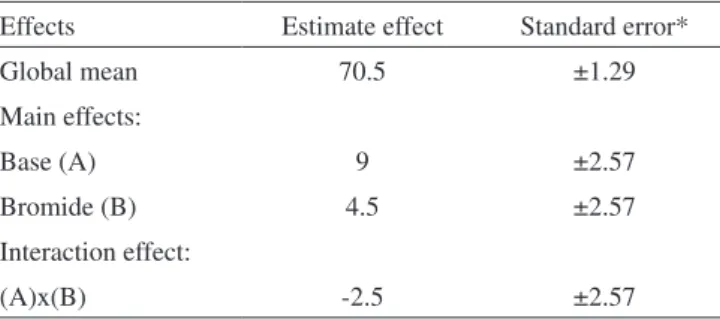
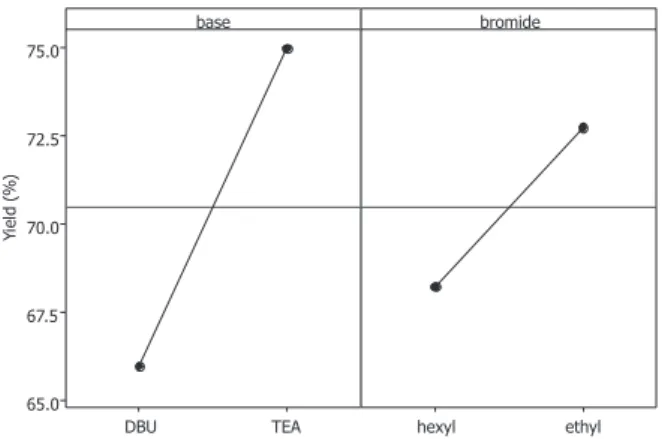
To evaluate the inluence of the base used and alkyl chain length of bromide in reaction, a 22 factorial design was performed, as shown in Table 1. Yields determinations were made in dupli-cate to estimate the standard deviation. Analyzing the results of standard errors and 95% of conidence interval, only the effect of changing the base was considered signiicant (Table 2 and Figure 3). It was not found signiicant effects of alkyl chain length and its interaction with base (Figure 4 and 5). Therefore, the type of base can be optimized individually.
Figure 2. Synthesis of POA esters 3a and 3b
Figure 3. Pareto chart of standardized effects of factorial design with 95% conidence level
Table 2. Calculated effects and its standard errors for 22 factorial design
Effects Estimate effect Standard error*
Global mean 70.5 ±1.29
Main effects:
Base (A) 9 ±2.57
Bromide (B) 4.5 ±2.57
Interaction effect:
(A)x(B) -2.5 ±2.57
* standard-error of effects was calculated using standard deviations presented in Table 1. Conidence intervals at the 95% level were calculated multiplying the standard-errors by t4,0.05 = 2.776.
Table 1. Average yields for the 22 factorial design
Base Alkyl bromide Average yield
(%)
Standard deviation
DBU (-) hexyl (-) 62.5 ±3.54
TEA (+) hexyl (-) 74.0 ±2.83
DBU (-) ethyl (+) 69.5 ±4.95
Fernandes et al.
2466 Quim. Nova
The used base for carboxylate generation varies, and can be highli-ghted as the most used in literature TEA, DBU, pyridine and carbonates.11 In this work, TEA was evaluated as more appropriate, because the easi-ness of excess elimination by distillation, and the higher yields obtained. Results of factorial design revealed that use of DBU provided lower yields to TEA (4.5-11.5% lower), observed by the positive effect value when base is changed from DBU to TEA (Table 2). Also, TEA presents advantages in puriication step, considering that it possess lower boiling point than DBU, its excess can easily be evaporated under vacuum, and its formed TEA-hydrobromide is as hydrosoluble as DBU-hydrobromide. According to Ono et al.,14 DBU presents the advantage to form more soluble hydrogen-bonded complexes with organic acids than complexes formed with TEA in apolar solvents like benzene. As POA has higher solubility in polar solvents, it was opted to use acetonitril for reactions, and therefore, this property is not advantageous.
Some authors had argued the importance of DBU in the prepara-tion of esters,14,15 obtaining higher yields with this base in comparison with other usual bases. It was proposed that DBU acts like a catalyst in some reactions,15,16 including esteriication. In the reactions proposed in this work, this characteristic was not observed. Merker and Scott17 showed that esteriication reactions with alkyl halides and TEA take long time reaction and need high temperature (ca. 150 °C), probably by the hydrogen-bonded complex solubility in benzene.14 It was observed that the reactivity of these bases is different in acetonitril.
The inluence of alkyl chain length of bromide was not evaluated as important to synthesis yield. It is an interesting fact, because it is possible maximize the yield of a series of primary alkyl esters. Howe-Figure 4. Main effects chart for type of base and alkyl chain length of bromide
Figure 5. Interaction effect chart between base used and bromide
ver, the inluence of secondary or tertiary bromides should be further evaluated. It is known that primary halides react generally through SN2 mechanism, and tertiary halides through SN1. The mechanism is inluenced by various factors, as type of solvent used (as protic or aprotic solvents) in these reactions, mainly with secondary halides.11 CONCLUSION
It was possible to conclude that nucleophilic substitution of alkyl halides to carboxylic acids is an important alternative to synthesize POA esters that possess antimycobacterial activity. This study re-vealed that the choice of the used base in this method is important mainly in carboxylate formation and in puriication step, but also, the change of DBU as base to TEA showed positive inluence in yield.
Results obtained in this study can be used in the future to ma-ximize the yield of POA esters using TEA as base. The inluence of alkyl chain length of bromide was not an important factor. Further studies should be made to evaluate the inluence of other factors, such secondary and tertiary halides, temperature and solvent used. ACKNOWLEDGEMENTS
Authors are grateful to Conselho Nacional de Desenvolvimento Cientíico e Tecnológico (CNPq) for the fellowship to J. P. S. Fer-(CNPq) for the fellowship to J. P. S. Fer-nandes, and to Prof. M. A. R. Silva by the English review.
REFERENCES
1. http://www.who.int/tb/en, accessed in May 2009.
2. Silva, M.; Ferreira, E. I.; Rev. Bras. Ciênc. Farm.1999, 35, 17. 3. Kushner, S.; Dalalian, H.; Sanjurjo, J. L.; Bach, F. L.; Sair, S. R.; Smith,
V. K.; Williams, J. H.; J. Am. Chem. Soc.1952, 74, 3617.
4. Lemke, T. L. In Foye’s Principles of Medicinal Chemistry; Williams, D. A.; Lemke, T. L., eds.; 5th ed., Lippincott Williams & Wilkins:
Philadel-phia, 2002, ch. 37.
5. Zimhony, O.; Cox, J. S.; Welch, J. T.; Vilcheze, C.; Jacobs, W. R. Jr.;
Nat. Med.2000, 6, 1043.
6. Cynamon, M. H.; Klemens, S. P.; J. Med. Chem.1992, 35, 1212; Cy-namon, M. H.; Gimi, R.; Gyenes, F.; Sharpe, C. A.; Bergmann, K. E.; Han, H. J.; Gregor, L. B.; Rapolu, R.; Luciano, G.; Welch, J. T.; J. Med.
Chem.1995, 38, 3902.
7. Konno, L.; Feldmann, F. M.; McDermott, W.; Am. Res. Respir. Dis.
1967, 95, 461.
8. Heifets, L. B.; Flory, M. A.; Lindholm-Levy, P. J.; Antimicrob. Agents
Chemoter.1989, 33, 1252.
9. Seitz, L. E.; Suling, W. J.; Reynolds, R. C.; J. Med. Chem.2002, 45, 5604.
10. Cynamon, M. H.; Welch, J. T.; US pat 5,643,912 1997.
11. March, J.; Advanced Organic Chemistry: Reactions, Mechanisms and
Structure, John Wiley & Sons: New York, 1992.
12. Barros Neto, B.; Scarminio, I. S.; Bruns, R. E.; Como Fazer
Experimentos, Editora da Unicamp: Campinas, 2001.
13. Minitab Incorporation; Minitab 15 statistical software; Version 15.1.30.0, State College, USA, 2004.
14. Ono, N.; Yamada, T.; Saito, T.; Tanaka, K.; Kaji, A.; Bull. Chem. Soc. Jpn.1978, 51, 2401.