Rev Paul Pediatr 2011;29(3):348-51.
Original Article
Association between oxygenation and ventilation index with the time
on mechanical ventilation in pediatric intensive care patients
Relação entre índice de oxigenação e ventilação com o tempo em ventilação mecânica de pacientes em terapia intensiva pediátrica
Relación entre índice de oxigenación y ventilación con el tiempo de ventilación mecánica de pacientes en unidad de terapia intensiva pediátrica
Daniela Ruy C. Barros1, Celize Cruz B. Almeida2, Armando Augusto A. Júnior3, Rosângela Alves Grande4,
Maria Ângela G. O. Ribeiro5, José Dirceu Ribeiro6
Instituição: Universidade Estadual de Campinas (Unicamp), Campinas, SP, Brasil
1Mestranda em Saúde da Criança e do Adolescente pela Faculdade de
Ciências Médicas da Unicamp, Campinas, SP, Brasil
2Doutora em Saúde da Criança e do Adolescente pela Faculdade de
Ciências Médicas da Unicamp; Fisioterapeuta do Hospital de Clínicas da Unicamp, Campinas, SP, Brasil
3Mestre em Pediatria pela Faculdade de Ciências Médicas da Unicamp;
Médico da Unidade de Terapia Intensiva Pediátrica do Hospital de Clínicas da Faculdade de Ciências Médicas da Unicamp, Campinas, SP, Brasil
4Mestranda em Saúde da Criança e do Adolescente pela Faculdade de
Ciências Médicas da Unicamp; Fisioterapeuta do Hospital de Clínicas da Unicamp, Campinas, SP, Brasil
5Doutora em Saúde da Criança e do Adolescente pela Faculdade de
Ciên-cias Médicas da Unicamp; Coordenadora do Departamento de Pediatria da Faculdade de Ciências Médicas da Unicamp, Campinas, SP, Brasil
ABSTRACT
Objective: To correlate the oxygenation index (OI) and the ventilation index (VI) with the time of invasive mechani-cal ventilation (IMV) in pediatric patients.
Methods: This prospective and observational study en-rolled patients from 28 days to 14 years of age, admitted in the Pediatric Intensive Care Unit of a university hospital. The values of age, weight, pH, partial pressure of oxygen (PaO2), partial pressure of carbon dioxide (PaCO2), OI and VI were measured from day one to the day ive and they were correlated with the time on IMV. The total time on mechani-cal ventilation was divided into: <7 days and ≥7 days.
Results: 28 patients were studied. The time spenton IMV showed a signiicant negative correlation with the pH on the fourth day and with the PaO2 on the ifth day. The time on IMV showed a positive correlation with the OI on the third and fourth days and with the VI on the third, fourth and ifth days. There were signiicant differences in the age and pH on the fourth and ifth days and in the VI from the second to ifth days between the group that remained less than seven days and those that remained seven days or more on IMV.
Conclusions: VI, OI, pH and PaO2 measured during the irst ive days of IMV were associated with prolonged IMV, relecting the severity of the initial ventilatory disturb.
Key-words: respiration, artiicial; pediatrics; intensive care.
RESUMO
Objetivo: Correlacionar o índice de oxigenação (IO) e o de ventilação (IV) com o tempo de ventilação mecânica invasiva (VMI) em pacientes pediátricos.
Métodos: Estudo prospectivo, observacional, com pa-cientes de 28 dias de vida a 14 anos de idade, internados na Unidade de Terapia Intensiva Pediátrica de um hospital universitário. Correlacionaram-se valores de idade, peso, pH, pressão parcial de oxigênio (PaO2), pressão parcial de gás carbônico (PaCO2), IO e IV, nos primeiros cinco dias em VMI, com o tempo em que o paciente permaneceu em VMI. O tempo total de ventilação mecânica foi dividido em <7 dias e ≥7 dias.
Resultados: Foram estudados 28 pacientes. Houve cor-relação negativa signiicante do tempo de VMI com o pH
6Doutor pelo Departamento de Pediatria da Faculdade de Ciências Médicas
da Unicamp; Professor do Departamento de Pediatria da Faculdade de Ciências Médicas da Unicamp, Campinas, SP, Brasil
Endereço para correspondência: Daniela Ruy C. Barros
Avenida Raimundo Pereira de Magalhães, 1.720, bloco 18, apto. 136 CEP 05145-000 – São Paulo/SP
E-mail: [email protected]
Conflito de interesse: nada a declarar
349 Rev Paul Pediatr 2011;29(3):348-51.
Daniela Ruy C. Barros et al
no quarto dia e com a PaO2 no quinto dia. Houve correlação positiva com o IO no terceiro e quarto dias e com o IV no terceiro, quarto e quinto dias. Houve diferença na idade e pH no quarto e quinto dias e IV do segundo ao quinto dias entre o grupo que permaneceu menos de sete dias e o que permaneceu sete dias ou mais em VMI.
Conclusões: IO, IV, pH e PaO2, medidos precocemente, associaram-se com VMI prolongada, reletindo a gravidade do distúrbio ventilatório inicial.
Palavras-chave: respiração articial; pediatria; cuidados intensivos.
RESUMEN
Objetivo: Correlacionar el índice de oxigenación (IO) y el de ventilación (IV) con el tiempo de ventilación mecánica invasiva (VMI) en pacientes pediátricos.
Métodos: Estudio prospectivo, observacional, con va-riables de pacientes de 28 días de vida a 14 años de edad, internados en la Unidad de Terapia Intensiva Pediátrica de un Hospital Universitario. Se correlacionaron valores de edad, peso, pH, PaO2, PaCo2, IO e IV los primeros 5 días en VMI, con el tiempo que en que el paciente permaneció en VMI. El tiempo total de ventilación mecánica fue dividido en <7 días y ≥7 días de VMI.
Resultados: Se estudiaron 28 pacientes. Hubo correla-ción negativa significante del tiempo de VMI con el pH el cuarto día, PaO2 el quinto día y correlación positiva con el IO el tercero y cuarto días e IV el tercero, cuarto y quinto días. Hubo diferencia en la edad y pH el cuarto y quinto días e IV del segundo al quinto días entre el grupo que permaneció menos de 7 días y el grupo que permaneció 7 días o más en VMI.
Conclusiones: El IO, IV, pH y PaO2 medidos tempra-namente fueron asociados con VMI prolongada, reflejando la gravedad del disturbio ventilatorio inicial.
Palabras clave: ventilación mecánica/monitoración; pediatría; cuidados intensivos.
Introduction
Invasive mechanical ventilation (MV) of pediatric patients in intensive care units is a routine procedure, but may lead to several complications that increase morbidity and mor-tality in cases of severe diseases(1). Moreover, long periods
receiving MV increase the incidence of complications, such as nosocomial infections, upper airway trauma and stress, as well as costs(2). Therefore, the time during which a patient receives MV should be shortened, and spontaneous ventila-tion should be resumed as soon as possible(1).
The evaluation of factors associated with time receiv-ing MV may generate important data to optimize the care provided to these patients(3). Oxygenation and ventilation indices (OI and VI) are currently used to evaluate MV duration and/or the severity of ventilation disorders(3-8) in pediatric patients, as well as to evaluate therapeutic interventions(9-13).
This study evaluated the correlation between OI, VI and other ventilation and blood gas variables with MV duration in children in a Pediatric Intensive Care Unit (PICU).
Method
This prospective longitudinal study was conducted in the PICU of Hospital de Clínicas of Universidade de Campinas
(Unicamp) from June 1 to October 20, 2006. This study was approved by the Ethics in Research Committee of the School of Medicine of Unicamp.
All patients aged 28 days to 14 years who required MV for at least 24 hours were included in the study. Patients were excluded if they were MV-dependent before the study, became dependent after hospitalization, or died during data collection.
Data were collected during 5 MV days: blood gases, pH, partial oxygen pressure (PaO2), partial carbon dioxide pressure (PaCO2), HCO3, oxygen saturation (SatO2) and MV parameters - fraction of inspired oxygen (FiO2), peak inspiratory pressure (PIP), positive end-expiratory pressure (PEEP), respiratory rate (RR) and inspiratory time.
The VI was calculated as: PaCO2 x PIP x mechanical RR divided by 1,000. The OI was calculated as: mean airway pressure x FiO2 x 100 divided by PaO2. OI and VI were calculated daily in the irst MV days; when blood gases were measured more than once a day, the highest FiO2, mechanical RR, mean airway pressure and PaCO2 and the lowest PaO2 were selected to calculate the indices.
350
Rev Paul Pediatr 2011;29(3):348-51. Association between oxygenation and ventilation index with the time on mechanical ventilation in pediatric intensive care patients
Table 1 - Patient distribution according to indications for invasive mechanical ventilation
MV indications n (%)
Restrictive and/or obstructive lung disorder, or in upper or lower airways 24 (86%)
Cardiovascular disorders 2 (7%)
Cardiac surgery postoperative care 2 (7%)
Table 2 - Correlation between monitoring lung function variables and mechanical ventilation duration
OI: oxygenation index; VI: ventilation index; *p<0.05
Spearman correlation coeficient (rs)
pH 4th day -0.61*
PaO2 5th day -0.60*
OI 3rd day 0.52*
OI 5th day 0.65*
VI 3rd day 0.45*
VI 4th day 0.47*
VI 5th day 0.52*
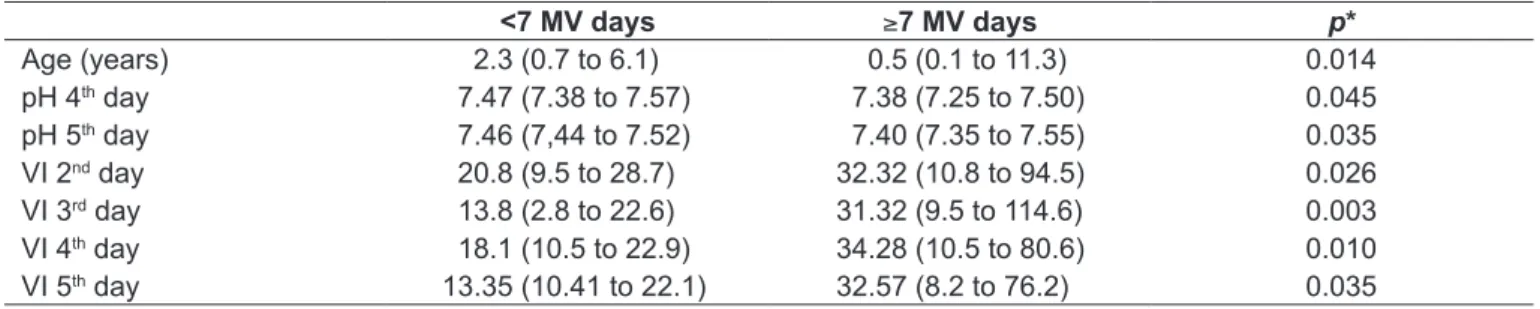
Table 3 - Monitoring lung function variables expressed as median (minimum and maximum) according to mechanical ventilation duration
* Mann-Whitney test; VI: ventilation index.
<7 MV days ≥7 MV days p*
Age (years) 2.3 (0.7 to 6.1) 0.5 (0.1 to 11.3) 0.014
pH 4th day 7.47 (7.38 to 7.57) 7.38 (7.25 to 7.50) 0.045
pH 5th day 7.46 (7,44 to 7.52) 7.40 (7.35 to 7.55) 0.035
VI 2nd day 20.8 (9.5 to 28.7) 32.32 (10.8 to 94.5) 0.026
VI 3rd day 13.8 (2.8 to 22.6) 31.32 (9.5 to 114.6) 0.003
VI 4th day 18.1 (10.5 to 22.9) 34.28 (10.5 to 80.6) 0.010
VI 5th day 13.35 (10.41 to 22.1) 32.57 (8.2 to 76.2) 0.035
ventilation has been deined as ventilatory support for more than seven days.
The SPSS for Windows 7.5.1 (SPSS Inc, Chicago, IL) was used to prepare the database and conduct the statistical analyses. The association between two continuous variables was analyzed using the Spearman correlation coeficient (rs). To analyze statistically signiicant differences between the two groups, less than 7 MV days and greater than or equal to seven MV days, the nonparametric Mann-Whitney test was used. The level of statistical signiicance was set at
p<0.05.
Results
During the study, 34 patients were admitted to the PICU and received MV. Of these patients, six were excluded due to the following factors: two received MV for less than 24 hours; three died; and one was transferred to another PICU before extubation. Therefore, 28 patients were included in the study: 12 (43%) were boys; median age was 0.9 years (0.1 to 11.4 years); and median time receiving MV was 9.1 days (2.7 to 58.7 days).
The patients were distributed according to MV indica-tions (Table 1). Table 2 shows the variables that correlated with MV duration and reveals that the OI had a positive correlation with MV duration on the third and ifth days and with VI on the third, fourth and ifth MV days.
The classiication into two groups, less than 7 MV days or greater than/equal to seven MV days, revealed that seven patients (25%) received MV for less than seven days, and 21, for seven or more days. Table 3 describes the variables that were statistically different between the two groups and shows that VI was higher from the second day on in the group of patients that received MV for more than seven days, which relects the greater severity of their conditions.
Discussion
351 Rev Paul Pediatr 2011;29(3):348-51.
Daniela Ruy C. Barros et al
References
1. Farias JA, Frutos F, Esteban A, Flores JC, Retta A, Baltodano A et al. What is the daily practice of mechanical ventilation in pediatric intensive care units? A multicenter study. Intensive Care Med 2004;30:918-25.
2. Torres A, Gatell JM, Aznar E, el-Ebiary M, Puig de la Bellacasa J, Gonzalez J et al. Re-intubation increases the risk of nosocomial pneumonia in patients needing mechanical ventilation. Am J Respir Crit Care Med 1995;152: 137-41.
3. Almeida-Júnior AA, da Silva MT, Almeida CC, Jacomo AD, Nery BM, Ribeiro JD. Association between ventilation index and time on mechanical ventilation in infants with acute viral bronchiolits. J Pediatr (Rio J) 2005;81:466-70. 4. Khan N, Brown AR, Venkataraman ST. Predictors of extubation success
and failure in mechanically ventilated infants and children. Crit Care Med 1996;24:1568-79.
5. Paret G, Ziv T, Barzilai A, Ben-Abraham R, Vardi A, Manisterski Y et al. Ventilation index and outcome in children with acute respiratory distress syndrome. Pediatr Pulmonol 1998;26:125-8.
6. Peters MJ, Tasker RC, Kiff KM, Yates R, Hatch DJ. Acute hypoxemic respiratory failure in children: case mix and the utility of respiratory severity indices. Intensive Care Med 1998;24:699-705.
7. Trachsel D, McCrindle BW, Nakagawa S, Bohn D. Oxygenation index predicts
outcome in children with acute hypoxemic respiratory failure. Am J Respir Crit Care Med 2005;172:206-11.
8. Venkataraman ST, Khan N, Brown A. Validation of predictors of extubation success and failure in mechanically ventilated infants and children. Crit Care Med 2000;28:2991-6.
9. Aggarwal R, Downe L. Use of high frequency ventilation as a rescue measure in premature babies with severe respiratory failure. Indian Pediatr 2000;37:522-6.
10. Goldman AP, Tasker RC, Hosiasson S, Henrichsen T, Macrae DJ. Early response to inhaled nitric oxide and its relationship to outcome in children with severe hypoxemic respiratory failure. Chest 1997;112:752-8.
11. Relvas MS, Silver PC, Sagy M. Prone positioning of pediatric patients with ARDS results in improvement in oxygenation if maintained > 12 h daily. Chest 2003;124:269-74.
12. Wessel DL, Adatia I, Van Marter LJ, Thompson JE, Kane JW, Stark AR et al. Improved oxygenation in a randomized trial of inhaled nitric oxide for persistent pulmonary hypertension of the newborn. Pediatrics 1997;100:E7.
13. Yapicioğlu H, Yildizdaş D, Bayram I, Sertdemir Y, Yilmaz HL. The use of surfactant in children with acute respiratory distress syndrome: efficacy in terms of oxygenation, ventilation and mortality. Pulm Pharmacol Ther 2003;16:327-33.
between survivors and non-survivors of acute respiratory failure, but their data were collected only on the irst and second MV days. In contrast, Paret et al, who calculated the VI on the irst 10 MV days in children with acute respira-tory distress syndrome (ARDS), found signiicantly higher values for non-survivors on the third, ifth, sixth, ninth and 10th MV days than for survivors. In the study conducted by Almeida et al, the pH and VI variables were associated with time receiving MV, and their results were similar to the ones found in our study. However, those authors conducted their study with infants that had acute viral bronchiolitis, and the association between the VI and time receiving MV was seen as early as on the second day. Trachsel et al analyzed the OI in a group of children with acute respiratory failure and reported that the same index was signiicantly predic-tive of prolonged MV when collected from the second MV day on.
The younger the age, the greater the lung immaturity, the smaller the number of alveoli and the more predominant the type-1 muscle ibers, which results in greater propensity to fatigue and the need for longer recovery times. This may explain why this study found a lower median age in the group that received prolonged MV when the patients were classiied according to MV duration.
The pH values on the fourth and ifth days showed a sta-tistically signiicant decrease in the group or patients with MV for 7 or more days. However, median pH on these days in the group that received MV for less than 7 days showed
alkalemia, which suggested that ventilatory support was excessive and that the ventilation parameters should have been reviewed.
The VI was statistically different between the two groups on the second to the ifth days, and was a good marker of the need for MV for more than seven days when its values were elevated. To evaluate whether the VI is a good predictor of prolonged MV in infants and children, further controlled studies should be conducted.
The OI on the third and ifth days had a positive correla-tion with MV time, but PaO2 on the 5th day had a negative correlation with MV duration. However, when patients were classiied into two groups according to MV duration, there were no statistically signiicant differences in these values. The reduced number of patients included in the study may explain this fact and be considered a limitation of this study, as the patients could not be grouped according to age, which would provide a more detailed evaluation of their condition.