Development of low birth weight preterm infants during the irst two
years of life
Desenvolvimento de prematuros com baixo peso ao nascer nos primeiros dois anos de vida
Desarrollo de prematuros con bajo peso al nacer en los primeros 2 años de vida
Cristiane Alves da Silva1, Sheila Brusamarello1, Fernanda Guimarães C. Cardoso2, Natasha Freixiela Adamczyk3, Francisco Rosa Neto4
Instituição: Laboratório de Desenvolvimento Humano do Centro de Ciên-cias da Saúde e do Esporte da Universidade do Estado de Santa Catarina (Udesc), Florianópolis, SC, Brasil
1Mestre em Ciências do Movimento Humano pela Udesc; Fisioterapeuta Colaboradora do Laboratório de Desenvolvimento Humano do Centro de Ciências da Saúde e do Esporte da Udesc, Florianópolis, SC, Brasil 2Mestranda em Ciências do Movimento Humano pela Udesc; Fisioterapeuta Colaboradora do Laboratório de Desenvolvimento Humano do Centro de Ciências da Saúde e do Esporte da Udesc, Florianópolis, SC, Brasil 3Acadêmica do Curso de Fisioterapia da Udesc; Colaboradora do Labo-ratório de Desenvolvimento Humano do Centro de Ciências da Saúde e do Esporte da Udesc, Florianópolis, SC, Brasil
4Doutor em Medicina da Educação Física e do Esporte pela Universidade de Zaragoza; Professor do Programa de Mestrado e Doutorado da Udesc, Florianópolis, SC, Brasil
ABSTRACT
Objective: To analyze and describe the neuropsychomo-tor development of low birth weight preterm infants in the irst two years of life.
Methods: This cross-sectional study enrolled preterm in-fants between 4 and 24 months old at the follow up clinic of Universidade Federal de Santa Catarina, Florianópolis, Brazil. The children were assessed in three moments: 8, 11 and 14 months (chronological age). The sample, initially composed by 69 individuals, was chosen intentionally according to the inclusion and exclusion criteria. The Brunet and Lèzine’s Scale was used to evaluate development in the following areas: hand-eye coordination, language, posture and sociability. Data were analyzed using descriptive and inferential statistics.
Results: The average gestational age was 31 weeks and the birth weight, 1236g. The global development quotient improved from the irst to the last assessment, reaching 85% of scores within the normal range in the third assessment. The speciic areas of hand-eye coordination and language had the worst initial results, while posture had the best scores. Correla-tion was found between birth weight and posture, language and social areas at the irst assessment and between birth weight and social and hand-eye coordination at the third assessment.
Conclusion: Deicits of neuromotor development of the studied population were more evident in the irst months
of life. Although the follow-up did not show statistic dif-ferences between the irst and last assessment, there was an improvement in all areas of development.
Key-words: child development; infant, premature; in-fant, low birth weight.
RESUMO
Objetivo: Analisar e descrever o desenvolvimento neu-ropsicomotor de prematuros com baixo peso ao nascer nos dois primeiros anos de vida.
Métodos: Estudo transversal realizado com prematuros entre quatro e 24 meses, no Ambulatório de Alto Risco Neonatal do Hospital Universitário da Universidade Federal de Santa Catarina, avaliados em três momentos: 8, 11 e 14 meses de idade cronológica. A amostra, composta inicial-mente por 69 indivíduos, teve caráter intencional, segundo os critérios de inclusão e exclusão estabelecidos. A Escala de Brunet e Lèzine foi usada para avaliar o desenvolvimento nas seguintes áreas: coordenação óculo-motriz, linguagem, postura e sociabilidade. Os dados foram analisados por meio de estatística descritiva e inferencial.
Resultados: A idade gestacional média foi de 31 se-manas e o peso ao nascer foi de 1236g. O quociente de desenvolvimento global apresentou melhora da primeira
Endereço para correspondência: Cristiane Alves da Silva
Rua Edelberto de Oliveira, 19 − Jardim Atlântico CEP 88117-040 – Florianópolis/SC
E-mail: [email protected]
Conflito de interesse: nada a declarar
Cristiane Alves da Silva et al
para a última avaliação, alcançando 85% de escores dentro da normalidade na terceira avaliação. As áreas especíicas da coordenação óculo-motriz e da linguagem tiveram os piores resultados iniciais, contrapondo-se à postural, que apresentou os melhores escores. Foi encontrada correlação entre o peso ao nascer e as áreas da postura, linguagem e sociabilidade na primeira avaliação e sociabilidade e coordenação óculo-motriz na terceira avaliação.
Conclusões: O desenvolvimento neuropsicomotor desta população apresentou déicits mais evidentes nos primeiros meses de vida. Embora o seguimento não tenha mostrado diferenças estatísticas entre a primeira e a última avaliação, houve melhora em todas as áreas do desenvolvimento.
Palavras-chave: desenvolvimento infantil; prematuro; recém-nascido de baixo peso.
RESUMEN
Objetivo: Analizar y describir el desarrollo neuropsicomo-tor de prematuros con bajo peso al nacer en los dos primeros años de vida del niño.
Métodos: Este estudio transversal fue realizado con prematuros entre 4 y 24 meses en el Ambulatorio de Alto Riesgo Neonatal del Hospital Universitario/UFSC, evaluados en 3 momentos. La muestra, compuesta inicialmente por 69 individuos, tuvo carácter intencional según los criterios de inclusión y exclusión establecidos. La Escala de Brunet y Lèzine fue usada para evaluar el desarrollo en las siguien-tes áreas: Coordinación óculo-motriz, Lenguaje, Postura y Sociabilidad. Los datos fueron analizados mediante
esta-dística descriptiva e inferencial utilizando el software SPSS
13.0.
Resultados: La edad gestacional mediana encontrada fue de 31 semanas, ya el peso mediano al nacer fue de 1236g. El cociente de desarrollo global presentó mejora de la primera para la última evaluación, alcanzando 85% de escores dentro de la Normalidad en la 3ª evaluación. Las áreas específicas de la coordinación óculo-motriz y del lenguaje tuvieron los peores resultados iniciales, contraponiéndose a la postural, que presentó los mejores escores. Se encontró correlación en-tre el peso al nacimiento y las áreas de la postura, lenguaje y sociabilidad en la 1ª evaluación y sociabilidad y coordinación óculo-motriz en la 3ª evaluación.
Conclusiones: El desarrollo neuropsicomotor de esta población presentó déficits más evidentes en los primeros meses de vida. Aunque el seguimiento no haya mostrado
diferencias estadísticas entre la primera y la última evalua-ción, hubo mejora en todas las áreas del desarrollo.
Palabras clave: Desarrollo infantil; prematuro; recién nacido de bajo peso.
Introduction
As a result of advances in the care provided to preterm and low birth weight newborn infants, the survival rates of these children, who are high-risk from a biological point of view, have increased signiicantly(1). However, the direct and indirect
repercussions associated with these conditions can cause harm
that compromises these children’s future development(2).
The motor abilities acquired during the irst year of life are appropriate milestones to indicate prognosis for global development, since the irst 12 months after birth are considered one of the most critical periods in child development(3). It is during this phase that children, and
particularly children such as preterms and low birth weight infants who are at increased risk of developing deiciencies, should be monitored in appropriate follow-up programs that assess their development longitudinally(4) in order to
detect signs of abnormalities, with a view to referring them for intervention programs aimed at minimizing the effects of these abnormalities.
Many different studies have shown that low birth weight children are more likely to develop neurological problems(5-11),
ranging from mild cognitive, behavioral or learning dificulties(5,9,10) through to cerebral palsy(5,6,8). Other factors
predisposing to these dysfunctions are prematurity(6-9) and
a low ratio of weight/gestational age (small for gestational age - SGA)(12).
It is concern with the impact that low birth weight and prematurity have on global development that motivated this study. The study objectives were to analyze and describe the neuropsychomotor development of low birth weight preterms during their irst 2 years of life.
Methods
This was a descriptive, cross-sectional ield study, with
data collected from each patient at three different times(13).
The study was approved by the Human Research Ethics
Committee at the Universidade do Estado de Santa Catarina.
“Neuropsychomotor Assessment of Preterm Infants” run by the High Risk Neonatology Clinic at the pediatrics
department of the Universidade Federal de Santa Catarina’s
University Hospital between August of 2006 and July of 2007. The entire population comprised 118 children seen over the period and the sample of 69 was selected intention-ally (failures to attend appointments meant that this igure had reduced to 53 by the second evaluation and to 39 by the third). Inclusion criteria were as follows: premature birth; authorization from parents or guardians for children to take part in the study; child registered with the high risk neonatal clinic; gestational age <37 weeks according to the Ballard method; birth weight <2,500g; and postnatal age of 4 to 24 months (the age by which children had been assessed three times) between August 2006 and July 2007, since this is considered the ideal age range for the instrument employed. Exclusion criteria were as follows: diagnosis of sensory dis-orders (sight or hearing), malformations, and severe diseases such as central nervous system infections, prior diagnosis of cerebral palsy (based on signiicant tonus abnormality), severe heart disease and genetic syndromes.
Children were assessed individually on the same days that they had appointments for their three-monthly medi-cal consultations at the clinic. Children who did not attend their appointments could not be assessed three times and the sample size was reduced as a result. Each participant underwent a neuropsychomotor development assessment conducted by the clinic’s physiotherapist using the Psycho-motor Development Scale for Early Infancy, created by
Bru-net and Lèzine(14). If any developmental abnormalities were
detected, the child’s carers were given instructions on how to stimulate speciic areas and the children were prescribed stimulation therapy, but were not excluded from the study (only three of the children in the sample had physiotherapy while follow-up was ongoing).
The Psychomotor Development Scale for Early Infancy, comprises a kit including the testing instruments them-selves and a questionnaire to be administered to parents or guardians. The scale is designed to assess the development of children aged 1 to 30 months in the following areas: Eye-hand and ine-motor coordination (E), Language (L), Posture and gross motor function (P) and Social reactions (S), in addition to Global development (G). This scale has been validated internationally and was shown to have criterion validity of 0.68 (concurrent validity with the Stanford-Binet, Terman-Merril, Cattel, Charlotte Bühler and Arnold Gesell scales) and reliability of 0.85 (correlation coeficient for
test-retest)(14). The original scale developed by Brunet and Lèzine
was translated into Portuguese in 1981(14), but has not been
validated or adapted for the Brazilian population.
Developmental quotients (DQ) were calculated for each development area and participants’ motor development was classiied for each area as Very High (>130), High (129 to 120), High Normal (119 to 110), Mid Normal (109 to 90), Low Normal (89 to 80), Low (79 to 70) or Very Low (<70)(15).
The following biopsychosocial data relating to the children were also investigated: identiication details; anthropometry and histories of intercurrent conditions during prenatal (eclampsia, infection, diabetes or arterial hypertension in the mother), perinatal (asphyxia, meconium aspiration and oligohydramnios, among others) and postnatal or neonatal periods (respiratory diseases, infections and ventricular hemorrhages). Data were collected from patients’ medical records and supplemented with information provided by parents to complete a standardized chart.
Chronological ages were corrected to 40 weeks’ gestation
by manual calculation(16).Data were analyzed using
descrip-tive and inferential statistics, with Pearson’s correlation and
the paired t test, using SPSS 13.0 software.
Results
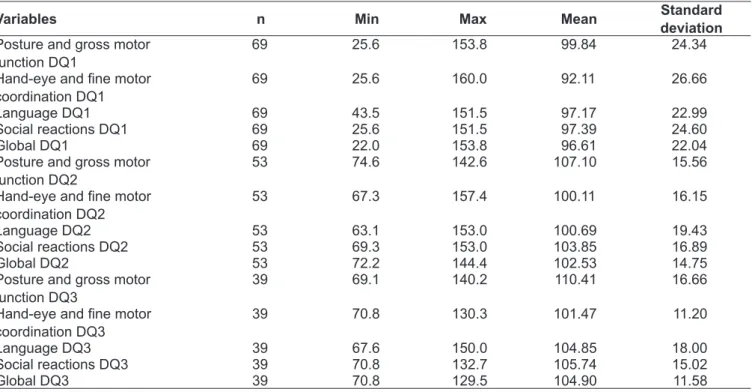
The irst neuropsychomotor development assessment investigated 69 children who met the inclusion criteria, which corresponded to 58% of the total population. Fifty-eight percent of these 69 children were male and 42% were female. Mean gestational age was 31 weeks, with extremes of 24 weeks and 36 weeks and 6 days, while 74% were born before 32 weeks’ gestation. Mean birth weight was
1236±372g, varying from 515 to 2215g. Mean length at
birth was 37.5±3.6cm and mean head circumference was
26.8±2.8cm, varying from 20 to 34cm.
Cristiane Alves da Silva et al
Table 2 - Values minimum, maximum, mean and standard deviation for Developmental Quotients (DQ) for all three assessments
Variables n Min Max Mean Standard
deviation
Posture and gross motor function DQ1
69 25.6 153.8 99.84 24.34
Hand-eye and ine motor
coordination DQ1
69 25.6 160.0 92.11 26.66
Language DQ1 69 43.5 151.5 97.17 22.99
Social reactions DQ1 69 25.6 151.5 97.39 24.60
Global DQ1 69 22.0 153.8 96.61 22.04
Posture and gross motor function DQ2
53 74.6 142.6 107.10 15.56
Hand-eye and ine motor
coordination DQ2
53 67.3 157.4 100.11 16.15
Language DQ2 53 63.1 153.0 100.69 19.43
Social reactions DQ2 53 69.3 153.0 103.85 16.89
Global DQ2 53 72.2 144.4 102.53 14.75
Posture and gross motor function DQ3
39 69.1 140.2 110.41 16.66
Hand-eye and ine motor
coordination DQ3
39 70.8 130.3 101.47 11.20
Language DQ3 39 67.6 150.0 104.85 18.00
Social reactions DQ3 39 70.8 132.7 105.74 15.02
Global DQ3 39 70.8 129.5 104.90 11.58
Table 1 - Minimum and maximum values, means and standard deviations for Developmental Ages (DA) for all three assessments
Variables n Min Max Mean Standard
deviation
Posture and gross motor function DA1
69 1.0 18.0 6.26 3.28
Hand-eye and ine motor
coordination DA1
69 0.0 14.4 5.90 3.15
Language DA1 69 2.0 18.0 6.05 3.14
Social reactions DA1 69 1.0 16.5 6.17 3.44
Global DA1 69 0.9 15.3 6.10 3.17
Posture and gross motor function DA2
53 5.0 21.0 9.77 3.14
Hand-eye and ine motor
coordination DA2
53 4.7 16.0 8.97 2.27
Language DA2 53 4.0 20.0 9.18 3.26
Social reactions DA2 53 4.3 18.0 9.44 2.90
Global DA2 53 4.9 18.9 9.28 2.69
Posture and gross motor functionDA3
39 8.3 21.0 13.55 3.53
Hand-eye and ine motor
coordination DA3
39 8.5 19.0 12.34 2.39
Language DA3 39 9.0 21.0 12.79 3.13
Social reactions DA3 39 8.5 19.5 12.91 2.94
Global DA3 39 8.5 19.8 12.81 2.75
In terms of weight, 75% of the infants were appropri-ate for their gestational ages while 25% were small for gestational age. Mean chronological age (CA) at the initial assessment (n=69) was 8 months with extremes of 4 and 20 months. Mean corrected chronological age (CCA) was 6 months, varying from 3 to 18 months.
Figure 1 - Graph of DQs for each development area, according to development classii cation at the i rst assessment. DQP: deve-lopmental quotient for posture and gross motor function; DQE: devedeve-lopmental quotient for hand-eye and i ne motor coordination; DQL: developmental quotient for language; DQS: developmental quotient for social reactions; DQG: global developmental quotient; LN: low normal
First Assessment
Hight or very hight Normal DQP
(%)
DQE DQL DQS DQG
At-Risk zone Low or very low 70
60
50
40
30
20 10
0
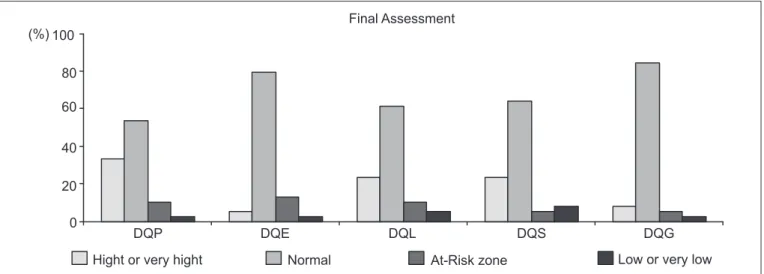
Figure 2 - Graph of DQs for each development area, according to development classii cation at the i nal assessment. DQP: deve-lopmental quotient for posture and gross motor function; DQE: devedeve-lopmental quotient for hand-eye and i ne motor coordination; DQL: developmental quotient for language; DQS: developmental quotient for social reactions; DQG: global developmental quotient; LN: low normal
(%) 100
80
60
40
20
0
Final Assessment
DQP DQE DQL DQS DQG
Hight or very hight Normal At-Risk zone Low or very low
developmental ages for all areas were below the sample’s mean CCA at the i rst assessment, indicating a negative developmental age in all areas.
At the second assessment (n=53) mean chronological age was 11 months, varying from 7 to 23 months. After correc-tion, mean CCA was 9 months, varying from 5 to 21 months. Mean developmental age was higher than mean CCA, for the majority of areas, with the exception of hand-eye coordination, which had an age that was negative by 0.2 months.
The third assessments (n=39) were conducted an average of 6 months after study outset, with mean CA of 14 months
and a range of 10 to 21 months. Mean CCA was 12 months; minimum was 9 months and maximum was 18 months. Table 1 shows that none of the (mean) developmental ages were negative at the third assessment and that all develop-mental ages were greater than mean CCA.
Cristiane Alves da Silva et al
third assessment, just 5% classii ed in the At-Risk Zone and a single case (3%) with a Low developmental quotient (Figures 1 and 2)
At the i rst assessment, Hand-eye and i ne motor coordi-nation was the specii c developmental area with the highest number of cases classed as Low or Very Low (25%) and in the At-Risk Zone (11%), with 36% below Mid-Normal. Thirty-six percent of cases had a Language DQ below Mid-Normal, with 19% in the At-Risk Zone and 17% Low or Very Low (Figure 1). Posture and gross motor function had the best quotients, with 79% of cases classii ed as Mid-Normal or higher. There was a signii cant improvement in Hand-eye and i ne motor coordination by the third assessment (Figure 2), with just 3% of cases classed as Low or Very Low.
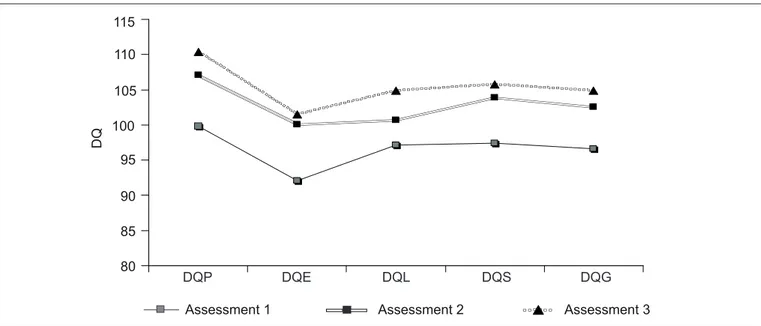
Figure 3 illustrates the mean developmental quotients for each developmental area as neuropsychomotor follow-up progressed. Note the linearity of the results, demonstrating that neuropsychomotor follow-up of infants born low weight did not lead to detectable signii cant differences, although there was a discrete improvement in all areas from the i rst to the third assessment.
When Pearson’s linear correlation was used to correlate
developmental quotients for each area by pairs (i rst vs
second assessments and i rst vs third assessments), it was found that differences between the majority of pairs were statistically signii cant, with the exception being Hand-eye
and i ne motor coordination (p=0.177) between i rst and
third assessments.
When the means for each specii c area were compared by pairs using the paired t test, there were no statistical differ-ences at a 95% coni dence level.
When birth weight was correlated with neuropsychomo-tor developmental quotients at the i rst assessment using Pearson’s linear correlation, statistical signii cance was detected for the relationships between weight and posture
and gross motor function (p=0.035), Language (p=0.022)
and Social reactions (p=0.009). When the correlations
be-tween birth weight and neuropsychomotor developmental quotients were tested for the third assessment, however,
only Social reactions (p=0.034) and Hand-eye and i ne motor
coordination (p=0.0340) were signii cant.
Discussion
Children with low birth weight often exhibit a different pat-tern of motor development during their i rst year of life to the pattern expected of children born at full term(4). The high rate
of prenatal, perinatal and neonatal complications and conditions in this study was because 74% of the sample was made up of preterms born at less than 32 weeks. According to Neubauer, Voss and Kattner(6), neonatal complications are signii cant risk
factors for compromised development at school age.
It is very often necessary to use mechanical ventilation to
treat these complications, as was observed here. Castellanos(17)
found that 27% of a group of low weight neonates who had been on mechanical ventilation had normal neuromotor
Figure 3 - Graphical representation of mean DQs over neuropsychomotor follow-up period. DQP: developmental quotient for posture and gross motor function; DQE: developmental quotient for hand-eye and i ne motor coordination; DQL: developmental quotient for language; DQS: developmental quotient for social reactions; DQG: global developmental quotient; LN: low normal
D
Q
115
110
105
100
95
90
85
80
Assessment 1 Assessment 2 Assessment 3
development results at 2 years of life, with 54% suffering mild developmental disorders and 19% with severe prob-lems. Just 2% of a control group that had not been venti-lated, but which was also recruited from low birth weight neonates had severe neurological development disorders.
Also as a result of the high rate of prenatal and perinatal intercurrent conditions, the most common type of delivery in the sample was caesarean (65%). Data for 2005 from the
Brazilian live births register (SINASC - Sistema de Informações
de Nascidos Vivos) show that there were a greater proportion of low birth weight babies in the city of Rio de Janeiro among
mothers who had had caesareans(18).
Although 73% of the mothers had received prenatal care, half of them had only attended 5 or 6 consultations. Data on Brazil from the SINASC database show that a smaller percentages of mothers who attended seven or more prenatal
consultations give birth to low birth weight infants(18).
Mean birth weight was 1236g, with a range of 515 to
2215g. Halpern et al(19) showed that children born with low
birth weight (<2500g) have a three times greater risk of devel-opmental delays, in comparison with those born heavier than 2500g (p<0.001). In a 2008 study, Halpern et al(20) concluded
that the prevalence of suspected cases of delay reduces as in-come and birth weight increase. In that study suspected delay was more prevalent among the children of poorer families, but the association with birth weight was stronger. Birth weight was also strongly associated with childhood developmental
problems in a study conducted by Wilcox(21).
At the initial assessment, mean Chronological Age (CA) and Corrected Chronological Age (CCA) were 8 and 6 months respectively. At the second assessment, mean CA was 11 months and mean CCA was 9.17 months, while at the third assessment mean CA and CCA were 14 and 12 months respectively. On the basis that the Brunet and Lèzine scale assesses global and spe-ciic motor development by age, the children’s developmental quotients (DQ) were classiied according to their CCA.
The prevalence of cases in which global DQ was Low Normal (16%) and Low or Very Low (15%) at the irst assess-ment is in line with results reported by other studies(11,20,21),
which conirm that neuropsychomotor development is slower in children with low birth weight.
In addition to investigating low birth weight, the chil-dren were also classiied for appropriateness of weight to gestational age, with 75% of patients being appropriate for gestational age (AGA) and 25% SGA. Many articles have linked low birth weight with intrauterine growth restriction and increased risk of mortality and of cognitive
dysfunctions(22) and also with increased neurological
mor-bidity, even including permanent brain damage, such as
cerebral palsy and mental retardation(16), through subtle
forms of delayed development(12). With regard to speciic
areas of development, Language was cited as one area that
is affected in preterm and low birth weight children(11,23).
Motor delays were also detected (including both posture and
Hand-eye and ine motor coordination)(4,11). Sociobehavioral
problems were observed in low birth weight preterms in a meta-analysis by Bhutta et al(9).
There was a visible improvement in the global devel-opment quotient between irst and last assessments. The percentage of normal cases rose from 58% at the irst sessment, to 70% at the second and 85% at the third as-sessment, while cases in the At-Risk and Low or Very Low zones respectively reduced from 16 and 14%, through 11% and 7%, to 5% and 3%, from the irst to the second to the third assessments, respectively. This improvement was not suficient to provide evidence of signiicant differences within this sample. A larger patient sample would possibly have conirmed the differences statistically.
Drillien’s classic study(24) found that 40% of 281 patients
with birth weight <2000g had neuromotor abnormalities during the irst months of life and that these abnormalities were transitory, calling this group of neurological symptoms “transient dystonia associated with low birth weight”.
Ped-ersen, Sommerfelt and Markestad(4), citing several different
studies, state that transient dystonia is most often detected between 3 and 5 months of age, with a subsequent reduc-tion in motor abnormalities from 8 months on, with normal levels achieved at 12 to 18 months. A similar pattern was also observed in the study described here, since improvement was observed in global development and in all of the speciic areas of development.
Hand-eye and ine motor coordination, which includes functional integration of object-eye-hand(25), was the area
with the greatest percentage of delayed development at the irst assessment (11% of cases were in the At-Risk zone and 24% in Low or Very Low), but it was also the area that exhib-ited greatest improvement in development as the systematic follow-up continued. The deicits observed here at these ages should be taken as a warning that stimulation is necessary from a very tender age, since these deicits could negatively impact on the child’s future academic performance.
Cristiane Alves da Silva et al
References
1. Carvalho AE, Linhares MB, Martinez FE. Developmental history and behavior
of pre-term and low birth-weight children. Psicol Refl Crit 2001;14:1-33. 2. Santos RS, Araújo AP, Porto MA. Early diagnosis of abnormal development of
preterm newborns: assessment instruments. J Pediatr (Rio J) 2008;84:289-99. 3. Mancini MC, Paixão ML, Gontijo AB, Ferreira AA. Perfil do desenvolvimento
neuromotor do bebê de alto risco no primeiro ano de vida. Temas Desenv
1992;8:3-8.
4. Pedersen SJ, Sommerfelt K, Markestad T. Early motor development of premature infants with birthweight less than 2000 grams. Acta Paediatr 2000;89:1456-61.
5. De Vries NK, Erwich JJ, Bos AF. General movements in the first fourteen days of life in extremely low birth weight (ELBW) infants. Early Hum Dev 2008;84:763-8.
6. Neubauer AP, Voss W, Kattner E. Outcome of extremely low birth weight survivors at school age: the influence of perinatal parameters on neurodevelopment. Eur J Pediatr 2008;167:87-95.
7. Gortner L, van Husen M, Thyen U, Gembruch U, Friedrich HJ, Landmann E. Outcome in preterm small for gestational age infants compared to appropriate for gestational age preterms at the age of 2 years: a prospective study. Eur J Obstet Gynecol Reprod Biol 2003;110 (Suppl 1):S93-7.
8. Vohr BR, Wright LL, Dusick AM, Mele L, Verter J, Steichen JJ et al.
Neurodevelopmental and functional outcomes of extremely low birth weight
infants in the National Institute of Child Health and Human Development
Neonatal Research Network, 1993–1994. Pediatrics 2000;105:1216-26. 9. Bhutta AT, Cleves MA, Casey PH, Cradock MM, Anand KJ. Cognitive and
behavioral outcomes of school-aged children who were born preterm: a meta-analysis. JAMA 2002;288:728-37.
10. Taylor HG, Klein N, Hack M. School-age consequences of birth weight less than 750 g: a review and update. Dev Neuropsychol 2000;17:289-321. 11. Eickmann SH, Lira PI, Lima MC. Mental and motor development at 24 months
of full-term low birthweight infants. Arq Neuropsiquiatr 2002;60:748-54. 12. Strauss RS. Adult functional outcome of those born small for gestational age:
twenty-six-year follow-up of the 1970 British Birth Cohort. JAMA 2000;283:625-32.
13. Cervo AL, Bervian PA, editors. Metodologia científica. 4th ed. São Paulo: Makron Books; 1996.
14. Brunet O, Lézine I. Desenvolvimento psicológico da primeira infância. Porto Alegre: Artes Médicas; 1981.
15. Souza JM. Avaliação do desenvolvimento neuropsicomotor de crianças de 6 a 24 meses de creches municipais de Florianópolis/SC [tese de mestrado]. Florianópolis (SC): UDESC; 2003.
16. Restiffe AP. O desenvolvimento motor dos recém-nascidos pré-termos nos primeiros seis meses de idade corrigida segundo Alberta Infant Motor Scale: um estudo de coorte [tese de mestrado]. São Paulo (SP): FMUSP; 2004. 17. Castellanos GR, Tellachea YR, Dieppa FD, Molina MC, Rodríguez SR, Millián
JD. Neurodesarrollo en recién nacidos ventilados con menos de 1500 gramos. Rev Cubana Pediatr 2000;72:267-74.
18. Andrade CL, Szwarcwald CL, Castilho EA. Low birth weight in Brazil according
to live birth data from the Ministry of Health, 2005. Cad Saude Publica
2008;24:2564-72.
19. Halpern R, Barros FC, Horta BL, Victora CG. Developmental status at 12 months of age in a cohort of children in southern Brazil: differences according birthweight and family income. Cad Saude Publica 1996;12 (Suppl 1):73-8. 20. Halpern R, Barros AJ, Matijasevich A, Santos IS, Victora CG, Barros FC.
Developmental status at age 12 months according to birth weight and family income: a comparison of two Brazilian birth cohorts. Cad Saude Publica 2008;24 (Suppl 3):S444-50.
21. Wilcox AJ. On the importance – and the unimportance – of birthweight. Int J Epidemiol 2001;30:1233-41.
22. Kok JH, den Ouden AL, Verloove-Vanhorick SP, Brand R. Outcome of very preterm small for gestational age infants: the first nine years of life. Br J Obstet Gynaecol 1998;105:162-8.
23. Isotani SM, Azevedo MF, Chiari BM, Perissinoto J. Expressive language of two year-old pre-term and full-term children. Pro Fono 2009;21:155-9. 24. Drillien CM. Abnormal neurologic signs in the first year of life in low-birthweight
infants: possible prognostic significance. Dev Med Child Neurol 1972;14:575-84. 25. Rosa Neto F. Manual de avaliação motora. Porto Alegre: Artmed; 2002.
26. Ferreira AT, Silva MM, Silva L, Merighi LB, Miranda AM, De-Vitto LP et al.
Acquisition and development language in premature triplets. Rev CEFAC 2008;10:15-21.
27. Lamônica DA, Picolini MM. Development abilities in preterm. Rev CEFAC 2009;11 (Suppl 2):145-53.
28. Lamônica DA. Linguagem na paralisia cerebral. In: Ferreira LP, Befi-Lopes DM, Limongi SC, editors. Tratado de fonoaudiologia. São Paulo: Roca; 2004.
p. 967-76.
delayed academic development is greater among children with low birth weight than among those with normal birth weight, which relects cognitive limitations caused by prematurity(26).
Language was the second-most affected area, which is
in line with other studies of similar populations(27-29).
Lan-guage development involves many different processes and progress is dependent on interactions involving biological,
social and psychological factors(27). One condition that can
cause language problems is motor limitations caused by
dificulties exploring and interacting with surroundings(30).
Motor development can therefore have a negative impact on language development.
Certain trends and correlations could not be investigated in this study because of the small number of participants, caused by the study design that imposed many restrictions on recruitment. Furthermore, the large losses from the sample,
which reached 43% by the last assessment, also made data analysis more dificult.