Comparison of two analgesia protocols for the treatment of
pediatric orthopedic emergencies
ANDREA BARCELOS1, PEDRO CELINY RAMOS GARCIA2*, JANETE L. PORTELA3, JEFFERSON P. PIVA4, JOÃO PEDRO TEDESCO GARCIA5,
JOÃO CARLOS B. SANTANA6
1MSc in Pediatrics, Pontifícia Universidade Católica do Rio Grande do Sul (PUCRS). Emergency Room Pediatrician at the Hospital Universitário de Santa Maria, RS, Brazil
2PhD in Medicine/Pediatrics, Universidade de São Paulo (USP). Titular Professor of the Medical School Pediatrics at PUCRS. Head of the Pediatrics Service and Intensive Care and Emergency Service at
Hospital São Lucas, PUCRS, Porto Alegre, RS, Brazil
3MSc in Child Health, PUCRS. Emergency Room Nurse at Hospital Universitário de Santa Maria, RS, Brazil.
4PhD in Medicine/Pediatrics, Head of the Intensive Care and Emergency Service at Hospital de Clínicas, Universidade Federal do Rio Grande do Sul (UFRGS), Porto Alegre, RS, Brazil 53rd Year Resident Physician in the Otorhinolaryngology Service and Head and Neck Surgery at Hospital São Lucas, PUCRS, Porto Alegre, Brazil
6PhD in Medicine/Pediatrics, UFRGS. Professor of the Medical School Pediatrics Department, UFRGS. Pediatrician of the Pediatrics Ward at Hospital São Lucas, PUCRS, Porto Alegre, RS, Brazil
S
UMMARYStudy conducted at Pontifícia Universidade Católica do Rio Grande do Sul, Porto Alegre, RS, Brazil
Article received: 6/24/2014
Accepted for publication: 6/25/2014
*Correspondence:
Address: Rua Curupaiti, 62 Porto Alegre, RS – Brazil Postal code: 90820-090 [email protected]
http://dx.doi.org/10.1590/1806-9282.61.04.362
Financial support: Pedro Celiny Ramos Garcia holds a productivity scholarship in 1D Research from the CNPQ
Objectives: to compare the efficacy of two analgesia protocols (ketamine versus
morphine) associated with midazolam for the reduction of dislocations or closed fractures in children.
Methods: randomized clinical trial comparing morphine (0.1mg/kg; max 5mg) and ketamine (2.0mg/kg, max 70mg) associated with midazolam (0.2mg/kg; max 10mg) in the reduction of dislocations or closed fractures in children treat-ed at the ptreat-ediatrics emergency room (October 2010 and September 2011). The groups were compared in terms of the times to perform the procedures, analge-sia, parent satisfaction and orthopedic team.
Results: 13 patients were allocated to ketamine and 12 to morphine, without differences in relation to age, weight, gender, type of injury, and pain scale be-fore the intervention. There was no failure in any of the groups, no differences in time to start the intervention and overall procedure time. The average hospi-tal stay time was similar (ketamine = 10.8+5.1h versus morphine = 12.3+4.4hs;
p=0.447). The median pain (faces pain scale) scores after the procedure was 2 in both groups. Amnesia was noted in 92.3% (ketamine) and 83.3% (morphine) (p=0.904). Parents said they were very satisfied in relation to the analgesic inter-vention (84.6% in the ketamine group and 66.6% in the morphine group; p=0.296). The satisfaction of the orthopedist regarding the intervention was 92.3% in the ketamine group and 75% in the morphine group (p=0.222).
Conclusion: by producing results similar to morphine, ketamine can be con-sidered as an excellent option in pain management and helps in the reduction of dislocations and closed fractures in pediatric emergency rooms.
Keywords: fractures, bones, clinical protocols, pediatrics, analgesia.
I
NTRODUCTIONTraumatic injuries in childhood, especially dislocations and fractures are one of the main reasons for services in pediatric emergency units (PEU). Several studies have dem-onstrated that analgesia and sedation for reducing dislo-cations or closed fractures are conducted in an improper manner in pediatric emergency services. The ideal drug for sedation and analgesia used in these procedures should have a fast onset, be safe and easy to administer, in addi-tion to causing amnesia and muscle relaxaaddi-tion. 1-8
In pediatric emergency services, analgesia and seda-tion for the reducseda-tion of fractures and dislocaseda-tions is of-ten the responsibility of the emergency pediatrician. There are a wide variety of painkillers and sedatives to provide fa-vorable conditions for carrying out the procedure safely. For this purpose, the pediatrician should know the main pharmacological characteristics, expected actions, adverse effects and, if necessary, how to antagonize them.7-13
by the orthopedic physician. To induce sedation, all pa-tients received intravenous midazolam (0.2 mg/kg up to a maximum dose of 10 mg) without additional dos-es. According to the draw performed by the nurse, one group received morphine 0.1 mg/kg intravenously, fol-lowed by increments of 0.05 mg/kg (at the physician’s discretion) up to a maximum dose of 5mg. The other group received ketamine 2 mg/kg intravenously up to a
maximum dose of 70 mg, without additional doses.16
All patients were monitored according to the sedation and analgesia routines, including measurements of vi-tal signs at the beginning, every 5 minutes and at the end of the procedure.
The SEP-HUSM nurse was responsible for the mon-itoring and follow-up of each patient during the proce-dure, recording adverse events. The faces pain scale was used to classify pain.6 To assess parental and orthopedist
satisfaction after the procedure, the authors used the 5 point Likert scale (1: very pleased to 5: very dissatisfied).7
Assessments
For comparison between both analgesia groups, the out-comes considered were time to start the intervention, du-ration of the procedure, the total time of the procedure, the child’s cooperation, parental satisfaction and the sat-isfaction of the surgeon responsible for procedure. The groups were also compared in relation to the occurrence of adverse events related to the medication.
The time to start the intervention was defined as the time in minutes between the administration of drugs until the orthopedic physician considered that there was suitable sedation/analgesia. The duration of the proce-dure was established as the time in minutes from the be-ginning of the procedure until the splint or plaster was placed. The total time (intervention and procedure) was defined as the time in minutes between the administra-tion of the drugs and the end of the placement of the splint or plaster. The procedure was considered success-ful if the patient did not need further reduction in the operating room. In the case of multiple reduction at-tempts only, the first attempt was included in the study. Demographic data, medication doses, fasting time, time for the start of the intervention, procedure duration and duration of hospitalization were recorded. Before se-dation and analgesia, and after the reduction procedure, the patient was assessed by the nurse using the faces pain scale. At the end of the procedure, a Likert scale was ap-plied to assess parental and orthopedist satisfaction in relation to the procedure. Before discharge, the child was questioned as to whether they remembered the procedure There is evidence demonstrating safer treatment regimens
than the combination of benzodiazepines and an opiate. Ketamine is a potent dissociative analgesic which in usu-al doses does not cause respiratory depression or hemo-dynamic instability. Due to its efficacy and limited ad-verse effects, it has become the drug of choice for many pediatric procedures. However, there are few well-designed, controlled and randomized clinical trials that have test-ed ketamine specifically in orthoptest-edic emergencies.1,2,4-19
This study aims to compare the efficacy of two
anal-gesia protocols (ketamine versus morphine) associated
with midazolam for the reduction of dislocations or closed fractures in children treated at a reference pediatric emer-gency unit (PEU).
M
ETHODSThe authors conducted a randomized clinical study com-paring two analgesia protocols in orthopedic emergen-cies in the pediatric emergency service of Hospital Uni-versitário de Santa Maria (SEP-HUSM). The HUSM is a public general hospital linked to the Universidade Feder-al de Santa Maria (UFSM), Brazil. It is the largest public hospital in the state of Rio Grande do Sul, with 311 beds, and it is a regional reference center for 46 municipalities. At the SEP-HUSM about 1,140 children aged from birth to 14 years are treated.
Between October 2010 and September 2011, all pa-tients admitted between Monday and Friday at the SEP-HUSM, aged 3 years to 14 years, with dislocation or closed fracture that required orthopedic reduction maneuvers were included in the study. The study excluded patients with: (a) class III or higher of the American Society of An-esthesiologists (ASA III or above) (b) fractures for more than 24 hours (c) allergies or (d) contraindication to any medication used in the study and (e) parent or guardians who did not consent to participate in the study.
Protocol
Patients were selected consecutively and allocated ran-domly to receive analgesia with ketamine or morphine associated with midazolam. Randomization was conduct-ed in blocks of ten (each manila envelope containconduct-ed 5 pa-pers from the ketamine group and 5 from the morphine group). Immediately after admission, the nurse respon-sible performed the draw, informed the pediatrician on duty of the results and prepared the medications accord-ing to the predefined doses.
by answering yes or no.The recommended criteria for hospital discharge were stable and satisfactory cardiovas-cular function, patent airways and ease in waking up the patient, able to talk and sit unaided and with protective reflexes intact. The study was approved by the Research Ethics Committee at the UFSM (CAAE - 0225.0.243.000-10), requiring parents or guardians to sign an informed consent form after being suitably informed in order to participate in the study.
Statistical analysis
The categorical variables were expressed as percentages and compared using the chi-square test or Fisher’s exact test. Continuous variables with normal distribution, were expressed using the mean with standard deviation, and compared using the Student’s t-test. Variables without a normal distribution were expressed as a median with the respective interquartile range (IQ 25%-75%) and compared using the Mann-Whitney U test. The data were transcribed into an Excel spreadsheet for Windows (Microsoft Office) and analyzed using SPSS software version 16.0.
R
ESULTSDuring the study period, 79 patients attended the SEP--HUSM due to an osteoarticular injury. Among these, 54 (68%) did not present criteria for inclusion in the sample (three under the age of three years, 18 required surgical treatment, 10 had open fractures and 23 were treated on weekends). 25 patients with a closed fracture or disloca-tion remained, who required intravenous sedadisloca-tion and analgesia to perform a closed reduction, with 13 patients allocated to ketamine and 12 to the morphine group. There were no differences between the groups with
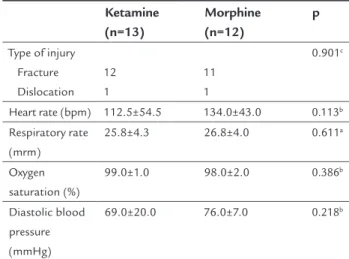
re-spect to age, weight, gender, fasting time, type of injury, vital signs on arrival to the emergency and pain scale be-fore the intervention (Table 1).
TABLE 1 General characteristics and vital signs of the two analgesia groups before the start of orthopedic reduction procedures.
Ketamine (n=13)
Morphine (n=12)
p
Age (months) Median
90.7±34.1 95.9 (52.6-125.9)
102.1±48.5 105.5 (57.0-141.7)
0.501a
Weight (kg) Median
27.5±13.6 25.0 (17.0-31.5)
30.4±14.3 28.0 (17.7-33.8)
0.461b
Male N (%) 11 (57.9) 8 (42.1) 0.294c
Fasting time (hours)
6 (5.0-7.5) 6 (4.0-7.6) 0.696b
(Continue)
TABLE 1 (Cont.) General characteristics and vital signs of the two analgesia groups before the start of orthopedic reduction procedures.
Ketamine (n=13)
Morphine (n=12)
p
Type of injury Fracture Dislocation
12 1
11 1
0.901c
Heart rate (bpm) 112.5±54.5 134.0±43.0 0.113b
Respiratory rate (mrm)
25.8±4.3 26.8±4.0 0.611a
Oxygen saturation (%)
99.0±1.0 98.0±2.0 0.386b
Diastolic blood pressure (mmHg)
69.0±20.0 76.0±7.0 0.218b
The averages are expressed with the respective standard deviation (DP), while the medians are accompanied by the respective ranges (minimum and maximum value) and absolute values (N) accompanied by the percentage (%).
a Continuous variables with normal distribution compared using Student’s t-test. b Continuous variables without normal distribution compared using Mann-Whitney U test. c Categorical variables compared using chi-square or Fisher exact tests.
Both protocols were shown to be effective, with no treat-ment failures in either group. The authors did not ob-serve significant differences in the time to begin the in-tervention, or in the total procedure time between the two groups (Table 2). However, the duration of the inter-vention was significantly lower in the morphine group in relation to the ketamine group (median of 3 versus 5
min-utes; p<0.027).
TABLE 2 Comparison between analgesia groups in
relation to the time to start the intervention, procedure duration and total time (intervention and procedure).
Ketamine (n=13)
Morphine (n=12)
p
Time to start intervention (min.) 3 (1.5-5.0) 2.5 (2.0-5.0) 0.867b
Procedure duration time (min.) 5 (4.0-15.0) 3 (1.0-5.0) 0.027b
Total time – intervention and procedure (min.)
10 (6.0-18.5) 6 (3.2-9.5) 0.063b
b Medians and respective ranges (minimum and maximum value) compared using
Mann-Whitney U test.
Based on Table 3, it is clear that the average time of hos-pitalization was similar between the two groups (ketamine = 10.8±5.2 hours versus morphine = 12.3±4.4 hours; p=0.447).
proce-dure in both types of analgesia (ketamine = 92.3% versus
morphine = 83.3%; p=0.904).
Adverse effects related to use of the drugs were simi-lar in both groups. No patient suffered apnea, simi- laryngo-spasm, tachycardia, or hypotension, neither was the use of antagonists (flumazenil or naloxone) required.
TABLE 3 Comparison between the two groups of
analgesia in relation to pain scale, satisfaction of parents and orthopedist, amnesia in relation to the procedure, adverse reactions to the analgesic and hospital stay.
Ketamine (n=13)
Morphine (n=12)
p
Hospitalization time (hours) 10.8±5.2 12.3±4.4 0.447a
Pain scale (after procedure) 2 (0.0-4.0) 2 (0.0-6.0) 0.909b
Pain delta (after procedure) 4 (0.0-6.0) 4 (-1.5-6.0) 0.868b
Amnesia of the procedure (yes) %
12 (92.3) 10 (83.3) 0.904c
Vomiting (yes) % 1 (7.7) 3 (25.0) 0.238c
Agitation/hallucination (yes) % 2 (15.4) 4 (33.3) 0.294c
Fall in oxygen saturation (yes) %
1 (7.7) 3 (25.0) 0.238c
Parental satisfaction (very satisfied) %
11 (84.6) 8 (66.6) 0.296c
Orthopedist satisfaction (very satisfied) %
12 (92.3) 9 (75) 0.222c
Key to tables: The measurements are expressed with the respective standard deviation ( SD) while the medians are present with their respective ranges (minimum and maximum value) and absolute values (N) accompanied by the percentage (%).
a Continuous variables with normal distribution compared using Student’s t-test. b Continuous variables without normal distribution compared using Mann-Whitney U test. c Categorical variables compared using chi-square or Fisher exact tests.
Parents said they were very satisfied in relation to the an-algesic intervention in 84.6% of patients that used ket-amine, and in 66.6% that used morphine (p=0.296). In the same manner, the maximum satisfaction of the or-thopedist regarding the intervention was 92.3% in the ketamine group and 75% in the morphine group (p=0.222).
D
ISCUSSIONSedoanalgesia is an essential procedure for closed ortho-pedic reduction at PEUs. The present study demonstrat-ed that analgesia with ketamine for closdemonstrat-ed rdemonstrat-eduction of fractures and dislocations showed similar clinical results to those obtained with morphine. Both parents and or-thopedic teams expressed satisfaction with both medica-tions. Therefore, by adopting morphine by default in this type of procedure, it may be concluded that ketamine had the same degree of effectiveness, alongside its known safe-ty and low incidence of side effects.
Sedation and analgesia in PEUs should be directed according to the effectiveness, safety and cost, and should be performed by physicians experienced in airway man-agement and treatment of cardio-respiratory complica-tions, familiar with the pharmacodynamics and phar-macokinetics of the drugs used.1,8,9,17,19-21 Sedation and
analgesia in these situations should be performed in a service that has support from nursing staff for the mon-itoring of vital signs and continuous clinical observa-tion of the patient, in addiobserva-tion to appropriate equipment for airway management and cardiopulmonary resusci-tation, especially heart monitors and/or continuous pulse oximetry.8,22,23
In this study, both analgesia protocols had favorable outcomes, notably in terms of pain control, start time of the intervention by the orthopedist, the total procedure time, success in reducing the fracture and the occurrence of amnesia, in agreement with other studies.1,2,4-7,12-17,23,24
The procedure duration time in the morphine group was slightly lower than in the ketamine group, a result also found in a similar study.9,10 The sedation and analgesia
schemes most commonly used in PEU involve the associ-ation of an opioid (morphine or fentanyl) with midazol-am or the administration of ketmidazol-amine with or without
midazolam.24-26 Morphine remains the most widely used
drug in severe and chronic pain, however, fentanyl has been employed in more time-consuming procedures due to its faster start and peak of action and more prolonged effect. Ketamine is a dissociative agent, blocking opioid receptors, which rapidly induces sedation, profound an-algesia, immobility and cataplegia, preserving spontane-ous respiration.16 Havel et al. monitored 89 children who
received two different analgesia schemes for fracture
re-duction (midazolam/morphine vs. propofol/morphine)
and found that both groups had similar efficiencies and insignificant adverse events.24 Godambe et al. analyzed
an-algesia used on 113 children undergoing orthopedic pro-cedures and found that both protocols (ketamine/mid-azolam vs. propofol/fentanyl) had similar results for the
relief of pain and anxiety, although the propofol/fentan-yl group presented a shorter procedure time.2
In this study, the presence of hypoxemia was an un-usual finding and there was significant difference between the groups who used ketamine or morphine. However, hypoxia is one of the adverse effects associated with the use of opioids cited most in the literature.2, 5,10 Kennedy et
al. observed that the group of patients using analgesia with
fentanyl/midazolam had more hypoxemia (25% vs. 6%;
p<0.001), requiring respiratory stimulation (12% vs. 1%;
those who received ketamine/midazolamm.5 Ketamine
administered by intravenous or intramuscular routes, even as a single drug, has been indicated as a safe and ef-fective alternative for rapid analgesia.6,10,27,28 In a
system-atic review of randomized trials of analgesia and sedation for reduction of fractures in children at a PEU, ketamine/ midazolam proved to be more effective as an analgesic and had fewer adverse effects than combinations of fen-tanyl/midazolam or propofol/midazolam.1,2,4,5,15,25
When the level of satisfaction of parents and orthope-dists were analyzed with analgesia for the orthopedic pro-cedure, it was found that levels were quite high. Satisfaction was similar regardless of analgesic used, whether morphine or ketamine, a fact also described in other studies.2,29
C
ONCLUSIONConsidering pain control, shorter start time of the inter-vention by the orthopedist, lower total procedure time, success in reduction of the fracture, the presence of am-nesia and low incidence of adverse effects, especially re-spiratory disorders, ketamine was shown to be a safe and effective analgesic for use in orthopedic emergencies. As these results were equivalent to those found in the group using morphine, a widely used analgesic, ketamine can be considered as an excellent option in pain management, and helps in the reduction of dislocations and closed frac-tures in pediatric emergency rooms.
R
ESUMOComparação de dois protocolos de analgesia para trata-mento de emergências ortopédicas pediátricas
Objetivo: comparar a eficácia de dois protocolos de
anal-gesia (cetamina versus morfina) associados ao
midazo-lam para a redução de luxações ou fraturas fechadas em crianças.
Métodos: ensaio clínico randomizado comparando mor-fina (0,1 mg/kg; máx. 5 mg) e cetamina (2,0 mg/kg; máx. 70 mg) associados a midazolam (0,2 mg/kg; máx. 10 mg) na redução de luxações ou fraturas fechadas em crianças atendidas em emergência pediátrica, no período de outu-bro de 2010 a setemoutu-bro de 2011. Os grupos foram compa-rados segundo os seguintes indicadores: tempo para reali-zar os procedimentos, analgesia, satisfação de pais e da equipe ortopédica.
Resultados: treze pacientes foram alocados para cetami-na e 12 para morficetami-na, sem diferenças em relação a idade, peso, gênero, tipo de lesão e escala da dor antes da inter-venção. Não houve falha em nenhum dos grupos, sem
di-ferenças no tempo para iniciar a intervenção e no tempo total de procedimento. O tempo médio de hospitalização foi similar (cetamina=10,8±5,1 h versus morfina=12,3±4,4
h; p=0,447). A mediana de dor (escala de faces da dor) após o procedimento foi de 2 em ambos os grupos. Amnésia foi observada em 92,3% (cetamina) e 83,3% (morfina) (p=0,904). Os pais declararam estar muito satisfeitos em relação à in-tervenção analgésica (84,6% no grupo cetamina e 66,6% no grupo morfina; p=0,296). A satisfação do ortopedista em relação à intervenção foi de 92,3% no grupo cetamina e 75% no grupo da morfina (p=0,222).
Conclusão: a cetamina, ao apresentar resultados seme-lhantes à morfina, pode ser considerada uma excelente op-ção no manejo da dor e no auxílio da reduop-ção de luxações e fraturas fechadas em salas de emergência pediátrica.
Palavras-chave: fraturas ósseas, protocolos clínicos, pe-diatria, analgesia.
R
EFERENCES1. Migita RT, Klein EJ, Garrison MM. Sedation and analgesia for pediatric fracture reduction in the emergency department: a systematic review. Arch Pediatr Adolesc Med. 2006; 160(1):46-51.
2. Godambe SA, Elliot V, Matheny D, Pershad J. Comparison of propofol/ fentanyl versus ketamine/midazolam for brief orthopedic procedural sedation in a pediatric emergency department. Pediatrics. 2003; 112(1 Pt 1):116-23. 3. Waterman GD Jr, Leder MS, Cohen DM. Adverse events in pediatric ketamine sedation with or without morphine pretreatment. Pediatr Emerg Care. 2006; 22(6):408-11.
4. Lee-Jayaram JJ, Green A, Siembieda J, Gracely EJ, Mull CC, Quintana E, et al. Ketamine/midazolam versus etomidate/fentanyl: procedural sedation for pediatric orthopedic reductions. Pediatr Emerg Care. 2010; 26(6):408-12. 5. Kennedy RM, Porter FL, Miller JP, Jaffe DM. Comparison of fentanyl/
midazolam with ketamine/midazolam for pediatric orthopedic emergencies. Pediatrics. 1998; 102(4 Pt 1):956-63.
6. Roback MG, Wathen JE, MacKenzie T, Bajaj L. A randomized, controlled trial of i.v. versus i.m. ketamine for sedation of pediatric patients receiving emergency department orthopedic procedures. Ann Emerg Med. 2006; 48(5):605-12. 7. McCarty EC, Mencio GA, Walker LA, Green NE. Ketamine sedation for the
reduction of childrens fractures in the emergency department. J Bone Joint Surg Am. 2000; 82-A(7):912-8.
8. Kennedy RM, Luhmann JD, Luhmann SJ. Emergency department management of pain and anxiety related to orthopedic fracture care: a guide to analgesic techniques and procedural sedation in children. Paediatr Drugs. 2004; 6(1):11-31.
9. Shavit I, Hershman E. Management of children undergoing painful procedures in the emergency department by non-anesthesiologists. Isr Med Assoc J. 2004; 6(6):350-5.
10. Pitetti RD, Singh S, Pierce MC. Safe and efficacious use of procedural sedation and analgesia by nonanesthesiologists in a pediatric emergency department. Arch Pediatr Adolesc Med. 2003; 157(11):1090-6.
11. Roback MG, Bajaj L, Wathen JE, Bothner J. Preprocedural fasting and adverse events in procedural sedation and analgesia in a pediatric emergency department: are they related? Ann Emerg Med. 2004; 44(5):454-9. 12. Atkinson P, Chesters A, Heinz P. Pain management and sedation for children
in the emergency department. BMJ. 2009; 339:b4234.
13. Sahyoun C, Krauss. Clinical implications of pharmacokinetics and pharmacodynamics of procedural sedation agents in children. Curr Opin Pediatr. 2012; 24(2):225-32.
15. McQueen A, Wright RO, Kido MM, Kaye E, Krauss B. Procedural sedation and analgesia outcomes in children after discharge from the emergency department: ketamine versus fentanyl/midazolam. Ann Emerg Med. 2009; 54(2):191-7. 16. Green SM, Roback MG, Kennedy RM, Krauss B. Clinical practice guideline
for emergency department ketamine dissociative sedation: 2011 update. Ann Emerg Med. 2011; 57(5):449-61.
17. Krauss B, Green SM. Sedation and analgesia for procedures in children. N Engl J Med. 2000; 342(13):938-45.
18. Melendez E, Bachur R. Serious adverse events during procedural sedation with ketamine. Pediatr Emerg Care. 2009; 25(5):325-8.
19. Green SM, Roback MG, Krauss B, Brown L, McGlone RG, Agrawal D, et al.; Emergency Department Ketamine Meta-Analysis Study Group. Predictors of emesis and recovery agitation with emergency department ketamine sedation: an individual-patient data meta-analysis of 8,282 children. Ann Emerg Med. 2009; 54(2):171-80.
20. Mace SE, Brown LA, Francis L, Godwin SA, Hahn SA, Howard PK, et al.; EMSC Panel (Writing Committee) on Critical Issues in the Sedation of Pediatric Patients in the Emergency. Clinical policy: critical issues in the sedation of pediatric patients in the emergency department. Ann Emerg Med. 2008; 51(4):378-99. 21. Krauss B, Green SM. Training and credentialing in procedural sedation and
analgesia in children: lessons from the United States model. Paediatr Anaesth. 2008; 18(1):30-5.
22. Krauss B, Green SM. Procedural sedation and analgesia in children. Lancet. 2006; 367(9512):766-80.
23. Doyle L, Colletti JE. Pediatric procedural sedation and analgesia. Pediatr Clin North Am. 2006; 53(2):279-92.
24. Havel CJ Jr, Strait RT, Hennes H. A clinical trial of propofol vs midazolam for procedural sedation in a pediatric emergency department. Acad Emerg Med. 1999; 6(10):989-97.
25. Wathen JE, Roback MG, Mackenzie T, Bothner JP. Does midazolam alter the clinical effects of intravenous ketamine sedation in children? A double-blind, randomized, controlled, emergency department trial. Ann Emerg Med. 2000; 36(6):579-88.
26. Evans D, Turnham L, Barbour K, Kobe J, Wilson L, Vandebeek C, et al. Intravenous ketamine sedation for painful oncology procedures. Paediatr Anaesth. 2005; 15(2):131-8.
27. Green SM, Krauss B. Clinical practice guideline for emergency department ketamine dissociative sedation in children. Ann Emerg Med. 2004; 44(5):460-71.
28. Taylor DM, Bell A, Holdgate A, MacBean C, Huynh T, Thom O, et al. Risk factors for sedation-related events during procedural sedation in the emergency department. Emerg Med Australas. 2011; 23(4):466-73. 29. O’Rourke D. The measurement of pain in infants, children, and adolescents: