Practices for rational use of blood components in a universitary
hospital
SYDNEY CORREIA LEÃO1*, MARIANA ARAÚJO BEZERRA GOMES2, MILA CINTRADE AZEVEDO ARAGÃO3, IZA MARIA FRAGA LOBO4
1MD – Resident Physician in Pathology – Universidade Federal de São Paulo, São Paulo, SP, Brazil 2MD – Universidade Federal de Sergipe, São Cristovão, SE, Brazil
3MD – Universidade Federal de Sergipe, São Cristovão, SE, Brazil
4MD, PhD – Risk Management, University Hospital, Universidade Federal de Sergipe, São Cristovão, SE, Brazil
SUMMARY
Study conducted at the Hospital Universitário, Universidade Federal de Sergipe, Aracaju, SE, Brazil
Article received: 9/13/2014
Accepted for publication: 9/16/2014
*Correspondence:
Address: Rua Botucatu, 740 Vila Clementino São Paulo, SP – Brazil Postal code: 04023-062 [email protected]
http://dx.doi.org/10.1590/1806-9282.61.04.355
Conflict of interest: none
Objective: to produce improvements in transfusion practices through the im-plementation of an educational program for health professionals in a universi-ty hospital.
Methods: this is an interventional and prospective study, with pre- and post-analysis of an educational intervention. The research was developed at the Uni-versity Hospital of the Universidade Federal de Sergipe, involving participation of health professionals in the stage of training, during the month of February 2011, in addition to the monitoring of blood transfusions performed in the pre- and post-intervention periods. Transfusion practices were investigated upon re-quest for transfusion or devolution of unused blood components. Knowledge of health professionals was assessed based on the responses to a questionnaire about transfusion practices.
Results: during the educative campaign, 63 professionals were trained, includ-ing 33 nurses or nursinclud-ing technicians and 30 physicians. Among the doctors, there was a statistically significant gain of 20.1% in theoretical knowledge (p=0.037). Gain in the nursing group was even higher: 30.4% (p=0.016). The comparative analysis of transfusion request forms showed a non-significant decrease from 26.7 to 19.5% (p=0.31) in all forms with incomplete information. We also observed a statistically significant improvement in relation to the filling of four items of transfusion request.
Conclusion: there was a significant improvement of the entire process related to blood transfusions after interventional project conducted in February 2011.
Keywords: erythrocyte transfusion, scientific exhibitions, platelet transfusion, comparative study.
I
NTRODUCTIONDespite the importance of blood for life being known since the times before Christ, the key step towards the realization of the first transfusion was given by William Harvey, in 1628, when he described blood circulation. Exactly 200 years had passed until the first successful blood transfusion was made in humans.1 Since then, the
therapeutic possibilities of blood and its components have been growing continually, with 75 million units of blood being collected each year worldwide, making the transfusion practice one of the most important medical acts of our days.2,3
Despite being a common and widespread practice, the use of blood products is associated with an increased
risk of infections, renal dysfunction and mortality, as al-ready demonstrated.4-7 In addition, normal hemoglobin
levels are not necessarily related to better outcomes post-operatively, and in some cases, may be advantageous to tolerate lower HB levels, avoiding unnecessary blood trans-fusions.8
The increasing complexity of therapy related to blood components, associated with increasing blood shortages and the inherent risks of its use, indicate the need for new approaches, aiming at a more rational prescription of blood products. With this objective, several protocols for use have been developed to guide the appropriate indication of blood components.10 From the launch of the Collegiate Board
Resolution (RDC) 153, in 2004, there was a standardiza-tion of procedures in relastandardiza-tion to collecstandardiza-tion, storage, trans-port and use of blood products.11 In this resolution,
guide-lines for the correct completion of transfusion requests were also established.
Knowing the indications, contraindications and com-plications of infusion of blood products is crucial for ac-curate decisions and the promotion of advantageous cost/ benefit and risk/benefit relationships. It is also essential to determine the clinical, laboratory and monitoring signs that should guide the start of blood transfusion, avoid-ing risks and waste of resources.12-14
The aim of this study was to produce improvements in transfusion practices through the implementation of an educational program for health professionals in a uni-versity hospital.
M
ETHODSStudy type, location, population and objectives
This is an interventional, analytical, comparative and pro-spective study, with pre- and post-analysis of an education-al intervention for improving transfusion practices in a public university hospital.
The study was developed at the University Hospital of the Universidade Federal de Sergipe. The hospital has about 100 medical and surgical beds, an intensive care unit with five beds, a surgical center with five rooms and a small trans-fusion agency, class IV, operating full-time and temporarily storing requests for blood components from the hospital through the blood center of the state of Sergipe (Hemose).
The work involved the participation of health profes-sionals from different categories in the stage of training and capacitation, through an educational intervention during the month of February 2011, and the monitoring of blood transfusions performed in the pre-intervention (September to November 2010), and post-intervention periods (March to August 2011). The months of December 2010 and Janu-ary 2011 were not evaluated because they were atypical due to academic recess, holidays and long weekends.
Characteristics of the study and statistical analysis
The transfusion practices and knowledge of health pro-fessionals about blood transfusions were evaluated by
comparing the differences between the proportion of cor-rect responses in a questionnaire before and after the training intervention by Fisher’s exact test, with signifi-cance level of 0.05.
Transfusion practices were assessed prospectively based on monitoring of procedures from the filling of a request form to transfusion itself and devolution of un-used blood components. The authors checked the request-ing sectors, sex, patient diagnosis, indication of the trans-fusion, and the amount and type of blood components that were ordered, received, transfused and returned.
The filling of transfusion requests was evaluated by observing the quality and compliance for all items: date of request, date of birth, diagnosis, registration, the hospital sector, bed, weight, age, hemoglobin, history of transfu-sion reaction, request type, font legibility, time of request, sex, platelet value and readability of carbon copy. Knowl-edge of health professionals, including doctors, nurses and lab technicians, was assessed based on the responses to a differentiated questionnaire for evaluation of theoretical knowledge with 10 multiple choice questions about trans-fusion practice. Physicians and residents responded about indications of blood components, management and con-duct in case of transfusion reactions; nurses and techni-cians about procedures related to installation, recognition of transfusion reactions, segregation, packaging and dis-posal of the waste generated. The evaluation was delivered to professionals for immediate response half hour before the start of training and soon after its completion.
The program was implemented in one month, through an educational campaign throughout the hospital, that led to the implementation of the following elements:
• Technical guide for blood transfusions, developed by the researchers based on guides of other institutions and available on all computers in the hospital;
• Poster indications of blood components and acute transfusion reactions printed on A3 paper size, pre-pared by the researchers and fixed in all areas of the hospital, including the surgical center;
• Risk management newsletter in a special issue entire-ly dedicated to disseminating the rational use of blood products. These newsletters were distributed to health professionals, and fixed in all areas of patient care;
dis-closed to guarantee the presence and participation of professionals.
Ethical aspects
The study was approved by the Research Ethics Commit-tee of the Universidade Federal de Sergipe, under proto-col number 0300.0.107.000-11. All health professionals who participated answered questionnaires to evaluate their specific knowledge on the use of blood and signed an informed consent form. This research was performed according to the Declaration of Helsinki, revised in 2008.
R
ESULTSComparative analysis of knowledge of health professionals
During the educative campaign, 63 health professionals, including 33 nurses and nursing technicians and 30 phy-sicians from all sectors of the hospital (28.6% of clinical areas, 25.4% of surgical areas, 20.6% of ICU, 23.8% of pe-diatrics and 1.6% of blood bank) received training.
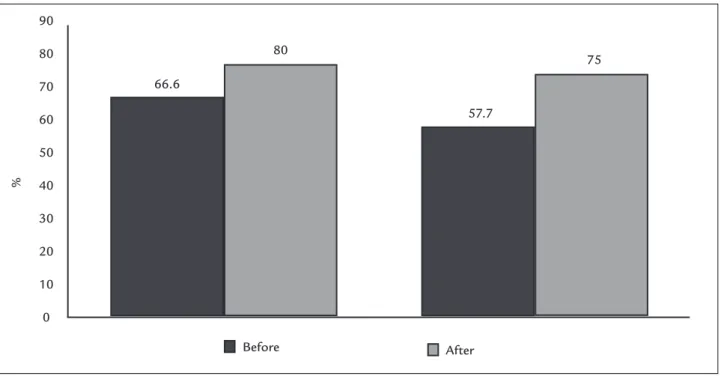
Among the doctors, there was a statistically significant gain of 20.1% on theoretical knowledge (p=0.037). The gain in the nursing group was even higher: 30.4% (p=0.016) (Fig-ure 1). In the medical group, the professionals working in the ICU had the greatest improvement in correct answers to the questionnaire. In the nursing group, pediatrics was the sector with higher gains: 26.4% (p<0.0001). The au-thors also observed statistically significant gain in the group
of doctors working in the pediatrics (13.9%; p=0.02) ser-vice and in the groups of nurses from the medical clinic (24%; p=0.0001) and the ICU (13.6%; p=0.04) (Table 1).
TABLE 1 Differences in improvement of theoretical knowledge in different sectors of the hospital, before and after training about blood transfusions. University Hospital: September/2010 to August/2011.
Hospital sectors Doctors (n=30) % of improvement (p)
Nurses (n=33) % of improvement (p)
ICU (n=13) 21.2 (p=0.001) 13.6 (p=0.04) Pediatrics (n=16) 13.92 (p=0.02) 26.4 (p<0.0001) Medical clinics
(n= 18)
7.81 (p=0.25) 24 (p=0.001)
Surgical clinics (n= 15)
10.06 (p=0.14) 5 (p=0.77)
Lab (n=1) - 5 (p=0.56)
Regarding doctors and nurses, the question with higher percentage of correct responses was that related to acute transfusion reaction (98 and 100%, respectively), on the post-intervention questionnaire. On the other hand, the questions with higher percentage of wrong responses were those related to the indication of concentrate of platelets, with only 5% of correct answers on the questionnaire after intervention for the doctors, and the question related to
FIGURE 1 Differences in percentage of correct answers in the questionnaire of theoretical knowledge among groups of professionals, before
and after training on blood transfusions.
Before 66.6
80
57.7
75
After 90
80
70
60
50
40
30
20
10
0
management of blood components, with 39% of correct re-sponses on the post-intervention questionnaire for nurses.
Comparative analysis for blood transfusions accompanied
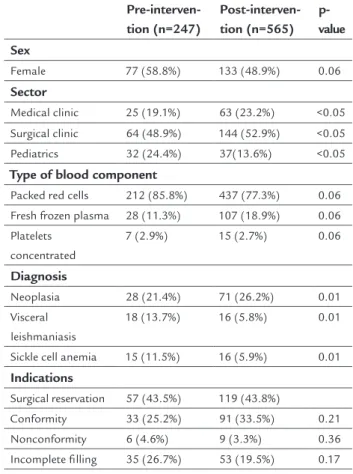
The authors compared 247 blood transfusions during the pre-intervention period, with 565 during post-inter-vention period. The surgical clinic was the sector which most prescribed blood products, both in the pre- and post-intervention periods: 48.9 and 52.9%, respectively. In medical clinic, there was a significant increase in con-sumption between the two periods, from 6.9 to 23.2% (p=0.002); while in pediatrics there was no significant re-duction from 24.4 to 13.6% (p=0.10). Among transfused patients, females prevailed in the pre-intervention peri-od, accounting for 58.8% of transfusions, falling to 48.9% in the post-intervention period (p=0.20). Comparison of types of blood components listed in both periods revealed non-significant differences: packed red cells before (85.8%) and after (76.5%) (p=0.15); fresh frozen plasma before (11.3%) and after (18.8%) (p=0.22); concentrated of plate-lets before (2.9%) and after (3.7%) (p=1.00) (Table 2).
TABLE 2 Comparative analysis of blood transfusions accompanied before and after an educational intervention. University Hospital: September/2010 to August/2011.
Pre-interven-tion (n=247)
Post-interven-tion (n=565)
p- value Sex
Female 77 (58.8%) 133 (48.9%) 0.06 Sector
Medical clinic 25 (19.1%) 63 (23.2%) <0.05
Surgical clinic 64 (48.9%) 144 (52.9%) <0.05 Pediatrics 32 (24.4%) 37(13.6%) <0.05
Type of blood component
Packed red cells 212 (85.8%) 437 (77.3%) 0.06 Fresh frozen plasma 28 (11.3%) 107 (18.9%) 0.06
Platelets concentrated
7 (2.9%) 15 (2.7%) 0.06
Diagnosis
Neoplasia 28 (21.4%) 71 (26.2%) 0.01 Visceral
leishmaniasis
18 (13.7%) 16 (5.8%) 0.01
Sickle cell anemia 15 (11.5%) 16 (5.9%) 0.01 Indications
Surgical reservation 57 (43.5%) 119 (43.8%)
Conformity 33 (25.2%) 91 (33.5%) 0.21 Nonconformity 6 (4.6%) 9 (3.3%) 0.36
Incomplete filling 35 (26.7%) 53 (19.5%) 0.17
The three most common diagnoses of patients were not significantly different when comparing the two periods: neoplasia increased from 21.4 to 26.2% (p=0.50), visceral leishmaniasis decreased from 13.7 to 5.8% (p=0.09) and sickle cell anemia from 11.5 to 5.9% (p=0.21). Regarding indications of blood products, the percentage of requests for surgical reservation remained stable: from 43.5 to 43.8% (p=1.00). There was no significant improvement in compliance indication of blood products evaluated by the hematologist of the transfusion agency after the ed-ucational campaign (which increased from 25.2 to 33.5%) (p=0.21), and a slight decrease in nonconformity, from 4.6 to 3.3% (p=0.72). The rate of return of blood products experienced a statistically nonsignificant decrease from 55.8 to 49.5% (p=0.47) (Table 2).
Comparative analysis of compliance in filling requests for transfusion
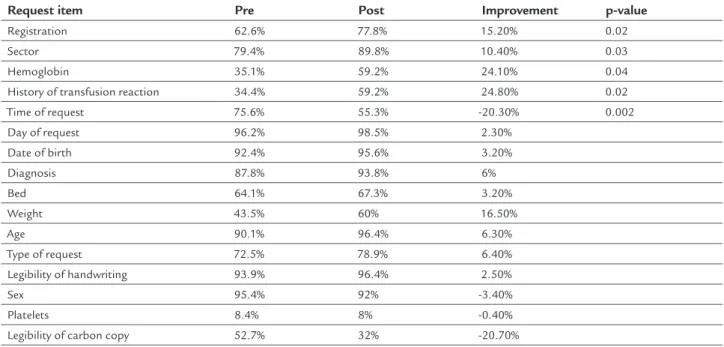
The comparative analysis of transfusion request forms from 848 blood transfusions that that have performed before and after the intervention showed a non-significant decrease from 26.7 to 19.5% (p=0.31) in all forms with incomplete fill-ing. The authors observed a statistically significant improve-ment in relation to the filling of various items of requests: registration 15.2% (p=0.02), sector 10.4% (p=0.03), hemoglo-bin 24.1% (p=0.04), history of transfusion reactions by 24.8% (p=0.02) (Figure 2). In contrast, there was a statistically sig-nificant decrease in relation to the filling of the hour of re-quest of blood (20.3%) (p=0.002). In other items, there was improvement without statistical significance (Table 3).
D
ISCUSSIONThe amount of transfused blood products has increased in recent years. In Great Britain, for example, it was ob-served a 10% increase in transfusions of fresh frozen plas-ma for a period of 15 years.15 However, the increase in
trans-fusions is not a phenomenon without side effects. Multiple organ failure after injury, transmission of bacterial, viral and other microorganisms, increased mortality and im-munosuppression, and febrile reactions are some of the most damaging consequences of blood transfusions.16-19
With the increase of complexity of therapy related to blood components, there is a need to reduce inadequate transfusion, through reliable educational programs.20-23
These programs are based on multiple strategies, such as teaching, development of protocols, creation of new trans-fusion requests, among others.21,23 Currently, a
TABLE 3 Comparative analysis of records of request forms for blood components before and after an educational intervention program. University Hospital: September, 2010 to August, 2011.
Request item Pre Post Improvement p-value
Registration 62.6% 77.8% 15.20% 0.02
Sector 79.4% 89.8% 10.40% 0.03
Hemoglobin 35.1% 59.2% 24.10% 0.04
History of transfusion reaction 34.4% 59.2% 24.80% 0.02
Time of request 75.6% 55.3% -20.30% 0.002
Day of request 96.2% 98.5% 2.30%
Date of birth 92.4% 95.6% 3.20%
Diagnosis 87.8% 93.8% 6%
Bed 64.1% 67.3% 3.20%
Weight 43.5% 60% 16.50%
Age 90.1% 96.4% 6.30%
Type of request 72.5% 78.9% 6.40%
Legibility of handwriting 93.9% 96.4% 2.50%
Sex 95.4% 92% -3.40%
Platelets 8.4% 8% -0.40%
Legibility of carbon copy 52.7% 32% -20.70%
FIGURE 2 Percentage of significant improvement in request parameters for blood components after the interventional project.
15.2
Registration Sector Hemoglobin
% Improvement
Transfusional reactions 10.4
24.1 24.8
30
25
20
15
10
5
0
In the present study, a statistically significant increase in the number of correct answers for the questions indicates the importance of educational programs to present new knowledge regarding the correct use of blood products. Educational programs, in addition to improve the
Interestingly, when comparing different sectors of the hospital, Pediatrics showed a statistically significant increase in correct answers and a statistically significant reduction in transfusions. In the medical clinic sector, we observed a non-significant increase in correct answers and a significant increase in the amount of blood com-ponents ordered. This fact can be explained by the high turnover of doctors in the medical clinic, due to a large amount of secondary specialists who work in that sector; the intervention program did not cover all professionals in that area.
The predominance of requests for blood components in the surgical clinic during the pre- and post-intervention periods is justified by the absence of blood reserves in the hematology unit of the referred hospital. This also explains the high prevalence rate of blood components returned (around 50%). The increase in the relative proportion of re-quests for blood components in the post-intervention pe-riod indicates the need for a separate approach with sur-geons, emphasizing appropriate indications and risks of blood transfusion, such as the program developed by Soumerai et al.25 This program was effective in reducing
the proportion of transfusions in surgical patients that did not conform to the transfusion protocol.25,26
Establishing protocols for transfusion of blood com-ponents has led to a significant reduction in the use of packed red blood cells, as observed by Brandt et al.16 But
in this study, proportionally, there was a non-significant reduction in requests for red blood cells, with an increased proportion of requests for fresh frozen plasma. Since the main diagnoses did not differ in the pre-and post-inter-ventional periods, the relative increase in requests for fresh plasma was due to a reduction in requests of packed red cells.
C
ONCLUSIONThe authors observed significant improvement in the en-tire process related to blood transfusions after an inter-ventional project conducted in February 2011. Develop-ment of a continuing education program is clearly necessary, so that the gains from this project are not lost.
R
ESUMOPráticas para uso racional de hemocomponentes em um hospital universitário
Objetivo: produzir melhorias em práticas transfusionais a partir da implementação de um programa educacional para profissionais de saúde em um hospital universitário.
Métodos: este é um estudo intervencional e prospectivo, com análises pré e pós-intervenção educacional. A pesquisa foi de-senvolvida no Hospital Universitário da Universidade Fede-ral de Sergipe, envolvendo a participação de profissionais de saúde no estágio de capacitação, durante o mês de fevereiro de 2011, além da monitorização de transfusões sanguíneas feitas nos períodos pré e pós-intervencionais. A busca por prá-ticas transfusionais foi checada via requerimentos de trans-fusão e devolução de hemocomponentes não utilizados. O conhecimento dos profissionais de saúde foi medido por meio de questionário relacionado a práticas transfusionais.
Resultados: durante a campanha educativa, foram capa-citados 63 profissionais de saúde, sendo 33 enfermeiros e técnicos de enfermagem e 30 médicos. Entre os médi-cos, houve um ganho estatisticamente significante de 20,1% nos conhecimentos teóricos (p=0,037). O ganho no grupo da enfermagem foi ainda maior, de 30,4% (p=0,016). A análise comparativa dos formulários de re-quisição transfusional mostrou uma diminuição não sig-nificativa de 26,7 para 19,5% (p=0,31) em todas as formas de preenchimento incompleto. Observou-se uma melho-ria estatisticamente significativa no preenchimento de quatro itens da requisição transfusional.
Conclusão: houve melhorias significativas em todo o processo relacionado às transfusões sanguíneas após in-tervenção conduzida em fevereiro de 2011.
Palavras-chave: transfusão de eritrócitos, exposições edu-cativas, transfusão de plaquetas, estudo comparativo.
R
EFERENCES1. Serinolli MI. Evolução da medicina transfusional no Brasil e no mundo. Rev Bras Hematol Hemoter. 1999; 5(1):16-38.
2. Ballester HMS, Hernández AAB, Santovenia JMB. Desarrollo de un sistema de hemovigilancia en la provincia de Matanzas. Reporte Técnico de Vigilancia 2006; 11(3):may-jun.
3. Wall MH, Prielip RC. Transfusion in the operating room and the intensive care unit: current practice and future directions. Int Anesthesiol Clin. 2000; 38(4):149-69.
4. Marik PE, Corwin HL. Efficacy of red blood cell transfusion in the critically ill: a systematic review of the literature. Crit Care Med. 2008; 36(9):2667-74. 5. Ang LB, Veloria EN, Evanina EY, Smaldone A. Mediastinitis and blood transfusion
in cardiac surgery: a systematic review. Heart Lung. 2012; 41(3):255-63. 6. Jakobsen CJ, Ryhammer PK, Tang M, Andreasen JJ, Mortensen PE. Transfusion
of blood during cardiac surgery is associated with higher long- term mortality in low-risk patients. Eur J Cardiothorac Surg. 2012; 42(1):114-20. 7. Bhaskar B, Dulhunty J, Mullany DV, Fraser JF. Impact of blood product
transfusion on short and long-term survival after cardiac surgery: more evidence. Ann Thorac Surg. 2012; 94(2):460-7.
8. Hajjar LA, Vincent JL, Galas FR, Nakamura RE, Silva CM, Santos MH, et al. Transfusion requirements after cardiac surgery: the TRACS randomized controlled trial. JAMA. 2010; 304(14):1559-67.
9. Brasil. Agência Nacional de Vigilância Sanitária, 2007.
12. Vincent JL, Baron JF, Reinhart K, Gattinoni L, Thijs L, Webb A, et al. Anemia and blood transfusion in critically ill patients. JAMA. 2002; 288(12):1499-507. 13. Shander A, Fink A, Javidroozi M, Erhard J, Farmer SL, Corwin H, et al.; International Consensus Conference on Transfusion Outcomes Group. Appropriateness of allogeneic red blood cell transfusion: the international consensus conference on transfusion outcomes. Transfus Med Rev. 2011; 25(3):232-46.e53.
14. Society of Thoracic Surgeons Blood Conservation Guideline Task Force, Ferraris VA, Ferraris SP, Saha SP, Hessel EA 2nd, Haan CK, et al. Perioperative blood transfusion and blood conservation in cardiac surgery: the Society of Thoracic Surgeons and The Society of Cardiovascular Anesthesiologists clinical practice guideline. Ann Thorac Surg. 2007; 83(5 Suppl):S27-86. 15. Cohen, H. Avoiding the misuse of fresh frozen plasma. BMJ. 1993;
307(6901):395-6.
16. Brandt M, Rubinfeld I, Jordan J, Trivedi D, Horst HM. Transfusion insurgency: practice change through education and evidence-based recommendations. Am J Surg. 2009; 197(3):279-83.
17. Marti-Carvajal, AJ, Muñoz-Navarro SR, Peña-Martí GE, Comunian G. An audit of appopriate use of blood products in adult patients in a Venezuelan university hospital. Int J Qual Health Care. 1999; 11(5):391-5.
18. Beutler E. Preservation and clinical use of erythrocytes and whole blood. In: Lichtmann MA. Williams Hematology. 7.ed. New York: McGraw-Hill, 2007. 19. Zallen G, Offner PJ, Moore EE, Blackwell J, Ciesla DJ, Gabriel J, et al. Age of transfused blood is an independent risk factor for postinjury multiple organ failure. Am J Surg. 1999; 178(6):570-2.
20. Hilman RS, Helbig S, Howes S, Hayes J, Meyer DM, McArthur JR. The effect of an educational program on transfusion practices in a regional blood program. Transfusion. 1979; 19(2):153-7.
21. Cheng G, Wong HF, Chan A, Chui CH. The effects of a self-educating blood component request form and enforcements of transfusion guidelines on FFP and platelet usage. Clin Lab Haematol. 1996; 18(2):83-7.
22. Barnette RE, Fish DJ, Eisenstaedt RS. Modification of fresh-frozen plasma transfusion practices through educational intervention. Transfusion. 1990; 30(3):253-7.
23. Arnold DM, Lauzier F, Whittingham H, Zhou Q, Crowther MA, McDonald E, et al. A multifaceted strategy to reduce inappropriate use of frozen plasma transfusions in the intensive care unit. J Crit Care. 2011; 26(6):636.e7-13.
24. Damiani G, Pinnarelli L, Sommella L, Farelli V, Mele L, Menichella G, et al. Appropriateness of fresh-frozen plasma usage in hospital settings: A meta-analysis of the impact of organizational interventions. Transfusion. 2010; 50(1):139-44.
25. Soumerai SB, Salem-Schatz S, Avorn J, Casteris CS, Ross-Degnan D, Popovsky MA. A controlled trial of educational outreach to improve blood transfusion practice. JAMA. 1993; 270(8):961-6.