Adjuvant radiotherapy
versus
observation alone, after radical
prostatectomy in high risk prostate cancer
ANDREA PETRUZZIELLO1*, MASSAKAZU KATO2, LAIS CRISTINE NIENKOTTER3, LUIS FELIPE MATIUSSODE SOUZA3,
LUIZ ANTÔNIO NEGRÃO DIAS4, MURILO LUZ4
1General Surgeon – Surgical Oncology Resident at Hospital Erasto Gaertner, Curitiba, PR, Brazil 2Surgical Oncologist – Head of Abdominal Surgery Department at Hospital Erasto Gaertner, Curitiba, PR, Brazil 3Medical Student – Internship at Hospital Erasto Gaertner, Curitiba, PR, Brazil
4Surgical Oncologist – Surgical Oncologist at Abdominal Surgery Department at Hospital Erasto Gaertner, Curitiba, PR, Brazil
S
UMMARYStudy conducted at Hospital Erasto
Gaertner – Liga Paranaense de Combate ao Câncer, Curitiba, PR, Brazil
Article received: 8/29/2014
Accepted for publication: 9/2/2014
*Correspondence: Address: Rua Dr. Ovande do Amaral, 201
Curitiba, PR – Brazil Postal code: 81520-060
http://dx.doi.org/10.1590/1806-9282.61.04.324
Conflit of interest: none
Objectives: the authors compared biochemical and clinical outcomes of pa-tients with resected high-risk prostate cancer, managed with adjuvant radiother-apy or observation alone.
Methods: patients treated with radical prostatectomy (RP) between January 1995 and December 2005 at the authors’ department were evaluated. Patients with pT3, with or without positive surgical margins (PSM), were included for analysis. De-mographic, clinical, pathologic and follow-up data were recorded. Comparison was made between adjuvant radiotherapy group (AR) and observation alone group (OA). Primary end-point was biochemical progression-free survival.
Results: out of 739 patients treated with RP, 49 presented with pT3 with or with-out PSM. 39 received adjuvant radiotherapy and 10 were observed. Median fol-low-up was 6.2 years for AR and 7.3 years for OA. Biochemical progression oc-curred in 12.8%, in AR, and 70%, in OA (p=0.0008). Five-year biochemical progression-free survival was 87.1% in AR and 30% in OA (HR 0.12, 95% CI 0.03-0.48 – p<0.0001). Rescue androgen deprivation therapy was needed in 2.6%, in AR, and 30%, in OA (p=0.023).
Conclusions: adjuvant radiotherapy after radical prostatectomy in high-risk prostate cancer provided better biochemical outcomes. Whether this translates into better clinical progression, it is still unknown.
Keywords: prostatic neoplasms, prostatectomy, adjuvant radiotherapy, recur-rence.
I
NTRODUCTIONRadical prostatectomy (RP) is commonly accepted as a treat-ment with excellent oncologic results in cancer confined to the prostate.1,2 However, positive surgical margins (PSM), as well pT3 lesion and extra-capsular extension, have been rec-ognized as predictors of biochemical and local recurrence.3,4
Three randomized clinical trials have addressed the role of adjuvant radiotherapy (AR) following RP for high-risk prostate cancer (PC).5,7 These trials showed biochem-ical and local relapse-free survival advantages, but failed to demonstrate long-term metastasis-free and overall sur-vival superiority. Thompson et al.8 published a long-term follow-up of their previous randomized trial. This is the only known report suggesting that AR provides superior metastasis-free survival and overall survival.
This study reports a retrospective analysis of the au-thor’s experience in the adjuvant treatment of resected high-risk prostate cancer. The initial assumption is that AR can offer better oncologic outcomes compared to
ob-servation alone (OA).
M
ETHODSneo-Table 2 demonstrates the final pathology report of the specimen. Pathologic clinical stage and extra-capsu-lar invasion were simiextra-capsu-lar. PSM were more common in the AR group (89.7%) than in the OA group (50%) – p=0.0116.
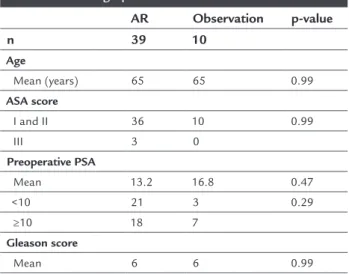
TABLE 1 Demographic characteristics.
AR Observation p-value
n 39 10
Age
Mean (years) 65 65 0.99
ASA score
I and II 36 10 0.99
III 3 0
Preoperative PSA
Mean 13.2 16.8 0.47
<10 21 3 0.29
≥10 18 7
Gleason score
Mean 6 6 0.99
AR: adjuvant radiotherapy; ASA: American Society of Anesthesiology.
TABLE 2 Specimen pathology report.
AR Observation p-value
n 39 10
Pathologic stage
pT3a 34 8 0.62
pT3b 5 2
Extra-capsular invasion
Yes 14 7 0.076
No 25 3
Positive surgical margins
Yes 35 5 0.0116
No 4 5
AR: adjuvant radiotherapy.
Follow-up
• Median follow-up was 6.2 years for AR and 7.3 years for OA (p=0.25). Results are summarized in Table 3.
• Post-operative PSA was undetectable in 64.1% of AR and in 60% of OA (p=0.99).
• Biochemical progression, our primary end-point, oc-curred significantly less in patients treated with AR, 12.8%, against 70% in OA (p=0.0008). Estimated
Kaplan-Meier biochemical progression-free survival in 5 years (Figure 1) was significantly higher for AR than for OA: 87.1 versus 30% (HR 0.12, 95% CI 0.03-0.48), p<0.0001.
• AR group needed rescue androgen-deprivation ther-apy (ADT) in 2.6% of cases, comparing to 30% in OA group (p=0.023).
adjuvant treatment, post-operative androgen deprivation therapy (ADT) concomitant to radiotherapy, positive lymph node at pathology analysis, previous prostate sur-gical intervention, other concomitant malignancy, or in-sufficient data on medical chart, were excluded from the final analysis.
For each patient, the following clinical variables were reviewed: age, initial prostate-specific antigen (PSA), Glea-son score at biopsy and ASA (American Society of Anes-thesiologist) score. Specimen data evaluated were: pathol-ogy AJCC clinical stage, extra-capsular invasion and positive surgical margins. PSA detection after surgery was recorded.
Follow-up outcomes included the indication of ad-juvant radiotherapy or observation alone, presence of bio-chemical recurrence (considered as 0.2 ng/dL PSA level above nadir), diagnosis of bone metastasis (indicated by bone radiography, computed tomography or bone scan), need for rescue androgen deprivation therapy and rescue radiotherapy, and follow-up length.
Death was considered related to prostate cancer if secondary to local complications (pelvic) or metastatic disease.
Patients were divided into 2 groups for comparison purposes: the adjuvant radiotherapy group, and the ob-servation alone group.
Primary end-point analysis was biochemical progres-sion-free survival. Secondary end-points were need for rescue androgen deprivation therapy, metastasis-free sur-vival and overall sursur-vival.
Statistical analysis was carried out using SPSS v.17, EPI info 3.5 software, applying Chi-Square, Fisher’s exact test and Student’s t-test, when necessary. Biochemical relapse-free survival was calculated using Kaplan-Meier method with log-rank test. The p-values were two sided at the sig-nificance level of <0.05.
R
ESULTSDemographics
From January 1995 to December 2005, 739 patients were treated for PC at Erasto Gaertner Hospital with RP. For-ty-nine presented with pT3 with or without PSM at de-finitive pathologic analysis.
After verifying that no exclusion criteria could be ap-plied, those 49 patients were included for analysis. Thir-ty-nine (79.6%) received AR, and 10 (20.4%) were observed without initial intervention.
• Bone metastasis occurred in only one patient in each group (p=0.37). No cancer-specific death occurred during the follow-up period.
TABLE 3 Follow-up.
AR Observation p-value
n 39 10
Post-operative PSA
Detectable 14 4 0.99
Undetectable 25 6
Biochemical progression
Yes 5 7 0.0008
No 34 3
Rescue ADT
Yes 1 3 0.023
No 38 7
ADT: androgen deprivation therapy; AR: adjuvant radiotherapy.
D
ISCUSSIONThese results show a significant longer biochemical re-lapse-free survival and a significant lower need of res-cue ADT, in patients treated with AR for high-risk re-sected PC.
Bone metastasis was a rare event, and the authors did not register mortality directly related to PC.
Limitations of this analysis include its retrospective nature and heterogeneity in some characteristics between groups.
Similar results have been reported by several retro-spective, non-randomized studies,9,10 all sharing similar bias common to such retrospective analyses.
In 2005, the European Organisation for Research and Treatment of Cancer (EORTC) trial 229115 was the first large, multicentric, randomized trial, trying to evaluate the role of AR in high-risk resected PC. This study found better biochemical relapse and clinical local relapse-free survival, but could not assess metastasis-free survival and overall survival due to the short follow-up.
Thompson et al.6 published the second large random-ized trial assessing the same question. This study had a more audacious primary end-point, metastasis-free sur-vival. It failed in reaching this end-point, with a tenden-cy to better distant failure outcomes with AR, but with-out reaching statistical significance (p=0.06). Overall survival advantage could not be proved, at a mean follow-up of 10.9 years (p=0.16). Similar to EORTC 22911 re-sults, AR showed significant better biochemical relapse and local relapse-free survival.
In 2009, Thompson et al.8 published a longer up of their previous reported trial. With a median follow-up of 12.7 years, they could demonstrate a significant bet-ter metastasis-free survival (HR 0.71 in favor of AR) and a significant better overall survival (15.2 versus 13.3 years, HR 0.72 in favor of AR). To date, this is the only report of metastasis-free and overall survival advantage of AR.
The ARO96-02/AUO AP09/95 trial,7 published in 2009, the last randomized trial published comparing AR
FIGURE 1 Cumulative biochemical recurrence-free survival in 5 years.
Image courtesy of author.
Adjuvant radiotherapy 87.1%
Observation 30%
Log-rank test: p<0.0001 HR 0.12 (95% CI 0.03-0.48) 1.0
0.4 0.8
0.2 0.6
0.0
0.0 10 20 30 40 50 60
Months
Cumulative biochemical r
ecurr
ence-fr
ee sur
to OA, analyzed separately patients with postoperative undetectable PSA. Even in these possible lower-risk pa-tients, they could demonstrate better biochemical relapse-free survival. The trial could not show additional clinical benefits.
A common criticism to these randomized studies is the small radiation dose, generally from 60 to 64 Gy, and a high proportion of patients treated with 2D technique. Such protocol was the standard radiotherapy treatment when many of the included patients were randomized. To-day, common treatment is 66 to 80 Gy, delivered with 3D or intensity-modulated radiation therapy (IMRT) plan-ning.9,11 However, this bias should probably not influence negatively data interpretation. Some suggest that the clin-ical results of these trials are underestimated by the worse radiotherapy technique available at the time, and that new trials with modern protocols could probably lead to even better results.
Differently from 2005, when the last patients select-ed for this analysis were includselect-ed, AR is now a well-ac-cepted therapy, and is offered routinely to our patients when presenting with a high-risk resected PC.
During the evaluated period, 1995-2005, AR was not a standard protocol at Erasto Gaertner Hospital. At the time, we did not have the results of the previous described trials.5-8
We could not identify selection criteria to AR or OA adopted in the patients, other than personal preference of the attending oncologist. This can generate a selection bias, not uncommon in such retrospective studies.
Nevertheless, we emphasize that if the two analyzed groups were different, AR group can be considered a high-er risk group, due to the significant highhigh-er proportion of PSM. Even with predictable worse outcomes in this group, AR could actually overcome the worst prognosis, and show
a significant longer biochemical relapse-free survival. Another important result is the significant less depen-dency of rescue ADT in AR group. ADT use is a frequent worry for the oncologist, due to the expiration date of its benefits and the known short and long-term side effects.
C
ONCLUSIONIn agreement to growing and already strong evidence in favor to AR after resected high-risk PC, the authors showed significant better outcomes with adjuvant radiotherapy. Although proving better metastasis-free and overall survival advantages in PC is difficult, it was already suggest-ed in previous randomizsuggest-ed trials that the biochemical ad-vantage of AR also translates into better clinical outcomes. In the author’s opinion, AR provided better treatment in these selected patients, it is now the first choice when
facing high-risk resected PC, and should always be of-fered as an option to the patient.
R
ESUMORadioterapia adjuvante versus vigilância após prostatec-tomia radical em câncer de próstata de alto risco
Objetivo: comparar resultados clínicos e bioquímicos de pacientes com câncer de próstata de alto risco submeti-dos à prostatectomia radical, tratasubmeti-dos com radioterapia adjuvante (RA) ou vigilância.
Métodos: foram avaliados os pacientes tratados com pros-tatectomia radical, entre janeiro de 1995 e dezembro de 2005. Pacientes que apresentaram pT3, com ou sem margens ci-rúrgicas positivas, foram incluídos para análise. Foram regis-trados dados demográficos, clínicos, patológicos e de segui-mento. Foram comparados os resultados entre o grupo que recebeu RA e o grupo em vigilância. O desfecho principal ava-liado foi a sobrevida livre de progressão bioquímica. Resultados: entre os 739 pacientes tratados com prosta-tectomia radical, 49 apresentaram tumores pT3, com ou sem margens cirúrgicas positivas. Trinta e nove recebe-ram RA e 10 forecebe-ram submetidos à vigilância. O seguimen-to médio foi de 6,2 anos para a RA e de 7,3 anos para a vi-gilância. Houve progressão bioquímica em 12,8% dos pacientes no grupo RA e em 70%, no grupo da vigilância (p=0,0008). A sobrevida livre de progressão bioquímica em 5 anos foi de 87,1% na RA e 30% na vigilância (HR 0,12, IC95% 0,03-0,48 - p<0,0001). Terapia hormonal de resga-te foi necessária em 2,6% dos pacienresga-tes na RA e em 30% na vigilância (p=0,023).
Conclusões: a radioterapia adjuvante após prostatectomia radical em pacientes com câncer de próstata de alto risco ofereceu melhores resultados bioquímicos. Ainda não está claro se isso se traduz em uma evolução clínica melhor.
Palavras-chave: prostatectomia, radioterapia adjuvante, neoplasias da próstata, recidiva.
R
EFERENCES1. Roehl KA, Han M, Ramos CG, Antenor JA, Catalona WJ. Cancer progression and survival rates following anatomical radical retropubic prostatectomy in 3,478 consecutive patients: long-term results. J Urol. 2004; 172(3):910-14.
2. Chunk FK, Graefen M, Zacharias M, Haese A, Steuber T, Schlomm T, et al. Anatomic radical retropubic prostatectomy long-term recurrence free-survival rates for localized prostate cancer. World J Urol. 2006; 24(3):273-80.
4. Billis A, Meirelles LL, Freitas LLL, Magna LA, Reis LO, Ferreira U. Influence of focal and diffuse extraprostatic extension and positive surgical margins on biochemical progression following radical prostatectomy. Int Braz J Urol. 2012; 38(2):175-84.
5. Bolla M, van Poppel H, Collette L, van Cangh P, Vekemans K, Pozzo L, et al. Postoperative radiotherapy after radical prostatectomy: a randomized controlled trial (EORTC trial 22911). Lancet. 2005; 366(9485):572-8. 6. Thompson IM Jr, Tangen CM, Paradelo J, Lucia MS, Miller G, Troyer D, et
al. Adjuvant radiotherapy for pathologically advanced prostate cancer: A randomized clinical trial. JAMA. 2006; 296(19):2329-35.
7. Wiegel T, Bottke D, Steiner U, Siegmann A, Golz R, Storkel S, et al. Phase III postoperative adjuvant radiotherapy after radical prostatectomy compared with radical prostatectomy alone in pT3 Prostate cancer with postoperative undetectable prostate-specific antigen: ARO 96-02/AUO AP 09/05. J Clin Oncol. 2009; 27(18):2924-30.
8. Tompson IM Jr, Tangen CM, Paradelo J, Lucia MS, Miller G, Troyer D, et al. Adjuvant radiotherapy for pathological T3N0M0 prostate cancer significantly reduces risk of metastases and improves survival: long-term followup of a randomized clinical trial. J Urol. 2009; 181(3):956-62.
9. Ost P, Fonteyne V, Villeirs G, Lumen N, Oosterlinck W, De Meerleer G. Adjuvant high-dose intensity-modulated radiotherapy after radical prostatectomy for prostate cancer: clinical results in 104 patients. Eur Urol. 2009; 56(4):669-75. 10. Brodak M, Kosina J, Holub L, Louda M, Odrazka K, Dolezel M, et al. Radical prostatectomy in high-grade prostate cancer, salvage and adjuvant radiotherapy. Urol Int. 2011; 86(2):146-51.