1. Medical Department, Brazilian Olympic Committee, Rio de Janeiro, RJ, Brazil.
2. LADETEC, LABDOP, Chemistry Institute, UFRJ, Rio de Janeiro, RJ, Bra-zil.
3. Toxicological Analysis Laboratory, Pharmaceutical Sciences School, USP, São Paulo, SP, Brazil.
4. Exercise Science Laboratory, Pharmacology and Physiology Department, UFF, Niterói, RJ, Brazil.
Received in 22/4/04. 2nd version received in 10/6/04. Approved in 22/6/04.
Correspondence to: Prof. Dr. Eduardo Henrique De Rose, Rua Felipe Be-cker, 95 – 91330-250 – Porto Alegre, RS. E-mail: [email protected]
Anti-doping control in Brazil: results from
the year of 2003 and prevention activities
Eduardo Henrique De Rose1, Francisco Radler de Aquino Neto2, Regina Lúcia de Moraes Moreau3
and Renata Rodrigues Teixeira de Castro4
O
RIGINALA
RTICLEKey words: Doping control. Doping. Statistics. Brazil. ENGLISH VERSION
ABSTRACT
This study presents the statistics of doping control, in- and out-of-competition in Brazil during the year 2003 and also shows the preventive actions developed. We have asked four laboratories and their coordinators to inform us about the controls on Brazilian ath-letes performed during the year 2003. All controls were performed under the World Anti-doping Agency’s (WADA) rules and regula-tions. Our results show that 3,797 controls were performed in this year, being 3,266 in-competition and 531 out-of-competition con-trols. Most of the in-competition (92.16%) and out-of-competition tests (92.47%) were performed by LAB DOP, the doping control laboratory of the Chemical Institute of the Rio de Janeiro Federal University (UFRJ), one of the South American accredited laborato-ries. Professional soccer was the sport where most of the in-com-petition controls were performed (2.975 = 91.1%), with eight pos-itive findings and a very low percent of pospos-itives (0.27%) when compared to the international literature. Most of the out-of-com-petition tests were performed by the Brazilian Olympic Commit-tee (COB), during the preparation of our athletes for participating in the XIV Pan-American Games, at the Dominican Republic (92.47%). The positive result found was 19 positive in in-competi-tion test and six in out-of-competiin-competi-tion test. Two equestrian ath-letes refused to be tested. The percentage of positive in-competi-tion (0.58%) is lower than the internain-competi-tional percentages described, that ranges from 1 to 2%, with the exceptions of arm-fighting (30%), Paralympics table-tennis (10%), track and field (6.15%) and cycling (4.69%). The out-of-competition tests were found to have a great-er incidence of positive results in bodybuilding (33.33%), equestri-an (22.22%) equestri-and boxing (7.69%). The results of swimming (2.56%), track and field (1.89%) were in agreement with international data. The preventive actions of COB, the Brazilian Soccer Confederation and LAB DOP were shown in this article, altogether with the new anti-doping law from the Brazilian Sports Ministry.
INTRODUCTION
Cases of doping have become more and more frequent in our country and worldwide. Aware of this problem, the World Anti-doping Agency (WADA) has performed important work to educate and to control elite athletes publishing annual reports with regard to the anti-doping control internationally performed(1). However,
anti-doping literature in Brazil is not extensive. Aquino Neto(2) discussed
on the athlete’s importance in Brazilian society and on the anti-doping control and Bento et al.(3) studied the recombinant
erytho-poietin in sports. Castro et al.(4) analyzed the analysis validity of the
variable time in the knowledge of national athletes about doping, while Damasceno et al.(5) recently disserted about the positive
con-trol of the VII South-American Games. Da Silva et al.(6) reviewed
the use of anabolizant steroids in sports and De Rose and Nóbre-ga(7) wrote a reviewing chapter about this thematic. Pereira et al.(8)
mention a clostebol contamination after a sexual intercourse and, in other article(9), Carreira Filho(10) refers in his Doctorate thesis that
12.8% of adolescents from both gender use or already used chem-ical substances aiming at altering body weight, especially anabolic steroids. The national statistics about the use of anabolizants in bodybuilding academies, despite being scarce, clearly indicate a public health problem, once show numbers around 95%, accord-ing to publication from Da Silva and Czepielewski(11) in a pilot study
performed in bodybuilding academies of the city of Porto Alegre, although the authors have not privileged bodybuilders in the pilot study of a Master Degree dissertation. Silva and Moreau(12), using
the questionnaire process, found steroids in 19% of individuals who attend to large bodybuilding academies in the city of São Pau-lo. The justification for such low number of works probably lies on the independence of the anti-doping control programs performed by the sportive confederations and by the Olympic and Paralympic Committees (COB) and (CPB) respectively. Thus, the global com-prehension of the anti-doping actions performed in our country becomes difficult.
With the objective of unifying the anti-doping control policies national and internationally, representatives from different govern-ments including the Brazilian, met conjointly with the Olympic movement in 2003, in Denmark capital, and signed the Copenhagen Declaration, approving the World Anti-doping Agency(13). In this
occasion, both public authorities and the Olympic movement agreed in following the determinations of a same code, which goes into effect in January 1st 2004(14). The main objective of this code was
to define doping as a possibility of increasing performance artifi-cially, being harmful to the athlete’s health or antagonistic to the fair play principles, which are there defined. When two of these three situations occur the doping is confirmed. As the World Anti-doping Agency requires the implementation of specific actions, which demand organization and high costs, there is a deadline for its accomplishment. Thus, the Olympic movement, including the sportive organizations, must suit the new laws of anti-doping con-trol until the beginning of the Athens Olympic Games in Greece (2004) while the public authorities must do it until the beginning of the Turin Winter Games in Italy (2006).
regard to doping and anti-doping, the COB has produced annually a handbook about “The use of medication in sports” including, besides a doping history and athletes’ rights and duties, the name of substances and methods forbidden in sports by the WADA and a updated list of the commercial name of medications that may be used in different clinical situations(15). This handbook was
distribut-ed to all athletes who participatdistribut-ed in the Pan-American Games last year and will also be distributed to those who will compose the Brazilian delegation to Athens this year, besides being in full in the COB electronic page www.cob.org.br. In preventive and formation feature, all Brazilian athlete who goes out the country for interna-tional meeting is tested by the COB since 1995, year of the Mar del Plata Pan-American Games, in Argentina.
The Brazilian government, in turn, re-created the Sports Nation-al Council (CNE) in the year of 2002. The council was restructured in 2003, year that the Anti-doping Commission is established in the Sports Ministry(16). This commission performed the first
statis-tics about anti-doping control in the country and proposed to the CNE the publication of the Anti-doping Resolution 02/04, more suitable and in agreement with the international laws, replacing the regulation 531 of July 10th, 1985. It should be yet considered
that the doping, besides being forbidden by the national and inter-national sportive legislation, is also forbidden by the Code of ethics in medicine(17) and Sports Medicine(18).
Considering the limited number of publications on the anti-dop-ing control and the Brazilian policy in this regard, we thought about performing this study. The objective of this work was to describe the anti-doping control performed in our country during the year of 2003 and to compare to data available in the international literature as well as to dissert on the national prevention activities. This study also provides data for further comparisons that will analyze the progress achieved in the anti-doping control performed in our coun-try after the implementation of the World Anti-doping Agency and the new legislation of the Anti-doping Commission, serving as da-tabase for governmental, sportive, Olympic and Paralympic author-ities in our country.
METHOD
For this study, we have consulted the two only anti-doping con-trol laboratories in our country: the Doping Concon-trol Laboratory of the Rio de Janeiro Federal University, accredited since 2002 by the International Olympic Committee (IOC) and the Toxicological Anal-ysis Laboratory of the Pharmaceutical Sciences School, University of São Paulo.
The Brazilian Aquatic Sports Confederation (CBDA) and the Bra-zilian Athletics Confederation (CBAt) also presented in-and-out-of-competition anti-doping control programs that eventually include erythropoietin control (EPO) that, once it is not detected in Brazil, is studied abroad in international laboratories equally accredited by the WADA such as the INRS Santé, Montreal, Canada and Labora-toire National de Depistage du Dopage, Paris, France(3).
The International Doping Test & Management (IDTM) also per-forms in-and-out-of-competition controls in our country for WADA and for the International Athletics Federations, Aquatic Sports (swimming, synchronized swimming, and diving), arc shooting and triathlon as well as for the ATP, sending controls to the INRS labo-ratory of Montreal, Canada.
Thus, this study consists of a retrospective analysis of the anti-doping controls performed in Brazil by both national and Montreal and Paris laboratories. To do so, we have requested the respective coordinators of these laboratories to inform us about the controls on Brazilian athletes performed during the year 2003, their respec-tive sporrespec-tive modalities, the collect situation (if in or out of compe-tition) and the results obtained.
All tests included in this study were performed according to ex-igencies of the current Brazilian and international law, basically
expressed in the World Anti-doping Agency. One urine sample of at least 75 ml is divided into two parts when collected and placed into two distinct flasks, labeled with an identical number and let-ters A and B with 2/3 and 1/3 from the urine total volume, respec-tively. This sample is thus sent by means of a safe mail service to the laboratory to be analyzed. The laboratory initially studies the first one, with about 50 ml or more. Indicated with letter A, the sample is divided into seven parts, being submitted to gaseous chromatography, mass spectrometry and immunologic trial for peptide hormones. The result is then informed in secret to the sportive authorities that requested the test(19).
In case the presence of forbidden substance or method or its metabolic markers is found, the athlete is informed by means of his entity and expresses the right to use or not the second part of the sample indicated with letter B with 25 ml or more. If positive, the sample B will be analyzed through the same technique in the presence of the athlete or his representative as well as in the pres-ence of his International Federation. One result is considered as adverse when the athlete abdicates the right of analysis of sample B or when this analysis also reveals the presence of forbidden sub-stance or method or its metabolic markers(19).
It is important to remind that the laboratorial analysis performed in competitions is more complete than that performed in out-of-competition controls. While the in-out-of-competition analysis research-es all forbidden substancresearch-es and methods, the out-of-competition controls only involve the research for anabolizants, diuretic sub-stances and peptide hormones, besides the forbidden methods. In its out-of-competition controls, the COB includes the ben-zoylecgonine (cocaine) and the THC (cannabis) due to the relative frequency of their use in sports and the importance of the athlete’s image for collectivity.
It is worthy emphasizing that the athlete’s identity is not informed to the laboratory when the urine sample is sent to analysis. Thus, the present study does not break the athlete’s anonymity and as it is retrospective, does not indicate the need of signing the consent form. On the other hand, most anti-doping control forms present an item informing athletes about the possibility of using the re-sults for research purposes, as long as his identity is preserved.
The analysis of the data obtained was performed in this study through descriptive statistics including total and percentile num-ber of controls, sportive modality, positivity percentile and type of forbidden substance found. With regard to the description of edu-cational programs aimed at athletes concerning the doping con-trol, we will describe here the experience of some authors of this work, collected along their participation in the IOC’s medical com-missions, the COB’s Pan-American Sportive Organization (ODE-PA) and in national sportive confederations.
RESULTS
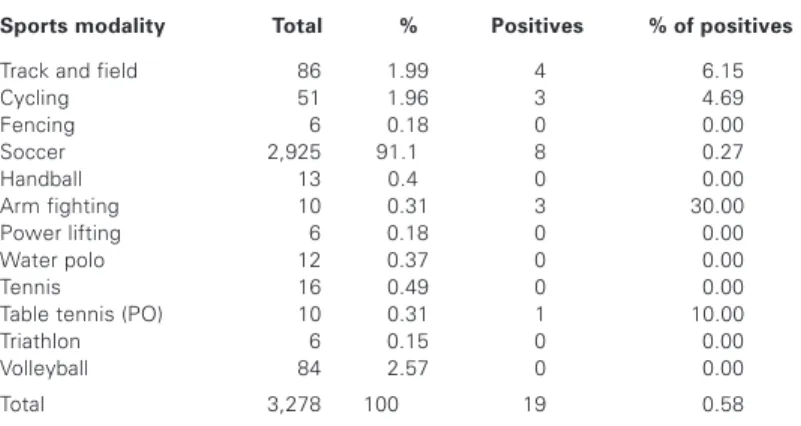
3,797 anti-doping controls were performed during the year of 2003, being 3,266 in national competitions and 531 out-of-national competitions without previous notice. Most in-competition tests were performed in professional soccer official games, 2,975 con-trols in a percentile of 91.1% of the total tests. This sport was the one presenting the highest number of positive findings (n = 8) with a positivity percentile of 0.27%.
Proportionally to the number of tests performed, the arm fight-ing presented the highest number of positive results (30%) with paralympics table-tennis (10%), track and field (6.1%) and cycling (4.1%) presenting a percentile equally high. The total number of positive tests was 19 and the positivity average found was of 0.58%.
In 2003, the XIV Pan-American Games were performed in Santo Domingo, Dominican Republic. Our athletes’ preparation involved the performance of out-of-competition anti-doping controls in a suppressive way in almost all athletes classified for the event. Among all Brazilian delegation, only a few athletes living abroad or those classified at the eve of the beginning of Games, as the case of the Basketball Brazilian Team, were not submitted to anti-dop-ing control tests. Furthermore, some athletes were studied out-of-competition by their national and international federations. Data related to these controls, besides data from other out-of-competi-tion controls are expressed in table 3 with total, percentiles, posi-tives and positivity percentiles.
The forbidden substances found in these tests are presented in table 4, classified by sportive modality.
Both equestrian cases were considered as positive because ath-letes refused to be tested, reason why we have only listed sub-stances found in four of the cases. Other five adverse analytical results that did not resulted in positive controls by being properly justified by athletes were also detected by LAB DOP in out-of-competition tests: one case of salbutamol, for asthma treatment and two cases of diuretic agents for hypertension treatment in sports presenting no weight category. Two other cases of adverse analytical results for testosterone/epitestosterone (T/E) ratio oc-curred in canoeing, not confirmed by further laboratorial and clini-cal controls, according to the rule.
TABLE 1
In-competition anti-doping controls performed in 2003
Sports modality Total % Positives % of positives
Track and field 86 1.99 4 6.15
Cycling 51 1.96 3 4.69
Fencing 6 0.18 0 0.00
Soccer 2,925 91.1 8 0.27
Handball 13 0.4 0 0.00
Arm fighting 10 0.31 3 30.00
Power lifting 6 0.18 0 0.00
Water polo 12 0.37 0 0.00
Tennis 16 0.49 0 0.00
Table tennis (PO) 10 0.31 1 10.00
Triathlon 6 0.15 0 0.00
Volleyball 84 2.57 0 0.00
Total 3,278 1000.000 19 0.58
(PO) = Paralympic athlete
The forbidden substances found in these tests are presented in table 2, classified by sportive modality.
TABLE 2
Substances found in in-competition anti-doping controls
Nun. Substance Classification Sports modality
01 Benzoylecgonine Stimulant Soccer
02 Benzoylecgonine Stimulant Soccer
03 Furosemide Diuretic Soccer
04 Petidin Narcotic Soccer
05 Chlortalidone Diuretic Soccer
06 Nandrolone Anabolic Soccer
07 Clostebol Anabolic Soccer
08 Testosterone/Epitestosterone Anabolic Soccer
09 Benzoylecgonine Stimulant Arm fighting 10 Benzoylecgonine Stimulant Arm fighting 11 Boldenone Anabolic Arm fighting 12 Amphepramone Stimulant Cycling 13 Amphepramone Stimulant Cycling 14 Nandrolone Anabolic Cycling 15 Norandrosterone Anabolic Track and field 16 Methyltestosterone Anabolic Track and field 17 Nandrolone Anabolic Track and field 18 Erythropoietin Peptide hormone Track and field 19 THC Cannabinoid Table tennis (PO)
(PO) = Paralympic athlete
TABLE 3
Out-of-competition anti-doping controls performed in 2003
Sports modality Total % Positives % of positives
Track and field 53 9.96 1 01.8
Badminton 6 1.12 0 00
Basketball 14 2.63 0 00
Baseball 18 3.38 0 00
Bowling 4 0.75 0 00
Boxing 13 2.44 1 07.6
Canoeing 13 2.44 0 00
Cycling 8 1.50 0 00
Fencing 15 2.81 0 00
Equestrian 6 1.12 2 22.2
Water skiing 4 0.75 0 00
Bodybuilding 3 0.56 1 33.33
Soccer 22 4.13 0 00
Artistic gymnastics 12 2.25 0 00 Rhythmic gymnastics 7 1.32 0 00
Handball 32 6.01 0 00
Hokey 10 1.87 0 00
Judo 24 4.51 0 00
Karate 4 0.75 0 00
Weight lifting 7 1.32 0 00
Wrestling 2 0.38 0 00
Wrestling freestyle 4 0.75 0 00 Synchronized swimming 10 1.87 0 00
Swimming 39 7.33 1 02.6
Skating 2 0.37 0 00
Pentathlon 3 0.56 0 00
Water polo 32 6.01 0 00
Rowing 24 4.51 0 00
Diving 3 0.56 0 00
Squash 6 1.12 0 00
Taekwondo 6 1.12 0 00
Tennis 6 1.12 0 00
Table tennis 8 1.50 0 00
Shooting 32 6.01 0 00
Arc shooting 1 0.18 0 00
Triathlon 13 2.44 0 00
Sailing 12 2.25 0 00
Volleyball 42 7.89 0 00
Sand volleyball 12 2.25 0 00
Total 532 100.00 6 01.13
TABLE 4
Substances found in out-of-competition anti-doping controls
Number Substance Sports modality
1 Clostebol Track and field 2 Norandrosterone Boxing
3 Stanozolol Swimming
4 THC Bodybuilding
TABLE 5
Anti-doping control statistics available in literature
Collect place and period Controls Positives (%)
26 laboratories from several countries (2002) 131,373 1.80 and 0.90
Israel (1993-1998) 273 2.70
Czechoslovakia (1997) 843 1.70 Norway (1977-1995) 12,870 1.20
TABLE 6
In-competition controls performed by the laboratories studied
Laboratory Number of tests Percentile (%)
Lab Dop UFRJ 3,010 091.8
Lab Tox USP 173 005.2
INRS Montreal 91 002.7
LDD Paris 4 000.1
DISCUSSION
The total number of tests performed apparently seems to be above the number performed in 2002, although no publication with this regard can be found. Such fact, based on the authors’ percep-tion, is mostly due to the performance of out-of-competition con-trols in the Brazilian delegation that participated in the XIV Pan-American Games 2003.
In in-competition tests performed, an almost dependence on the professional soccer, which performed most tests (91.1% of the controls) is verified, from a total of 2,975 tests performed with positivity percentile of 0.27%, far lower than the international per-centile, which is around 0.45% in competitions of this modality. This international percentile is related to the year of 2002, when 131,373 controls were analyzed in 26 international laboratories(20).
Other publications presented by the international literature indi-cate higher percentiles, although with a lower casuistic(21-23).
The average positive percentile of in-competition controls was low if compared to the international literature: 0.58% against 1.80 on average. Now, the positive percentile of out-of-competition con-trols may still be considered as in the normality upper limit, if we consider data obtained by the IOC, which establishes this percen-tile in 0.90%. Bodybuilding, equestrian, boxing, swimming and track and field presented percentiles above the average, eventually caused by the low number of controls performed.
Most substances found in in-competition tests were anabolic agents (anabolic steroids) (n = 8), and the others were: stimulants (n = 6), diuretic agents (n = 2), peptide hormones (n = 1), cannab-inoids (n = 1) and narcotics (n = 1). Drugs considered as “social use”, due to new detection techniques may be observed for as long as one week through urine analysis, also forbidden by the Brazilian Civil Legislation such as the benzoylecgonine (cocaine) and the THC (cannabis), performed almost one third of the drugs found in competitions. In this context, the fact that the only posi-tive case in bodybuilding not have been due to the use of zants attracts attention, once it is known that the use of anaboli-zants artificially improves performance in this modality, but else due to the use of THC, what once again emphasizes the problem of the use of “social drugs” by athletes.
Since 2002, Brazil holds the technology for the detection of eryth-ropoietin (EPO) in urine in the sample collecting, although a selec-tion is performed from blood tests (hematocrit, hemoglobin and reticulocytes), according to norms of the IAAF. So far, the authors have verified two positive cases for the use of this substance, both evidenced by the CBAt in street running.
In the year of 2002, the South-American Games took place in four state capitals in our country and nine positive results were found (3.3%), three of them in Brazilian athletes, fact of great rele-vance in the media and probably influencing the low number found in 2003(5).
The out-of-competition tests were almost all performed by the Brazilian Olympic Committee (92.4%). Although the average posi-tive values had been of 1.1%, those found in bodybuilding (33.33%), equestrian (22.2%), boxing (7.6%) and swimming (2.5%) were high-er than the inthigh-ernational refhigh-erence. In out-of-competition tests, anabolic (anabolic steroids) (n = 3) and cannabinoid (n = 1) agents were found. Certainly, the low number of tests in some modalities generated high positivity percentiles, what influenced the final percentile.
It is worthy emphasizing that no Brazilian athlete was positive in the Pan-American games or in the Olympic Games due to the ex-cellent prevention work developed by the COB’s medical team.
The Brazilian Soccer Confederation (CBF), in turn, gathers its doping control physicians and the physicians from the professional soccer teams in Rio de Janeiro every two years to speak about doping prevention, while LAB DOP from UFRJ frequently performs meetings on the subject with national Confederations and
Federa-tions. The Brazilian Sports Ministry, through the Sports National Council (CNE) and the Anti-doping Commission (CCD) has updated the Brazilian law, searching to make it suitable with the WADA Anti-doping Code.
A significant percentile of in-competition tests (92.1%) is per-formed in the LAB DOP of the Chemistry Institute - UFRJ, which is the only laboratory accredited in Brazil by the WADA. The others are performed in the Toxicology Laboratory – USP in São Paulo (5.3%) or abroad, in the INRS in Montreal, Canada (2.4%) and in the LDD in Paris, France (0.1%).
The out-of-competition tests are almost all performed in the LAB DOP (92.4%) and the rest performed in the INRS in Montreal, Can-ada (7,5%).
CONCLUSION
Most in-competition anti-doping tests performed in Brazil are requested by the professional soccer. Now, the out-of-competition tests are mostly performed by the Brazilian Olympic Committee. The in-competition controls show low positivity percentile, while the out-of-competition tests present a slightly high average per-centile, but still in agreement with the international literature.
The LAB DOP of the Chemistry Institute – UFRJ performs most tests in Brazil, and the others are performed by the University of São Paulo, Montreal and Paris. Considering that, according to the statistics mentioned, the main international anti-doping laborato-ries perform between 8.000 to 10.000 tests a year on average; our country needs to grow significantly in this area of vital importance for an ethic sports.
The use of anabolizants seems to be a practice that starts in high schools, following by bodybuilding academies and finally re-flecting in the professional sports, although in lower percentiles if compared to the international reality. Due to the prevention activi-ties of the Brazilian Sports Ministry, COB, CBF and LAB DOP of the UFRJ, the Brazilian Athletes have not presented positive anti-doping controls for forbidden substances and methods in Pan-American and Olympic Games.
These data certainly cannot be used in order to analyze statis-tics from other countries, but they may serve for comparative stud-ies between these statistics and those from Brazil in the year of 2003 mentioned in the present study.
All the authors declared there is not any potential conflict of inter-ests regarding this article.
REFERENCES
1. WADA-AMA. World Anti-Doping Agency. Annual Report, 2002. WADA, Montre-al, 2002.
2. Aquino Neto FR. O papel do atleta na sociedade e o controle de dopagem no esporte. Rev Bras Med Esporte 2001; 8:138-48.
3. Bento RMA, Damasceno LPM, Aquino Neto FR. Eritropoetina recombinante humana no esporte: uma revisão. Rev Bras Med Esporte 2003;9:181-90. 4. Castro RRT, Ramalho SHR, De Rose EH, Nóbrega ACL. Conhecimento de
atle-tas de esportes olímpicos sobre controle antidoping: o tempo de participação do esporte nos jogos olímpicos faz diferença? Rev Bras Med Esporte 2003;9:S13. 5. Damasceno LMP, Bento RMA, Gomes LNL, Marques MAS, Ramos SB, Souza ANB, Aquino Neto FR. Doping control during the VII South American Games in Brazil. In: Schaenzer W, Geyer H, Gotzman A, Marek U, editors. Recent advanc-es in doping analysis. Cologne: Strauss, 2003;377-82.
6. Da Silva PRP, Danielsky R, Czepielewsky M. Esteróides anabolizantes no espor-te. Rev Bras Med Esporte 2002;8:1-9.
7. De Rose EH, Nobrega ACL. O doping na atividade esportiva. In: Pace Lasmar N, Camanho G, Pace Lasmar RC, editores. Medicina do esporte. Rio de Janeiro: Editora Revinter, 2002;31-46.
8. Pereira HMG, Marques MAS, Aquino Neto FR. Incidental clostebol contamina-tion in athletes after sexual intercourse. Clin Chem 2004;50:456-7.
10. Carreira Filho D. Relevância do uso de substâncias químicas, com finalidade de alteração corporal, entre adolescentes de ambos os sexos, regularmente ma-triculados e freqüentes na rede escolar do Município de São Caetano do Sul-SP-Brasil. Tese de doutorado, Faculdade de Ciências Médicas, Universidade de Campinas, São Paulo, 2004.
11. Da Silva PRP, Czepielewski M. Uso de agentes esteróides anabólicos, estimu-lantes, diuréticos, insulina e GH em amostra de praticantes de musculação de Porto Alegre. Rev Bras de Toxicologia 2001;71:71-182.
12. Silva LSMF, Moreau RLM. Uso de esteróides anabólicos androgênicos por prati-cantes de musculação de grandes academias da cidade de São Paulo. Revista Brasileira de Ciências Farmacêuticas 2003;39: 327-33.
13. WADA-AMA. Copenhagen declaration on anti-doping in sport. WADA, Montreal, 2003.
14. WADA-AMA. World anti-doping code. (Version 3). WADA, Montreal, 2003. 15. De Rose EHR, Feder MG, Bento RMA, Aquino Neto FR. Informações sobre o
uso de medicamentos no esporte. Rio de Janeiro: COB, 2004.
16. Diário Oficial da União. Poder Executivo. Ministério do Esporte. Gabinete do Ministro: Portaria 101 de 29 de julho de 2003. N 150, pág. 54, agosto de 2003. 17. Diário Oficial da União. Conselho Federal de Medicina. Código de ética médica:
Resolução CFM 1246/88. N 25, pág. 1.574-7, janeiro de 1988.
18. Federação Internacional de Medicina do Esporte. Code of ethics in sports med-icine. FIMS Directory. FIMS, Porto Alegre, 1999.
19. WADA. International standard for testing. (Version 3.0). WADA, Montreal, 2003.
20. International Olympic Committee. Statistics of the accredited laboratories. COI, Lausanne, 2002.
21. Jeschke J, Nekola J, Chlumsky. Doping in sports. Cas Lek Cesk 1999;138:291-7.
22. Bahr R, Tjornhom M. Prevalence of doping in sports: doping control in Norway 1977-1995. Clin J Sport Med 1998;8:32-7.