Carlos Pestana Barros & Nicolas Peypoch
A Comparative Analysis of Productivity Change in Italian and Portuguese Airports
WP 006/2007/DE _________________________________________________________
Horácio Faustino & Isabel Proença
Effects of Immigration on Intra-Industry Trade:
A logit analysis
WP 19/2011/DE/SOCIUS/CEMAPRE _________________________________________________________
Department of Economics
W
ORKINGP
APERSISSN Nº 0874-4548
1 1
Effects of Immigration on Intra-Industry Trade: A logit analysis.
Horácio C. Faustino–ISEG, Technical University of Lisbon and SOCIUS
Isabel Proença – ISEG, Technical University of Lisbon and CEMAPRE
Abstract: This study estimates the effects of the immigration stock, as well as those of immigrants’ characteristics,
such as having the same language as that of the host country and the level of qualification or entrepreneurship, on
Portuguese intra-industry trade (IIT) by types, controlling for the effects of other socio-economic factors, like
economic dimensions, price indexes and distance. In addition to the member-countries of the EU-27, the group of
countries studied includes five African countries with Portuguese as their official language, known as the PALOPs,
and the BRIC countries. Since indexes are fractional variables, the pseudo-likelihood Logit estimator was used on
the panel data to obtain the empirical results. The study found that an increase of the immigrant stock will produce
an increment in the trade indexes considered and this effect is enhanced if immigrants originate from a country
where Portuguese is the official language, or if they are highly qualified, whereas immigrant entrepreneurs have no
significant effect.
JEL no. C33, F11, F12, F22.
Keywords: Immigration; trade; skills; entrepreneurship; panel data; Portugal.
Addresses:
Horácio C. Faustino (corresponding author)
ISEG - Instituto Superior de Economia e Gestão. Rua Miguel Lúpi, 20.
1249-078 Lisboa, Portugal
T: (+351) 213925902 ; Fax: (00351) 21396640 ; E-mail: [email protected]
Isabel Proença
ISEG, Rua do Quelhas, 6
1200-781 Lisboa, Portugal.
1 2
I. Introduction
Globalisation today offers diaspora communities new opportunities for international
business, by exploiting their international social networks. Due to these social and ethnic
networks, transaction costs have decreased and immigration has contributed to the increase of
both types of international trade: inter-industry trade and intra-industry trade (IIT), commonly
defined as the simultaneous exports and imports of goods from the same industry. Immigrants’
preferences for products from their country of origin may also result in increased trade, primarily
in host-country imports, and the trade in differentiated products (IIT). According to the trade
theory, the reduction in transaction costs increases trade. However, the link between migration
and trade has not yet been formalised by the trade theory. The factor proportions theory
(Heckscher-Ohlin model) considers that factors are immobile between countries and that
international trade is a perfect substitute for international factor immobility (Samuelson theorem
for factor prices equalisation). According to this theory, immigration and trade are substitutes.
The new trade theory, based on monopolistic competition and product differentiation, provides
arguments for a complementary relationship between immigration and IIT through the trade
transaction cost reductions and immigrants’ preferences (see, for a synthesis of IIT models,
Helpman and Krugman, 1985). Despite the theoretical problems, the empirical studies that test
the hypothesis of a positive correlation between immigration and trade have increased in the last
decade, using ad hoc processes as a gravitational approach, extended to include explanatory
variables arising from the traditional and the new trade theories. These studies provide empirical
evidence of the links between inter- and intra-industry trade and immigration, proposing new
hypotheses for the trade theory. Gould (1994), Helliwell (1997), Head and Ries (1998) Rauch
(1999,2001), Rauch and Watson (2002), Rauch and Trindade (2002), Girma and Yu (2002),
Piperakis et al. (2003), Co et al. (2004), Herander and Saavedra (2005), Blanes (2005,2006),
Blanes and Martin-Montaner (2006), Dunlevy (2006), Greenaway et al. (2007), White (2007a,
2007b, 2008, 2009a, 2009b), White and Tadesse (2007, 2008a, 2008b, 2009), Tadesse and White
(2008, 2010a, 2010b), Bandyopadhyay et al. (2008), Faustino and Leitão (2008a, 2008b),
Faustino and Peixoto (2009), Faustino et al. (2009), Gonçalves and Africano (2009), Leitão et al.
1 3
characteristics, using different approaches. Tadesse and White (2011) examine the effects of
emigrants on the trade flows with other host nations. Insel et al. (2010) also consider the link
between Turkish trade and Turkish emigration.
The present study analyses immigration into Portugal between 2000 and 2005, estimating
the effect of the increasing stock of immigrants and some of its characteristics on Portugal’s
bilateral intra-industry trade with 37 countries. These comprise all the partner-states of the
EU-27 (including Belgium and Luxembourg as a single entity), the five African countries with
Portuguese as their official language (PALOP) i.e. Angola, Cape Verde, Guinea-Bissau,
Mozambique and São Tomé and Príncipe, together with Brazil, Russia, India and China, the
USA, Moldova and Ukraine. In 2006, these countries accounted for 89% of the immigrants in Portugal and 83% of the country’s trade in goods.
With reference to the methodology, the characterisation of immigration is elabourated on
the basis of data from INE (the Portuguese National Institute of Statistics), SEF (Foreigners and
Frontiers Administration Agency) and the Personnel Statistics (micro data) compiled by the
Ministry of Employment and Social Security.
Concerning estimation, since by definition the intra-industry trade indexes assume values
between zero and one we follow the recent approach of Papke and Wooldridge (2008) to model
fractional responses with panel data. While these authors use a Probit regression, we have chosen
the Logit based on the results of a specification test. Linear regression would be easier to apply,
but it may overlook important non-linearities in the conditional mean. On the other hand, it does
not guarantee that the predicted values lie in the unit interval. To overcome the latter problem,
traditionally the log-odds transformation is applied to the fractional response. However, this
procedure requires that variables do not assume the corner values of zero and one, which is not
verified in our data, given that we have observed zeros for the vertical integration index.
Moreover, partial effects of the explanatory variables are easy to estimate for the transformed
variables in the linear model, but they are not relevant since our interested is focused rather on
the partial effects for the expected value of the untransformed fractional responses, that is the
trade indexes. These effects are difficult to obtain, since the expected value is impossible to
recover from the transformed variables, unless strong independence assumptions are made.
Therefore, the Logit functional form for the conditional mean response is more appropriate to
1 4
to provide simple estimates of the partial effects averaged across the population, known as the “average partial effects” (APEs). As far as we know, this is the first work in which the impacts of immigration on intra-industry trade flows are rigorously quantified, identifying the specific
effects of immigrants’ qualifications and cultural affinities, such as having the same language as
that of the host country.
The remainder of the paper is organised as follows: Section 2 examines the theoretical
relationship between immigration and trade; Section 3 introduces the econometric model,
together with definitions of the independent and explanatory variables; the results are displayed
and discussed in Section 4, while Section 5 comprises our concluding remarks.
II. The Relationship between Immigration and Trade
There are two mechanisms by which immigrants can exert influence on bilateral trade
flows: first, their preference for products from their countries of origin and second, the role of
cultural ties and social networks in creating opportunities between the host country and their
home countries. The preference for determined products connected with the immigrant’s ethnicity, which are not initially available in the host country’s market, can lead to an increase of imports to the host country from the respective country of origin. Similarly, cultural and
linguistic ties, being associated to the information in the possession of immigrants about markets
in their countries of origin, as well as the social networks into which they are integrated, can
prove advantageous to the reduction of transaction costs. Rauch (2001) emphasises the role of
social networks in removing certain barriers to trade, asserting that access to information on
business and trading opportunities, through the social networks and the flexibility of
relationships between economic agents, based more on the building of mutual trust than on
formal contracts, have positive implications in terms of economic efficiency.
In addition, the process of immigrants’ adaptation to the host society, in particular their integration into the labour market, is a variable of vital importance, to the extent that it can
influence the development of an entrepreneurial-commercial class among immigrants. Several
authors have sought to explain the causes and effects of entrepreneurship among immigrants,
1 5
entrepreneurial strategies can be a vehicle for upward social mobility. Within the scope of the
present paper, another issue is to verify whether the impact of immigrant entrepreneurs on
bilateral trade is greater or less than the impact made by non-entrepreneurs. Light et al. (2002)
tested this hypothesis in relation to Chinese immigrants in the USA. They concluded that the
immigrant entrepreneurs had a positive effect on US exports, whereas no influence was found on
imports.
From a different perspective, as Borjasi (1989) and Blanes (2005) highlight, both the
theory of international trade and empirical research have, until recently, ignored the effects of the
labour migration factor on trade flows. The Heckscher-Ohlin model and theorem consider that
labour is mobile at the national level, but immobile internationally. When countries open up to
trade and as long as the hypothesis of incomplete specialisation is verified (countries will
continue to produce, for the purpose of trading, the goods that they previously produced only for
their own consumption), the equalisation of absolute and relative price factors will tend to occur.
Thus, trade will function as a perfect substitute for international factor mobility. The
Heckscher-Ohlin model explains inter-industry trade, considering that the markets function in perfect
competition and that information circulates without costs and is symmetrical for all economic
agents.
When intra-industry trade is examined (i.e. exports and imports belonging statistically to
the same industry), we find a different situation and it is accepted that a relationship of
complementarity may exist between trade and international factor mobility. The imperfection of
markets, in particular the asymmetry of information and its effect on the preferences of
consumers, may justify the relationship of complementarity between immigration and the
increase of trade in differentiated products. According to the model of imperfect competition,
when immigrants have fully legalised status, more information on their preferences is obtainable.
If the costs of acquiring information become similar to the transaction costs, it is possible to state
that the relationship between immigration and trade is positive, since transaction costs are
decreasing.
Gould (1994) argued that the effects of immigration are stronger on the trade of
differentiated products (intra-industry trade). This is explained by the fact that the additional
information brought by immigrants is of greater relevance for consumers than for producers, so
1 6
products’ variety or characteristics). The increased trade in differentiated products satisfies the specific preferences of the consumers. Rauch (1999) stressed the role of the immigrants’ networks in reducing the transaction costs of trade in differentiated products. He also called
attention to the preference and network effects on intra-industry trade. White (2008) finds that
the final effect on intra-industry trade is ambiguous.
The relationship between immigration and trade can be established on the basis of the
transaction costs. The underlying hypothesis assumes that immigration contributes to the
reduction of transaction costs, thus leading to increases of all trade flows.
There is a heterogeneous set of variables that determines the influence of immigrants on
international trade, not only in respect of the country of origin, but also the host country, or even
the immigrant community itself, particularly its social networks. These social networks are
reinforced when immigrants share a common language. As this common characteristic can
promote trade flows, the specified model should introduce a dummy variable to capture this
effect.
Since Anderson (1979), it has been acknowledged that the gravitational model explains
adequately the flows of bilateral trade and that the gravitational equation can be based on the
various models of trade: those of Ricardo and Hechscher-Ohlin and the models of intra-industry
trade.
Theoretically supported by the works of Anderson (1979), Bergstrand (1985, 1989,
1990), Helpman and Krugman (1985), Baier and Bergstrand (2001) and Feenstra et al. (2001),
the gravitational model can include other explanatory hypotheses of trade, as well as GDP and
distance. Feenstra et al. (2001) demonstrate that a large series of theories is consistent with the
gravitational equation. In other words, different alternative theories of international trade can use
the gravitational equation. Nevertheless, according to Helpman (1999), the gravitational equation
yields better results when the countries are similar, with high levels of intra-industry trade, than
when they differ widely in terms of the relative endowment factors and they are countries in
which inter-industry trade is predominant.
1 7
The main explanatory variables are those related to immigrant characteristics: immigrant
stock (distinguishing those who speak the same language as the host country from the others),
the percentage of highly-qualified immigrants employed in manufacturing industry (also making
here the same distinction as before) and the percentage of immigrant employers (entrepreneurs)
operating in manufacturing industry. However, in order to capture the effect of the transport
costs, we will include the geographic distance as explanatory variable. To avoid problems of
misspecification, we also include a set of control variables that, according to the international
trade theory, have significant effects on intra-industry trade. Thus, the empirical model has the
general form:
(1) where is the trade index between Portugal and country i at time t, assuming three different
forms: intra-industry trade index (IIT), horizontal intra-industry trade index (HIIT) and vertical
intra-industry trade index (VIIT).
Since is an index verifying , we assume that its conditional expected value has the
following Logit specification:
(2) where is a vector of explanatory variables including the immigration-related and
country-specific variables, is vector of unknown coefficients, is a parameter to be
estimated allowing for a different intercept each year which captures all factors (not included in
the other variables) specific to year t affecting all countries equally, is the Logit function
verifying and ensuring that lies in the unit interval.
Papke and Wooldridge (2008) use alternatively the Probit specification. There are no theoretical
reasons to choose between Probit or Logit in this specific case, therefore our choice was made
based on the results of a specification test. We use the pooled Bernoulli quasi-maximum
1 8
with robust estimation of variances to prevent for misspecification, due to the fact that we are
dealing with fractional data instead of Bernoulli. Additionally, it accommodates arbitrary
heteroskedasticity and serial dependence across t.
III.1. Dependent Variables
In order to measure intra-industry trade by types, three alternative measures are
considered: the total intra-industry trade index (IIT), the vertical intra-industry trade index
(VIIT) and the horizontal intra-industry trade index (HIIT). These will be the three variables to
be explained. For the industry, l, and for the partner country, i, we have:
(3)
The Grubel and Lloyd IITindex
The Grubel and Lloyd index (1975) is used as the measure of the intra-industry trade between
Portugal and the trading partner, country i. In order to avoid the problems of statistical
aggregation, the index is calculated with the maximum of statistical disaggregation allowed by
INE- Portuguese National Institute of Statistics (five digits):
(4)
where and are bilateral exports and imports respectively of Portugal with partner i,
concerning the 5-digit product level j (of the CAE-Economic Activities Classification1) at time t.
It can be clearly observed that An alternative measure is proposed by Fontagné
and Freudenberg (1977). Blanes (2005) also considers the marginal intra-industry index (MIIT),
proposed by Brulhart (1994), as an alternative dependent variable.
1
1 9
The HIIT and VIIT indexes
HIIT and VIIT are defined as simultaneous imports and exports of quality-differentiated products
(5-digit product level). HIIT are trade flows that are not significantly different in quality,
whereas VIIT are trade flows that are not similar in quality. The empirical studies require a
methodology to separate HIIT from VIIT.
In this paper, the methodology of Abd-el-Rahaman (1991) and Greenaway et al. (1994) is
used to separate the horizontal from the vertical intra-industry trade. The unit values of exports
(UVX ) related to the unit values of imports (UVM ), defined as the value of trade by tonne, are
used to distinguish between VIIT and HIIT. We use, as is common practice, a dispersion value of
15%. Fontagné and Freudenberg (1997) also proposed a different method to disentangle HIIT
from VIIT. Despite the difference between definitions of IIT, both methodologies consider that
there is a high correlation between prices (unit values of exports and imports) and quality of
traded products. This assumption is realistic if the statistical aggregation is minimised. So, The
HIIT and VIIT are calculated with disaggregation of 5 digits. The calculations are made at the
5-digit product categories and the results are then aggregated to make up each 3-5-digit industry
category.
HIIT satisfies the condition for all t:
(5)
while VIIT satisfies the condition for all t:
1 10
where j denotes a 5-digit product, l denotes an industry and i is a trading partner of Portugal. The
constant α can take any value between 0 and 1, but in this study, as in the majority of studies, we
consider only α = 0.15.
III.2. Independent Variables
The fundamental independent variables are those related to immigration. However, since
there are other determinants for trade, both at the inter-industry trade (exports and imports) and
the intra-industry trade levels (IIT, HIIT, VIIT), these variables must be included in the model in
order to control the effects, improve the quality of the adjustment and avoid biased estimation
due to omitted variables. As control variables, we chose: the per-capita GDP of Portugal and the
GDP of the respective trading partner to measure the economic dimension of both countries,
which is a commonly used variable in the empirical studies on intra-industry trade; the price
index of the trading partner of Portugal (another option was the ratio of the price indexes
between Portugal and each of its trading partners, but this did not prove to be statistically
robust); and the variable, geographic distance, measured in kilometers (we also used the distance
measured in nautical miles, but the results did not improve with respect to the theoretically
expected sign), as proxy for transportation costs. In addition to these quantitative variables, we
also introduced qualitative dummy variables to reflect the impact of countries belonging to the
European Union prior to the enlargement of 2004 (EU-15); of the emerging economies Russia,
China and India (RICS) and of the five African Countries having Portuguese as the official
language, together with Brazil (SLHC). It should be noted that further control variables that are
commonly used in empirical studies were added, namely: the absolute difference between the
per-capita incomes of the trading partners, the difference in electrical energy consumption
between the trading partners (as proxy of the differences in physical capital endowments; the
degree of openness and the weight of the trade balance in the GDP for each trading partner.
However, these independent variables did not prove to be statistically significant and did not
improve the quality of fit. Empirical linear correlations were calculated among the independent
1 11
different specifications always produced very similar results regarding the immigrant STOCK
variable, mainly with regard to the positive sign of its coefficient.
The selected independent variables in the final model were the following:
- LYPCPT: i.e. the logarithm of the per-capita GDP of Portugal. This is a control variable
related to dimension used in the intra-industry trade models, the expected sign for the coefficient
of this variable being positive in the three equations related to intra-industry trade (IIT, HIIT and
VIIT). It represents the hypothesis that the larger the economic dimension the larger the
intra-industry trade (see Hummels and Levinshon,1995);
- LYPCK: i.e. the logarithm of the per-capita GDP of the trading partner. This is the other
control variable related to dimension used in the intra-industry trade models; the sign for the
coefficient of this variable is expected to be positive, consequently, the larger in economic terms
is the trading partner, the larger the intra-industry trade should be (see Hummels and
Levinshon,1995);
- IPK: i.e. the price index for Portugal’s trading partner. It is expected that the increase of
this prices index in the trading partner-country will favour the competitiveness of the Portuguese exports and produce a negative effect on Portugal’s imports from that country. Regarding the effect on the intra-industry trade indexes, we cannot assume a priori what the expected effect
will be. The horizontal intra-industry trade is determined more by other characteristics than the
price itself and the vertical intra-industry trade, although determined by price (considered
equivalent to quality), is not homogeneous (there are low-quality products on which the impact
of price modification can be relevant and high-quality products on which the impact of price
modification can be less relevant). Consequently, we assume that the sign of the estimated
coefficient in these equations is more a matter of empirical evidence. It must also be noted that
since the ITT includes both the VIIT and the HIIT, the sign of the IPK coefficient for the IIT
equation is always an ambiguous one;
- LDIST: i.e. the logarithm of geographic distance, measured in kilometers, between the
capital cities of the trading partners. This is used as a proxy variable for transportation costs.
Hence, a negative sign is expected for the coefficient of this variable. The same notion of the
negative effect is reinforced when the empirical studies use the gravitational equation to explain
1 12
- LSTOCK: i.e. the logarithm of immigrant stock in Portugal. Until 2000, the stock is
equivalent to the stock of residence permits (AR). From 2000 to 2004, the stock is equivalent to
the sum of AR and permits to stay (AP). From 2004 to 2005, the stock is equivalent to the sum of
AR, renewed AP and renewed long-term visas (VL). A positive sign for the coefficient of this
variable in all equations is expected, according to the hypothesis that migrant networks decrease
transaction costs, facilitate the spread of information and, as a result, promote the increase in all
types of trade;
-MIHQW: i.e. the percentage of highly-qualified immigrants employed in manufacturing
industry (MI). A positive sign is expected for the coefficient of this variable, on the basis of the
hypothesis that an increase in the level of qualification of immigrant workers will increase the products’ quality and differentiation, and hence, will boost all types of intra-sector trade;
-MIENT: i.e. the percentage of immigrant employers (entrepreneurs) operating in
manufacturing industry. A positive sign is expected for the coefficient of this variable, based on
the hypothesis that increases in the number of immigrant employers will reinforce the ethnic and
commercial networks, thereby contributing to the reduction of transaction costs;
- EU15: i.e. a dummy variable that assumes the value 1 if the trading partner is a member
of the EU15 and zero otherwise. We expect a positive sign for the coefficient of this variable,
because the integration process reinforces the intra-industry trade;
- RICS: i.e. a dummy variable that assumes the value 1 if the country is Russia, India or
China and zero otherwise. The sign for the coefficient of this variable is a question of empirical
evidence. It is to be noted that since the language of Brazil is Portuguese, it was decided to
include this country with the PALOPs (see the next variable). For this reason, instead of a BRIC
dummy variable, this study uses the RIC dummy variable, which is a bloc of the three
above-named countries.
- SLHC: i.e. a dummy variable that assumes the value 1 if the trading partner is one of the
five African countries considered in this study with Portuguese as its official language or Brazil,
and zero otherwise. We expect a positive sign for the coefficient of this variable;
- Interaction terms: we have interacted LSTOCK and MIHQW with SLHC in order to
evaluate if the channels through which the stock of immigrants and the percentage of
highly-qualified immigrants employed in the manufacturing industry effect in trade indexes work more
1 13
IV. Analysis of the Results
IV.1.The Data
The data set used in the estimation it is an unbalanced panel of 38 countries (Angola,
Austria, Belgium and Luxembourg (data is combined for these two countries), Brazil, Bulgaria,
Cape Verde, China, Cyprus, Csech Republic, Denmark, Estonia, Finland, France, Germany,
Greece, Guiné Bissau, Hungary, India, Ireland, Italy, Latvia, Lithuania, Malta, Moldova,
Mozambique, Netherlands, Poland, Portugal, Romania, Russia, São Tomé and Principe,
Slovakia, Slovenia, Spain, Sweden, UK, Ukraine and USA) observed for the years 2000 and
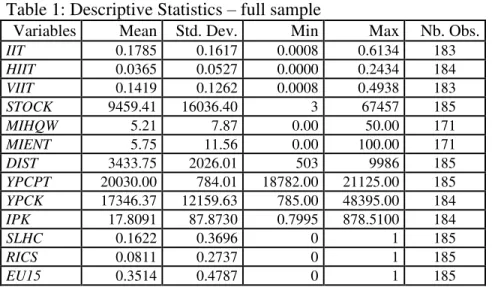
2002 to 2005. Descriptive statistics for the data are given in Table 1.
Table 1: Descriptive Statistics – full sample
Variables Mean Std. Dev. Min Max Nb. Obs.
IIT 0.1785 0.1617 0.0008 0.6134 183
HIIT 0.0365 0.0527 0.0000 0.2434 184
VIIT 0.1419 0.1262 0.0008 0.4938 183
STOCK 9459.41 16036.40 3 67457 185
MIHQW 5.21 7.87 0.00 50.00 171
MIENT 5.75 11.56 0.00 100.00 171
DIST 3433.75 2026.01 503 9986 185
YPCPT 20030.00 784.01 18782.00 21125.00 185
YPCK 17346.37 12159.63 785.00 48395.00 184
IPK 17.8091 87.8730 0.7995 878.5100 184
SLHC 0.1622 0.3696 0 1 185
RICS 0.0811 0.2737 0 1 185
EU15 0.3514 0.4787 0 1 185
As can be observed in the results for the mean, the IIT índex is mainly of the VIIT type (IIT=
0,1785; HIIT= 0,0365; VIIT= 0,1419).
IV.2. Estimation results
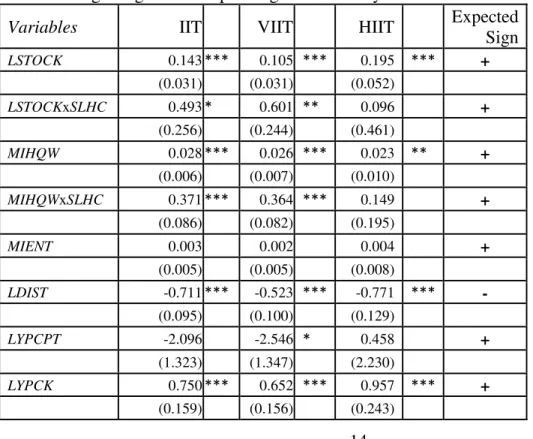
The results of the estimation of model (2) are presented in Table 2. The pooled fractional
Logit was used with standard errors robust to general heteroskedasticity and serial correlation.
All regressions show a very reasonable determination coefficient (particularly for the IIT fit) and
1 14
statistic. The results are in accordance with the theory. The stock of immigrants (LSTOCK) has a
positive and statistically significant effect (at 1%) in all trade indexes. Moreover, we see that the
common language with the host country enhances this effect for IIT and VIIT at, respectively,
the 10% and 5% significance levels, given that the estimated coefficient of the interaction
between LSTOCK and SLHC is positive. The percentage of highly-qualified immigrants
employed in manufacturing industry (MIHQW) has a positive impact as well in all indexes and is
statistically significant at 1% for IIT and VIIT and at 5% for HIIT. This effect is also amplified
when immigrants speak the same language as that of the host country in relation to IIT and VIIT.
The percentage of immigrant employers (MIENT) has no effect in the intra-industry trade
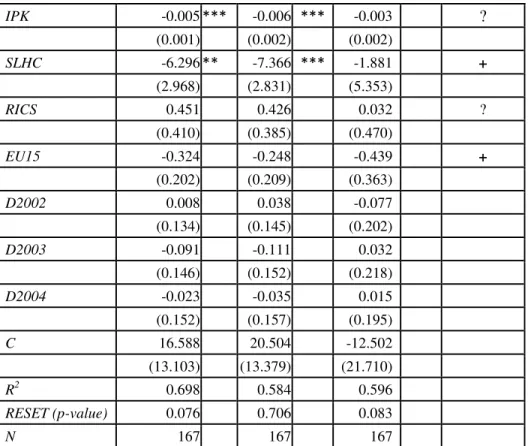
indexes considered. The other control variables have the expected signs, except for the per-capita
GDP of Portugal (LYPCPT), which proved to be not statistically significant at 5%. Equally, the
RICS and EU15 dummies are also not statistically significant. Therefore, we can only depict a
distinct behaviour of immigrants on intra- industry trade for those whose language is the same as
that of the host country, which shows the importance of linguistic and cultural ties in promoting
trade. Note that the coefficient of the dummy SLHC cannot be interpreted alone, due to the
interactions terms.
Table 2: Logit Regression Explaining Intra-industry Trade Indexes
Variables IIT VIIT HIIT Expected
Sign
LSTOCK 0.143*** 0.105 *** 0.195 *** +
(0.031) (0.031) (0.052)
LSTOCKxSLHC 0.493* 0.601 ** 0.096 +
(0.256) (0.244) (0.461)
MIHQW 0.028*** 0.026 *** 0.023 ** +
(0.006) (0.007) (0.010)
MIHQWxSLHC 0.371*** 0.364 *** 0.149 +
(0.086) (0.082) (0.195)
MIENT 0.003 0.002 0.004 +
(0.005) (0.005) (0.008)
LDIST -0.711*** -0.523 *** -0.771 ***
-(0.095) (0.100) (0.129)
LYPCPT -2.096 -2.546 * 0.458 +
(1.323) (1.347) (2.230)
LYPCK 0.750*** 0.652 *** 0.957 *** +
1 15
IPK -0.005*** -0.006 *** -0.003 ?
(0.001) (0.002) (0.002)
SLHC -6.296** -7.366 *** -1.881 +
(2.968) (2.831) (5.353)
RICS 0.451 0.426 0.032 ?
(0.410) (0.385) (0.470)
EU15 -0.324 -0.248 -0.439 +
(0.202) (0.209) (0.363)
D2002 0.008 0.038 -0.077
(0.134) (0.145) (0.202)
D2003 -0.091 -0.111 0.032
(0.146) (0.152) (0.218)
D2004 -0.023 -0.035 0.015
(0.152) (0.157) (0.195)
C 16.588 20.504 -12.502
(13.103) (13.379) (21.710)
R2 0.698 0.584 0.596
RESET (p-value) 0.076 0.706 0.083
N 167 167 167
This table includesthe results of the Logit regression applied to each of the intra-trade indexes. Robust standard errors are in round brackets. ***, **, * denote significance at the 1%, 5% and 10% levels respectively.
The average partial effect of each variable is calculated in Table 3, together with the respective
standard error and p-value to test the null that this effect is zero.
Table 3: Average Partial Effects
IIT VIIT HIIT
APE St. Err. p-val. APE St. Err. p-val. APE St. Err. p-val
LSTOCK (AVERAGE) 0.0230 0.0041 0.00 0.0165 0.0036 0.00 0.0071 0.0018 0.00
LSTOCK (SLHC=0) 0.0195 0.0043 0.00 0.0125 0.0038 0.00 0.0071 0.0019 0.00
LSTOCK (SLHC=1) 0.0416 0.0120 0.00 0.0458 0.0107 0.00 0.0126 0.0168 0.46
MIHQW (AVERAGE) 0.0065 0.0009 0.00 0.0055 0.0009 0.00 0.0010 0.0004 0.02
MIHQW (SLHC=0) 0.0038 0.0008 0.00 0.0030 0.0008 0.00 0.0008 0.0004 0.03
MIHQW (SLHC=1) 0.0261 0.0016 0.00 0.0253 0.0024 0.00 0.0074 0.0088 0.40
MIENT 0.0004 0.0006 0.51 0.0002 0.0006 0.73 0.0001 0.0003 0.61
LDIST -0.0962 0.0128 0.00 -0.0617 0.0117 0.00 -0.0277 0.0048 0.00
LYPCPT -0.2836 0.1787 0.11 -0.3004 0.1587 0.06 0.0165 0.0802 0.84
LYPCK 0.1015 0.0219 0.00 0.0769 0.0188 0.00 0.0344 0.0093 0.00
IPK -0.0007 0.0002 0.00 -0.0007 0.0002 0.00 -0.0001 0.0001 0.17
SLHC 0.0499 0.0370 0.18 0.0526 0.0347 0.13 0.0308 0.0700 0.66
RICS 0.0662 0.0650 0.31 0.0557 0.0554 0.32 0.0012 0.0173 0.95
1 16
This table includes the average partial effect (APE) for each variable, the respective standard error (St. Err.)
calculated with the Delta Method and the p-value (p-val.) to test the null that the average partial effect is zero. For
LSTOCK and MIHQW, the APEs were included for the entire sample, the APE calculated at SLHC=0 and at
SLHC=1.
Because the model is non-linear, the coefficients do not directly give the partial effect of
the variables. In general, the statistical significance of the average partial effects follows that
obtained in the regression for the coefficient estimates, except for SLHC and the interaction with
LSTOCK, which here is statistically significant at the 1% level for IIT and VIIT. If the stock of
immigrants increases by 10%, then on average, the IIT index is estimated to increase by 0.0023,
by 0.0020 if immigrants do not originate from countries with Portuguese as their official
language and by 0.0042 if they are from a Portuguese-speaking country. Thus, the latter estimate
amounts to the double of the former. This difference reflects the relevance of immigrants whose
language is the same as that of the host country to expanding trade ties. This relevance is
particularly important for the APE of highly-qualified immigrants, for whom the discrepancy
between those who speak Portuguese and the remainder is almost 7 times greater. With regard to
the VIIT index, the conclusions are basically the same, but the effects are, in general, a little less.
Regarding HIIT, the effects are substantially less, which is not so surprising given that the IIT is
mainly vertical in nature. Moreover, the language influence is not depicted in HIIT, since the
APEs for the immigrant stock and highly-qualified immigrants who speak the same language as
that of the host country are not statistically significant.
V. Concluding remarks
This paper uses the Logit regression to model the intra-industry trade, in view of the
fractional nature of the response variables. This is a new approach allowing the explicit
quantification of the average partial effects of each explanatory variable, in particular those
related to immigration. The results show that there is strong empirical evidence that the stock of
immigrants has a positive impact in all intra-industry trade indexes. On the other hand, the
increase of the percentage of highly-qualified immigrants employed in manufactory industry
1 17
entrepreneurs has no effect in those indexes. The effects of the stock of immigrants and level of
qualification are clearly potentiated if immigrants speak the same language as that of the host
country. However, this effect was not detected for the horizontal intra-industry trade. As
expected, the effect of the distance between trading-partner countries in all type intra-industry
trade is negative, as it is in the empirical studies that use the gravitational equation.
The consequences for immigration policy and economic policy are clear. When viewed
as a whole, immigration brings beneficial effects to the Portuguese economy in terms of
international trade. These effects are reinforced when two characteristics of the immigrants come
under consideration: skills in the context of manufacturing industry and cultural ties proxied by
common language. What the data suggests is that immigration policies that facilitate the
admission of immigrants and favour their skills-upgrading are beneficial for Portugal, in terms of
the trade balance and the trade pattern.
It is also noteworthy that this study has not obtained robust results regarding the effects
of other immigrant characteristics on bilateral trade. These included variables such as gender,
educational level, occupation, skill levels (other than the percentage of highly-skilled immigrants
in manufacturing industry) and type of employment contract. As statistical databases on
immigration become more numerous and reliable, we expect to estimate again these models in
order to establish whether the results for these variables will be confirmed or not.
Acknowledgments
The authors wish to thank the Observatório da Imigração do Alto Comissariado para a Imigração e Diálogo
Intercultural (ACIDI) for funding the project on which this paper is based. Appreciation is also expressed to
Catarina Reis Oliveira and João Peixoto for their most helpful comments on a broader version of the paper, and to
Patrícia Baptista, who contributed to the research tasks. Isabel Proença would like to acknowledge financial support
from FCT (Fundação para a Ciência e Tecnologia) through the programme FEDER/POCI 2010.
References
Abd el Rahaman, K. (1991). Firms competitive and national comparative advantages as joint
determinants of trade composition. Review of World Economics/Weltwirtschaftliches Archiv,
1 18
Anderson, P. (1979). A theoretical foundation for the gravity equation. American Economic
Review 69, 106-116.
Baier, S. & Bergstrand, J. (2001). The growth of world trade tariffs, transport costs, and income
similarity. Journal of International Economics, 53 (1), 1-27.
Bergstrand, J. (1985). The gravity equation in international trade: some microeconomic
foundations and empirical evidence. The Review of Economics and Statistics, 67, 474-481.
Bergstrand, J. (1989). The generalised gravity equation, monopolistic competition, and the factor
proportions theory in international trade. The Review of Economics and Statistics, 71,
143-153.
Bergstrand, J. (1990). The Heckscher-Ohlin-Samuelson model, the Linder hypothesis, and the
determinants of bilateral intra-industry trade. Economic Journal, 100, 1216-1229.
Blanes, J. (2005). Does immigration help to explain intra-industry trade? Evidence for Spain.
Review of World Economics/Weltwirtschaftliches Archiv, 141, 244-270.
Blanes, J. (2006). Immigrant´s characteristics and their different effects on bilateral trade.
Evidence from Spain. Working Paper 06/08. Universidad Pablo de Olavide, Depaertamento
de Economia.
Blanes, J., & Martin-Montaner, J.(2006). Migration flows and intra-industry trade adjustments.
Review of World Economy, 142 (3), 567-584.
Bonifazi, C., et al. (2008). International migration in Europe . New trends and new methods of
analysis. Amsterdam: Amsterdam University Press.
Borjas, G. (1989). Economic theory and international migration. International Migration Review,
23, 457-485.
Dunlevy, J., & Hutchinson, W. (1999). The impact of immigration on American import trade in
the late nineteenth and twentieth centuries. Journal of Economic History 59: 1043-1062.
Faustino, H. C., & Leitão, N. C. (2008a). Immigration and trade in Portugal: A static and
1 19
Faustino, H. C., & Leitão, N. C. (2008b). Using the gravity equation to explain the Portuguese
immigration-trade link. (ISEG working paper 12), Lisbon.
Faustino, H.C., & Peixoto, J.(2009). Immigration-trade links: The impact of recent immigration
on Portuguese trade. (ISEG working paper 36), Lisbon.
Faustino, H.C., Peixoto, J. & Baptista, P. (2009). As Caracteristicas da imigração em Portugal e
os seus efeitos no comércio bilateral. Observatório da Imigração, ACIDI.Lisbon (
http://www.oi.acidi.gov.pt/docs/Estudos_OI/OI_31.pdf).
Feenstra, R., Markusen, J. & Rose, A. (2001). Using the gravity equation to differentiate among
alternative theories of trade. The Canadian Journal of Economics, 34, 430-447.
Fontagné, L., & Freudenberg, M. (1997). Intra-industry trade: Methodological issues
reconsidered. (CEPII working paper 1997).
Girma, S., & Yu, Z. (2002). The link between immigration and trade. Evidence from UK. Review
of World Economics/Weltwirtschaftliches Archiv, 138, 116-130.
Gonçalves, N. and A.P. Africano (2009). The Immigration and trade link in the European Union
integration process. ( FEP working paper 340), Porto.
Gould, D. (1994). Immigrant links to the home country: empirical implications for U.S bilateral
trade flows. Review of World Economics/Weltwirtschaftliches Archiv,76 (2), 302-316.
Greenaway, D., Hine, R. & Milner, C. (1994). Country-specific factors and the pattern of
horizontal and vertical intra-industry trade in the UK. Review of World
Economics/Weltwirtschaftliches Archiv, 130 (1), 77-100.
Greenaway, D., Mahabir, P. & Milner, C. (2007). Does the presence of ethnic Chinese in trading
partner countries influence bilateral trade flows with China? (University of Nottingham
Working Paper), Leverhulme Centre for Research in Globalisation and Economic Policy.
Grubel, H.,& Lloyd, P. (1975). Intra-industry trade. The theory and measurement of
international trade in differentiation products. London: The Mcmillan Press.
Head, K., & Ries, J. (1998). Immigration and trade creation:Econometric evidence from Canada.
1 20
Helpman, E., & Krugman, P. (1985). Market structure and foreign trade. Brighton, United
Kingdom: Harvester Wheatsheaf.
Helpman, E. (1999). The structure of foreign trade. Journal of Economic Perspectives, 13 (2),
121-144.
Herander, M. G., & Saavedra, L. A. (2005). Exports and the structure of immigrant-based
networks: The role of geographic proximity. Review of Economics and Statistics, 87 (2),
323-335.
Hummels, D., & Levinshon, J. (1995). Monopolistic competition and international trade:
reconsidering the evidence. Quarterly Journal of Economics, 110 (3), 799-836.
Insel, A., Cakmak, N.S. & Okten, A. (2010). The link between the Turkish emigrants and the
Turkish trade in Europe. 30th Annual Meeting of the MEEA in Conjunction with the annual
Meeting of the ASSA, January 3-6, 2010, Atlanta, USA.
Iranzo, S. & Peri, G. (2009). Migration and trade: Theory with an application to the
Easter-Western European integration. (Working Paper Series No. 05/09), Center for Research and
Analysis of Migration.
King, R., et al. (2000). Eldorado or fortress? Migration in Southern Europe. London:
Macmillan.
Lee, H. & Lee, Y. (1993). Intra-industry trade in manufactures: The case of Korea,
Weltwirtschaftliches Archiv, 129(1),159- 171.
Leitão, N.C., Surugiu, M.R. & Surugiu, C. (2010). Trade and Portuguese immigration. Romanian
Journal of Economics, 31( 2), 38-48.
Light, I., Zhou, M., and Kim, R. (2002). Transnationalism and American exports in an
English-speaking world. International Migration Review, 36 (3), 702-725.
Murat, M., & Pistoresi, B. (2009a). Migrant networks: Empirical implications for the Italian
bilateral trade. International Economic Journal, 23 (3),371-390.
Murat, M., & Pistoresi, B. (2009b).Emigrant and immigrant networks in FDI. Applied
1 21
Papke, L. E. and Wooldridge, J. M. (2008). Panel data methods for fractional response variables
to test pass rates. Journal of Econometrics, 145, 121-133.
Rauch, J. (1999). Networks versus markets in international trade. Journal of International
Economics, 48, 7-35.
Rauch, J. (2001). Business and social networks in international trade. Journal of Economic
Literature, 39 (4), 1177-1203.
Tadesse, B. & White, R. (2008). Do Immigrants counter the effect of cultural distance on trade?
Evidence from US State-level exports. Journal of Socio-Economics , 37(6),2304-2318.
Tadesse, B. & White, R. (2010a). Cultural distance as a determinant of bilateral trade flows: Do
immigrants counter the effect of cultural distances. Applied Economic Letters, 17(2),147-152.
Tadesse, B. & White, R. (2010b). Does cultural distance hinder trade? A comparative study of
nine OECD member nations. Open Economies Review, 21(2),237-261.
White, R. (2007a). Immigration-Trade Links, Transplanted Home Bias and Network Effects.
Applied Economics 39 (7): 839-852.
White, R. (2007b). An examination of the Danish immigrant-trade link. International Migration,
45 (5), 61-86.
White, R. (2008). Exploring a US immigrant-intra-industry trade link. Eastern Economic
Journal, 34 (2), 252-262.
White, R. (2009a).Immigration, trade and product differentiation. Economic Issues, (14(1),43-63.
White, R. (2009b). Immigration, trade and home country development: State-level variation in
the US immigrant-export link. Journal of International Migration and Integration,
10(2),121-143.
White, R., & Tadesse, B. (2007). Immigration policy, cultural pluralism and trade: Evidence
from the white Australia policy. Pacific Economic Review, 12 (4), 489-509.
White, R. & Tadesse, B. (2008a). Cultural distance and the US immigrant-trade link. The World
1 22
White, R. & Tadesse, B. (2008b). Immigrants, cultural distance and US State-level exports of
cultural products. North American Journal of Economics and Finance, 19(3),331-348.
White, R. & Tadesse, B. (2009). East-West migration and the immigrant-trade link: Evidence