Contents lists available atScienceDirect
Applied Catalysis A: General
j o u r n a l h o m e p a g e :w w w . e l s e v i e r . c o m / l o c a t e / a p c a t a
Solvent-free chromium catalyzed aerobic oxidation of biomass-based alkenes as
a route to valuable fragrance compounds
Patricia A. Robles-Dutenhefner
a, Bruno B.N.S. Brandão
b, Líniker F. de Sousa
a, Elena V. Gusevskaya
b,∗aDepartamento de Química, Universidade Federal de Ouro Preto, 35400-000 Ouro Preto, MG, Brazil
bDepartamento de Química, Universidade Federal de Minas Gerais, 31270-901 Belo Horizonte, MG, Brazil
a r t i c l e
i n f o
Article history:
Received 24 January 2011
Received in revised form 21 March 2011 Accepted 28 March 2011
Available online 1 April 2011
Keywords: Monoterpenes Oxidation Oxygen
Chromium catalysts Mesoporous molecular sieves
a b s t r a c t
Chromium containing mesoporous molecular sieves MCM-41 were shown to be an efficient hetero-geneous catalyst for the liquid-phase aerobic oxidation of various monoterpenic alkenes under mild solvent-free conditions. The material was prepared through a direct hydrothermal method and charac-terized by ICP-AES, N2adsorption–desorption, TEM, XRD, SAXS, and H2-TPR techniques. Characterizations
suggest that chromium introduced in MCM-41 is essentially incorporated in the silica framework, with no extraframework chromium oxides being detected. Various oxygenated monoterpenoids important for the flavor and fragrance industry were obtained with high combined selectivities (75–92%) at 30–40% substrate conversions. The oxidation of-pinene led almost exclusively to allylic mono-oxygenated derivatives, whereas limonene and␣-pinene gave both epoxides and allylic oxidation products. The cat-alyst undergoes no metal leaching and can be easily recovered and re-used. A silica-included chromium catalyst prepared through a conventional sol–gel method showed activity comparable with that of Cr-MCM-41; however, selectivity was much lower.
© 2011 Elsevier B.V. All rights reserved.
1. Introduction
The catalytic oxidation of organic compounds with molecular oxygen represents an attractive route to a great variety of valu-able commodity and specialty chemicals. These processes occur with high atom efficiency giving water as the only byproduct and can replace conventional stoichiometric processes in the fine chemicals industry[1]. In the case of liquid-phase oxidations, the development of the technologies which use solid catalysts under solvent-free conditions is particularly relevant to green chemistry concepts.
A conventional route to prepare heterogeneous metal catalysts is the impregnation of metal compounds onto the solid surface. A general problem associated with the use of such catalysts in liquid-phase oxidations is a rapid leaching of metal ions from the solid support. On the other hand, the application of heterogeneous gas-phase processes in the fine chemicals industry is restricted by limited volatility and thermal stability of complex substrates. A promising approach to develop stable catalysts for liquid-phase oxidations is the incorporation of redox-active metals in the frame-work positions of solid matrices during the synthesis of the solid,
∗Corresponding author at: Universidade Federal de Minas Gerais, Departamento de Quimica, Av Antonio Carlos 6627, 31270-901 Belo Horizonte, Minas Gerais, Brazil. Tel.: +55 3134095741; fax: +55 3134095700.
E-mail address:[email protected](E.V. Gusevskaya).
i.e., isomorphic substitution[1,2]. Such site-isolation of active metal ions can be an important factor in catalytic liquid-phase oxidations in heterogeneous systems. It often results in the materials highly stable to leaching and also prevents the aggregation of the metal to less reactive species[1].
Ordered mesoporous molecular sieves, such as MCM-41, dis-covered by Mobil Company in 1992 have received considerable attention in catalysis research over the last decades [3,4]. The MCM-41 material possesses a high surface area (above 700 m2) and
hexagonal array of uniform mesopores (2–10 nm) with narrow pore size distribution. Such large pore catalysts are especially important for the conversion of bulky molecules in the fine chemicals indus-try. No diffusion problems are usually observed with the catalysts based on MCM-41[2].
Mesoporous molecular sieves containing different transition metals have a great potential as heterogeneous catalysts in liquid-phase oxidations. We have recently developed an efficient process for the aerobic oxidation of isolongifolene, one of the most avail-able sesquiterpenes, over Co-MCM-41[5]. The catalyst was stable to leaching and exhibited much higher selectivity then the material prepared by a conventional sol–gel method without the surfac-tant. The aim of the present work was to prepare MCM-41-included chromium materials and to study their potential as redox catalysts for the aerobic oxidation of biomass-based alkenes.
Chromium reagents are widely used in organic chemistry in both stoichiometric and catalytic oxidations[6]. Considering envi-ronmental factors, the most attractive approach obviously consists
in using toxic chromium compounds in catalytic amounts and in heterogenized forms. A number of chromium containing solid materials have been utilized in liquid-phase oxidations of organic substrates (mostly, alkanes and alkylaromatics) with H2O2,tert
-butyl hydroperoxide (TBHP)[7–10], or molecular oxygen[11–13]
as final oxidants. However, the main problem of these catalysts was chromium leaching out of the solid, especially in the presence of water[1].
In recent years, considerable attention has been focused on the development of chromium/MCM-41 catalysts for the liquid-phase oxidations of alkanes and aromatics with H2O2or TBHP[14–20].
Among them, MCM-41-included materials, i.e., those prepared via the direct incorporation of chromium ions during the synthesis of the molecular sieve, exhibited remarkable stability even under aqueous conditions. In some of these works, Cr-MCM-41 materi-als maintained activity in several recycling experiments, with the reaction being stopped after catalyst removal[16,18,19]. In other studies[17,20], loss of activity was observed only in the first recy-cling experiment due to leaching of non-framework chromium ions and then the activity remained nearly the same.
To the best of our knowledge no attempts to use MCM-41-included chromium catalysts for the oxidation of organic compounds with molecular oxygen have been reported so far. Within our program aimed at adding value to natural ingredients of renewable essential oils, we decided to apply Cr-MCM-41 catalysts for the liquid-phase aerobic oxidation of limonene,␣-pinene, and
-pinene, the most abundant natural terpenes.
Terpenic compounds, in general, are an important renewable feedstock for the flavor and fragrance industry. Their oxygenated derivatives usually show interesting organoleptic properties and form one of the most important groups of fragrance ingredients
[21]. The oxidation of␣-pinene is also relevant because verbenone, the product of the allylic oxidation of␣-pinene, is widely used for the synthesis of taxol, an important therapeutic agent. For several years, we have been interested in the aerobic oxidation of
monoter-penic alkenes catalyzed by palladium[22–24]and cobalt[25–27]
compounds. As concerned with chromium compounds, they are known to catalyze the allylic oxidation of alkenes by TBHP[6–8,28]. However, no heterogeneous chromium catalysts stable to leaching under the conditions of these reactions have been reported yet, as far as we know. The photocatalytic oxidation of alkenes with molec-ular oxygen on chromium containing silica gave both epoxide and allylic oxidation products[29,30].
In the present work, we report a simple and efficient aerobic oxi-dation of various monoterpenes with high combined selectivities for valuable epoxy and/or allylic derivatives under mild sol-vent free conditions. The MCM-41 material containing chromium incorporated into the framework (Cr-MCM-41) was used as a heterogeneous, stable to leaching catalyst. The performance of Cr-MCM-41 was compared with that of the silica-included chromium material prepared by a conventional sol–gel method without a sur-factant.
2. Experimental
2.1. Catalyst preparation and characterization
The 5.0 wt% Cr/SiO2 catalyst (denoted as Cr–SiO2/sol–gel) was
prepared by a sol–gel method using tetraethoxysilane (15.1 g, TEOS, 98%, Sigma–Aldrich) and CrCl3·6H2O (1.0 g, Sigma–Aldrich) as
pre-cursors. The sol was obtained from a TEOS/ethanol/water mixture in a 1/3/10 molar ratio with the addition of HCl and HF (up to pH 2.0) as catalysts. The sample was dried at 110◦C for 24 h and thermally
treated for 2 h at 900◦C in air.
The 5.0 wt% Cr/MCM-41 catalyst (denoted as Cr-MCM-41) was prepared by a direct incorporation of Cr into the MCM-41 frame-work aiming for the isomorphous substitution of Si by Cr ions. TEOS and CrCl3·6H2O (Sigma–Aldrich) were used as precursors and
hex-adecyltrimethylammonium bromide (C16-TAB, Sigma–Aldrich) as a structure template. The C16-TAB solution in water was added to the solution of TEOS (2.5 g) in aqueous tetramethylammo-nium hydroxide (TMAOH, 25 wt%, Sigma–Aldrich). The mixture was stirred for 30 min before CrCl3·6H2O (1.6 g) and remaining
TEOS (21.0 g) were added. After additional mixing at 40◦C for 24 h,
the mixture was placed in the autoclave at 100◦C for 24 h and
then cooled to room temperature. The obtained solid was sepa-rated by filtration, washed with de-ionized water and ethanol, and dried at 40◦C. Then, the solid was heated from room temperature
to 550◦C under flowing nitrogen and calcinated for 3 h at 550◦C
under flowing air to remove the residual organics. The TEOS/C16-TAB/TMAOH/water molar ratio was 1.0/0.12/0.3/22.0.
The determination of total chromium contents was performed by inductively coupled plasma atomic emission spectrometry (ICP-AES) on a Spectro Ciros CCD instrument. The samples were dissolved in a mixture of HF and HNO3before the measurements.
The textural characteristics of the catalysts were determined from nitrogen adsorption isotherms (Autosorb-Quantachrome
NOVA-1200 instrument, nitrogen, −196◦C). Samples were
out-gassed for 2 h at 300◦C before analysis. Specific surface areas and
average pore diameter were determined by the Brunauer-Emmett-Teller (BET) equation. The pore size distributions were calculated from the desorption isotherms using the Barrett-Joyner-Halenda (BJH) method. Average pore diameters were determined by the BJH method.
Transmission microscope (TEM) characterization was per-formed through a Tecnai–G2-20 (FEI) electron microscope with an acceleration potential of 200 kV.
The small angle X-ray scattering (SAXS) experiment at the D11A-SAXS beam line was performed at the LNLS synchrotron laboratory, Campinas, Brazil using a Huber-423 3-circle diffractometer. The SAXS setup was equipped with a Si (1 1 1) monochromator, giving a
horizontally focused X-ray beam. The incident X-ray wavelength
was 1.488 nm and the scattering angle 2was approximately 0–10◦.
The powder X-ray diffractometry (XRD) measurements were performed on a Rigaku model Geigerflex-3034 equipment using a Co(K␣) radiation scanning from 4 to 70◦(2) to register the
pres-ence of chromium oxide phases.
The temperature-programmed reduction with hydrogen (H2
-TPR) was performed on a Quantachrome-ChemBET 300 instrument equipped with a thermal conductivity detector. The experiments were performed between 30 and 900◦C (10◦C/min) in a flow of a
N2/H2mixture containing 5 vol% of H2.
2.2. Catalytic oxidation experiments
The reactions at atmospheric pressure were carried out in a glass reactor equipped with a magnetic stirrer and sampling system. The reactions at higher pressure were carried out in a stainless steel 20-mL reactor (autoclave) equipped with a magnetic stirrer. In a typical run, a mixture of monoterpene (6.2 mmol) and the catalyst (0.03 g, ca. 3.5 wt%) was transferred in the reactor. The glass reac-tor was connected to a gas burette containing molecular oxygen to measure a gas uptake. The autoclave was pressurized with molec-ular oxygen to the total pressure of 5 atm. The reactors were placed in an oil bath; then, the solutions were intensively stirred at 60◦C
Table 1
Elemental analysis data and textural properties of Cr-MCM-41 and Cr–SiO2/sol–gel.
Sample Cr
content (wt%)
BET surface area (m2g−1)
Total pore volume (cm3g−1)
BJH average pore diameter (nm)
Color
Cr-MCM-41 4.9 622 0.53 3.4 Yellow
Cr–SiO2/sol–gel 5.1 244 0.97 18.7 Pale green
was attributed to the formation of oligomers, which were GC unob-servable.
Catalyst recycling experiments were performed as follows: after the reaction, the catalyst was centrifuged, washed with acetonitrile and ethanol and reused. To control metal leaching, the catalyst was removed at the reaction temperature after 0.5 h and the solution was allowed to react further.
The structures of products 4–15 were confirmed by GC/MS (Shimadzu QP2010-PLUS instrument, 70 eV) by comparison with authentic samples. NMR and/or MS data for products4–15were presented in our previous paper[26].
3. Results and discussion
3.1. Characterization of the catalysts
The results of the elemental analysis of the prepared samples, their BET surface areas, average pore sizes, and pore volumes are
presented inTable 1. Nitrogen adsorption–desorption isotherms
and corresponding BJH pore size distributions are shown in
Figs. 1 and 2. The Cr-MCM-41 material shows a much higher specific surface area (622 m2g−1) than Cr–SiO2/sol–gel (244 m2g−1) and a
much smaller average BJH pore diameter (3.4 nm for Cr-MCM-41 vs. 18.7 nm for Cr–SiO2/sol–gel).
The Cr-MCM-41 sample exhibits a type IV isotherm (in the IUPAC classification) with a well defined H1 hysteresis loop at inter-mediate relative pressures, which indicate a textural mesoporosity with uniform cylindrical pore geometry and facile pore connectiv-ity (Fig. 1)[31,32]. The pore size distribution in our Cr-MCM-41 sample is narrow and monomodal, showing a peak pore diameter at 3.4 nm with a peak width of ca. 2.4 nm at half-maximum (Fig. 1). Thus, the high BET surface area, nitrogen adsorption–desorption isotherm, and narrow pore size distribution confirm the uniform mesoporosity and organized structure of the Cr-MCM-41 sample.
The ordered hexagonal structure of Cr-MCM-41 was further confirmed by TEM (Fig. 3). Although the micrographs do not allow to determine the shape of individual pores, a regularity of pore
500 400
300 200
100 0
0,000 0,005 0,010 0,015 0,020
dV/dD / cm
3 .g -1 Å
-1
Pore Diameter / D,Å
1,0 0,8 0,6 0,4 0,2 0,0 100 150 200 250 300 350 400
Vol
u
me adsorbed (cm
3.g -1)
Relative Pressure/ P/Po
Fig. 1.Nitrogen adsorption–desorption isotherm for the Cr-MCM-41 sample and pore size distribution calculated from the desorption isotherm using the BJH method.
800 700 600 500 400 300 200 100 0,000 0,002 0,004 0,006 0,008 0,010
dV/dD / cm
3 .g -1 Å
-1
Pore Diameter / D,Å
1,0 0,8 0,6 0,4 0,2 0,0 0 100 200 300 400 500 600
Volume Adsorbed / cm
3.g
-1
Relative Pressure / P/Po
Fig. 2. Nitrogen adsorption–desorption isotherm for the Cr–SiO2/sol–gel sample and pore size distribution calculated from the desorption isotherm using the BJH method.
sizes can be clearly seen. In addition, the TEM images of Cr-MCM-41 unambiguously show the existence of the hexagonal arrangement of uniform pores (Fig. 3a).
The isotherm for the Cr–SiO2/sol–gel material with a sharp
inflection step also corresponds to the type IV, which is charac-teristic of mesoporous materials (Fig. 2). The appearance of the hysteresis loop of type H1 at high relative pressures (P/P0≈0.7–0.9)
may be related to the textural interparticle mesoporosity or macroporosity. A pore size distribution is also quite narrow and
monomodal (Fig. 2). However, the average pore diameter in
Cr–SiO2/sol–gel (18.7 nm) is much larger than that in Cr-MCM-41
2 4 6 8 10
Intenstiy / a.u.
2 θ
Fig. 4.SAXS pattern for the Cr-MCM-41 sample.
(3.4 nm). In addition, the Cr–SiO2/sol–gel material exhibits much
broader pore size distribution than Cr-MCM-41 (cf. Fig. 2 and Fig. 1).
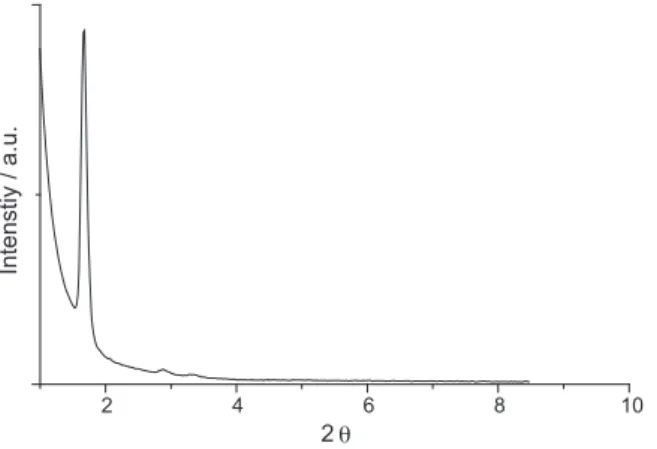
The structure of most ordered mesoporous materials shows a long range ordering of amorphous elements that can be studied by a SAXS technique. The synchrotron radiation small-angle pattern for the Cr-MCM-41 (Fig. 4) exhibits (1 0 0), (1 1 0) and (2 0 0) reflections at 2= 1.67, 2.90 and 3.35◦, respectively. The peaks can be indexed
to the 2D hexagonal symmetry, indicating a highly ordered hexago-nal structure[3]. Thus, the SAXS experiment has also confirmed that the prepared chromium-containing material has a typical structure of the MCM-41 silicate.
The diffractogram of the Cr-MCM-41 material exhibits no defined peaks of chromium oxide phases (Fig. 5a). On the other hand, the XRD pattern for Cr–SiO2/sol–gel (Fig. 5b) shows the
pres-ence of weak peaks characteristic of the Cr2O3phase indicating the
formation of small amounts of chromium oxide microcrystallites on the material surface. The crystallites size estimated from the most intense peak using the Scherrer equation showed the value of 26 nm. The matrices of both materials are amorphous.
After calcinations, the Cr–SiO2/sol–gel material was pale green
in color, whereas the Cr-MCM-41 sample was yellow. The green color could be due to the presence of Cr3+ions, whereas the
yel-low one could be caused by Cr6+ions. Really, the TPR profile of the
Cr-MCM-41 sample (Fig. 6) exhibits a broad peak at 430◦C, which
can be assigned to the reduction of Cr6+to Cr3+ [33,34]. On the
other hand, the Cr–SiO2/sol–gel material shows only high
temper-ature peaks: one at 665◦C and the other at 870◦C (Fig. 6). These
peaks can be related to the reduction of strongly interacting with the silica matrix Cr3+ions. In the TPR profile of Cr-MCM-41, there
are no well-defined high temperature peaks up to 900◦C,
suggest-ing even stronger interaction of Cr3+ions with the silica matrix
in this material than in Cr–SiO2/sol–gel. This fact is expected to
contribute valuably to the stability of the catalyst toward metal
1000 800
600 400
200 0
0 2 4 6 8 10 12
TPR Signal/ mV
Temperature / oC
Fig. 6.TPR profiles of the Cr-MCM-41 (dotted line) and Cr–SiO2/sol–gel samples.
leaching under liquid-phase oxidative conditions. It should be men-tioned that in the H2-TPR profiles of both samples, there are no low
temperature peaks which could be assigned to the reduction of bulk Cr2O3(expected at 250–300◦C[34,35]). Thus, the amounts of the
extra-framework Cr2O3in these materials should be small or even
negligible, which correlates with the XRD data (Fig. 5).
The results obtained support the hypothesis that, at least in the Cr-MCM-41 sample, chromium seems to be essentially incor-porated in the silica framework or attached to the surface via surface functional groups, e.g., hydroxyl groups. Small amounts of extraframework Cr2O3were detected only in the Cr–SiO2/sol–gel
material.
3.2. Catalytic studies
The behavior of the prepared Cr–SiO2/sol–gel and Cr-MCM-41
samples was examined in the oxidation of-pinene(1),␣-pinene
(2), and limonene(4) under solventless conditions. In all exper-iments, the reactions were carried out in neat liquid substrates under the atmosphere of molecular oxygen. The results are pre-sented inTables 2–4.
In blank reactions in the absence of catalysts, the conversions of all tested monoterpenes exposed to oxygen at 60◦C were negligible,
both at 1 and 5 atm (not shown in the Tables). On the other hand, both chromium containing materials promoted relatively rapid oxi-dations of these substrates showing similar activities but different selectivities. It is remarkable that the selectivities for the corre-sponding products obtained with Cr-MCM-41 were much higher than those obtained with Cr–SiO2/sol–gel. In general, the
selec-tivities obtained with the Cr-MCM-41 material were the best or among the best reported so far in the literature[22–27]. The oxida-tion of limonene and-pinene gave only four major products with a combined selectivity of 75–90% at 30–40% conversions, which
70 60 50 40 30 20 10
Intensity (a.u.)
2 θ
20 30 40 50
*
*
*
*
Intensity (a.u.)
2 θ
70 60 50 40 30 20
a
b
Table 2
Oxidation of-pinene(1)catalyzed by Cr-catalysts under solvent-free conditions.a
Run Catalyst P(atm) Time (h) Conversion (%) Product selectivity (%) Sallylb(%) TONc
4 5 6 7
1 Cr-MCM-41 1 6 28 29 24 18 21 92 76
2 Cr-MCM-41 5 3.5 32 26 22 15 17 80 87
3d Cr-MCM-41 1 6 4 – – – – – 11
4e Cr-MCM-41 1 6 26 28 22 18 22 90 146
5f Cr-MCM-41 1 6 28 30 22 16 23 91 222
6 Cr–SiO2/sol–gel 1 6 29 30 14 14 16 74 78
7 Cr–SiO2/sol–gel 5 3.5 30 18 16 9 10 53 81
aConditions: catalyst (3.5 wt%), 60◦C, gas phase O2, reaction time 6.0 h at 1 atm and 3.5 h at 5 atm. Conversion and selectivity were determined by GC.
bSelectivities for allylic oxidation products4–7. c TON–moles of the substrate converted/moles of Cr.
dThe catalyst was removed by filtration after 0.5 h at the reaction temperature and the filtrate was allowed to react further. Only trace amount of the products were detected.
eThe catalyst was re-used after run 1; total TON for two reaction cycles is given. f The catalyst was re-used after run 4; total TON for three reaction cycles is given.
Table 3
Oxidation of␣-pinene(2)catalyzed by Cr-catalysts under solvent-free conditions.a
Run Catalyst P(atm) Conversion (%) Product selectivity (%) Sallylb(%) Sepoxb(%) TONc
Allylic oxidation Epoxidation
4–7 8 9 10 11
1 Cr-MCM-41 1 40 12 33 26 8 4 71 12 108
2 Cr-MCM-41 5 38 13 25 26 5 3 64 8 103
3 Cr–SiO2/sol–gel 1 45 10 22 16 8 3 48 11 122
4 Cr–SiO2/sol–gel 5 37 8 25 12 3 3 45 6 100
aConditions: catalyst (3.5 wt%), 60◦C, gas phase O2, reaction time 6.0 h at 1 atm and 3.5 h at 5 atm. Conversion and selectivity were determined by GC.
bSelectivities for allylic oxidation and epoxidation products:4–9and10+11, respectively. c TON–moles of the substrate converted/moles of Cr.
should be considered a good to excellent result for radical reac-tions. At the oxidation of␣-pinene, two major products accounted for 50–60% of the mass balance.-Pinene gave almost exclusively the products of allylic oxidation, i.e., allylic ketones and alcohols; whereas limonene and␣-pinene also produced epoxides in signif-icant amounts.
One of the technological advantages of the process is a possibil-ity to obtain high concentrations of valuable oxygenated products in the final mixtures (30–40 wt%) as the reactions occur in the absence of solvent. Although several major products are formed from each substrate, for practical purposes their separation is often not necessary as the mixtures themselves show interesting organoleptic properties and can be used directly in fragrance com-positions. Moreover, even the separation of the unreacted substrate from the products is often not necessary because the oils enriched in oxygenated compounds find various direct practical applications and cost much more than original oils with higher content of non-functionalized terpenes.
As it will be shown below, the Cr-MCM-41 catalyst does not release the active metal into the solution and can be removed from
the reaction mixture by simple centrifugation or filtration. Such a simple handling represents another attractive feature of the pro-cess. The recovered catalyst after washing can be re-used several times without a significant loss of activity and selectivity.
The oxidation of-pinene(1)in the presence of Cr-MCM-41
occurred smoothly resulting in a 28% conversion for 6 h at 1 atm of oxygen (Table 2, run 1). The reaction gave almost exclusively allylic oxidation products, i.e.,trans-pinocarveol(4), pinocarvone
(5), myrtenal(6), and myrtenol(7), with a high combined selectiv-ity of 92% based on the reacted substrate (Scheme 1). No epoxide or epoxide derived products were detected in the reaction mixtures. In our previous studies,-pinene also exhibited a strong preference for the allylic oxidation over epoxidation, which was explained by the enhanced reactivity of the allylic hydrogen[26,27]. The results of run 1 inTable 2corresponded to a turnover number of 76 with respect to the total amounts of chromium in the material. How-ever, considering that most of the chromium ions were located in the bulk solid and were not accessible to the substrate, the real effi-ciency of the surface chromium species was much higher. In other words, if only the surface chromium species could be counted, the
Table 4
Oxidation of limonene(3)catalyzed by Cr-catalysts under solvent-free conditions.a
Run Catalyst P(atm) Conversion (%) Product selectivity (%) Sallylc(%) Sepoxc(%) TONd
Allylic oxidation Epoxidationb
12 13 14 15
1 Cr-MCM-41 1 36 22 8 25 20 55 20 97
2 Cr-MCM-41 5 41 17 6 22 17 45 17 111
3 Cr–SiO2/sol–gel 1 49 12 4 13 19 29 19 132
4 Cr–SiO2/sol–gel 5 46 12 3 10 13 25 13 124
aConditions: catalyst (3.5 wt%), 60◦C, gas phase O2, reaction time 6.0 h at 1 atm and 3.5 h at 5 atm. Conversion and selectivity were determined by GC.
OH
+
O
2catalyst
+
1
4
5
6
O
+
OH CHO
7
Scheme 1.Oxidation of-pinene(1).
OH
O
+
O2 catalyst
+
2 8 9 10
O O
+
11
Scheme 2.Oxidation of␣-pinene(2).
TON would be higher. It should be mentioned that the reaction rate was not affected by changes in the intensity of stirring, thus the diffusion limitations, if exist, seem to be intraparticle ones.
The reaction was faster under 5 atm of oxygen than at atmo-spheric pressure; however, selectivity was lower (cf. run 2 and run 1 inTable 2). Similar results were obtained for limonene and␣ -pinene (Tables 3 and 4). Thus, there is no practical advantage in using elevated oxygen pressures for this process, which obviously would involve the use of more expensive equipments and more rigorous safety requirements.
The leaching of chromium ions under the reaction conditions was verified in special experiments. In run 3 (Table 2), the Cr-MCM-41 catalyst was filtered off during the course of the reaction at the reaction temperature to avoid re-adsorption of leached metal ions onto the solid support. Then, the filtrate was allowed to react further. No further conversion of-pinene was observed after catalyst removing, providing strong evidence in support of heterogeneous catalysis. Thus, the reaction solution contained no significant amounts of dissolved chromium species and the activity of the catalyst was due to the chromium ions immobilized in the mesoporous silica framework.
After the reaction in run 1 (Table 2), the catalyst was removed by centrifugation, washed with acetonitrile and ethanol and reused two times (Table 2, runs 4 and 5). The behavior of the spent catalyst with fresh substrate was near the same as in the original reac-tion. A total TON for three reaction cycles reached the value of 222. Thus, the catalyst released no chromium into the medium and can be easily recovered either by centrifugation or filtration and re-used. The results obtained in leaching and recycling experiments are in agreement with previous studies[16,18,19]reporting that MCM-41-included chromium catalysts do not suffer metal leaching
during the oxidation reactions. In some cases[17,20]the catalysts lost the activity but only in the first recycling experiment due to leaching of non-framework chromium ions and then their activity was stable.
The oxidation of␣-pinene(2)over the Cr-MCM-41 catalyst gave
mainly verbenol(8) (ca. 80% trans) and verbenone(9) (25–30%
each) as well as small amounts of␣-pinene oxide(10)and camp-holenic aldehyde(11)(Scheme 2,Table 3). Campholenic aldehyde more likely resulted from the skeletal rearrangement of␣-pinene
oxide [36], thus it was referred in Table 2 as the epoxidation
product. In addition, the products of the allylic oxidation of 
-pinene (4–7) were observed in appreciable amounts indicating
that the partial isomerization of␣-pinene occurred in the reaction
medium. On the other hand, no products derived from␣-pinene
were detected at the oxidation of-pinene over the Cr-MCM-41
catalyst. The same substrate conversion of nearly 40% was achieved under 5 atm of oxygen for shorter time; however, the product selec-tivity slightly decreased (Table 3, run 1 vs. run 2).
The reaction with limonene(3) over Cr-MCM-41 resulted in
three main products: carveol(12)(ca. 80%cis), carvone(14), and limonene oxide(15)(cis/trans≈1/1), each at 20–25% selectivity
(Scheme 3,Table 4). Approximately 40% conversion was attained for 6 h under 1 atm and for 3.5 h under 5 atm of oxygen; how-ever, the selectivities for each of the identified products12–15
were lower, likewise with␣-pinene and-pinene (Table 4, runs
1 and 2). Theendocyclic double bond of limonene was much more
sensitive to epoxidation as the epoxide resulting from the oxida-tion of theexocyclic double bond (not shown) was detected only
in small amounts. A higher reactivity of theendo cyclic double
bond of limonene compared to theexocyclic one toward allylic
oxidation is due to a so-called “cyclic activation”, which is an
OH O
O
+ O2
catalyst
+ +
3 12 13 14 15
OH
enhanced reactivity of cyclic allylic hydrogens compared to acyclic ones[27].
It should be mentioned that, in the presence of chromium cat-alysts, both limonene and␣-pinene have demonstrated a stronger preference to allylic oxidation over epoxidation as compared to
cobalt catalysts. In our previous works [25,27] a molar ratio
between allylic oxidation and epoxidation products at the oxidation of limonene and␣-pinene over the cobalt catalysts varied from 1/1 to 2/1, whereas the Cr-MCM-41 catalyst produced allylic products in much higher proportions (3/1–6/1). Thus, chromium catalysts represent interesting alternative for the conventional cobalt cat-alysts in the aerobic oxidations of essential oil-based alkenes; in addition, they could result in fragrance mixtures with other organoleptic characteristics.
The Cr–SiO2/sol–gel material also promoted the oxidation of
all three substrates, -pinene, limonene and ␣-pinene. Product distributions were similar to those obtained with Cr-MCM-41; however, the reaction selectivity was significantly lower. The com-bined selectivity for products4–7formed from-pinene decreased from 92% with the Cr-MCM-41 catalyst to 74% with the conven-tional catalyst prepared without the surfactant, Cr–SiO2/sol–gel
(Table 2, run 1 vs. run 6). Similar results were obtained at the oxi-dation of␣-pinene (Table 3, run 1 vs. run 3) and limonene (Table 4, run 1 vs. run 3), where the combined selectivity for the identified products decreased from 83 to 59% and from 75 to 48%, respectively. Although the surface area of the Cr-MCM-41 material is two and a half times higher than that of Cr–SiO2/sol–gel (Table 1), their
activities were quite similar. Thia could be related to the fact that in the Cr–SiO2/sol–gel a larger proportion of chromium might be
accessible for the substrate due to the larger amounts of extra-framework Cr2O3or/and less amounts of small pores.
In the previous work[5], we have observed a remarkably high selectivity of the MCM-41-included cobalt catalyst in the oxida-tion of isolongifolene. The activity of Co-MCM-41 was much higher than that of the material prepared by the conventional sol–gel method without the surfactant. The results obtained in the present study clearly show that a highly organized structure of the Cr-MCM-41 material also exerts a pronounced beneficial effect on the selectivity of the oxidation of-pinene, limonene, and␣-pinene. In spite of the Cr–SiO2/sol–gel catalyst having larger pores and
higher total pore volume compared to Cr-MCM-41, the reactions over Cr–SiO2/sol–gel were less selective. This implies that pore
geometry is a crucial factor to ensure high selectivity of chromium species during the reaction and to avoid over-oxidation. The struc-ture of the solid matrix should allow a rapid diffusion of bulky products throughout the porous medium to prevent successive reactions. A highly ordered uniform channel-like pore geometry and facile pore connectivity in the Cr-MCM-41 material should favor the transport of the products away from the active chromium sites. The Cr–SiO2/sol–gel material, on the other hand, shows much
more heterogeneous pore shape distribution and might posses ink-bottle pores with narrow mouths. Thus, the primarily formed products could undergo a further oxidation in this material due to a longer contact with catalytically active sites. Besides, the chromium active sites in Cr-MCM-41 are expected to be more energetically
homogeneous than those in Cr–SiO2/sol–gel, which shows lower
surface uniformity. Thus, the textural properties of the Cr-MCM-41 material remarkably benefit the overall selectivity of the oxidation reactions.
4. Conclusions
In summary, chromium-incorporated molecular sieves are effi-cient catalysts for the aerobic oxidation of monoterpenic alkenes
under mild conditions. The use of the renewable biomass-based compounds as the substrates, chromium immobilized in a solid matrix as the catalyst, molecular oxygen as the final oxidant, and solvent free conditions are significant practical advantages of this environmentally friendly process. The catalyst undergoes no metal leaching, and can be easily recovered and re-used without a special treatment. The Cr-MCM-41 material exhibited better per-formance than the sample prepared by the conventional sol–gel method without the surfactant. Further studies are directed toward the applications of chromium-incorporated ordered mesoporous molecular sieves for the oxidation of other renewable substrates.
Acknowledgments
Financial support from the CNPq, CAPES, FAPEMIG and INCT-Catálise (Brazil) is gratefully acknowledged. The authors wish to thank the Microscopy Center, UFMG, Brazil and the LNLS syn-chrotron laboratory, Campinas, Brazil for the equipment time.
References
[1] I.W.C.E. Arends, R.A. Sheldon, Appl. Catal., A 212 (2001) 175–187. [2] M. Ziolek, Catal. Today 90 (2004) 145–150.
[3] C.T. Kresge, M.E. Leonowicz, W.J. Roth, J.C. Vartuli, J.S. Beck, Nature 359 (1992) 710–712.
[4] J.S. Beck, J.C. Vartuli, W.J. Roth, M.E. Leonowicz, C.T. Kresge, K.C. Chu, D.H. Olson, E.W. Sheppard, S.B. McCullen, J.L. Schenkler, J. Am. Chem. Soc. 114 (1992) 10834–10843.
[5] P.A. Robles-Dutenhefner, K.A. da Silva Rocha, E.M.B. Sousa, E.V. Gusevskaya, J. Catal. 265 (2009) 72–79.
[6] J. Muzart, Chem. Rev. 92 (1992) 113–140.
[7] B.M. Choudary, A.D. Prasad, V. Swapna, V.L.K. Valli, V. Bhuma, Tetrahedron 48 (1992) 953–962.
[8] H.E.B. Lempers, R.A. Sheldon, Appl. Catal., A 143 (1996) 137–143.
[9] W.A. Carvalho, P.B. Varaldo, M. Wallau, U. Schuchardt, Zeolites 18 (1997) 408–416.
[10] S. Shylesh, Ch. Srilakshmi, A.P. Singh, B.G. Anderson, Microporous Mesoporous Mater. 99 (2007) 334–344.
[11] J.D. Chen, R.A. Sheldon, J. Catal. 153 (1995) 1–8.
[12] I.C. Chisem, J. Rafelt, J. Chisem, J.H. Clark, D. Macquarrie, M.T. Shieh, R. Jachuck, C. Ramshaw, K. Scott, Chem. Commun. (1998) 1949–1950.
[13] S. Shylesh, P.P. Samuel, A.P. Singh, Appl. Catal., A 318 (2007) 128–136. [14] W. Zhang, J. Wang, P.T. Tanev, T.J. Pinnavaia, Chem. Commun. (1996)
979–980.
[15] N. Ulagappan, C.N.R. Rao, Chem. Commun. (1996) 1047–1048.
[16] T.K. Das, K. Chaudhari, E. Nandanan, A.J. Chandwadkar, A. Sudalai, T. Ravin-dranathan, S. Sivasanker, Tetrahedron Lett. 38 (1997) 3631–3634.
[17] A. Sakthivel, S.K. Badamali, P. Selvam, Catal. Lett. 80 (2002) 73–76.
[18] N. Srinivas, V. Radha Rani, S.J. Kulkarni, K.V. Raghavan, J. Mol. Catal. A 179 (2002) 221–231.
[19] S. Samanta, N.K. Mal, A. Bhaumik, J. Mol. Catal. A 236 (2005) 7–11. [20] A. Sakthivel, P. Selvam, J. Catal. 211 (2002) 134–143.
[21] H. Mimoun, Chimia 50 (1996) 620–625.
[22] M.J. da Silva, J.A. Gonc¸alves, O.W. Howarth, R.B. Alves, E.V. Gusevskaya, J. Organomet. Chem. 689 (2004) 302–308.
[23] J.A. Gonc¸alves, M.J. da Silva, D. Piló-Veloso, O.W. Howarth, E.V. Gusevskaya, J. Organomet. Chem. 690 (2005) 2996–3003.
[24] M.G. Speziali, P.A. Robles-Dutenhefner, E.V. Gusevskaya, Organometallics 26 (2007) 4003–4009.
[25] M.J. da Silva, P.A. Robles-Dutenhefner, L. Menini, E.V. Gusevskaya, J. Mol. Catal. A 201 (2003) 71–77.
[26] L. Menini, M.J. da Silva, M.F.F. Lelis, J.D. Fabris, R.M. Lago, E.V. Gusevskaya, Appl. Catal., A 269 (2004) 117–121.
[27] L. Menini, M.C. Pereira, L.A. Parreira, J.D. Fabris, E.V. Gusevskaya, J. Catal. 254 (2008) 355–364.
[28] E.F. Murphy, T. Mallat, A. Baiker, Catal. Today 57 (2000) 115–126. [29] Y. Shiraishi, Y. Teshima, T. Hirai, J. Phys. Chem. B 110 (2006) 6257–6263. [30] F. Amano, T. Yamaguchi, T. Tanaka, J. Phys. Chem. B 110 (2006) 281–288. [31] M. Kruk, M. Jaroniec, Chem. Mater. 13 (2001) 3169–3183.
[32] A. Corma, Chem. Rev. 97 (1997) 2373–2419.
[33] A.B. Gaspar, R.L. Martins, M. Schmal, L.C. Dieguez, J. Mol. Catal. A 169 (2001) 105–112.
[34] P. Michorczyk, J. Ogonowski, P. Kusˇıtrowski, L. Chmielarz, Appl. Catal., A 349 (2008) 62–69.
[35] T.V.M. Rao, Y. Yang, A. Sayari, J. Mol. Catal. A 301 (2009) 152–158.