Licenciado sob uma Licença Creative Commons DO): http://dx.doi.org. . / - . . .AO
[T]
Flexor-extensor relationship knee after reconstruction
of the anterior cruciate ligament
[)]
Relação l exo-extensora de joelho após a
reconstrução do ligamento cruzado anterior
[A]
Cristiano Ingo Dagnoni[a], Jaqueline Bilibiu[b], Susan Stiehler[c], Cássio Preis[d], Luiz Bertassoni Neto[e]
[a] Spec., Pontifícia Universidade Católica do Paraná PUCR , Curitiba, PR - Brazil, e-mail: [email protected] [b] Spec., Pontifícia Universidade Católica do Paraná PUCR , Curitiba, PR - Brazil, e-mail: [email protected] [c] Spec., Pontifícia Universidade Católica do Paraná PUCR , Curitiba, PR - Brazil, e-mail: [email protected] [d] MSc, professor, Pontifícia Universidade Católica do Paraná PUCR , Curitiba, PR - Brazil, e-mail: [email protected] [e] MSc, professor, Pontifícia Universidade Católica do Paraná PUCR , Curitiba, PR - Brazil, e-mail:
[R]
Abstract
Introduction: The incidence of knee injuries is very high in young adults. Anterior cruciate ligament ACL
rupture is the most frequent of them. The isokinetic dynamometry evaluation determines the function-al patterns of strength and muscle bfunction-alance. Objective: To compare the isokinetic hamstring/quadriceps
peak torque and work ratios of young adults after surgical reconstruction of the anterior cruciate ligament.
Methods: We selected medical records filed by the )sokinetic laboratory of the Physiotherapy Clinic
of the Catholic University of Paraná PUCPR , which belonged to patients who had undergone isokinetic assessment at the request of a physiotherapist or physician in Curitiba, Paraná. The tabulated data were: (amstring/Quadriceps peak torque and work ratios of all injured and non-injured limbs at an angular ve-locity of °/s. Data were processed by the statistical software L(stat. )nferential statistics was used in order to apply the comparison test between means unpaired t-test with a confidence interval of %.
Results: The average flexion-extension ratio of the non-involved limb was lower than the involved limb both
limbs and variables, however, the subjects presented a greater number of muscle asymmetries in the in-volved limb than in the non-inin-volved limb.
[P]
Keywords: )sokinetic. Knee. Anterior cruciate ligament ACL .
[B] Resumo
Introdução: A incidência de lesões de joelho em adultos jovens é muito alta, sendo a ruptura do ligamento cru-zado anterior (LCA) a mais frequente. A avaliação por Dinamometria Isocinética determina o padrão funcional
de força e equilíbrio muscular. Objetivos: Comparar a relação das variáveis isocinéticas torque e trabalho de
flexores e extensores do joelho em adultos jovens após a reconstrução cirúrgica do ligamento cruzado anterior.
Metodologia: Foram selecionados 33 prontuários arquivados pelo laboratório de Isocinética da Clínica de
Fisioterapia da Pontifícia Universidade Católica do Paraná (PUCPR), de pacientes que realizaram a avaliação
isocinética a pedido de fisioterapeutas e de médicos da cidade de Curitiba (PR). Os dados tabulados foram:
re-lação flexora/extensora de pico de torque e trabalho em todos os membros lesionados e não-lesionados a uma
velocidade angular de 60°/s. Os dados foram tratados pelo software de estatística LHstat. A estatística inferen-cial foi empregada para aplicar o teste de comparação entre médias (Teste t não pareado) com um intervalo
de confiança de 95%. Resultados: A média da relação flexo-extensora é menor no membro não envolvido
tanto no pico de torque (relação pico de torque do membro não envolvido 56,1% e relação do pico de torque do membro envolvido 66,3%, apresentando diferença de 10,2%) quanto no trabalho (relação do trabalho no membro não envolvido 60,1% e relação do trabalho do membro envolvido 66,1% apresentando diferença de
6%). Conclusão: A média encontrada da relação flexo-extensora foi adequada para ambos os membros e
vari-áveis, no entanto os indivíduos apresentaram assimetrias musculares em maior número no membro envolvido
do que no membro não envolvido. [K]
Palavras-chave: Isocinética. Joelho. Ligamento cruzado anterior (LCA).
Introduction
The incidence of knee injuries is very high in young adults and reaches approximately % in sports practice. Anterior cruciate ligament ACL disruption is the most frequent of these injuries and males are usually more affected by it. (owever, the incidence in females is increasing every year , , .
The ACL is responsible for about % of the an-terior stabilization of the knee joint. The signs and symptoms that indicate its rupture include: joint stroke, cracking, missteps, pain and difficulty in per-forming some daily life activities. Nevertheless, some individuals do not report symptoms and are classified as adapted to the injury. Surgery candidates usually present motor impairments and have the intention of returning to sport , .
Among the surgical reconstruction procedures available, the most common grafts are derived from the patellar tendon, the tendon of the semitendi-nosus muscle, cadavers allograft , or are synthetic
grafts. Morbidity of the site the graft is acquired from, muscle weakness associated with initial injury and the surgical procedure itself are factors that may in-terfere with postoperative recovery , . )n injured knees, the hamstrings act as ACL synergists and help reduce the incidence of new ligament injuries . Even if the knee presents stability and good range of motion, the ultimate goal of surgical reconstruction cannot be achieved without the recovery of muscle strength , .
and one maximum contraction for familiarization and recruitment of motor units. An angular velocity of °/s was measured in concentric mode and the patient performed three maximum repetitions.
The tabulated data were: (amstring/Quadriceps peak torque and work ratios in all injured and unin-jured limbs at an angular velocity of °/s. The post-operative time period and the side involved were also assessed. The Body Mass )ndex BM) of the entire sample was calculated as body weight divided by height squared kg/m . Data were then processed by the statistical software L(stat and presented though descriptive statistics, graphs and tables. The inferential statistics was used in order to apply the comparison test between means unpaired t-test with a confidence interval of %.
Peak torque ratios between . % and . % were considered to be normal or appropriate both for peak torque and work . Values above . % and below . % were considered to be abnormal or inadequate.
Results
The average body weight was . ± . kg mini-mum of kg and maximini-mum of kg . The average height was . ± . m minimum of . m and maximum of . m . The BM) average was . ± . kg/m minimum of . kg/m and maximum of . kg/m . We found that subjects had a healthy BM) normal range between . and . kg/m and subjects were above the recommend-ed weight to . kg/m .
Regarding the anatomic distribution of the inju-ry, among the cases selected, cases . % had injured the nondominant limb and . % had injured the dominant limb. Most of the subjects . % were evaluated after - months . % and . % were assessed after - .
Table shows the descriptive statistical findings of the following variables: hamstring/quadriceps peak torque ratio in the non-involved limb PTRN) ; ham-string/quadriceps peak torque ratio in the involved limb PTR) ; quadriceps-to-hamstring work ratio in the non-involved limb WRN) and quadriceps-to-hamstring work ratio in the involved limb WR) .
The PTRN) obtained approximately . % of the sample with values between . % to . %. The PTR) obtained approximately . % of the sample important tool to evaluate the functional ability of
joints and to calculate indices of injury risk , . Thus, the aim of this study was to compare the isokinetic hamstring/quadriceps peak torque and work ratios.
Materials and methods
This is an applied study. We used a quantitative descriptive approach and the research design was ex-post facto and documental .
Data collection was performed in August . We collected data from October to June , through the selection of medical records archived by the )sokinetic laboratory of the Physiotherapy Clinic of the Catholic University of Paraná PUCPR which met inclusion and exclusion criteria. )nclusion crite-ria were: male gender; age between and years; postoperative PO ACL reconstruction with semiten-dinosus graft and )sokinetic assessment performed
- months after surgery. Exclusion criteria were: a bilateral knee injury; musculoskeletal and joint disor-ders of the knees; systemic and neurological diseases. All of the selected records belonged to patients who had undergone isokinetic assessment at the re-quest of a physiotherapist or physician in the city of Curitiba. There was, therefore, no prior contact with any recovery stage. )ndividuals undergoing the isokinetic testing were previously assessed through the use of a physical therapy record, on which per-sonal data, height estimated by use of stadiometer , body weight assessed by scale , clinical diagnosis, and other data were recorded. After this first contact was made, patients performed a -minute warm-up on a cycle ergometer with Kpm load.
necessary that its variables follow the normal dis-tribution, because, regardless of the distribution of these variables, their average will be close enough to the normal distribution in order to allow for the use of the t-test .
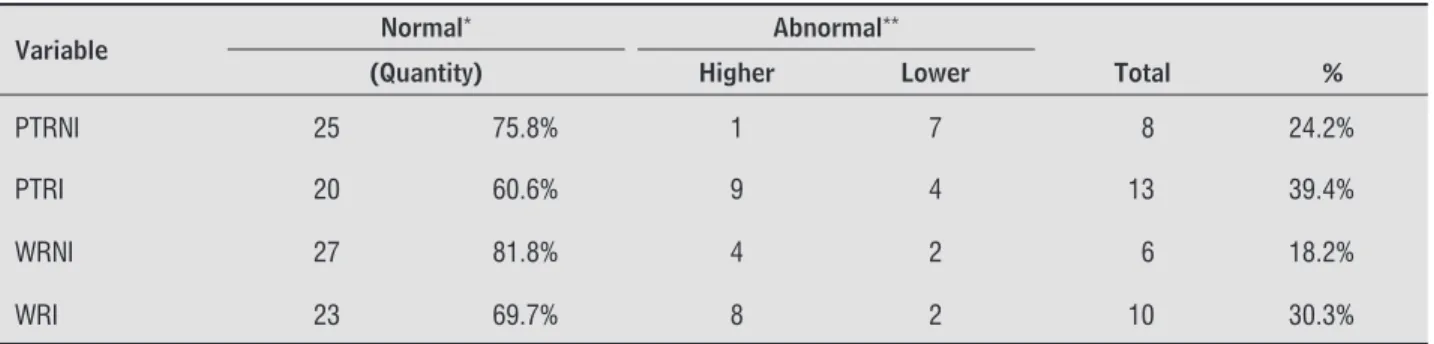
Table shows the distribution of normal and ab-normal cases among the variables, both in absolute value and in percentage. We found a greater ham-strings weakness values in the non-involved lower limb for the peak torque variable. (owever, for all other variables, quadriceps weakness values were higher, even though the sample was constituted by subjects who had undergone ACL reconstruction us-ing a graft of the semitendinosus muscle.
Table shows the distribution of cases of quad-riceps-to-hamstring peak torque and work ratios, according to postoperative months and in absolute number and percentage.
Regarding the peak torque, we observed that subjects had muscle balance and subjects still presented alterations in this aspect, both bilaterally and unilaterally. With regards to work, subjects showed balance, while subjects showed altera-tions from normality.
According to the data from Table , there are more individuals with muscle dysfunction or deficit in the involved limb than in the non-involved limb, inde-pendent of the month considered. (owever, the study also found changes in muscle strength in both limbs.
Data crossing of BM) data with standard values for the agonist-antagonist ratio . % to . % resulted in the formation of two groups: normal BM) and overweight BM). . % of the sample had normal BM) and balance of the agonist-antagonist ratio, . % of the sample showed weakness of the extensor muscles, . % showed weakness of the flexor muscles, and only % showed weakness of both agonists and antagonists.
with values between . % to . %. The average PTRN) was . %, and the average PTR) was . %. Thus, the difference between members was . %, considered statistically significant p < . . The average comparison test was performed with paired data and a normal distribution of sample means at a significance level of %. Student's t value was < % error. Thus, PTR) is higher than PTRN).
The WRN) obtained approximately . %, with values between . % and . %. (owever, the WR) obtained about . % of the sample, with values between . % and . %. The average WRN) was . %, and the average WR) was . %. Thus, the difference between limbs was %, considered statis-tically significant p < . . The average comparison test was also performed with paired data and a nor-mal distribution of sample means at a significance level of %. Student's t value was < % error. Thus, WR) is higher than WRN)
Tests of normality and homoscedasticity were performed for the analysis of the variables PTRN), PTR), WR) and WRN) . The Shapiro-Wilk normal-ity test accepts the hypothesis of normal distribu-tion. A significance level of % or . was used. )f the p-value is below . , the hypothesis of normality for the variable analyzed is rejected. The PTRN) and WRN) variables had p-values > . ; which denotes a normal distribution. The PTR) and WR) variables, on the other hand, had p-values < . ; which denotes an abnormal distribution. This change is due to the high value of standard deviation associated with these variables, which are related to the injured knee.
The homoscedasticity test supports the hypoth-esis of uniform variance of distribution is also based on the p-value and has a significance level of . . All of the analyzed variables analyzed showed val-ues > . ; which indicates the homogeneity of the sample. With a sample of individuals, it is not
Table 1 - Comparison of the hamstring/quadriceps peak torque ratio: descriptive statistical findings
Variable
Peak torque Work
Non-involved limb Involved limb Non-involved limb Involved limb
Minimum 41.8% 36.5% 46.3% 36.9%
Maximum 70.4% 129.5% 75.3% 127.9%
Average 56.1 ± 7.4% 66.3 ± 18% 60.1 ± 7.4% 66.1 ± 17.1%
Table 2 - Distribution of cases among the variables (absolute value and percentage)
Variable Normal
* Abnormal**
(Quantity) Higher Lower Total %
PTRNI 25 75.8% 1 7 8 24.2%
PTRI 20 60.6% 9 4 13 39.4%
WRNI 27 81.8% 4 2 6 18.2%
WRI 23 69.7% 8 2 10 30.3%
Note: PTRNI = hamstring/quadriceps peak torque ratio of the non-involved limb; PTRI = hamstring/quadriceps peak torque ratio of the involved limb; WRNI = quadriceps-to-hamstring work ratio of the non-involved limb; WRI = quadriceps-to-hamstring work ratio of the involved limb; *Normal = PTRNI and PTRI are between 49.9 and 69.9%; **Abnormal = Higher than 69.9% and Lower than 49.9%. Source: Research data.
Table 3 - Distribution of cases among the variables (absolute value and percentage)
Peak torque Work
Time (months)
Normal *
n (%)
Abnormal
** Time
(months)
Normal *
n (%)
Abnormal **
I NI None *** % I NI None *** %
4 5 (15.2%) 5 1 2 24.2 4 8 (24.2%) 2 2 1 15.2
5 3 (09.1%) 2 1 1 12.1 5 5 (15.2%) 2 0 0 06.0
6 à 8 6 (18.2%) 4 2 1 21.2 6 à 8 7 (21.2%) 4 1 1 18.2
Total 14 (42.5%) 11 4 4 57.5 Total 20 (60.6%) 8 3 2 39.4
Note: I = involved limb; NI = non-involved limb; *Normal = NI and I are between 49.9 and 69.9%; **Abnormal = NI and I are lower than 49.9% and/or higher than 69.9%; *** None = none of the lower limbs has any values between 49.9 and 69.9%.
Source: Research data.
. % of the sample had overweight BM) and shoed balance of agonist-antagonist ratio, . % showed weakness of extensor muscles and % showed weakness of the hamstrings.
Discussion
The isokinetic assessment has been used in recent decades as a method to determine the functional pat-tern of muscular strength and balance through the analysis of the following variables: peak torque and agonist-antagonist balance ratio. The angular velocity of °/s is widely used to evaluate the maximum joint moment given in torque, basically for two reasons:
the first is that, the smaller the angular velocity the larger the torque; the second is because at this speed there will hardly be fatigue, obviously respecting the maximum number of repetitions. )n the present study, we used the flexor/extensor FLX/EXT ratio as an assessment parameter, because it is an indica-tor of normality with regard to the balance between the function of the extensors and flexors of the knee. There is a - % oscillation in the flexor/extensor ratio of the healthy knee joint , , , , .
during which time the recovery of muscle function is expected, physical evaluation revealed a deficit in muscle strength , , , , , , .
)n a survey, eleven amateur-level athletes were evaluated months after ACL reconstruction us-ing patellar tendon autogtraft. )ts results show that the FLX/EXT ratio is lower on the involved side. On the other hand, the assessment of twenty-eight ath-letes who had ACL laxity or not , could not detect significant differences in FLX/EXT ratios between the two groups. This evidences that ACL laxity does not affect knee joint muscle balance. Another study evalu-ated patients in the preoperative and postoperative period on two occasions : after months and one year. An imbalance in the FLX/EXT relationship after ACL reconstruction was found, especially in the period of months after surgery , , , . Our study found a higher FLX/EXT ratio on the injured limb, when compared to the non-injured side. This suggests a deficit of the extensor muscles. Our results show a higher FLX/EXT ratio on the reconstructed knee both in the peak torque % deficit between limbs and in work . % deficit between limbs .
A muscle-ligament reflex prevents excessive Anterior Tibial Translation ATT . )t promotes the inhibition of the quadriceps and the activation of the hamstring, which act as a dynamic agonist of the ACL in injured individuals . (owever, there is a significant difference in the agonist/antagonist relation, due to the quadriceps deficit and a little loss of strength of hamstrings, promoting an imbalance in the relationship. During the postoperative recov-ery the readjustment of the FLX/EXT relationship is sought. (owever, an excessive development of quad-riceps strength contributes to a decreased antagonist coactivation of the hamstrings and favors ligament rupture, due to the decrease in the stabilizing forces of this joint , , , , , .
Muscle imbalances detected by the FLX/EXT ratio are associated with a higher incidence of injury in athletes. The current literature shows evidence that the muscle coactivation that takes place in the knee would serve to protect and stabilize the joint during powerful muscle contractions. Moreover, it would be responsible for distributing pressure across the joint and minimizing fatigue and joint damage , .
Among soccer and futsal players , the FLX/ EXT ratio at °/s had an average of . %. The au-thors suggested that the ideal ratio for football play-ers was %. Other studies , found a FLX/EXT of good acceptability; there is, however, no consensus
on the desired normative value. Nevertheless, the use of the conventional ratio alone has limitations since it represents a situation that is absent during the execution of functional movements. Therefore, the functional ratio eccentric flexor peak torque/ extensor concentric peak torque is currently used for this evaluation. Changes in this ratio predispose to injury in the knee joint and strains in the hamstring muscles , , , , , . )n the present study we could confirm average values of to % for the agonist-antagonist ratio within to months of postoperative reavaluation in the absolute majority of the sample.
Quadriceps muscle atrophy, instability and pain are clinical complaints that may be explained by defi-cits in muscle performance after the recovery process
, , .
The loss of muscle strength is associated with pro-prioceptive loss, thus, one should be cautious when using the non-injured side as a normal parameter for the injured side, because the injured side can influ-ence the contralateral side , .
Studies in subjects with ACL disruption show that return to function at pre-injury level is dependent on the knee extensor strength and that return to a functional level is positively correlated with muscle strength assessments. The FLX/EXT ratio in healthy individuals reaches between % and % and the increase in FLX/EXT is probably due to a extensor muscle strength deficit .
smaller part presented asymmetries. Regarding the measuring variables peak torque and work , indi-viduals presented a great number of muscle deficits in the involved limb than in the non-involved limb.
Therefore, we suggest the need to promote great-er attention to the functional recovgreat-ery of muscle strength of the limb involved by the lesion, yet with-out forgetting the importance of maintaining muscle strength and balance of the contralateral limb, both in bilateral balance and FLX/EXT ratio.
References
. Kisner C, Colby LA. Exercícios terapêuticos: funda-mentos e técnicas. . ed. São Paulo: Manole; . . Tria AJ. Lesões ligamentares do joelho: anatomia,
di-agnóstico, tratamento e resultados. Rio de Janeiro: Revinter; .
. Cohen M. Tratado de Ortopedia. São Paulo: Roca; .
. Fatarelli )FC, Almeida GL, Nascimento BG. Lesão e reconstrução do LCA: uma revisão biomecânica e do controle motor. Rev Bras Fisioter. ; : - . . Silva R, Matos MA, Silva DJA, Abreu MS. Associação
en-tre tempo de rupturas do ligamento cruzado anterior e frequência de outras lesões articulares do joelho. Rev Bras Ortop. ; : - .
. Eriksson K, (amberg P, Jansson E, Larsson (, Shalabi A, Wredmark T. Semitendinosus muscle in anterior cru-ciate ligament surgery: morphology and function. Ar-throscopy. ; : - .
. Vasconcelos RA, Bevilaqua-Grossi D, Shimano AC, Paccola CJ, Salvini TF, Prado CL, et al. Análise da cor-relação entre pico de torque, desempenho funcional e frouxidão ligamentar em indivíduos normais e com reconstrução do ligamento cruzado anterior. Rev Bras Ortop. ; : - .
. Rosene JM, Fogarty TD, Mahaffey BL. )sokinetic hamstrings: quadriceps ratios in intercollegiate ath-letes. J Athl Train. ; : - .
. Kobayashi A, (iguchi (, Terauchi M, Kobayashi F, Kimura M, Takagishi K. Muscle performance after anterior cruciate ligament reconstruction. )nt Orthop.
; : - . . % at the same speed in men and an average of
and % in young volleyball players . Thus, in the present study, the involved limb pre-sented higher averages of FLX/EXT peak torque and work ratios. Even though within the normal range . % to . % , they were closer to the superior boundary value, which suggests a tendency for exten-sor muscle strength deficiency. )t can be observed, taking the value of normality as parameter, that there was a decrease of approximately % of the total sample for the peak torque ratio and % of the total sample for the work ratio, when the non-injured limb was compared with the injured. The lowest abso-lute percentage of the sample found in the involved limbs may suggest the process of functional recovery, which is still in continuity. This correlation further demonstrates the difficulty in achieving muscular balance during post-surgical recovery process, given the fact that not even the healthy limb reached % of normality.
)n sedentary people, muscle imbalances values lower than % are considered normal and accept-able. (owever, in athletes, imbalance values superior to % may, sometimes, already be important, because their muscles must be well conditioned for maximum performance during sports activity . The imbal-ance between the strength of the quadriceps and hamstring muscles suggests not to exceed the po-tential strength of the quadriceps more than % in relation to the hamstring muscles, in order to protect the joints and muscles. )t is stated that a reduction of - % of the strength of the hamstrings to the quadriceps predisposes to injury. A careless strength training of the hamstring muscles may reduce coacti-vation of antagonists in response to the superiority of quadriceps strength . We found in this study, a bilateral difference of . % for the FLX/EXT peak torque ratio and % for the work ratio, which brings a concern about the imbalance found, given the fact that, in a sample of physically active people, such in-dices may be interpreted as a risk of injury.
Conclusion
. Fonseca ST, Ocarino JM, Silva PLP, Bricio RS, Costa CA, Wanner LL. Caracterização da performance muscu-lar em atletas profissionais de futebol. Rev Bras Med Esporte. ; : - .
. Coombs R, Garbutt G. Developments in the use of the hamstring: quadriceps ratio for the assessment of muscle balance. J Sports Sci Med. ; : - . . Weber FS, Silva BGC, Radaelli R, Paiva C, Pinto RS.
Aval-iação isocinética em jogadores de futebol profissional e comparação do desempenho entre as diferentes posições ocupadas no campo. Rev Bras Med Esporte.
; : - .
. Pássaro AC, Marques AP, Sacco )CN, Amadio AC, Ba-carin TA. Mecanismos de ativação agonista e antago-nista no joelho de indivíduos com reconstrução de ligamento cruzado anterior: estudo cinético e ele-tromiográfico. Acta Ortop Bras. ; : - . . Dvir Z. )socinética: avaliações musculares,
interpre-tações e aplicações clínicas. São Paulo: Manole; . . Lautamies R, (arilainen A, Kettunen J, Sandelin J, Ku-jala UM. )sokinetic quadriceps and hamstring muscle strength and knee function years after anterior cru-ciate ligament reconstruction: comparison between bone-patellar tendon-bone and hamstring tendon autografts. Knee Surg Sports Traumatol Arthrosc.
; : - .
. Vasconcelos RA, Arakaki JC, Simão AP, Oliveira AS, Paccola CJ, Bevilaqua-Grossi D. Análise da translação anterior da tíbia, pico de torque e atividade eletro-miográfica do quadríceps e isquiotibiais em indivídu-os com lesão do ligamento cruzado anterior em cadeia cinética aberta. Acta Ortop Bras. ; : - . . Aquino CF, Vaz DV, Brício RS, Silva PLP, Ocarino JM,
Fonseca ST. A utilização da dinamometria isocinética nas ciências do esporte e reabilitação. R Bras Ci e Mov.
; : - .
. Jamshidi AA, Olyaeia GR, (eydarian K, Talebian S. )so-kinetic and functional parameters in patients follow-ing reconstruction of the anterior cruciate ligament. )ES. ; : - .
. Pincivero DM, (eller BM, (ou S). The effects of ACL injury on quadriceps and hamstring torque, work and power. J Sports Sci. ; : - .
. (iemstra LA, Webber S, MacDonald PB, Kriellaars DJ. (amstring and quadriceps strength balance in normal and hamstring anterior cruciate ligament-reconstruct-ed subjects. Clin J Sport Mligament-reconstruct-ed. ; : - . . Vasconcelos RA, Bevilaqua-Grossi D, Shimano AC,
Pac-cola CJ, Salvini TF, Prado CL, et al. Confiabilidade e validade de um dinamômetro isométrico modificado na avaliação do desempenho muscular em indivíduos com reconstrução do ligamento cruzado anterior. Rev Bras Ortop. ; : - .
. Machado SM, Souza RA, Simão AP, Jerônimo DP, Silva NS, Osorio RAL, et al. Estudo comparativo de variáveis isocinéticas do joelho em atletas de taekwondo e kick-boxing. Fit Perf J. ; : - .
. Goulart LF, Dias RMR, Altimari LR. Variação do equilí-brio muscular durante uma temporada em jogadores de futebol categoria sub- . Rev Bras Med Esporte.
; : - .
. Gil AC. Como elaborar projetos de pesquisa. . ed. São Paulo: Atlas; .
. Loesch C. Probabilidade e estatística. Rio de Janeiro: LTC; .
. Bowerman SJ, Smith DR, Carlson M, King GA. A com-parison of factors influencing ACL injury in male and female athletes and non-athletes. Phys Ther Sport.
; : - .
. Kong PW, Burns SF. Bilateral difference in hamstrings to quadriceps ratio in healthy males and females. Phys Ther Sport. ; : - .
. (olcomb WR, Rubley MD, Lee (J, Guadagnoli MA. Effect of hamstring-emphasized resistance training on hamstring: quadriceps strength ratios. J Strength Cond Res. ; : - .
. Terreri ASAP, Greve JMD, Amatuzzi MM. Avaliação isocinética no joelho do atleta. Revista Brasileira de Medicina do Esporte. ; : - .
. (ewett TE, Myer GD, Zazulak BT. (amstrings to quad-riceps peak torque ratios diverge between sexes with increasing isokinetic angular velocity. J Sci Med Sport.
; : - .
. Bittencourt NFN, Amaral GM, Anjos MTS, D’Alessandro RD, Silva AA, Fonseca ST. )sokinetic muscle evalua-tion of the knee joint in athletes of the under- and under- male Brazilian national volleyball team. Rev Bras Med Esporte. ; : - .
. Assis MMV, Gomes M), Carvalho EMS. Avaliação isoci-nética de quadríceps e ísquios-tibiais nos atletas de jiu-jitsu. Rev Bras Promoç Saúde. ; : - .
Received: / /
Recebido: / /
Approved: / /
Aprovado: / /
. Portes EM, Portes LA, Botelho VG, Pinto SS. )sokinetic torque peak and hamstrings/quadriceps ratios in en-durance athletes with anterior cruciate ligament lax-ity. Clinics. ; : - .
. Traete RF, Pinto KNZ, Mattiello-Rosa SM. Relationship between chondral lesion and peak torque following anterior cruciate ligament reconstruction: case study. Rev Bras Fisioter. ; : - .
. Ageberg E, Roos (P, Silbernagel KG, Thomeé R, Roos EM. Knee extension and flexion muscle power after anterior cruciate ligament reconstruction with patel-lar tendon graft or hamstring tendons graft: a cross-sectional comparison years post surgery. Knee Surg Sports Traumatol Arthrosc. ; : - . . )ga J, George K, Lees A, Reilly T. Cross-sectional
inves-tigation of indices of isokinetic leg strength in youth soccer players and untrained individuals. Scand J Med Sci Sports. ; : - .