ORIGIN
AL RESEAR
CH
Corresponding address: Igor Almeida Silva – Rua Santa Luzia, nº 3061, Bairro Ilhotas – Teresina (PI), Brasil – Zip Code: 64014-073 – Phone: +55 (86) 99900-8528 – Email: [email protected] – Source of inancing: Nothing to declare – Conlict of interests: Nothing to declare – Presentation: Dec. 2016 – Accepted for publication: Mar. 2017 – Approved by the Ethics Committee with opinion no. 218.352.
1Undergraduate student of Physical therapy at Universidade Estadual do Piauí (UESPI) – Teresina (PI), Brazil.
2Doctor in Biomedical Engineering at Universidade Camilo Castelo Branco (UNICASTELO) and professor at Universidade Estadual do Piauí (UESPI) – Teresina (PI), Brazil.
3Doctor in Biomedical Engineering from Universidade Camilo Castelo Branco (UNICASTELO) and professor at Universidade Estadual do Piauí (UESPI) – Teresina (PI), Brazil.
ABSTRACT | Aging causes morphological, functional and biochemical changes. Feet are afected in this process, which impairs the functional balance and increases the risk of falls. To reduce such efects, Proprioceptive Neuromuscular Facilitation (PNF) can be used, because it improves perfusion, strength and coordination of lower limbs. Objective: To evaluate the efects of PNF on balance in older adults. Method: This is a longitudinal and quantitative study, from a public hospital in Teresina-Piauí. Twenty women aged from 65 to 80 years were submitted to a PNF protocol. Baropodometry (total, forefoot and hindfoot areas) was measured in static (no perturbation) and dynamic (with perturbation) conditions. Timed Up and Go (TUG) and functional reach were also tested. No diferences were found in forefoot when the areas before and after intervention were compared. However, the area decreased after the exercises in static (hindfoot before: 150.85cm² and after: 147.40cm²; p=0.0593) and dynamic assessments (hindfoot before: 154.30cm² and after: 151.40cm²; p=0.0783). TUG decreased from 10.75s to 8.23s (p<0.0001) and functional reach increased from 21.07cm to 31.10cm (p<0.0001). Older women showed higher activation of plantar muscles and the plantar area decreased after the PNF protocol. Gait speed and functional reach improved after the exercises and such improvement is associated to a lower risk of falls.
Keywords | Aged; Rehabilitation; Exercise; Postural Balance.
62
RESUMO | Envelhecimento é um processo no qual existem alterações morfológicas, funcionais e bioquímicas. Os pés são estruturas acometidas nesse processo, afetando o equilíbrio corporal e aumentando o risco de quedas. Para minimizar esses efeitos, a Facilitação Neuromuscular Proprioceptiva (FNP) pode ser utilizada, pois melhora a perfusão, a força e a coordenação dos membros inferiores. Teve objetivo avaliar os efeitos da FNP no equilíbrio de idosos. Trata-se de estudo longitudinal e quantitativo, realizado em um hospital público em Teresina (PI). Participaram 20 idosas com idade entre 65 e 85 anos, submetidas a um protocolo de FNP. Foram coletados dados baropodométricos (áreas total, do antepé e do retropé) de forma estática (sem perturbação) e dinâmica (com perturbação), além do teste Timed Up and Go (TUG) e do teste de alcance funcional. Não houve diferença nas áreas plantares antes e após a intervenção, apesar da diminuição da área após os exercícios na avaliação estática (retropé antes: 150,85cm² e depois: 147,40cm²; p=0,0593) e na avaliação dinâmica (retropé antes: 154,30cm² e depois: 151,40cm²; p=0,0783). Foi observada diminuição do tempo do TUG de 10,75s para 8,23s (p<0,0001) um aumento da área de deslocamento, de 21,07cm para 31,10cm (p<0,0001) no teste de alcance funcional. As idosas apresentaram maior ativação dos músculos plantares, com diminuição da área de apoio após o protocolo de FNP. Houve melhora signiicativa no tempo de marcha e no alcance funcional
Efect of a Proprioceptive Neuromuscular Facilitation
(PNF) protocol on the postural balance of older
women
Efeito de um protocolo de Facilitação Neuromuscular Proprioceptiva (FNP) no equilíbrio
postural de idosas
Resultado de un protocolo de Facilitación Neuromuscular Propioceptivo (FNP) en el balance
postural de adultos mayores
Igor Almeida Silva1, Jeferson Rodrigues Amorim1, Fabiana Teixeira de Carvalho2, Laiana Sepúlveda de
nas idosas, o que está associado a um menor risco de quedas após os exercícios.
Descritores | Idoso; Reabilitação; Exercício; Equilíbrio Postural.
RESUMEN | Envejecer es un proceso en el que ocurre cambios morfológicos, funcionales y bioquímicos. Los pies sufren este proceso, lo que afecta al balance corporal y aumenta el riesgo de caídas en los adultos mayores. Para minimizar estos efectos, la Facilitación Neuromuscular Propioceptiva (FNP) es empleada ya que mejora la perfusión, la fuerza y la coordinación de los miembros inferiores. Este estudio tiene el propósito de evaluar los resultados de la FNP en el balance postural de adultos mayores. Se trata de un estudio de tipo longitudinal y cuantitativo, llevado a cabo en un hospital público de la ciudad de Teresina, Brasil. Participaron veinte adultos mayores entre 65 y 85 años de edad, y los sometieron a un protocolo de FNP. Se recolectaron datos baropodométricos (áreas total, del antepié y del retropié) de forma estática (sin interferencias) y dinámicas
(con interferencias), además de aplicar la prueba Timed Up and Go (TUG) y la prueba del alcance funcional. Las áreas plantares antes y después de la intervención no presentaron diferencias, aunque ocurrió una disminución del área después de los ejercicios en la evaluación estática (retropié antes: 150,85cm² y después: 147,40cm²; p=0,0593) y en la evaluación dinámica (retropié antes: 154,30cm² y después: 151,40cm²; p=0,0783). Se observó una disminución del tiempo del TUG de 10,75s para 8,23s (p<0,0001) y un aumento del área de desplazamiento de 21,07cm para 31,10cm (p<0,0001) en la prueba del alcance funcional. Los adultos mayores tuvieron sus músculos plantares más activados, con una disminución del área de apoyo después del protocolo FNP. Además, presentaron una mejora signiicativa en el tiempo de marcha y en el alcance funcional, lo que puede asociar a un menor riesgo de caídas después de los ejercicios.
Palabras clave | Anciano; Rehabilitación; Ejercicio; Balance Postural.
INTRODUCTION
he number of older people increases at a faster rate than the number of people who are born, generating a change in the structure of spending in several areas, among them health. his is a trend that will persist over the next few years, and by the year 2025 it is estimated that there will be more than 800 million people over the age of 65 worldwide. In Brazil, in 2030 it is estimated that 40.7 million people will be over 65 years old. Regarding life expectancy in Brazil, it should reach 77.4 years in 2030. his longevity can be associated with improvements in the population’s health conditions, together with advances in health care1-3.
Aging is understood as a natural, progressive and dynamic process in which there are morphological, functional and biochemical changes that make the organism more susceptible to aggressions and deformities4. As a person ages, the risk of various
diseases increases, including those that afect sensory and motor control of the feet.
Scott et al.5 characterized the feet of older adults.
hey observed predominance of lat and pronated positioning and hallux valgus, and reported deformities in the toes, muscle weakness of the lexors and extensors of the hallux, reduction of tactile sensitivity, and pressure in the heel and in the anterior and lateral
region of the foot. Chiappin6 observed that older adults
had a larger plantar area when compared with young people, and Luvizutto4 reported that the older adults
had a reduction in the median longitudinal arch. All of these changes can impair the balance and cause falls.
Falls represent, according to the International Classiication of Diseases (ICD-10), the main cause of damages in older adults. hey can generate complications, such as prolonged bed rest, hospitalization, depression, dependence on activities of daily living and even death7-9.
One proposed treatment to minimize the efects of aging is Proprioceptive Neuromuscular Facilitation (PNF). PNF is a method that uses diagonal and spiral movements, aiming at facilitating, strengthening, gaining control and coordinating movements. Such method activates proprioceptors that are located in the joints, tendons and muscles10, consequently improving
motor function.
Studies have shown positive efects of PNF on the balance and functionality of older adults11,12. However,
and the functional balance of older women submitted to a PNF exercises protocol in order to better adapt future rehabilitation programs.
METHODOLOGY
his is a longitudinal, quantitative study conducted in the Outpatient Physical therapy sector of a public hospital in Teresina-Piauí. It obeyed the ethical criteria, based on Resolution no. 218.352 of the National Health Council – CNS, with approval by the Research Ethics Committee of Universidade Estadual do Piauí – CEP / UESPI, with opinion no. 218.352 and signature of informed consent form.
he sample was of the simple random type, consisting of 20 older women. Women between 65 and 85 years old were included, who did not perform regular physical activity and who agreed to participate in the study. Women who presented some restriction to perform the proposed activities or lack of understanding were excluded as well as those that lacked in more than two consecutive attendances.
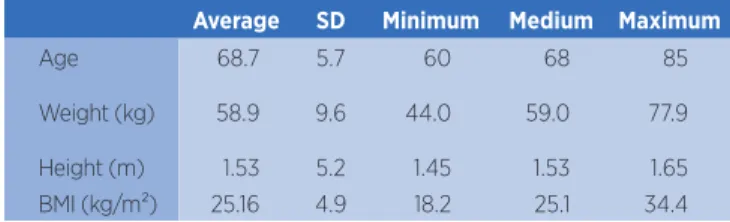
An anthropometric evaluation (weight, height and body mass index – BMI, Table 1) was performed. Baropodometric and stabilometric data were collected with the S-PLATE Electronic Baropodometry device, with a force platform with 1,600 sensors and an active surface of 400 x 400mm, with dimensions of 610 x 580 x 4mm, connected to a laptop with 1.86GHz processor, 0.99 GB of RAM. Participants were instructed to stand on the platform, in bipodal support, barefoot, spaced approximately the same width of the hip. hey were instructed to remain open-eyed, gazing at a point marked on the wall, at eye level and arms relaxed throughout the body, for a period of 30 seconds.
Table 1. Age and anthropometric characteristics of study participants
Average SD Minimum Medium Maximum
Age 68.7 5.7 60 68 85
Weight (kg) 58.9 9.6 44.0 59.0 77.9
Height (m) 1.53 5.2 1.45 1.53 1.65
BMI (kg/m²) 25.16 4.9 18.2 25.1 34.4
Kg: kilograms; M: meters; Kg/m²: kilograms per square meter; SD: standard deviation
he evaluation was divided in two stages: static (T1), in which the participant remained in static posture during the 30s and dynamics (T2), after 15s a visual
signal was given and a 90° lexion of the upper limbs was requested and the maintenance until it completes another 30 seconds. Total plantar support area in cm2,
forefoot and hindfoot area were evaluated. For functional evaluation, the Timed Up and Go Test (TUG) and the functional reach test were used.
he Timed Up and Go Test (TUG) measures the time it takes the individual to perform movements such as lifting from a chair, walking ten feet forward, turning, walking back, and sitting on the chair. It thus characterizes a set of routine, basal actions for independent mobility. Performance is afected by factors such as reaction time, muscle strength, balance and gait13-15.
he functional reach test aims to determine how capable the older person is to move within the previous stability limit. It was performed in orthostatism, with bare feet parallel and perpendicular to the wall, without touching it, with the shoulder bent at 90°, elbow extended and ingers lexed. A tape measure was placed horizontally on the wall at the participant’s shoulder. he initial value corresponded to the positioning of the 3º metacarpus in relation to the tape. Participants were instructed to lean forward as much as possible, without losing their balance, or taking a step. he space traveled on the tape was evaluated considering the displacement of the 3rd metacarpal. his test is widely used to identify risk of falls. he result is given by the average, after three attempts, of the diference between the measurement in the initial and inal positions16,17.
he PNF exercise protocol was performed based on an earlier study by Mesquita et al.17. he exercises lasted
for four weeks. In the irst, only a series of ten repetitions was performed; in the second week, two sets of ten repetitions, and, in the third and fourth weeks, three sets of ten repetitions. he resistance of the exercises was manually done during the entire range of motion. hree speciic principles of PNF were used: rhythmic initiation, sustain-relax, and reversal of antagonists.
and internal abduction-abduction-rotation diagonal was performed.
Continuing, exercises were performed for lower limbs, in the symmetrical bilateral antagonist pattern with the diagonal of lexion-adduction-medial rotation and extension-abduction-lateral rotation (diagonal that simulates gait). hen, the lexion-abduction-medial rotation and lateral extension-adduction-rotation diagonal was performed, with the knee lexion variant in the lexion patterns and the knee extension variant in the extension patterns. In the lateral decubitus position, we performed shoulder and pelvic girdle exercises in the diagonal anterior-elevation-posterior-depression, in a symmetrical and reciprocal manner, aiding in the dissociation of the waists.
Data processing and analysis were performed with the BioEstat 5.0 program. Firstly, the Shapiro-Wilk test was applied to evaluate the normality of the variables. Since the variables followed the standard of normality, we performed the Student’s T-test for paired pair of samples, considering statistically signiicant values of p <0.05.
RESULTS
he comparative analysis of the baropodometric data showed an increase in the areas of forefoot, back foot and total plantar area, comparing before treatment without disturbance (A1) and with disturbance (A2). he same behavior was observed after the PNF exercises, when we compared the conditions without (D1) and with the disturbance (D2), with an increase in the average of the forefoot, hindfoot and total plantar areas when there was disturbance (Table 2).
here was a reduction in the means of the forefoot, backfoot and total plantar area when comparing the data before (A1) and after treatment (D1) without disturbance (A1), but without signiicant diference (Table 3). here was a decrease in hindfoot and total plantar area in comparison to before (A2) and after treatment (D2) with disturbance, but without reaching the level of signiicance (Table 3).
We observed a signiicant improvement in the performance of the Timed Up and Go tests and functional range, comparing before and after treatment (Table 4)
Table 2. Comparison of baropodometric data before treatment with and without disturbance and after treatment with and without disturbance
Area A1 A2 P D1 D2 p
Average (SD) Average (SD) Average (SD) Average (SD)
Forefoot (cm²) 148.75 (21.77)
158.15
(20.46) 0.0034t
147.05 (23.8470)
158.45
(21.12) <0.0001t
Hindfoot (cm²) 150.85 (15.04)
154.30
(14.66) 0.0023t
147.40 (14.15)
151.40
(13.86) <0.0001t
Total (cm²) 299.60 (31.17)
312.45
(31.04) <0.0001t
294.45 (30.35)
310.85
(29.06) <0.0001t
Caption: cm²: square centimeters; t: Student’s t-test; A1: older adults before treatment without disturbance ; A2: older adults before treatment with disturbance; D1: older adults after treatment without disturbance; D2: older adults after treatment with disturbance; SD: standard deviation
Table 3. Comparison of baropodometric data before and after treatment without disturbance and before and after treatment with disturbance
Area A1 D1 p A2 D2 p
Average (SD) Average (SD) Média (DP) Média (DP)
Forefoot (cm²) 148.75 (21.77)
147.05
(23.84) 0.3714t
158.15 (20.46)
158.45
(21.12) 0.4707t
Hindfoot (cm²) 150.85 (15.04)
147.40
(14.15) 0.0593t
154.30 (14.66)
151.40
(13.86) 0.0783t
Total (cm²) 299.60 (31.17)
294.45
(30.35) 0.1263t
312.45 (31.04)
310.85
(29.06) 0.3437t
Table 4. Correlation of functional tests before and after treatment
Before After
p Average (SD) Average (SD)
Functional
reach test (cm) 21.07 (7.36) 31.10 (5.91) <0.0001 t
TUG (s) 10.75 (1.72) 8.23 (1.82) <0.0001t
Caption: cm: centimeters; s: seconds; t: Student’s t-test; SD: standard deviation
DISCUSSION
his study used baropodometry and functional tests to evaluate older women submitted to an exercise protocol with FNP. here was a tendency to reduce plantar area, comparing before and after exercise and improvement in balance assessed by functional tests. Baropodometry has been used to understand the mechanisms of adaptation and postural control in people with foot disorders such as older adults. hese processes are dynamic, progressive and irreversible, linked to biological, psychic and social factors18,19.
Body balance is the ability to stand erect or perform body acceleration and rotation movements without any wobbles or falls. Static balance controls the oscillation of the body in the still position and the dynamic uses information from the external and/or internal environment to react to changes in stability, activating the muscles in a coordinated way20,21. In the present work, we compare
the two situations. An increase in the means of the plantar areas was observed in the comparison of the static balance with the dynamic balance (arm elevation). Vandervoort22
describe that older adults present static and dynamic balance alterations, caused by the decline of visual, vestibular and somatosensory function9,23,24. In addition,
there is loss of muscle mass and, consequently, contraction force, increased reaction time and joint stifness due to the loss of elasticity of the connective tissue.
Postural adjustments depend on the functioning of the proprioceptors (muscle spindles, neurotendinous organs and joint receptors) and cutaneous mechanoceptors (Paccini corpuscles and Merckel discs)25. Decreased
sensitivity of plantar baroreceptors impairs control and maintenance of balance24. Toledo and Barela9 report that
the somatosensory system has a more important action in maintaining the balance of older adults. Other sensory systems are more afected by the aging process than the somatosensory system.
PNF exercises are accompanied by great sensory and proprioceptive stimulation. hey use stretch relex,
manual contact, visual and verbal stimulation, with diagonals that simulate functional movements. Regular physical exercise is a good strategy to improve the postural control of older individuals26,27.
In the keep-relax technique28 there is increased lexibility
and increased range of joint motion and muscle strength. During the execution of the movement, the muscles are briely stretched before contraction, stimulating the neuromuscular terminations (proprioceptors), producing higher levels of strength10.
here was a tendency to reduce the means of plantar areas when we compared the conditions before and after the intervention (Table 3). his decrease in area may be related to increased strength and tonus of lower limb muscles. According to Rodrigues et al., one of the important factors that negatively inluence the body balance in older adults is the decrease in muscle strength. In our study, the backrest support area showed a greater tendency to reduce after PNF exercises (p=0.0593t).
here was improvement of the static and dynamic balance after the PNF exercises, with a reduction in TUG time and an increase in trunk lexion in the functional reach test. Cilento et al.29 also veriied
improvement in the balance of older adults after 10 weeks of exercises with PNF, twice a week, evaluated by the functional reach test, sit and lift timed and TUG. Song et al.30 veriied the beneicial efect
of PNF exercises in older women with falls. hey reported improvement in pacing and step length after four weeks of exercises, totaling 12 sessions.
We suggest further research on the exposed subject, with larger samples.
CONCLUSION
Older people showed a tendency to decrease plantar support areas and a signiicant improvement in static and dynamic balance after the four-week PNF protocol.
REFERENCES
2. Andrade FCD, Wu F, Lebrão ML, Duarte YAO. Life expectancy without depression increases among Brazilian older adults. Rev Saude Pública. 2016;50:12. doi: 10.1590/ S1518-8787.2016050005900.
3. Diaconescu MR, Glod M, Costea I. Clinical features and surgical treatment of thyroid pathology in patients over 65 years. Chirurgia (Bucur). 2016;111(2):120-5.
4. Rosa WGN, Navarro RL, Conti ACCF, Almeida MR, Oltramari-Navarro PVP. Assessment of cephalometric characteristics in the elderly. Braz Oral Res. 2015;29(1):1-9. doi: 10.1590/1807-3107BOR-2015.vol29.0040.
5. Scott G, Menz HB, Newcombe L. Age-related diferences in foot structure and function. Gait Posture. 2007;26(1):68-75. doi: 10.1016/j.gaitpost.2006.07.009.
6. Chiappin D. A importância da análise do apoio plantar em idosos: um estudo comparativo entre jovens e idosos. [dissertação]. Porto Alegre: Pontifícia Universidade Católica do Rio Grande do Sul; 2007.
7. Bechara FT, Santos SMS. Efetividade de um programa isioterapêutico para treino de equilíbrio em idosos. Rev Saúde e Pesq. 2008;1(1):15-20.
8. Rebelatto JR, Castro AP, Sako FK, Aurichio TR. Equilíbrio estático e dinâmico em indivíduos senescentes e o índice de massa corporal. Fisioter Mov. 2008;21(3):69-75.
9. Toledo DR, Barela JA. Diferenças sensoriais e motoras entre jovens e idosos: contribuição somatossensorial no controle postural. Rev Bras Fisioter. 2010;14(3):267-75. doi: 10.1590/ S1413-35552010000300004.
10. Magdalon EC. Facilitação neuromuscular proprioceptiva: tratamento isolado em comparação com a associação da estimulação elétrica neuromuscular em membro superior de pacientes hemiparéticos pós-AVC. [dissertação]. Campinas: Universidade Estadual de Campinas; 2004.
11. Song HS, Park SD, Kim JY. The efects of proprioceptive neuromuscular facilitation integration pattern exercise program on the fall eicacy and gait ability of the elders with experienced fall. J Exerc Rehabil. 2014;10(4):236-40. doi: 10.12965/jer.140141.
12. Rodrigues JE, Dibai Filho AV, Silva AG, Gameleira AB, Pontes-Barros JF, Gomes CAFP. O uso da Facilitação Neuromuscular Proprioceptiva em membros inferiores para ganho de equilíbrio dinâmico em idosas sedentárias. Fisioterapia Ser. 2010;5(4):230-4.
13. Bohannon RW, Schaubert K. Long-term reliability of the timed up-and-go test among community-dwelling elders. J Phys Ther Sci. 2005;17(2):93-6.
14. Paula FL, Alves Junior ED, Prata H. Teste “timed up and go”: uma comparação entre valores obtidos em ambiente fechado e aberto. Fisioter Mov. 2007;20(4):143-8.
15. Camara FM, Gerez AG, Miranda MLJ, Velardi M. Capacidade funcional do idoso: formas de avaliação e tendências. Acta Fisiatr. 2008;15(4):249-56.
16. Karuka AH, Silva JAMG, Navega MT. Análise da concordância entre instrumentos de avaliação do equilíbrio corporal em idosos. Rev Bras Fisioter. 2011;15(6):460-6. doi: 10.1590/ S1413-35552011000600006.
17. Mesquita LSA, Carvalho FT, Freire LSA, Neto OP, Zângaro RA. Efects of two exercise protocols on postural balance of elderly women: a randomized controlled trial. BMC Geriatrics. 2015;15:61. doi: 10.1186/s12877-015-0059-3.
18. Brito FC, Litvoc J. Conceitos básicos. In: Brito FC, Litvoc J. Envelhecimento: prevenção e promoção de saúde. São Paulo: Atheneu; 2004. p. 1-16.
19. Fortaleza ACS, Martinelli AR, Nozabieli AJL, Mantovani AM, Camargo MR, Chagas EF, et al. Avaliação das pressões plantares em diferentes situações por baropodometria. Colloquium Vitae. 2011;3(1):6-10. doi: 10.5747/cv.2011.v03. n1.v040.
20. Spirduso WW. Dimensões físicas do envelhecimento. Barueri: Manole; 2005.
21. Pedalini ME, Cruz OL, Bittar RS, Lorenzi MC, Grasel SS. Sensory organization test in elderly patients with and without vestibular dysfunction. Acta Otolaryngol. 2009;129(9):962-5. doi: 10.1080/00016480802468930.
22. Vandervoort AA. Alterações biológicas e isiológicas. In: Pickles B, Compton A, Cott C, Simpson J, Vandervoort AA. Fisioterapia na terceira idade. 2ª ed. São Paulo: Santos; 2000. p. 382-98.
23. Speers RA, Kuo AD, Horak FB. Contributions of altered sensation and feedback responses to changes in coordination of postural control due to aging. Gait Posture. 2002;16(1):20-30.
24. Oliveira DLC, Goretti LC, Pereira LSM. O desempenho de idosos institucionalizados com alterações cognitivas em atividades de vida diária e mobilidade: estudo piloto. Rev Bras Fisioter. 2006;10(1):91-6. doi: 10.1590/S1413-35552006000100012. 25. Souza GS, Gonçalves DF, Pastre CM. Propriocepção cervical e
equilíbrio: uma revisão. Fisioter Mov. 2006;19(4):33-40. 26. Alieri FM. Distribuição da pressão plantar em
idosos após intervenção proprioceptiva. Rev Bras Cineantropom Desempenho hum. 2008;10(2):137-42. doi: 10.5007/1980-0037.2008v10n2p137.
27. Sherrington C, Tiedemann A, Fairhall N, Close JC, Lord SR. Exercise to prevent falls in older adults: an updated meta-analysis and best practice recommendations. N S W Public Health Bull. 2011;22(3-4):78-83. doi: 10.1071/NB10056. 28. Rees SS, Murphy AJ, Watsford ML, McLachlan KA, Coutts
AJ. Efects of proprioceptive neuromuscular facilitation stretching on stifness and force-producing characteristics of the ankle in active women. J Strenght Cond Res. 2007;21(2):572-7. doi: 10.1519/R-20175.1.