Self-esteem in adolescents with Angle Class I, II and III
malocclusion in a Peruvian sample
Karla Florián-Vargas1, Marcos J. Carruitero Honores2, Eduardo Bernabé3, Carlos Flores-Mir4
Objective: To compare self-esteem scores in 12 to 16-year-old adolescents with different Angle malocclusion types in a Pe-ruvian sample. Material and Methods: A cross-sectional study was conducted in a sample of 276 adolescents (159, 52 and 65 with Angle Class I, II and III malocclusions, respectively) from Trujillo, Peru. Participants were asked to complete the Rosen-berg Self-Esteem Scale (RSES) and were also clinically examined, so as to have Angle malocclusion classification determined. Analysis of covariance (ANCOVA) was used to compare RSES scores among adolescents with Class I, II and III malocclusions, with participants’ demographic factors being controlled. Results: Mean RSES scores for adolescents with Class I, II and III malocclusions were 20.47 ± 3.96, 21.96 ± 3.27 and 21.26 ± 4.81, respectively. The ANCOVA test showed that adolescents with Class II malocclusion had a significantly higher RSES score than those with Class I malocclusion, but there were no differences between other malocclusion groups. Supplemental analysis suggested that only those with Class II, Division 2 malocclusion might have greater self-esteem when compared to adolescents with Class I malocclusion. Conclusion: This study shows that, in general, self-esteem did not vary according to adolescents’ malocclusion in the sample studied. Surprisingly, only adolescents with Class II malocclusion, particularly Class II, Division 2, reported better self-esteem than those with Class I malocclusion. A more detailed analysis assessing the impact of anterior occlusal features should be conducted.
Keywords: Self-esteem. Malocclusion classification. Adolescents.
1 Dentist, Private Practice, Trujillo, Peru.
2 Assistant professor, Universidad Privada Antenor Orrego, Trujillo, Peru. 3 Senior lecturer, King’s College London Dental Institute, Division of Population
and Patient Health, London, United Kingdom.
4 Associate professor and Head of the Division of Orthodontics, University of
Alberta, Edmonton, Canada.
Submitted: February 26, 2015 - Revised and accepted: July 06, 2015
DOI: http://dx.doi.org/10.1590/2177-6709.21.2.059-064.oar
How to cite this article: Florián-Vargas K, Carruitero MJ, Bernabé E, Flores-Mir C. Self-esteem in adolescents with Angle Class I, II and III maloc-clusion in a Peruvian sample. Dental Press J Orthod. 2016 Mar-Apr;21(2):59-64. DOI: http://dx.doi.org/10.1590/2177-6709.21.2.059-064.oar
» The authors report no commercial, proprietary or financial interest in the products or companies described in this article.
Contact address: Marcos J. Carruitero Honores E-mail: [email protected]
Objetivo: comparar os escores relacionados à autoestima de adolescentes com 12 a 16 anos de idade, portadores de diferentes tipos de má oclusão de Angle, em uma amostra de peruanos. Métodos: um estudo transversal foi conduzido com uma amostra de 276 adolescentes (159, 52 e 65, respectivamente, com má oclusão de Classe I, II e III de Angle) da cidade de Trujillo, Peru. Os participantes foram instruídos a completar a Escala de Autoestima de Rosenberg (Rosenberg self-esteem scale, ou RSES), e também foram submetidos a exames clínicos para determinar qual sua má oclusão, segundo a classificação de Angle. A análise de covariância (ANCOVA) foi utilizada para comparar os escores da RSES dos adolescentes com más oclusões de Classes I, II e III, controlando-se os fatores demográficos dos participantes. Resultados: as médias dos escores da RSES dos adolescentes com Classes I, II e III foram, respectivamente: 20,47 ± 3,96, 21,96 ± 3,27 e 21,26 ± 4,81. O teste ANCOVA revelou que o escore da RSES dos adolescentes com Classe II foi significativamente maior do que o escore dos adolescentes com Classe I, mas não houve diferenças entre os outros grupos de más oclusões. Uma análise adicional sugeriu que podem ser somente os adolescentes Classe II, subdivisão 2, que apresentam autoestima mais elevada, quando comparados aos adolescentes Classe I.
Conclusão: esse estudo mostrou que, no geral, a autoestima dos adolescentes incluídos na amostra estudada não variou em função da má oclusão apresentada. Inesperadamente, apenas os adolescentes com Classe II — especialmente os com Classe II, subdivisão 2 — relataram apresentar uma autoestima mais elevada do que os adolescentes com Classe I. Uma análise mais detalhada deve ser conduzida, avaliando qual característica oclusal da região anterior tem mais impacto.
INTRODUCTION
The physical, social and psychological consequences of a malocclusion have been topics of research for a long time. However, the related evidence is still conlicting. Although studies generally report an association be-tween malocclusion and quality of life scores, the strength of evidence is relatively low. There is a need for standardized methods to enhance comparability be-tween studies.1,2,3 In addition, other subjective domains, such as well-being, happiness and self-esteem, have re-mained largely unexplored in relation to malocclusion. Self-esteem can be defined as the perception of one’s own ability to effectively master or deal with the surrounding environment, and it is affected by the reactions of others towards an individual.4,5,6 It was initially claimed that facial features, especially those related to oral aesthetics, may have a high potential to influence self-esteem, especially during life stages when there is intense social and affective interaction.7 However, the scarce literature on the subject provides conflicting evidence, with some authors arguing that malocclusion affects patients’ self-esteem;8,9 while others report weak to nonsignificant effects of maloc-clusion10 or orthodontic treatment.11,12,13 Reasons are probably related to the multifactorial nature of self-esteem and how individuals may weight individual factors differently. Further research is needed to shed some light onto this research area. There have been no studies reported in Peruvian people, in spite of differences that would need additional investigation, specifically to this population.
The aim of this study was to compare self-esteem scores in 12 to 16-year-old adolescents with difer-ent types of Angle malocclusions in a Peruvian sam-ple. It was hypothesized that adolescents with Class II and III malocclusions would report lower levels of self-esteem than those with Class I malocclusion.
MATERIAL AND METHODS Study sample
A cross-sectional study was conducted with a sam-ple of 276 adolescents aged between 12 to 16 years old, recruited from a typical public school in the Porvenir District, Trujillo, Peru. The sample was selected from a population of 1083 students (550 males and 533 fe-males), with the aid of a stratiied random sampling method proportional to each level of study (332, 220
199, 193 and 139 students, from irst to ith grade, re-spectively). The study included adolescents with per-manent dentition; and excluded those who had cra-niofacial syndromes or congenital malformations, any missing tooth (except for third molars) and had received or were undergoing orthodontic treatment.
A minimum sample size of 156 adolescents (52 com-prising each one of the three Angle malocclusion groups) was required to estimate a mean diference in the Rosenberg Self-Esteem Score equal to or greater than 0.55 units between two of those groups, with an 80% statistical power, 95% conidence level and a com-mon standard deviation of 1 unit.
The study protocol was approved by the Stomatology Permanent Research Committee of Universidad Privada Antenor Orrego (Trujillo, Peru). A written informed consent form from the participants’ parents and an in-formed assent form from the adolescents were obtained before participation.
Data collection
Data were collected with the aid of a self-administered questionnaire and clinical examinations. The ten-item Rosenberg Self-Esteem Scale (RSES) was used to assess participants’ global self-esteem.5,14 Responses to the ten items were scored using a four-point scale ranging from 0 (strongly disagree) to 3 (strongly agree) with items 2, 5, 6, 8, and 9 reverse scored. Higher scores indicate higher self-esteem (possible scores range from 0 to 30). The Spanish ver-sion of the RSES was used for this study and showed good psychometric properties (validity and reliabil-ity) in a similar adolescent population.15 Cronbach’s alpha of the RSES was 0.70 in this sample.
Ten individuals were re-examined ater a week for reli-ability. Kappa values for intra- and inter-reliability were 1.00 and 0.85, respectively.
Statistical analysis
RSES total score showed a negatively skewed dis-tribution, suggesting the use of nonparametric tests. However, we used analysis of covariance (ANCOVA) to compare the total score, as ANCOVA has several advantages over nonparametric tests.17 It allows cpensating for multiple comparisons by using an om-nibus test, controlling for categorical and continuous confounders (adolescents’ sex and age in years, respec-tively) and testing for interactions among explanatory variables.17,18 Post-hoc comparisons between pairs of malocclusion groups were conducted by Schefé’s test and only if the omnibus test was statistically signiicant. A logistic regression analysis was used to evaluate the inluence of malocclusion on low self-esteem.
RESULTS
A total of 276 12 to 16-year-old adolescents (141 girls and 135 boys) participated in the present study. Their mean age was 14.2 ± 1.3 years, with a quarter of the sample being 14 years old. According to Angle’s classiication, 57.6% of the sample had Class I malocclusion, 18.9% had Class II malocclusion and 23.5% Class III malocclusion (Table 1).
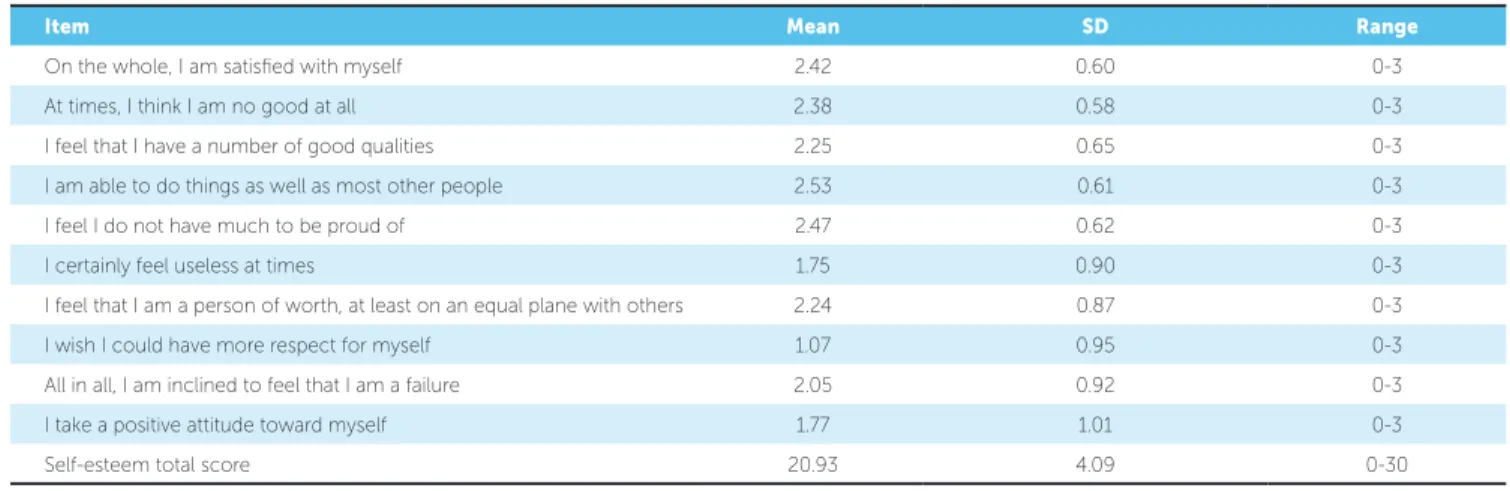
Table 2 shows the mean scores for RSES individ-ual items and the total score. The mean RSES total score was 20.93 ± 4.09; range = 0 - 30. There was no
floor effect (minimum possible score), but four indi-viduals had the maximum possible score (ceiling ef-fect). Mean scores for RSES individual items ranged between 1.07 for the item “I wish I could have more respect for myself,” and 2.53 for the item “I am able to do things as well as other people.”
There were significant differences in the total self-esteem score between the three Angle’s maloc-clusion groups (ANCOVA test, p = 0.048). Post-hoc comparisons showed that adolescents with Class II malocclusion had a significantly higher total self-esteem score than those with Class I malocclusion (21.96 versus 20.47 units). There were no significant differences between other malocclusion groups. Finally, the two-way interaction terms between malocclusion group and sex, and malocclusion group and age, were not significant (p > 0.05 in both cases).
In further exploratory analysis, due to limited num-bers of participants with Class II, Divisions 1 and 2 malocclusion (30 and 22 individuals, respectively), there was signiicant diference in the RSES score be-tween Class II, Division 2 (Mean = 22.59, SD = 2.50) and Class I malocclusion groups (independent group t-test, p = 0.001), but not between Class II, Divi-sion 1 (Mean = 21.50, SD = 3.70) and Class I malocclu-sion groups (independent group t-test, p = 0.172).
A logistic regression analysis was used to evaluate the inluence of malocclusion on low self-esteem. Accord-ing to this analysis, there was no inluence of any type of malocclusion on low self-esteem (R2 = 0.01, p > 0.05).
Characteristic n %
Sex Girls 141 51.1
Boys 135 49.9
Age
12 years 29 10.5
13 years 58 21.0
14 years 70 25.4
15 years 62 22.5
16 years 57 20.6
Angle’s classiication
Class I 159 57.6
Class II 52 18.9
Class III 65 23.5
DISCUSSION
Our indings showed that self-esteem scores, as mea-sured by RSES, vary by certain Angle’s malocclusion groups. Contrary to our hypothesis, only adolescents with Class II malocclusion reported higher self-esteem when compared to those with Class I malocclusion. No other groups were found to difer in terms of self-esteem scores. Our indings disagree with previous studies in which ad-olescents with Class II malocclusion had poorer self-es-teem, which was measured by the child self-esteem scale, than those with Class I and III malocclusions.9 In further supplemental, but exploratory analysis, we also found that it may be those with Class II, Division 2 malocclusion who have greater self-esteem compared to adolescents with Class I malocclusion.
We could speculate on possible explanations for the present indings. First, Class II, Division 2 malocclusion individuals tend to have a very prominent chin, straight or concave facial proile and strong facial muscular dei-nition.19 These features could very well be associated with a more aesthetic facial deinition. The problem with this explanation is that prominent chins and strong
facial musculature are characteristics that are associated with male facial features and not female ones.
A second explanation relates to how adolescents’ malocclusion was assessed in this study. Angle’s clas-siication remains the most commonly used classiica-tion of malocclusions and its universal acceptance by the dental profession is evidence of its practicability.20 We chose this classiication for the relationship it has with the facial proile of the patient,21 which impacts on oneself and lay person’s perception.22 However, Angle’s classiication system was mainly based on the antero-posterior position of irst molars,16 and not all anterior dentoalveolar features that are likely to impact lay per-son’s aesthetic preferences. Puzzling in Class II, Divi-sion 2, the usual dentoalveolar characteristics are pro-clined upper laterals, retropro-clined centrals, deep bite and excessive upper incisor display at smiling. These are not features that are normally aesthetically pleasant.23,24 Evaluation of more speciic features, such as overjet, overbite, dentoalveolar discrepancy, gingival exposure, labial competence and position, among others, may al-low for a more precise discrimination and identiication
Item Mean SD Range
On the whole, I am satisied with myself 2.42 0.60 0-3
At times, I think I am no good at all 2.38 0.58 0-3
I feel that I have a number of good qualities 2.25 0.65 0-3
I am able to do things as well as most other people 2.53 0.61 0-3
I feel I do not have much to be proud of 2.47 0.62 0-3
I certainly feel useless at times 1.75 0.90 0-3
I feel that I am a person of worth, at least on an equal plane with others 2.24 0.87 0-3
I wish I could have more respect for myself 1.07 0.95 0-3
All in all, I am inclined to feel that I am a failure 2.05 0.92 0-3
I take a positive attitude toward myself 1.77 1.01 0-3
Self-esteem total score 20.93 4.09 0-30
Table 2 - Item and total scores for Rosenberg Self-Esteem Scale in the sample (n = 276).
Table 3 - Comparison of self-esteem scores by malocclusion type (n = 276).
ANCOVA was used for comparison, controlling for adolescents’ sex and age (continuous form). Superscripts indicate which groups were significantly different (Scheffé’s post-hoc test was used).
Malocclusion n Mean SD (95% CI)
Class I 159 20.47a 3.96 (19.85 – 21.09)
Class II 52 21.96a 3.27 (21.05 – 22.87)
Class III 65 21.26 4.81 (20.07 – 22.45)
of which particular occlusal traits are linked to poor and high self-esteem, respectively. There is some prelimi-nary evidence that crowding of anterior teeth may afect adolescents’ self-esteem, particularly among girls.8
A inal explanation is that malocclusion considered as an anteroposterior classiication has no actual impact on adolescents’ self-esteem. This is relected by the fact that the diferences found between Class II and Class I malocclusions may be statistically signiicant, but not clinically important. RSES ranges from 0 to 30 units, with values between 15 and 25 considered normal. Val-ues below 15 and above 25 are indicative of low and high self-esteem, respectively.5,14,25 All malocclusion groups had, on average, values within the normal range, suggesting that diferences between groups may not be of clinical importance. Prior research has shown that malocclusion and orthodontic treatment have no im-pact on self-esteem.10-13 Nevertheless, low self-esteem has been associated with the aesthetic impact of mal-occlusion, and that it signiicantly afects the quality of life of schoolchildren.26 In addition, an anteroposterior classiication of malocclusion does not consider the se-verity of malocclusion. This aspect could have afected the results, clinical signiicance and implications on the priority need for treatment, speciically when consider-ing public health policies and resource allocation.
Some limitations of this study need to be dis-cussed. First, all adolescents included in this study had some type of malocclusion, and, therefore, had some degree of need for orthodontic treatment. Having an alternative comparison group with no malocclusion might have produced different results. The absence of a control group could provide possible implications
on the outcomes found, mainly the possibility to compare the results with a normal occlusion. Fur-thermore, self-esteem could be influenced by several factors; a person may have high self-esteem in his or hers working life and low self-esteem in his or hers personal life. Also self-esteem could have hereditary characteristics, and genetics could play a role on it too. It is difficult to identify the pure contribution of malocclusion on the self-esteem of individuals. It would be necessary to consider these aspects in fur-ther investigations.
Second, we used RSES to measure adolescents’ self-esteem and it is possible that results may be difer-ent if a diferdifer-ent scale was used. However, RSES is one of the most widely used measures of global self-esteem in social sciences.25 The popularity of RSES is due in part to its good psychometric properties, simplicity and brevity (only 10 questions that can be completed within 1-3 minutes). More importantly, it has been adapted to several languages, including Spanish,16 and has been used in diferent populations and settings.25,27 Overall, further research should evaluate self-esteem by means of multiple instruments and considering anterior teeth features, with and without malocclusion also classiied in transversal and vertical ways.
CONCLUSION
1. Zhang M, McGrath C, Hagg U. The impact of malocclusion and its treatment on quality of life: a literature review. Int J Paediatr Dent. 2006 Nov;16(6):381-7. 2. Kiyak HA. Does orthodontic treatment afect patients’ quality of life? J Dent Educ.
2008 Aug;72(8):886-94.
3. Liu Z, McGrath C, Hagg U. The impact of malocclusion/orthodontic treatment need on the quality of life. A systematic review. Angle Orthod. 2009 May;79(3):585-91.
4. Gecas V. The self-concept. Annu Rev Sociol. 1982;8(1):1-33.
5. Rosenberg M, Schooler C, Schoenbach C, Rosenberg F. Global self-esteem and speciic self-esteem: Diferent concepts, diferent outcomes. Am Soc Rev 1995;60(1):141-56.
6. Haney P, Durlak JA. Changing self-esteem in children and adolescents: a meta-analytic review. J Clin Child Psychol. 1998 Dec;27(4):423-33.
7. Burden DJ. Oral health-related beneits of orthodontic treatment. Semin Orthod. 2007;13(2):76-80.
8. Jung MH. Evaluation of the efects of malocclusion and orthodontic treatment on self-esteem in an adolescent population. Am J Orthod Dentofacial Orthop. 2010 Aug;138(2):160-6.
9. Sun Y, Jiang C. [The impact of malocclusion on self-esteem of adolescents]. Zhonghua Kou Qiang Yi Xue Za Zhi. 2004 Jan;39(1):67-9.
10. Badran SA. The efect of malocclusion and self-perceived aesthetics on the self-esteem of a sample of Jordanian adolescents. Eur J Orthod. 2010 Dec;32(6):638-44.
11. Kenealy PM, Kingdon A, Richmond S, Shaw WC. The Cardif dental study: a 20-year critical evaluation of the psychological health gain from orthodontic treatment. Br J Health Psychol. 2007 Feb;12(Pt 1):17-49.
12. Birkeland K, Bøe OE, Wisth PJ. Relationship between occlusion and satisfaction with dental appearance in orthodontically treated and untreated groups. A longitudinal study. Eur J Orthod. 2000 Oct;22(5):509-18.
13. Varela M, Garcia-Camba JE. Impact of orthodontics on the psychologic proile of adult patients: a prospective study. Am J Orthod Dentofacial Orthop. 1995 Aug;108(2):142-8.
REFERENCES
14. Rosenberg M. Society and the adolescent self-image. Revised edition. New Jersey: Princeton University Press; 1965.
15. Martin-Albo J, Nuniez JL, Navarro JG, Grijalvo F. The Rosenberg Self-Esteem Scale: translation and validation in university students. Span J Psychol. 2007;10:458-67.
16. Angle EH. Classiication of malocclusion. Dent Cosmos. 1899;41:248-64. 17. Hair JF Jr, Black WC, Babin BJ, Anderson RE. Multivariate data analysis.
Upper Saddle River: Prentice Hall; 2009.
18. Huberty CJ, Olejnik S. Applied MANOVA and discriminant analysis. New Jersey: Wiley Interscience; 2006.
19. Moyers RE, Riolo ML, Guire KE, Wainright RL, Bookstein FL. Diferential diagnosis of class II malocclusions. Part 1. Facial types associated with Class II malocclusions. Am J Orthod. 1980 Nov;78(5):477-94.
20. Peck S. The contributions of Edward H. Angle to dental public health. Community Dent Health. 2009 Sept;26(3):130-1.
21. Siriwat PP, Jarabak JR. Malocclusion and facial morphology, is there a relationship? An epidemiologic study. Angle Orthod. 1985 Apr;55(2):127-38. 22. Johnston C, Hunt O, Burden D, Stevenson M, Hepper P. Self-perception of
dentofacial attractiveness among patients requiring orthognathic surgery. Angle Orthod. 2010 Mar;80(2):361-6.
23. Witt M, Flores-Mir C. Laypeople’s preferences regarding frontal dentofacial esthetics: periodontal factors. J Am Dent Assoc. 2011 Aug;142(8):925-37. 24. Witt M Flores-Mir C. Laypeople’s preferences regarding frontal dentofacial
esthetics: tooth-related factors. J Am Dent Assoc. 2011 Jun;142(6):635-45. 25. Sinclair SJ, Blais MA, Gansler DA, Sandberg E, Bistis K, LoCicero A. Psychometric
properties of the Rosenberg Self-Esteem Scale: overall and across demographic groups living within the United States. Eval Health Prof. 2010 Mar;33(1):56-80. 26. Marques LS, Ramos-Jorge ML, Paiva SM, Pordeus IA. Malocclusion: esthetic
impact and quality of life among Brazilian schoolchildren. Am J Orthod Dentofacial Orthop. 2006 Mar;129(3):424-7.