FREE THEMES
1 Departamento de Odontologia Social, Faculdade de Odontologia de Piracicaba, Universidade Estadual de Campinas. Av. Limeira 901, Areião. 13414-903 Piracicaba SP Brasil. [email protected] 2 Universidade Metodista de Piracicaba. Piracicaba SP Brasil.
Relationship between risk classifications used to organize
the demand for oral health in a small city of São Paulo, Brazil
Abstract Oral health teams can work with both information of the people related to the family context as individual epidemiological through risk ratings, considering equity and service orga-nization. The purpose of our study was to evaluate the association between tools that classify individ-ual and family risk. The study group consisted of students from the age group of 5-6 years and 11-12 years who were classified regarding risk of caries and whether their parents had periodontal disease, in addition to the family risk. There was an association between the risk rating for decay in children (n = 128) and family risk classifica-tion with Coef C = 0.338 and p = 0.01, indicating that the higher the family’s risk, the higher the risk of caries. Similarly, the association between the risk classification for periodontal disease in par-ents and family risk classification with Coef C = 0.5503 and p = 0.03 indicated that the higher the family risk, the higher the risk of periodontal dis-ease. It can be concluded that the use of family risk rating tool is indicated as a possibility of ordering actions of the dental service, organizing their de-mand with greater equity, in this access door.
Key words Risk, Equity, Family health, Oral
health
João Peres Neto1
Karine Laura Cortellazzi Mendes 1
Ronaldo Seichi Wada 2
P
er
es N
Introduction
Family Health Strategy (FHS), adopted by the Brazilian Ministry of Health (MS) as a means of reorganizing Primary Health Care (PHC), brought important advances in health and liv-ing conditions of Brazilians, reachliv-ing more than
half of its population1.The Oral Health Teams
(OHT), inserted in the FHS, through Ordi-nance-MS 1,444, dated 12/28/2000, in the expec-tation of expansion of actions in oral health has been consolidated within the Brazilian Unified
Health System (SUS)2. However, equity in
ac-cess to their actions is still a problem to be faced, mainly due to the relationship of oral diseases
and unfavorable socioeconomic conditions3.
SUS advocates the use of equity as a way to resolve the inequities caused by these adverse social conditions. In practice of access to health services, the use of this principle tends to be a feasible alternative from the local point of view, considering that social inequalities almost always reflect the health-disease pattern of the popula-tion and hence it is necessary to use informapopula-tion
about the living conditions of the population3
and thus prioritize those who need it the most. OHT have a basic instrument of recognition of the reality of the territory, the register of the families of each unit. It contains basic informa-tion on the living condiinforma-tions of each family and their social insertion – Form A of the Primary Health Care Information System (SIAB). Based on this instrument, Coelho and Savassi elaborat-ed a family risk classification, aiming at establish-ing priorities and beestablish-ing a tool for evaluatestablish-ing and monitoring the social and economic reality in
the context of the life of each family4. This tool,
applied to families assigned to a health team, in-tends to determine their social and health risk, reflecting the potential of illness in each family unit. It is an objective tool for analyzing family risk through the use of the so-called “Sentinels of Risk”, which are the information presented in Form A and selected for their epidemiological, health and potential impact on family dynamics. Families are classified from low risk to high risk, from the sum of the scores that each sentinel re-ceives: R1 – Low risk (score 5 or 6); R2 – Moderate risk (score 7 or 8) and R3 – High risk (score
great-er than 9)5.
Although the Ministry of Health is commit-ted to the restructuring of the Primary Health Care Information System (SIAB), aiming at improving the quality of health information, through the new Health Information System for
Primary Health Care (SISAB) (SISAB), more specifically the eSUS AB with its computerized
character6, where Form A is being abandoned,
the proposed family risk classification thought by Coelho and Savassi will not be jeopardized, since the information collected is contemplated in the new eSUS AB proposal.
In order to provide for the principle of equity, ensuring that priority attention is given to where and for whom it is necessary, to the data on the family condition, epidemiological information should be added for the population assigned to the unit”s coverage area, considering the
classifi-cation of risk to oral diseases7.This risk
classifi-cation is a procedure that has been widely used to organize the demand, since it is a dynamic pro-cess of identification of patients who need im-mediate treatment, according to the potential of
risk, health problems or suffering degree8,9.
It is well known that the adult population is at greater risk of developing periodontal disease, while children are at greater risk of developing tooth decay, and, in order to establish individu-al risk for planning purposes, it can be consid-ered the most significant event for the
popula-tion group to be examined and classified6. For
such purpose, the Department of Health of the State of São Paulo proposes the individual risk classification, considering the disease activity to determine the priority in health care, for tooth
decay and periodontal disease10, using two tools
that classify individuals in three categories for the mentioned morbidities, which are: Low risk – no signs of disease activity and no previous history of disease; Moderate risk – no signs of disease ac-tivity, but with a previous history of disease; and High risk – with presence of disease activity, with
or without previous history of disease7.
Studies relating the household socioeconom-ic context and oral morbidities (tooth decay and periodontal disease) show that families at risk are
twice as likely to present dental caries disease11
and that gingivitis and periodontitis present higher prevalence in populations with worse so-cioeconomic indicators such as income and
edu-cation level12.
It is known that a major problem of the FHS, still under construction in Brazil, refers to disderly demand, which continues to suppress or-ganized demand within the Family Health Units (FHU). It is evident the need for tools that enable to prioritize the actions within the work process
of the multiprofessional teams inserted in FHU4.
aúd
e C
ole
tiv
a,
22(6):1905-1912,
2017
and individual risk classifications for dental caries and periodontal disease in the families of the city of Ubirajara, SP, aiming to improve health care.
Methodology
Design, location, and period of study
This is an exploratory cross-sectional study, carried out from June 2014 to May 2015 in the city of Ubirajara, SP, Brazil, with an estimat-ed population of 4.662 inhabitants, comprising 68.98% of the municipalities in the country,
with a population of up to 20,000 inhabitants13
and with fluoridation of the water supply since 21 years ago. It has 100% population coverage by the Family Health Strategy (FHS), and is assisted by three Oral Health Teams and a ratio of 1.554 inhabitants to each Surgeon-Dentist in the city.
Population
The subjects of this study were the students of the age groups of 5-6 years, 11-12 years of age and their parents/guardians, all covered by local Family Health Units. A census was chosen with the students, because it is recommended for practical and statistical purposes, when the refer-ence population is less than or equal to 250
indi-viduals14, while parents/guardians were selected
through simple random sampling by numerical identification of families, considering all ten mi-cro-areas of the local FHS after the examinations of the participating students, since the numeri-cal identification of the families by the students was already known, and also because the parents/ guardians were in the residences, which would take a long time for all identified families of schoolchildren to be examined, hence the num-ber of parents/guardians to be sampled and not to follow the census of schoolchildren.
We included all schoolchildren who were en-rolled in the only two schools in the city, 140 ag-ing 5-6 years; 98 agag-ing 11-12 years, totalag-ing 238 students, of both sexes. As exclusion criteria, the absence of more than three examination oppor-tunities, families not enrolled in the FHS, and non-authorization through the Informed Con-sent Form were adopted.
Research Tools
Two tools were used for individual risk classi-fications proposed by the Department of Health
of the State of São Paulo (SES/SP), for caries and periodontal disease, presented on Charts 1 and 2, and another for family risk classification
pro-posed by Coelho & Savassi5, presented on Chart
3. The risk ratings for caries and periodontal disease were divided into three categories: low, moderate and high risk, considered as dependent variables according to the activity and history of the disease and scored the worst situation found.
The family risk classification was divided into four categories: no risk (score less than 5), low (score 5 or 6), moderate (score 7 or 8) and high risk (score above 9), according to the sum of scores, considering that the score of each condi-tion or “sentinel” is attributed to the number of individuals that present it within the family, that is, if there are two hypertensive, it is scored with two (2), if two are in condition of drug addiction, it is scored with four (4), considered dependent variables.
Data collection
The researcher responsible was the only one to collect the data, after a period of 8 hours of discussion and theoretical training of the adopt-ed criteria, with a standard examiner. The exam-inations of the students took place in a school en-vironment, under natural light, seated and using a wooden spatula; they were classified according to risk for dental caries, while the parents were examined in their homes, under natural light, seated and using a wooden spatula and classified according to risk for periodontal disease, both following the SES/SP recommendations for the
adopted classifications15. A 10% rate of reviews
was established to assess intra-examiner agree-ment. After the examination phase, the data on the Form A of the Primary Health Care Informa-tion System (SIAB) were collected, through the use of files for the family risk classification, also performed by the researcher responsible for the study. There were three opportunities for the ex-ams to be carried out, and a meeting was held with the parents and/or persons responsible for exposing the research project and presenting the Informed Consent Form in order to be autho-rized and to minimize losses and non-responses, while selection bias.
Data analysis
dis-P
er
es N
ease according to family risk, with a significance cut-off point of 5% for significant associations. Data were analyzed according to the Coefficient of Contingency C (Coef C), indicated to analyze magnitude of associations of variables measured at the ordinal level, arranged in contingency ta-bles k x r. Biostat 5.3 software was used.
Ethical aspects
The research was approved by the Research Ethics Committee of the School of Dentistry of Piracicaba – UNICAMP.
Results
The study included 128 students from the 238 ini-tially identified for the census, for not presenting the authorized Informed Consent Form, absence in more than three examination opportunities and families not registered in the local FHS; 81 were of the age group of 5-6 years, and 47 of the age group of 11-12 years. From the 128
school-Chart 1. Individual risk classification for dental caries, proposed by the Department of Health of the State of São Paulo.
Classification Group Individual Situation
Low Risk A Absence of carious lesion, no plaque, no gingivitis and/or active white spot lesion
Moderate Risk
B History of restored tooth, no plaque, no gingivitis and/or active white spot lesion
C One or more cavities in chronic caries, but without plaque, without gingivitis and/ or active white spot lesion
High Risk
D Absence of caries lesion and/or restored tooth, but with presence of plaque, gingivitis and/or active white spot lesion
E One or more cavities in acute caries lesion situation
F Presence of pain and/or abscess Source: Municipal Health Department of São Paulo, SP, 2012.
Chart 3. Family risk classification, proposed by Coelho and Savassi5.
Form A Data (SIAB) Score
Bedridden 3
Physical Disability 3 Mental Disability 3 Low Sanitation Conditions 3 Severe Malnutrition 3 Drug Addiction 2 Unemployment 2
Illiteracy 1
Children under 6 months 1 Over 70 years old 1 Arterial hypertension 1 Diabetes Mellitus 1 Residents/room relation More than 1 3
Equal to 1 2
Less Than 1 1
Low risco – Score 5 or 6 Moderate risk – Score 7 or 8
High risk – Score above 9
Source: Nascimento et al.4.
Chart 2. Individual risk classification for periodontal disease, proposed by the São Paulo State Department of Health.
Classification Group Individual Situation
Low Risk 0 Element with healthy periodontium
X Absence of element in the sextant
Moderate Risk
1 Element with gingivitis
2 Element with supragingival calculus
B Sequel of previous periodontal disease
High Risk 6 Element with subgingival calculus
aúd
e C
ole
tiv
a,
22(6):1905-1912,
2017
children examined, 124 families were composed, because in four of them there were two brothers; from these, 30 families (24.2%) composed the parents/guardians sample with 32 subjects, since only two of them were both present and consent-ing to participate in the study. There was an in-tra-examiner agreement of 92.86% of the exams performed with the students and 87.5% of the exams performed with the parents/guardians.
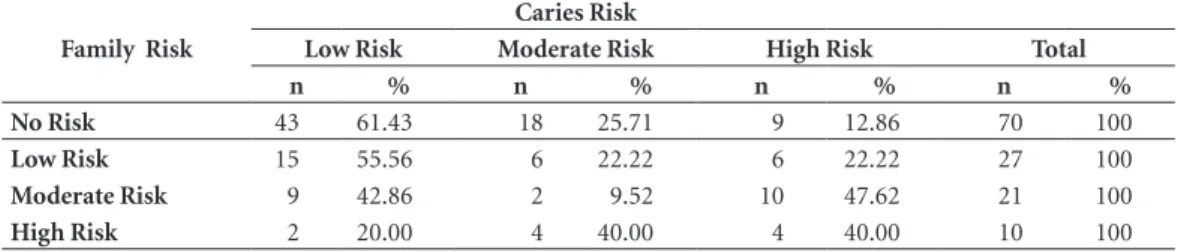
Table 1 shows the distribution of the 128 students who were classified for dental caries ac-cording to the family classification:
According to this distribution, the percentage of individuals as for the risk of caries, according to family risk, shows an association between fam-ily risk and caries risk (Coef C = 0.338 and p = 0.0113). When family risk is increased, the dis-tribution of the subjects in the classification of caries accompanies this increase, demonstrating that the higher the family risk, the higher the risk of dental caries.
Table 2 shows the distribution of the 32 sub-jects (parents/guardians) who were classified for periodontal disease according to the family clas-sification.
According to this distribution, the percentage of individuals as for periodontal risk, according to family risk, shows an association between fam-ily risk and periodontal risk (Coef C = 0.5503 and
p = 0.0307). When family risk is increased, the distribution of the subjects in the classification of periodontal risk accompanies this increase, showing a tendency of association between the two variables.
Discussion
The guidelines of the Política Nacional de Saúde
Bucal (Brazilian Oral Health Policy – PNSB) are aimed at ensuring that dental actions and ser-vices result from an adequate knowledge of the health reality of each locality, and, in doing so,
build an effectively resolutive practice16. Knowing
the health reality of areas under the responsibil-ity of FHS teams means knowing the most im-portant individual conditions in terms of sever-ity and prevalence of the main diseases and the family context in which they are inserted. In this study, we chose risk ratings to know this health reality. The classifications used signaled an asso-ciation between family risk and individual risk, that is, when the social vulnerability of families increases, the greater the possibility of finding the higher individual risks for caries and periodontal disease. This means that those most in need of health care can be found through active family search.
Table 1. Frequency and percentage of schoolchildren, according to caries risk in relation to family risk. Ubirajara, SP, 2015.
Family Risk
Caries Risk
Low Risk Moderate Risk High Risk Total
n % n % n % n %
No Risk 43 61.43 18 25.71 9 12.86 70 100
Low Risk 15 55.56 6 22.22 6 22.22 27 100
Moderate Risk 9 42.86 2 9.52 10 47.62 21 100
High Risk 2 20.00 4 40.00 4 40.00 10 100
Table 2. Frequency and percentage of parents/guardians, according to periodontal risk in relation to family risk. Ubirajara, SP, 2015.
Family Risk
Periodontal Risk
Low Risk Moderate Risk High Risk Total
n % n % n % n %
No Risk 12 66.67 5 27.78 1 5.56 18 100
Low Risk 2 33.33 3 50.00 1 16.67 6 100
Moderate Risk 1 14.29 2 28.57 4 57.14 7 100
P
er
es N
Considering that the results of the study point to a tendency that the higher the family risk, the higher the individual risk of caries and periodon-tal disease, the identification of family risk may precede the identification of the individual risk, and the higher risk families may be the first ones to participate in the registration of oral health
conditions, in order to identify individual risk7.
Proactive action by OHT in this perspective, us-ing the family risk classification tool as an order-ing of actions, would allow for openness in terms of greater accessibility with fairness and organi-zation, as spaces could be created in the agendas for the families of higher risk, and consequently their most needy members would have the op-portunity to access the service. Such a proposal seems to be more feasible in the daily practice of the dental service, in terms of achievement and adherence, than to propose, for example, a general screening of all individuals, to be classi-fied individually and to organize the demand, as
demonstrated by a study by Cheachire et al.17 in
which only 7.8% of the individuals participated in a screening, with this purpose.
This sequence of action proposed, from the family to the individual field meets the guidelines of the PNSB, since it agrees with the actions that must be developed by the FHS, when performing household registration, developing activities ac-cording to planning and programming based on
situational diagnosis and focusing on the family18.
In this sequence, when considering the social determinants of health and the integrality of ac-tions, one of the factors to consider is family risk. A risk classification scale proposed by Coelho and Savassi, based on the Form A of the Prima-ry Health Care Information System (SIAB), was used to establish priorities in the actions to fam-ilies, thus emerging as a tool that allows
know-ing the social and economic reality of families4,
as well as to organize demand, since this classi-fication was related to individual classiclassi-fications, justifying the proposition.
Some studies have already been carried out using the same risk classifications proposed by the present study, and pointed out that a high family risk ratio indicates a greater chance of developing dental caries, but also indicates that most individuals at high risk of caries belong to
high-risk families11,19, corroborating our
propos-al in ordering the demand for family risk, show-ing the association between individual and fami-ly risks, which must be considered.
In a study carried out to evaluate the asso-ciation of family risk with caries risk and
peri-odontal disease in the city of Santo André, SP, the authors concluded that the instruments and risk criteria used should be restructured and reassessed in other populations so that they can contribute more effectively to plan the oral
health teams in the FHS17. Such study adopted
the same individual risk classifications for caries and periodontal disease, proposed by the SES/SP; however, a classification of family risk elaborat-ed by the employees of the local Health Depart-ment was used unlike the classification used in our study, a tool used and analyzed in previous
studies11,19, which is the Coelho & Savassi Scale,
and may be indicative that the data obtained are more reliable. In addition, we worked with differ-ent populations for individual risks (caries and periodontal disease), while in the study conduct-ed in Santo André, SP, we appliconduct-ed classifications for adults, differently from what was adopted in this study.
The fact that the present study addressed the most prevalent groups for the morbidities stud-ied, that is, caries in schoolchildren and peri-odontal disease in the parents/guardians, it was decided to consider the most significant aggrava-tion for the group to establish the individual risk to be examined and classified, which would en-able early identification, control and prevention of oral diseases and a search for equity in health
care7. Pereira et al.20 states that the classification
of caries risk proposed by the Department of Health of the State of São Paulo (SES/SP), which was used in this study, is based on scientific evi-dence and also on several municipal experiences carried out in the state, and which is certainly not the only way to classify individuals, but it is a tool that is widely used because of its the ease and
practicality20. Another classification of caries risk,
proposed by the Department of Health of the Federal District, has shown to be very different in determining the priority of dental care focused on caries when compared with that of the state of São Paulo, however it indicates that it should be prioritized together with a family risk
classifica-tion10, as adopted in our study. It was not sought
to analyze the limitations that such classifications may present, as several studies have shown, that the diagnostic threshold from cavity lesion does not inform epidemiologists and health managers about which lesions/individuals need preventive and non-invasive treatment. We still encounter an old view of the disease being treated in public
services only through its sequel, the cavity21; but
aúd
e C
ole
tiv
a,
22(6):1905-1912,
2017
In Brazil, the majority of epidemiological studies on oral health are focused on the child population, particularly in schoolchildren, main-ly addressing dental caries, and there is a lack of periodontal health studies, which may hinder
better planning of health services11. Therefore, we
chose to classify the parents/guardians for peri-odontal disease because it is the population most affected by such disease. International studies have shown that gingivitis and periodontitis pres-ent higher prevalence in populations with worse
socioeconomic indicators22,23, which may
corrob-orate our findings, which proposes to adopt the family classification as an ordinator of the actions, since higher risk families tend to have greater in-dividual problems of periodontal nature.
Barros et al.24 identified that the FHS showed
greater coverage among the population with worse social status; however, this coverage was still inadequate, since a small proportion of this population, precisely composed of the neediest people, did not have access to services. In addi-tion, actions focused on i these families, through the classification and providing opportunity for care, can be a palpable alternative to reach this small portion of the population.
A possible limitation of this study is the fact that the sample of parents/guardians was small (32 subjects). Another limitation is due to the fact that the initial proposal of classification of family risk adopted used the Form A of SIAB, considering that such form is in the process of being replaced. However, it does not make it in-feasible, since all information or “sentinels” are part of the new information methodology to be employed by MS, the eSUS AB.
Conclusion
We can conclude that the use of the family risk classification tool is indicated as a possibility of ordering the actions of the dental service, by the OHT, given the association evidenced among the classifications studied, pointing to a trend that the higher the family risk, the greater the individ-ual risks for caries and periodontal disease. Such tool has the possibility to classify the families of the territory for which they are responsible in a practical way and to plan the actions, organizing their demand in its prioritization, with greater equity.
Collaborations
P
er
es N
References
1. Organização Pan-americana de Saúde (OPAS). Refor-ma da Atenção Primária à Saúde na cidade do Rio de Janeiro – avaliação dos três anos de Clínicas da Famí-lia. Pesquisa avaliativa sobre aspectos de implantação, estrutura, processo e resultados das Clínicas da Família
na cidade do Rio de Janeiro. Porto Alegre: OPAS; 2013.
2. Brasil. Portaria n. 1.444, de 28 de dezembro de 2000. Reorganização das ações de saúde bucal na atenção bá-sica: portaria de incentivos financeiros. Diário Oficial
da União 2000; 29 dez.
3. Carnut L, Filgueiras LV, Figueiredo N, Goes PSA. Vali-dação inicial do índice de necessidade de atenção à saú-de bucal para as equipes saú-de saúsaú-de bucal na estratégia saú-de saúde da família. Cien Saude Colet 2011; 16(7):3083-3091.
4. Nascimento FG, Prado TN, Galavote HS, Maciel PA, Lima RCD, Maciel ELN. Aplicabilidade de uma escala de risco para organização do processo de trabalho com famílias atendidas na Unidade Saúde da Família em Vitória (ES). Cien Saude Colet 2010; 15(5):2465-2472. 5. Savassi LCM, Lage JL, Coelho FLG. Sistematização de
um instrumento de estratificação de risco familiar: Es-cala de risco familiar de Coelho-Savassi. J Manag Prim
Health Care 2012; 3(2):179-185.
6. Brasil. Ministério da Saúde (MS). Secretaria de Aten-ção à Saúde. e-SUS AtenAten-ção Básica: manual do Sistema com Coleta de Dados Simplificada: CDS. Brasília: MS; 2014.
7. São Paulo (Cidade). Secretaria Municipal da Saúde (SMS). Diretrizes para a atenção em saúde bucal:
cres-cendo e vivendo com saúde bucal. São Paulo: SMS; 2012.
8. Brasil. Ministério da Saúde (MS). Acolhimento e
clas-sificação de risco nos serviços de urgência. Brasília: MS;
2009.
9. Taboulet P, Moreira V, Haas L, Porcher R, Bragança A, Fontaine JP, Poncet MC. Triage with the french emer-gency nurses classification in Hospital scale: reliability and validity. Eur J Emerg Med 2009; 16(2):61-67. 10. Terreri ALM, Soler ZASG. Estudo comparativo de dois
critérios utilizados no Programa Saúde da Família na priorização do tratamento da cárie entre crianças de 5 a 12 anos. CadSaude Publica 2008; 24(7):1581-1587. 11. Kobayashi HM. Relação entre classificação de risco de
cá-rie dentária e escala de risco familiar [tese]. Piracicaba:
Unicamp; 2012.
12. Gesser HC, Peres MA, Marcenes W. Condições gengi-vais e periodontais associadas a fatores socioeconômi-cos. Rev Saude Publica 2001;35(3):289-293.
13. Instituto Brasileiro de Geografia e Estatística (IBGE).
Coordenação de População e Indicadores Sociais – CO-PIS. Rio de Janeiro: IBGE; 2014.
14. Pine CM, Pitts NB, Nugent ZJ. British Association for the study of community dentistry (BAS-CD) guin-dance on sampling for surveys of child dental health. A BASCD coordinated dental epidemiology programme quality standard. Community Dent Health 1997; 14(Supl. 1):10-17.
15. São Paulo (Estado). Secretaria de Estado de Saúde. Re-comendações sobre uso de produtos fluorados na âm-bito do SUS/SP em função do risco de cárie dentária – Grupo de Trabalho RSS-95, de 27.06.2000 [acesso 2015 fev 12]. Disponível em: http://www.saude.sp.gov.br 16. Brasil. Ministério da Saúde (MS). Diretrizes da política
nacional da saúde bucal. Brasília: MS; 2004.
17. Cheachire LA, Cortellazzi KL, Vazquez FL, Pereira AC, Meneghim MC, Mialhe FL. Associação entre Risco So-cial Familiar e Risco à Cárie Dentária e Doença Perio-dontal em Adultos na Estratégia de Saúde da Família.
Pesq Bras Odontoped Clin Integr 2013; 13(1):101-110.
18. Brasil. Ministério da Saúde (MS). Caderno de Atenção
Básica - nº 17 – Saúde Bucal. Brasília: MS; 2006.
19. Silva RDR, Amaral RC, Sousa MLR. Relação entre ris-co de cárie individual e risris-co familiar da doença prio-rizando atendimentos. Rev Assoc Paul Cir Dent 2013; 67(1):70-74.
20. Pereira AC, organizador. Tratado de Saúde Coletiva em
Odontologia. Nova Odessa: Napoleão; 2009.
21. Cortellazzi KL, Tagliaferro EPS, Assaf AV, Tafner APMF, Ambrosano GMB, Bittar TO, Pereira AC. Influência de variáveis socioeconômicas, clínicas e demográfica na experiência de cárie dentária em pré-escolares de Pi-racicaba, SP. Rev Bras Epidemiol 2009; 12(3):490-500. 22. Gilbert L. Social factors and self-assessed oral health in
South Africa. Community Dent Oral Epidemiol 1994; 22(1):47-51.
23. Papapanou PN. Periodontal diseases: epidemiology.
Ann Periodontol 1996; 1(1):1-36.
24. Barros AJD, Victora CG, César JA, Neumann NA, Bertoldi AD. Brazil: are health and nutrition programs
reaching the neediest? Washington: The International
Bank for Reconstruction and Development; 2005.
Article submitted 10/01/2015 Approved 05/10/2016