Objective: This study aims at assessing the normative need for orthodontic treatment and the factors that determine the subjective impact of malocclusion on 12-year-old Brazilian school children. Methods: A total of 451 subjects (215 males and 236 females) were randomly selected from private and public schools of Juiz de Fora, Brazil. The collected data included sociodemographic information and occlusal conditions. The esthetic subjective impact of malocclusion was assessed by means of the Orthodontic Aesthetic Subjective Impact Score – OASIS, whereas the malocclusion and the need for orthodontic treatment were assessed by means of the Dental Aesthetic Index (DAI) and the Index of Orthodontic Treatment Need-Aesthetic Component (IOTN-AC). Results: Prevalence of normative need for orthodontic treatment was 65.6% (n = 155), and prevalence of orthodontic esthetic subjective impact was 14.9%. The following variables showed significant association with esthetic subjective impact of malocclu-sion: female (p = 0.042; OR = 0.5; CI = 0.2-0.9), public school student (p = 0.002; OR = 6.8; CI = 1.9-23.8), maxillary overjet ≥ 4 mm (p = 0.037; OR = 1.7; CI = 1-3) and gingival smile ≥ 4 mm (p = 0.008; OR = 3.4; CI = 1.3-8.8).Conclusion: The normative need for orthodontic treatment overestimated the perceived need. Occlusal and sociocultural factors influenced the dissatisfaction of schoolchildren with their dentofacial appearance.
Keywords: Malocclusion. Orthodontics. Quality of life.
Dissatisfaction with dentofacial appearance
and the normative need for orthodontic treatment:
determinant factors
Anderson Barbosa de Almeida1, Isabel Cristina Gonçalves Leite2, Camilo Aquino Melgaço3, Leandro Silva Marques4
How to cite this article: Almeida AB, Leite ICG, Melgaço CA, Marques LS. Dissatisfaction with dentofacial appearance and the normative need for orthodontic treatment: determinant factors. Dental Press J Orthod. 2014 May-June;19(3):120-6. DOI: http://dx.doi.org/10.1590/2176-9451.19.3.120-126.oar
Submitted: April 03, 2013 - Revised and accepted: June 08, 2013
» The authors report no commercial, proprietary or financial interest in the products or companies described in this article.
Contact address: Camilo Aquino Melgaço
Av. Álvares Cabral, 982 – sala 502 – Belo Horizonte/MG — Brazil. CEP: 30.170-001 – E-mail: [email protected]
1 MSc in Collective Health, Federal University of Juiz de Fora, UFJF. 2 Adjunct professor, Federal University of Juiz de Fora, UFJF.
3 Professor, School of Dentistry — Federal University of Minas Gerais, UFMG. 4 Adjunct professor, Federal University of the Jequitinhonha and Mucuri Valleys,
UFVJM.
DOI: http://dx.doi.org/10.1590/2176-9451.19.3.120-126.oar
Objetivo: o objetivo desse estudo foi avaliar a necessidade normativa de tratamento ortodôntico e os fatores que determinam o impacto subjetivo da má oclusão, em escolares brasileiros de 12 anos. Métodos: um total de 451 indivíduos (215 homens e 236 mulheres) foi selecionado aleatoriamente de escolas públicas e particulares de Juiz de Fora, Minas Gerais. Os dados coletados incluíam informações sociodemográficas e condições oclusais. O impacto estético subjetivo da má oclusão foi avaliado pelo Orthodontic Aesthetic Subjective Impact Score (OASIS). A avaliação da má oclusão e a necessidade de tratamento ortodôntico foram avaliadas pelo Dental Aesthetic Index (DAI) e pelo Index of Orthodontic Treatment Need-Aesthetic Component (IOTN-AC). Resultados: a prevalência da necessidade normativa de trata-mento ortodôntico foi de 65,6% (n = 155) e a prevalência do impacto estético ortodôntico subjetivo foi de 14,9%. As seguintes variáveis mostraram associação significativa com impacto estético subjetivo da má oclusão: sexo feminino (p = 0,042, OR = 0,5, IC = 0,2-0,9); aluno de escola pública (p = 0,002, OR = 6,8, IC = 1,9-23,8); ≥ 4mm (p = 0,037, OR = 1,7; ICI = 1-3); e sorriso gengival ≥ 4mm (p = 0,008, OR = 3,4, IC = 1,3-8,8). Conclusão: a necessidade normativa de tratamento ortodôntico superestimou a necessidade percebida. Fatores oclusais e socioculturais influenciaram a insatisfação de escolares com a aparência dentofacial.
INTRODUCTION
Malocclusion is a craniofacial growth and devel-opment disorder that may lead to functional problems with esthetic impact and consequent psychosocial
implications in children and adults.1,5 It is considered
a public health concern and the third most frequent oral disorder after dental caries and periodontal prob-lems. Thus, orthodontists must include in diagnosis and planning, instruments that highlight the influ-ence of sociocultural components and their relation to the perception of the malocclusion developed by the individual.
Eforts to develop solid diagnostic criteria that al-low patients to understand their problems have been the main focus of dentists and orthodontists; however, it is diicult to determine the importance of malocclu-sion as a facial problem and its impact on the quality of
life of the individuals afected.6 This problem is
partic-ularly more complex during childhood due to constant changes in psychosocial and body characteristics and great variability in cognitive development that occur
in children of the same age group.7
Orthodontic treatment during childhood is
gener-ally associated with esthetic problems8,9 normally
re-lated to considerable diversity in patient’s perception
process.7,10 Although the esthetic impact of
malocclu-sion greatly inluences a child’s biopsychosocial
devel-opment,11 little attention has been given to its
associa-tion with normative values of treatment needs.
This study aims at assessing the normative need for orthodontic treatment and the factors determining the subjective impact of malocclusion on 12-year-old Brazilian schoolchildren.
MATERIAL AND METHODS
This cross-sectional study was carried out with 12-year-old Brazilian schoolchildren randomly selected from public and private schools of Juiz de Fora — Minas Gerais/Brazil. Cluster sampling method was used with proportional raling of school categories: public (local, state and federal) and private. The participating classes and schoolchildren were also raled.
Sample size (n = 451) was calculated based on de-mographic data from the “Brazilian oral health report
– 2010”12 considering 38% of estimated
malocclu-sion prevalence at the age of 12, with 95%
confi-The following exclusion criteria were applied: Craniofacial malformation or syndromes with dento-facial manifestations, previous orthodontic treatment and mental or behavior disorders that could interfere in patient’s self-perception of the assessed factors. This project was approved by the Institutional Re-view Board of the Federal University of Juiz de Fora. Patients’ parents or guardians signed an informed consent form.
The collected data included sociodemographic in-formation and clinical features concerning the subjects’ occlusal conditions. The schoolchildren answered a questionnaire that included a test to assess the esthetic subjective impact of malocclusion (Orthodontic Aes-thetic Subjective Impact Score – OASIS). Malocclu-sion as well as the need for orthodontic treatment were assessed through the Dental Aesthetic Index (DAI) and the Index of Orthodontic Treatment Need-Aesthetic Component (IOTN-AC). For economic characteriza-tion, patients’ parents or guardians answered a
self-ap-plied questionnaire.15
Dental examination
Dental examination followed the World Health
Organization criteria for oral health research.16
All oral assessments were performed by the same or-thodontist who was previously calibrated and trained for all indexes used in this study. Intra-observer agree-ment was calculated by Kappa coefficient (96%).
Dental aesthetic index (DAI)
DAI assesses the esthetic aspects of dental occlu-sion, identifying the need for orthodontic treatment based on malocclusion severity. Its scale defines se-verity in a similar manner to orthodontists’ judgment. DAI scores equal to or lower than 25 refer to maloc-clusions with a slight need for orthodontic treatment. Scores varying from 26 to 30 represent malocclusion with elective need for treatment. Scores varying from 31 to 35 represent malocclusion with a high need for treatment. Scores ≥ 36 represent severe malocclusion
with compulsory need for treatment.17
Orthodontic Aesthetic Subjective Impact Score – OASIS
of children with their teeth.13 OASIS has been vali-dated and culturally adapted to Brazilian
Portu-guese.18 It comprises 5 questions, with the answers
matching into the 7-point Likert scale. This de-pendent variable was dichotomized into satisfied or dissatisfied. Based on self-perception, the child was asked to identify in the IOTN-AC, the photography that best matched their oral condition. In order to facilitate children’s understanding, the Likert scale was reduced to 3 possible answers; maintaining the initial and final scoring limits (5 - 35 points) of the original instrument, which were further added to the answers of the IOTN-AC (1 to 10). Median was used as the cut-off point to define aesthetic maloc-clusion impact. According to the IOTN-AC crite-ria, assessment of the need for orthodontic treatment classified the subjects into 3 groups: no need (1-4),
borderline cases (5-7) and definite need (8-10).19
Statistical analysis
Initially, a descriptive analysis of results was per-formed. Next, associations between dependent and independent variables were tested by means of the
univariate analysis (chi-square test and Fisher’s exact test) and both simple and multiple logistic regression analyses (stepwise forward procedure). The lack of an association between variables was considered as the null hypothesis (signiicance values greater than 0.05). The Statistical Package for the Social Sciences program (SPSS) - SPSS Inc., Chicago, USA, version 8.0, was used for statistical analysis.
RESULTS
The total sample of 451 schoolchildren comprised 215 (47.7%) males and 236 (52.3%) females. With re-gard to skin color, 299 (66.3%) were white and 152 (33.7%) were classified as non-white. As for their economic level, 373 guardians (82.7%) adequately answered the questionnaire, thus yielding the follow-ing results: 8.6% - class A (n = 32); 32.2% - class B (n = 120); 45.2% - class C (n = 169); 13.7% - class D (n = 51); and 0.3% - class E (n = 1) (Table 1).
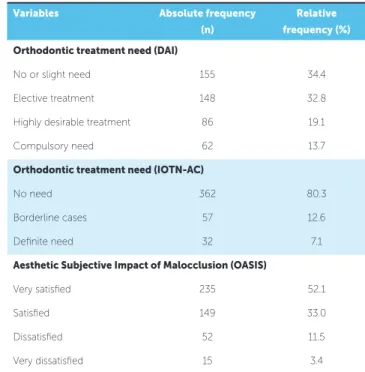
The normative need for orthodontic treatment and aesthetic subjective impact of malocclusion are presented in Table 2.
Table 3 shows the results of the bivariate analysis for
Table 1 - Sample characterization according to sex, skin color, economic level and school category.
Sample
characterization
Absolute frequency (n)
Relative frequency (%)
Sex
Male 215 47,7
Female 236 52.3
Skin color
White 299 66.3
Non-white 152 33.7
Economic level
High (Class A and B) 152 40.8 Intermediate (Class C) 169 45.2 Low (Class D and E) 52 14.0
School category
Private 126 27.9
Public 162 35.9
State 153 33.9
Federal 10 2.2
Variables Absolute frequency (n)
Relative frequency (%)
Orthodontic treatment need (DAI)
No or slight need 155 34.4
Elective treatment 148 32.8 Highly desirable treatment 86 19.1
Compulsory need 62 13.7
Orthodontic treatment need (IOTN-AC)
No need 362 80.3
Borderline cases 57 12.6
Deinite need 32 7.1
Aesthetic Subjective Impact of Malocclusion (OASIS)
Very satisied 235 52.1
Satisied 149 33.0
Dissatisied 52 11.5
Very dissatisied 15 3.4
Occlusal Alterations
Appearance Satisfaction (OASIS)
Odds Ratio
(95% CI) p
No Yes
(n) (%) (n) (%)
Missing upper tooth
Not observed 62 14.6 364 85.4 1
0.457
Observed 5 20.0 20 80.0 1.4(0.5-4.0)
Missing lower tooth
Not observed 66 14.8 381 85.2 1
0.567
Observed 1 25.0 3 75.0 1.9 (0.1-18.7)
Incisor crowding
None 19 14.0 117 86.0 1
0.425 One or more segments 48 15.2 267 84.8 1.1 (0.6-1.9)
Incisor spacing
None 43 14.1 261 85.9 1
0.541 One or more segments 24 16.3 123 83.7 1.1 (0.6-2.0)
Median diastema
≤ 1 mm 58 14.2 351 85.8 1
0.209
≥ 2 mm 9 21.4 33 78.6 1.6 (0.7-3.6)
Maxillary malalignment
≤ 1 mm 39 13.7 245 86.3 1
0.382
≥ 2 mm 28 16.8 139 83.2 1.2 (0.7-2.1)
Mandibular malalignment
≤ 1 mm 36 13.0 241 87.0 1
0.161
≥ 2 mm 31 17.8 143 82.2 1.4 (08-2.4)
Maxillary overjet
≤ 3 mm 27 11.0 218 89.0 1
0.009
≥ 4 mm 40 19.4 166 80.6 1.9 (1.1-3.3)
Anterior crossbite
No 65 14.8 375 85.2 1
0.754
Yes 2 18.2 9 81.8 1.2 (0.2-6.0)
Anterior openbite (mm)
= 0 mm 63 14.5 372 85.5 1
0.245
≥ 1 mm 4 25.0 12 75.5 1.9 (0.6-6.2)
Molar relationship
Class I 20 12.0 147 88.0 1
Class II 44 18.0 200 82.0 1.6 (0.9-2.8) 0.062
Class III 3 7.5 37 92.5 0.5 (0.1-2.1) 0.311
Posterior crossbite
No 53 14.2 321 85.8 1
0.368
Yes 14 18.2 63 81.8 1.3 (0.7-2.5)
Gingival smile (mm)
≤ 3 mm 59 13.7 371 86.3 1
Table 4 - Association between socioeconomic variables (number and percentages) and appearance satisfaction of 12-year-old schoolchildren of Juiz de Fora/ Minas Gerais.
Sociodemographic variables
Appearance satisfaction (Oasis)
Odds Ratio
p
No Yes
(n) (%) (n) (%) (95% CI)
Skin color
Non-white 27 17.8 125 82.2 1 0.216
White 40 13.4 259 86.6 0.7 (0.4-1,2)
Sex
Female 42 17.8 194 82.2 1 0.043
Male 25 11.6 190 88.4 0.6 (0.3-1.0)
Economic level
High 11 7.2 141 92.8 1 0.004
Intermediate 30 17.8 139 82.2 2.7 (1.3-5.7) <0.001
Low 13 25.0 39 75.0 11.9 (4.6-30.6)
School category
Private 4 3.2 122 96.8 1 0.000
Public 63 19.4 262 80.6 7.3 (2.6-20.6)
female (p = 0.042; OR = 0.5; CI = 0.2-0.9), pub-lic school student (p = 0.002; OR = 6.8; CI = 1.9-23.8), maxillary overjet ≥ 4 mm (p = 0.037; OR = 1.7; CI=1-3) and gingival smile ≥ 4 mm (p = 0.008; OR = 3.4; CI = 1.3-8.8).
DISCUSSION
The need for orthodontic treatment is difficult to be recognized by professionals, given that the deci-sion on the need for orthodontic treatment must
in-tegrate clinical criteria and perceptible needs.18,20,22
Several authors report a tendency to overestimate the need for orthodontic treatment when normative
cri-teria are used.20,22,23 The present results confirm these
findings when DAI values are compared to the aes-thetic subjective impact of malocclusion (OASIS). the dependent variable “aesthetic subjective impact of
malocclusion” (OASIS), considering the occlusal al-terations. Only maxillary overjet ≥ 4 mm, and gingival exposure at smile ≥ 4 mm were statistically associated with child’s tooth appearance dissatisfaction.
Regarding the relationship between the depen-dent variable and the sociodemographic variables, a statistically significant association was found for school category (p < 0.001), low economic level (p < 0.001), intermediate economic level (p = 0.004) and sex (p = 0.043) (Table 4).
However, Marques et al19 found the opposite in a study conducted with Brazilian adolescents, prob-ably due to the social status related to the use of orth-odontic appliances and the free treatment offered by the public institution(as part of the Brazilian public health system) where the study was carried out.
Dental aesthetics has signiicant implications on an individual’s quality of life and psychosocial relationships, being an important factor for those who seek
orthodon-tic treatment.3,5 In this study, however, the aesthetic
subjective impact of malocclusion (OASIS) was signii-cantly (p < 0.001) lower than normative needs. Only 14.9% of individuals comprising the sample were not satisied with their tooth appearance. Although the aes-thetic subjective impact of malocclusion (OASIS) was strongly associated with normative impact (DAI), the diference in the frequencies found leads to important relections on the need for orthodontic treatment. Once aesthetics is considered one of the most important
as-pects in orthodontic treatment,3,5 the instrument used
to assess its impact should be more closely related to the self-perceived need for orthodontic treatment and ap-pearance satisfaction than to normative indexes, only. Yet, they were signiicantly diferent in this study.
Normative need for treatment (DAI) was strongly as-sociated with the aesthetic subjective impact of malocclu-sion (p = 0.007). However, when occlusal alterations were analyzed separately, only the variables overjet ≥ 4 mm and gingival smile ≥ 4 mm were statistically signiicant. As-sociation between great overjet and gingival smile with appearance satisfaction has been reported in other
stud-ies.7,24,25 Increase in overjet is strongly associated with the
risk of dental injuries due to lack of labial seal and ex-posure of upper teeth. Additionally, the social impact of this problem must be considered as an important factor for facial stigmatization. The same occurs when gingival
smile is assessed.5,7 In the present study, these problems
clearly afected patients’ dental dissatisfaction.
Except for skin color, all other sociodemographic variables showed statistically significant association with the aesthetic impact of malocclusion. In agree-ment with other studies, this impact was more
signif-icant in females23,26 and intermediate economic level.
Yet, after logistic regression, only sex and school re-mained significantly associated with the impact of malocclusion.
Some occlusal conditions related to aesthetic im-pairment, such as incisor crowding, upper and lower misalignment and missing teeth, were not associated with the aesthetic subjective impact of malocclusion (OASIS). This finding was in disagreement with a previous study which showed an association between
this instrument and occlusal alterations.23 This fact
highlights the great variability and complexity of per-ception of facial aesthetics, with significant
differenc-es between normative and self-perceived valudifferenc-es.27,30
The exclusive use of normative criteria to determine the need for orthodontic treatment does not con-sider the subjective aspects related to the individu-al’s perception and the psychosocial implications of malocclusions. For this reason, it tends to overesti-mate the prevalence of malocclusion with treatment need. This is particularly important for the planning of health policies, especially in underfunded public health services.6,20,21
CONCLUSIONS
• The normative need for orthodontic treatment overestimated the perceived need.
• The variables sex, school category, maxillary over
1. Davis DM, Fiske J, Scott B, Radford DR. The emotional efects of tooth loss: a preliminary quantitative study. Br Dent J. 2000;188(9):503-6.
2. Eli I, Bar-Tal Y, Kostovetzki I. At irst glance: social meanings of dental
appearance. J Public Health Dent. 2001;61(3):150-4.
3. Petrén S, Bondemark L. Correction of unilateral posterior crossbite in the
mixed dentition: a randomized controlled trial. Am J Orthod Dentofacial Orthop. 2008;133(6):790.e7-13.
4. Shaw WC, Rees G, Dawe M, Charles CR. The inluence of dentofacial
appearance on the social attractiveness of young adults. Am J Orthod. 1985;87(1):21-6.
5. Shaw WC. The inluence of children’s dentofacial appearance on their
social attractiveness as judged by peers and lay adults. Am J Orthod. 1981;79(4):399-415.
6. Continuous improvement of oral health in the 21st century – the
approach of the WHO Global Oral Health Programme [homepage]. Geneva: World Health Organization; 2003 [cited 2012 Mar 03]. Available from: http://www.who.int/en.
7. Peres KG, Traebert ESA, Marcenes W. Diferenças entre autopercepção e
critérios normativos na identiicação das oclusopatias. Rev Saúde Pública. 2002;36(2):230-6.
8. Rinchuse DJ, Rinchuse DJ. Orthodontics justiied as a profession. Am J
Orthod Dentofacial Orthop. 2002;121(1):93-6.
9. Zhang M, McGrath C, Hägg U. The impact of malocclusion and its
treatment on quality of life: a literature review. Int J Paediatr Dent. 2006;16(6):381-7.
10. Christopherson EA, Briskie D, Inglehart MR. Preadolescent orthodontic treatment need: objective and subjective provider assessments and patient self-reports. Am J Orthod Dentofacial Orthop. 2009;135(4 Suppl):S80-6.
11. Paula Jr DF, Santos NCM, Silva ET, Nunes MFN, Leles CR. Psychosocial impact of dental esthetics on quality of life in adolescents. Association with malocclusion, self-image, and oral health–related issues. Angle Orthod. 2009;79(6):1188-93.
12. Brasil. Ministério da Saúde. Relatório SB Brasil, 2010. Pesquisa Nacional de Saúde Bucal - 2010. Resultados principais. Brasília, DF; 2011. 13. Jenny J, Cons NC. Comparing and contrasting two orthodontic indices,
the Index of Orthodontic Treatment Need and the Dental Aesthetic Index. Am J Orthod Dentofacial Orthop. 1996;110(4):410-6.
14. Agou S, Locker D, Streiner DL, Tompson B. Impact of self-esteem on the oral-health-related quality of life of children with malocclusion. Am J Orthod Dentofacial Orthop. 2008;134(4):484-9.
15. Levy OS, Lemeshow S, Lemeshow S. Sampling of populations: methods and applications book description. 4ª ed. New York: John Wiley & Sons; 2008.
16. Critérios de Classiicação Econômica. São Paulo (SP): Associação Brasileira de Empresas de Pesquisa ABEP; 2008 [citado em 3 mar 2012]. Disponível em: www.abep.org.
REFERENCES
17. World Health Organization. Oral health surveys: basic methods. 4ª ed. Geneva: ORH/EPID; 1997.
18. Mandall NA, McCord JF, Blinkhorn AS, Worthington HV, O’Brien KD. Perceived aesthetic impact of malocclusion and oral self-perceptions in 14-15 years-old Asian and Caucasian children in greater Manchester. Eur J Orthod. 2000;22(2):175-83.
19. Marques LS, Barbosa CC, Ramos-Jorge ML, Pordeus IA, Paiva SM. Prevalência da maloclusão e necessidade de tratamento ortodôntico em escolares de 10 a 14 anos de idade em Belo Horizonte, Minas Gerais, Brasil: enfoque psicossocial. Cad Saúde Pública. 2005;21(4):1099-106. 20. Mtaya M, Astrom AN, Brudvik P. Malocclusion, psycho-social impacts and
treatment need: A cross-sectional study of Tanzanian primary school-children. BMC Oral Health. 2008 May 6;8:14.
21. Grzywacz I. The value of the aesthetic component of the Index of Orthodontic Treatment Need in the assessment of subjective orthodontic treatment need. Eur J Orthod. 2003;25(1):57-63.
22. Gherunpong S, Tsakos G, Sheiham A. A socio-dental approach to assessing children’s orthodontic needs. Eur J Orthod. 2006;28(4):393-9. 23. Baldwin DC. Appearance and aesthetics in oral health. Community Dent
Oral Epidemiol. 1980;8(6):244-56.
24. Marques LS, Ramos-Jorge ML, Paiva SM, Pordeus IA. Malocclusion: esthetic impact and quality of life among Brazilian schoolchildren. Am J Orthod Dentofacial Orthop. 2006;129(3):424-7.
25. Tarvit DJ, Freer TJ. Assessing malocclusion: the time factor. Br J Orthod. 1998;25(1):31-4.
26. Van der Geld P, Oosterveld P, Van Heck G, Kuijpers-Jagtman AM. Smile Attractiveness Self-perception and Inluence on Personality. Angle Orthod. 2007;77(5):759-65.
27. Kok YV, Mageson P, Harradine NWT, Sprod AJ. Comparing a quality of life measure and the Aesthetic Component of the Index of Orthodontic Treatment Need (IOTN) in assessing orthodontic treatment need and concern. J Orthod. 2004;31(4):312-8.
28. Peres KG, Barros AJ, Anselmi L, Peres MA, Barros FC. Does malocclusion inluence the adolescent’s satisfaction with appearance? A cross-sectional study nested in a Brazilian birth cohort. Community Dent Oral Epidemiol. 2008;36(2):137-43.
29. Bernabé E, Flores-Mir C, Sheiham S. Prevalence, intensity and extent of oral impacts on daily performances associated with self-perceived malocclusion in 11-12-year-old children. BMC Oral Health. 2007;7:6. 30. Christopherson EA, Briskie D, Inglehart MR. Objective, subjective, and