Artigo Original
Márli de Borborema Neves1 John Van Borsel1,2 Mônica Medeiros de Britto Pereira2 Emylucy Martins Paiva Paradela3
Keywords
Aphasia Language Language tests Diagnosis Speech Language and Hearing Sciences
Descritores
Afasia Linguagem Testes de linguagem Diagnóstico Fonoaudiologia
Correspondence address:
Mônica Medeiros de Britto Pereira Secretaria de Pós-graduação e Pesquisa R. Ibituruna, 108, casa 3,
Tijuca, Rio de Janeiro (RJ), Brazil, CEP: 20271-021.
E-mail: [email protected]
Received: 01/29/2013
Accepted: 11/28/2013
Study carried out at the Universidade Veiga de Almeida – UVA – Rio de Janeiro (RJ), Brazil. (1) Universidade Veiga de Almeida – UVA – Rio de Janeiro (RJ), Brazil.
(2) Universiteit Gent – Gent, Belgium.
(3) Universidade do Estado do Rio de Janeiro – UERJ – Rio de Janeiro (RJ), Brazil; Pontifícia Universidade Católica do Rio de Janeiro – PUC-Rio – Rio de Janeiro (RJ), Brazil.
Conlict of interests: nothing to declare.
Revised screening test to Brazilian Portuguese:
a preliminary study
Adaptação transcultural para o Português Brasileiro do
Teste de Rastreamento Western Aphasia Battery – Revised:
um estudo preliminar
ABSTRACT
Purpose: The purpose of this study was to translate and cross-culturally adapt the Western Aphasia Battery – Revised (WAB-R) screening test, thus contributing to future applications of the instrument with Brazilian adults.
Methods: The adaptation was based on a universalist perspective. The steps for conceptual, item, semantic and operational equivalence were strictly followed, resulting in a short version used in the pretest. The study participants were 30 individuals, between 18 to 89 years old; all were Brazilian speakers, with Portuguese as their irst language. However, only 28 volunteers met the criteria for inclusion in the study. Two participants were excluded because they had low scores on the mini-mental state examination and were referred to geriatric assessment. Results: The short version of the WAB-R screening test, used in the pretest, allowed us to observe the behavior and language of the individuals during interactions, to collect impressions of overall communication, and to quantify communication ability by calculating the aphasia quotient and the language quotient, according to parameters of the original instrument. Conclusion: When adapting an instrument, it is important to maintain its original characteristics. However, the properties of measurement may not be in accordance with the psychometric properties of Brazilian culture. Therefore, we propose further analyses of the reliability and validation of the instrument in question in Brazil, which will occur by means of measurement and functional equivalence. RESUMO
Objetivo: A proposta deste estudo foi traduzir e adaptar transculturalmente o Teste de Rastreamento Western Aphasia Battery-Revised (WAB-R), colaborando para futura aplicação do instrumento em adultos brasileiros.
INTRODUCTION
Human language is the result of a set of brain activities responsible for the reception, integration, and elaboration of linguistic messages, from the phonetic and phonological plane to the pragmatic and discursive sphere(1).
Research studies in the ield of neurocognition have dem-onstrated the importance of different cortical areas in language processing other than Wernicke’s and Broca’s areas. The left cerebral hemisphere, dominant for language, and the right hemisphere, acting in paralinguistic aspects and complement-ing the lcomplement-inguistic role of the left hemisphere, propitiate true communication(2-4).
The variety of syndromes found in the literature has turned aphasia into one of the most frequently classiied disorders, namely those that result from cranioencephalic trauma and cerebrovascular, neoplastic, inlammatory, and degenerating diseases(5-7).
Aphasia is a neurological language disorder consequential of some type of anomaly in the central nervous system. When aphasia is present, several areas can be compromised, with different severity degrees; it is characterized by alterations in the content, form, and/or use of language(8,9).
In 1974, Kertesz and Poole organized criteria that distinguish aphasias according to similarities and differences in the linguistic processes of patients with neurological lesions — focal, diffuse, and/or progressive — classifying them as global, broca, isolated, transcortical motor, Wernicke, transcortical sensory, conduction, and anomic aphasia(8,9).
Concerning the communication aspects of a patient, an ad-equate proile allows medical and rehabilitation teams to associ-ate information and circumstances, thus reaching a differential diagnosis and predicting measures, therapy, and prognosis(10).
Research studies that refer to the normal language of adults and elderly individuals and to the analysis of its structure and pro-cesses should expand possibilities when it comes to the study of acquired language disorders(11). However, despite the existence
of international assessment batteries that have been adapted to the Brazilian context, there is still room for instruments that assess the communication components of individuals.
Upon reviewing the available instruments to screen language disorders, we did not ind any instrument adapted for use in Brazil. Owing to a lack of theoretical foundation on neurological language disorders, we, speech-language pathologists and audiologists, take on the role of research-ers and introduce a cross-cultural adaptation of the Western Aphasia Battery – Revised (WAB-R) to Brazilian Portuguese, thus attenuating the time and inancial resources spent to create new instruments. Conceptual, item, semantic, and op-erational equivalences were rigorously followed, according to Herdman’s universalist perspective(12-14).
The WAB-R is a language assessment instrument created by Dr. Andrew Kertesz in Canada (2007), based on principles of neurolinguistics and on the neuroanatomic model of lan-guage. It is applicable to adults from 18 to 89 years of age. It is recognized internationally and recommended by the Scientiic Department of Cognitive Neurology and Ageing of
the Brazilian Academy of Neurology, and it has not yet been standardized or validated in Brazil(15-17).
The complete battery can be applied in about 45 minutes, but the screening test — the reason for this study — can be applied in a short period of time, approximately 15 minutes, with the purpose of estimating an individual’s communication functionality. The tasks refer to spontaneous speech (content and luency), auditory and verbal comprehension, sequential commands, repetition, naming, reading, writing, and apraxia.
The aphasia quotient (AQ) and the language quotient (LQ) inform the severity of a language disorder, predicting and estab-lishing relations between the location of the lesion and the clinical manifestations of language, thus allowing for the assessment of linguistic competence, including that of individuals with demen-tia(9,18,19). The cut-point for normality in the original version of
the WAB is 93.8, which correlates good abilities of functional communication and highlights communication eficacy.
An imprecise approach to a diagnosis leads to inadequate therapy(9). The importance of screening the proile of a language
disorder lies, above all, in the predictability of a differential di-agnosis, in the possibility of replicating the test by means of a baseline for future comparisons (of the same case), and in the urgency of combined medical treatment(9).
The present article is dedicated to studying the cross-cultural adaptation of the WAB-R to Brazilian Portuguese, all the while complying with conceptual, item, semantic, and operational equivalence.
METHODS
This study was approved by the National Research Ethics Committee (Plataforma Brasil), under protocol number 54747-2012, without any conlict of interest. The informed consent was signed by all participants.
This is a preliminary study for the cross-cultural adaptation of the WAB-R screening test to Brazil.
For the purposes of this preliminary proposal, we followed these stages, as suggested by Reichenheim and Moraes(14):
1. Conceptual and item equivalency – this stage comprised a discussion with a group of health professionals (three speech-language pathologists and audiologists, one medi-cal doctor and one psychologist) who reviewed the WAB-R screening test by exploring whether the different dimensions approached by the original instrument were relevant and pertinent to the Brazilian culture. Five volunteers were part of the analysis of the instrument, each representing the following age ranges: 18 to 29 years; 30 to 44 years; 45 to 59 years; 60 to 74 years; and 75 to 89 years.
At the end of both meetings, the moderator expressed his conclusions and recommendations according to the subjec-tive nature of the discussion. The WAB-R screening test was evaluated as a possibility of language triage for the adult and elderly Brazilian population, and the continuation of the study was suggested.
2. Semantic equivalence – this stage comprised three parts, namely:
• Production of initial translations – two translations from the
original in English were independently performed by two professionals active in the area of speech-language pathol-ogy — one who knew the topic in question and another who did not, both were Brazilian and had knowledge of their mother tongue and English.
• Retranslations – the preliminary versions were compared,
few discrepancies were solved, and the instrument was translated once again, simultaneously, by two English teachers. Relevant and complementary aspects were taken into consideration by both teachers, who sought a semantic equivalence between the original version and the transla-tions, as well as literal meanings and senses. Few adjust-ments were made in the retranslation proposed here and the initial versions.
In the subtest for auditory and verbal comprehension — yes/no answers, the names used were Luís and João, in accordance with a previous informal version of the WAB(15), because in the original
version in English, Smith and Brown are surnames and had to be modiied in order to it into the Brazilian context.
In the sequential commands subtest, we used the verb (“apontar”) (“to point at”) in the ininitive, because the word “aponte” (“point at”), which should be the one used, could be confused upon hearing with “a ponte” (“the bridge”).
In the repetition subtest, instead of the literal translation, the English teachers suggested a Brazilian Portuguese pangram, which is a meaningful sentence using all alphabet letters (in the literal translation, the sentence in English would no longer be a pangram). We were careful to assimilate the number of ele-ments in the sentence and the context that refers to animals. Thus, the inal proposition was “Um pequeno jabuti xereta viu dez cegonhas felizes” (eight elements in the sentence), and this sentence replaced the original “The quick brown fox jumps over the lazy dog” (nine elements).
In the object naming subtest, we replaced the item “bed” with “mesa” (“table”), given that the author offers the lexibility of substituting objects(9).
• Review by specialists and short version – this phase
consisted of reviewing and assembling the short version (through the retranslations performed by the two English teachers in comparison with the original instrument). The same three speech-language pathologists who evaluated the conceptual and item equivalence analyzed the content, prioritizing the Brazilian cultural context.
All the materials for screening language disorders were stowed in a box. There were no dificulties to select the objects used in an individual’s routine.
A short-version form was printed, and the choices for answers were displayed in parenthesis, exactly as in the original version.
As proposed in the original instrument, we chose im-ages and paragraphs from magazines, with some degree of complexity, to be applied with the subtests for spontaneous speech/content, reading, and writing.
3. Operational equivalence – the research trio evaluated the suitability and the appropriation of the manner of conduct-ing the test, with regard to the questions, instructions, loca-tion and manner of applicaloca-tion, as well as categorizaloca-tion. This same group of researchers thoroughly examined the original manual, by surveying its technical and psychometric properties, especially when calculating the AQ and the LQ. These professionals also studied the possibilities of language disorders (paraphasias, hesitation, circumlocution, etc.), dis-played on the WAB-R screening test form.
The training that elucidated the application, scoring, and in-terpretation of the results of the short version was conducted as indicated in the manual — in a calm and well-lit place, without distractions and with a table. All the materials selected were in the box, and the form for the short version of the WAB-R screening test was printed and duly explicated.
4. Pretest – 30 individuals participated in this study. They were allocated in ive groups composed of three men and three women each, according to their age range, as follows: from 18 to 29 years of age; from 30 to 44 years; from 45 to 59 years; from 60 to 74 years; and from 75 to 89 years of age.
The convenience sample, composed of volunteer elderly individuals from a Community Center in Rio de Janeiro and of their adult relatives, enabled us to organize the pretest of the short version of the WAB-R screening test.
We adopted the following inclusion criteria: volunteers who spoke Brazilian Portuguese as their irst language; with read-ing and writread-ing skills (we did not take years of schoolread-ing into consideration); and without cognitive impairments.
We used the following exclusion criteria: individuals with visual and/or auditory deiciencies that were not compensated with the use of prostheses; those who could not write due to motor impairments; and volunteers with cognitive impairments.
First, the participants were contacted in person, with the purpose of informing them about the proposal of this study. A date and time to sign the informed consent was agreed upon, as stated in Resolution 196/96 of the National Health Council, and thus their participation in the study was authorized.
Second, an interview was conducted with the purpose of identi-fying the individuals’ health condition and socioeducational proile for the pretest application. Each participant informed his/her health condition and the medical monitoring routine in place to avoid any disease or medication effects on cognition.
It was in this second moment that we applied a cogni-tion screening test, namely the mini-mental state examination (MMSE)(20,21), with the purpose of inding individuals without
we applied the pretest per se. Then, a meeting was held with the participants to clarify and discuss the acceptability of the short version and their observations about the application of the instrument, such as those concerning their understanding of the questions. The volunteers had no questions or sugges-tions, which denotes comprehensibility and easiness to answer the questions on the short version we applied.
5. Statistical procedures – we used the statistical package SPSS, version 17.0, to ile and analyze the data and results, as well as the averages and intervals of the subtests. The individuals were informed about their score on the language screening test, and two participants who had difi-culties to answer the questions on the pretest were referred for medical assessment. We worked with a convenience sample, which justiies the study, considering that we did not ind a totally homogeneous group.
RESULTS
The steps for conceptual, item, semantic, and operational equivalence were carefully carried out with the purpose of reach-ing a short version of the WAB-R screenreach-ing test in Brazilian Portuguese, in accordance with the convenience sample used.
The pretest application allowed us to observe the indi-viduals’ behavior and language during interactions, collect impressions about their functional language, and quantify their communication skills.
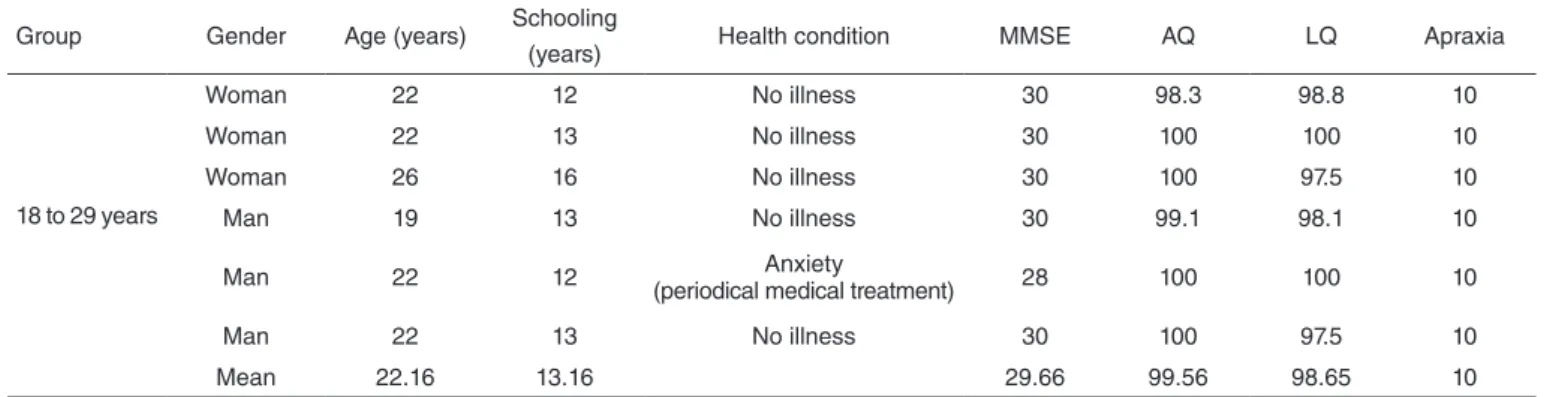
The group with participants who were between 18 and 29 years old presented excellent performance in all sec-tions (Table 1).
All individuals in this group counted at least 12 years of schooling and were in very good health condition. Although one participant complained about anxiety and reported that he had been followed up periodically by a doctor in the past, he had a very good score and lost two points in the mini-mental state examination possibly due to the tension of taking the test. The averages in this group were: age – 22.16; schooling years – 13.16; MMSE – 29.66; AQ – 99.56; LQ – 98.65; and apraxia – 10.
The group with participants who were between 30 and 44 years old (Table 2) was heterogeneous in relation to years of schooling, which varied from 3 to 15 years. The means in this group were: age – 37.83; schooling years – 9.8; MMSE – 28.16; AQ – 96.51; LQ – 94.28; and apraxia – 10.
The group with individuals who were between 45 and 59 years old had homogeneous results. The means were: age, 54.83; schooling years – 11.16; MMSE – 29.5; AQ – 99.71; LQ – 98.55; and apraxia – 10 (Table 3).
Table 2. Data and results of the group with individuals between 30 and 44 years of age
Group Gender Age (years) Schooling
(years) Health condition MMSE AQ LQ Apraxia
30 to 44 years
Woman 33 10 Obesity, SAH
(medical treatment) 28 98.3 92.5 10
Woman 41 3 No illness 25 90 88.8 10
Woman 42 10 Thyroid dysfunction
(medical treatment) 28 98.3 98.8 10
Man 34 8 Anxiety (medical treatment) 28 93.3 90 10
Man 36 15 SAH (medical treatment) 30 99.2 98.1 10
Man 41 13 No illness 30 100 97.5 10
Mean 37.83 9.8 28.16 96.51 94.28 10
Caption: MMSE = mini-mental state examination; AQ = aphasia quotient; LQ = language quotient; SAH = systemic arterial hypertension Table 1. Data and results of the group with individuals between 18 and 29 years of age
Group Gender Age (years) Schooling
(years) Health condition MMSE AQ LQ Apraxia
18 to 29 years
Woman 22 12 No illness 30 98.3 98.8 10
Woman 22 13 No illness 30 100 100 10
Woman 26 16 No illness 30 100 97.5 10
Man 19 13 No illness 30 99.1 98.1 10
Man 22 12 Anxiety
(periodical medical treatment) 28 100 100 10
Man 22 13 No illness 30 100 97.5 10
Mean 22.16 13.16 29.66 99.56 98.65 10
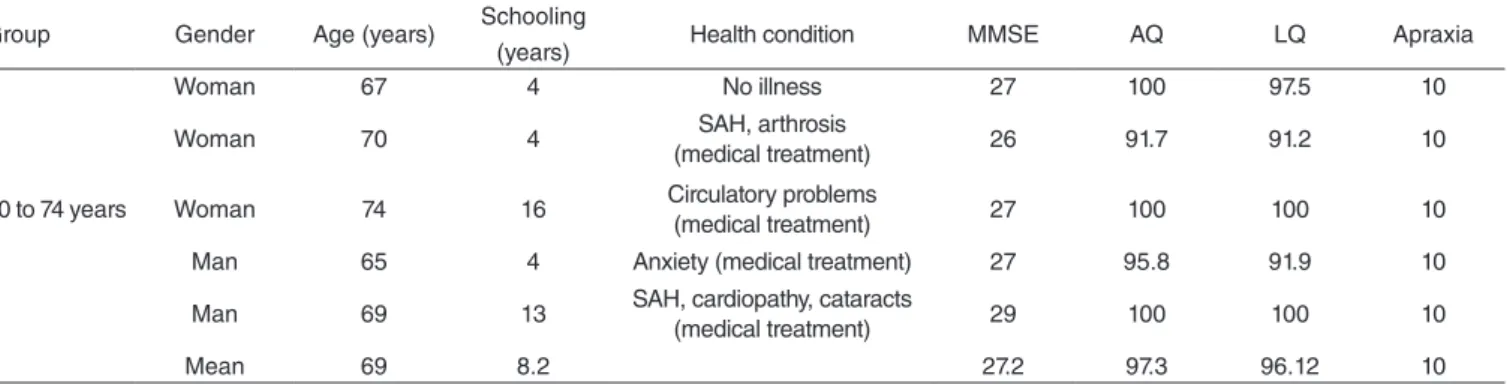
The group with individuals who were between 60 and 74 years old (Table 4) presented precarious health condi-tions in some cases. The participants were functionally active and independent, but were on a combination of medical treat-ments. This group of elderly people demonstrated diversity regarding years of schooling, which did not prevent them from achieving good scores in the pretest, as they presented reading and writing skills, part of the inclusion criteria. (One elderly man was excluded from the research study, since he obtained 19 points in the mini-mental state examination, despite having
abilities that were compatible with the four years of elementary school, which may suggest lower cognition. He was instructed to undergo a geriatric assessment.) The means of this group were: age – 69; schooling years – 8.2; MMSE – 27.2; AQ – 97.3; LQ – 96.12; and apraxia – 10.
The group with individuals who were between 75 and 89 years old (Table 5) also presented precarious health condi-tions in some cases. Although they were functionally active and independent, the elderly individuals in this group maintained a routine of combined medical treatments. The means of this
Table 3. Data and results of the group with individuals between 45 and 59 years of age
Group Gender Age (years) Schooling
(years) Health condition MMSE AQ LQ Apraxia
45 to 59 years
Woman 50 16 No illness 30 100 100 10
Woman 51 13 Hormone replacement
therapy (medical treatment) 30 100 97.5 10
Woman 58 13
Obesity, SAH, hormone replacement therapy, arthrosis
(medical treatment)
30 100 97.5 10
Man 54 16 No illness 30 100 100 10
Man 57 16 SAH, diabetes
(medical treatment) 28 100 97.5 10
Man 59 13 No illness 29 98.3 98.8 10
Mean 54.83 11.16 29.5 99.71 98.55 10
Caption: MMSE = mini-mental state examination; AQ = aphasia quotient; LQ = language quotient; SAH = systemic arterial hypertension
Table 4. Data and results of the group with individuals between 60 and 74 years of age
Group Gender Age (years) Schooling
(years) Health condition MMSE AQ LQ Apraxia
60 to 74 years
Woman 67 4 No illness 27 100 97.5 10
Woman 70 4 SAH, arthrosis
(medical treatment) 26 91.7 91.2 10
Woman 74 16 Circulatory problems
(medical treatment) 27 100 100 10 Man 65 4 Anxiety (medical treatment) 27 95.8 91.9 10
Man 69 13 SAH, cardiopathy, cataracts
(medical treatment) 29 100 100 10
Mean 69 8.2 27.2 97.3 96.12 10
Caption: MMSE = mini-mental state examination; AQ = aphasia quotient; LQ = language quotient; SAH = systemic arterial hypertension
Table 5. Data and results of the group with individuals between 75 and 89 years of age
Group Gender Age (years) Schooling
(years) Health condition MMSE AQ LQ Apraxia
75 to 89 years
Woman 75 4 Arthrosis, osteosclerosis
(medical treatment) 28 100 98.8 10
Woman 76 4 SAH (medical treatment) 28 100 100 10
Man 77 12 SAH (medical treatment) 28 95 96.3 10
Man 83 12 Cardiopathy
(medical treatment) 24 93.3 95 10
Man 88 4 SAH, diabetes
(medical treatment) 28 96.7 95 10
Mean 79.8 7.2 27.2 97 97 10
group were: age – 79.8; schooling years – 7.2; MMSE – 27.2; AQ – 97; LQ – 97; and apraxia – 10. (One elderly woman was excluded from the research study, as she obtained 22 points in the mini-mental state examination, although her schooling was compatible with a inished high school degree, totaling 12 years of schooling. She was instructed to undergo a geriatric assess-ment due to the possibility of having cognitive impairassess-ments.) Scores were recorded for each section, resulting in the AQ and the LQ of the population studied here. It is possible to observe that, although the sample was heterogeneous, there are relevant aspects to be taken into consideration concerning ageing. Elderly people systematically present more alterations in their health states, need periodical medical care in order to maintain functionality, and lose points in reading and writing skills tests, regardless of their level of education.
The averages and interval on the AQ subtests indicate that better results were achieved by the groups with individuals who were between 18 and 29 years old and between 45 and 59 years old. The group with participants who were between 30 and 44 years old presented shortcomings, possibly due to low schooling. Nevertheless, these individuals were included in the study because they had preserved reading and writing skills.
In the sequential commands section, the average 9.2 (8– 10 interval) was obtained by the group with individuals from 60 to 74 years of age, which presented the lowest performance. All groups made more mistakes in the repetition subtest. The group of participants who were between 30 and 44 years of age had the lowest average – 9.25 (8–10 interval). The averages and intervals obtained in the LQ subtests indicated better perfor-mances for the group between 18 and 29 years of age, in which all participants had 12 or more years of schooling.
The group that counted participants from 30 to 44 years of age had heterogeneous schooling. The average was 9.08 (8–10 interval) for reading, and the lowest average was 8.6 (7–10 interval) for writing.
The other groups, with individuals between 45 and 59 years, 60 and 74 years, and 75 and 89 years, had more homogeneous scores. In the reading section, the average was 9.7 (8–10 in-terval), 9.2 (8–10 inin-terval), and 10, respectively. In the writing section, the average was 9.3 (8–10 interval), 9.2 (8–10 interval), and 9.4 (8–10 interval), respectively. In the apraxia section, all individuals included in the study did not present any impair-ments, reaching an average of 10 points.
DISCUSSION
The translation and cross-cultural adaptation of the WAB-R screening test is the result of minutely followed instructions and stages, in accordance with Herdman’s universalist perspec-tive(12-14). Few original items had to be adapted — the entire
test was linguistically treated, both with regard to context and the process of literal translation.
There are disadvantages and dificulties to adapt an instru-ment elaborated in a certain cultural context, such as Canada, where the individuals’ normative data conirm their good socio-economic and educational level, in addition to the opportunities
that arise in developed countries(14). Nevertheless, the results
of the pretest application, conducted with the Brazilian short version of the WAB-R screening test, suggest that the afore-mentioned version has been assimilated, as the performances were favorable, including those of individuals with only a few years of schooling.
Concerning the test’s grey areas, we highlight the possibility of different scores given by different evaluators in subjective tasks such as luency, reading, and writing. For instance, when an individual describes an image, orally or in writing, his/her score may vary from specialist to specialist. The same is true of the quantiication of an individual’s reading. On the other hand, in expected answers for tasks such as pointing to objects and repeating structures, scoring is objective and does not of-fer any margin of error to the evaluator.
In the content subtest of the spontaneous speech section, the answers to conversation questions were scored; thus, com-munication was evaluated, which in turn pointed to a functional communication state devoid of dificulties(22).
The task of describing images contributed substantially in the evaluation of information content and luency, which are subtests of the spontaneous speech section. All participants presented normal luency, without hesitations or dificulties to ind words, despite a certain tension they experienced for being tested at that moment(23).
In the auditory and verbal comprehension, yes/no answers were requested. The irst relevant, and immediately answered, questions referred to personal orientation. The subsequent questions referred to the environment and general topics, with increased linguistic complexity, which required syntax com-prehension. In this item, it was important to consider the pos-sibility that an individual could provide only one answer, thus randomly scoring 50% of the section. An experienced evaluator must detect this possibility promptly, without deterring his/her attention exclusively to the score(9).
As another item of auditory and verbal comprehension, the sequential commands were related to a few cognitive opera-tions — phonological perception, auditory processing, short-term memory, lexical retrieval, semantic memory, etc. The tasks of this subtest are considered the most dificult ones to assess comprehension with the WAB-R because they determine the severity of comprehension impairments(9).
In the repetition section, it is possible to assess phonological processing, short-term auditory memory, and working memory, as well as comprehension. Repetition must not be underesti-mated just because it is not a function of natural language. The items included repetition of words of increasing length and sentences of increasing duration and grammatical complex-ity(23,24). All groups made mistakes in this subtest.
executive working memory(22-25). In the object naming
sec-tion, the individuals’ lexical retrieval, in a stimulus–response situation, occurred without any mediation, and all presented very good competence.
In the reading and writing sections, dificulties inherent to the individuals’ intellect and educational level occurred, includ-ing in the youngest ones. Some participants read the paragraph aloud without oral agility and with mistakes in intonation and punctuation, despite successful interpretation(4).
The writing tasks, requested by dictation or spontaneously (image description), were suficient to identify orthographical mistakes made by participants with low schooling, despite the efforts employed in idea organization, and textual coherence and cohesion.
The apraxia section, considered optional, was also applied. Praxis is intimately linked to language, and, consequently, apraxia follows language disorders(9). This section had a single
score. All participants included in the study obtained satisfac-tory scores.
Although encouraging, the results obtained deserve to be reviewed after future psychometric assessments that establish mensuration and functional equivalence. It is also important to take into consideration that the results presented here are based on a small number of participants. Further studies with more participants in the groups, distributed according to their age range and similar schooling, are expected. Addressing the quality of information in epidemiologic studies includes caution in the process of cross-cultural adaptation in the research agenda(14).
CONCLUSION
When adapting a scale and submitting it to translations and retranslations, it is important to maintain the speciicity and characteristics of the original instrument. The adaptation of the short version of the WAB-R screening test to Brazilian Portuguese followed the adaptation guidelines proposed by Herdman, namely conceptual, item, semantic, and operational equivalence. The cross-cultural adaptation of this test showed the instrument’s applicability, and it is a pioneer work in Brazil.
We highlight that the measuring properties of the original version might not be in accordance with the psychometric properties of Brazilian culture, which are still unknown. In light of this, we propose the continuity of this study by means of analyzing its reliability and validation for Brazil, and selecting samples that include a higher number of participants.
ACKNOWLEGMENTS
We thank Prof. Paulo Caramelli and Prof. Mirna Senaha for providing the previous informal version of the WAB. We thank the elderly people and the staff of the Community Center that opened its doors to our work in Rio de Janeiro, as well as friends and relatives who were available to participate as collaborators and/or volunteers. We thank John Van Borsel, Mônica Medeiros de Britto Pereira, and Emylucy Martins Paiva Paradela, M.SCs, who were our partners in this proposal and illuminated each stage of this study.
*MBN was responsible for data collection and tabulation, and manuscript elaboration; JVB supervised and outlined the entire study; JVB and MBP were responsible for supervising the study and data collection, and for collaborating with data analysis; JVB and MBP were responsible for supervising the stages of study conduction and manuscript elaboration; EMPP was responsible for the overall supervision of the stages, collaboration with data analysis, and manuscript supervision.
REFERENCES
1. Caplan D, Dickerson BC, Mesulam MM, Weintraub S, Naplipinski P, Negreira A, et al. Cortical neuroanatomic correlates of symptom severity and primary progressive aphasia. Neurology. 2010;75(4):358-66.
2. Vigneau M, Beaucousin V, Hervè PY, Jobard G, Petit L, Crivello F, et al. What is right-hemisphere contribution to phonological, lexico-semantic, and sentence processing? Insights from a meta-analysis. Neuroimage. 2011;54(1):577-93.
3. Ralph MAL, Sage K, Jones RW, Mayberry EJ. Coherent concepts are computed in the anterior temporal lobes. Proc Natl Acad Sci. 2010;107(6):2717-22.
4. Brauer J, Anwander A, Friederici AD. Neuroanatomical prerequisites for language functions in the maturing brain. Cereb Cortex. 2011;21(2):459-66.
5. Hartwigsen G, Saur D, Price CJ, Ulmer S, Baumgaertner A, Siebner HR. Perturbation of the left inferior frontal gyrus triggers adaptive plasticity in the right homologous area during speech production. Proc Natl Acad Sci. 2013;110(41):16402-7.
6. Kiran S. What is the nature of poststroke language recovery and reorganization? ISRN Neurol. 2012;2012:786872.
7. Monti A, Ferrucci R, Fumagalli M, Mameli F, Cogiamanian F, Ardolino G, et al. Transcranial direct current stimulation (tDCS) and language. J Neurol Neurosurg Psychiatry. 2013;84(8):832-42.
8. Talarico TR, Venegas MJ, Ortiz KZ. Peril populacional de pacientes com distúrbios da comunicação humana decorrentes de lesão cerebral, assistidos em hospital terciário. Rev CEFAC. 2011;13(2):330-9. 9. Kertesz A. Western Aphasia Battery-Revised Examiner’s Manual. USA:
Pearson Education; 2007.
10. Radanovic M, Mansur L. Performance of Brazilian population sample in the Boston Diagnostic Aphasia Examination. A pilot study. Braz J Med Biol Res. 2002;35(3):305-17.
11. Casarin FS, Pagliarin KC, Koehler C, Oliveira CR, Fonseca RP. Instrumentos de avaliação breve da comunicação: ferramentas existentes e sua aplicabilidade clínica. Rev CEFAC. 2011;13(5):917-25. 12. Herdman M, Fox-Rushby J, Badia X. Equivalence and the translation and
adaptation of health-related quality of life questionnaires. Qual Life Res. 1997;6(3):237-47.
13. Herdman M, Fox-Rushby J, Fox-Rushby J. A model of equivalence in the cultural adaptation of HRQoL instruments: the universalist approach. Qual Life Res. 1998;7(4):323-35.
14. Reichenheim ME, Moraes CL. Operacionalização de adaptação transcultural de instrumentos de aferição usados em epidemiologia. Rev Saúde Pública. 2007;41(4):665-73.
15. Meguro K, Senaha MLH, Caramelli P, Ishizaki L, Chubaci RYS, Meguro M, et al. Language deterioration in four Japanese Portuguese bilingual patients with Alzheimer’s disease: a trans-cultural study of Japanese elderly immigrants in Brazil. Psychogeriatrics. 2003;3:63-8.
16. Nitrini R, Caramelli P, Bottina CMC, Damasceno BP, Brucki SMD, Anghinah R. Diagnóstico da doença de Alzheimer no Brasil: avaliação cognitiva e funcional. Recomendações do Departamento Cientíico de Neurologia Cognitiva e do Envelhecimento da Academia Brasileira de Neurologia. Arq Neuro-Psiquiatr. 2005;63(3a):720-7.
18. Kertesz A, Harciarek M. Primary progressive aphasias and their contribution to the contemporary knowledge about the brain-language relationship. Neuropsychol Rev. 2011;21(3):271-87.
19. Kertesz A, Mackenzie IR, Feldman H, Woodward M, Jacova C, Black SE; ACCORD investigator group. Differentiating the frontal variant of Alzheimer’s disease. Int J Geriatr Psychiatry. 2010;25(7):732-8. 20. Lourenço RA, Veras RP. Mini-Exame do Estado Mental: características
psicométricas em idosos ambulatoriais. Rev Saúde Pública. 2006;(40)4:712-9. 21. Lourenço RA, Veras RP, Ribeiro PCC. Coniabilidade teste-reteste do Mini-Exame do Estado mental em uma população idosa assistida em uma unidade ambulatorial de saúde. Rev Bras Geriatr Gerontol. 2008;11(1):7-16.
22. Federmeier KD, Kutas M, Schul R. Age-related and individual differences in the use of prediction during language comprehension. Brain Lang. 2010;115(3):149-61.
23. Brauer J, Anwander A, Friederici AD. Neuroanatomical prerequisites for language functions in the maturing brain. Cereb Cortex. 2011;21(2):459-66. 24. Peelle JE, Troiani V, Wingield A, Grossman M. Neural processing during older adults comprehension of spoken sentences: age differences in resource allocation and connectivity. Cereb Cortex. 2010;20(4):773-82. 25. Caplan D, Waters G, Alpert N. Effects of age and speed of processing on